

6. Heroes and Villains of World War I: The Opening Moves and the Schlieffen Plan (1914–1916)


My Name is Alfred von Schlieffen: The Architect of the Plan
I was born into the disciplined world of Prussia, where order and duty shaped a man’s purpose. From an early age, I learned that nations rise and fall not by chance, but by preparation. War, I believed, was not chaos—it was a problem to be solved. While others spoke of honor and glory, I studied movement, timing, and precision. I was not drawn to the battlefield for its noise, but for its patterns.
The Mind of a Strategist
I rose through the ranks not by bold charges, but by careful thought. Maps became my language, railroads my tools, and time my greatest weapon. I asked a simple question: how does a nation fight and win when surrounded by enemies? Germany, I knew, would face war on two fronts—France in the west and Russia in the east. To hesitate was to lose. To divide our strength was to fail. There had to be a single, decisive solution.
The Plan That Defined Me
So I created what others would later call the Schlieffen Plan. It was elegant, precise, and relentless. We would strike France first with overwhelming force, sweeping through Belgium in a great arc, encircling Paris, and crushing the French army in weeks. Then, and only then, would we turn east to face Russia. Speed would be everything. Timing would be everything. There would be no room for doubt, no tolerance for delay.
A Necessary Violation
Many objected to my insistence on marching through Belgium. They spoke of neutrality, of treaties, of the outrage it would cause. I saw only the map. The shortest and fastest path to victory lay through Belgian territory. Was it controversial? Of course. But war is not governed by comfort or politeness. I did not understand why others clung so tightly to ideals that would only slow us down and cost us victory. Nations do not survive by hesitation.
Frustration with Doubt
Even within Germany, there were those who questioned the scale of my vision. They worried it was too ambitious, too dependent on perfection. I found their doubts small-minded. War demands boldness, not caution. If every soldier moved as planned, if every train arrived on time, if every commander followed orders exactly, victory would be inevitable. I believed this completely. I could not understand why others could not see what seemed so clear to me.
The Plan Leaves My Hands
Before the war came, I left this world in 1913, my plan unfinished in practice but complete in design. Others would inherit it, adjust it, weaken it, and carry it forward. I was not there to enforce its precision, not there to demand its full execution. And in war, small changes become great consequences. I often wonder if they truly understood what I had built—or if they only followed its outline without its spirit.
A Late Reflection
Only at the end, when I consider how events unfolded after my death, do I allow myself a moment of reflection. Perhaps I believed too strongly in perfection. Perhaps I placed too much faith in timing and obedience, and too little in the unpredictable nature of men and nations. I still believe the problem I sought to solve was real. But I have come to understand that even the most perfect plan must face an imperfect world.
The Logic Behind the Schlieffen Plan - Told by Alfred von Schlieffen
I will tell you plainly: Germany’s greatest fear was not a single enemy, but two at once. To the west stood France, determined to reclaim lost honor and territory. To the east stood Russia, vast in size and growing stronger each year. If both struck at the same time, Germany would be trapped, forced to divide its strength and bleed slowly on two fronts. I studied this problem for years, and I came to a firm conclusion—Germany could not fight a long war against both. It had to win quickly, and it had to do so with precision.
The Problem of Time and Distance
Russia was large, but slow. Its armies required time to gather, organize, and move across its immense lands. France, on the other hand, was smaller, faster, and ready to strike almost immediately. This difference in timing became the foundation of my thinking. If we could defeat France before Russia was fully prepared, we could then turn our full strength eastward. But this required more than strength. It required exact timing, flawless coordination, and the will to act without hesitation. I did not understand why others saw this as risky. To me, it was the only logical path forward.
Why France Had to Fall First
Some argued that Germany should split its forces evenly or adopt a defensive posture. I rejected this completely. Dividing strength is the surest way to lose everywhere. War is not won by caution, but by concentration. France had to be struck with overwhelming force, crushed so completely and so quickly that it could not recover. Only then could Germany survive the larger war. I saw no value in half-measures, and I could not understand why others hesitated to commit fully to what was so clearly necessary.
The Great Sweep Through the West
To defeat France quickly, we could not simply attack head-on. Their defenses along the border were strong and well prepared. Instead, I designed a massive sweeping movement through Belgium, curving around the French armies and striking from the side and rear. It would be a great turning motion, like a door swinging shut. Paris itself would be threatened, and the French army would be encircled and destroyed. Speed would be everything. Every delay would weaken the plan. Yet some objected to violating Belgian neutrality. They spoke of treaties and consequences. I saw only the map and the necessity of victory.
A Plan Built on Precision
Every part of my plan depended on perfect execution. Railways would move troops with exact timing. Armies would march in coordinated lines, each supporting the other. There was no room for confusion, no allowance for hesitation. Critics said it was too rigid, too dependent on perfection. I found such criticism frustrating. War demands discipline. If every man does his duty, if every commander follows the plan, then success is not chance—it is certainty. I believed this without doubt.
The Relentless Logic of War
In the end, the Schlieffen Plan was not born from ambition or recklessness, but from necessity. Germany faced a problem that could not be ignored, and I offered a solution that matched the scale of that problem. It was bold, yes, but it was also calculated. I did not understand why so many feared its risks more than they feared the consequences of doing nothing. In war, hesitation is defeat. Only decisive action offers a chance at survival.
The Assumption of Belgian Neutrality Violation - Told by Alfred von Schlieffen
When I studied the map of Western Europe, I did not see borders as sacred lines. I saw obstacles and opportunities. France had spent years strengthening its frontier with Germany, building defenses that would slow any direct attack. To strike them head-on would mean delay, and delay was the one thing Germany could not afford. If we were to defeat France quickly, we had to avoid their strongest positions. The path to victory did not lie where it was expected. It lay where it was least defended.
Why Belgium Became the Key
Belgium stood between Germany and the open plains of northern France. Its terrain allowed for rapid movement, wide flanking maneuvers, and the possibility of encircling the French army. By passing through Belgium, German forces could sweep around the French defenses and strike from the side and rear, collapsing their lines before they could react. This was not a matter of preference. It was a matter of necessity. Without Belgium, the entire plan slowed, and a slow war was a lost war. I did not understand why others hesitated when the solution was so clearly written across the landscape.
The Reality of Neutrality
Belgium was a neutral nation, protected by international agreements. Many pointed to these treaties as barriers that could not be crossed. I saw them differently. Treaties are promises made in times of peace, but war does not respect such agreements when survival is at stake. If Germany faced destruction from a two-front war, what value would a treaty hold then? I believed that military necessity outweighed diplomatic concern. Nations that wish to survive must act decisively, even when it offends the expectations of others.
The Risk of British Intervention
There were those who warned that violating Belgian neutrality would draw Britain into the war. Britain had long guaranteed Belgium’s independence, and crossing that border could provoke their response. I did not dismiss this risk, but I judged it differently. Britain’s army was small compared to those of the continent, and its ability to act quickly was uncertain. Even if Britain entered the war, I believed the speed of our victory over France would render their involvement too late to matter. I could not understand why the fear of a potential enemy outweighed the certainty of immediate danger.
Speed Over Diplomacy
In my calculations, time was the most valuable resource. Every day mattered. Every delay gave France time to regroup and Russia time to mobilize. Diplomatic caution would only slow the advance and weaken the plan. By moving through Belgium, we gained speed, surprise, and position. These were the elements that would decide the war in its opening weeks. I believed that swift victory would silence diplomatic outrage. History, I thought, would remember success, not the path taken to achieve it.
A Necessary Gamble
Looking back on the reasoning, I do not deny that the decision carried risk. But all great strategies do. The choice was not between risk and safety, but between different kinds of danger. To respect Belgian neutrality was to risk a prolonged and unwinnable war. To violate it was to risk broader opposition but gain the chance for rapid victory. I chose the path that offered a solution, not the one that preserved appearances. Only at the very end do I allow myself to wonder whether the world I calculated so carefully was more complicated than even I was willing to admit.
The Assumption of Belgian Neutrality Violation - Told by Alfred von Schlieffen
I did not allow sentiment to cloud what the map revealed. France had fortified its eastern border, expecting Germany to strike directly across it. That was precisely why we could not. A frontal assault would slow our armies, bleed our strength, and give our enemies the time they needed. The battlefield, before a single shot was fired, already demanded a different path. If we were to move quickly and decisively, we had to go where France was weakest, not where it was strongest.
Belgium as the Open Door
Belgium was not simply a neighbor; it was the key to the entire western campaign. Its plains offered room to maneuver, to swing wide, and to strike deep into northern France. By advancing through Belgium, German armies could bypass French defenses and threaten Paris itself from an unexpected direction. This was not a reckless idea—it was the only route that allowed speed, scale, and surprise. Without Belgium, the plan slowed, and once slowed, it failed. I found it difficult to understand why others could not see that geography itself dictated the decision.
Neutrality in Theory and War in Reality
Belgium’s neutrality was guaranteed by international agreements, and many held these treaties as untouchable. I saw them as conditional. Treaties exist in peace, but war reshapes what is possible and what is necessary. If Germany faced destruction by fighting both France and Russia at once, then clinging to diplomatic formalities would serve no purpose. I believed that survival justified difficult choices. Others called this dangerous thinking. I called it realism.
The Shadow of Britain
There were warnings, of course, that violating Belgium would bring Britain into the war. Britain had pledged to defend Belgian neutrality, and its involvement could widen the conflict. I weighed this carefully, but I did not see it as decisive. Britain’s army was small, and its ability to intervene quickly was uncertain. If France could be defeated in weeks, then Britain’s entry would come too late to change the outcome. I did not understand why so many allowed a potential threat to outweigh the immediate necessity before us.
The Priority of Speed
Everything in my plan depended on time. Every hour mattered. Every delay weakened the advance and strengthened the enemy. Passing through Belgium gave Germany the advantage of movement, allowing our armies to maintain the pace required for victory. Diplomatic caution, on the other hand, introduced hesitation. And hesitation, in war, is defeat in slow motion. I believed that a swift and overwhelming success would quiet any outrage that followed. Victory has a way of rewriting judgments.
A Calculated Decision
The decision to move through Belgium was never careless. It was deliberate, calculated, and grounded in the realities of modern warfare. I understood the risks, but I believed they were outweighed by the opportunity to end the war quickly. Only in reflection do I consider that war does not always reward calculation as neatly as one expects. Yet at the time, the logic was clear, and I followed it without hesitation.

My Name is Alexander von Kluck: The Aggressive Executor
I was forged in the traditions of the Prussian army, where discipline and action defined a man’s worth. I was never one to sit and wait while others debated. War, to me, was meant to be seized with speed and force. I rose through the ranks because I believed that hesitation was the enemy, and that victory belonged to those who acted boldly and without fear.
The Call to Lead the First Army
When the great war began in 1914, I was given command of Germany’s First Army, the powerful right wing of our grand offensive. We were to sweep through Belgium and into France, forming the outer edge of the great wheel that would crush the French forces. I understood my role clearly. I was not there to question the plan. I was there to drive it forward with relentless energy, to push faster than anyone thought possible.
Through Belgium with Relentless Force
As we crossed into Belgium, resistance came quickly and unexpectedly. Fortresses like Liège slowed our advance, and civilians resisted in ways that angered many in our ranks. I did not see these obstacles as reasons to pause. I saw them as proof that we needed to push harder. War is not gentle, and I did not understand why some expected it to be. Every delay was dangerous. Every hesitation gave our enemies time to recover.
Speed Above All Else
I drove my men forward at a pace that few armies could match. We marched long distances, fought constantly, and pressed deeper into France. I believed that speed would win us the war. If we moved fast enough, the French would collapse before they could reorganize. I did not agree with those who urged caution or rest. War is not won by comfort. It is won by momentum, and I intended to keep it at all costs.
The Turn Toward Paris
As we approached Paris, I made a decision that would define my name in history. Instead of continuing the wide sweep west of the city, I turned inward, seeking to strike directly at the French forces retreating before us. It was a bold move, one I believed would bring a quicker and more decisive victory. Some have said this created a dangerous gap between my army and others. At the time, I saw only opportunity. I did not understand why others could not see that striking the enemy directly was better than following a rigid line on a map.
Criticism and Confusion
After the war began to turn against us at the Marne, criticism came swiftly. Some blamed my decision, claiming that my turn exposed our flank and weakened the overall plan. I found this difficult to accept. War is not a fixed diagram. It changes with every movement of the enemy. I acted on what I saw, not what had been imagined years before. I could not understand why others clung so tightly to a plan when the battlefield demanded flexibility.
A Soldier’s Reflection
In the end, I remained proud of my actions, for I did what I believed was necessary to win. Yet as I look back, I allow myself one final thought. Perhaps in my drive for speed and decisive action, I underestimated the importance of coordination and the risks of acting alone. I still believe boldness is essential in war, but I have come to see that even boldness must remain tied to the larger whole.
Germany Invades Belgium - Told by Alexander von Kluck
When the war began in August of 1914, there was no hesitation in our ranks. Orders were clear, and the moment had come to act. Germany could not afford a slow beginning. The plan demanded immediate movement, and Belgium stood directly in our path. Crossing its border was not a side action—it was the opening move that would decide everything that followed. From the very first march, we understood that speed would determine whether we would win swiftly or be drawn into a long and dangerous war.
Crossing the Border
When our forces entered Belgium, we moved with purpose and precision. Columns of infantry, artillery, and cavalry pushed forward in disciplined waves. Railways had delivered men to their positions with remarkable efficiency, and now they advanced on foot and by road, covering ground at a pace that few believed possible. Belgium resisted, as any nation would, but their army was small compared to ours. I did not see their resistance as a barrier, only as something to be overcome quickly. Every hour mattered, and delay was unacceptable.
The Shock of the Advance
The speed of our movement created a shock that spread far beyond the battlefield. Towns and cities that had expected neutrality suddenly found themselves in the path of a massive army. Belgian fortresses, such as those at Liège, attempted to slow us, and for a time they did. But we brought heavy artillery to bear, weapons capable of destroying fortifications that had once been considered nearly invincible. The thunder of those guns sent a clear message—this war would not be fought as the last had been.
Momentum Above All
I drove my army forward relentlessly. We marched long distances each day, often under great strain, but the objective was clear. If we slowed, the French would prepare. If we hesitated, the opportunity would be lost. Some believed we should pause to consolidate or rest. I disagreed. War rewards those who maintain momentum. I did not understand why anyone would risk the success of the entire campaign for the sake of temporary comfort or caution.
Resistance and Consequences
Belgian resistance, though brave, could not stop our advance, but it did create friction. There were skirmishes, delays, and acts of defiance that angered many within our ranks. These moments hardened attitudes and intensified the conflict. War is not a clean or controlled thing, no matter how carefully it is planned. Still, I believed that pushing forward without hesitation was the only way to ensure that these difficulties did not grow into something larger.
The Road Into France
As we moved deeper through Belgium and toward France, the scale of our advance became clear. This was not a limited engagement. It was a sweeping movement designed to decide the war in weeks. The world watched as German armies surged forward, and for a time, it seemed nothing could stop us. The shock of our advance was not only felt by our enemies, but by all of Europe.
A Reflection on the Opening Blow
Looking back, I remain convinced that the invasion of Belgium achieved its immediate purpose. It allowed us to move with the speed and force the plan required. Yet I can admit that such a bold opening carried consequences beyond the battlefield. The shock we created was not limited to our enemies’ armies, but extended to nations watching from afar. Even so, in that moment, I believed—and still believe—that only decisive action could give Germany the chance it needed to win.
The Siege of Liège and Unexpected Resistance - Told by Alexander von Kluck
When we crossed into Belgium in August 1914, we expected resistance—but not the kind that awaited us at Liège. The city stood as a gateway, protected by a ring of modern forts designed to block any advance into the heart of Belgium. According to the plan, these defenses were to fall quickly, allowing our armies to continue their rapid movement into France. Time was everything. Every delay threatened the entire operation. Yet at Liège, we met something far more stubborn than anticipated.
The Strength of the Forts
The Belgian forts were not relics of the past. They were strong, reinforced with concrete, and armed with artillery capable of striking advancing forces. As our troops moved forward, they were met with organized fire and determined defense. The Belgians did not collapse under pressure as some had expected. Instead, they held their positions and forced us to confront the reality that even a smaller army, properly prepared, could slow a much larger one. I did not see this as a reason to question the plan, but it was clear that this was not going to be as simple as some had believed.
The Delay We Could Not Afford
Every day at Liège mattered. The Schlieffen Plan depended on precise timing, and the forts disrupted that rhythm. Our advance slowed as we brought in heavier artillery to deal with the defenses. Massive siege guns, including those capable of destroying even the strongest fortifications, were brought forward. When they fired, the results were devastating. Forts that had resisted for days were shattered in hours. Yet the time lost could not be recovered. I found this frustrating, not because the forts held, but because the delay threatened the speed that was essential to our success.
A Warning in Disguise
Some began to see Liège as a warning—that the plan might face more resistance than expected, that our enemies might not break as quickly as predicted. I did not share this concern at the time. Every plan meets obstacles, and overcoming them is part of war. Still, I could not ignore that the Belgians had bought time—time for others to prepare, time for our enemies to react. I did not understand why some used this as an argument for caution rather than as a call to push forward even harder.
The Cost of Underestimation
Looking back on those days, it is clear that Liège represented more than just a tactical challenge. It showed that assumptions could be wrong, that even a well-designed plan could encounter unexpected resistance. The belief that smaller nations would quickly give way proved to be flawed. Yet in that moment, I remained focused on the objective. The forts fell, the path opened, and the advance continued. That was what mattered to me.
A Relentless Advance Continues
Once Liège was secured, we moved forward again with renewed urgency. The delay had been frustrating, but it had not stopped us. The larger movement of the army continued, and we pressed deeper into Belgium and toward France. Still, the memory of those early days remained. It was the first sign that this war, though carefully planned, might not unfold exactly as intended. Only later would I consider how much that first delay truly mattered.
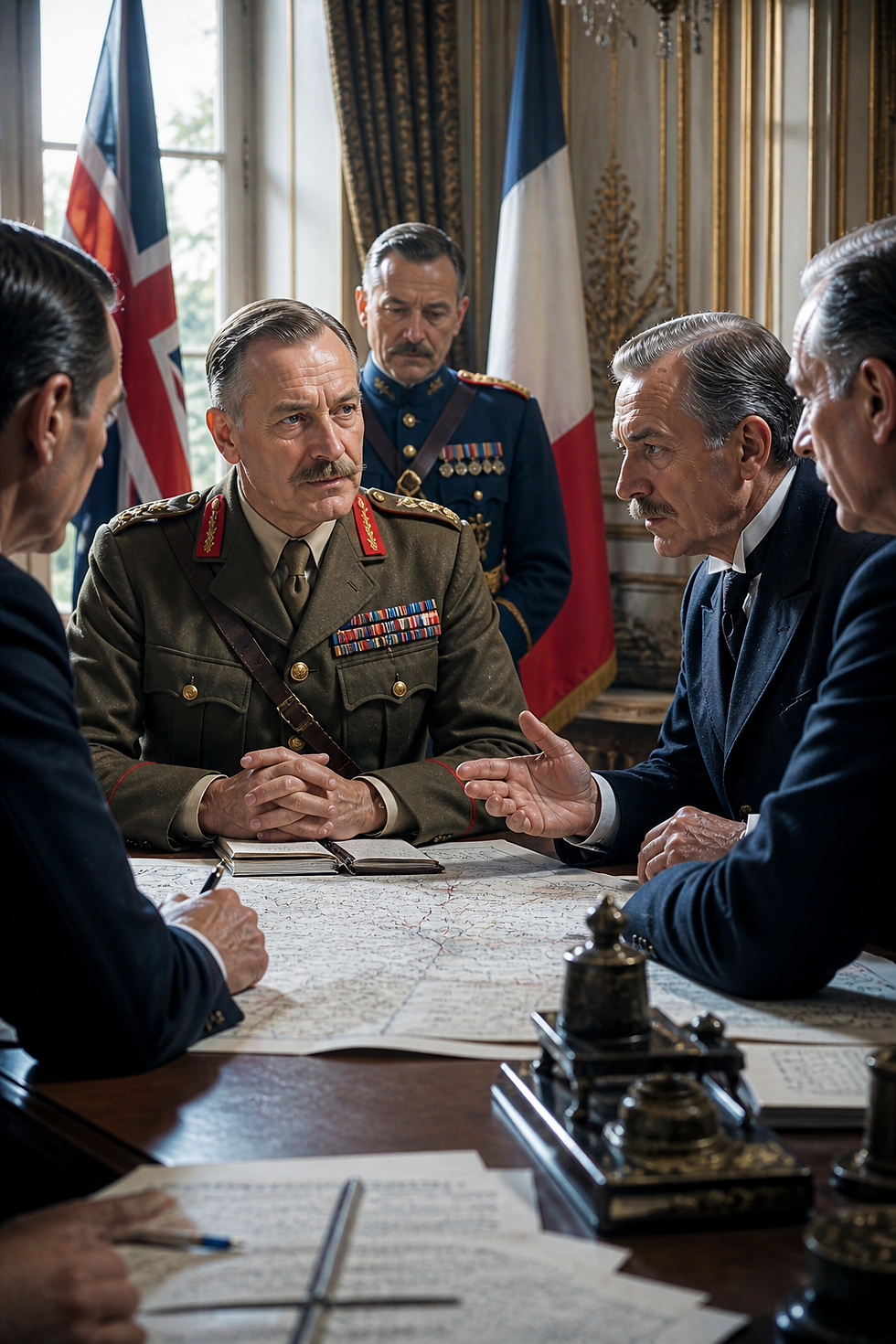
My Name is John French: The Reluctant but Crucial Ally
I began my career not in grand strategy, but in the saddle. I was a cavalry officer, shaped by the traditions of mobility, discipline, and personal courage. I believed in the value of professionalism and the strength of a well-trained army. War, as I first understood it, was something fast and decisive, shaped by leadership and spirit. I did not expect the kind of war that was coming.
The Burden of Command
When I was given command of the British Expeditionary Force, I knew Britain was stepping into a continental war unlike any it had faced in generations. Our army was small but highly trained, and I believed it could stand against any force in Europe. Still, I understood the risks. Britain had long avoided deep entanglements on the continent, and I felt the weight of sending our soldiers into such a vast conflict. Others spoke with certainty. I carried caution with me.
The First Clash at Mons
Our first major engagement came at Mons, where we faced the advancing German armies. My men performed brilliantly, holding their ground against overwhelming numbers. Yet I quickly saw the reality of the situation. We could not stand alone against such force. I ordered a retreat, a decision that some viewed as weakness. I did not see it that way. Preservation of the army was essential. I did not understand why some believed it was better to stand and be destroyed than to withdraw and fight again.
The Strain of Alliance
Working with the French command was not always simple. Their expectations, their plans, and their communication often differed from our own. I grew frustrated at times, feeling that British forces were being pushed into dangerous positions without full consideration. I was cautious, sometimes more than my allies preferred. They wanted bold action. I wanted survival and effectiveness. I did not understand why they could not see the importance of protecting a force that was so vital to the war effort.
Moments of Doubt and Decision
During the long retreat from Mons, I faced some of the most difficult decisions of my career. There were moments when I questioned whether we should pull back even further, perhaps even withdraw from the continent entirely. Some saw this as hesitation or lack of resolve. I saw it as realism. War must be fought with clear eyes, not blind determination. Still, I could sense that others did not agree, and their pressure weighed heavily on me.
Standing at the Marne
When the time came to stand and fight at the Marne, I committed British forces alongside the French in the counterattack. It was not a decision made lightly. But I understood that this was a turning point. Together, we helped halt the German advance and force their retreat. It proved that cooperation, even when strained, could achieve what no single army could do alone.
A Final Reflection
Looking back, I remain convinced that caution and preservation were not weaknesses, but necessities. Yet I can admit, in the quiet of reflection, that perhaps my caution sometimes appeared as doubt, and my reluctance as hesitation. I believed I was protecting my men and my country’s future, and I still believe that. But I have come to understand that in war, even necessary caution must be balanced with visible resolve.
Britain Enters the War - Told by John French
For many years Britain had stood apart from the shifting tensions of the continent, careful not to be drawn too deeply into European conflicts. But in August 1914, that distance vanished. When Germany crossed into Belgium, a line had been broken—one that Britain had pledged to defend. Belgian neutrality was not a minor detail in diplomacy; it was a commitment backed by honor and treaty. Once it was violated, the question was no longer whether Britain would act, but how quickly we could prepare.
The Meaning of Belgian Neutrality
Belgium’s neutrality had been guaranteed by major European powers, including Britain, long before the war began. It was intended to prevent exactly what was now unfolding—a great power using Belgium as a pathway for invasion. When German forces advanced through Belgian territory, it was seen not only as a military move but as a direct challenge to the balance of Europe. Many in Britain believed that if such agreements could be ignored without consequence, then no nation could trust any promise. I understood this clearly. The defense of Belgium was about more than land—it was about credibility and the kind of world that would follow.
The Call to Arms
On August 4, 1914, Britain declared war on Germany. With that decision came the immediate need to act. The British Expeditionary Force, though small compared to the vast armies of the continent, was highly trained and ready to move. I was tasked with leading this force across the Channel to support our French allies. There was little time for hesitation. Plans that had been prepared in theory now had to be carried out in reality, and every hour mattered as events unfolded rapidly across Belgium and northern France.
The Rapid Mobilization of the BEF
What followed was one of the most efficient mobilizations in British history. Troops were assembled, equipped, and transported across the English Channel with remarkable speed. Ships moved continuously, carrying soldiers, horses, artillery, and supplies. Within days, British forces began to arrive in France, taking their place alongside French armies facing the advancing Germans. I took pride in the discipline and professionalism of our troops. They were not numerous, but they were skilled, and I believed they would make a difference.
A Small Force in a Great War
Even as we mobilized, I was aware of the scale of the conflict we were entering. The armies of Germany and France numbered in the millions. The BEF was far smaller, designed more for rapid deployment than prolonged continental warfare. Some questioned whether such a force could have any meaningful impact. I did not share their doubts, but I understood the challenge. Our role would not be to overwhelm, but to support, to hold, and to fight with precision where it mattered most.
Stepping Onto the Continental Stage
As British troops took their positions in France, the reality of the war became clear. This was not a distant conflict that could be observed from afar. Britain was now fully engaged, committed to the defense of its allies and the principles it had long upheld. The entry into war was swift, but its consequences would be far-reaching.
A Reflection on the Moment
Looking back, it is clear that Britain’s decision to enter the war was shaped by both obligation and necessity. The defense of Belgium provided the immediate cause, but the broader balance of power in Europe was also at stake. At the time, there was little room for doubt. Action was required, and we acted. Only later would we come to understand how long and difficult that commitment would become.

My Name is Joseph Joffre: The Calm Defender
I was not born into glory, but into patience. I came from the south of France, far from the great political circles, and built my career step by steady step. I was an engineer first, a builder of fortifications and railways, a man who understood structure and endurance. I did not seek attention, and I rarely raised my voice. But I learned that calmness in war can be stronger than shouting.
Rising Through Discipline
In the years before the Great War, I earned my place not through dramatic gestures, but through reliability. I believed in preparation, in order, and in the strength of the army as a whole. When I became Commander-in-Chief, I knew that France faced a powerful and determined enemy. I did not fear this. I believed that if we held firm, if we trusted our system, we could endure whatever came.
The Faith in Offensive Spirit
Before the war, I supported the idea that the French army must attack with spirit and determination. Plan XVII, our strategy, called for bold offensives into Alsace and Lorraine. Some questioned this approach, warning that it underestimated German strength. I did not agree. I believed that hesitation would break morale. A nation must show confidence in itself. I did not understand why some preferred caution over courage, especially when the honor of France was at stake.
The Shock of Early Defeat
When the war began, our offensives met fierce resistance. We suffered heavy losses, and the German advance through Belgium threatened to overwhelm us. Many would have panicked. I did not. I ordered retreats where necessary, reorganized our forces, and prepared for the moment when we could strike back. Some criticized my calm, saying I did not react quickly enough or dramatically enough. They did not understand that panic is the greatest enemy of command.
Holding the Line
As the Germans pushed toward Paris, I made the decision to stand and fight along the Marne. It was a risk, but one I believed in completely. I gathered our forces, coordinated with the British, and prepared a counterattack. Others doubted whether we were ready. I did not share their doubts. The moment had come, and I believed that discipline and unity would carry us through.
The Turning of the Tide
At the First Battle of the Marne, we struck the German forces and forced them to retreat. It was not a dramatic charge, but a steady, determined push that broke their momentum. France was saved, and the war changed its course. Some have said that victory came by chance, that we were fortunate. I did not accept that view. Victory came because we held firm when others might have faltered.
In the end, I remained confident in my decisions, for they preserved France in its darkest hour. Yet as I reflect, I allow myself a quiet thought. Perhaps I placed too much faith in offensive spirit at the beginning, and too little in the changing nature of modern war. I believed deeply in strength and resolve, and I still do, but I have come to see that even calm certainty must be willing to adapt.
The Battle of the Frontiers - Told by Joseph Joffre
When war came in August 1914, France did not wait. We had prepared our strategy long before the first shots were fired. Plan XVII called for immediate offensives into Alsace and Lorraine, lands we had lost decades earlier and longed to reclaim. I believed that attack would restore confidence, unify the army, and seize the initiative. War rewards those who act with determination. I did not understand those who urged delay when the moment demanded action.
Marching Into Battle
Our armies advanced with courage and discipline, crossing into contested territory with the expectation that spirit and momentum would carry us forward. But we soon encountered a reality different from what had been imagined. German forces were not only well-prepared, they were stronger in position and number than anticipated. Their defensive firepower, especially from artillery and machine guns, cut deeply into our advancing lines. Still, I ordered the offensives to continue. Retreat at the beginning of a war can break a nation’s will, and I would not allow that.
Clashing at the Frontiers
The series of battles that followed—across Alsace, Lorraine, and into the Ardennes—became known as the Battle of the Frontiers. These were not isolated engagements, but a wide and violent collision of armies stretching across the eastern borders of France. Our troops fought bravely, often advancing under intense fire, but the results were costly. The Germans held strong positions and used their firepower effectively. It became clear that this war would not be won by spirit alone.
The Weight of Losses
The losses we suffered in those early weeks were severe. Entire units were cut down as they pressed forward against entrenched positions. It was a difficult truth to face, but one I did not allow to weaken my resolve. Some criticized the offensives, arguing that we had underestimated the enemy and overestimated the power of attack. I did not accept their conclusions at the time. War is never won without sacrifice, and I believed that maintaining the offensive spirit was essential, even in the face of heavy loss.
Adapting Under Pressure
As the German advance through Belgium began to threaten our northern flank, I recognized the need to shift our focus. The battlefield was changing, and so too must our approach. I began to reorganize our forces, pulling back where necessary and preparing for a more coordinated response. Some saw this as a reversal, but I saw it as adjustment. Command is not about clinging to a single idea, but about guiding the army through changing conditions.
A Hard Lesson Learned
The Battle of the Frontiers taught us that modern war had evolved. Firepower, coordination, and positioning played a greater role than ever before. Courage remained vital, but it was no longer enough on its own. I did not admit this easily. I had believed deeply in the strength of offensive action, and I struggled to understand why others questioned it so strongly. Yet the battlefield does not lie, and its lessons must be faced.
A Quiet Reflection
Looking back, I remain proud of the courage shown by the French army in those opening battles. They did not falter, even under the most difficult conditions. Still, I can now acknowledge that our expectations did not fully match the reality we encountered. The war we had prepared for was not the war we found. And in that difference lay the challenges that would shape everything that followed.
The British Expeditionary Force at Mons - Told by John French
By late August 1914, the moment had come for British forces to meet the German army in full battle. Our troops had landed in France swiftly and taken positions alongside our French allies, but until Mons, we had not yet faced the full weight of the German advance. This would be the first true clash between British and German soldiers, and I understood that the outcome would shape how both sides viewed the war ahead.
A Small but Skilled Force
The British Expeditionary Force was not large, especially when compared to the massive armies Germany had mobilized. Yet what we lacked in numbers, we made up for in training and discipline. Our soldiers were professionals, many with years of experience, trained to fire their rifles with remarkable speed and accuracy. I had great confidence in them. Still, I was fully aware that we were about to face a force far greater in size, advancing with momentum from their sweep through Belgium.
Holding the Line at Mons
At Mons, our forces took position along a canal, using it as a natural defensive line. When the German army approached, they did so in great numbers, expecting to push through quickly. What they encountered instead was a disciplined and determined resistance. British rifle fire was so rapid and precise that some Germans believed they were facing machine guns. Wave after wave of advancing troops were checked, and for a time, we held firm against the advance.
The Weight of Numbers
Despite the success of our defense, the reality of the situation could not be ignored. The German army continued to bring forward more men, more artillery, and greater pressure. Their numbers allowed them to stretch our lines and threaten our flanks. I could see clearly that while we had proven our strength, we could not hold indefinitely. Some might have chosen to stand and fight until overwhelmed, but I did not see that as wisdom. Preserving the army was essential for the battles still to come.
The Order to Withdraw
I gave the order to withdraw, not out of defeat, but out of necessity. It was a difficult decision, one that some might misunderstand. Our troops had performed exceptionally, and there was pride in what they had accomplished. Yet war is not about holding a single position at all costs. It is about maintaining the ability to fight another day. I did not understand why some saw withdrawal as weakness. To me, it was the only logical choice in the face of overwhelming force.
A Clash That Echoed Beyond the Field
The battle at Mons was brief, but its impact was significant. It demonstrated that the British army, though small, could stand against one of the most powerful forces in Europe and hold its ground. It also revealed the scale of the challenge ahead. This would not be a quick or simple war. The German advance was powerful, and it would require coordination, resilience, and continued effort to resist it.
A Measured Reflection
Looking back, I remain confident in the decisions made at Mons. Our soldiers proved their capability, and our withdrawal preserved the force for future battles. Yet I can admit that the experience revealed just how vast this conflict would become. The professionalism of our army was undeniable, but even the finest soldiers must face the reality of numbers and scale. It was a lesson that would shape every decision that followed.
The Great Retreat - Told by Joseph Joffre
When the early battles of 1914 did not go as we had hoped, the situation demanded clear thinking, not panic. As German forces pushed through Belgium and into northern France, our armies were forced to fall back. Many saw this as defeat, as the beginning of collapse. I did not. A retreat, when ordered with purpose and control, is not failure—it is a maneuver. I did not understand why so many believed that stepping back meant the end, when in truth it was the only way to preserve the army for what was to come.
Facing the German Advance
The German armies moved with speed and determination, pressing against our lines and those of our British allies. Their advance threatened to outflank and overwhelm us if we stood in place. I could see that holding every position would lead to encirclement and destruction. So I made the decision to withdraw, not in disorder, but in coordination. Our forces would fall back toward Paris, maintaining their structure and readiness. This was not an easy choice, but it was the correct one.
Order in the Midst of Pressure
The retreat was carried out under constant pressure. Our troops marched long distances, often fighting delaying actions to slow the German advance. It required discipline at every level—officers maintaining order, soldiers holding their ground just long enough before pulling back. I demanded that units remain organized, that communication be preserved, and that no unnecessary panic spread through the ranks. Some critics believed the situation was slipping beyond control. I did not share their view. I saw an army that was bending, not breaking.
Strategic Withdrawal, Not Collapse
There is a difference between retreat and collapse, though many fail to see it. Collapse is disorder, panic, and the loss of command. What we carried out was deliberate. Each step back brought us closer to a position where we could regroup and strike. I did not understand why some officers and observers could not see this distinction. They feared the movement itself, rather than recognizing its purpose. War is not won by holding ground blindly, but by choosing when and where to fight.
Preparing for the Counterstroke
As we withdrew, I worked to reorganize our forces, shifting units, reinforcing weak points, and preparing for the moment when we would turn and face the enemy again. The retreat created space—space to think, to plan, and to gather strength. Paris lay behind us, and it was clear that we could not retreat indefinitely. The time would come when we would stand. I remained calm because I knew that moment was approaching.
The Edge of Decision
By early September, the German advance had stretched its lines, and an opportunity began to emerge. Our retreat had not been in vain. It had drawn the enemy forward, extended their position, and opened the possibility for a counterattack. What others had feared as defeat had created the conditions for resistance. This was the purpose I had seen from the beginning.
A Measured Reflection
Looking back, I remain convinced that the Great Retreat was necessary and correctly executed. It preserved the French army and made possible the victory that would follow at the Marne. Yet I can admit that such a movement demands immense trust—from soldiers, from commanders, and from the nation itself. I believed in that trust, even when others did not, and in the end, it was that belief that carried us through one of the most dangerous moments of the war.
The Gap in the German Line - Told by Alexander von Kluck
By early September 1914, my army had driven deep into France. We had marched farther and faster than many believed possible, pushing the French and British forces back toward Paris. The great sweep of our advance had nearly achieved its purpose. Yet war does not move along a fixed path. The enemy was retreating, but not collapsing, and I saw before me an opportunity that demanded action.
The Decision to Turn Inward
Instead of continuing the wide arc west of Paris as originally conceived, I chose to turn my forces inward, toward the city and the retreating Allied armies. I believed that by pressing directly against them, I could strike a decisive blow, breaking their resistance before they could reorganize. To me, this was not a deviation from the plan, but an adaptation to the reality unfolding on the battlefield. War rewards those who seize the moment. I did not understand why some would have preferred to follow the original path when the enemy stood within reach.
The Pressure of Pursuit
Our advance had created immense pressure on the Allied forces, and I intended to maintain it. Every mile we gained brought us closer to victory. I drove my army forward with urgency, believing that hesitation would allow the enemy to escape and regroup. Some argued that coordination with neighboring armies should take priority, that alignment must be preserved at all costs. I saw things differently. The enemy in front of me was the immediate threat, and defeating him seemed the surest path to ending the war quickly.
The Gap Emerges
In turning inward, a gap began to form between my First Army and the Second Army to our east. It was not immediately apparent how significant this separation would become. The distances involved in modern warfare were vast, and communication was never perfect. At the time, I believed the risk was manageable, that our momentum and strength would prevent any serious exploitation. I did not fully grasp how quickly such a gap could become dangerous when faced with a determined enemy.
A Weakness Revealed
As events unfolded, the Allies recognized the opening between our armies. French and British forces began to move into that space, threatening to divide our lines and strike at our flanks. What had been a bold advance now carried a hidden vulnerability. Some later claimed that this gap was a critical error, a turning point that allowed the Allies to halt our progress. I found such criticism difficult to accept. Decisions in war are made with the information available in the moment, not with the clarity of hindsight.
The Cost of Initiative
My decision was driven by the belief that decisive action would bring victory. I chose to engage the enemy directly rather than adhere strictly to the original design. In doing so, I accepted certain risks, though I did not view them as excessive at the time. War is not a static exercise. It demands judgment, and judgment often requires choosing between imperfect options. I did not understand why some viewed initiative as a flaw rather than a necessity.
A Reflection on the Moment
Looking back, I can see that the gap between our armies played a role in what followed at the Marne. It created an opportunity that the Allies were able to use against us. Yet I remain convinced that in that moment, the decision to turn inward was driven by the conditions before me, not by carelessness. Only now do I consider that even the boldest action must remain balanced with the broader structure of the army as a whole.
The First Battle of the Marne - Told by Joseph Joffre
By early September 1914, the long retreat of our armies had brought us to a critical point. The Germans had advanced deep into France, and Paris itself stood in danger. Yet in their advance, they had stretched their lines and exposed weaknesses. I had watched carefully, waiting for the moment when retreat must end and action must begin. That moment had arrived. I did not share the fear that had spread among some. I saw an opportunity, and I intended to seize it.
The Plan for Counterattack
I ordered a coordinated counterattack along the Marne River, bringing together French forces and the British Expeditionary Force. This was not a reckless charge, but a calculated strike against an overextended enemy. Our armies would move forward in unison, pressing into the gap that had formed between German forces. Some doubted whether we had the strength or organization to carry out such an operation after weeks of retreat. I did not understand their hesitation. The army was still intact, and discipline had been maintained. That was enough.
The Advance Begins
As the battle unfolded, French and British troops moved forward with determination. The fighting was intense, but this time we were no longer giving ground. Instead, we pressed the Germans, forcing them to respond to our movements rather than dictating the pace themselves. One of the most remarkable efforts came when Paris taxis were used to transport French soldiers to the front, a small but symbolic act that showed the nation itself was committed to the defense. Every element of the army and the country seemed to move together in that moment.
Breaking the German Momentum
The German advance, which had appeared unstoppable, began to slow and then falter. Their lines, stretched and vulnerable, could not hold under the pressure of our attack. As we pushed into the gap between their armies, we threatened to divide and encircle them. The effect was immediate. German forces began to withdraw, step by step, abandoning the forward momentum they had carried since the opening weeks of the war. What had seemed inevitable suddenly changed.
The “Miracle of the Marne”
Many would later call this victory the “Miracle of the Marne,” as if it had come about by chance or fortune. I did not see it that way. The success was the result of discipline, planning, and the willingness to act decisively at the right moment. It was the product of an army that had endured retreat without breaking and was ready to strike when the opportunity appeared. I found it difficult to accept that such effort and coordination could be reduced to a miracle alone.
A Turning Point in the War
The outcome of the battle forced the Germans to retreat northward, away from Paris, and marked the end of their rapid advance. It was a turning point, not because the war was won, but because it would no longer be decided quickly. The hope of a swift victory had passed, and a new phase of the war was beginning. I understood this even as the battle ended.
A Quiet Reflection
Looking back, I remain certain that the decision to counterattack at the Marne was necessary and correctly timed. It preserved France and changed the course of the war. Yet I can admit that such moments depend not only on planning, but on the ability to recognize when the tide has shifted. I believed I saw that moment clearly, and I acted without hesitation.
The Failure of the Schlieffen Plan - Told by Alfred von Schlieffen
Though I did not live to see the war unfold, I can look upon its events with a clarity that comes only in reflection. The plan I designed was meant to deliver a swift and decisive victory in the west, avoiding the disaster of a prolonged two-front war. Yet as it was carried out, it did not achieve its purpose. The reasons for this failure are not simple, but they are not beyond understanding.
The Burden of Overextension
The plan relied on an immense movement of men and material, stretching across great distances in a precise and coordinated arc. For it to succeed, every part had to move with speed and exact timing. As German armies advanced deeper into France, their supply lines lengthened, their formations stretched, and their coordination weakened. Armies that were meant to operate as a unified whole became separated by distance and circumstance. What was designed as a powerful sweep became, in practice, a fragile extension.
Resistance Beyond Expectation
One of the assumptions underlying the plan was that resistance in Belgium and northern France would be overcome quickly. This proved incorrect. Belgian forces delayed the advance at key points, most notably at Liège, buying valuable time for the Allies. French and British forces, though driven back, did not collapse as expected. They fought, regrouped, and continued to resist. Each day of resistance disrupted the timing upon which the entire plan depended. I did not fully account for the degree to which determined opposition could slow even the strongest advance.
Miscalculations in Execution
No plan survives unchanged once it meets the reality of war. Adjustments were made, decisions taken in the moment, and these altered the original design. The strength of the right wing, which I believed should be overwhelming, was reduced. Movements that were meant to remain wide and coordinated became more direct and independent. The turning of forces inward toward Paris, rather than around it, created gaps that the enemy could exploit. These changes, though perhaps understandable to those who made them, weakened the structure of the plan itself.
The Problem of Time
Above all, the plan was a race against time. It required that France be defeated before Russia could fully mobilize in the east. Delays in the west—caused by resistance, logistical strain, and altered movements—allowed time to slip away. As days passed, the balance shifted. The war that was meant to be short began to lengthen, and with that, the advantage I had sought to secure began to disappear.
The Moment of Collapse
The First Battle of the Marne revealed the full consequence of these factors. The German advance, once powerful and continuous, faltered under the strain of overextension and coordinated Allied resistance. The gap between German armies became a point of vulnerability, and the Allies struck where the line was weakest. The result was not a complete defeat, but a failure to achieve the decisive victory upon which the entire plan depended.
Looking back, I can see that the plan I created demanded perfection in an imperfect world. It relied on assumptions that proved too rigid when faced with the unpredictability of war. I believed that precision, discipline, and speed could overcome all obstacles, and perhaps I placed too much faith in that belief. The problem I sought to solve was real, but the solution, though logical in design, could not fully account for the human and material realities it would encounter.
The Race to the Sea - Told by John French
After the German advance was halted at the Marne, the war did not pause—it shifted. Both sides, having failed to achieve a decisive breakthrough, sought another way to gain advantage. The answer seemed clear: outflank the enemy. If we could move around their northern edge, we might turn their line and regain the initiative. The Germans thought the same. What followed was not a single battle, but a series of rapid movements, each side racing to reach the open ground before the other.
The Push Northward
Our armies began to extend their lines northward, moving through northern France and into Belgium. Each time one side attempted to outmaneuver the other, the opposing force would shift to block it. It became a contest of movement, with both sides advancing, digging in, and then advancing again. I directed British forces to move quickly, coordinating with our French allies, determined not to allow the Germans to gain the upper hand along the coast. It was a fluid and uncertain period, unlike anything we had experienced before.
Clashes Without Decision
As we moved north, we encountered repeated engagements—at places like the Somme, Artois, and eventually Flanders. None of these battles produced a decisive victory. Instead, they extended the line further and further. Each clash forced both sides to dig in, creating temporary defensive positions that soon became permanent. I found it difficult to accept that despite all this movement, neither side could break through. I had believed that maneuver would restore mobility to the war. Instead, it seemed only to stretch the conflict across a wider front.
The Closing of the Line
Eventually, the race reached the North Sea. There was no more open ground to exploit, no unguarded flank to turn. From the Swiss border in the south to the Belgian coast in the north, a continuous line of opposing forces had formed. Trenches, barbed wire, and fortified positions now defined the battlefield. What had begun as a war of movement had become something far more static. I did not fully understand at the time how complete this transformation would be.
A War Transformed
The implications of this continuous line were profound. There would be no easy path around the enemy, no swift maneuver to end the war. Every advance would now have to break through prepared defenses, and every position would be contested fiercely. I had hoped that the race northward would open new opportunities. Instead, it closed them. The battlefield had hardened, and with it, the nature of the war itself.
A Measured Reflection
Looking back, I can see that the Race to the Sea marked the end of one phase of the war and the beginning of another. It was not a failure of effort, but a result of two determined sides adapting to each other’s moves. Yet I can admit that I underestimated how completely this would lock the front into place. What we thought was a temporary condition became the defining feature of the war that followed.
From Movement to Stalemate - Told by John French, Alexander von Kluck, and Joseph Joffre
The End of Open War
John French: I am John French, and I watched the war change before my eyes. Only weeks earlier, armies had marched across vast distances, maneuvering for position, seeking advantage through movement. But after the Marne and the Race to the Sea, that movement began to disappear. Each attempt to outflank the enemy was met with equal speed, equal determination. Eventually, there was nowhere left to go. We faced the Germans not across open ground, but along a fixed line that neither side could easily break.
Momentum Lost
Alexander von Kluck: I am Alexander von Kluck, and I can tell you that this was not how we expected the war to unfold. Our early advances had relied on speed and pressure, on forcing the enemy to retreat and collapse. But once our lines were halted and stretched across the front, that momentum was gone. We could no longer maneuver freely. Every attempt to move forward met resistance that could not simply be pushed aside. I did not fully accept it at first. I believed that with enough force, movement could be restored. But the battlefield had changed.
Holding What Was Gained
Joseph Joffre: I am Joseph Joffre, and from my position, I saw that this new form of warfare required a different kind of thinking. Our objective was no longer to advance rapidly across the countryside, but to hold the line we had secured. The German advance had been stopped, and that alone was significant. Now the task was to prevent them from regaining the initiative. This meant strengthening positions, coordinating defenses, and ensuring that no weakness could be exploited.
Digging In
John French: As the line stabilized, our soldiers began to dig—not as a temporary measure, but as a necessity. The firepower on both sides had made open movement increasingly dangerous. Rifles, artillery, and machine guns could sweep the ground with devastating effect. To survive, men needed protection. What began as shallow positions quickly became more organized, more permanent. I saw this as a practical response to the conditions we faced, though I did not yet grasp how enduring these positions would become.
The Limits of Attack
Alexander von Kluck: We attempted to break through these developing defenses, but each effort revealed the same truth. The enemy, protected and prepared, could inflict heavy losses on any advancing force. The cost of attack rose sharply, while the chance of success diminished. I had believed that determination and strength could overcome any obstacle. Yet here, the obstacle was not a single position, but an entire system of defense stretching across the front. It was not easily broken.
A New Reality
Joseph Joffre: What emerged was a continuous line, fortified and defended, where neither side could achieve a decisive breakthrough. This was not the war we had planned, but it was the war we now faced. Commanders had to adjust, to think not in terms of rapid victory, but of endurance and control. I understood that holding firm would be essential, even if progress seemed slow or absent.
A Shared ReflectionJohn French would say that the war had lost its fluidity, becoming fixed in place. Alexander von Kluck would admit that the speed and shock of early operations had given way to resistance that could not be easily overcome. I, Joseph Joffre, would add that stability, though imperfect, had prevented defeat and created a new balance. Together, we saw the same transformation from different sides. Movement had given way to stalemate, and in that change, the war took on a character that none of us had fully anticipated at the beginning.


Comments