

2. Lesson Plan from World War I: Militarism, Alliances, Imperialism, Nationalism (MAIN Causes)

What Are the “MAIN” Causes? In the late 1800s and early 1900s, Europe appeared strong, advanced, and confident. Nations were growing richer through industry, expanding their influence across the globe, and celebrating their achievements. Yet beneath this progress, tensions were quietly rising. Like cracks forming in a dam, these forces were building pressure that would eventually burst into one of the most devastating conflicts in history.
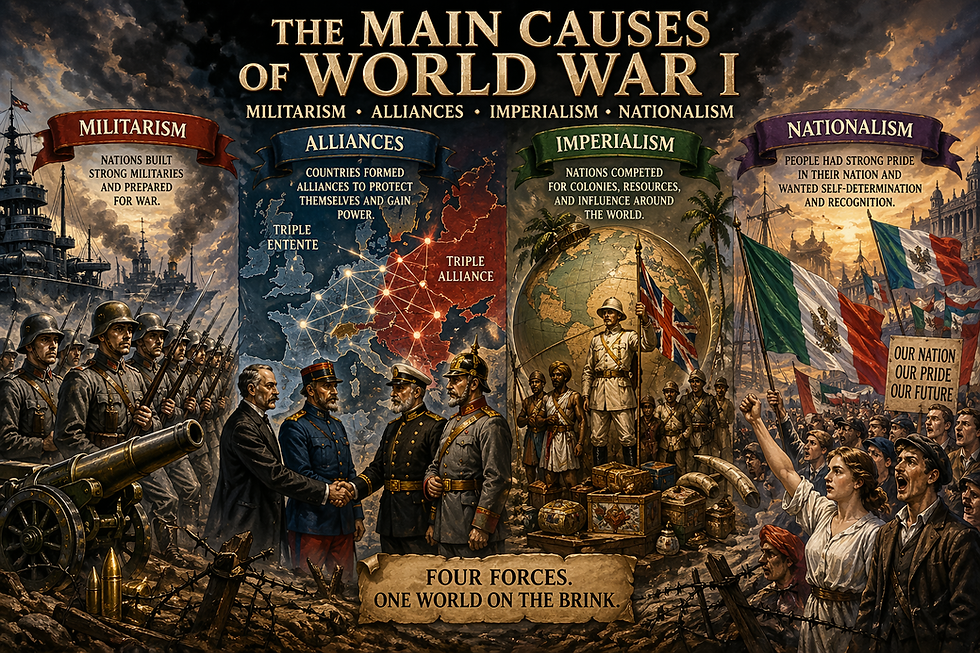
What Are the MAIN Causes?
Historians often use the acronym “MAIN” to organize and understand the deeper causes of World War I. These causes are not single events, but powerful trends that developed over many years. Militarism refers to the belief in building up strong armed forces and being ready to use them. Alliances are agreements between nations to support one another, especially in times of war. Imperialism is the competition for land, resources, and power across the world. Nationalism is a deep pride in one’s country, sometimes leading people to believe their nation is superior to others. Each of these forces alone could create tension—but together, they created a dangerous and unstable situation.
Militarism: Preparing for War Before It Began
Across Europe, nations invested heavily in their military strength. Armies grew larger, weapons became more advanced, and military leaders gained influence in government decisions. Many countries believed that having the strongest military would protect them or give them an advantage over their rivals. However, this constant preparation also made war more likely. When nations are heavily armed and ready to fight, it becomes easier to turn to conflict instead of compromise.
Alliances: Friends Who Pull You Into Conflict
To protect themselves, European nations formed alliances. These agreements were meant to prevent war by ensuring that no country would stand alone. However, alliances also created a system where a small conflict could quickly grow larger. If one country went to war, its allies were expected to join. This meant that disagreements between two nations could rapidly involve many others, turning local tensions into a widespread crisis.
Imperialism: The Race for Power and Resources
European nations competed fiercely to build empires around the world. Colonies provided valuable resources, new markets for goods, and increased national prestige. This competition led to conflicts and rivalries, especially in Africa and Asia. Countries began to view one another as obstacles to their success. The desire for power and wealth pushed nations into direct competition, increasing distrust and hostility.
Nationalism: Pride That Divides
Nationalism inspired people to love and support their country, but it also created division. Citizens often believed their nation was the best and deserved more power. In some regions, especially within large empires, different ethnic groups wanted independence and self-rule. This created internal conflicts and weakened stability. National pride could unite people, but it could also lead to anger, rivalry, and a willingness to fight.
How Historians Make Sense of Complexity
World War I did not begin because of one single cause. Instead, it was the result of many forces working together over time. Historians use frameworks like “MAIN” to organize these complex ideas and better understand how they connect. By grouping causes into categories, they can see patterns and relationships that might otherwise be confusing. This approach helps us understand not just what happened, but why it happened.
Long-Term and Short-Term Causes
To fully understand the outbreak of World War I, historians also divide causes into long-term and short-term categories. Long-term causes are the slow-building forces, like militarism, alliances, imperialism, and nationalism, that developed over decades. Short-term causes are the immediate events that triggered the war. While the short-term causes may spark the conflict, it is the long-term causes that make such a large and destructive war possible. Without the pressure built up over time, a single event would not have led to a global crisis.
A World on the Edge
By the early 1900s, Europe was like a tightly wound spring, filled with tension and ready to snap. Militaries were prepared, alliances were locked in place, empires were competing, and national pride was at its peak. The continent did not yet know when or how war would begin—but the conditions made it almost inevitable. Understanding these MAIN causes reveals that World War I was not just an accident of history, but the result of powerful forces that had been shaping the world for years.
Europe in Transition (1870–1914)
In the decades after 1870, Europe did not stand still. It evolved rapidly, driven by new technologies, growing economies, and changing political structures. Railroads stretched across nations, factories reshaped cities, and populations grew at unprecedented rates. Beneath this progress, however, lay deep changes that would reshape the balance of power and quietly prepare Europe for conflict.
Industrialization and Modernization
The Industrial Revolution had already begun earlier in the 1800s, but by 1870 it accelerated across much of Europe. Countries like Germany and Britain expanded their factories, producing steel, machinery, and weapons at remarkable speeds. Railways connected cities and borders, allowing goods, people, and armies to move faster than ever before. Communication improved with telegraphs and newspapers, spreading information quickly across the continent. Cities grew crowded as workers left rural areas in search of jobs, creating both economic opportunity and social challenges. Industrial strength became a measure of national power, and nations began to compete not just in wealth, but in their ability to produce and mobilize resources.
The Rise of Powerful Nation-States
This period also saw the emergence of strong, unified nations. Germany, once a collection of smaller states, became a powerful empire after its unification in 1871 under Otto von Bismarck. With its growing industry and disciplined military, Germany quickly became one of Europe’s dominant forces. Similarly, Italy completed its unification in the late 1800s, bringing together regions that had long been divided. These new nation-states were driven by a sense of identity and ambition. They sought recognition, influence, and a place among Europe’s established powers. Their rise shifted the balance, creating both competition and unease among older nations.
The Strain on Old Empires
While new nations rose, older empires began to face serious challenges. The Ottoman Empire, once a powerful force spanning three continents, struggled to maintain control over its territories. Internal divisions, economic weakness, and external pressures caused it to lose land and influence. At the same time, the Austro-Hungarian Empire faced growing tension within its borders. It ruled over many different ethnic groups—each with its own language, culture, and desires for independence. These internal pressures made the empire fragile, as loyalty to the empire weakened and nationalist movements grew stronger.
A Changing Balance of Power
As Europe moved toward the 20th century, the balance of power became increasingly uncertain. Industrial strength, military growth, and political change reshaped relationships between nations. New powers demanded influence, while older empires struggled to hold their ground. Competition grew sharper, and trust between nations became more fragile. Though peace remained, it was a peace built on shifting ground.
The Stage Is Set
By 1914, Europe had been transformed. It was more advanced, more connected, and more powerful than ever before—but also more divided and unstable. Industrialization had given nations the tools for large-scale conflict, new states had altered the balance of power, and weakening empires created uncertainty across regions. These changes did not cause war by themselves, but they created the conditions where conflict could grow quickly and spread widely. Europe stood at a turning point, shaped by decades of transformation and moving steadily toward a moment that would change the world forever.
The Rise of Standing Armies
In the late 1800s, a quiet but powerful shift was taking place across the continent. Armies were no longer temporary forces raised only in times of crisis. Instead, they became permanent institutions—large, organized, and constantly expanding. This transformation changed not only how nations defended themselves, but how they thought about power, security, and the possibility of war.
From Temporary Forces to Permanent Power
For centuries, many European countries relied on small professional forces or quickly assembled troops during emergencies. By the late 19th century, this approach had changed dramatically. Nations began maintaining massive standing armies even in peacetime. These armies were well-trained, equipped with modern weapons, and ready to mobilize at a moment’s notice. Military planning became more precise, with detailed timetables for movement and supply. Governments invested heavily in barracks, weapons factories, and officer training schools. The presence of these large, permanent forces meant that war was no longer a distant possibility—it was something nations were constantly prepared to fight.
Conscription: Armies of the People
A key factor in this growth was the widespread use of conscription, or mandatory military service. Countries like France and Germany required young men to serve in the army for a set period, often followed by years in reserve forces. This system allowed nations to maintain relatively smaller active armies while still being able to call upon millions of trained soldiers when needed. Conscription also tied the military closely to everyday life. Service became a shared experience for citizens, reinforcing discipline, loyalty, and national identity. In many ways, entire societies became connected to their armies, blurring the line between civilian and soldier.
Germany’s Expanding Military Strength
After its unification in 1871 under Otto von Bismarck, Germany rapidly built one of the most powerful armies in Europe. Its leaders believed that strength and readiness were essential to maintaining security and influence. The German military was highly organized, with efficient leadership, advanced training, and detailed planning strategies. Railroads were designed not just for trade, but for moving troops quickly across the country. Military leaders held significant influence in government decisions, and the army became a symbol of national pride. As Germany’s power grew, other nations took notice—and responded by expanding their own forces.
A Continent Armed and Ready
The rise of standing armies created a new reality in Europe. Nations no longer needed time to prepare for war—they were already prepared. Millions of soldiers could be mobilized within days, and detailed plans ensured that armies would move quickly and decisively. While these developments were intended to provide security, they also increased tension. When every nation is armed, organized, and ready, even a small conflict can escalate rapidly. By the early 1900s, Europe had become a continent where military strength was constantly on display, and the readiness for war made the possibility of peace far more fragile.
The Naval Arms Race
In the years before World War I, the oceans became a stage for competition just as intense as any battlefield. Control of the seas meant control of trade, protection of empire, and the ability to project power across the globe. For European powers, especially Great Britain and Germany, naval strength was not just about defense—it was about dominance.
Britain’s Command of the Seas
For much of the 19th century, Great Britain held the undisputed title as the world’s greatest naval power. Its massive fleet protected trade routes that stretched across a global empire. The British economy depended on these routes, making naval supremacy essential to its survival. To maintain this advantage, Britain followed a strict policy: its navy had to be stronger than the next two largest navies combined. This commitment ensured that no rival could challenge its control of the seas.
Germany’s Challenge
After unification, Germany began to rise rapidly as an industrial and military power. Its leaders believed that a strong navy was necessary to secure its place among the world’s great nations. Under Kaiser Wilhelm II, Germany launched an ambitious plan to build a powerful fleet capable of rivaling Britain’s. Shipyards expanded, resources were poured into naval construction, and a new sense of urgency took hold. This move did not go unnoticed—Britain saw it as a direct threat to its long-held dominance.
The Revolution of the HMS Dreadnought
In 1906, Britain introduced a warship that changed everything: the HMS Dreadnought. Faster, more heavily armed, and more advanced than any ship before it, the Dreadnought made all existing battleships outdated overnight. This technological leap did not end the competition—it intensified it. Germany quickly began building its own versions, and both nations raced to outproduce one another. Ship counts, firepower, and speed became measures of national strength, and each new vessel added fuel to the growing rivalry.
A Race Without a Battlefield
Unlike land armies preparing for immediate conflict, the naval arms race was a competition without direct combat—yet it carried serious consequences. Each ship built by one nation was seen as a threat by the other. Suspicion deepened, trust eroded, and diplomatic relations grew more strained. The race for naval superiority became a symbol of broader competition between nations, reflecting fears, ambitions, and the desire for security.
Tension Beneath the Surface
By the early 1900s, the waters surrounding Europe were filled with powerful fleets, each ready but waiting. The naval arms race had not yet led to war, but it had created an atmosphere of rivalry and unease. Britain and Germany stood as competitors on a global stage, each determined not to fall behind. The ships themselves never fired in this race, but their presence alone helped push Europe closer to the edge of conflict, where strength and suspicion would soon collide.
War as a Cultural Ideal
In the late 1800s and early 1900s, war was not widely feared as it would be later. Instead, many people across Europe viewed it as a test of strength, a chance for glory, and a way to prove national greatness. This mindset did not appear suddenly—it was built over time through education, public displays, and cultural beliefs that shaped how entire generations understood conflict.
Teaching Honor and Heroism
In schools, children were often taught stories that praised bravery in battle and the sacrifices of soldiers. Textbooks highlighted past victories and celebrated national heroes, presenting war as a noble duty rather than a destructive force. Young students learned to admire courage, loyalty, and obedience—qualities closely tied to military service. Literature and newspapers reinforced these ideas, frequently portraying war as exciting and honorable. These messages helped shape a generation that would grow up believing that fighting for one’s country was both expected and admirable.
Symbols of Strength in Everyday Life
Military culture was highly visible in daily life. Parades filled city streets with marching soldiers, polished uniforms, and displays of discipline and unity. These events drew large crowds and stirred feelings of pride and excitement. Uniforms themselves became symbols of honor and respect, worn not only by soldiers but admired by civilians. In many countries, military service was seen as a rite of passage, a way for young men to prove their loyalty and strength. This constant presence of military imagery made the idea of war feel familiar and even celebrated.
A Growing Sense of Inevitability
As tensions between nations increased, many Europeans began to believe that war was unavoidable. Rivalries between countries, combined with growing militaries and alliances, created a sense that conflict was only a matter of time. Instead of fearing this possibility, some leaders and citizens welcomed it. They believed war could solve problems, strengthen nations, and restore honor. There was a widespread assumption that any future war would be short and decisive, bringing quick victory rather than prolonged suffering.
The Danger of Romanticizing War
This cultural attitude toward war had serious consequences. By glorifying conflict and underestimating its dangers, societies became more willing to support military action. The excitement surrounding war masked its true cost, making it easier for nations to move toward confrontation. When war finally came, it would reveal a reality far different from the one many had imagined. But in the years leading up to that moment, the belief in war as a noble and necessary force helped push Europe closer to the edge.
Why Nations Form Alliances
In the years before World War I, European nations did not stand alone. Instead, they formed alliances—formal agreements to support one another in times of conflict. These alliances were not created out of friendship alone, but out of necessity. In a world where power was constantly shifting, nations looked for ways to protect themselves, deter enemies, and maintain stability.
Fear and the Search for Security
At the heart of every alliance was fear. Nations feared invasion, loss of territory, and the growing strength of their rivals. Rather than face these threats alone, they sought protection through partnerships. By aligning with other countries, a nation could increase its chances of survival in a crisis. Alliances offered reassurance, creating a sense that if danger came, help would not be far behind. However, this search for security often increased suspicion, as each alliance could be seen as a threat by those outside it.
Strength in Numbers: The Power of Deterrence
Alliances were also built on the idea of deterrence—the belief that strength could prevent war. The message was clear: “If you attack one of us, you will face all of us.” This concept was meant to discourage aggression by making the cost of conflict too high. A single nation might be vulnerable, but a group of nations working together could present a powerful defense. In theory, this system would keep peace by making war too risky to begin.
The Idea of Balance Without Stability
As alliances formed across Europe, they created a balance of power—a situation where no single nation or group could easily dominate the others. This balance was meant to prevent any one country from becoming too strong. However, maintaining this balance required constant adjustment. When one nation grew stronger, others responded by strengthening their own alliances. Instead of creating lasting stability, this system often led to increased tension, as countries watched one another closely and prepared for the possibility of conflict.
A System Built on Uncertainty
While alliances were designed to protect, they also carried hidden risks. Nations were now tied to the decisions and conflicts of their partners. A dispute involving one country could quickly draw in others, expanding a small conflict into something much larger. The same agreements that promised security also made the international system more complicated and unpredictable.
A Delicate Web of Commitments
By the early 20th century, Europe had become a network of interconnected alliances, each one designed to prevent war but capable of spreading it. Nations believed these agreements would keep them safe, yet they also increased the stakes of any conflict. In trying to avoid war through unity and strength, Europe created a system where peace depended on careful balance—and where a single spark could pull entire nations into a larger struggle.
The Web of Secret Agreements
In the years before World War I, alliances did not always operate in the open. While nations publicly declared friendships and partnerships, many agreements were made behind closed doors, known only to a small group of leaders. These secret commitments created a tangled system of obligations, where countries were tied together by promises that could suddenly pull them into conflict.
Defensive and Offensive Promises
Not all alliances were the same. Some were designed as defensive agreements, meaning nations promised to protect each other if attacked. Others had more aggressive intentions, allowing or even encouraging joint action if an opportunity arose. The difference between defensive and offensive alliances was not always clear, and this ambiguity created uncertainty. A country might believe it was entering a partnership for protection, only to find itself expected to support actions that could lead to war.
Secrecy and Uncertainty
One of the most dangerous aspects of these agreements was their secrecy. Governments often kept the details hidden from both their citizens and other nations. This lack of transparency made it difficult for countries to fully understand each other’s intentions. Suspicion grew as leaders tried to guess who was allied with whom and under what conditions. Without clear communication, even small misunderstandings could escalate into serious diplomatic tensions.
Key Alliances That Shaped Europe
Several major alliances formed the backbone of this system. The Dual Alliance between Germany and Austria-Hungary was a defensive agreement aimed at protecting both nations from potential threats, particularly from Russia. This partnership later expanded into the Triple Alliance, which included Italy, creating a stronger bloc of cooperation. In response, France and Russia formed the Franco-Russian Alliance, balancing the growing power of their rivals. These alliances were intended to provide security, but they also divided Europe into opposing groups.
A System Ready to React
The web of secret agreements meant that any conflict could quickly spread beyond its original borders. If one nation became involved in a dispute, its allies were expected to act, often without hesitation. Because the terms of these agreements were not always fully understood, leaders had to make decisions quickly, sometimes based on incomplete information. This created a system that was both reactive and unpredictable.
Hidden Promises, Visible Consequences
By the early 20th century, Europe’s alliances had become a complex and fragile network. While they were meant to preserve peace, their secrecy and overlapping commitments made the situation more dangerous. Nations were bound together by promises that could not easily be broken, and the lack of openness increased mistrust. In this environment, even a small spark could trigger a chain reaction, as hidden agreements came to life and drew entire countries into conflict.
The Danger of Chain Reactions
In the early 1900s, Europe was connected by a complex system of alliances, each designed to provide protection and strength. Yet this system carried a hidden risk. Instead of containing conflicts, alliances had the power to expand them. Like a row of falling dominoes, one event could trigger a series of reactions that no single nation could easily stop.
From Small Disputes to Massive Wars
When two countries argued or went to war, alliances meant they were rarely alone. If one nation called on its allies for support, those allies were often bound by treaty to respond. This could quickly bring additional countries into the conflict. As more nations joined, their allies were drawn in as well, creating a chain reaction. What might begin as a local dispute could rapidly grow into a widespread war involving many of Europe’s most powerful countries.
A Simple Scenario with Serious Consequences
Imagine a disagreement between two nations over territory or influence. One country decides to act, believing the conflict will remain limited. However, its opponent calls on an ally for help. That ally, in turn, is connected to other nations, each with their own agreements and obligations. Within days, several countries are mobilizing armies, preparing defenses, and declaring their positions. What began as a small dispute now becomes a much larger crisis, with each step making it harder to return to peace.
Speed, Pressure, and Limited Choices
The danger of these chain reactions was increased by the speed at which decisions had to be made. Military plans were often designed to be carried out quickly, leaving little time for negotiation or reconsideration. Leaders faced intense pressure to act decisively, knowing that hesitation could leave their nation vulnerable. Once the process began, it was difficult to stop. Each action led to another, creating a cycle that pushed nations closer to full-scale war.
A System That Could Not Easily Stop Itself
Alliances were meant to create stability, but they also created a system that could escalate beyond control. Nations were tied together by promises that required action, even when leaders might have preferred to avoid conflict. This meant that decisions made by one country could have far-reaching consequences for many others.
A Tension Waiting to Unfold
By the years leading up to World War I, Europe was a network of nations linked by obligations and expectations. The danger was not just in the alliances themselves, but in how quickly they could transform a single event into a continental crisis. Understanding this chain reaction helps explain how Europe moved from tension to war so rapidly, setting the stage for the dramatic events that would soon unfold.
The Scramble for Empire
In the late 1800s, the map of the world began to change rapidly as European nations pushed beyond their borders, claiming vast territories overseas. This was not a slow or careful expansion—it was a fast-moving race, driven by ambition and rivalry. Nations sought to expand their reach, and in doing so, they often collided with one another in distant lands.
A Race Across Continents
European countries turned their attention to regions in Africa and Asia that had not yet been fully controlled by foreign powers. Expeditions, military campaigns, and negotiations quickly followed, as nations attempted to claim as much land as possible before their rivals could. Borders were often drawn with little regard for the people living there, focusing instead on European interests. This rapid expansion created a sense of urgency, where nations feared being left behind if they did not act quickly.
The Pursuit of Resources and Trade
Economic motives played a central role in this expansion. Colonies offered access to valuable natural resources such as rubber, gold, oil, and minerals—materials that were essential for growing industries back in Europe. Control of these resources meant increased wealth and economic power. Colonies also provided new markets where European countries could sell their manufactured goods. Trade routes became just as important, with nations seeking control over key ports and passages to protect and expand their global commerce.
Empire as a Symbol of Strength
Beyond economics, empire became a powerful symbol of national pride. The size and reach of a nation’s colonies were seen as a measure of its greatness. Leaders and citizens alike took pride in the expansion of their country’s influence, viewing it as proof of strength and success. This sense of pride fueled further competition, as no nation wanted to appear weaker or less important than its rivals. Colonies were not just possessions—they were statements of power.
Competition Without Boundaries
As more land was claimed, tensions between European powers increased. Rivalries that began in distant territories often carried back into Europe, shaping how nations viewed one another. The scramble for empire was not just about land—it was about dominance, reputation, and control. Each new colony added to the competition, making cooperation more difficult and suspicion more common.
A World Divided by Ambition
By the early 1900s, much of Africa and large parts of Asia had been divided among European powers. The race for empire had reshaped global relationships and intensified rivalries. While these actions expanded wealth and influence for some, they also created lasting tensions between nations. The scramble for empire helped build a world where competition was constant, and where the desire for power pushed countries ever closer to conflict.
Colonial Rivalries and Tensions
As European nations expanded their empires across Africa and Asia, they did not do so in isolation. Their ambitions often overlapped, placing them in direct competition with one another. What began as a race for land and resources soon became a source of growing hostility, as each nation sought to protect its interests and challenge its rivals.
Clashing Claims and Competing Ambitions
Colonial expansion created numerous points of conflict between major powers. When two nations claimed the same region or sought influence in the same area, tensions quickly rose. These disputes were not always settled peacefully. Military presence, political pressure, and strategic threats were often used to gain advantage. Even when war did not break out, these confrontations increased distrust and deepened rivalries. Colonies were no longer just distant territories—they became flashpoints that could influence relationships across Europe.
The Morocco Crises: A Test of Power
One of the most significant examples of these tensions occurred in Morocco, where France and Germany clashed over control and influence. In 1905 and again in 1911, Germany challenged France’s growing presence in Morocco, hoping to weaken its rival and gain concessions. These confrontations, known as the Morocco Crises, brought Europe dangerously close to war. Although open conflict was avoided, the crises intensified suspicion and hostility. Other nations became involved diplomatically, choosing sides and reinforcing alliances, which only increased the pressure.
Imperialism Creates Direct Conflict Points
The Morocco Crises revealed a larger truth about imperialism: it created direct and unavoidable conflict points between nations. As empires expanded, the chances of overlap and disagreement grew. Each new colony or region of influence became a potential source of dispute. These tensions were not isolated—they were connected to broader rivalries and alliances, making them more difficult to resolve. Imperial competition ensured that even distant territories could have serious consequences for European stability.
Rivalries That Could Not Be Ignored
By the early 20th century, colonial rivalries had become a constant source of tension among Europe’s powers. Nations watched each other closely, ready to respond to any perceived threat or challenge. The competition for empire had created a world where conflict was always possible, even if it had not yet erupted into full-scale war.
A World on Edge
Colonial disputes like those in Morocco showed how quickly tensions could rise and how difficult they were to contain. These rivalries did more than divide distant lands—they divided nations and deepened mistrust. As competition intensified, Europe moved closer to a point where these conflicts could no longer be managed peacefully, setting the stage for a much larger confrontation.
Economic Competition and Industrial Power
In the late 1800s and early 1900s, Europe experienced rapid industrial growth that transformed economies and societies. Nations no longer measured strength only by land or population, but by their ability to produce goods, control resources, and compete in global markets. This new form of competition created both opportunity and tension, as countries raced to outproduce and outmaneuver one another.
Factories and the Engines of Growth
Industrialization brought the rise of factories that could produce goods on a massive scale. Steel, coal, machinery, and textiles flowed out of industrial centers, fueling economic expansion. Countries like Germany and Great Britain became leaders in industrial production, using advanced technology and skilled labor to increase output. This growth required a steady supply of raw materials, pushing nations to secure access to resources both within Europe and abroad. Factories became the engines of national power, shaping how countries viewed their place in the world.
Global Markets and the Race for Trade
As production increased, nations needed new markets to sell their goods. This led to intense competition for trade routes, ports, and overseas markets. Control of key shipping lanes and access to distant regions became essential for economic success. Countries invested in infrastructure, such as railways and ports, to strengthen their trade networks. The global economy became more interconnected, but also more competitive, as each nation sought to expand its influence and protect its interests.
Industrial Strength and Military Power
Industrial success was closely tied to military capability. Factories that produced steel and machinery could also produce weapons, ships, and equipment for armies. A nation with a strong industrial base could build larger armies, supply them more effectively, and sustain them during long conflicts. This connection meant that economic strength directly influenced military power. Nations began to view industrial growth not just as a path to prosperity, but as a critical element of national defense and security.
Competition Beyond the Battlefield
Economic competition extended beyond production and trade into political relationships. Nations competed for influence, forming partnerships and making strategic decisions based on economic interests. Tariffs, trade agreements, and access to resources became tools of competition. Rivalries that began in markets and factories often carried over into diplomacy, shaping how countries interacted with one another.
A Contest of Power and Influence
By the early 20th century, Europe was engaged in a constant contest for economic and industrial dominance. Nations were not only competing for wealth, but for the ability to shape global affairs. This competition increased tension, as each country sought to strengthen its position while limiting the power of its rivals. Economic competition and industrial power became central forces in shaping Europe’s future, contributing to an environment where rivalry was constant and the stakes were higher than ever before.
National Pride and Identity
In the late 1800s and early 1900s, people across Europe felt a deep and growing connection to their countries. This sense of belonging, known as nationalism, was more than simple pride—it influenced how citizens thought, acted, and responded to events around them. Nations were no longer just governments; they became symbols of identity, unity, and purpose.
Loyalty to the Nation Above All
Citizens were encouraged to place their loyalty to the nation above all else. This loyalty created a strong sense of unity, bringing people together under shared traditions, language, and history. Individuals saw themselves as part of something larger, and their nation’s success became their own. This powerful connection inspired people to support their country in times of peace and to stand ready to defend it in times of conflict. However, this same loyalty could also create division, as people began to view other nations as rivals or threats.
Shaping Minds Through Education and Media
Governments and institutions played a key role in strengthening national pride. Schools taught history in ways that emphasized national achievements and heroic figures. Students learned stories that highlighted victories and sacrifices, reinforcing a sense of pride and responsibility. Newspapers, posters, and public speeches spread patriotic messages, shaping how people viewed their nation and the world around them. This use of propaganda helped unify citizens, but it also influenced their perceptions, often presenting other countries in a negative light.
The Memory of Loss and the Desire for Revenge
In some cases, national pride was closely tied to past defeats. After losing the region of Alsace-Lorraine to Germany in 1871, France carried a lasting sense of loss and humiliation. Many French citizens believed that reclaiming this territory was essential to restoring their nation’s honor. This desire for revenge, known as revanchism, became a powerful force within French society. It kept tensions alive and shaped how France viewed its relationship with Germany.
Unity That Could Divide
National pride had the power to unite people, but it could also deepen divisions between nations. As citizens grew more loyal to their own country, they often became less trusting of others. Differences in culture, language, and history were emphasized, creating a sense of competition and rivalry. This environment made cooperation more difficult and increased the likelihood of conflict.
A Force That Shaped the Future
By the early 20th century, national pride and identity had become central to life in Europe. Citizens were deeply connected to their nations, and these feelings influenced decisions at every level of society. While nationalism brought unity and strength, it also contributed to rising tensions between countries. This powerful force helped shape the conditions that would eventually lead Europe into one of the most significant conflicts in history.
Ethnic Nationalism and Internal Divisions
In the late 1800s and early 1900s, nationalism did not only unite people under one flag—it also divided empires that ruled over many different groups. Across Europe, millions of people began to identify more strongly with their language, culture, and ethnic background than with the empire that governed them. This growing sense of identity created powerful movements that challenged authority and threatened stability.
Empires of Many Peoples
Large empires such as the Austro-Hungarian Empire and the Ottoman Empire controlled vast territories filled with diverse populations. These empires included groups with different languages, religions, and traditions, all living under a single government. While this diversity could bring richness and strength, it also created tension. Many groups felt that their voices were not fully represented and that their cultures were not respected. As communication improved and ideas spread more quickly, these concerns became harder to ignore.
The Desire for Independence
Ethnic groups within these empires increasingly sought independence or greater self-rule. They wanted the right to govern themselves, preserve their traditions, and build their own nations. Movements for independence grew stronger over time, fueled by shared identity and a desire for freedom. In some regions, this led to peaceful demands for reform, while in others it sparked unrest and resistance. These movements weakened the authority of empires, making it more difficult for them to maintain control over their territories.
Tensions That Could Not Be Contained
As different groups pushed for independence, empires faced difficult choices. Granting autonomy to one group might encourage others to demand the same, while refusing these demands could lead to rebellion. This created a constant state of tension, where stability depended on balancing competing interests. In many cases, these tensions spilled over into conflict, further weakening the empires and increasing uncertainty across Europe.
A Fragile Political Landscape
By the early 20th century, the internal divisions within multi-ethnic empires had become a major source of instability. Nationalist movements continued to grow, and the ability of empires to hold themselves together was increasingly in doubt. These internal struggles did not remain isolated—they influenced relationships between nations and contributed to broader tensions across the continent.
A Force Pulling Empires Apart
Ethnic nationalism reshaped Europe by challenging the very structure of its largest empires. The desire for identity and independence was powerful and difficult to suppress. As these movements gained momentum, they created a more fragile and divided political landscape. This instability would play a significant role in the events that followed, as internal divisions became part of a much larger and more complex conflict.
Nationalism as a Unifying and Dividing Force
In the late 1800s and early 1900s, nationalism reshaped Europe in dramatic ways. It inspired people to unite under common languages, cultures, and histories, creating strong new nations. At the same time, it fueled division in regions where many different groups lived side by side. This double-edged force made nationalism one of the most influential—and dangerous—ideas of the era.
Uniting Nations: Germany and Italy
Nationalism played a key role in the unification of both Germany and Italy. Before unification, these regions were made up of smaller, independent states with shared cultural and linguistic ties. Nationalist leaders and movements encouraged people to see themselves as part of a single nation rather than separate regions. In Germany, strong leadership and a sense of shared identity helped bring these states together into a powerful empire. Italy followed a similar path, uniting its regions into one nation. In both cases, nationalism created unity, strength, and a new sense of purpose.
Division in the Balkans
While nationalism united some areas, it created serious division in others—especially in the Balkans. This region was home to many different ethnic groups, each with its own language, culture, and history. Instead of coming together, these groups often sought independence and control over their own territories. Nationalist movements clashed with one another, leading to tension and conflict. Larger empires, such as Austria-Hungary and the Ottoman Empire, struggled to maintain control as these divisions grew stronger.
When Unity Becomes Rivalry
Nationalism not only united people within nations but also increased competition between them. As countries grew stronger and more confident, they often began to compare themselves to others. Pride could quickly turn into rivalry, and cooperation became more difficult. In regions like the Balkans, competing national interests created an environment where conflict was always possible. Each group believed in its right to independence, and these overlapping claims made peaceful solutions harder to achieve.
A Bridge to Greater Conflict
By the early 20th century, nationalism had become a force that shaped both unity and division across Europe. It created powerful nations while also weakening empires and destabilizing regions. Nowhere was this tension more visible than in the Balkans, where competing identities and ambitions created constant unrest. This region would soon become known as one of the most volatile areas in Europe, where the pressures of nationalism continued to build.
A Force That Changed Europe
Nationalism transformed the continent, giving rise to new nations and new conflicts. It brought people together with a shared sense of identity, but it also deepened divisions where unity was harder to achieve. This dual nature made nationalism both a source of strength and a cause of instability, setting the stage for the growing tensions that would soon demand resolution.
Global Events Shaping the MAIN Causes of World War I
While the MAIN causes developed within Europe, they were not isolated. Events across the globe—industrial expansion, colonial conflicts, political revolutions, and shifting empires—fed directly into the tensions that would eventually lead to war. Understanding these global influences reveals that World War I was not just a European conflict, but the result of a rapidly changing world.
The Industrial Revolution Expands Worldwide
The continued spread of industrialization beyond early leaders like Great Britain reshaped global competition. Nations such as Germany and the United States rapidly increased production, creating intense economic rivalry. This global industrial race strengthened militarism by enabling mass production of weapons and strengthened imperialism by increasing the need for raw materials. Industrial power became directly tied to military strength, making nations more competitive and less willing to fall behind.
The Scramble for Africa and Global Imperial Competition
The division of Africa among European powers brought nations into direct competition far from home. Countries like France, Belgium, and Germany competed for land, resources, and influence. These actions intensified imperialism and increased nationalist pride, as empires became symbols of strength. At the same time, disputes over territory raised tensions between nations, feeding into alliance-building and mistrust.
The Decline of the Ottoman Empire
The weakening of the Ottoman Empire created instability across regions it once controlled. As territories broke away, new nations formed and others competed to influence these areas. This fueled nationalism among emerging groups and increased rivalry among European powers seeking control. The power vacuum left by the empire’s decline contributed to alliances forming as nations sought to protect or expand their interests.
The Rise of New World Powers
Outside Europe, countries like Japan and the United States began to assert themselves on the global stage. Japan’s victory in the Russo-Japanese War (1904–1905) shocked European powers and demonstrated that non-European nations could compete militarily. The United States expanded its influence through economic growth and overseas territories. These developments increased global competition and encouraged European nations to strengthen their militaries and alliances to maintain dominance.
Revolutions and Political Change
Political unrest and revolutions also influenced the MAIN causes. The Russian Revolution of 1905 exposed weaknesses within Russia and forced reforms, but it also increased instability. Governments across Europe became more cautious and defensive, strengthening alliances and military readiness. Fear of internal unrest made leaders more determined to maintain control and project strength abroad.
Global Trade and Economic Rivalries
As international trade expanded, nations became more economically connected—but also more competitive. Access to markets, shipping routes, and resources became critical. Rivalries over trade intensified imperialism and influenced alliances, as nations partnered to protect their economic interests. Economic competition often mirrored political competition, increasing tensions between major powers.
A World Interconnected and Unstable
By the early 20th century, the world was more connected than ever before. Events in Africa, Asia, and the Americas directly influenced European decisions. Industrial growth strengthened militaries, imperial competition created conflict points, and political changes increased instability. These global forces did not act separately—they reinforced militarism, alliances, imperialism, and nationalism simultaneously.
The Global Pressure Behind European Conflict
The MAIN causes of World War I were deeply rooted in European society, but they were shaped and intensified by global events. Industrial expansion, imperial competition, rising powers, and political unrest all added pressure to an already tense system. Europe did not move toward war alone—it was pushed forward by a world that was rapidly changing, increasingly competitive, and filled with uncertainty.
The Most Important People Behind the MAIN Causes of World War I
The forces that led to World War I did not emerge on their own. They were shaped by individuals—politicians, rulers, reformers, and activists—whose decisions and ideas influenced entire nations. Some strengthened their countries, others challenged systems of power, but all played a role in creating the conditions that led to global conflict.
Otto von Bismarck and the Balance of Power
Otto von Bismarck was one of the most influential political figures of the late 19th century. As the architect of German unification in 1871, he transformed a collection of smaller states into a powerful empire. Bismarck carefully built a system of alliances designed to maintain peace and isolate France. His approach was cautious and strategic, aiming to prevent large-scale war. However, after his dismissal, the alliance system became less stable, contributing to the tensions that followed. His work laid the foundation for the alliance networks that later shaped the conflict.
Kaiser Wilhelm II and Militarism’s Expansion
Wilhelm II played a central role in expanding Germany’s military power. Unlike Bismarck, he pursued a more aggressive foreign policy, believing Germany deserved a larger place on the global stage. Under his leadership, Germany increased its army and built a powerful navy, challenging Britain’s dominance. His actions intensified militarism and heightened tensions with other nations, especially through the naval arms race.
Queen Victoria and the Height of Empire
Queen Victoria ruled during a period when Great Britain expanded its empire across the globe. Though her role was largely ceremonial, she symbolized the power and reach of British imperialism. During her reign, Britain controlled vast territories, and this global presence influenced competition among European powers. The expansion of the British Empire encouraged other nations to pursue their own imperial ambitions.
Cecil Rhodes and Imperial Expansion
Cecil Rhodes was a key figure in the expansion of British influence in Africa. A businessman and politician, he believed strongly in the expansion of British control and worked to establish territories in southern Africa. His actions represented the economic and ideological motivations behind imperialism, as well as the competition for land and resources that increased tensions between European powers.
Giuseppe Garibaldi and National Unity
Giuseppe Garibaldi was a leading figure in the unification of Italy. Through military campaigns and popular support, he helped bring together fragmented regions into a single nation. His efforts demonstrated the power of nationalism to unite people with shared identities. This same force would later contribute to divisions and conflict in other parts of Europe.
Otto von Bismarck’s Rival: Napoleon III
Napoleon III played a significant role in shaping European politics before World War I. As the leader of France, he sought to expand French influence and maintain its status as a major power. His defeat in the Franco-Prussian War (1870–1871) led to the loss of Alsace-Lorraine, fueling French nationalism and a desire for revenge that persisted for decades.
Emmeline Pankhurst and National Identity Movements
Emmeline Pankhurst is often remembered for her role in the women’s suffrage movement, but her work also reflected broader national identity changes. Her activism demonstrated how citizens sought a stronger voice within their nations. Movements like hers reshaped societies and highlighted the connection between national identity and political participation.
Archduke Franz Ferdinand and Imperial Tensions
Franz Ferdinand was a key figure within the Austro-Hungarian Empire. He supported reforms that might have given more autonomy to different ethnic groups within the empire. His ideas reflected the challenges of governing a multi-ethnic state during a time of rising nationalism. Although he would later be known for his assassination, his life also represents the internal tensions that weakened empires.
Tsar Nicholas II and Struggling Authority
Nicholas II ruled over Russia during a time of political unrest and growing nationalism. His leadership faced challenges from both internal pressures and external competition. Efforts to maintain control and strengthen Russia’s position contributed to alliance-building and military expansion, reflecting the broader struggles of empires during this period.
Bertha von Suttner and the Voice for Peace
Bertha von Suttner offered a powerful counterpoint to the growing militarism of the time. As a writer and activist, she advocated for peace and international cooperation. Her work highlighted the dangers of unchecked militarism and nationalism, even as many leaders moved in the opposite direction. She became one of the first women to receive the Nobel Peace Prize, showing that not all influential voices supported the path toward war.
A World Shaped by Individuals
The MAIN causes of World War I were driven not only by broad forces, but by the actions and ideas of influential people. Leaders built alliances, expanded empires, and strengthened militaries. Activists and reformers challenged systems and shaped national identities. Together, these individuals helped create a world filled with ambition, competition, and tension.
The Human Element Behind History
Understanding these figures reveals that history is not only shaped by events, but by people making decisions in moments of uncertainty. Their choices, beliefs, and actions influenced entire nations and contributed to the forces that led to World War I. By studying their lives, we gain a deeper understanding of how the MAIN causes developed—and how human decisions can shape the course of history.
Life Lessons from the MAIN Causes of World War I
The road to World War I was not shaped by a single mistake, but by a series of choices, beliefs, and patterns of thinking. By examining these causes, we gain more than historical knowledge—we gain lessons about how people and nations respond to fear, competition, pride, and uncertainty.
The Danger of Preparing Only for Conflict
Militarism teaches an important lesson about mindset. When individuals or nations focus heavily on preparing for conflict, they may begin to see conflict as inevitable. European powers built large armies and developed detailed war plans, believing this would protect them. Instead, it made war easier to start and harder to avoid. The lesson is clear: preparation is important, but when all thinking is centered on defense or competition, it can limit creativity and peaceful solutions.
How Fear Can Shape Decisions
Alliances show how fear influences choices. Nations formed alliances to feel secure, but these agreements also locked them into commitments they could not easily escape. Fear of standing alone led countries to make promises that later pulled them into larger conflicts. In life, decisions made primarily out of fear can create long-term consequences that are difficult to control. Thoughtful decision-making requires balancing caution with flexibility.
Competition Without Limits Leads to Conflict
Imperialism highlights the risks of unchecked competition. European nations competed for land, resources, and influence across the globe. This constant drive to gain more created tension and rivalry. While competition can encourage growth and innovation, it becomes dangerous when it lacks boundaries or respect for others. The lesson is to pursue success without creating unnecessary conflict or harm.
The Power and Risk of Identity
Nationalism demonstrates both the strength and danger of strong identity. Pride in one’s nation brought people together, creating unity and purpose. However, it also led to division, as nations viewed others as rivals or enemies. A strong sense of identity can inspire confidence and cooperation within a group, but it must be balanced with respect and understanding for others. Without that balance, unity can turn into exclusion and conflict.
The Importance of Clear Communication
Across all the MAIN causes, a lack of clear communication played a significant role. Secret alliances, misunderstood intentions, and assumptions about other nations increased tension. Many decisions were made based on incomplete or incorrect information. This highlights the importance of transparency and communication in preventing misunderstandings. Whether in leadership or everyday life, clarity can prevent small issues from becoming major problems.
Thinking Beyond the Immediate Moment
Another key lesson is the importance of long-term thinking. Many leaders focused on short-term gains—strengthening their military, forming alliances, or expanding their influence—without fully considering the long-term consequences. These decisions, when combined, created a situation that was difficult to control. Effective decision-making requires looking beyond immediate benefits and considering how actions will affect the future.
Recognizing Patterns Before They Escalate
Studying these causes also teaches us to recognize patterns. Rising tension, increasing competition, and growing mistrust are warning signs that conflict may be approaching. In Europe, these signs were present for years, yet they were not fully addressed. Being able to identify patterns early allows for intervention before problems grow larger. This applies to both global events and personal situations.
Balancing Strength with Wisdom
The MAIN causes show that strength alone is not enough. Nations had powerful armies, strong economies, and large empires, yet they lacked the wisdom to manage their relationships peacefully. True strength comes from the ability to balance power with thoughtful decision-making, cooperation, and restraint.
A Guide for Better Decisions
By studying militarism, alliances, imperialism, and nationalism, we gain insight into how decisions are made under pressure and how they can shape outcomes. These lessons encourage careful thinking, balanced judgment, and awareness of consequences. History provides more than a record of the past—it offers guidance for making better choices in the present and the future.
Vocabulary to Learn While Studying the MAIN Causes of World War I
1. Militarism
Definition: The belief in building up strong armed forces and being prepared to use them.
Sentence: Militarism led many European countries to expand their armies before World War I.
2. Alliance
Definition: An agreement between nations to support each other, especially in times of war.
Sentence: The alliance between countries meant that a conflict involving one nation could quickly involve others.
3. Imperialism
Definition: A policy of extending a country’s power by gaining territories and influence abroad.
Sentence: Imperialism drove European nations to compete for land in Africa and Asia.
4. Nationalism
Definition: Strong pride and loyalty to one’s nation, often placing it above others.
Sentence: Nationalism inspired people to support their country, even if it meant going to war.
5. Conscription
Definition: Mandatory enlistment for military service.
Sentence: Conscription allowed countries to quickly build large armies when needed.
6. Arms Race
Definition: A competition between nations to build more powerful weapons and military forces.
Sentence: The arms race between Britain and Germany increased tensions in Europe.
7. Balance of Power
Definition: A situation where countries have roughly equal strength, preventing any one from dominating.
Sentence: European nations tried to maintain a balance of power to avoid being overpowered by rivals.
8. Colony
Definition: A territory settled and ruled by people from another country.
Sentence: European countries established colonies to gain resources and expand their influence.
9. Propaganda
Definition: Information used to influence people’s opinions, often promoting a specific viewpoint.
Sentence: Governments used propaganda to encourage citizens to support their nation.
10. National Identity
Definition: A shared sense of belonging to a nation based on culture, language, and history.
Sentence: National identity helped unite people within newly formed countries.
11. Ethnic Group
Definition: A group of people who share common cultural, linguistic, or ancestral traits.
Sentence: Different ethnic groups within empires often sought independence.
12. Autonomy
Definition: The ability of a group or region to govern itself.
Sentence: Some regions demanded autonomy instead of being ruled by a distant empire.
13. Rivalry
Definition: Ongoing competition between nations or groups.
Sentence: Rivalry between European powers increased as they competed for colonies.
14. Deterrence
Definition: The idea of preventing conflict by showing strength and the ability to respond.
Sentence: Alliances were meant to create deterrence by making war too risky.
15. Mobilization
Definition: The act of preparing and assembling troops for war.
Sentence: Rapid mobilization of armies made it difficult to stop the spread of conflict.
16. Revanchism
Definition: The desire to regain lost territory and seek revenge.
Sentence: Revanchism in France grew after losing Alsace-Lorraine.
17. Empire
Definition: A group of territories ruled by one central government or nation.
Sentence: The Ottoman Empire controlled many different regions and peoples.
18. Treaty
Definition: A formal agreement between nations.
Sentence: Treaties often defined alliances and commitments between countries.
19. Sovereignty
Definition: The authority of a state to govern itself independently.Sentence: Many nationalist movements aimed to achieve sovereignty for their people.
Activities for Teaching the MAIN Causes of World War I
The Alliance Chain Reaction Game
Recommended Age: 10–16
Activity Description: Students simulate how alliances can turn a small conflict into a large-scale war by forming connections and responding to events.
Objective: To demonstrate how alliances create chain reactions that expand conflicts.
Materials: Index cards, markers, string or yarn
Instructions: Assign each student or group a country. Have them form alliances by connecting with string. Introduce a small conflict between two “countries” and instruct them to respond based on their alliances. Watch as more students are drawn in step by step. Pause and discuss how quickly the situation escalated and why.
Learning Outcome: Students will understand how alliances increase the risk of widespread conflict and how interconnected systems can escalate quickly.
Build an Empire Challenge
Recommended Age: 10–18
Activity Description: Students compete to build the most powerful “empire” by acquiring resources, land, and trade routes in a structured simulation.
Objective: To explore the motivations and consequences of imperialism.
Materials: World map, tokens or paper slips representing resources, dice (optional)
Instructions: Divide students into groups representing different nations. Allow them to “claim” territories on a map and collect resources. Introduce challenges such as competition for the same region or trade route. After several rounds, discuss how competition led to tension and conflict.
Learning Outcome: Students will understand how economic desires and competition for resources drove imperial expansion and increased rivalries.
Propaganda Poster Creation
Recommended Age: 9–16
Activity Description: Students design posters that promote national pride or support for their country.
Objective: To explore how propaganda shapes public opinion and strengthens nationalism.
Materials: Paper, markers, colored pencils
Instructions: Assign each student a country and ask them to create a poster encouraging loyalty, pride, or support. Afterward, have students present their posters and explain the message. Discuss how these messages might influence people’s attitudes.
Learning Outcome: Students will understand how governments and societies used propaganda to influence citizens and build national identity.
Decision-Making Under Pressure Scenario
Recommended Age: 13–18
Activity Description: Students act as national leaders faced with a developing crisis and must make decisions based on alliances, military strength, and national interests.
Objective: To practice critical thinking and understand how leaders’ decisions impact outcomes.
Materials: Scenario cards, paper for notes
Instructions: Present a scenario where tensions are rising between nations. Provide each group with information about their alliances, military strength, and goals. Ask them to decide how to respond. After decisions are made, reveal consequences and discuss alternative choices.
Learning Outcome: Students will gain insight into how complex and high-pressure decisions can lead to unintended consequences.


Comments