

1. Heroes and Villains of World War I: The World Before the Storm (Late 1800s Europe)

Updated: Apr 24
Europe at Its Peak: The Age of Confidence
By the late 1800s, European nations dominated global politics, controlled vast empires, and shaped the economies of continents far beyond their borders. The British Empire alone stretched across the globe, while France, Germany, and other powers extended their influence into Africa, Asia, and the Pacific. European languages, laws, and customs were carried worldwide, and cities like London, Paris, and Berlin became centers of culture, finance, and innovation. To many observers, it seemed that Europe was not just leading the world—it was defining the future of civilization itself.
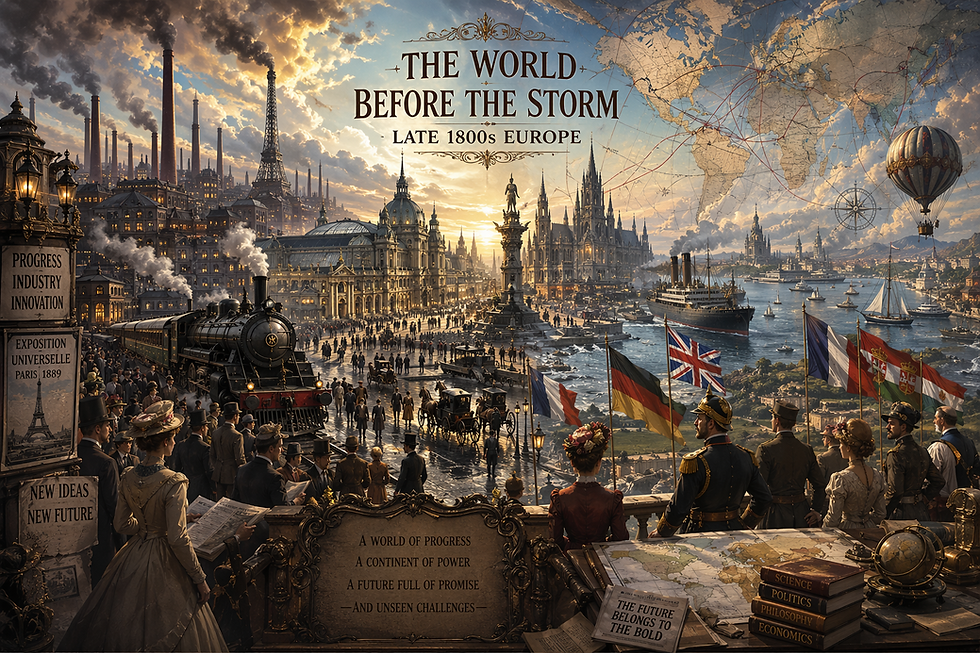
The Power of Industry and Wealth
This confidence was fueled by extraordinary economic strength. The Second Industrial Revolution transformed Europe into a powerhouse of production, with factories turning out steel, machinery, and goods at unprecedented levels. Railroads connected distant regions, allowing resources and products to move quickly across countries. Banks and financial institutions in cities like London and Paris financed projects around the world, giving Europe enormous economic reach. Wealth poured into European capitals, funding grand architecture, scientific research, and expanding middle classes who enjoyed new comforts and opportunities. The steady growth of industry made it seem as though prosperity would continue without end.
Faith in Progress and Science
At the heart of this age was a deep belief in progress. Scientific discoveries and technological innovations appeared to be improving life year after year. Electricity lit up cities, medical advancements reduced disease, and new inventions such as the telephone and telegraph brought people closer together. Many Europeans believed that reason, science, and education would solve society’s problems and lead humanity toward a brighter future. Schools expanded, literacy increased, and new ideas spread rapidly through newspapers and books. There was a widespread sense that civilization was advancing in a straight line—forward, upward, and unstoppable.
A Culture of Achievement and Pride
European culture during this time reflected this confidence. Art, music, literature, and philosophy flourished, often celebrating human creativity and national achievement. World’s fairs and international exhibitions showcased the latest inventions and cultural accomplishments, drawing millions of visitors who marveled at what seemed like limitless human potential. Nations took pride in their histories and identities, celebrating their achievements through monuments, museums, and public ceremonies. For many, this was not just an era of progress—it was proof that their nation had reached greatness.
Why War Seemed Unthinkable
Despite rivalries between nations, many Europeans believed that a large-scale war was unlikely. Trade connected economies so closely that conflict seemed too costly to risk. Diplomacy had managed disputes in the past, and leaders often assumed it would continue to do so. Advances in technology and communication also gave a false sense of control, as if modern systems could prevent chaos. Some even believed that the horrors of past wars had taught nations valuable lessons, making future conflict less likely. To many, war belonged to an older, less civilized past—not the modern, enlightened age they believed they were living in.
The Illusion of Stability
Yet beneath this confidence lay tensions that few fully understood or took seriously. While Europe appeared stable and prosperous, its foundations were more fragile than they seemed. The very forces that created strength—industrial power, national pride, and global influence—also carried hidden risks. But in this moment, at the height of its power, Europe saw itself as secure, advanced, and destined for continued greatness. It was an age filled with optimism, ambition, and belief in progress—an age that stood unknowingly on the edge of one of the most devastating conflicts in human history.
The Second Industrial Revolution Begins a New Age of PowerThe Second Industrial Revolution was a period of rapid transformation that reshaped Europe and the world in the late 1800s. Unlike the earlier industrial age driven by steam and textiles, this new era was powered by breakthroughs in steel, electricity, chemicals, and oil. These innovations did not just improve existing systems—they created entirely new industries and possibilities. Nations that embraced these changes surged ahead, building stronger economies and more advanced societies. For many Europeans, it felt like they were living in a time where human ingenuity had unlocked a new level of progress.
Steel, Electricity, Chemicals, and Oil Transform Society
Steel became the backbone of modern industry, replacing iron as the preferred material for building railways, bridges, skyscrapers, and machines. The ability to produce steel cheaply and in large quantities allowed cities to grow upward and outward at astonishing rates. At the same time, electricity revolutionized daily life and industry, powering factories, lighting streets, and making cities safer and more productive after dark. Chemical industries produced new dyes, medicines, and fertilizers, improving both manufacturing and agriculture. Meanwhile, oil emerged as a powerful new energy source, fueling engines and laying the groundwork for future transportation systems. Together, these four forces reshaped how people lived, worked, and moved.
The Rise of Factories and Mass Production
Factories became the heart of this new industrial world, growing larger, more organized, and more efficient than ever before. Instead of small workshops producing goods by hand, massive factories used machines to create products quickly and in great quantities. Assembly-line methods began to take shape, allowing workers to focus on specific tasks and dramatically increase output. This shift made goods more affordable and accessible to ordinary people, from clothing to tools to household items. Cities filled with the sounds of machinery, and millions of workers found employment in these expanding industrial centers. The pace of production and life itself seemed to accelerate.
Industrial Power and National Strength
As industries expanded, nations began to measure their strength not just by land or population, but by their industrial output. Countries with strong factories, advanced technology, and abundant resources gained economic influence and global importance. Rail networks connected regions, allowing goods to move quickly and efficiently, while ports and shipping industries linked nations to global markets. Industrial strength allowed governments to build infrastructure, support growing populations, and compete economically on the world stage. Nations like Germany and Britain rose as industrial leaders, their success demonstrating that economic power could shape a country’s place in the world just as much as tradition or territory.
A World Transformed by Innovation
The Second Industrial Revolution created a world that felt modern in ways previous generations could scarcely imagine. Cities glowed with electric light, factories produced goods at incredible speeds, and new industries offered opportunities that had never existed before. This period fostered a belief that progress was not only possible but inevitable—that each new invention would lead to an even better future. It was an age of energy, ambition, and rapid change, where innovation seemed to hold the key to limitless growth and success.
Urbanization and the Growth of Cities Transforms Everyday LifeThe growth of cities was one of the most dramatic changes of the late 1800s, as millions of people left the countryside behind in search of new opportunities. For generations, most Europeans had lived in rural villages, working the land and following traditional ways of life. But as factories expanded and industries grew, cities began to offer jobs, wages, and the promise of a different future. This movement from rural areas to urban centers reshaped society, concentrating populations in places that were rapidly evolving into hubs of industry, culture, and innovation.
A Great Migration from the Countryside
The pull of the city was powerful. Farms could no longer support growing populations, and industrial jobs promised more steady income than the uncertainties of agriculture. Young men and women, and often entire families, packed their belongings and traveled to cities like London, Paris, and Berlin. Railroads made these journeys faster and more accessible than ever before. For many, the city represented hope—a chance to escape poverty, gain independence, and build a better life. But this mass migration also meant that cities grew faster than they could handle.
Crowded Streets and Difficult Living Conditions
As populations surged, cities struggled to keep up. Housing was often cramped and poorly constructed, with entire families living in small, crowded rooms. Neighborhoods became densely packed, and sanitation systems lagged behind the rapid growth. Clean water was not always available, and waste often piled up in the streets, leading to the spread of disease. Factories, while offering employment, filled the air with smoke and pollution. Life in the city could be harsh, especially for the working class, who faced long hours, low wages, and challenging conditions both at work and at home.
New Social Realities and Changing Communities
Urban life brought people from different regions, cultures, and backgrounds together in ways that had never happened before. This created both opportunity and tension. New communities formed, and workers began to share experiences and organize for better conditions. At the same time, the gap between the wealthy and the poor became more visible than ever. Grand homes and elegant districts stood just blocks away from overcrowded slums. These contrasts forced societies to confront questions about fairness, responsibility, and the role of government in improving living conditions.
The Rise of Modern City Life
Despite its challenges, the city also became a place of excitement and possibility. Electric lights illuminated streets at night, public transportation made it easier to move around, and entertainment such as theaters, music halls, and cafés offered new ways to spend time. Newspapers spread information quickly, connecting people to events happening across the country and the world. Cities became centers of culture, education, and innovation, shaping trends that would influence entire nations. For many, urban life represented the future—a fast-paced, ever-changing world full of opportunity.
A New Way of Living
Urbanization did more than move people from one place to another—it changed how they lived, worked, and thought about their place in society. The rhythms of city life replaced the slower pace of the countryside, and individuals found themselves part of a larger, more complex world. While the challenges were real, the transformation of cities marked the beginning of modern life as we know it today, setting the stage for the social and economic developments that would define the 20th century.
New Social Classes and Changing Lifestyles Reshape SocietyOld social structures, once dominated by landowning elites and rural peasants, began to shift as new groups rose and others struggled to adapt. Cities became places where class could be seen in daily life, from elegant neighborhoods to crowded tenements. For the first time, large numbers of people found themselves part of new social identities shaped not by birth alone, but by occupation, income, and opportunity.
The Expansion of the Middle Class
One of the most significant changes was the rapid growth of the middle class. Professionals, business owners, managers, teachers, and clerks found themselves in a new and expanding social group that benefited directly from industrial and economic growth. This class valued education, stability, and respectability, often striving to improve their status through hard work and discipline. Middle-class families enjoyed better housing, access to consumer goods, and more leisure time than ever before. They played a key role in shaping culture, supporting schools, reading newspapers, and participating in civic life. Their influence grew steadily, helping redefine what it meant to succeed in modern society.
The Reality of the Industrial Working Class
In contrast, the industrial working class faced a far more difficult reality. Millions of men, women, and even children worked long hours in factories, often under harsh and dangerous conditions. Wages were low, job security was uncertain, and workplace safety was limited. Many workers lived in overcrowded urban housing, where poverty and disease were constant concerns. Despite these challenges, the working class became an essential part of the industrial system, powering the factories that drove economic growth. Over time, shared hardships began to unite workers, leading to early efforts to organize for better wages, shorter hours, and improved conditions.
A Growing Gap Between Rich and Poor
As wealth increased across Europe, it did not spread evenly. Industrial leaders and wealthy business owners accumulated vast fortunes, living in luxury and enjoying comforts far beyond what most people could imagine. At the same time, many workers struggled to meet basic needs. This growing gap between rich and poor became one of the most visible features of urban life. Grand buildings, fine clothing, and extravagant lifestyles stood in sharp contrast to the crowded neighborhoods and difficult lives of the working class. These differences raised important questions about fairness, opportunity, and the responsibilities of those with wealth and power.
Rising Tensions and New Ideas
The differences between social classes did not go unnoticed. As people became more aware of inequality, tensions began to rise. Workers demanded change, while governments and reformers debated how to respond. New ideas about society, fairness, and economic systems began to spread, challenging traditional views about wealth and power. Some believed that hard work would eventually bring improvement, while others argued that deeper changes were needed to create a more balanced society. These debates reflected a world in transition, where old systems were being questioned and new possibilities were being explored.
A Society in Transition
The emergence of new social classes and changing lifestyles marked a turning point in European history. People no longer lived within the same clear social boundaries that had existed for centuries. Instead, society became more complex, dynamic, and, at times, divided. While the middle class grew in confidence and influence, the struggles of the working class highlighted the challenges of rapid industrial change. Together, these shifts created a society full of opportunity, tension, and transformation—one that would continue to evolve as Europe moved closer to the challenges of the twentieth century.
The Rise of Modern Technology and Communication Connects a New WorldFor centuries, distance had limited how quickly people, goods, and ideas could travel. Now, new inventions began to shrink the world. Messages that once took days or weeks to deliver could suddenly arrive in minutes, and journeys that once required long, difficult travel became far more efficient. These changes did not just improve life—they reshaped how people thought, interacted, and understood the world around them.
Railroads: The Engines of Movement
Railroads became the backbone of this new era of connection. Expanding rapidly across Europe, they linked cities, towns, and rural areas into a vast network of movement. Goods could be transported quickly from factories to markets, and people could travel for work, trade, or leisure with greater ease than ever before. Railways also helped unify nations by connecting distant regions and encouraging economic cooperation. Time itself became more organized, as standardized time zones were introduced to keep trains running on schedule. The railroad was more than transportation—it was a symbol of progress and national strength.
Telegraphs and Telephones: Instant Communication
While railroads moved people and products, the telegraph and telephone revolutionized communication. The telegraph allowed messages to be sent across long distances using electrical signals, often in a matter of minutes. Governments, businesses, and newspapers relied on it to share information quickly and efficiently. Soon after, the telephone brought an even more personal form of communication, allowing voices to travel across wires and connect people directly. These inventions changed how decisions were made, how news spread, and how people stayed in contact. Distance no longer meant silence.
Newspapers and the Rise of Mass Media
As communication improved, newspapers became a powerful force in everyday life. Advances in printing technology made newspapers cheaper and easier to produce, allowing them to reach larger audiences than ever before. Millions of people began reading daily news, learning about events not only in their own cities but across Europe and the world. Journalists reported on politics, industry, culture, and international affairs, shaping how people understood current events. Newspapers also gave a voice to public opinion, influencing governments and sparking debates among readers.
The Rapid Spread of Ideas and Information
With faster transportation and communication, ideas spread more quickly than ever before. New inventions, political movements, scientific discoveries, and cultural trends could move across borders with surprising speed. A speech given in one city could be reported in newspapers across the continent within a day. Innovations in one country could inspire change in another. This rapid exchange of information created a more informed and connected population, but it also meant that tensions, disagreements, and competing ideas could spread just as quickly.
A World Drawn Closer Together
The rise of modern technology and communication brought Europe into a new age where distance mattered less and connection mattered more. People became part of a broader world, aware of events far beyond their immediate surroundings. While these advances made life more efficient and exciting, they also created a faster-paced society where change seemed constant. This new level of connection would play an important role in shaping the future, as information and ideas continued to move across borders at unprecedented speeds.
Education, Literacy, and Mass Culture Shape a New SocietyAs nations modernized, leaders recognized that an educated population was essential for economic growth, national unity, and social stability. Schools expanded, literacy increased, and for the first time in history, large portions of the population could read, write, and engage with ideas beyond their immediate surroundings. This shift helped create a more connected and informed society.
The Expansion of Public Education
Governments across Europe began investing heavily in public education, making schooling more widely available and, in many places, mandatory for children. New school systems were designed not only to teach reading and writing but also to instill discipline, civic responsibility, and a sense of national identity. Classrooms became more standardized, with trained teachers, organized curricula, and structured schedules. For many children, education opened doors that had never existed before, offering opportunities for advancement and participation in a rapidly changing world.
Rising Literacy and New Opportunities
As access to education grew, literacy rates rose dramatically. More people than ever before could read books, understand written instructions, and communicate through writing. This change had a profound impact on daily life, allowing individuals to access information, pursue skilled jobs, and participate in public discussions. Literacy empowered the middle and working classes, giving them tools to improve their circumstances and engage with the wider world. It also created a demand for printed material, fueling the growth of publishing and media industries.
The Power of Newspapers and Books
With more people able to read, newspapers and books became central to everyday life. Newspapers provided regular updates on local, national, and international events, helping people stay informed about politics, economics, and culture. Books, ranging from novels to educational texts, offered both entertainment and knowledge. Authors gained wide audiences, and their ideas could influence how people thought about society, government, and the future. Print culture helped spread information quickly and created shared experiences among readers across entire nations.
Entertainment and the Rise of Mass Culture
Beyond education and news, a new form of mass culture began to emerge. Theaters, music halls, and public performances became popular forms of entertainment, drawing crowds from different social classes. Magazines, serialized novels, and popular literature reached audiences hungry for stories and ideas. These shared forms of entertainment helped create a common cultural experience, where people across a nation could enjoy the same performances, read the same stories, and discuss the same events. Culture was no longer limited to elites—it became something widely shared.
A More Connected and Informed Population
The growth of education, literacy, and mass culture brought people together in new ways. Individuals who might once have lived isolated lives now shared knowledge, ideas, and cultural experiences with millions of others. This created a stronger sense of national identity and awareness, as people began to see themselves as part of a larger community. At the same time, the spread of information and ideas encouraged debate, curiosity, and change. Europe was becoming not only more educated, but more connected—setting the stage for the powerful movements and challenges of the 20th century.
Political Systems Across Europe Balance Tradition and ChangeWhile the continent appeared stable on the surface, it was governed by a wide variety of systems, each reflecting different histories and values. Some nations moved toward greater participation by their citizens, while others held tightly to long-standing systems of control. This diversity created a political landscape that was both dynamic and fragile, as countries tried to adapt to a rapidly changing world.
Democracies, Monarchies, and Empires
Across Europe, governments took several forms. Countries like Britain and France had developed systems that allowed citizens a growing voice in government, though participation was still limited in many ways. Monarchies remained common, with kings and queens serving as heads of state, sometimes sharing power with elected bodies. At the same time, large empires such as Austria-Hungary, Russia, and the Ottoman Empire governed vast and diverse populations under centralized authority. These empires often ruled over many different ethnic and cultural groups, making governance more complicated and, at times, unstable.
Parliamentary Systems and Autocratic Rule
In some parts of Europe, parliamentary systems were gaining strength. Elected representatives debated laws, influenced policy, and, in some cases, held significant power over national decisions. Britain stood as a leading example, where Parliament played a central role in governance. In contrast, other nations maintained more autocratic systems, where rulers held most or all political power. In Russia, for example, the tsar governed with limited constraints, making decisions without broad public input. These differences shaped how countries responded to challenges and how their citizens experienced political life.
The Appearance of Stability
To many observers, Europe seemed politically stable during this period. Governments functioned, economies grew, and daily life continued without major disruptions in most countries. Diplomatic relationships helped manage conflicts between nations, and many believed that existing systems were strong enough to handle future challenges. Leaders often projected confidence, and citizens adapted to the structures that governed them. This outward sense of order gave the impression that Europe had achieved a lasting balance.
Hidden Tensions Beneath the Surface
Beneath this stability, however, tensions were quietly building. In empires, diverse populations sometimes resisted centralized control, seeking greater autonomy or recognition. In more democratic systems, citizens pushed for expanded rights and reforms, challenging existing power structures. Differences between political systems also created misunderstandings and rivalries between nations. While these issues did not always lead to immediate conflict, they revealed that Europe’s political systems were under pressure. The balance that seemed so secure was, in reality, more delicate than it appeared.
A Continent at a Crossroads
Political systems across Europe reflected a continent in transition, caught between tradition and transformation. Some nations moved toward broader participation and reform, while others resisted change and held tightly to established authority. This mixture of systems created both strength and uncertainty, as Europe faced the challenges of modernization. Though many believed their governments were stable and enduring, the underlying tensions suggested that change was not only possible—it was inevitable.
The Great European Empires at a Glance Reveals a World of Power & Complexity
These nations stood at the height of influence, controlling vast lands, populations, and resources. Yet beneath their strength lay differences in structure, culture, and stability. Each empire or nation carried its own advantages and internal challenges, creating a continent that was powerful but far from uniform.
Britain: The Global Empire
The United Kingdom stood as the world’s leading global power, with an empire that stretched across continents. Its strength lay in its powerful navy, advanced industry, and global trade networks. Governed by a constitutional system, it balanced monarchy with parliamentary authority. However, its vast empire required constant management, and tensions existed both abroad and within its own territories. Its diversity was global, encompassing people from many cultures, languages, and traditions under British rule.
France: A Republic of Influence
France combined strong cultural influence with a growing colonial presence. As a republic, it emphasized national identity and civic participation, though political instability had marked much of its recent past. France’s strengths included its military tradition, cultural leadership, and expanding economy. Internally, it was more unified than some empires, but divisions over politics and identity remained part of its national story.
Germany: A Rising Industrial Power
German Empire was one of the newest major powers, unified in 1871 and rapidly becoming an industrial and economic leader. Its strength came from advanced industry, education, and efficient organization. Governed by a strong central authority under a Kaiser, it combined elements of modern governance with traditional monarchy. While largely unified culturally, it still contained regional differences, and its rapid growth brought both confidence and pressure.
Austria-Hungary: A Multi-Ethnic Empire
The Austria-Hungary was a complex empire made up of many different ethnic groups, languages, and cultures. Governed as a dual monarchy, it attempted to balance power between Austria and Hungary while ruling over diverse populations. Its strength lay in its long history and central location in Europe, but its diversity also created challenges. Different groups often had competing interests, making unity difficult to maintain.
Russia: Vast and Powerful, Yet Uneven
Russian Empire was the largest empire in Europe, stretching across vast territories with immense natural resources. Ruled by an autocratic tsar, it maintained strong centralized control. Its size and population were major strengths, but its economy and infrastructure lagged behind more industrialized nations. The empire included many different ethnic and cultural groups, adding to its complexity and making governance more difficult.
The Ottoman Empire: A Legacy of Centuries
The Ottoman Empire was one of the oldest empires, with a long history of influence across Europe, Asia, and Africa. By the late 1800s, it still controlled important territories but faced internal and external pressures. Its strength came from its strategic location and historical legacy, but it struggled with modernization and maintaining control over its diverse population. The empire included many religions, languages, and cultures, making it one of the most diverse political entities of its time.
A Continent of Strength and Strain
Together, these empires and nations formed the backbone of European power. Each possessed unique strengths—industrial might, global reach, cultural influence, or sheer size—but also faced internal challenges that tested their stability. Diversity, rapid change, and the demands of modern governance created pressures that were not always visible at first glance. While Europe appeared dominant and confident, these underlying complexities would play an important role in shaping its future.
National Identity and Cultural Pride Shapes a Shared Sense of Belonging
As nations modernized, individuals began to identify more strongly with their country—its language, traditions, and shared history. This growing sense of belonging united people who might never meet but who felt connected through common symbols, stories, and values. It was a time when nations were not just political boundaries, but living identities that people embraced with growing enthusiasm.
The Growth of Language and National Traditions
Language played a central role in shaping national identity. Governments and educators promoted a common language to unify populations, especially in regions where many dialects or languages had once existed. Schools taught children to read, write, and speak in the national language, helping to create a shared way of communication. At the same time, traditional customs, holidays, music, and dress were celebrated and preserved as symbols of national culture. Folk traditions that had once been local were now seen as part of a broader national heritage, connecting people across regions.
Pride in History and Achievement
As national identity grew, so did pride in each country’s past and accomplishments. Nations looked back on their histories—victories, leaders, cultural achievements—and used these stories to inspire unity and confidence. Monuments were built, museums expanded, and public ceremonies honored important events and figures. Citizens were encouraged to take pride in their country’s contributions to art, science, industry, and exploration. This pride helped strengthen loyalty and gave people a sense that they were part of a successful and meaningful story.
Shared Culture Across Society
New forms of communication and education helped spread culture more widely than ever before. Newspapers, books, and public performances allowed people across a nation to experience the same stories, ideas, and entertainment. A play performed in one city could become popular across an entire country, and a novel could be read by thousands who shared the same language and cultural references. This shared culture created a sense of unity, as people from different regions began to see themselves as part of a common national experience.
Unity Within Diversity
Even within unified nations, diversity still existed in the form of regional customs, accents, and traditions. However, rather than dividing people, these differences were often embraced as part of the richness of national culture. Citizens could celebrate both their local identities and their connection to the larger nation. This balance helped strengthen the idea that a nation could be both diverse and united, drawing strength from its variety while maintaining a shared sense of purpose.
A Stronger Sense of Belonging
The rise of national identity and cultural pride created societies that felt more connected and self-aware than ever before. People were no longer just residents of a village or city—they were citizens of a nation with a shared language, history, and culture. This growing sense of belonging brought confidence and unity, helping nations present themselves as strong and cohesive. It was a powerful force that shaped how people saw themselves and their place in the world, setting the stage for the events that would soon test that unity.
Life in Multi-Ethnic Empires Reveals a World of Diversity and Complexity
Life in Multi-Ethnic Empires in the late 1800s was shaped by the experience of living among many different peoples, languages, and traditions under a single government. Empires such as Austria-Hungary, the Ottoman Empire, and the Russian Empire governed vast territories filled with diverse populations. Unlike more unified nations, these empires were made up of groups with their own histories, customs, and identities. This created societies that were rich in culture but often complicated to manage, as rulers sought to maintain order across wide and varied lands.
A Tapestry of Languages and Cultures
Within these empires, daily life often involved interaction with people from different cultural backgrounds. In Austria-Hungary, Germans, Hungarians, Czechs, Slovaks, Croats, and many others lived within the same borders, each speaking their own language and preserving their traditions. The Ottoman Empire stretched across regions where Turkish, Arabic, Greek, and many other languages were spoken, while the Russian Empire included Slavic peoples alongside numerous ethnic groups from Eastern Europe and Asia. Markets, cities, and trade routes became places where cultures met, mixed, and influenced one another, creating vibrant and diverse communities.
Governance Across Diversity
Ruling over such diversity required careful balance. Leaders often allowed local customs and traditions to continue while maintaining central authority. In some areas, local leaders helped govern communities, preserving order while respecting cultural differences. However, this system could also create challenges, as not all groups felt equally represented or treated. Laws, languages, and administrative systems sometimes favored certain groups over others, adding layers of complexity to governance. Despite these difficulties, these empires managed to function for decades, holding together populations that might otherwise have been divided.
Daily Life in a Shared Empire
For ordinary people, life in these empires could feel both familiar and unique. In rural areas, traditions remained strong, with communities following long-established customs tied to religion, language, and local culture. In cities, diversity was more visible, as people from different backgrounds lived and worked side by side. Markets offered goods from across the empire, and festivals reflected a mix of cultural influences. While differences sometimes created tension, they also enriched daily life, exposing people to new ideas, foods, and ways of living.
Opportunities and Challenges of Diversity
Living in a multi-ethnic empire offered opportunities for trade, cultural exchange, and shared growth. At the same time, differences in language, religion, and identity could create misunderstandings or disagreements. Balancing unity with diversity was a constant challenge for both leaders and citizens. Some people embraced the mix of cultures as a strength, while others felt a stronger connection to their own group. These differing perspectives shaped how people experienced life within the empire.
A Complex and Changing World
Life in multi-ethnic empires reflected a world that was both interconnected and divided. These vast political systems brought together a wide range of peoples under one rule, creating societies full of cultural richness and complexity. While they offered stability and shared opportunity, they also required constant effort to maintain balance. As Europe moved toward the twentieth century, the unique challenges and strengths of these empires would play an important role in shaping the future of the continent.
The Role of Religion in European Society Shapes Belief and Identity
For centuries, Christianity had guided not only personal belief but also education, law, and government. By this time, Europe was divided primarily among Catholic, Protestant, and Orthodox traditions, each with its own history, practices, and areas of influence. Religion continued to shape how people understood morality, community, and their place in the world, even as its role began to evolve.
Christian Traditions Across Europe
Different regions of Europe were strongly connected to particular branches of Christianity. Catholicism remained dominant in countries like France, Italy, and parts of Austria-Hungary, with the Church playing a visible role in both public and private life. Protestant traditions were widespread in Britain, northern Germany, and Scandinavia, often emphasizing individual reading of scripture and local church governance. In Eastern Europe and Russia, Orthodox Christianity formed a central part of cultural and national identity, closely tied to long-standing traditions. These religious divisions were not just about belief—they influenced culture, education, and community life across the continent.
Religion in Daily Life and Community
For many Europeans, religion was woven into the rhythm of everyday life. Church attendance, religious holidays, and community gatherings were regular parts of the weekly and yearly calendar. Births, marriages, and deaths were often marked by religious ceremonies, reinforcing the Church’s presence in personal milestones. Religious teachings influenced moral values, family life, and social expectations. In both rural villages and growing cities, churches often served as centers of community life, offering not only spiritual guidance but also support and connection among neighbors.
Religion and Political Influence
Religion also played a role in politics, though its influence varied by region. In some countries, religious institutions maintained strong connections to government, shaping laws and public policy. Leaders often worked closely with religious authorities, and in certain cases, rulers were seen as defenders of the faith. In other areas, movements toward more secular governments began to reduce the direct power of religious institutions in political affairs. Debates over education, law, and public life sometimes reflected tensions between religious traditions and newer, more secular ideas about governance.
Changing Influence in a Modern Age
As Europe advanced scientifically and industrially, the influence of religion began to shift. In many urban and industrial regions, people placed greater emphasis on science, reason, and new ways of thinking, leading to a gradual decline in religious influence in some areas. At the same time, in rural communities and more traditional societies, religion remained a strong and central force. This created a contrast across Europe, where some regions embraced secular ideas while others held firmly to long-standing religious traditions.
A Lasting Presence in a Changing World
Despite these changes, religion continued to play a significant role in European society. It shaped identities, guided communities, and influenced how people understood right and wrong. Even as new ideas emerged and societies modernized, the legacy of Christianity remained deeply rooted in culture and tradition. The balance between faith and modern thought became an important part of Europe’s transformation, reflecting a continent navigating between its past and its future.
Intellectual Movements and New Ideas Challenge the Future of Society
The rapid changes brought by industrialization, urban growth, and expanding education led many to ask new questions about fairness, power, and the role of government. Ideas were no longer limited to small groups of elites—they spread through newspapers, books, and public debates, reaching a wide and curious audience eager to understand the future.
Socialism, Liberalism, and Conservatism Take Shape
Several major political and social ideas began to define these debates. Socialism focused on the challenges faced by the working class, arguing that wealth and resources should be more evenly distributed to create a fairer society. Liberalism emphasized individual rights, freedoms, and the importance of representative government, building on earlier ideas about liberty and equality. Conservatism, on the other hand, sought to preserve tradition, stability, and established institutions, valuing gradual change over rapid transformation. These ideas were not always clearly separated, but together they formed the foundation of many discussions about how society should move forward.
Thinkers and Public Debate
Across Europe, intellectuals and political leaders engaged in lively debates about the direction of their nations. Writers and philosophers published works that questioned existing systems and proposed new ways of organizing society. Public speeches, political gatherings, and printed materials allowed these ideas to reach growing audiences. People from different backgrounds—workers, professionals, and leaders—began to take part in discussions that had once been limited to a small group. This exchange of ideas helped shape public opinion and encouraged individuals to think critically about the world around them.
Competing Visions for the Future
These intellectual movements offered competing visions of what the future should look like. Some believed that expanding rights and opportunities would lead to a more just and prosperous society. Others worried that too much change could weaken stability and tradition. Still others focused on addressing inequality and improving conditions for those who struggled most. These different perspectives did not always agree, but they reflected a shared belief that society could be improved. The question was not whether change would come, but what form it would take.
A Continent of Ideas in Motion
Europe in this period was not only a place of industrial and economic growth—it was a center of intellectual energy. New ideas moved quickly across borders, influencing governments, shaping policies, and inspiring individuals. The debates of this era did not remain in books or speeches; they became part of everyday life, affecting how people viewed their rights, responsibilities, and possibilities. This was a time when the future felt open to discussion, and when ideas had the power to shape the path forward for entire nations.
Women, Family, and Changing Roles Redefine SocietyFor generations, women’s roles had been centered on the home, family life, and community responsibilities. While these roles remained important, the rapid changes brought by industrialization, urbanization, and education opened new possibilities. Society did not change all at once, but the foundations were beginning to move, creating a period of transition that would shape the future.
Tradition and the Expectations of Family Life
In most parts of Europe, traditional expectations still guided daily life. Women were often expected to manage households, raise children, and support their families, while men typically worked outside the home. These roles were reinforced by cultural norms, religion, and law. Family life was seen as the center of stability, and many believed that maintaining these roles was essential to preserving order in society. Even as change began to emerge, these expectations remained strong, especially in rural areas and more traditional communities.
Expanding Education and New Opportunities
One of the most important changes came through education. As public schooling expanded, more girls gained access to basic education, learning to read, write, and develop new skills. In some regions, opportunities for higher education began to open, allowing women to pursue advanced studies in fields such as teaching and medicine. Education provided new pathways for women to contribute beyond the home, and it encouraged greater independence and awareness of the wider world. These changes, though gradual, marked an important step toward expanding roles in society.
Women in the Workforce
Industrial growth also brought women into the workforce in increasing numbers. Factories, offices, and service industries offered employment opportunities, though often with lower wages and fewer protections than men received. Women worked as factory laborers, domestic servants, teachers, and clerks, helping support their families and contributing to the growing economy. While these jobs could be demanding, they also allowed women to gain experience, earn income, and become more visible in public life. The presence of women in the workforce began to challenge traditional ideas about their roles.
The Early Women’s Rights Movements
As opportunities expanded, some women began to organize and advocate for greater rights. Early movements called for improved working conditions, access to education, and greater legal protections. In some countries, women also began to push for the right to vote and participate more fully in government. These movements were often led by determined individuals who believed that society could be fairer and more inclusive. While progress was slow and faced resistance, these early efforts laid the groundwork for future change.
A Society in Transition
The changing roles of women reflected a broader transformation taking place across Europe. Tradition and change existed side by side, sometimes in harmony and sometimes in tension. Families adapted to new realities, and society gradually adjusted to expanding opportunities. While the full impact of these changes would not be realized for many years, the late 1800s marked the beginning of a shift that would reshape the roles of women and redefine the structure of family and society in the modern world.
A World Connected: Europe and the Global System Links Continents and Peoples
Advances in transportation and communication allowed goods, people, and ideas to move across oceans faster than ever before. European nations were deeply involved in global trade, shaping markets and influencing distant regions. This growing interconnectedness created a world that felt smaller, more dynamic, and increasingly dependent on shared systems.
Trade Networks and Expanding Influence
European economies were driven by complex trade networks that stretched across the globe. Raw materials such as cotton, rubber, and minerals flowed into Europe, where factories transformed them into finished goods. These products were then shipped back out to markets around the world. Major ports like those in London and Liverpool became bustling centers of commerce, handling goods from distant lands. Banks and financial institutions supported this system, providing the capital needed to expand trade and industry. Through these networks, Europe played a central role in shaping global economic activity.
The Movement of People Across OceansAt the same time, millions of Europeans left their homelands in search of new opportunities. Economic challenges, population growth, and the promise of land and work encouraged people to migrate, especially to the United States and other parts of the Americas. Steamships made these journeys faster and more reliable, allowing families to cross the Atlantic in days rather than weeks. These migrants carried their languages, traditions, and skills with them, helping shape the societies they joined while maintaining connections to their European roots.
Cultural Exchange and Shared Ideas
As goods and people moved across the globe, so did ideas and cultural influences. European languages, education systems, and cultural practices spread widely, influencing societies far beyond the continent. At the same time, Europe absorbed ideas, foods, and cultural elements from other parts of the world. This exchange created a more connected global culture, where influences could travel quickly and shape societies in new ways. Communication technologies ensured that news and innovations did not remain isolated but became part of a shared global experience.
Shaping the Modern World
Europe’s central role in global systems helped lay the foundations of the modern world. International trade, migration patterns, and cultural exchange created connections that continue to influence global relationships today. European institutions, technologies, and economic practices became models adopted in many regions. While this influence brought growth and opportunity, it also created dependencies and lasting connections between nations. The systems built during this time did not disappear—they evolved, becoming part of the global structure we recognize today.
A Connected World on the Edge of Change
By the early 1900s, Europe had helped create a world more interconnected than ever before. Goods,
people, and ideas moved across continents with increasing speed, linking distant places into a shared system. This level of connection brought opportunity and growth, but it also meant that events in one part of the world could have far-reaching effects elsewhere. Europe stood at the center of this global web, confident in its position, yet unknowingly part of a system that would soon be tested by the challenges ahead.
Global Events Shaping Europe Before the Storm Reveals a Connected Age
While Europe appeared confident and powerful, events across the globe were shaping its economy, ideas, and future in profound ways. From rising powers in Asia to transformations in the Americas and Africa, the world was changing rapidly—and these changes fed directly into Europe’s sense of strength, competition, and uncertainty.
The Rise of the United States as an Industrial Power
The United States experienced rapid industrial growth after its Civil War, becoming one of the world’s leading economic powers by the late 1800s. Its factories, railroads, and natural resources allowed it to compete with European industries. This rise challenged Europe’s economic dominance and created new competition in global markets. At the same time, millions of European immigrants moved to the United States, relieving population pressures in Europe but also drawing away labor and talent.
The Meiji Restoration and Japan’s Modernization (1868 onward)
In Japan, the Meiji Restoration transformed a once-isolated society into a rapidly modernizing industrial and military power. Japan adopted Western technologies, education systems, and industrial practices, quickly becoming competitive with European nations. This development showed that non-European countries could modernize successfully, challenging the belief that Europe alone would dominate the future. It also introduced a new player into global economic and political systems.
The Opening of Global Trade Routes and the Suez Canal (1869)
The completion of the Suez Canal dramatically shortened the travel distance between Europe and Asia. Goods, people, and information could move faster than ever before, strengthening Europe’s global trade networks. This increased access to resources and markets boosted European economies and reinforced their global influence. At the same time, it made Europe more dependent on global stability, as disruptions in distant regions could now affect European trade more directly.
The Scramble for Africa (Late 1800s)
European nations rapidly expanded their control across Africa during the Scramble for Africa, dividing the continent among themselves. This expansion provided access to raw materials and new markets, fueling industrial growth back in Europe. However, it also increased competition between European powers, as nations sought to expand their influence. While this period reinforced Europe’s sense of dominance, it also heightened rivalries that would later contribute to tensions on the continent.
Latin American Economic Integration and Independence Movements
Countries across Latin America had gained independence earlier in the 1800s but remained economically tied to Europe through trade. They exported raw materials and agricultural goods while importing European manufactured products. This relationship strengthened European economies and reinforced global trade systems. At the same time, political developments in these regions showed that European-style governance and independence movements could spread beyond Europe itself.
The Decline of the Ottoman Empire
The weakening of the Ottoman Empire affected the balance of power across Europe and the Middle East. As the empire struggled to maintain control over its territories, new political questions arose about who would influence these regions. This created uncertainty and competition among European powers, even if it was not yet openly leading to conflict. The decline of such a long-standing empire signaled that even powerful systems could weaken over time.
Migration and Global Population Movement
Mass migration reshaped societies across the world. Millions of Europeans moved to the Americas, Australia, and other regions in search of opportunity. This movement spread European languages, cultures, and traditions globally, while also easing social pressures at home. However, it also connected Europe more closely to global developments, as families, businesses, and economies became linked across continents.
Scientific and Technological Exchanges Worldwide
Scientific discoveries and technological innovations were not confined to one country—they spread across borders and continents. Advances in medicine, engineering, and communication moved quickly between nations, allowing Europe to adopt and improve upon new ideas. This global exchange reinforced the belief in progress and innovation, while also increasing competition as nations sought to stay ahead.
A Global System Shaping Europe’s Future
The events unfolding around the world in the late 1800s helped shape Europe’s confidence and its challenges. Economic competition, global trade, migration, and rising powers all influenced how European nations viewed themselves and their place in the world. While Europe stood at the center of this global system, it was also deeply affected by it. The world was becoming more connected than ever before—and that connection would play a critical role in the events that were soon to come.
Most Important People During The World Before the Storm
The Most Important People During The World Before the Storm were individuals who helped build, guide, and challenge the powerful Europe of the late 1800s. These leaders, thinkers, reformers, and innovators did not know a world war was coming, yet their decisions, ideas, and influence helped shape the society that stood on the edge of dramatic change. From rulers of empires to voices calling for reform, these figures reveal a continent full of ambition, confidence, and growing tension.
Otto von Bismarck – The Architect of a New Germany
Otto von Bismarck was the powerful chancellor who unified Germany in 1871 and helped turn it into one of Europe’s strongest nations. Known for his skillful diplomacy and strategic thinking, he maintained stability in Europe through careful balancing of power. Bismarck also introduced social welfare programs to strengthen the state and reduce unrest. His leadership helped create a powerful Germany, but after his removal in 1890, the system he built began to shift, leaving Europe less stable.
Queen Victoria – Symbol of an Expanding Empire
Queen Victoria ruled the United Kingdom during a period of immense growth and global influence. Her reign, known as the Victorian Era, saw Britain become the world’s leading industrial and imperial power. While her political authority was limited, she became a powerful symbol of national unity and stability. Under her reign, Britain expanded its global reach, and her image represented confidence, tradition, and progress.
Kaiser Wilhelm II – A New and Assertive Leader
Kaiser Wilhelm II became Germany’s emperor in 1888 and took a more aggressive approach to leadership than Bismarck. He believed strongly in Germany’s future as a world power and sought to expand its influence. His leadership style was bold and often unpredictable, contributing to a shift in how Germany interacted with other nations. His actions reflected the growing confidence—and ambition—of the era.
Tsar Nicholas II – Ruler of a Vast but Strained Empire
Tsar Nicholas II ruled over the enormous Russian Empire during a time of growing change and pressure. While deeply committed to maintaining traditional authority, he struggled to manage the demands of modernization and reform. His reign highlighted the contrast between old systems of rule and the new forces shaping Europe. The challenges faced during his leadership revealed the difficulties of governing such a vast and diverse empire.
Empress Elisabeth of Austria – A Voice Within a Complex Empire
Empress Elisabeth, often known as Sisi, was a prominent figure within Austria-Hungary. Though not directly involved in politics, she became a symbol of the empire’s cultural life and its internal struggles. She supported Hungarian interests within the empire and reflected the tensions of a multi-ethnic society trying to remain united. Her life showed both the elegance and the challenges of imperial life.
Karl Marx – A Thinker Who Challenged Society
Karl Marx was a philosopher and writer whose ideas about class, labor, and economics influenced debates across Europe. Though he died in 1883, his writings continued to shape how people thought about industrial society and inequality. His work inspired discussions about fairness, workers’ rights, and the structure of society, making him one of the most influential thinkers of the era.
John Stuart Mill – Advocate for Liberty and Reform
John Stuart Mill was a leading voice in liberal thought, emphasizing individual freedom, representative government, and social progress. He also supported women’s rights and argued for greater equality in society. His ideas helped shape political discussions about rights and governance, influencing both leaders and citizens during a time of rapid change.
Florence Nightingale – Transforming Care and Public Health
Florence Nightingale revolutionized nursing and healthcare, emphasizing sanitation, organization, and professional training. Her work during and after the Crimean War led to major improvements in hospitals and public health systems. Her influence extended beyond medicine, showing how individuals could improve society through knowledge and dedication.
Emmeline Pankhurst – A Voice for Women’s Rights
Emmeline Pankhurst was a leading figure in the early women’s rights movement. She campaigned for women’s suffrage and greater equality, organizing efforts that brought attention to the issue across Britain and beyond. Her work represented the growing push for change in traditional roles and helped lay the foundation for future reforms.
Louis Pasteur – Advancing Science and Medicine
Louis Pasteur made groundbreaking discoveries in microbiology, leading to advances in medicine and public health. His work on germ theory helped people understand how diseases spread and how they could be prevented. These discoveries improved life expectancy and strengthened the belief in science as a force for progress.
Lessons from The World Before the Storm Reveal the Dangers of Overconfidence
Progress Does Not Eliminate Human Conflict
This period teaches that technological and scientific progress does not automatically solve deeper human challenges. Europe had advanced industries, modern communication, and improved education, yet tensions still existed within and between societies. Differences in culture, beliefs, and priorities remained, even in a modernizing world. The thought process to take from this is that progress in tools and systems must be matched by growth in understanding, cooperation, and wisdom.
Strength Can Create Pressure, Not Just Stability
Industrial power and economic success made European nations stronger, but they also created new forms of pressure. Competition increased, expectations rose, and nations sought to maintain or expand their position. This teaches that strength is not always calming—it can lead to rivalry and comparison. Individuals and societies must learn to handle success carefully, recognizing that growth brings responsibility and potential tension.
Unity Requires Effort, Not Assumption
Across Europe, people developed strong national identities and shared cultures, but unity was not always as solid as it appeared. Differences in language, class, and belief still existed, even within unified nations. In multi-ethnic empires, these differences were even more visible. The lesson is that unity must be actively maintained through understanding and fairness. It cannot simply be assumed because people live under the same system.
Ideas Shape the Future as Much as Actions
The spread of new ideas—about government, society, and fairness—shows how powerful thought can be. Debates about socialism, liberalism, and tradition influenced how people saw the world and what they expected from it. These ideas did not immediately change everything, but they shaped the direction of future events. This teaches that the way people think today will influence the world of tomorrow, making it important to engage thoughtfully with new ideas.
Change Brings Opportunity and Challenge
The rapid transformations of the late 1800s created new opportunities in industry, education, and daily life. At the same time, they introduced challenges such as inequality, urban crowding, and social tension. The key lesson is that change is rarely purely positive or negative—it brings both. A thoughtful approach requires recognizing both sides and preparing to respond wisely.
Vocabulary to Learn While Studyingthe World Before the Storm (Late 1800s)
1. Industrialization
Definition: The process of developing industries and factories on a wide scale.Sentence: Industrialization transformed European economies by shifting work from farms to factories.
2. Urbanization
Definition: The movement of people from rural areas to cities.Sentence: Urbanization led to crowded cities as people searched for factory jobs.
3. Middle Class
Definition: A social group between the working class and upper class, often including professionals and business owners.Sentence: The middle class grew as more people found jobs in offices and businesses.
4. Working Class
Definition: People who earn wages through physical or manual labor, often in factories.Sentence: The working class faced long hours and difficult conditions in industrial cities.
5. Mass Production
Definition: The manufacturing of large quantities of goods using machines and assembly lines.Sentence: Mass production made goods cheaper and more available to ordinary people.
6. Empire
Definition: A group of territories ruled by a single government or leader.Sentence: The British Empire controlled lands across several continents.
7. Migration
Definition: The movement of people from one place to another.Sentence: Migration increased as Europeans moved to cities and overseas for new opportunities.
8. National Identity
Definition: A shared sense of belonging to a nation, including its culture, language, and traditions.Sentence: Schools helped strengthen national identity by teaching a common language and history.
9. Culture
Definition: The beliefs, customs, arts, and way of life of a group of people.Sentence: European culture spread through books, music, and education.
10. Literacy
Definition: The ability to read and write.Sentence: Rising literacy rates allowed more people to read newspapers and learn about current events.
11. Parliament
Definition: A group of elected representatives who make laws for a country.Sentence: In Britain, Parliament played a major role in governing the nation.
12. Autocracy
Definition: A system of government where one person holds all the power.Sentence: In Russia, the tsar ruled under an autocracy with little public input.
13. Infrastructure
Definition: The basic systems and structures needed for a country to function, such as roads and railways.Sentence: Railroads became an important part of Europe’s infrastructure.
14. Globalization (Early Form)
Definition: The increasing connection of countries through trade, communication, and movement of people.Sentence: Early globalization connected Europe to markets around the world.
15. Social Class
Definition: A division of society based on wealth, occupation, and status.Sentence: Industrialization created new social classes in European society.
16. Secular
Definition: Not connected to religion.Sentence: Some governments became more secular, reducing the influence of religion in politics.
17. Standard of Living
Definition: The level of wealth, comfort, and material goods available to a person or group.Sentence: The standard of living improved for many in the growing middle class.
18. Modernization
Definition: The process of adopting new technologies and ideas to become more advanced.Sentence: European nations experienced rapid modernization during the late 1800s.
Activities for Teaching The World Before the Storm (Late 1800s Europe)
Newspaper of the 1890s
Recommended Age: 10–16
Activity Description: Students create their own newspaper as if they lived in late 1800s Europe.
Objective: To connect students with daily life, communication, and major themes of the time.
Materials: Paper or digital tools, markers, reference materials
Instructions: Students write articles such as a factory opening, a new invention, a city problem, or a cultural event. Encourage headlines, illustrations, and short opinion pieces.
Learning Outcome: Students will better understand how information spread and what issues mattered to people during this time.
Then vs. Now Comparison
Recommended Age: 8–14
Activity Description: Students compare life in the late 1800s to modern life.
Objective: To help students relate historical content to their own experiences.
Materials: Paper, pencils, chart templates
Instructions: Create a two-column chart labeled “Late 1800s” and “Today.” Students fill in categories such as transportation, communication, work, education, and entertainment. Discuss similarities and differences as a group.
Learning Outcome: Students will gain perspective on how much society has changed and what has remained similar.
Map the Global Connections
Recommended Age: 12–18
Activity Description: Students map trade routes, migration paths, and connections between Europe and the rest of the world.
Objective: To understand Europe’s role in a growing global system.
Materials: World map (printed or digital), colored pencils or markers
Instructions: Students draw arrows showing movement of goods, people, and ideas between Europe and other regions. They label what is being traded or exchanged.
Learning Outcome: Students will see how connected the world had become and how Europe influenced global systems.


I’ve been following the real estate market in Marrakech quite closely recently because several people around me are considering investing there, either for a second residence or long-term rental opportunities. What makes the city interesting to me is the balance between traditional architecture, luxury hospitality, and the lifestyle that certain neighborhoods offer throughout the year. While exploring different property options and agencies online, I came across request information and found the presentation of high-end residences much more refined than many standard listings that focus only on surface details. What I appreciate most when looking at luxury real estate is understanding the atmosphere of the property and its surroundings rather than simply comparing prices or sizes. In a city like Marrakech, the…