

5. Heroes and Villains of World War I: The Assassination of Archduke Franz Ferdinand and the July Crisis


My Name is Archduke Franz Ferdinand: Heir to the Austro-Hungarian Empire
I was born into the powerful and ancient house of Habsburg, a family that believed itself chosen to rule. From an early age, I understood that my life would not be my own. I was not raised to follow, but to inherit. Though I was not originally first in line, fate—through death and misfortune—placed the weight of an empire upon my shoulders. I accepted it not with hesitation, but with certainty. I believed I could guide Austria-Hungary into a stronger future, even if others doubted me.
An Unlikely Heir with Strong Opinions
Many found me difficult, and I never cared to hide my thoughts. I saw weakness where others saw tradition. The empire was fragile, divided among many peoples—Germans, Hungarians, Slavs—and I believed it could not survive without change. I supported reforms that would give greater voice to the Slavic populations, not out of kindness, but out of necessity. Yet this made me enemies on all sides. The Hungarians feared losing power, while nationalists believed I did not go far enough. I often wondered why they could not see what I saw so clearly—that without unity, the empire would crumble.
Marriage, Defiance, and Isolation
My marriage to Sophie, Duchess of Hohenberg only deepened my isolation. She was not of royal rank, and for this, our union was considered beneath me. I defied the court to marry her, and though I never regretted it, I resented the treatment we endured. She was denied honors, excluded from ceremonies, and reminded constantly of her place. I saw this as hypocrisy within the empire I was meant to lead. If those closest to power could not act with fairness, how could we expect loyalty from the millions under our rule?
A Vision Few Understood
I believed in a stronger empire, one that could endure the rising tide of nationalism. I opposed reckless war, especially with Serbia, not because I feared conflict, but because I understood its cost. Yet my ideas were misunderstood. Some called me too rigid, others too radical. I believed I was simply right. I could not understand why those around me clung to outdated ideas when the world was clearly changing. It frustrated me that those in power could not see the dangers ahead, even as they stood directly before us.
Sarajevo and the Final Journey
In June of 1914, I traveled to Sarajevo, a city filled with tension and resentment. I was aware of the risks, but I refused to be ruled by fear. If I were to lead this empire, I would not hide from its problems. That day, danger found me more than once, but fate had already chosen its moment. As I sat beside Sophie, the shots rang out. In that instant, everything ended—not just my life, but the fragile balance of Europe.
A Final Reflection
Only at the end did I see what I had not fully understood. The divisions I sought to control were deeper than I had believed. The anger, the pride, the desire for independence—these forces could not be reshaped so easily. I had been certain in my vision, certain that strength and reform could hold the empire together. But as the world moved toward war, I realized too late that conviction alone is not enough to unite a divided world.
The Balkans in 1914: A Region Ready to Explode - Told by Archduke Ferdinand
I traveled through Bosnia knowing it was no ordinary province. Within its borders lived Serbs, Croats, and Bosnian Muslims—different peoples with different loyalties, bound together under the rule of Austria-Hungary. On paper, it was part of our empire, but in truth, it was a land divided in spirit. Many among the Slavic population did not see Vienna as their rightful authority. They looked instead to Serbia, a small but fiercely independent kingdom just beyond our borders, as the center of their identity and future.
The Rise of Serbian Nationalism
Serbia had grown bold in recent years. Victories in the Balkan Wars had expanded its territory and strengthened its confidence. But more dangerous than its army was its idea—that all South Slavs should unite under Serbian leadership. This vision directly threatened the integrity of our empire. If Bosnia’s Slavs were to join such a movement, it would not end there. Other regions would follow, and the empire itself could begin to fracture. I saw this clearly, yet many underestimated how powerful this nationalism had become.
Bosnia Under Austrian Rule
We had formally annexed Bosnia in 1908, believing that stronger administration would bring stability. Instead, it deepened resentment. To many Bosnian Serbs, our rule felt like occupation rather than governance. Secret groups formed, driven by the belief that violence could achieve what diplomacy could not. These were not large armies, but small networks of determined young men, willing to risk everything for their cause. Sarajevo, as the capital, became a focal point for this unrest—a city where loyalty to the empire was constantly challenged beneath the surface.
A City Filled with Tension
Sarajevo was not simply another imperial city. It was a place where cultures met, but also where tensions simmered. Walking its streets, one could feel the unease. Austrian officials carried out their duties, but they were surrounded by a population that did not fully accept them. There were whispers, quiet defiance, and an undercurrent of anger that never fully disappeared. It was the kind of place where a single act could ignite something far larger.
Why Sarajevo Was So Dangerous
I understood the risks of visiting Sarajevo, especially on June 28—a date deeply significant to Serbian history and identity. It marked the anniversary of the Battle of Kosovo, a symbol of resistance and sacrifice. To appear there on such a day, as the representative of imperial authority, was seen by some as a provocation. Yet I believed that avoiding such places would only signal weakness. If we were to maintain control, we had to show presence and confidence, even in the most unstable regions.
A Region on the Edge\
The Balkans in 1914 were not merely troubled—they were poised for conflict. Empires, nations, and identities collided in ways that made peace fragile at best. Serbia pushed outward with its vision, Austria-Hungary held firm to its authority, and Russia watched closely as the self-proclaimed protector of Slavic peoples. It was a region where alliances extended beyond borders and where local tensions could quickly become international crises. I saw the danger, but I also believed it could still be managed. What I did not fully realize was just how little it would take for everything to erupt.
The Visit to Sarajevo: A Risky Decision - Told by Archduke Franz Ferdinand
When the plans were laid for my visit to Sarajevo in June of 1914, I did not hesitate to approve them. Bosnia was part of the empire, and as its future ruler, I believed it was my responsibility to be seen there. Authority is not maintained from a distance—it must be present, visible, and unafraid. Many understood the tensions in the region, but I refused to believe that avoiding Sarajevo would strengthen our position. If anything, it would suggest weakness, and weakness was something our empire could not afford to display.
The Significance of June 28
The date of my visit was not chosen without consequence. June 28 carried deep meaning for the Serbian people—it marked the anniversary of the Battle of Kosovo, a moment they remembered as both a defeat and a symbol of national identity. I was aware of this, as were those around me, yet the visit remained scheduled. Some questioned whether appearing in Sarajevo on such a day might provoke anger or unrest. I did not see it that way. To me, the empire governed Bosnia every day of the year. Why should one date change that reality?
Warnings and Concerns
There were those who advised caution. Reports spoke of rising nationalist sentiment, of secret groups operating in the shadows, and of the growing influence of Serbia beyond its borders. Security concerns were raised, and there were discussions about altering the plans. Yet I believed that too much caution would only embolden those who opposed us. I did not ignore the risks—I simply believed they were manageable. After all, the empire had faced unrest before and remained standing.
A Show of Strength and Stability
The visit was meant to demonstrate control and confidence. I was to observe military exercises and then proceed into Sarajevo itself, accompanied by my wife, Sophie, Duchess of Hohenberg. Her presence made the occasion more personal, and perhaps, in some ways, more meaningful. I wanted to show that the empire was not merely a force of power, but one of stability and continuity. I believed that by appearing calm and resolute, we could quiet some of the unrest that lingered in the region.
Misjudging the Moment
Looking back, I can see that the situation was more volatile than I allowed myself to believe. The symbolism of the date, the tensions in Bosnia, and the ambitions of those who sought to challenge our rule had all converged. Yet at the time, I did not view these factors as enough to alter my course. I believed that leadership required firmness, not hesitation. I could not fully understand why others thought the risk was so great.
A Decision That Echoed Beyond Sarajevo
My journey to Sarajevo was intended as a statement of authority, but it became something far greater. The decision to proceed, despite the warnings and the symbolism of the day, placed me at the center of forces I had only partially understood. It was a moment where duty, pride, and circumstance came together—and where a single choice would soon echo far beyond the streets of Sarajevo, shaping events across all of Europe.
The Assassination Attempt That Failed First - Told by Archduke Franz Ferdinand
The morning of June 28, 1914, began as any official visit might—structured, ceremonial, and deliberate. I rode through Sarajevo in an open motorcade, aware of the eyes upon me but not overly concerned by them. The city had its tensions, yes, but I had traveled before under similar circumstances. Beside me sat my wife, Sophie, Duchess of Hohenberg, calm and composed. The streets were lined with onlookers, some curious, some silent, and I saw no immediate sign of danger.
The Sudden Flash of Violence
As our procession moved along the Appel Quay, everything changed in an instant. A man stepped forward from the crowd—later I would learn his name was Nedeljko Čabrinović—and hurled an object toward our car. It was a bomb. In that split second, I saw it strike the folded roof behind us and then bounce away. It exploded beneath the following vehicle with a violent force, sending smoke and debris into the air. The sound echoed through the streets, shattering the illusion of control we had carried into the city.
A Narrow Escape
We were spared only by chance. The timing of the device caused it to detonate too late to strike us directly. Officers and members of the entourage were injured, some seriously, and chaos briefly took hold of the scene. Yet our driver pressed forward, accelerating away from the danger. I remember feeling not fear, but anger. This was not merely an attack on me—it was an attack on the authority I represented. I could not understand how such an act had been allowed to occur so openly.
Refusing to Turn Back
After reaching safety, there was immediate discussion of canceling the remainder of the visit. The danger was now undeniable. Yet I refused to retreat. To abandon the schedule would have signaled weakness, confirming to those who opposed us that violence could dictate our actions. Instead, I insisted on continuing, even altering plans only slightly to visit those injured in the explosion. I believed firmly that order must be maintained, especially in the face of disruption.
The Missed Warning
What I did not fully grasp was that this was not an isolated act. The failed attempt was part of a larger plan, carried out by multiple conspirators positioned throughout the city. The bomb had not ended the threat—it had only revealed it. Still, in that moment, I viewed it as a single, failed attack, one that had already been overcome. I believed the danger had passed, or at least diminished.
A Moment That Could Have Changed Everything
Looking back, I see how close history came to turning in a different direction. Had the bomb struck true, the events that followed might never have unfolded as they did. The explosion was both a warning and a missed opportunity—an instant where fate hesitated before moving forward again. I continued through Sarajevo that day believing the worst was behind me, unaware that the true moment of consequence had yet to arrive.
Fatal Turn: Assassination on the Streets of Sarajevo - Told by Archduke Ferdinand
After the bomb failed to kill us, I chose to continue the day’s plans. Some urged caution, even withdrawal, but I refused. Authority could not retreat in the face of violence. Instead, I decided to visit the wounded officers at the hospital, believing it was both my duty and a sign of resolve. The route was to be changed for safety, and I was assured that precautions had been taken. I believed the danger had passed, or at least that it had been contained.
A Miscommunication on the Road
As our motorcade set out again through Sarajevo, something went wrong. The driver, unaware of the updated route, followed the original path along the Appel Quay and turned onto a side street—Franz Josef Street. Almost immediately, there were shouts from the car behind us. We had taken a wrong turn. The driver stopped, attempting to reverse and correct the mistake. In that brief pause, time seemed to hold still, though none of us yet understood its significance.
An Unexpected Encounter
Standing near that very corner was Gavrilo Princip, one of the conspirators who had earlier failed to act. By chance or fate, he found himself directly beside our stalled vehicle. There was no chase, no pursuit—only proximity. He stepped forward, raised his pistol, and fired. Two shots rang out in quick succession, each finding its mark with devastating precision.
The Moment Everything Changed
I felt the impact immediately. One bullet struck me, another struck my wife, Sophie, Duchess of Hohenberg. The world around us dissolved into confusion and urgency. I remember turning toward her, seeing the reality of what had happened before I could fully grasp my own condition. Those nearby shouted for help, for movement, for action—but the moment had already passed. What had been avoided earlier that day had now occurred with finality.
A City, A Region, A World on the Edge
There was no grand battle, no drawn-out confrontation—only a brief encounter on a quiet street. Yet in that instant, something far greater than two lives was set into motion. The tensions that had been building across the Balkans and beyond now had their spark. I had believed that strength and presence could stabilize the region, that control could be maintained through resolve. But in that moment, it became clear that the forces at work were no longer contained.
The Weight of a Single Moment
What happened on that street in Sarajevo was not the result of one mistake alone, but of many converging decisions—mine, my advisors’, and those who opposed us. The wrong turn, the halted car, the waiting conspirator—each played its part. It was a moment that could not be undone, one that would echo far beyond the city, far beyond the empire. In a matter of seconds, the course of history shifted, and the world began its descent into war.
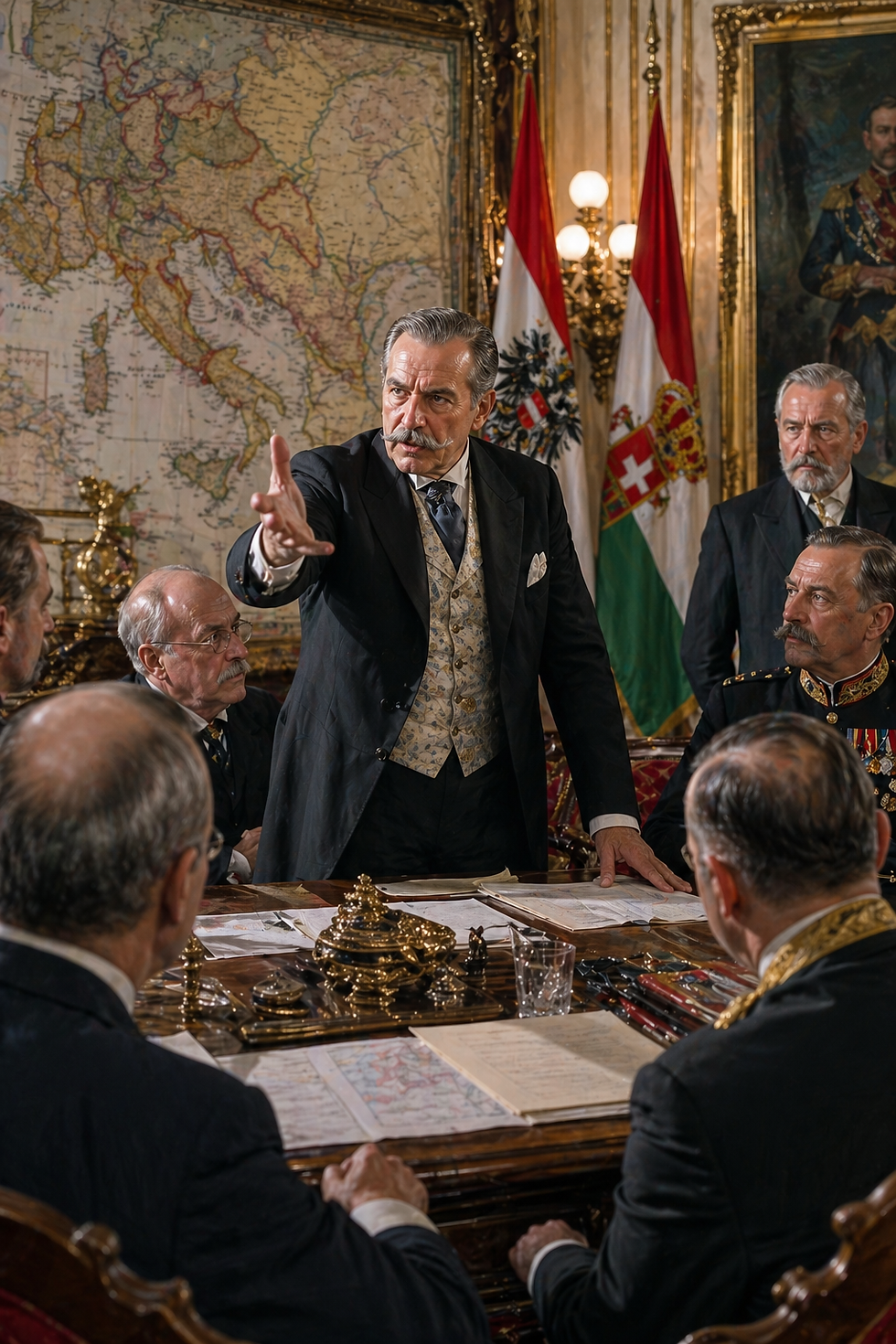
My Name is Count Leopold Berchtold: Foreign Minister of Austria-Hungary
I was born into one of the great noble families of the Austro-Hungarian Empire, a world where influence and duty were inseparable. From an early age, I was taught that stability must be protected at all costs. Diplomacy was not simply conversation—it was the careful preservation of order in a world that constantly threatened to unravel. I believed deeply in the empire’s role as a stabilizing force in Europe, and I saw it as my responsibility to defend that position with clarity and strength.
A Diplomat in a Changing World
My career in foreign service brought me face to face with the growing tensions across Europe. Nations were no longer content to remain under imperial rule, and the Balkans in particular had become a constant source of unrest. Serbia stood at the center of this agitation, encouraging Slavic nationalism that directly threatened Austria-Hungary’s authority. I viewed this not as a minor regional issue, but as a direct challenge to the survival of the empire. Yet many around me hesitated, urging caution. I struggled to understand their reluctance. To me, the danger was obvious and immediate.
The Balkan Problem and My Conviction
I believed that Serbia had to be dealt with decisively. The empire could not afford to appear weak, especially in a region already slipping from its grasp. When tensions escalated, I saw an opportunity to resolve what had long been a growing threat. Others questioned whether such actions might provoke a larger conflict, but I believed that firm action would prevent greater instability. It seemed clear to me that hesitation would only invite further defiance. I could not understand why so many feared decisive measures when the alternative was slow collapse.
The Assassination and the Turning Point
When Archduke Franz Ferdinand was assassinated, I saw the moment we had been waiting for. This was not merely a tragedy—it was a justification. The empire had been struck, and it had to respond. I helped shape the ultimatum delivered to Serbia, ensuring that it demanded accountability in the strongest terms. Some argued that the demands were too severe, that they would lead to war. But I believed that if Serbia truly wished to avoid conflict, it would comply fully. Anything less would prove its guilt.
The Path to War
When Serbia’s response fell short, I supported the decision to move forward. War was no longer a possibility—it was a necessity. I believed that a swift and decisive conflict would restore order and demonstrate the strength of Austria-Hungary. Even as other nations began to react, I remained convinced that the situation could be contained. I did not believe that Europe would allow itself to be drawn into a wider war over a regional dispute. It seemed unreasonable to think that such a chain reaction would unfold.
Only at the end did I begin to see the full scope of what had been set in motion. The alliances activated, the mobilizations spread, and what I had believed would be a controlled response became something far greater. I had acted with certainty, convinced that strength would preserve the empire. Yet as the conflict expanded beyond all expectations, I understood too late that the forces at play were larger than any one decision. What I had seen as necessary action had helped open the door to a war that could not be contained.
Vienna Reacts: Shock, Anger, and Opportunity - Told by Count Leopold Berchtold
When word arrived in Vienna that Archduke Franz Ferdinand had been assassinated in Sarajevo, the reaction was immediate and profound. Shock spread through the court and government, but it did not linger long. It gave way quickly to anger. This was not seen as a random act of violence, but as a direct challenge to the authority of Austria-Hungary. The heir to the throne had been murdered in a province we governed, and many of us believed that such an act could not go unanswered.
From Tragedy to Calculation
Even in those first hours, discussions began to move beyond grief. There was a growing sense among us that this moment carried more than sorrow—it carried significance. Serbia had long been a source of agitation, encouraging nationalist movements within our borders and undermining stability in the Balkans. Now, with the assassination tied to Serbian elements, many believed we finally had justification to act decisively. I saw this clearly. This was not simply about justice; it was about restoring order and asserting strength.
The Question of Serbia
Within the leadership, there was little doubt about where responsibility lay. Though Serbia denied direct involvement, the connections between its networks and the conspirators were difficult to ignore. The question was not whether to respond, but how far that response should go. Some urged restraint, concerned about the reactions of other powers, particularly Russia. But I believed hesitation would only embolden those who opposed us. Serbia had tested the limits of our patience for years. Now, those limits had been reached.
An Opportunity to Act
To many of us, this moment represented something more than retaliation—it was an opportunity. If we acted swiftly and decisively, we could weaken Serbia and reassert control over the region. The Balkans had long been unstable, and Serbia’s influence had grown too strong. A firm response could change that balance. I believed that a clear demonstration of power would not only punish those responsible, but also deter future challenges to the empire.
Concerns of Wider Conflict
There were, of course, warnings. Some feared that a move against Serbia might draw in Russia, and from there, other powers. But I found such concerns overstated. It seemed unlikely that Europe would allow itself to descend into a general war over a regional matter. We had seen crises before, and they had been contained. I believed this situation could be managed in the same way—through strength, clarity, and resolve.
A Decision Taking Shape
In the days following the assassination, our course became clearer. The empire could not afford to appear weak, not in Bosnia, not in the Balkans, and not before the eyes of Europe. The anger in Vienna hardened into determination. What began as shock transformed into action. We would respond to Serbia, not with words alone, but with measures designed to ensure that such a challenge would never arise again. At the time, it seemed not only justified, but necessary.
Debate Within Austria-Hungary: Punish or Destroy Serbia? - Told by Berchtold
In the days after the assassination of Archduke Franz Ferdinand, our leadership faced a decision that would define the future of the empire. No one doubted that Serbia must be held accountable, but the scale of that response was far from agreed upon. The question before us was simple in form yet immense in consequence—should we punish Serbia for its actions, or should we move to destroy its power entirely?
Voices of Caution
Some within the government urged restraint. They argued that a limited response, carefully measured, could achieve justice without provoking a wider conflict. These men were concerned about Russia, which had long positioned itself as Serbia’s protector. They warned that a full-scale attack might draw Russia into the conflict, turning a regional matter into something far more dangerous. I listened to these concerns, but I found them lacking in resolve. To me, caution in this moment risked appearing weak, and weakness would invite further challenges.
The Case for Decisive Action
I believed that Serbia had crossed a line that could not be addressed with half-measures. For years, it had supported nationalist movements within our borders, undermining our authority in Bosnia and beyond. The assassination was not an isolated act—it was the result of a pattern of behavior that threatened the stability of the empire. If we responded lightly, we would only encourage more defiance. I could not understand why others failed to see that this was an opportunity to settle the Serbian problem once and for all.
Balancing Justice and Strategy
The debate was not purely emotional; it was also strategic. Some proposed issuing demands that Serbia could realistically accept, ensuring compliance without war. Others, myself included, favored a stronger approach—demands so firm that rejection would justify military action. This was not about forcing peace; it was about preparing for conflict under terms that favored us. I believed that if Serbia resisted, it would reveal its true intentions, and we would have the justification needed to act decisively.
The Shadow of Russia
Russia’s potential involvement was never far from our thoughts. Those advocating caution saw it as a reason to limit our actions. I saw it differently. If Russia chose to intervene, it would only confirm that the issue extended beyond Serbia itself. Still, I believed that swift and decisive action might prevent such escalation. A rapid strike against Serbia could resolve the matter before other powers had time to respond. It seemed to me that delay, not action, posed the greater risk.
The Decision Takes Shape
As discussions continued, the momentum shifted toward a hardline response. The desire to restore authority, to demonstrate strength, and to eliminate a growing threat proved stronger than the calls for restraint. I supported this direction fully. The empire could not afford hesitation, not in the face of such a direct challenge. In the end, the debate did not end in compromise, but in determination. We would confront Serbia with demands that left little room for evasion, and we would be prepared to act when those demands were not fully met. At the time, it seemed the only path that ensured the survival of Austria-Hungary.

My Name is Helmuth von Moltke the Younger: Chief of the German General Staff
I was born into a legacy I did not choose, yet could never escape. My uncle, Helmuth von Moltke the Elder, had shaped Prussia’s greatest victories, and from the beginning I was expected to follow in his path. I embraced the responsibility, though I understood that I would always be compared to him. Where he had proven the power of decisive war, I sought to prepare Germany for the conflicts I believed were coming—conflicts that would not wait for hesitation or doubt.
A Soldier in an Age of Tension
As I rose through the ranks, I saw Europe hardening. Alliances formed like drawn swords, and every nation prepared for the inevitable. I did not believe peace could last. War, to me, was not a question of if, but when. Germany stood surrounded by potential enemies, particularly France and Russia, and I believed we had only a narrow window to act before those enemies grew stronger. Many disagreed, arguing for caution or diplomacy, but I saw delay as weakness. I could not understand why others failed to see how dangerous time itself had become.
The Weight of Strategy
When I became Chief of the General Staff, I inherited plans designed for a two-front war. These plans demanded speed, precision, and absolute commitment. If war came, we would have to strike quickly in the west before turning east toward Russia. There was no room for half-measures. Yet even within Germany, there were those who questioned the rigidity of these plans. I saw their doubts as dangerous. War could not be improvised—it had to be executed with discipline. I believed firmly that only decisive action could secure Germany’s future.
The July Crisis and the Push for Action
When Austria-Hungary moved against Serbia after the assassination of Archduke Franz Ferdinand, I supported immediate and firm backing. I believed that if war was to come, it was better to face it sooner rather than later. Russia was growing stronger, and delay would only make our position worse. Some feared escalation, but I believed escalation was already inevitable. The only choice was whether we would meet it prepared or unprepared. I urged readiness, convinced that hesitation would cost us everything.
Mobilization and the Point of No Return
When Russia began to mobilize, I saw it as confirmation of everything I had believed. There was no longer any possibility of avoiding war. Germany had to act, and act quickly. Mobilization began, and with it, the machinery of war moved forward with unstoppable force. Some hoped for last-minute diplomacy, but I knew that once the plans were set in motion, they could not simply be paused. War was no longer a decision—it was a process unfolding exactly as we had prepared for.
A Final Reflection
Only at the end did I begin to question what I had once accepted without doubt. I had believed that preparation and speed would bring victory, that decisive action would secure Germany’s future. But as the war expanded beyond expectations, I saw that even the most careful plans could not control the chaos they unleashed. I had acted with certainty, convinced that I understood the nature of the coming conflict. Yet in the face of a war greater than any we had imagined, I realized too late that certainty can be as dangerous as hesitation.
The “Blank Check”: Germany’s Promise of Support - Told by Helmuth von Moltke
When Austria-Hungary turned to us after the assassination of Archduke Franz Ferdinand, the situation was already moving beyond a simple regional crisis. Serbia stood behind the unrest in the Balkans, and Russia stood behind Serbia. To me, the lines were clear. If Austria-Hungary hesitated, it would lose authority. If Germany hesitated, we would lose our strongest ally. There could be no uncertainty in such a moment. Austria-Hungary needed to know that we stood firmly beside them.
The Decision to Offer Full Support
Germany’s leadership, under Kaiser Wilhelm II, made the decision to give Austria-Hungary what has since been called a “blank check”—a promise of support regardless of the course they chose. I supported this fully. An alliance that wavers in times of crisis is no alliance at all. Austria-Hungary needed confidence, not hesitation, and we provided it. Some questioned whether such a commitment might escalate the situation, but I believed the opposite. Strength, clearly demonstrated, could deter further interference.
Why It Mattered Strategically
From a military standpoint, this decision was essential. Germany faced the possibility of war on two fronts—against France in the west and Russia in the east. If Austria-Hungary faltered against Serbia, it would weaken our position before a larger conflict even began. By ensuring that Austria-Hungary acted decisively, we strengthened the alliance and improved our chances should war spread. I could not understand why others worried that this support would lead to escalation. To me, the greater danger lay in uncertainty and delay.
The Risk Others Saw
There were those, even within Germany, who feared that offering unconditional support would encourage Austria-Hungary to act too aggressively. They believed it might provoke Russia and draw all of Europe into conflict. I found this reasoning flawed. The tensions already existed. The alliances were already formed. A crisis of this magnitude would not simply fade away. If war was coming—and I believed it was—then it was better to face it with unity and preparation than with hesitation and division.
A Calculated Confidence
We believed that a strong, swift response by Austria-Hungary could contain the situation. If Serbia were dealt with quickly, perhaps Russia would reconsider its involvement. Even if it did not, we would at least be entering the conflict on our own terms. Time, in my view, favored our enemies. Russia’s military was growing stronger each year. Waiting would only make the eventual conflict more difficult. Acting now, with resolve, offered the best chance for success.
The Commitment That Set Events in Motion
The promise we gave Austria-Hungary was not made lightly, but it was made with conviction. It removed doubt, replaced hesitation with action, and set the crisis on a path from which it could not easily turn back. At the time, it seemed like the necessary step to preserve strength and stability within the alliance. Yet in giving that assurance, we helped ensure that the conflict would move forward with momentum, drawing nation after nation into a war that would soon extend far beyond the Balkans.
The Ultimatum to Serbia: Designed to Be Rejected - Told by Count Berchtold
After securing Germany’s full support, the next step was clear—we would confront Serbia directly. The assassination of Archduke Franz Ferdinand demanded more than outrage; it required action that would restore authority and eliminate the threat Serbia posed to the empire. Yet this could not be a simple declaration of war. It had to be framed in a way that justified our response before Europe. The ultimatum would serve that purpose.
Crafting the Demands
We carefully constructed a list of demands that addressed what we saw as the root of the problem—Serbia’s support for nationalist movements and its failure to suppress anti-Austrian activity. These demands included suppressing publications hostile to the empire, dissolving nationalist organizations, and removing officials tied to anti-imperial efforts. But most significantly, we required that Austro-Hungarian authorities be allowed to participate directly in investigations within Serbia. This was not a minor request; it struck at the heart of Serbian sovereignty.
The Strategic Intent
Some have said that the ultimatum was designed to be rejected, and I will not deny that it left Serbia with very little room to maneuver. That was precisely its strength. If Serbia accepted every demand, it would effectively submit to our authority. If it refused, we would have clear justification for military action. In either case, we would achieve our objective—either control or conflict under favorable conditions. I could not understand why others viewed this approach as dangerous. To me, it was a calculated and necessary step.
The Deadline and the Pressure
We issued the ultimatum with a strict deadline of 48 hours. Time was not on our side, and we did not intend to give Serbia the opportunity to stall or seek broad international mediation. The speed of the process was deliberate. A prolonged diplomatic exchange might weaken our position or allow other powers to interfere. By forcing a rapid response, we maintained control of the situation and ensured that events would move according to our design.
Expectations of the Outcome
Within our leadership, there was little doubt about how Serbia would respond. The demands were too extensive, too intrusive. We expected resistance, and with it, the justification we needed to act. Some voices suggested that Serbia might attempt partial compliance to avoid war, but I believed that anything short of full acceptance would only confirm its unwillingness to change. In my view, the outcome was already set. The ultimatum was not merely a negotiation—it was the final step before action.
A Path Without Easy Return
When the ultimatum was delivered, the crisis entered a new phase. The choice had been placed before Serbia, but in truth, it had also been placed before all of Europe. The demands, the deadline, and the expectations behind them ensured that whatever response came would carry consequences far beyond the immediate dispute. At the time, I believed we had acted with precision and purpose, creating a situation that would resolve a long-standing threat. What I did not fully grasp was how little control any of us would have once the response arrived.

My Name is Tsar Nicholas II: Emperor of All Russia
I was born into the Romanov dynasty, raised to inherit one of the largest empires the world had ever known. Yet I was never meant to rule so soon. When my father died, the crown fell upon me before I felt prepared—but I did not question it. I believed that authority came from God, and that it was my duty to rule as an autocrat, just as my ancestors had done. Many around me doubted my readiness, but I could not understand their concern. To me, the system had worked for generations. Why should it not continue?
Holding Firm to Absolute Power
As emperor, I faced growing unrest within Russia. Workers protested, intellectuals demanded reform, and revolutionaries called for change. They spoke of constitutions and shared power, but I saw these ideas as threats to stability. I believed that weakening the authority of the throne would lead only to chaos. Even after the turmoil of 1905, when I was forced to allow the creation of a representative assembly, I never truly accepted it. I granted concessions when necessary, but I did not believe in them. I struggled to understand why my people could not trust in the system that had held Russia together for centuries.
Family, Faith, and Isolation
My wife, Alexandra Feodorovna, and I lived within a world shaped by faith and duty, yet we were increasingly isolated from those we ruled. We trusted few, relying instead on a small circle of advisors. Many criticized our decisions, especially our reliance on figures they viewed as unfit or dangerous. I could not understand why they questioned my judgment. I believed I was acting in the best interests of Russia, guided by conviction and responsibility, even as others saw only weakness or misdirection.
The Burden of War and Alliance
When tensions in Europe escalated following the assassination of Archduke Franz Ferdinand, I faced a decision that weighed heavily on me. Russia had long seen itself as the protector of Slavic peoples, and Serbia looked to us for support. I did not seek war, but I believed that abandoning Serbia would be both dishonorable and dangerous. Still, I hesitated. I exchanged messages with other leaders, hoping that diplomacy might prevail. Yet even as I hoped for peace, I felt the pressure of expectation—from my advisors, from the military, and from the very role I held.
The Decision to Mobilize
In the end, I authorized mobilization. I did not see it as a declaration of war, but as a necessary step to prepare for what might come. Others warned that such actions would provoke Germany, but I believed that strength might prevent conflict, or at least ensure we were not caught unprepared. I could not understand why such a defensive measure would lead directly to war. Yet once the order was given, events moved quickly. Alliances activated, and the conflict spread beyond control.
A Final Reflection
Only at the end did I begin to grasp how fragile everything had become. I had believed in the strength of tradition, in the authority of the crown, and in the idea that careful decisions could preserve stability. But the forces shaping the world were greater than I had allowed myself to see. My hesitation, my convictions, and my choices all played a part in what followed. As war consumed nations and unrest grew within my own, I realized too late that holding firmly to the past does not always protect the future.
Serbia’s Response: Submission with Limits - Told by Tsar Nicholas II
When Austria-Hungary delivered its ultimatum to Serbia following the assassination of Archduke Franz Ferdinand, I watched the situation with growing concern. The demands were severe, far beyond what one sovereign nation would normally accept from another. Serbia stood in a difficult position—yield too much, and it would lose its independence; refuse, and it would face war. As Russia, we could not ignore what happened next, for Serbia was not just another country—it was closely tied to us by culture, faith, and shared identity.
Serbia’s Attempt to Comply
To my observation, Serbia did not answer with defiance alone. Its leaders responded carefully, accepting most of the demands placed before them. They agreed to suppress anti-Austrian publications, to dissolve nationalist groups, and to remove individuals linked to the assassination plot. It was a response designed to show cooperation, to avoid war if possible. Yet there was one critical point they could not accept—the involvement of Austro-Hungarian officials operating within Serbia’s own legal system.
The Line They Would Not Cross
Serbia’s refusal on this issue was not, in my view, unreasonable. Allowing a foreign power to conduct investigations and operate within its borders would have meant surrendering its sovereignty. No nation could accept such terms without effectively becoming subordinate. I believed Serbia had gone as far as it could without compromising its existence as an independent state. Still, Austria-Hungary did not see it this way. To them, anything short of full acceptance was rejection.
Why It Was Not Enough
Austria-Hungary had already begun to move toward war, and Serbia’s response, no matter how conciliatory in parts, did not change that course. The ultimatum had been structured in such a way that partial agreement would not satisfy it. What Serbia offered was compromise, but what Austria-Hungary demanded was complete submission. I could see that the decision had already been made in Vienna. The reply, however carefully written, would not prevent what was coming.
Russia’s Growing Concern
As I considered Serbia’s position, I felt the weight of responsibility pressing upon me. If Austria-Hungary moved against Serbia, it would not be a simple punishment—it would threaten the balance of power in the Balkans and weaken Russia’s influence in the region. I did not seek war, but I could not ignore what I saw as an unjust demand placed upon a smaller nation. Serbia had shown willingness to cooperate, yet it was not being given a path to peace.
A Response That Changed Nothing
In the end, Serbia’s reply, though measured and partially compliant, did not alter the course of events. It revealed the limits of diplomacy in a crisis already driven by deeper forces. I watched as the situation moved forward despite attempts to avoid conflict. What could have been a moment for resolution instead became confirmation that war was no longer a distant possibility—it was approaching rapidly, and with it, decisions that could not easily be undone.
Austria-Hungary Declares War (July 28, 1914) - Told by Count Leopold Berchtold
By the time Serbia’s response to our ultimatum was received, the course ahead had already taken shape. The assassination of Archduke Franz Ferdinand had demanded action, and the reply—though compliant in parts—did not meet the full measure of our demands. To us, this confirmed what we had long believed: Serbia was unwilling to submit to the authority necessary to ensure stability in the Balkans. The time for diplomacy had ended. The time for action had come.
The Final Decision in Vienna
Within Vienna, discussions no longer centered on whether to act, but on how and when. The empire’s leadership understood the weight of the decision before us. Declaring war was not a step taken lightly, yet it was seen as necessary. We believed that failing to respond decisively would weaken the empire beyond repair. I supported the declaration fully. The situation required clarity, not hesitation, and war would provide that clarity.
The Declaration Delivered
On July 28, 1914, Austria-Hungary formally declared war on Serbia. The announcement marked the official beginning of the conflict. Artillery would soon fire across the Danube, and military operations would begin. What had been a diplomatic crisis was now a military reality. At that moment, it still appeared to many as a localized conflict—one that could be resolved through strength and swift action.
Confidence in a Limited War
There remained a belief, even then, that the war could be contained. We anticipated that Serbia would be defeated quickly, restoring order in the region. Though there were concerns about Russia’s reaction, I believed that decisive action might prevent broader involvement. Europe had experienced crises before without descending into general war. It seemed reasonable to expect that this situation might follow a similar path.
The Point of No Return
Yet in declaring war, we crossed a threshold from which there was no easy return. Diplomatic options narrowed, and events began to move with increasing speed. Each decision now carried consequences that extended beyond our immediate control. Alliances, once distant considerations, began to take on immediate importance. What had started as a response to a single act of violence was rapidly becoming something far greater.
A Decision That Reshaped Europe
At the time, I believed the declaration of war was the necessary step to preserve the strength and authority of Austria-Hungary. It was meant to resolve a persistent threat and restore balance in the Balkans. But as the days unfolded and other powers began to react, it became clear that this decision would not remain confined to Serbia. The declaration of July 28 did more than begin a war—it set in motion a chain of events that would draw all of Europe into conflict, transforming a regional crisis into a global catastrophe.
Russia’s Dilemma: Protect Serbia or Avoid War? - Told by Tsar Nicholas II
When Austria-Hungary declared war on Serbia after the assassination of Archduke Franz Ferdinand, I found myself facing a decision that carried enormous weight. Serbia was not merely a distant nation—it was tied to Russia through shared Slavic heritage and Orthodox faith. Many within my empire believed it was our duty to stand by Serbia in its time of need. Yet I also understood the danger. Any action we took could bring us into direct conflict with Austria-Hungary, and beyond that, with Germany. I stood at the center of a crisis where every path carried risk.
Voices Demanding Action
Within my government and military, the pressure to act was immediate and forceful. Advisors warned that if Russia failed to support Serbia, we would lose influence in the Balkans and appear weak before the world. Public opinion echoed these concerns. There was a strong sense that Russia could not abandon a fellow Slavic nation under attack. Demonstrations and political voices called for intervention, and many believed that inaction would be a betrayal of both principle and power. I could feel that expectation growing with each passing day.
The Fear of a Greater War
At the same time, I could not ignore the larger consequences. I knew that Germany stood firmly behind Austria-Hungary, just as we were expected to stand by Serbia. If we intervened, it would not remain a limited conflict for long. Europe’s alliances were tightly bound, and one move could set off a chain reaction. I did not seek such a war. I hoped that diplomacy might still prevail, that pressure and negotiation could bring about a resolution without drawing all of Europe into conflict.
Hesitation and Hope
In those critical days, I hesitated. I exchanged messages with Kaiser Wilhelm II, hoping that personal appeals might ease tensions and prevent escalation. I considered partial measures—limited military preparations that might signal strength without provoking immediate war. I believed there might still be a path between action and restraint. Yet with each passing moment, that path seemed to narrow.
The Weight of Decision
The more I delayed, the more the pressure grew. My advisors warned that hesitation could leave Russia unprepared if war came suddenly. The military insisted that mobilization required time and could not be improvised. Meanwhile, the public expected a clear stance. I found myself pulled in opposing directions—toward caution by the fear of war, and toward action by the demands of duty and expectation. It was not a choice between right and wrong, but between two dangerous outcomes.
A Tipping Point Approaches
As events moved forward, it became clear that neutrality would not hold. Austria-Hungary’s actions against Serbia continued, and the calls for Russian intervention grew louder. The moment of decision was approaching, and I could no longer delay indefinitely. I had hoped that restraint might preserve peace, but I began to see that in this crisis, restraint itself might lead to consequences just as severe as action. The dilemma remained unresolved, but the time to choose was rapidly running out.
Russian Mobilization: The Fatal Decision - Told by Tsar Nicholas II
As Austria-Hungary pressed its war against Serbia, the pressure on me became impossible to ignore. I had hoped to avoid war, to find some path that would preserve both peace and honor, but the situation no longer allowed for hesitation. My advisors warned that if we did not act, Russia would be unprepared should the conflict spread. Serbia looked to us for protection, and the expectations within my empire grew louder with each passing day. I realized that doing nothing was no longer an option.
Mobilization as a Defensive Measure
When I authorized mobilization, I did not see it as an act of aggression. To me, it was a defensive necessity. Russia was vast, and its army required time to assemble and organize. Mobilization was not a declaration of war—it was preparation for the possibility of one. I believed that by demonstrating readiness, we might deter further advances by Austria-Hungary or discourage Germany from intervening. It seemed reasonable that strength could preserve peace, or at least prevent us from being caught unprepared.
The Limits of Partial Action
At first, there was discussion of partial mobilization—directed only against Austria-Hungary. This seemed like a compromise, a way to act without provoking a wider conflict. But the military leadership quickly made clear that such a plan was impractical. Russia’s mobilization system was not designed for limited action; it required full commitment to function effectively. Faced with this reality, I was forced to consider a broader mobilization, knowing that it would be seen differently by other powers.
The Reaction Across Europe
As soon as our mobilization became known, the response was immediate. Germany, already wary of Russian intentions, saw it as a direct threat. In their view, mobilization was inseparable from war itself. What I had considered a necessary precaution was interpreted as an aggressive step. Panic spread quickly through the capitals of Europe. Alliances that had once seemed distant now became active, and each nation began preparing for conflict in earnest.
A Chain Reaction Unleashed
I had hoped that mobilization might stabilize the situation, but instead it accelerated it. Germany issued warnings, demanding that we halt our preparations. Yet by that point, the machinery of mobilization had already been set in motion. It could not simply be stopped without leaving us vulnerable. The decision I had made, believing it to be defensive, had triggered a response that moved Europe closer to war with each passing hour.
The Weight of the Decision
Looking back, I see how pivotal that moment was. Mobilization was not just a military action—it was a signal, one that others interpreted in the most dangerous way. I had acted out of duty, convinced that readiness was necessary to protect Russia and its interests. Yet in doing so, I helped set off a chain of events that could not be contained. What I believed would preserve stability instead contributed to the collapse of it, as Europe moved rapidly toward a war that none of us could now prevent.
Germany Responds: Mobilization and War Planning Activated - Told by Moltke
When news reached us that Tsar Nicholas II had ordered full mobilization, I did not see it as a precaution—I saw it as the beginning of war. In our system, mobilization and war were inseparable. Armies do not gather by chance; they gather to move. Russia’s vast forces, once set in motion, would soon press toward our borders. There was no time for illusion. To hesitate in that moment would have meant surrendering the initiative entirely.
The Reality of Two Fronts
Germany’s position was uniquely dangerous. We stood between Russia in the east and France in the west, both bound by alliance. If Russia mobilized, France would not remain idle for long. I had long prepared for this possibility, knowing that we could not fight both at once without speed and precision. Our plans demanded immediate action, not gradual response. Once Russia moved, the clock began ticking against us.
The Plans Already in Place
For years, we had developed a strategy designed to meet this exact crisis. It required rapid mobilization and a swift offensive in the west before turning east to face Russia. There was no alternative plan of equal strength. War, as we understood it, could not be improvised. It had to follow a structure built long before the first shots were fired. When Russia mobilized, that structure was activated. It was not a matter of choice, but of necessity.
Diplomacy Overtaken by Events
Even as political leaders exchanged messages, hoping to delay or limit the conflict, the military reality moved faster. Once mobilization orders were issued, trains began to run, troops began to assemble, and timetables began to unfold with exact precision. These movements could not simply be halted without causing disorder and weakness. I could not understand why some believed diplomacy could still control events at this stage. The moment for negotiation had already passed.
A Decision That Expanded the War
Germany’s response was clear—we mobilized in turn and prepared to strike. We issued demands that Russia halt its mobilization, but I knew it was unlikely to happen. At the same time, we looked toward France, knowing that its involvement was only a matter of time. Our plans required us to act before being surrounded, and so the path toward full-scale war became unavoidable. What had begun as a regional crisis now spread outward, drawing in the great powers of Europe.
The Machinery of War Unleashed
As mobilization took hold, everything moved with speed and certainty. Railways carried soldiers to the front, commands were issued, and the vast machinery of modern war came alive. I had spent years preparing for this moment, convinced that readiness and decisiveness would ensure victory. Yet even as events unfolded exactly as planned, I could see that the scale of what was beginning was unlike anything Europe had faced before. What we had set into motion was no longer a limited conflict, but a war that would consume nations.
Final Countdown: Declarations of War Across Europe - Told by Moltke & Nicholas
The Moment Before the BreakMoltke: When Tsar Nicholas II ordered full mobilization, I saw the final barrier fall. There could be no more uncertainty. Germany could not wait while Russian armies gathered strength. We demanded that Russia halt its mobilization, but even as the message was sent, I knew the answer would not come in time, or at all. The machinery of war had already begun to move.
Nicholas: I understood the gravity of that moment, yet I did not believe it had to lead to war. Mobilization, in my mind, was a necessary defense, not a declaration. I hoped that even at the edge of conflict, reason might still prevail. I did not see my decision as the breaking point, though I could feel how close we had come.
Germany Declares War on RussiaMoltke: On August 1, 1914, Germany declared war on Russia. To me, it was not a sudden decision, but the inevitable result of the steps that had come before. Mobilization meant conflict, and we could not allow ourselves to be caught unprepared. Every hour mattered. The sooner we acted, the stronger our position would be.
Nicholas: When the declaration came, it confirmed what I had hoped to avoid. The conflict was no longer limited to Austria-Hungary and Serbia. It had expanded into a war between empires. I had sought to protect Serbia and preserve Russia’s standing, but now I saw that the consequences were far greater than I had wished.
The Western Front Awakens
Moltke: Our plans required immediate action against France, Russia’s ally. We could not risk fighting on two fronts at once without striking first in the west. On August 3, Germany declared war on France. It was a calculated move, one that followed the strategy we had prepared for years. There was no room for delay or hesitation.
Nicholas: I watched as the conflict spread, just as many had feared. What had begun in the Balkans was now drawing in the great powers of Europe. Alliances that had once seemed like safeguards were now pulling nations into war. I could see the pattern forming, yet there was no longer any way to stop it.
The March Through Belgium
Moltke: To carry out our strategy, we moved through Belgium, seeking a rapid advance into France. It was the most efficient path, though we knew it would bring additional consequences. Speed was everything. If we could defeat France quickly, we could turn our full attention to Russia before its forces were fully prepared.
Nicholas: Each step widened the conflict. The violation of Belgium’s neutrality brought new powers into consideration. The war was no longer contained by borders or intentions. It was expanding with a force of its own, beyond the control of any one nation.
Europe Falls Into War
Moltke: With declarations issued and armies in motion, Europe entered a state of total war. What had once been a series of decisions and responses became a single, unstoppable chain of events. I believed we had acted as necessity demanded, following the logic of strategy and survival. Yet even I could see that the scale of what had begun was greater than any of us had fully imagined.
Nicholas: I had hoped to protect my nation and its allies without igniting a wider conflict. Instead, I found myself at the center of a war that now involved all of Europe. The decisions we made, each one justified in its moment, had combined into something irreversible. As the first shots echoed across the continent, it became clear that we had crossed into a new and uncertain world—one from which there would be no easy return.


Comments