

4. Lesson Plan from World War I: The Powder Keg of the Balkans

Where Are the Balkans? A Land at the Crossroads of Empires
Where are the Balkans? This question leads us to one of the most important—and most dangerous—regions in European history, a place where continents, cultures, and empires collided. The Balkans sit in southeastern Europe, bordered by the Adriatic Sea to the west, the Black Sea to the east, and stretching down toward the Mediterranean world. This region includes lands that today are known as Serbia, Bosnia and Herzegovina, Bulgaria, Greece, Albania, Montenegro, North Macedonia, and parts of Romania and Turkey. For centuries, it has been less of a single country and more of a meeting ground—where different peoples, religions, and ambitions all pressed tightly against one another.
A Natural Fortress of Mountains and Valleys
The geography of the Balkans is rugged and complex, dominated by steep mountain ranges like the Dinaric Alps and the Balkan Mountains themselves. These natural barriers made travel and communication difficult, isolating communities from one another. Villages developed their own identities, languages, and loyalties, often with little connection to neighboring regions. At the same time, narrow valleys and passes became vital routes for trade and armies. Whoever controlled these passes could control movement through the region, making them fiercely contested. The land itself helped shape a history of division, independence, and frequent conflict.
The Gateway Between East and West
The Balkans have long been known as a bridge between Europe and Asia. Trade routes passed through the region, linking Western Europe with the Byzantine Empire and later the Ottoman Empire. Merchants, soldiers, and travelers moved through these lands carrying goods, ideas, and religions. Because of this, the Balkans became a cultural crossroads where Eastern Orthodox Christianity, Roman Catholicism, and Islam all took root. This blending of cultures made the region rich and diverse—but also deeply divided, as different groups often competed for influence and control.
Empires That Fought to Control the Region
For centuries, powerful empires battled for dominance in the Balkans. The Ottoman Empire ruled much of the region for hundreds of years, bringing Islamic influence and a centralized system of control. To the north and west, the Austro-Hungarian Empire pushed into Balkan territories, seeking to expand its power and protect its borders. Meanwhile, the Russian Empire looked southward, hoping to gain access to warm-water ports and to support Slavic peoples in the region. These competing ambitions turned the Balkans into a constant battleground of influence and rivalry.
Strategic Importance: Why Everyone Wanted the Balkans
The Balkans were not just important because of who lived there—they were crucial because of where they were. Control of the region meant access to key waterways, including routes to the Mediterranean Sea. It also meant the ability to move armies quickly between Europe and the Near East. For empires, this was not just about land—it was about power, trade, and survival. A single shift in control could change the balance of power across the continent. This made every conflict in the Balkans feel larger than it really was, pulling in outside nations and raising the stakes.
A Region Ready to Explode
By the early 1900s, the Balkans had become one of the most unstable regions in the world. Mountains divided the people, empires competed for control, and cultures clashed in close quarters. Every border was questioned, every alliance uncertain. It was a place where small conflicts could quickly grow into larger crises. Understanding where the Balkans are—and why they mattered—reveals why this region earned its reputation as the most dangerous crossroads in Europe, setting the stage for the explosion that would soon shake the entire world.
A Land of Many Peoples: A Region of Diversity and DivisionThe Balkans were not home to just one group of people, but to many: Serbs, Croats, Bosniaks, Bulgarians, Greeks, Albanians, and others, each with their own traditions and identities. These groups had lived in the region for centuries, developing strong loyalties to their families, communities, and histories. While this diversity made the Balkans rich in culture, it also created deep divisions that were not easily resolved.
Languages, Traditions, and Identity
Each group in the Balkans spoke its own language or dialect and followed its own customs. Even neighboring villages could feel like entirely different worlds. Stories, songs, and traditions were passed down through generations, shaping how people saw themselves and their place in the region. Identity was not just about where someone lived—it was about who their ancestors were, what language they spoke, and which traditions they followed. These differences made unity difficult, especially when outside powers tried to control or reorganize the region without understanding its complexity.
Religions That Shaped Loyalties
Religion played a powerful role in dividing and defining the peoples of the Balkans. Many Serbs and Bulgarians followed Eastern Orthodox Christianity, closely tied to traditions influenced by the Byzantine world. Croats were largely Roman Catholic, aligning them more with Western Europe. Meanwhile, many Bosniaks and Albanians practiced Islam, a legacy of centuries under the Ottoman Empire. These religious differences were not just matters of belief—they often determined political alliances, cultural connections, and even who people considered friend or enemy.
Centuries of Rule and Influence
The diversity of the Balkans was shaped by centuries of conquest and rule by powerful empires. The Ottomans brought Islamic influence and governed a wide range of peoples under one system, while the Austro-Hungarian Empire controlled other parts of the region, introducing different laws, languages, and administrative systems. These empires did not erase local identities; instead, they added new layers to them. As a result, the Balkans became a patchwork of overlapping cultures and influences, where people might live under one empire but feel connected to another group entirely.
Neighbor Against Neighbor
Because so many different groups lived so close together, tensions often ran high. Disagreements over land, religion, and political control could quickly turn into conflict. In some areas, people of different backgrounds lived peacefully for years, only for violence to erupt when outside forces or political changes stirred old rivalries. Loyalties could shift rapidly, and trust was often fragile. The closeness of these diverse groups meant that even small disputes could have serious consequences.
Diversity as Strength and Danger
The Balkans’ diversity was both its greatest strength and its greatest challenge. It created a region filled with unique cultures, rich traditions, and vibrant communities. But it also made unity difficult and conflict more likely, especially when combined with the ambitions of powerful nations nearby. By the early 1900s, this mixture of peoples, religions, and loyalties had created a delicate balance—one that could easily be disturbed. Understanding this diversity helps explain why the Balkans became such a tense and unpredictable region, where differences could inspire both beauty and conflict.
The Decline of the Ottoman Empire: The “Sick Man of Europe” Begins to FadeFor centuries, the Ottoman Empire ruled much of southeastern Europe, the Middle East, and North Africa. It controlled key trade routes, governed diverse populations, and stood as one of the great powers of the world. But by the 1800s, cracks had begun to show. Military defeats, economic struggles, and internal corruption weakened the empire, leading European leaders to give it a harsh nickname—the “Sick Man of Europe,” a sign that it was no longer able to maintain its former power.
A Weakening Grip on the Balkans
As the Ottoman Empire weakened, its control over the Balkans began to slip. Local leaders and communities, once tightly governed, started to push back against Ottoman authority. Communication broke down, taxes became harder to collect, and imperial officials lost influence in distant regions. What had once been a unified system began to fragment. Provinces that had been held together for centuries started acting more independently, creating uncertainty and instability throughout the region.
The Rise of National Movements
With the empire losing control, new ideas began to take hold among the people of the Balkans. Groups that had long lived under Ottoman rule began to see themselves not just as subjects of an empire, but as members of distinct nations. Serbs, Greeks, Bulgarians, and others began to demand independence, inspired by the growing idea that people with shared language and culture should govern themselves. Revolts and uprisings became more common, and some were successful, leading to the creation of new, independent states. The weakening empire had unintentionally opened the door for these movements to grow.
Old Rivalries Reignite
As new nations emerged, old rivalries that had been suppressed under Ottoman rule began to resurface. Neighboring groups competed for land, influence, and recognition. Borders were unclear, and many regions were home to mixed populations, making it difficult to decide who should control what. Instead of bringing stability, independence often led to new tensions, as each group sought to expand its territory or protect its people. The absence of a strong central authority allowed these conflicts to grow more intense.
Foreign Powers Step In
The decline of the Ottoman Empire did not go unnoticed by other powerful nations. The Russian Empire saw an opportunity to support Slavic peoples and expand its influence southward. Meanwhile, the Austro-Hungarian Empire aimed to strengthen its position by taking control of nearby territories. These outside powers often supported different groups within the Balkans, turning local conflicts into larger international struggles. What began as regional unrest started to draw in the major powers of Europe.
A Dangerous Power Vacuum
The decline of Ottoman authority created what historians call a power vacuum—a situation where no single power is strong enough to maintain order. In the Balkans, this vacuum allowed new nations to rise, but it also removed the structure that had kept rivalries in check. Competing ambitions, unclear borders, and outside interference combined to create a region filled with tension and uncertainty. By the early 1900s, the Balkans had become one of the most unstable areas in Europe, where even a small spark could ignite a much larger conflict.
The Rise of Balkan Nationalism: Small Nations with Big Dreams
As the Ottoman Empire weakened, the people of the Balkans began to see themselves not as subjects of a distant ruler, but as members of distinct nations with shared language, history, and culture. This shift in thinking sparked a wave of nationalism unlike anything the region had experienced before. Small nations began to dream not only of freedom, but of expansion—of reclaiming lands they believed were rightfully theirs.
National Identity Takes Root
In villages and cities across the Balkans, people began to rediscover their past. Folk songs, legends, and historical stories were revived, reminding communities of former kingdoms and heroes. Language became a symbol of unity, and cultural traditions were celebrated as markers of identity. For many, nationalism was not just political—it was deeply personal. It shaped how people saw themselves and their neighbors. These growing identities created a strong sense of belonging, but also drew sharper lines between different groups.
From Independence to Expansion
At first, many nationalist movements focused on breaking free from foreign rule. Countries like Greece and Serbia gained independence after long struggles, inspiring others to follow. But independence was only the beginning. Soon, these nations began to look beyond their borders, aiming to unite all people who shared their ethnicity or culture. This often meant claiming territories where populations were mixed, leading to competing demands over the same land. Nationalism in the Balkans was not just about freedom—it was about growth, influence, and power.
Competing Visions of the Future
One of the most challenging aspects of Balkan nationalism was that different groups often had overlapping goals. For example, Serbian leaders imagined a larger Serbian state that would unite Slavic peoples, while Bulgarians and Greeks had their own visions of expansion. These competing ambitions created tension, as each nation believed its claim was justified by history or culture. Instead of bringing unity to the region, nationalism often deepened divisions and set neighbors against one another.
Fuel for Conflict and Change
Nationalism gave people the courage to challenge empires, but it also made compromise difficult. Leaders were under pressure to defend their nation’s honor and pursue its goals, even if it meant conflict. Uprisings, protests, and even wars became more common as nations pushed for their place in the region. At the same time, powerful countries like the Russian Empire and the Austro-Hungarian Empire became involved, supporting different groups to expand their own influence.
A Region Transformed—and Tense
By the early 1900s, nationalism had reshaped the Balkans. New nations had emerged, old empires had weakened, and the map of the region was constantly changing. But this transformation came with a cost. The same forces that inspired independence also created rivalry and suspicion. The Balkans became a place where national pride ran deep, and where the desire for unity and expansion often clashed. It was a region full of energy and ambition—but also one standing on the edge of conflict, where the next spark could ignite something far greater.
Serbia’s Dream: A Greater Serbia and the Vision of UnityAfter gaining independence from the Ottoman Empire in the 1800s, Serbia began to see itself as more than just a single country. Its leaders and thinkers believed Serbia could become the center of a larger Slavic nation, bringing together people who shared language, culture, and history. This idea was not just political—it was fueled by pride, memory, and a desire to restore what many believed had once existed in the region.
A History That Inspired Ambition
Serbia’s dream was deeply connected to its past, especially the legacy of the medieval Serbian Empire under Stefan Dušan. During his reign in the 1300s, Serbia had been one of the most powerful states in the Balkans, controlling large territories and influencing the region. Even though that empire had long since fallen, its memory lived on through stories, traditions, and national identity. For many Serbians, the idea of a Greater Serbia was not about creating something new—it was about reclaiming lost greatness and restoring a sense of unity among their people.
Uniting the Slavic Peoples
The goal of a Greater Serbia focused on uniting South Slavs, especially those living outside Serbia’s borders. Large populations of Serbs and other Slavic groups lived in places like Bosnia-Herzegovina and parts of the Austro-Hungarian Empire. These communities often shared language and cultural ties with Serbia, but were ruled by foreign powers. Serbian nationalists believed these people should be brought into one nation, free from outside control. This idea gained strength as nationalist movements spread across the Balkans, encouraging people to think beyond local identities and toward broader unity.
Tension with Austria-Hungary
Serbia’s ambitions brought it into direct conflict with Austria-Hungary, which controlled territories with large Slavic populations. The Austro-Hungarian Empire feared that Serbia’s influence would inspire its own Slavic citizens to rebel or break away. As Serbia grew stronger and more confident, Austria-Hungary saw it as a threat to the stability of its empire. This tension was especially intense in Bosnia-Herzegovina, a region filled with Slavic peoples but governed by Austria-Hungary. Each move by Serbia to support Slavic unity increased suspicion and hostility between the two powers.
Support from Powerful Allies
Serbia did not stand alone in its ambitions. The Russian Empire supported Serbia, seeing itself as a protector of Slavic peoples and an ally against Austria-Hungary. Russia’s backing gave Serbia confidence and strength, but it also made conflicts in the Balkans more dangerous. What might have remained a regional struggle now had the potential to involve major European powers, raising the stakes of every decision and action.
A Dream That Shaped the Future
The dream of a Greater Serbia was powerful and inspiring for many, but it also contributed to rising tensions across the Balkans. It brought hope to those seeking unity and independence, while at the same time alarming neighboring empires and rival nations. This vision helped drive political decisions, alliances, and conflicts in the years leading up to World War I. In a region already filled with competing ambitions, Serbia’s dream added another layer of intensity—one that would play a key role in shaping the events that followed.
Austria-Hungary’s Fear of Slavic Unity: A Fragile Empire Under PressureThe Austro-Hungarian Empire was not a single unified nation, but a vast and complex state made up of many different ethnic groups—Germans, Hungarians, Czechs, Slovaks, Croats, Serbs, and others. While this diversity had allowed the empire to expand across Central and Eastern Europe, it also made it difficult to govern. By the early 1900s, rising nationalist movements threatened to break the empire into pieces, and nowhere was this threat more dangerous than in the Balkans.
A Patchwork of Peoples and Loyalties
Within Austria-Hungary’s borders lived millions of Slavic people, many of whom shared cultural and linguistic ties with neighboring Serbia. These populations did not always feel loyal to the empire that ruled them. Instead, they often looked beyond its borders, imagining a future where they could join or form independent Slavic nations. This created a serious problem for Austria-Hungary. If even one group successfully broke away, it could inspire others to follow, leading to a chain reaction that might destroy the empire entirely.
Serbia as a Rising Threat
To Austria-Hungary, Serbia was more than just a neighboring country—it was a growing symbol of Slavic nationalism and unity. After gaining independence from the Ottoman Empire, Serbia began to expand its influence and promote the idea of uniting all South Slavs. This directly challenged Austria-Hungary’s control over regions like Bosnia-Herzegovina, where many Slavs lived under imperial rule. Serbian leaders and nationalists encouraged these populations to resist foreign control, making Austria-Hungary increasingly uneasy.
The Fear of Losing Control
Austria-Hungary’s leaders feared that if Slavic unity gained momentum, they would lose control over large portions of their empire. The government relied on maintaining order across its many regions, but nationalism made that task more difficult each year. Protests, political movements, and secret organizations began to appear, all pushing for greater independence or unification with Serbia. The empire faced a difficult choice: allow these movements to grow and risk collapse, or take action to suppress them.
Bosnia-Herzegovina: The Center of Tension
The region of Bosnia-Herzegovina became a focal point of this fear. Annexed by Austria-Hungary in 1908, it was home to many Slavic people who felt connected to Serbia. The annexation angered Serbia and its supporters, while increasing unrest within the region itself. Austria-Hungary saw Bosnia as both a strategic asset and a potential weakness—a place where Slavic nationalism could either be contained or explode into open conflict.
A Dangerous Balance on the Edge
By the years leading up to World War I, Austria-Hungary was walking a dangerous line. It needed to maintain control over its diverse population while confronting the growing influence of Serbia and Slavic nationalism. Every decision carried risk. Acting too aggressively could spark rebellion or war, while doing nothing could allow the empire to slowly unravel. This fear of Slavic unity became one of the driving forces behind Austria-Hungary’s actions, pushing it toward choices that would have consequences far beyond the Balkans.
Bosnia-Herzegovina: A Land Caught in the Middle of Empires and IdentitiesLocated in the heart of the Balkans, Bosnia-Herzegovina was a place where cultures, religions, and loyalties overlapped. By the early 1900s, it had become one of the most contested regions in Europe, not because of its size, but because of what it represented: a crossroads of identity and power.
A Region of Many Voices
The population of Bosnia-Herzegovina was diverse, made up largely of South Slavic peoples, including Serbs, Croats, and Bosniaks. While they shared language similarities, they were divided by religion and history. Many Serbs in the region followed Eastern Orthodox Christianity and felt a strong cultural connection to neighboring Serbia. Croats, often Roman Catholic, had ties to Central Europe, while Bosniaks, many of whom practiced Islam, carried the legacy of centuries under the Ottoman Empire. These overlapping identities made it difficult for the region to unite under a single vision.
From Ottoman Rule to New Control
For hundreds of years, Bosnia-Herzegovina had been part of the Ottoman Empire. But as that empire weakened, control of the region shifted. In 1908, the Austro-Hungarian Empire officially annexed Bosnia-Herzegovina, bringing it under its direct rule. This move was meant to strengthen Austria-Hungary’s position in the Balkans, but it also created new tensions. Many of the people living there did not feel loyalty to their new rulers, especially those who identified closely with Serbia.
Sympathy for Serbia
Serbia, a rising power in the Balkans, promoted the idea of uniting all South Slavs into one nation. This message resonated strongly with many in Bosnia-Herzegovina, particularly among the Serb population. They saw Serbia not as a foreign country, but as a homeland or a leader for their people. This created a deep divide between the rulers and the ruled. While Austria-Hungary sought to maintain control, many within Bosnia-Herzegovina quietly supported Serbian ambitions.
A Political and Cultural Battleground
Bosnia-Herzegovina became more than just a territory—it became a battleground of ideas and influence. Austria-Hungary worked to strengthen its authority through administration, infrastructure, and military presence. At the same time, nationalist groups and secret organizations spread messages of resistance and unity with Serbia. Loyalties were often hidden, and tensions simmered beneath the surface. The region was stable on the outside, but underneath, it was filled with uncertainty and unrest.
The Center of a Growing Crisis
By the years leading up to World War I, Bosnia-Herzegovina stood at the center of a growing crisis. It was a place where empire met nationalism, where control met resistance, and where competing visions of the future clashed. Its position between Austria-Hungary and Serbia made it one of the most dangerous regions in Europe. In this land caught in the middle, even a single event had the potential to ignite a much larger conflict—one that would soon draw the world into war.
The Annexation Crisis of 1908: A Bold Move That Shook Europe
The Annexation Crisis of 1908 tells the story of a single decision that sent shockwaves across Europe and pushed the Balkans closer to war. In that year, the Austro-Hungarian Empire made a bold and controversial move—it officially annexed Bosnia-Herzegovina, a region it had already occupied but did not legally own. This action was meant to strengthen Austria-Hungary’s position in the Balkans, but instead it ignited anger, fear, and rising tension among neighboring nations.
From Occupation to Annexation
Bosnia-Herzegovina had been under Austria-Hungary’s administration since 1878, following agreements made after the decline of the Ottoman Empire. Although the Ottomans still technically held sovereignty, Austria-Hungary controlled the region’s government, military, and infrastructure. For years, this arrangement created an uneasy balance. But in 1908, Austria-Hungary decided to end the uncertainty by formally annexing the territory, making it an official part of the empire. This sudden move broke previous agreements and caught much of Europe off guard.
Serbia’s Outrage and Frustration
No country reacted more strongly than Serbia. Many Serbs believed Bosnia-Herzegovina should belong to them, or at least become part of a larger Slavic state. The annexation crushed those hopes, placing the region firmly under Austrian control. Serbian leaders and citizens alike saw the move as a direct threat to their ambitions and influence in the Balkans. Anger spread quickly, and calls for resistance grew louder. Serbia, however, was not strong enough to challenge Austria-Hungary alone, creating a sense of frustration and tension that would not easily fade.
Russia Steps Into the Conflict
Serbia was not without allies. The Russian Empire, which saw itself as the protector of Slavic peoples, strongly opposed the annexation. Russia had hoped to expand its influence in the Balkans and gain access to important waterways, and Austria-Hungary’s action stood in the way of those goals. Russian leaders protested the annexation and supported Serbia diplomatically. However, Russia was still recovering from recent military defeats and internal struggles, leaving it unprepared for a direct confrontation. Reluctantly, it backed down, but the resentment remained.
Europe Watches and Reacts
The crisis did not stay confined to the Balkans. Other European powers watched closely, aware that the situation could spiral into a larger conflict. Germany supported Austria-Hungary, strengthening its position, while other nations worried about the growing instability. Although war was avoided in 1908, the crisis revealed how quickly tensions could rise and how deeply divided Europe had become. Alliances were tested, and trust between nations weakened.
A Turning Point Toward War
The Annexation Crisis of 1908 left lasting scars. Serbia felt humiliated but more determined than ever to pursue its goals. Russia, though forced to step back, began rebuilding its strength, preparing for future conflicts. Austria-Hungary, confident after its success, became more willing to take bold actions. The crisis did not end the struggle in the Balkans—it intensified it. It showed that a single decision in this region could draw in powerful nations and bring Europe closer to the brink of war.
Russia as Protector of the Slavs: A Power Beyond Its BordersIn the late 1800s and early 1900s, the Russian Empire claimed a special role in defending Slavic nations, especially those living in the Balkans under foreign rule. This belief was not only political—it was cultural and religious. Russia shared linguistic roots and Eastern Orthodox Christian traditions with many Slavic groups, and its leaders believed it had both a duty and an opportunity to protect them.
A Shared Identity Across Borders
Many Slavic peoples in the Balkans, including Serbs and Bulgarians, shared deep cultural ties with Russia. They spoke related languages, followed similar religious traditions, and looked to Russia as a powerful ally. This connection created a sense of unity that went beyond national borders. When Slavic populations faced pressure from empires like the Ottoman Empire or the Austro-Hungarian Empire, they often turned to Russia for support. Russia, in turn, used this connection to strengthen its influence in the region.
A Strategic Opportunity
While Russia’s role as protector was rooted in shared identity, it was also driven by strategic goals. The Balkans were a gateway to warm-water ports and important trade routes, something Russia had long desired. By supporting Slavic nations, Russia could expand its influence southward and challenge its rivals. This made every conflict in the Balkans more than just a local issue—it became part of a larger struggle between powerful empires.
Backing Serbia and the Slavic Cause
Serbia, in particular, benefited from Russia’s support. As Serbia pushed for greater unity among South Slavs, Russia offered diplomatic backing and encouragement. This relationship gave Serbia confidence to stand up to larger powers, knowing it had a strong ally behind it. However, this also made Austria-Hungary more suspicious and defensive, as it saw Russian involvement as a direct threat to its own stability.
Raising the Stakes of Conflict
Russia’s involvement in Balkan affairs added a new level of danger to the region. Local disputes that might have remained small could quickly draw in major powers. When tensions rose between Serbia and Austria-Hungary, Russia’s support for Serbia meant that any conflict risked becoming much larger. Alliances began to harden, and nations prepared for the possibility of war. The Balkans were no longer just a regional concern—they had become a focal point for international rivalry.
A Protector with Consequences
By the early 1900s, Russia’s role as protector of the Slavs had reshaped the political landscape of Europe. It gave hope and strength to Slavic nations seeking independence or expansion, but it also increased fear and tension among rival empires. Russia’s involvement ensured that conflicts in the Balkans would not stay contained. Instead, they would echo across Europe, pulling powerful nations into a growing crisis. In trying to protect its allies, Russia helped create a situation where even a single spark could ignite a much larger war.
The Balkan League Forms: A Temporary اتحاد Against a Fading EmpireIn the early 1900s, the power of the Ottoman Empire in Europe was weakening rapidly. Sensing an opportunity, several Balkan nations—Serbia, Bulgaria, Greece, and Montenegro—began to consider what had once seemed impossible: cooperation. Though they had long histories of rivalry and competing ambitions, these nations shared a common goal—to push the Ottomans out of the Balkans and claim land for themselves.
A Region of Rivals Becomes Allies
For years, these nations had disagreed over territory, identity, and influence. Yet the declining Ottoman presence created a rare moment of unity. Diplomats worked behind the scenes to negotiate alliances, often encouraged by the Russian Empire, which supported cooperation among Slavic nations. Agreements were made carefully and sometimes secretly, as each country tried to secure its own future gains while committing to a joint effort. The result was the Balkan League, a coalition formed not out of trust, but out of shared opportunity.
A Calculated Alliance with Hidden Tensions
While the Balkan League appeared united, its foundation was fragile. Each member had its own vision for what victory would bring. Serbia sought to expand southward, Bulgaria hoped to dominate large parts of the region, Greece aimed to strengthen its control over coastal areas, and Montenegro looked to secure nearby territories. These competing goals were not fully resolved before the alliance was formed. Instead, they were set aside temporarily, with the understanding that the immediate priority was defeating the Ottomans.
Preparing for War
Once the alliance was in place, preparations for war moved quickly. Armies were mobilized, strategies were planned, and communication between the allies intensified. The Balkan League had a clear advantage: while the Ottoman Empire was struggling to maintain control over distant provinces, the Balkan nations were fighting close to home with strong motivation. Their knowledge of the terrain and their determination gave them confidence that they could succeed where others had failed.
A United Front with a Limited Purpose
The formation of the Balkan League marked a significant turning point in the region. It demonstrated that even long-time rivals could unite when faced with a shared goal. However, this unity was never meant to last. The alliance was built for a specific purpose—to defeat the Ottomans—and once that goal was achieved, the underlying tensions remained. The same ambitions that brought these nations together would soon begin to pull them apart.
The Beginning of a New Conflict
The Balkan League’s formation set the stage for the First Balkan War, where the allied nations would challenge Ottoman control and dramatically reshape the map of southeastern Europe. But it also planted the seeds for future conflict. By uniting against a common enemy, the Balkan nations gained strength and territory—but they also brought their competing visions into sharper focus. The alliance that had once seemed like a solution would soon become part of the problem, as the struggle for land and influence continued.
The First Balkan War (1912): The Ottoman Empire Driven from Europe
In October 1912, the Balkan League—Serbia, Bulgaria, Greece, and Montenegro—launched a coordinated attack on the weakening Ottoman Empire. For centuries, the Ottomans had controlled much of the Balkans, but now their hold was slipping. Within months, the League’s armies advanced rapidly, capturing key cities and forcing the Ottomans to retreat from most of their European territories.
A Coordinated Offensive Across the Region
The strength of the Balkan League lay in its ability to strike on multiple fronts at once. Bulgarian forces pushed eastward toward Thrace, winning decisive victories that threatened the Ottoman capital. Serbian troops advanced through Macedonia, defeating Ottoman armies and expanding their influence. Greek forces secured important coastal areas and cities, including Thessaloniki, while Montenegro attacked from the northwest. The Ottomans, already weakened by internal struggles and limited resources, could not effectively respond to this united assault.
Rapid Victories and a Changing Map
By early 1913, the Ottoman Empire had lost nearly all of its territory in Europe, except for a small area near Constantinople. The speed and success of the Balkan League shocked the rest of Europe. Regions that had been under Ottoman rule for centuries were now divided among the victorious nations. Borders were redrawn, and new territories were claimed, giving the Balkan states a sense of achievement and newfound power. The balance of control in the region had shifted almost overnight.
Rising Expectations and Growing Ambitions
Victory brought more than land—it brought confidence and higher expectations. Each member of the Balkan League believed it deserved a fair share of the newly conquered territories. However, these expectations were not clearly agreed upon before the war. As the fighting ended, disagreements over who should control which regions began to surface. Serbia wanted greater access to the Adriatic Sea, Bulgaria sought dominance in Macedonia, and Greece aimed to secure its gains along the coast. The alliance that had worked so effectively in war now faced the challenge of peace.
The Ottoman Empire’s Retreat and Its Consequences
The defeat marked a major turning point for the Ottoman Empire, signaling its near-complete withdrawal from Europe. While it remained a significant power elsewhere, its influence in the Balkans was largely broken. This created a new political landscape, one filled with independent nations but also with unresolved tensions. The absence of Ottoman control removed a long-standing authority, leaving the region to manage its own conflicts.
A Victory That Led to New Conflict
The First Balkan War achieved its immediate goal of pushing the Ottomans out of much of Europe, but it also set the stage for further instability. The same success that united the Balkan League now threatened to divide it. Competing claims, rising nationalism, and unmet expectations created an environment ripe for conflict. The war had ended, but the struggle for control and influence in the Balkans was far from over—and the next chapter would come even sooner than expected.
The Second Balkan War (1913): Allies Become Enemies OvernightJust months after defeating the Ottoman Empire together, the former members of the Balkan League turned on one another in a struggle over land and power. The shared victory of 1912 had removed a common enemy, but it also exposed deep disagreements. Instead of celebrating peace, the region plunged back into war—this time with former allies facing each other on the battlefield.
Disputes Over Macedonia
At the center of the conflict was the region of Macedonia, a land claimed by several Balkan nations. Bulgaria, which had played a major role in the First Balkan War, believed it deserved the largest share of territory. However, Serbia and Greece had already taken control of much of the area and were unwilling to give it up. Negotiations failed, and tensions escalated rapidly. What had been a united front against the Ottomans now became a bitter dispute over who would control the spoils of victory.
Bulgaria Strikes First
In June 1913, Bulgaria made the bold decision to attack its former allies, Serbia and Greece, hoping to quickly secure the disputed territories. This move shocked Europe and shattered any remaining trust within the region. Instead of achieving a swift victory, Bulgaria found itself facing stronger resistance than expected. Serbian and Greek forces pushed back, and the conflict quickly widened.
A War That Quickly Expands
The instability of the Balkans became clear as other nations joined the fight. Romania entered the war against Bulgaria, seeking to gain territory for itself, while the Ottoman Empire seized the opportunity to reclaim some of the lands it had recently lost. Bulgaria, now surrounded on multiple fronts, struggled to defend itself. The war that had begun as a dispute between former allies had grown into a broader regional conflict.
A Swift and Decisive End
The Second Balkan War was short but intense. Within weeks, Bulgaria was forced to seek peace. The Treaty of Bucharest redrew the map once again, but this time in a way that left Bulgaria weakened and resentful. Serbia and Greece emerged stronger, gaining territory and influence, while Romania and the Ottomans also secured their own gains. The rapid outcome showed just how quickly power could shift in the Balkans.
Proof of a Region on Edge
The Second Balkan War demonstrated that the Balkans were one of the most unstable regions in Europe. Alliances were fragile, and cooperation could quickly turn into conflict. National ambitions, competing claims, and a lack of trust made lasting peace difficult to achieve. The war revealed that even after a major victory, the region remained divided and competitive.
Setting the Stage for a Larger Conflict
By the end of 1913, the Balkans were more tense than ever. Serbia had grown stronger, alarming the Austro-Hungarian Empire, while Bulgaria’s defeat created lingering bitterness. The constant shifting of borders and alliances left the region unstable and unpredictable. The Second Balkan War did more than settle territorial disputes—it showed how easily conflict could erupt, setting the stage for the much larger crisis that would soon follow.
Secret Societies and Radical Nationalists: Shadows Behind the ConflictWhile governments debated and armies prepared, underground groups were already taking action. These secret organizations believed that change could not wait for diplomacy. Instead, they turned to covert operations, conspiracies, and even assassination to achieve their goals of national unity and independence.
The Rise of Underground Movements
As nationalism spread across the Balkans, not everyone was satisfied with slow political progress. Some individuals believed that only bold, direct action could free their people or unite their nation. This led to the formation of secret societies—groups that operated in the shadows, recruiting members who were willing to risk everything. They often used coded messages, hidden meetings, and strict oaths of loyalty. These organizations were small but highly dedicated, and their influence grew as tensions in the region increased.
The Black Hand and Its Mission
One of the most famous of these groups was the Black Hand, a secret organization formed in Serbia. Its members were largely military officers and nationalists who supported the idea of a Greater Serbia. Their goal was to unite all South Slavs, especially those living under foreign rule, into one nation. The Black Hand believed that this could be achieved through any means necessary, including violence. They trained operatives, supported revolutionary actions, and worked to weaken the control of rival powers in the Balkans.
Fueling Extremism and Violence
Secret societies like the Black Hand contributed to a growing culture of extremism. They encouraged individuals to take drastic actions in the name of national pride and unity. In a region already filled with tension, these groups added another layer of danger. Their actions often bypassed governments entirely, making conflicts more unpredictable. A single act carried out by a small group could have consequences far beyond what anyone expected, drawing entire nations into crisis.
A Challenge to Governments and Stability
These underground movements did not always align with official government policies, even in countries like Serbia. While some leaders quietly supported their goals, others worried about the risks they posed. Secret societies operated independently, making it difficult to control or stop them. Their existence created uncertainty, as governments could not always predict when or where the next act of violence might occur. This lack of control made the political situation in the Balkans even more fragile.
The Power of a Hidden Hand
By the early 1900s, secret societies had become a powerful force in the Balkans. Though small in number, their willingness to act boldly gave them an outsized impact on events. They represented the most extreme side of nationalism—where ideas turned into action, and action often led to violence. In a region already on edge, these hidden groups helped push tensions closer to a breaking point, proving that sometimes the most dangerous forces are the ones that operate out of sight.
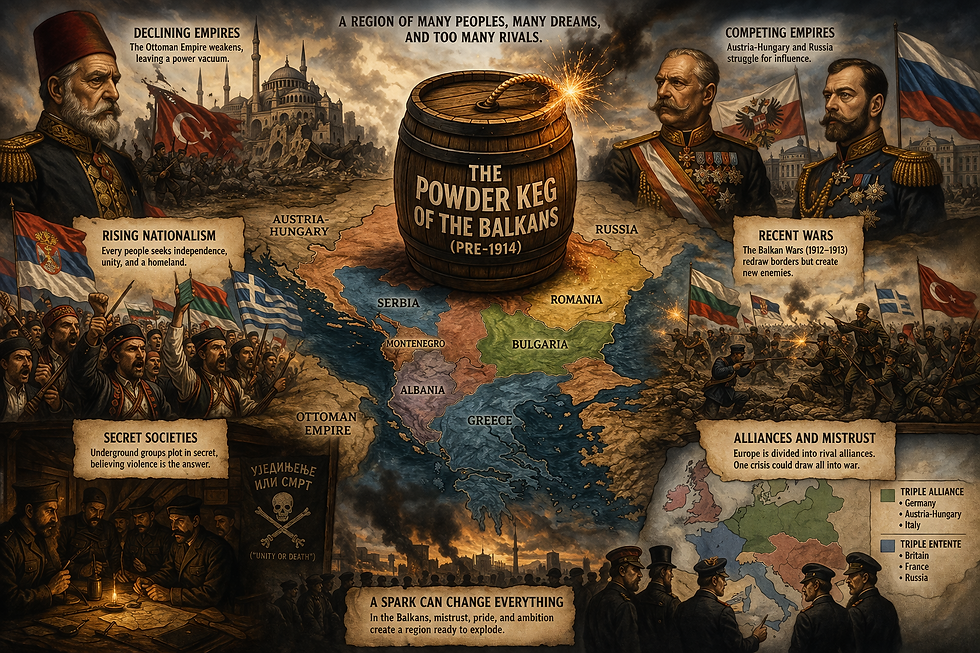
Why the Balkans Became the “Powder Keg”: A Region Ready to ExplodeBy the early 1900s, the Balkans were filled with competing ambitions, deep divisions, and growing frustration. It was not one single issue that made the region dangerous, but a combination of many forces—ethnic tensions, rising nationalism, weakening empires, recent wars, and secret plots—all pressing together in a small and crowded space.
A Patchwork of Peoples and Loyalties
The Balkans were home to a wide mix of ethnic groups, including Serbs, Croats, Bosniaks, Bulgarians, Greeks, and others. These groups often lived side by side, but they did not always share the same identity or goals. Religion added another layer of division, with Eastern Orthodox Christians, Roman Catholics, and Muslims shaping different cultural and political loyalties. These differences made unity difficult and created frequent disagreements over land, leadership, and the future of the region.
Nationalism on the Rise
As the power of the Ottoman Empire declined, nationalist movements grew stronger. Small nations began to seek independence or expansion, aiming to unite people who shared their language and culture. Serbia, in particular, pushed for the unification of South Slavs, while other nations pursued their own ambitions. These competing goals often overlapped, leading to conflict rather than cooperation. National pride ran deep, and compromise became increasingly difficult.
Empires Competing for Control
The Balkans were not only important to local nations—they were also a key battleground for powerful empires. The Austro-Hungarian Empire sought to maintain control over its diverse population and expand its influence in the region. At the same time, the Russian Empire supported Slavic nations and aimed to extend its reach southward. These rivalries meant that even small conflicts in the Balkans could quickly involve much larger powers.
Recent Wars and Unsettled Borders
The Balkan Wars of 1912 and 1913 had dramatically reshaped the region, pushing the Ottomans out of most of Europe and redrawing national boundaries. However, these changes did not bring stability. Instead, they created new tensions, as countries argued over who should control key territories. Former allies became rivals, and resentment grew among nations that felt they had not received their fair share. The region was left with unresolved disputes and a sense that more conflict was inevitable.
Secret Plots and Hidden Forces
Adding to the instability were secret societies and radical nationalist groups, such as the Black Hand. These organizations operated outside government control, promoting extreme ideas and carrying out covert actions. Their willingness to use violence made the situation even more unpredictable. A single act by a small group could have consequences far beyond the region, drawing powerful nations into conflict.
A Region on the Brink
By the years leading up to World War I, the Balkans had become a place where every tension was heightened. Ethnic divisions, national ambitions, imperial rivalries, and recent conflicts all combined to create an unstable and explosive environment. It was a region where peace was fragile and mistrust was widespread. When the spark finally came, it did not remain contained—it ignited a chain reaction that spread far beyond the Balkans, proving that the “Powder Keg” name was more than just a metaphor.
Global Tensions: A World Already Under PressureAcross the world in the late 1800s and early 1900s, powerful nations were competing, expanding, and preparing for conflict. These global events created an environment where even a regional crisis could trigger something far greater. The Balkans became the spark—but the world had already been filled with fuel.
The Scramble for Africa and Imperial Rivalries
During the late 1800s, European nations rushed to claim territory in Africa in a period known as the Scramble for Africa. Countries like Britain, France, and Germany competed fiercely for land, resources, and influence. This competition increased distrust and rivalry between the major powers. These same nations, already suspicious of one another, carried that tension into Europe. When conflicts arose in the Balkans, they were viewed through the lens of this global competition, making cooperation far more difficult.
The Rise of Industrial and Military Power
Industrialization transformed nations like Germany and Britain into powerful economic and military forces. Factories produced weapons faster than ever before, and new technologies made armies more efficient and deadly. The German Empire, in particular, expanded its military strength rapidly, alarming other nations. This arms buildup created a sense that war was not only possible, but perhaps inevitable. When tensions rose in the Balkans, countries were already prepared—and in some cases eager—to act.
The Decline of Old Empires
While some nations were rising, others were weakening. The Ottoman Empire was losing control of its territories, especially in the Balkans, while the Austro-Hungarian Empire struggled to manage its many ethnic groups. This decline created instability and power vacuums, allowing smaller nations to rise but also increasing competition over who would control these regions. The Balkans became one of the most contested areas because of this shifting balance of power.
Alliance Systems Expanding Across Europe
At the same time, European nations formed alliances to protect themselves and strengthen their positions. The Triple Alliance (Germany, Austria-Hungary, and Italy) and the Triple Entente (France, Russia, and Britain) divided Europe into opposing sides. These alliances were meant to prevent war, but they often had the opposite effect. A conflict involving one nation could quickly pull in its allies. This meant that any crisis in the Balkans had the potential to spread across the entire continent.
The Russo-Japanese War and Shifting Power
The early 1900s also saw the Russo-Japanese War, where Japan defeated Russia in a surprising victory. This weakened Russia temporarily and forced it to focus on rebuilding its strength. However, it also made Russia more determined to assert its influence elsewhere, particularly in the Balkans. This added pressure to the region, as Russia became more committed to supporting Slavic nations like Serbia.
Revolutions and Political Instability
Many countries were experiencing internal unrest during this time. The Russian Revolution of 1905 exposed weaknesses in the Russian government, while other nations faced protests, strikes, and demands for reform. Governments felt threatened both from within and from abroad. This instability made leaders more cautious, but also more willing to take strong actions to maintain power, especially in regions like the Balkans where their influence was at stake.
The Naval Arms Race Between Britain and Germany
Another major source of tension was the naval arms race between Britain and Germany. Both nations competed to build the largest and most powerful fleets, symbolized by massive battleships known as dreadnoughts. This rivalry increased fear and suspicion, particularly in Britain, which had long relied on its naval dominance. The growing competition made relations between the two nations more strained, adding to the overall tension in Europe.
A World Ready for a Spark
By the early 1900s, the world was filled with competing ambitions, rising militaries, fragile alliances, and unstable empires. The Balkans were only one part of this larger picture, but they were the most volatile. When conflict erupted there, it did not stay contained because the rest of the world was already tense and divided. The global events surrounding the Balkans turned a regional crisis into an international disaster, proving that the “Powder Keg” was connected to forces far beyond its borders.
Most Important Figures To Know While Studying the Balkans
Franz Joseph I (1830–1916)
Franz Joseph I ruled the Austro-Hungarian Empire for nearly 70 years and was one of the most influential figures in Europe during this period. He governed a vast, multi-ethnic empire that included many Slavic populations in the Balkans. His leadership was defined by a desire to maintain stability and control, but this became increasingly difficult as nationalist movements grew stronger. His approval of policies like the annexation of Bosnia-Herzegovina in 1908 intensified tensions with Serbia and Russia. His long reign represented both the strength and fragility of the empire he struggled to hold together.
Nicholas II (1868–1918)
Nicholas II was the last Tsar of Russia and played a key role as a supporter of Slavic nationalism. He saw Russia as the protector of Slavic peoples, especially in the Balkans, and supported Serbia in its ambitions. However, his leadership was challenged by internal unrest and political instability, particularly after the Russian Revolution of 1905. Despite these struggles, his commitment to supporting Slavic allies increased tensions with Austria-Hungary and helped turn regional disputes into international crises.
Peter I of Serbia (1844–1921)
Peter I ruled Serbia during a time of rising nationalism and expansion. He supported the idea of a Greater Serbia and encouraged efforts to unite South Slavic peoples. Under his leadership, Serbia became more assertive in Balkan affairs, especially after victories in the Balkan Wars. Though seen as a unifying figure at home, his nation’s ambitions brought it into direct conflict with Austria-Hungary, making Serbia a central player in the tensions leading up to World War I.
Georgi Rakovski (1821–1867)
Though he lived earlier in the 1800s, Georgi Rakovski was a foundational figure in Balkan nationalism. He was a writer, revolutionary, and organizer who helped inspire Bulgarian resistance against Ottoman rule. His ideas about national identity and independence influenced later leaders and movements throughout the Balkans. Rakovski’s legacy helped ignite the broader wave of nationalism that contributed to instability in the region.
Eleftherios Venizelos (1864–1936)
Venizelos was a key political leader in Greece who played a major role in shaping Balkan alliances and conflicts. He helped guide Greece through the Balkan Wars, expanding its territory and influence. A skilled diplomat, he balanced cooperation and competition with neighboring countries. His leadership strengthened Greece but also contributed to the shifting alliances and rivalries that defined the region.
Tsar Ferdinand I of Bulgaria (1861–1948)
Ferdinand I ruled Bulgaria during both Balkan Wars and sought to expand his nation’s territory and influence. Initially part of the Balkan League, Bulgaria turned against its former allies in the Second Balkan War due to disputes over land. His decisions led to both military defeat and lasting resentment, increasing instability in the region. His ambition reflected the competitive nationalism that drove conflict in the Balkans.
Dragutin Dimitrijević (1876–1917)
Known by the nickname “Apis,” Dragutin Dimitrijević was a powerful and secretive figure within Serbia’s military. He was a leader of the Black Hand, which supported the unification of South Slavs through covert and often violent means. His influence extended beyond official government control, and his actions contributed to the rise of radical nationalism. Figures like Dimitrijević showed how underground movements could shape major historical events.
Milunka Savić (1888–1973)
Milunka Savić stands out as one of the most remarkable female figures of the era. She disguised herself as a man to join the Serbian army during the Balkan Wars and later became one of the most decorated female soldiers in history. Her bravery and dedication symbolized the intense national pride and personal sacrifice that defined the region. She represents how the struggles of the Balkans affected not just leaders, but ordinary individuals who became extraordinary through their actions.
Ismail Qemali (1844–1919)
Ismail Qemali was a key figure in the creation of Albania as an independent nation in 1912. As the Ottoman Empire weakened, he led efforts to establish Albania as its own state, separate from both Ottoman and neighboring influences. His leadership helped prevent Albania from being divided among other Balkan nations, but also added another layer of complexity to the already tense regional dynamics.
Alois Lexa von Aehrenthal (1854–1912)
Aehrenthal was the architect behind the annexation of Bosnia-Herzegovina in 1908. As foreign minister of Austria-Hungary, he believed this move would strengthen the empire’s position in the Balkans. Instead, it angered Serbia and Russia, escalating tensions across Europe. His actions demonstrated how diplomatic decisions could have far-reaching and unintended consequences.
Life Lessons from the Powder Keg of the Balkans: Understanding The Conflict
Small Tensions Can Become Major Conflicts
One of the most important lessons is that conflicts rarely begin suddenly. In the Balkans, disagreements over land, identity, and power existed for years before they erupted into war. Each unresolved issue added pressure, like air filling a balloon. Eventually, even a small event could cause everything to burst. This teaches the importance of addressing problems early, before they grow into something much larger and more dangerous.
Identity Is Powerful—But Can Divide
The people of the Balkans were deeply connected to their language, culture, and religion. These identities gave them strength and unity within their groups, but they also created division between different groups. When identity becomes more important than cooperation, it can lead to misunderstanding and conflict. This lesson reminds us that while identity is important, it must be balanced with respect for others.
Competition Without Cooperation Leads to Instability
Many nations in the Balkans wanted similar things—land, influence, and recognition—but they were unwilling to compromise. Even when they briefly worked together, as in the Balkan League, their cooperation did not last. This shows that success built on competition alone is fragile. Long-term stability requires communication, trust, and a willingness to find common ground.
Leadership Decisions Have Lasting Consequences
Leaders in this period often made decisions based on pride, fear, or pressure rather than long-term thinking. Actions like annexing territory or supporting aggressive nationalism seemed beneficial in the moment, but they increased tensions over time. This teaches that leadership requires careful thought, patience, and an understanding of how decisions will affect not just the present, but the future.
Outside Involvement Can Escalate Problems
The Balkans were not only influenced by local issues but also by powerful nations like the Russian Empire and the Austro-Hungarian Empire. These outside powers supported different sides, turning regional disputes into international crises. This lesson shows how involvement from others can sometimes make situations worse rather than better, especially when each side is pursuing its own interests.
Hidden Forces Can Shape Big Events
Secret societies and underground movements played a role in increasing tension in the Balkans. These groups acted outside official control, often pushing for extreme actions. This teaches that not all influence is visible, and that unseen forces can have a powerful impact on outcomes. Understanding the full picture requires looking beyond what is obvious.
Vocabulary to Learn While Studying the Powder Kep of the Balkans
1. Annexation
Definition: The act of taking control of a territory and making it part of another country.
Sample Sentence: Austria-Hungary’s annexation of Bosnia-Herzegovina increased tensions in Europe.
2. Ethnic Group
Definition: A group of people who share a common culture, language, or ancestry.
Sample Sentence: The Balkans were home to many ethnic groups living close together.
3. Insurgency
Definition: A rebellion against authority, often involving armed resistance.
Sample Sentence: Insurgencies in the Balkans weakened imperial control over the region.
4. Diplomacy
Definition: The practice of managing international relations through negotiation and discussion.
Sample Sentence: Diplomacy failed to resolve the disputes between Balkan nations.
5. Pan-Slavism
Definition: A movement that aimed to unite all Slavic peoples under one political or cultural group.
Sample Sentence: Russia supported Pan-Slavism to increase its influence in the Balkans.
6. Revolution
Definition: A sudden and significant change in government or political power, often involving conflict.
Sample Sentence: Revolutionary ideas spread quickly among Balkan nationalists.
7. Autonomy
Definition: The ability of a region or group to govern itself independently within a larger state.
Sample Sentence: Some regions sought autonomy instead of full independence.
8. Balance of Power
Definition: A situation in which countries have equal strength to prevent any one from dominating.
Sample Sentence: European leaders tried to maintain a balance of power in the Balkans.
9. Secret Society
Definition: An organization that keeps its activities, members, or goals hidden from the public.
Sample Sentence: The Black Hand was a secret society that supported nationalist causes.
10. Power Vacuum
Definition: A situation where no strong authority exists, allowing others to compete for control.
Sample Sentence: The decline of the Ottoman Empire created a power vacuum in the Balkans.
11. Territorial Dispute
Definition: A disagreement between countries over who controls a specific area of land.
Sample Sentence: Territorial disputes between Balkan nations led to increased conflict.
12. Radicalism
Definition: The belief in making extreme political or social changes, often through bold or violent actions.
Sample Sentence: Radicalism grew as some groups believed peaceful change was too slow.
13. Coalition
Definition: A temporary alliance of groups or nations working together for a common goal.
Sample Sentence: The Balkan League was a coalition formed to fight the Ottomans.
14. Independence
Definition: Freedom from control by another country or authority.
Sample Sentence: Many Balkan nations fought for independence from imperial rule.
15. Instability
Definition: A condition where a region or government is likely to change or face conflict.
Sample Sentence: Political instability in the Balkans made the region unpredictable and dangerous.
Activities to Try While Studying the Powder Kep of the Balkans
Nationalism Role-Play Debate
Recommended Age: 12–16
Activity Description: Students take on the roles of different Balkan nations and argue for their territorial and political goals in a structured debate.
Objective: To explore how nationalism influenced decision-making and conflict.
Materials: Role cards (Serbia, Bulgaria, Greece, Austria-Hungary, Russia), background notes, paper, pencils
Instructions: Assign each student or group a country. Provide them with goals and background information. Students prepare arguments explaining what land they want and why. Hold a moderated debate where each group presents and responds to others.
Learning Outcome: Students will see how competing national interests made peaceful solutions difficult.
“Powder Keg” Science Connection Demonstration
Recommended Age: 10–16
Activity Description: A visual demonstration comparing the Balkans to a powder keg using a safe, controlled analogy.
Objective: To illustrate how pressure builds and leads to sudden conflict.
Materials: Balloon, small strips of paper (labeled with causes like nationalism, alliances, etc.)
Instructions: As you discuss each cause, place a labeled paper inside or attach it to a balloon while inflating it. Explain how each factor adds pressure. Eventually pop the balloon (or simulate it) to represent the outbreak of war.
Learning Outcome: Students will understand how multiple factors combined to create an explosive situation.
News Reporter Assignment (1913 Edition)
Recommended Age: 12–18
Activity Description: Students act as journalists reporting on events in the Balkans just before World War I.
Objective: To develop perspective-taking and communication skills while reinforcing historical understanding.
Materials: Paper, pens, optional costumes or props
Instructions: Assign students a specific event (Balkan Wars, annexation crisis, nationalism movements). They write or present a news report explaining what happened, who was involved, and why it matters. Encourage dramatic, engaging storytelling.
Learning Outcome: Students will be able to explain key events clearly and understand their importance in context.


Comments