

7. Lesson Plan from the Progressive Era: Trust-Busting and Corporate Regulation (c. 1900–1912)

The Rise of Corporate Power in America
By the late 1800s, the United States was no longer a land of small shops and scattered farms—it had become a roaring engine of industry. Railroads stretched across the continent, steel framed the skeletons of rising cities, and oil fueled machines that powered a new way of life. At the center of this transformation stood a new kind of force: massive corporations. These businesses grew so large and powerful that they could shape entire industries, influence government decisions, and determine the prices Americans paid for everyday goods. This was the age when corporate power rose to dominate the nation.
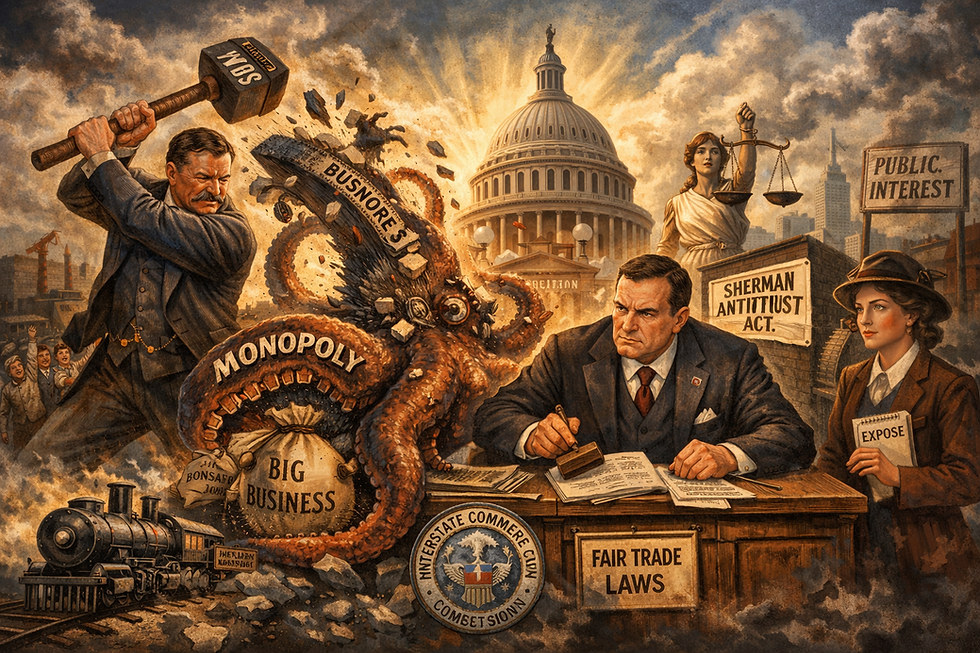
From Competition to Control
In the early days of industrial growth, thousands of small businesses competed fiercely. But competition was costly and unpredictable. To survive, powerful leaders began to buy out rivals, form alliances, or crush competitors entirely. Over time, industries that once had many players became controlled by just a few giants. This process created monopolies—situations where a single company dominated an entire market—and trusts, which were agreements that allowed multiple companies to operate as one powerful unit. What began as competition slowly turned into control.
The Empire of Standard Oil
No example better captures this shift than Standard Oil, led by John D. Rockefeller. Starting as a small refinery, Rockefeller’s company used careful planning, aggressive pricing, and strategic buyouts to take control of nearly the entire oil industry. By the 1880s, Standard Oil refined about 90% of the nation’s oil. Competitors found it nearly impossible to survive against such power. Rockefeller defended his methods as efficient and beneficial, but many Americans saw something different—a system that crushed opportunity and concentrated wealth into the hands of a few.
Railroads: The Lifelines of Power
Railroads were the arteries of the American economy, and those who controlled them held enormous influence. Railroad companies determined shipping rates, controlled access to markets, and often gave secret discounts—called rebates—to favored businesses. This allowed certain companies to grow while others struggled or failed. Farmers and small business owners grew increasingly frustrated, feeling trapped by a system they could not control. Railroads did more than move goods—they shaped who succeeded and who did not.
Steel and the Rise of Industrial Giants
Meanwhile, the steel industry, led by figures like Andrew Carnegie, fueled the construction of bridges, railways, and skyscrapers. Carnegie’s company became one of the largest and most efficient steel producers in the world. Through vertical integration—controlling every step of production from raw materials to transportation—he lowered costs and outpaced competitors. While this efficiency helped build modern America, it also concentrated immense power into a single enterprise, raising questions about fairness and control.
Wealth, Power, and Public Concern
As these corporations grew, so did the gap between the wealthy and the working class. Industrial leaders amassed fortunes unlike anything seen before, while many workers faced long hours, low wages, and dangerous conditions. Americans began to ask difficult questions: Was this system fair? Should a handful of individuals have so much control over the nation’s economy? Newspapers, politicians, and everyday citizens started to challenge the unchecked growth of corporate power.
Setting the Stage for Reform
By 1900, the rise of corporate power had reshaped the United States—but it had also sparked a growing demand for change. Many believed that the government had a responsibility to step in, not to destroy business, but to ensure fairness. This tension between freedom and control would define the next chapter of American history, as leaders like Theodore Roosevelt stepped forward to confront the giants of industry. The age of unchecked corporate power had reached its peak—and the push for reform was just beginning.
Understanding Monopoly Structures: The Hidden Power Behind Big Business
At the height of America’s industrial boom, a new kind of business power quietly reshaped the economy—trusts, monopolies, and vast corporate networks that controlled entire industries. To many Americans, these systems were confusing, even invisible, yet they determined prices, crushed competition, and concentrated wealth like never before. To understand what leaders like Theodore Roosevelt were fighting, we must first uncover how these structures worked and why they became so powerful.
Monopolies: When One Company Rules All
A monopoly exists when a single company dominates an entire industry, leaving little to no room for competition. This meant that one business could set prices, control supply, and dictate terms without fear of rivals. For consumers, this often led to higher costs and fewer choices. For smaller businesses, it meant survival was nearly impossible. Monopolies didn’t always begin with bad intentions, but as they grew, their power could easily be abused.
Trusts: Cooperation That Eliminated Competition
A trust was a clever way for multiple companies to act as one without officially merging. Business owners would place their companies under the control of a small group of trustees, who then managed all operations together. This allowed formerly competing businesses to coordinate prices, divide markets, and eliminate competition entirely. Trusts created the illusion of separate companies, but in reality, they operated as a single, powerful force.
Holding Companies: Control Without Ownership in Name
Another powerful structure was the holding company. Instead of directly running businesses, a holding company owned enough stock in multiple companies to control their decisions. This allowed a small group of leaders to influence entire industries from behind the scenes. It was a quieter form of control, but just as effective. Holding companies made it easier to manage large networks of businesses while avoiding some of the public criticism aimed at trusts.
Horizontal Integration: Controlling the Competition
Horizontal integration occurred when a company expanded by buying out or merging with its competitors. By doing this, a business could reduce competition and increase its share of the market. Over time, this strategy could lead to near-total control of an industry. Standard Oil famously used this method to dominate oil refining, steadily absorbing rival companies until few remained.
Vertical Integration: Controlling the Entire Process
Vertical integration took a different approach. Instead of focusing on competitors, a company would take control of every step in the production process—from raw materials to transportation to final sales. This allowed businesses to lower costs, increase efficiency, and eliminate dependence on outside suppliers. Companies like Carnegie Steel used vertical integration to build powerful, self-sufficient operations that were difficult for others to compete with.
Why These Structures Alarmed Americans
While these systems brought efficiency and rapid growth, they also concentrated enormous power into the hands of a few individuals. Prices could be manipulated, workers had little leverage, and smaller businesses were pushed aside. Many Americans began to feel that the economy was no longer fair or open. The rise of trusts and monopolies created a growing belief that without limits, corporate power could threaten both opportunity and democracy itself.
The Target of Reform
By the early 1900s, these complex business structures had become the primary target of reformers. Leaders like Theodore Roosevelt did not oppose business success—but they opposed systems that eliminated fairness and competition. Understanding trusts, monopolies, holding companies, and integration strategies reveals exactly what was at stake: not just economic power, but the balance between freedom and control in a rapidly changing nation.
Public Backlash Against Big Business: Pushes Back Against Corporate Power
As the 20th century approached, many Americans began to feel that something had gone wrong with the promise of industrial progress. While towering corporations brought wealth, innovation, and growth, they also created a sense of imbalance that was hard to ignore. Ordinary citizens—farmers, workers, and small business owners—looked at the rising power of big business and began to ask a simple but powerful question: who was this new economy really serving?
The Fear of Rising Prices and Limited Choices
One of the most immediate concerns was the control corporations had over prices. When a single company dominated an industry, there was little to stop it from raising prices at will. Consumers found themselves paying more for basic goods like oil, steel products, and transportation. Without competition, there were few alternatives. What had once been a free market began to feel like a system where choices were shrinking and costs were rising, leaving everyday Americans with little control over their own economic lives.
Small Businesses Pushed to the Edge
For small business owners, the rise of monopolies was especially threatening. Large corporations could afford to lower prices temporarily to drive out competition, only to raise them again once rivals had disappeared. This tactic made it nearly impossible for independent businesses to survive. Many entrepreneurs who had once believed in the American dream of success through hard work found themselves forced out, not because they lacked skill or determination, but because they could not compete with the sheer size and influence of corporate giants.
A Growing Sense of Unfair Advantage
Beyond prices and competition, Americans began to notice that large corporations often operated under a different set of rules. Their size allowed them to negotiate better deals, secure favorable shipping rates, and expand rapidly into new markets. While these advantages were legal, they created a system that felt uneven. Success seemed less about innovation or effort and more about scale and control. This growing sense of imbalance fueled frustration and resentment across the country.
The Power to Shape Everyday Life
What made big business especially concerning was its reach into nearly every aspect of daily life. Corporations didn’t just produce goods—they influenced how those goods were made, how they were delivered, and how much they cost. From the fuel that powered homes to the railroads that transported food, corporate decisions affected millions of people. This level of influence made many Americans uneasy, as it placed enormous power in the hands of a few individuals far removed from the communities they impacted.
The Call for Fairness and Balance
As concerns grew, so did the desire for change. Americans were not necessarily against business success or industrial growth, but they wanted a system that felt fair and open. They believed that competition should be protected, that prices should be reasonable, and that no single company should have unchecked control over an entire industry. This demand for balance began to unite people from different backgrounds, setting the stage for a new era of reform.
The Beginning of a National Movement
By the early 1900s, the backlash against big business had become impossible to ignore. Public pressure was building, and leaders began to recognize that action might be necessary to restore trust in the system. This growing movement did not seek to destroy industry, but to guide it—to ensure that progress benefited the many, not just the few. It was this rising wave of concern that would soon give momentum to reformers determined to reshape the relationship between government and business.
Good Trusts vs. Bad Trusts: Roosevelt’s Bold Idea of Fair Business
At a time when massive corporations dominated the American economy, President Theodore Roosevelt introduced a powerful and surprising idea—not all big businesses were bad. While many Americans called for the complete destruction of trusts, Roosevelt took a more balanced approach. He believed that size alone was not the problem. Instead, the real issue was how that power was used. This distinction between “good” trusts and “bad” trusts would reshape how the nation thought about business and government.
The Rise of Efficiency and Innovation
Roosevelt recognized that some large corporations brought real benefits to the country. These “good” trusts used their size to improve efficiency, lower production costs, and deliver goods more reliably to consumers. By organizing industries on a large scale, they could eliminate waste, streamline operations, and make products more affordable. In a rapidly growing nation, these companies helped fuel expansion and modernization. Roosevelt did not want to destroy these advantages—he wanted to preserve them.
When Power Turned into Abuse
However, not all trusts used their power responsibly. “Bad” trusts were those that took advantage of their dominance to crush competition, raise prices unfairly, and control markets in ways that harmed the public. These corporations often forced smaller businesses out, limited choices for consumers, and created systems where success was no longer based on fairness. For Roosevelt, these abuses were unacceptable. Power, he believed, had to come with responsibility.
A New Role for Government
Rather than attacking all large corporations, Roosevelt believed the government should act as a referee—stepping in only when necessary to ensure fair play. This was a major shift in thinking. Instead of allowing businesses to operate without limits or breaking them apart entirely, the government would examine their behavior. If a company acted in the public interest, it could continue to grow. If it abused its power, it would face regulation or legal action.
Changing the National Conversation
Roosevelt’s distinction between good and bad trusts helped calm fears while also addressing real concerns. It showed Americans that reform did not have to mean destroying progress. Instead, it could mean guiding it. This approach also challenged the idea that all big business leaders were villains. Some were innovators who contributed to the nation’s success, while others crossed the line into exploitation.
The Foundation for Modern Regulation
By introducing this balanced perspective, Roosevelt laid the groundwork for a new relationship between business and government. His ideas influenced future leaders and shaped how the United States would regulate corporations for decades to come. The debate was no longer about whether big business should exist, but about how it should behave.
A Lasting Lesson in Balance
The concept of good trusts versus bad trusts remains an important lesson in understanding power and responsibility. It reminds us that size and success are not inherently wrong—but without fairness and accountability, they can quickly become dangerous. Roosevelt’s vision challenged the nation to think more carefully about where to draw the line, and how to protect both progress and the public at the same time.
Roosevelt’s Philosophy: The Square Deal: A New Vision of Fairness in America
At the dawn of the 20th century, Theodore Roosevelt stepped into the presidency with a bold idea that would reshape the nation—the Square Deal. It was not a law or a single policy, but a guiding philosophy built on one powerful belief: every American deserved a fair chance. In a time when corporations were growing stronger and workers often struggled to be heard, Roosevelt sought balance. He did not aim to tear down big business, but to make sure it played fair with workers and consumers alike.
Not Against Business, But Against Unfairness
Roosevelt believed that big business was a natural and even necessary part of modern America. Factories, railroads, and corporations helped the country grow and compete on a global stage. But he also understood that without limits, this power could be misused. His goal was not to punish success, but to prevent abuse. The Square Deal stood for fairness—not favoritism—ensuring that no group, no matter how powerful, could take advantage of others.
Three Sides of the Same Table
At the heart of the Square Deal was a simple idea: business, labor, and consumers all deserved protection. Roosevelt saw these groups as connected, not competing. Businesses needed the freedom to grow, workers needed fair conditions and wages, and consumers needed safe products and reasonable prices. If one group dominated the others, the system would become unstable. The government’s role, in Roosevelt’s view, was to keep this balance intact.
A President as Referee
Roosevelt redefined what it meant to be president by acting as a referee in disputes between powerful interests. One of the clearest examples came during the coal strike of 1902, when miners demanded better wages and conditions. Instead of siding automatically with business leaders—as many presidents before him had done—Roosevelt stepped in to negotiate a fair solution. This moment showed the nation that the government could act as a neutral force for justice.
Protecting the Public Interest
The Square Deal also emphasized the importance of protecting everyday Americans. Roosevelt supported efforts to regulate industries, ensure fair pricing, and prevent dangerous business practices. He believed that the economy should serve the people—not the other way around. This idea helped build trust in government at a time when many felt left behind by rapid industrial growth.
A Philosophy That Changed Expectations
Roosevelt’s approach changed how Americans viewed both government and business. For the first time, many expected the federal government to step in when things became unfair. The Square Deal created a new standard—that success should come with responsibility, and power should be balanced by accountability.
The Lasting Impact of the Square Deal
Though Roosevelt’s presidency eventually ended, his philosophy continued to influence future leaders and reforms. The idea that fairness should guide economic decisions became a lasting part of American thought. The Square Deal was more than a policy—it was a turning point, reminding the nation that progress must be shared, and that true strength comes from balance, not dominance.
The Northern Securities Case (1904): The Moment the Government Took on a Giant
In 1904, a single court decision changed the balance of power in the United States forever. The Northern Securities case was not just about railroads—it was about whether the federal government had the authority to challenge the largest corporations in the nation. At a time when powerful business leaders seemed unstoppable, President Theodore Roosevelt made a bold move that would prove no company was above the law.
The Creation of a Railroad Empire
The story began when some of the most powerful financiers in America, including J.P. Morgan and James J. Hill, formed the Northern Securities Company. This massive holding company controlled several major railroads in the northern United States, effectively eliminating competition across a huge region. By combining these rail lines under one organization, they created a transportation monopoly that could set prices and control access to markets. To many Americans, this was exactly the kind of unchecked power they feared.
Roosevelt Steps In
Unlike previous presidents, Roosevelt refused to ignore the growing influence of such corporations. Using the Sherman Antitrust Act, a law that had rarely been enforced, his administration filed a lawsuit against Northern Securities. This decision shocked the business world. For the first time, the federal government was directly challenging one of the most powerful corporate combinations ever created. Roosevelt was sending a clear message: size and influence would not protect a company from accountability.
A Battle in the Courts
The case quickly became one of the most closely watched legal battles in the country. Corporate leaders argued that their actions were efficient and beneficial for economic growth. The government argued that the company destroyed competition and violated federal law. When the case reached the Supreme Court, the stakes could not have been higher. The decision would determine whether the government had real power to regulate big business—or whether corporations would continue to operate without meaningful limits.
The Supreme Court’s Historic Decision
In a narrow 5–4 ruling, the Supreme Court sided with the government. It declared that the Northern Securities Company was an illegal monopoly and ordered it to be dissolved. This decision marked a turning point. For the first time, the highest court in the land had firmly supported the use of federal law to break up a major trust. It showed that even the most powerful corporations could be challenged and dismantled if they violated the principles of fair competition.
A New Era of Federal Authority
The victory in the Northern Securities case gave Roosevelt and future presidents the confidence to take further action against monopolies. It established that the federal government had both the right and the responsibility to regulate large corporations when necessary. This was no longer just an idea—it was a proven reality. The balance of power had shifted, and businesses now had to consider the possibility of government intervention.
The Beginning of Trust-Busting
The success of this case earned Roosevelt a new reputation as a “trust-buster,” though his goal was not to destroy all large businesses, but to control those that abused their power. The Northern Securities case became a symbol of this new approach—firm, measured, and focused on fairness. It marked the beginning of a period where the government would play a more active role in shaping the economy, ensuring that growth did not come at the expense of competition and opportunity.
The Role of the Sherman Antitrust Act: From Forgotten Law to Powerful Weapon
Passed in 1890, the Sherman Antitrust Act was America’s first major attempt to control the growing power of trusts and monopolies. On paper, it was bold and clear—declaring that any combination or conspiracy that restrained trade was illegal. Yet for years, this law sat largely unused, more a symbol of concern than a tool of action. It wasn’t until Theodore Roosevelt became president that the Sherman Antitrust Act transformed from a quiet statement into a powerful force that could challenge the largest corporations in the nation.
A Law Ahead of Its Time
When Congress passed the Sherman Antitrust Act, Americans were already worried about the rise of massive corporations. The law aimed to protect competition and prevent businesses from gaining too much control over markets. However, its language was broad and somewhat unclear, making it difficult to enforce. Early presidents were hesitant to use it aggressively, and courts often struggled to interpret its meaning. As a result, trusts continued to grow stronger, largely unchecked.
Limited Use and Missed Opportunities
In the years following its passage, the Sherman Antitrust Act was used only sparingly. When it was applied, it sometimes had unexpected results. In a few cases, courts even used the law against labor unions, arguing that strikes interfered with trade. This created confusion and frustration, as many Americans felt the law was not being used as intended. Meanwhile, powerful corporations continued to expand, reinforcing the belief that the government lacked the will—or the ability—to challenge them.
Roosevelt Revives the Law
Everything changed when Theodore Roosevelt took office in 1901. Unlike his predecessors, Roosevelt saw the Sherman Antitrust Act as a tool that could—and should—be used to regulate big business. He believed that the law provided the authority needed to act against corporations that abused their power. Instead of ignoring it, he embraced it, directing his administration to bring cases against major trusts that limited competition and harmed the public.
Turning Words into Action
Roosevelt’s use of the Sherman Antitrust Act was both strategic and selective. He did not target all large companies, only those he considered harmful. By carefully choosing his battles, he strengthened the law’s credibility. Cases like the breakup of the Northern Securities Company demonstrated that the act could be successfully enforced. For the first time, corporations realized that the law had real consequences, and that the federal government was willing to act.
A Shift in Government Power
The revival of the Sherman Antitrust Act marked a major shift in the role of the federal government. No longer was it a passive observer of economic growth—it became an active participant in ensuring fairness. The law gave the government a legal foundation to investigate, regulate, and even dismantle powerful corporations when necessary. This change helped restore public confidence and signaled that economic power would not go unchecked.
A Lasting Legacy of Enforcement
By the end of Roosevelt’s presidency, the Sherman Antitrust Act had become one of the most important tools in the fight against monopolies. Its renewed use set a precedent for future leaders and laid the groundwork for modern antitrust policy. What had once been an overlooked law was now a central part of maintaining balance in the American economy. The act’s transformation showed that sometimes, the power to change a nation already exists—it simply needs someone willing to use it.
Strengthening Federal Power Over Corporations: A New Era of Responsibility
At the start of the 20th century, the federal government stood at a crossroads. For decades, it had taken a limited role in overseeing the nation’s growing industries, often stepping in only after problems had already caused harm. But under President Theodore Roosevelt, this approach began to change. Roosevelt believed that the government should not simply punish corporations after abuses occurred—it should actively guide and regulate them to prevent those abuses in the first place. This shift marked the beginning of a stronger, more involved federal presence in the American economy.
From Reaction to Prevention
Before Roosevelt, government action against corporations was often slow and reactive. Laws like the Sherman Antitrust Act were used only occasionally, and usually after monopolies had already gained overwhelming power. Roosevelt saw the weakness in this approach. Waiting until harm was done meant that consumers, workers, and smaller businesses often suffered first. Instead, he pushed for a system where the government could monitor corporate behavior and step in early, ensuring fairness before problems grew out of control.
Expanding the Government’s Role
Roosevelt expanded the federal government’s role by strengthening its ability to investigate and oversee large corporations. He supported the creation of agencies that could gather information about business practices, making it harder for companies to operate in secrecy. This was a major change. Instead of relying on guesswork or public complaints, the government could now base its actions on detailed evidence. This new level of oversight allowed for more informed and effective regulation.
Regulation, Not Destruction
A key part of Roosevelt’s philosophy was that regulation should not destroy business, but improve it. He believed that large corporations were a permanent and necessary part of modern society. The goal was not to eliminate them, but to ensure they operated fairly. By setting rules and expectations, the government could create a stable environment where businesses could thrive without harming the public. This balanced approach helped reduce fear while still addressing real concerns.
Holding Power Accountable
With increased federal authority came a new expectation: corporations would be held accountable for their actions. Roosevelt made it clear that no company, no matter how large or influential, was above the law. This message reshaped the relationship between business and government. Companies now had to consider not only profits, but also their impact on society. The federal government had established itself as a force capable of enforcing fairness on a national scale.
Building Public Confidence
As the government took a more active role, public confidence began to grow. Many Americans felt reassured knowing that there was an authority capable of checking corporate power. This trust was essential in a time of rapid change, as new technologies and industries continued to reshape daily life. Roosevelt’s actions helped bridge the gap between progress and protection, showing that growth did not have to come at the expense of fairness.
A Lasting Transformation
The expansion of federal power under Roosevelt did more than address the challenges of his time—it set a lasting precedent. Future presidents would continue to build on his approach, using government authority to regulate industries and protect the public interest. What began as a shift in policy became a defining feature of modern American governance. The idea that the government should actively oversee the economy, not just respond to crises, remains one of Roosevelt’s most important contributions to the nation.
The Bureau of Corporations Investigating: Shining Light on Corporate Power
In the early 1900s, as corporations grew larger and more complex, one major problem stood in the way of fair regulation—no one truly knew how these businesses operated behind closed doors. President Theodore Roosevelt understood that before the government could regulate big business, it first needed information. In 1903, the creation of the Bureau of Corporations marked a turning point. For the first time, the federal government had a dedicated agency to investigate, analyze, and expose the inner workings of America’s most powerful companies.
Why Information Was the Missing Piece
Before the Bureau existed, corporations operated with very little transparency. Their finances, pricing strategies, and business practices were often hidden from the public and even from government officials. This secrecy made it difficult to prove wrongdoing or enforce laws like the Sherman Antitrust Act. Roosevelt believed that knowledge was power. If the government could gather reliable data, it could act with confidence and fairness rather than guesswork.
A New Kind of Government Agency
The Bureau of Corporations was not designed to punish companies directly. Instead, its primary role was to investigate and report. It had the authority to examine corporate records, study industry practices, and uncover patterns of behavior that might harm competition or consumers. This approach was new. Rather than immediately bringing lawsuits, the government could first understand how industries operated and identify where problems existed.
Exposing the Truth About Big Business
One of the Bureau’s most important functions was to make its findings public. By releasing detailed reports, it informed both government leaders and everyday citizens about how corporations conducted business. These reports often revealed unfair practices, such as price-fixing or secret agreements between companies. Public awareness became a powerful tool. When Americans understood what was happening, pressure for reform grew stronger.
Encouraging Fair Practices Through Oversight
The presence of the Bureau also had a preventative effect. Knowing that their actions could be investigated and exposed, corporations became more cautious. This helped encourage fairer business practices without always needing direct legal action. In many cases, the threat of investigation alone was enough to influence behavior. The Bureau showed that regulation could work not only through punishment, but through oversight and accountability.
Supporting Roosevelt’s Broader Strategy
The Bureau of Corporations fit perfectly into Roosevelt’s larger vision of balanced regulation. It provided the information needed to distinguish between “good” trusts and “bad” ones, allowing the government to act wisely rather than broadly. Instead of attacking all large businesses, Roosevelt could focus on those that truly abused their power. This made his policies more effective and more widely accepted.
The Foundation of Modern Regulation
Although the Bureau of Corporations would later evolve into other regulatory agencies, its impact was lasting. It established the idea that government oversight should be informed, transparent, and based on evidence. This approach became a cornerstone of modern economic regulation. By shining a light on big business, the Bureau helped ensure that growth and fairness could exist side by side in an increasingly complex economy.
Railroad Regulation and the Hepburn Act (1906): Control of the Nation’s Lifelines
At the start of the 20th century, railroads were more than transportation—they were the backbone of the American economy. Every product, from grain to steel, depended on rail lines to reach markets. But with this power came serious problems. Railroad companies could charge whatever rates they wanted, often favoring large corporations while burdening farmers and small businesses. In 1906, the Hepburn Act changed that balance, marking a major step toward government control over unfair business practices.
The Problem of Unchecked Railroad Power
Before the Hepburn Act, railroad companies operated with enormous freedom. They set shipping rates without oversight and often used secret rebates to give preferred customers lower prices. This created an uneven playing field where large companies thrived while smaller competitors struggled. Many Americans believed the system was deeply unfair. Railroads, meant to connect the nation, had instead become tools of economic control.
The Interstate Commerce Commission Gains Strength
The federal government had already created the Interstate Commerce Commission (ICC) in 1887 to regulate railroads, but its powers were limited. It could investigate complaints, but it could not effectively enforce its decisions. The Hepburn Act changed this by giving the ICC the authority to set maximum railroad rates. For the first time, the government could directly control how much railroads could charge, ensuring that prices remained fair and reasonable.
Ending Rebates and Hidden Deals
One of the most important parts of the Hepburn Act was its attack on secret rebates. These hidden discounts allowed powerful companies to ship goods at lower costs, giving them a major advantage over smaller competitors. The new law made these practices illegal and strengthened enforcement. By increasing transparency, the government helped restore a sense of fairness to the marketplace.
Expanding Regulation Beyond Railroads
The Hepburn Act also extended government oversight to other industries connected to transportation, including pipelines, ferries, and terminals. This broader reach recognized that controlling railroads alone was not enough. To truly ensure fairness, the entire system of moving goods had to be regulated. This expansion marked a significant step toward a more comprehensive approach to economic oversight.
A Turning Point in Government Authority
The passage of the Hepburn Act demonstrated that the federal government was willing and able to take a more active role in regulating major industries. It showed that laws could go beyond punishment and actually shape how businesses operated on a daily basis. This was a clear shift from earlier policies, where government intervention had been limited and inconsistent.
Building a Fairer Economic System
The impact of the Hepburn Act reached far beyond railroads. It helped restore trust among Americans who felt disadvantaged by corporate power. Farmers gained more predictable shipping costs, small businesses found a more level playing field, and consumers benefited from a more balanced system. The law did not eliminate big business, but it placed important limits on its power.
A Foundation for Future Regulation
The Hepburn Act became a model for future reforms, proving that government regulation could improve fairness without stopping economic growth. It strengthened the idea that essential industries—especially those that affected the entire nation—should operate under rules that protect the public. In doing so, it helped lay the groundwork for modern economic regulation, where oversight and accountability are key to maintaining balance in a powerful and growing economy.
Balancing Business Growth with Consumer Protection: Progress and Fairness
As America surged into the 20th century, it faced a powerful dilemma—how to encourage the rapid growth of industry while protecting the people who depended on it. New inventions, expanding factories, and nationwide markets brought incredible opportunity, but they also introduced new risks. Businesses sought to grow faster and more efficiently, while consumers needed safety, fair pricing, and honest practices. Finding the right balance between these two forces became one of the most important challenges of the Progressive Era.
The Power of Innovation and Expansion
Large corporations played a key role in driving innovation. They had the resources to invest in new technologies, improve production methods, and distribute goods across vast distances. This growth helped lower costs and made products more widely available. From steel production to oil refining, big business helped build modern America. Many leaders believed that limiting this growth too much could slow progress and weaken the nation’s economic strength.
When Growth Led to Harm
However, rapid expansion often came with consequences. Some companies cut corners to increase profits, leading to unsafe products, misleading claims, or unfair pricing. Without strong oversight, consumers had little protection against these practices. In industries where competition had disappeared, companies could raise prices or reduce quality without fear of losing customers. These problems revealed that growth alone was not enough—it had to be guided by responsibility.
The Role of Government as a Balancer
To address this tension, the federal government began to take on a new role—not as an enemy of business, but as a regulator that ensured fairness. Leaders like Theodore Roosevelt believed that businesses should be allowed to succeed, but not at the expense of the public. By setting rules and enforcing standards, the government could protect consumers while still allowing innovation to continue. This approach aimed to create a system where both progress and protection could exist together.
Building Trust Through Fair Practices
Consumer protection also helped build confidence in the marketplace. When people believed that products were safe and prices were fair, they were more willing to participate in the growing economy. This trust benefited businesses as well, creating a more stable and predictable environment. Regulation, when applied carefully, did not stop growth—it supported it by making the system more reliable for everyone involved.
The Challenge of Finding the Right Balance
Balancing business growth with consumer protection was not simple. Too little regulation could lead to exploitation, while too much could limit innovation and slow economic development. Policymakers had to constantly adjust their approach, learning from both successes and mistakes. This ongoing effort required careful judgment and a willingness to adapt as industries evolved.
A Lasting Economic Principle
The tension between growth and protection did not end in the Progressive Era—it became a lasting feature of the American economy. The idea that businesses should be free to innovate, but also accountable for their actions, continues to shape policies today. This balance remains essential, reminding us that true progress is not just about how fast we grow, but how fairly that growth is shared.
Roosevelt and Big Business: Conflict and Cooperation: Balance Over Extremes
At a time when many Americans saw big business as either a threat to destroy or a force to protect at all costs, Theodore Roosevelt took a different path. Roosevelt understood that corporations were essential to the nation’s growth, but he also recognized their potential to abuse power. Rather than choosing sides, he navigated a middle ground—challenging businesses when necessary, but also working with them when their goals aligned with the public good. This balanced approach defined his leadership and reshaped how government and industry interacted.
Standing Up to Corporate Abuse
Roosevelt did not hesitate to act when corporations crossed the line. When companies formed monopolies that limited competition or harmed consumers, he used the power of the federal government to investigate and break them up. Cases like the Northern Securities Company showed that even the most powerful business leaders could be held accountable. These actions earned him a reputation as a “trust-buster,” but this label only told part of the story.
Recognizing the Value of Big Business
Despite his willingness to challenge corporations, Roosevelt did not believe that all large businesses were harmful. He saw that many companies brought efficiency, innovation, and stability to the economy. Large-scale operations could lower costs, expand markets, and support national growth. Roosevelt believed that destroying these benefits would hurt the country. Instead, he focused on ensuring that businesses operated fairly and responsibly.
Working Together for the Public Good
In some cases, Roosevelt chose cooperation over confrontation. When corporations acted in ways that benefited the public, he was willing to support them. He encouraged business leaders to follow fair practices and often worked with them to achieve shared goals, such as improving infrastructure or stabilizing industries. This approach showed that government and business did not have to be enemies—they could be partners when guided by fairness.
A President as Both Enforcer and Mediator
Roosevelt’s leadership style combined strength with diplomacy. He acted as an enforcer when laws were broken, but also as a mediator when conflicts arose. By engaging directly with business leaders, he could influence their behavior without always resorting to legal battles. This flexibility allowed him to address problems more effectively and maintain stability during a time of rapid change.
Changing the Relationship Between Government and Industry
Roosevelt’s approach transformed how Americans viewed the role of government. Instead of being either passive or hostile, the government became an active participant in shaping the economy. It could challenge wrongdoing while also encouraging responsible growth. This balanced relationship helped reduce tensions and created a more stable environment for both businesses and the public.
A Lasting Lesson in Leadership
Roosevelt’s ability to combine conflict and cooperation remains one of his most important contributions. He showed that effective leadership does not require choosing extremes, but finding the right balance between them. By holding corporations accountable while recognizing their value, he created a model for managing power that continues to influence economic policy today.
Trust-Busting vs. Trust-Regulating: Two Paths to Controlling Corporate Power
As massive corporations came to dominate American industry, reformers faced a critical question: should these powerful trusts be broken apart, or should they be allowed to exist under strict government supervision? This debate shaped the policies of the Progressive Era and revealed two very different approaches to managing economic power. Both aimed to protect the public, but each carried its own risks and advantages.
The Case for Trust-Busting: Breaking Up the Giants
Trust-busting focused on dismantling monopolies that controlled entire industries. By breaking large corporations into smaller companies, the government hoped to restore competition. This approach was rooted in the belief that competition naturally kept prices fair, encouraged innovation, and prevented any one company from gaining too much control. When monopolies were broken apart, new businesses had a chance to enter the market, creating a more dynamic and open economy.
The Strengths of Breaking Monopolies
One major advantage of trust-busting was its direct impact. It removed concentrated power and forced companies to compete again. Consumers often benefited from lower prices and improved choices. It also sent a strong message that no corporation was above the law. However, breaking up large companies could sometimes reduce efficiency, as smaller firms might struggle to achieve the same scale and coordination.
The Case for Trust-Regulating: Controlling Without Destroying
Trust-regulating took a different approach. Instead of dismantling large corporations, the government would monitor and control their behavior. Regulations could limit pricing, prevent unfair practices, and ensure transparency. This method recognized that large companies could be efficient and beneficial if properly managed. Rather than removing them, it aimed to guide them.
The Strengths of Regulation
Regulation allowed businesses to maintain their size and efficiency while protecting the public from abuse. It provided stability and avoided the disruption that could come from breaking up major industries. However, this approach required constant oversight. If regulations were weak or poorly enforced, corporations could still find ways to exploit their power. Effective regulation depended on a strong and capable government.
Roosevelt’s Balanced Approach
Theodore Roosevelt did not fully commit to one side of this debate. Instead, he used both strategies depending on the situation. He believed that “bad” trusts—those that abused their power—should be broken up, while “good” trusts could be allowed to operate under careful supervision. This flexible approach allowed him to address specific problems without applying a single solution to every case.
The Ongoing Debate Over Power and Control
The question of whether to break up or regulate large corporations did not end with Roosevelt. It continues to shape economic policy today. As industries grow and new technologies emerge, the challenge remains the same: how to encourage progress while preventing abuse. Both trust-busting and trust-regulating offer tools for achieving this balance.
A Lesson in Choosing the Right Tool
The debate between trust-busting and trust-regulating teaches an important lesson—there is no one-size-fits-all solution to managing power. Sometimes competition must be restored by breaking up monopolies. Other times, careful oversight is enough to ensure fairness. The key is understanding when and how to use each approach, a challenge that continues to define the relationship between government and business.
The Long-Term Impact of Roosevelt’s Policies: A Blueprint for Future Presidents
When Theodore Roosevelt left office, he did more than end a presidency—he left behind a new way of governing. His actions had reshaped the role of the federal government, proving that it could actively regulate powerful industries and protect the public interest. Future presidents would not start from scratch; they would build on the foundation Roosevelt had created. His policies became a blueprint that guided how the nation approached big business for decades to come.
William Howard Taft: Expanding the Use of Antitrust Power
Roosevelt’s successor, William Howard Taft, took the tools he inherited and used them even more aggressively. Taft filed more antitrust lawsuits than Roosevelt, targeting major corporations that limited competition. While Roosevelt had carefully selected which trusts to challenge, Taft applied the law more broadly. This showed that the federal government’s authority to regulate business was no longer questioned—it was expected. Roosevelt had opened the door, and Taft pushed it wider.
Woodrow Wilson: Refining and Strengthening Regulation
Following Taft, Woodrow Wilson continued to shape federal regulation with a more detailed and structured approach. His administration introduced new laws to clarify and strengthen antitrust efforts, including measures that defined unfair business practices more clearly. Wilson also supported the creation of agencies designed to oversee corporate behavior on an ongoing basis. These developments built directly on Roosevelt’s earlier efforts, turning broad ideas into a more organized system.
From Occasional Action to Ongoing Oversight
Before Roosevelt, government action against corporations had been rare and inconsistent. After his presidency, regulation became a regular part of governance. The federal government was no longer simply reacting to problems—it was continuously monitoring industries, setting standards, and enforcing rules. This shift created a more stable and predictable economic environment, where businesses understood that oversight was a permanent reality.
Shaping the Structure of Modern Regulation
Roosevelt’s policies helped establish key principles that still define modern regulatory systems. The idea that large corporations require oversight, that competition should be protected, and that the government has a responsibility to act in the public interest all became widely accepted. Agencies and laws developed in later years followed these same principles, adapting them to new industries and challenges.
Balancing Growth and Accountability
One of Roosevelt’s most important contributions was demonstrating that economic growth and government regulation could exist together. His approach showed that it was possible to support innovation and expansion while also setting limits to prevent abuse. This balance became a guiding principle for future leaders, influencing how policies were designed and implemented.
A Lasting Shift in Expectations
Perhaps the most enduring impact of Roosevelt’s policies was the change in public expectations. Americans came to believe that the government should play an active role in maintaining fairness in the economy. This expectation did not fade with time—it became a standard by which future leaders were judged.
Continuing Influence in a Changing Economy
Even as industries evolved and new technologies emerged, the influence of Roosevelt’s policies remained. His actions had set a direction that future administrations continued to follow, adapting his ideas to new circumstances. The systems of regulation seen today can be traced back to this moment when the federal government first stepped forward to guide the nation’s economic future with purpose and authority.
The Creation of the Federal Reserve: Bringing Order to America’s Financial System
By the early 1900s, the United States had grown into a powerful industrial nation—but its financial system remained unstable and unpredictable. Banks failed suddenly, credit disappeared without warning, and economic panics could spread across the country in days. The creation of the Federal Reserve in 1913 was a direct response to these dangers. While trust-busting focused on controlling corporate power, the Federal Reserve addressed a different but equally important problem—bringing stability and oversight to the nation’s money and banking system.
The Panic That Exposed the Problem
One of the most serious wake-up calls came during the Panic of 1907. Banks collapsed, businesses closed, and people rushed to withdraw their savings, fearing the worst. Without a central authority to manage the crisis, the economy depended on private bankers, such as J.P. Morgan, to organize emergency solutions. This revealed a major weakness: the nation’s financial stability was being held together by individuals rather than a reliable system. Many Americans began to demand a more structured and dependable approach.
Why a Central Bank Was Needed
Before the Federal Reserve, the United States lacked a central bank that could control the money supply or respond to financial emergencies. This made it difficult to prevent economic crises or support banks during times of stress. Leaders recognized that just as corporations needed oversight, the financial system itself needed supervision. A central bank could provide stability by managing currency, regulating banks, and acting as a lender of last resort during emergencies.
The Federal Reserve Act of 1913
In 1913, Congress passed the Federal Reserve Act, creating a new system designed to balance national control with regional needs. Instead of a single central bank, the system included twelve regional Federal Reserve Banks overseen by a central governing board. This structure aimed to prevent too much power from being concentrated in one place while still allowing for coordinated action. The Federal Reserve was given the authority to regulate banks, control the supply of money, and respond to financial crises.
Regulating Finance as Part of a Larger Movement
The creation of the Federal Reserve fit directly into the broader goals of the Progressive Era. Just as trust-busting sought to limit the power of large corporations, the Federal Reserve aimed to prevent instability and abuse within the financial system. Both efforts reflected a growing belief that the government had a responsibility to oversee powerful economic forces. Together, they marked a shift toward a more balanced and regulated economy.
Stabilizing Growth and Preventing Panic
With the Federal Reserve in place, the government could take action to stabilize the economy during difficult times. By adjusting interest rates and providing support to banks, it could reduce the risk of widespread panic. This helped create a more predictable environment for businesses and consumers alike. Economic growth could continue, but with safeguards designed to prevent the sudden collapses that had once been so common.
A New Kind of Economic Oversight
The Federal Reserve represented a new level of federal involvement in the economy. It did not break up companies or regulate industries directly, but it controlled something just as important—the flow of money and credit. This made it a key part of the larger effort to manage economic power in a rapidly changing nation.
A Lasting Pillar of Regulation
More than a century later, the Federal Reserve remains one of the most important institutions in the United States. Its creation marked a turning point, showing that economic stability required careful planning and oversight. Alongside trust-busting and corporate regulation, it helped shape a system where growth could continue without sacrificing security—ensuring that the nation’s economy would be guided not just by power, but by balance and control.
Global Forces Shaping Trust-Busting and Corporate Regulation
At the same time the United States was confronting the power of massive corporations, the rest of the world was also undergoing dramatic change. Industrial expansion, imperial competition, political reform, and financial crises were reshaping global economies. These events did not occur in isolation—they influenced American thinking about regulation, fairness, and the role of government. As the world modernized, the need to manage economic power became a shared challenge across nations.
The Second Industrial Revolution Spreads Worldwide
Across Europe and parts of Asia, the Second Industrial Revolution accelerated rapidly. Nations like Germany and Great Britain expanded their steel, chemical, and manufacturing industries, creating powerful industrial firms similar to those in the United States. This global rise of large-scale industry reinforced the idea that big business was not just an American issue—it was an international reality. American leaders saw that competing in this global economy required strong industries, but also careful regulation to prevent abuse at home.
European Cartels and Organized Industry
In countries like Germany, businesses often formed cartels—agreements between companies to control prices and production. Unlike in the United States, where trusts were increasingly challenged, some European governments tolerated or even supported these arrangements to stabilize their economies. This contrast helped shape American policy debates. Reformers argued that the U.S. should avoid allowing unchecked cooperation between corporations, while still maintaining economic strength in a competitive world.
Imperial Expansion and the Global Race for Resources
During this period, European powers were expanding their empires across Africa and Asia in search of raw materials and new markets. This global competition increased demand for resources like oil, rubber, and steel—industries often controlled by large corporations. American businesses were part of this global network, and their growing influence raised concerns about how much power private companies should have in shaping international trade. This reinforced the need for oversight at home as American corporations expanded abroad.
The Panic of 1907 and Global Financial Instability
The financial crisis of 1907 was not only an American event—it had ripple effects across global markets. Banks failed, credit tightened, and economies slowed in multiple countries. The panic exposed weaknesses in financial systems and showed how interconnected economies had become. For the United States, this crisis strengthened the argument that stronger regulation and oversight were necessary, both for corporations and for the financial system itself.
Political Reform Movements in Europe
At the same time, many European nations were experiencing their own reform movements. Governments began introducing labor protections, social welfare programs, and economic regulations to address the challenges of industrialization. These reforms showed that government intervention could improve conditions without halting progress. American reformers drew inspiration from these efforts, using them as examples that regulation could coexist with economic growth.
The Rise of Japan as an Industrial Power
Japan’s rapid industrialization following the Meiji Restoration also influenced global thinking. By the early 1900s, Japan had developed powerful industries and modern infrastructure in a short period of time. This demonstrated how quickly a nation could grow through industrial organization. For the United States, it highlighted both the benefits of strong industry and the importance of managing that growth carefully to avoid instability or imbalance.
Global Trade Networks and Corporate Reach
Advances in transportation and communication connected markets across continents. Corporations could now operate internationally, moving goods, capital, and resources with increasing speed. This expansion made it harder for any single nation to fully control corporate behavior. American leaders recognized that as businesses grew beyond national borders, strong domestic regulation became even more important to maintain fairness within the country.
The Most Important People of Trust-Busting and Corporate RegulationTheodore Roosevelt: The Architect of Balanced Reform
Theodore Roosevelt stands at the center of this movement. As president from 1901 to 1909, he believed in a “Square Deal” that balanced the interests of business, labor, and consumers. Roosevelt did not seek to destroy all large corporations, but he acted decisively against those that abused their power. He used the Sherman Antitrust Act to challenge monopolies like the Northern Securities Company and expanded the government’s role in regulating industry. His leadership redefined the presidency and established the idea that the federal government should actively ensure fairness in the economy.
William Howard Taft: The Legal Enforcer of Antitrust Laws
William Howard Taft, Roosevelt’s successor, took a more aggressive legal approach to trust-busting. Serving as president from 1909 to 1913, Taft filed more antitrust lawsuits than Roosevelt, targeting major corporations across multiple industries. He believed strongly in enforcing the law through the courts, rather than relying on negotiation or public pressure. Taft’s actions strengthened the government’s authority and demonstrated that antitrust enforcement would continue beyond Roosevelt’s presidency.
Woodrow Wilson: The System Builder of Regulation
Woodrow Wilson, elected in 1912, carried the movement forward by refining and expanding regulatory policies. He supported stronger antitrust legislation and helped establish clearer rules for corporate behavior. Wilson’s administration contributed to the development of ongoing regulatory systems, ensuring that oversight would not depend solely on individual presidents. His work helped transition the nation from reactive enforcement to structured, continuous regulation.
John D. Rockefeller: The Face of Corporate Power
John D. Rockefeller, founder of Standard Oil, became one of the most recognizable figures in the debate over trusts. Through horizontal integration and strategic business practices, he built one of the most powerful corporations in American history. While he argued that his company brought efficiency and lower prices, critics saw Standard Oil as a symbol of monopoly power. Rockefeller’s success and influence made him a central figure in the push for antitrust action.
J.P. Morgan: The Financier of Industrial America
J.P. Morgan was one of the most powerful bankers and financiers of the era. He played a key role in organizing major corporations, including railroads and steel companies, and helped stabilize the economy during financial crises like the Panic of 1907. Morgan also helped create large corporate combinations, such as the Northern Securities Company, which became a target of Roosevelt’s trust-busting efforts. His influence highlighted both the benefits and risks of concentrated financial power.
Ida Tarbell: The Journalist Who Exposed Standard Oil
Ida Tarbell was a pioneering investigative journalist whose work helped turn public opinion against monopolies. Through detailed research and powerful writing, she exposed the business practices of Standard Oil, revealing how the company eliminated competition and secured unfair advantages. Her reporting made complex economic issues understandable to the public and played a key role in building support for regulation. Tarbell demonstrated the power of information in driving reform.
Louis Brandeis: The Legal Mind Behind Regulation
Louis Brandeis, a lawyer and later a Supreme Court justice, became one of the leading intellectual voices against unchecked corporate power. He argued that large monopolies threatened both economic fairness and democracy itself. Brandeis advocated for transparency, competition, and government oversight. His ideas influenced both public policy and legal thinking, helping shape the principles behind modern antitrust enforcement.
Elbert H. Gary: The Corporate Leader Under Scrutiny
Elbert H. Gary, chairman of U.S. Steel, represented the perspective of large corporate leadership during this period. He worked closely with financiers like J.P. Morgan and led one of the largest corporations in the world. Gary supported cooperation among businesses to stabilize prices and reduce competition, which drew the attention of regulators. His role highlighted the tension between corporate organization and government oversight.
Jane Addams: A Voice for Fairness and Social Responsibility
Jane Addams, a social reformer and leader in the Progressive movement, connected the issue of corporate power to broader social concerns. Through her work at Hull House and her advocacy for reform, she emphasized the need for fairness, improved living conditions, and government responsibility. While not directly involved in trust-busting cases, her influence helped shape the moral and social arguments for regulating powerful institutions.
Vocabulary to Learn While Studying Trust-Busting and Corporate Regulation
1. Trust
Definition: A group of companies that combine to reduce competition and control prices in an industry.Sample Sentence: The oil trust controlled nearly all refining, making it difficult for smaller businesses to compete.
2. Monopoly
Definition: When one company has complete control over a product or service in a market.Sample Sentence: The railroad monopoly could set prices however it wanted because there were no competitors.
3. Antitrust
Definition: Laws and actions designed to prevent monopolies and promote fair competition.Sample Sentence: Antitrust laws were used to break up companies that abused their power.
4. Sherman Antitrust Act
Definition: A federal law passed in 1890 that made monopolies and restraints of trade illegal.Sample Sentence: Theodore Roosevelt used the Sherman Antitrust Act to challenge powerful trusts.
5. Trust-Busting
Definition: Government actions taken to break up monopolies and large trusts.Sample Sentence: Roosevelt became known for trust-busting after taking on major railroad companies.
6. Interstate Commerce Commission (ICC)
Definition: A government agency created to regulate railroads and later other industries.Sample Sentence: The ICC gained power to set railroad rates under the Hepburn Act.
7. Hepburn Act
Definition: A 1906 law that strengthened the government’s ability to regulate railroad rates.Sample Sentence: The Hepburn Act allowed the government to limit how much railroads could charge.
8. Square Deal
Definition: Theodore Roosevelt’s policy of fairness between business, workers, and consumers.Sample Sentence: Roosevelt’s Square Deal aimed to create a balanced and fair economy.
9. Holding Company
Definition: A company that owns enough stock in other companies to control them.Sample Sentence: The holding company controlled several railroads without directly operating them.
10. Horizontal Integration
Definition: When a company buys out or merges with its competitors to dominate a market.Sample Sentence: Standard Oil used horizontal integration to eliminate rival oil companies.
11. Vertical Integration
Definition: When a company controls every step of production, from raw materials to sales.Sample Sentence: The steel company used vertical integration to reduce costs and increase efficiency.
12. Bureau of Corporations
Definition: A government agency that investigated and reported on corporate practices.Sample Sentence: The Bureau of Corporations exposed unfair business practices in major industries.
13. Consumer Protection
Definition: Efforts to ensure that products are safe and fairly priced for buyers.Sample Sentence: Consumer protection laws helped prevent companies from selling harmful goods.
14. Federal Reserve
Definition: The central banking system of the United States, created in 1913 to manage money and stabilize the economy.Sample Sentence: The Federal Reserve was created after financial panics showed the need for better oversight.
Activities to Try While Studying Trust-Busting and Corporate Regulation
Build a Monopoly (Then Break It Up!)
Recommended Age: 4th–8th Grade
Activity Description: Students simulate the growth of a monopoly by competing in a simple classroom market game, then experience what happens when one group controls everything—and how regulation changes the system.
Objective: Help students understand how monopolies form and why they can become harmful.
Materials: Play money, simple goods (paper cards or tokens), chart paper or whiteboard
Instructions:
Divide students into small “companies” selling the same product.
Allow free competition for a few rounds.
Secretly give one group advantages (extra money, lower costs).
Let that group buy out others until they dominate.
Pause and discuss how it felt.
Introduce “government rules” (price limits, fairness laws) and continue play.
Learning Outcome: Students will understand how monopolies form and why government intervention may be necessary to maintain fairness.
Good Trust vs. Bad Trust Debate
Recommended Age: 7th–12th Grade
Activity Description: Students debate whether certain large corporations should be broken up or allowed to operate under regulation.
Objective: Teach Roosevelt’s distinction between helpful and harmful corporations.
Materials: Scenario cards (different types of companies), paper for notes
Instructions:
Divide students into small groups.
Give each group a “corporation scenario.”
Students decide: Is this a good trust or bad trust?
Groups present and defend their reasoning.
Learning Outcome: Students will learn to evaluate complex situations and avoid all-or-nothing thinking.
Railroad Rate Challenge
Recommended Age: 5th–9th Grade
Activity Description: Students act as railroad companies and customers to explore how pricing affects fairness and competition.
Objective: Understand why laws like the Hepburn Act were needed.
Materials: Price cards, scenario sheets, tokens or play money
Instructions:
Assign some students as railroad companies and others as businesses shipping goods.
Railroads set their own prices (some may give secret discounts).
Run several rounds of “shipping.”
Introduce government regulation (fixed price limits).
Compare results before and after regulation.
Learning Outcome: Students will see how unfair pricing affects markets and why regulation promotes fairness.


Comments