

14. Heroes and Villains of the Great Depression: The Great Depression Around the World

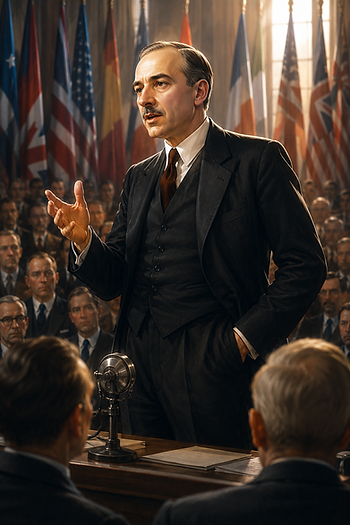
My Name is John Maynard Keynes: Economist, and Modern Economic Architect
I was born in Cambridge, England, in 1883. I entered a world where ideas were treated with the same respect that others reserved for wealth or political power. My father was an economist, and my mother was deeply involved in public service. From an early age I learned that questions were worth asking and that careful reasoning could solve problems that emotion alone could not. I found great pleasure in mathematics, philosophy, and history, believing that every difficult problem had an answer if one searched long enough.
Learning to Understand the World
My years at Eton and later at King's College, Cambridge, strengthened my conviction that knowledge should serve practical purposes. I admired elegant theories, but I admired useful ideas even more. Many economists believed that markets would naturally correct themselves if governments simply waited. I respected much of their work, yet I also believed that theories should answer to reality. If facts changed, then wisdom demanded that our conclusions change as well.
Watching the Old Order Fail
After the First World War, I attended the peace conference at Versailles. I watched governments negotiate not only peace but punishment. It became clear to me that crushing Germany with impossible financial demands would not produce lasting stability. I warned that Europe needed economic recovery rather than revenge. Many dismissed those concerns, yet the years that followed seemed to confirm my fears as instability spread across the continent.
The Great Depression Challenges Old Beliefs
When the Great Depression swept across the world, millions lost their jobs while factories stood silent and businesses closed their doors. I could not accept the argument that governments should simply wait for prosperity to return on its own. Idle workers and idle factories represented wasted opportunity. A nation, I believed, should not remain frozen while its people suffered. If private investment disappeared, then public investment could keep economies moving until confidence returned.
A Different Way of Thinking
Some criticized my proposals because they called for governments to spend money during difficult times, even if it meant borrowing. To me, this was not recklessness but common sense. Families tighten their budgets during hardship because they cannot create income. Governments, however, possess tools that families do not. They can build roads, schools, bridges, and public works that employ workers today while strengthening the nation for tomorrow. Economics should improve human lives, not merely balance columns of numbers.
Teaching and Influencing Nations
I spent much of my life writing books, advising governments, and teaching students. My ideas gradually spread beyond Britain, influencing leaders throughout Europe and North America. During the Second World War and afterward, I helped shape plans for rebuilding international finance. I believed that stable economies and cooperation between nations offered the best hope for lasting peace. Prosperity was not merely about wealth; it was one of the strongest defenses against conflict.
The Depression Becomes a Global Crisis (1929–1930) – Told by John Keynes
When many people think of the Great Depression, they imagine traders shouting on Wall Street in New York as stock prices collapsed in October 1929. That scene was dramatic, but it was only the beginning. The real story is not how one nation's stock market fell, but how the entire world's economy became tightly connected like gears in a great machine. When one important gear broke, the others could not continue turning for long. The financial crisis did not remain in America because banks, businesses, and governments across the globe had spent years lending to one another, investing together, and depending upon international trade. A crisis in one nation quickly became a crisis for nearly every nation.
The Invisible Web of World Finance
During the prosperous 1920s, American banks and investors sent enormous sums of money overseas. Germany relied heavily on American loans to rebuild after the First World War and to make its reparations payments under agreements such as the Dawes Plan and the Young Plan. Britain and France, in turn, depended on Germany's payments to help repay the massive debts they owed the United States from the war. This created an international chain of financial obligations. As long as American money continued flowing, the system appeared stable. Yet it was balanced upon confidence rather than certainty. Once investors grew fearful and began calling in loans after the Wall Street Crash, the chain began to break link by link.
Banks Lose Confidence
Financial systems are built upon trust. A bank can lend money because depositors believe their savings are safe, borrowers believe credit will remain available, and investors believe tomorrow will resemble today. After the stock market crash, those assumptions vanished. American banks became cautious and demanded repayment of overseas loans. European banks suddenly found themselves short of cash. Businesses that depended on borrowed money could no longer obtain it. Investments stopped, factories reduced production, and unemployment began climbing long before many people fully understood what was happening.
Trade Between Nations Begins to Shrink
The financial panic soon spread beyond banks into world commerce. Consumers everywhere had less money to spend, which meant fewer goods were purchased. Factories slowed production because warehouses filled with products that could not be sold. Nations attempted to protect their own industries by raising tariffs on imported goods. While this seemed sensible to many governments, it produced the opposite effect internationally. Countries bought less from one another, ships carried fewer cargoes, and ports that had once bustled with activity became increasingly quiet. International trade, the lifeblood of many economies, began to contract at an alarming rate.
The Human Cost Behind the Numbers
Economists often speak in figures, percentages, and statistics, but behind every declining number stood real families. A closed factory meant a father or mother without wages. A failed bank meant a lifetime of savings disappearing overnight. A farmer unable to sell crops often lost the land that had belonged to the family for generations. Shopkeepers watched customers disappear, teachers worried about hungry children, and governments struggled to provide relief. The Depression became global because hardship itself became global, touching people who had never owned a single share of stock in New York.
Lessons from the Beginning of the Crisis
The events of 1929 and 1930 revealed that modern economies had become far more connected than many leaders appreciated. Capital, trade, and confidence crossed borders as easily as ships crossed oceans. The collapse demonstrated that prosperity could not be understood as merely a national achievement, nor could financial disasters be contained within one country's borders. It convinced me that governments must think beyond old assumptions and recognize that preserving confidence, maintaining employment, and encouraging economic cooperation were not simply domestic concerns. They had become international responsibilities in an increasingly interconnected world.
Europe's Banking Failures and Financial Panic (1930–1931) – Told by John Keynes
The years 1930 and 1931 taught Europe a painful lesson that I had long feared. Banks do not fail simply because they run out of money. They fail because people lose confidence. Once depositors believe a bank may collapse, they rush to withdraw their savings. Even a well-managed bank cannot survive if everyone demands their money at once. During these years, fear spread through Europe's financial system more quickly than any army could have marched across the continent, and confidence disappeared almost overnight.
A Fragile Financial System
Europe had entered the Great Depression already carrying heavy burdens from the First World War. Governments owed enormous debts, businesses depended upon borrowed money, and many banks held investments that had lost much of their value after the Wall Street Crash. Germany remained dependent upon foreign loans, particularly from American banks, while Austria struggled with a weak economy and declining trade. Financial institutions were connected across national borders, meaning that trouble in one country could quickly become trouble in another.
The Fall of Credit-Anstalt
The greatest shock came in May 1931 when Austria's largest bank, Credit-Anstalt, announced that it could no longer cover its enormous losses. The bank had financed many of Austria's industries, so its weakness threatened much more than one financial institution. Depositors rushed to withdraw their money, investors lost confidence, and foreign lenders became increasingly reluctant to provide additional support. Governments attempted to stabilize the situation, but the panic had already begun. Around Europe, people wondered whether their own banks might be next.
Germany Faces a Banking Crisis
The crisis soon crossed the border into Germany, where banks were already under severe pressure. American lenders demanded repayment of loans, while nervous depositors withdrew their savings in growing numbers. German banks found themselves short of cash just as businesses needed credit the most. Several major institutions were forced to close temporarily, and in July 1931 the German government declared a banking holiday, shutting banks for several days to slow the panic. Instead of reassuring the public, the closures demonstrated how serious the situation had become.
Credit Dries Up Across Europe
A healthy economy depends upon credit. Farmers borrow money to plant crops, manufacturers borrow to purchase machinery, merchants borrow to stock their shelves, and families borrow to buy homes. During the financial panic, banks became unwilling or unable to lend. Businesses canceled expansion plans, factories reduced production, and employers laid off workers. The shortage of credit spread throughout Europe, turning what had begun as a financial crisis into a broader economic collapse. The absence of lending became as damaging as the original banking failures themselves.
Fear Becomes More Powerful Than Facts
One of the most dangerous features of financial panic is that fear often grows faster than evidence. Rumors of weakness encouraged more withdrawals, and more withdrawals created genuine weakness. Healthy businesses failed because banks could no longer finance them. Banks weakened because businesses could not repay their loans. This vicious cycle fed upon itself, making recovery increasingly difficult. Confidence, once lost, proved far harder to restore than many political leaders had imagined.
The Lesson Europe Learned
The banking failures of 1930 and 1931 demonstrated that modern economies require more than balanced ledgers. They require stable financial institutions and governments prepared to prevent panic from becoming catastrophe. Europe learned that banks were not isolated businesses but essential foundations of commerce, employment, and public confidence. When those foundations cracked, the effects reached factories, farms, schools, and homes across the continent. The crisis strengthened my conviction that governments could not simply stand aside while financial systems collapsed. Without decisive action, fear itself could become one of the most destructive economic forces in the world.
International Trade Comes to a Standstill – Told by John Maynard Keynes
Before the Great Depression, the world's economies were linked together by an immense network of trade. Ships crossed oceans carrying wheat from Canada, coffee from Brazil, cotton from Egypt, rubber from Southeast Asia, machinery from Germany, textiles from Britain, and manufactured goods from the United States. Every nation depended, in one way or another, upon buying from others and selling to others. This international exchange created prosperity, but it also created dependence. When trade slowed, the effects reached far beyond the docks and marketplaces.
Demand Begins to Collapse
After the financial panic of 1929 and 1930, businesses reduced production and workers lost their jobs. Unemployed families could no longer afford to purchase as many goods, causing demand to fall sharply. Factories that once operated day and night suddenly found warehouses filling with products that could not be sold. Farmers harvested crops that brought only a fraction of their former prices. As spending declined in one nation, exporters in another found fewer customers. The decline spread from country to country like a row of falling dominoes.
Tariffs Promise Protection
Faced with growing unemployment, many governments believed they could protect their industries by raising tariffs on imported goods. A tariff is a tax placed on products entering a country, making foreign goods more expensive. The United States passed the Smoot-Hawley Tariff Act in 1930, raising duties on thousands of imported products. Many American leaders hoped consumers would instead buy goods made at home, preserving jobs and strengthening domestic businesses. At first glance, the idea appeared reasonable.
Retaliation Across the Globe
The difficulty was that other nations responded in exactly the same manner. Canada, Britain, France, Germany, Italy, and many others raised their own tariffs or introduced trade restrictions against foreign products. Instead of protecting prosperity, these actions reduced it. Countries bought less from one another, exporters lost customers, shipping companies carried fewer cargoes, and manufacturers saw foreign markets disappear. Each nation attempted to protect itself, yet together they weakened the international economy even further.
Commerce Nearly Stops
Between 1929 and 1933, world trade fell dramatically, declining by roughly two-thirds in total value. Ports that had once been crowded with merchant ships became unusually quiet. Freight trains carried fewer goods across continents, factories closed assembly lines, and farmers watched crops remain unsold. Nations that relied heavily on exports suffered especially severe hardships. Countries producing coffee, sugar, rubber, wheat, copper, and many other raw materials experienced collapsing prices that devastated both businesses and families.
A World Growing More Divided
As trade declined, many nations turned inward. Governments encouraged economic self-sufficiency, believing they should depend less upon foreign markets. Some formed exclusive trading blocs with their colonies or close allies, while others tightly controlled imports and exports. These policies reduced international cooperation at precisely the moment when cooperation was most needed. Economic disagreements increasingly strained diplomatic relationships, making it more difficult for nations to work together on other growing international problems.
The Lesson of Closed Markets
The Great Depression revealed that no industrial nation could prosper for long if every nation attempted to stand alone. Trade is not merely the exchange of goods; it is the exchange of opportunity, employment, investment, and confidence. Closing markets may appear to offer temporary relief, but widespread protectionism often leaves everyone poorer. I became convinced that lasting recovery required nations to restore commerce rather than restrict it. Prosperity grows strongest when countries exchange their talents and resources freely, for economic cooperation has always proven more powerful than economic isolation.

My Name is Hjalmar Schacht: Banker, Economist, and President of the Reichsbank
I was born in 1877 in the town of Tinglev, then part of the German Empire. My parents valued education, discipline, and hard work, and I soon discovered that I was fascinated by economics, commerce, and the forces that moved nations. While others dreamed of commanding armies or leading political movements, I believed that money, credit, and confidence could shape the destiny of countries just as surely as soldiers and generals.
Learning the Business of Banking
After studying economics and political science, I entered the world of banking. I worked diligently, learning that prosperity rests not only upon factories and farms but also upon trust. A banknote has little value if no one believes in it. A nation's currency is more than paper—it is a promise. If that promise is broken, confidence disappears, and economies can collapse with astonishing speed. These lessons remained with me throughout my career.
Germany's Greatest Financial Crisis
The years after the First World War tested Germany as few nations have ever been tested. Reparations, political instability, and reckless printing of money produced the terrible hyperinflation of 1923. Prices rose by the hour, families carried baskets of banknotes to buy bread, and lifelong savings became worthless. As Commissioner for Currency and later President of the Reichsbank, I helped introduce the Rentenmark, a new currency designed to restore stability. Money alone did not solve every problem, but restoring confidence allowed Germany to begin standing on its feet once again.
The Great Depression Arrives
Just as Germany regained some stability, the Great Depression swept across the world. International loans disappeared, businesses failed, and unemployment climbed into the millions. Economic despair spread through every city and village. I believed governments had to rebuild confidence by restoring production and encouraging investment. Factories could not remain silent forever. A nation that loses faith in its economy eventually begins losing faith in its institutions as well.
Returning to Public Service
When Adolf Hitler became Chancellor in 1933, I returned as President of the Reichsbank and later served as Minister of Economics. My responsibility was to revive Germany's economy after years of hardship. We expanded public works, improved infrastructure, and developed financial methods that reduced unemployment. Many Germans experienced renewed hope as jobs returned and industry expanded. My concern remained economic recovery, not political ideology. I believed a strong economy was essential for national stability.
When Economics and Politics Collided
As the years passed, it became increasingly clear that Germany's economic revival was becoming tied to military expansion on a scale that troubled me. I favored rebuilding prosperity, but I questioned policies that pushed the nation toward unlimited rearmament and growing conflict. My disagreements with other leaders became more pronounced, and my influence steadily declined. Eventually I left the positions I had once held with such authority, recognizing that economic judgment had given way to political ambition.
Germany's Economic Collapse and Mass Unemployment – Told by Hjalmar Schacht
When many people think of Germany during the early 1930s, they immediately think of politics. I ask you to look first at the economy, for it was there that much of the nation's despair began. By the time I returned to public service, Germany had endured years of financial instability, heavy reparations after the First World War, and then the worldwide shock of the Great Depression. Factories stood idle, businesses closed their doors, and millions of capable men and women searched for work that simply did not exist. Before political movements gained their greatest strength, economic suffering had already weakened the confidence of an entire nation.
The World Stops Lending
During the 1920s, Germany depended heavily upon loans from the United States to rebuild industry and finance recovery. These loans supported businesses, local governments, and public projects across the country. When the Wall Street Crash occurred in 1929, American banks demanded repayment and dramatically reduced new lending. German banks suddenly found themselves without the credit upon which they had relied. Businesses that had planned to expand instead struggled merely to survive, and investment nearly disappeared.
Businesses Close Their Doors
Without access to loans, many companies could no longer purchase raw materials, modernize equipment, or pay their workers. Large factories reduced production while thousands of smaller businesses simply failed. Every closure created another wave of unemployment, and every unemployed worker spent less money in local shops. Merchants lost customers, restaurants emptied, and suppliers received fewer orders. The collapse spread through the economy in a relentless cycle, where each failure produced another.
Millions Without Work
By early 1932, Germany's unemployment reached approximately six million people, representing nearly one-third of the workforce. The numbers alone cannot tell the full story. Families exhausted their savings, skilled craftsmen could not practice their trades, and young people often found themselves entering adulthood without hope of employment. Soup kitchens became common, charitable organizations struggled to meet growing needs, and many citizens questioned whether democratic institutions could solve problems of such enormous scale.
Desperation Changes Public Opinion
Economic hardship does more than empty wallets—it tests faith in government itself. As unemployment worsened, many Germans lost confidence in the leaders who had guided the Weimar Republic. Political parties that promised rapid and dramatic solutions attracted increasing support. Some citizens sought answers from the political left, while others turned to the political right. Fear, frustration, and uncertainty often encourage people to embrace ideas they might have rejected during times of prosperity. Economic collapse became fertile ground for political extremism of many kinds.
Searching for Recovery
When I returned as President of the Reichsbank in 1933 and later became Minister of Economics, my principal concern was restoring economic activity. Germany needed functioning banks, growing industries, and meaningful employment. Public works projects, expanded construction, and financial innovations helped stimulate production and reduce unemployment. Confidence slowly began returning as factories reopened and workers earned wages once again. I believed that an economy must first regain movement before it could regain lasting strength.
Lessons from Germany's Crisis
The years before Germany's new government fully consolidated its power demonstrated how profoundly economic conditions can shape history. Financial collapse, business failures, and mass unemployment did not automatically determine Germany's political future, but they created circumstances in which extraordinary promises became increasingly attractive to desperate citizens. Looking back, I remain convinced that stable banking, responsible finance, and meaningful employment are not merely economic objectives. They are essential safeguards for every free and orderly society. When millions lose hope in their economic future, they may begin searching for certainty wherever they believe it can be found.
Britain, France, and Europe's Different Paths to Recovery – Told by John Keynes
By the early 1930s, Europe faced a question that no generation of economists had answered on such a scale: How could nations recover from an economic collapse that had spread across continents? There was no single instruction manual waiting upon a shelf. Every government had its own history, resources, political traditions, and financial burdens. Some leaders believed budgets should remain balanced even during hardship, while others argued that governments must spend more to revive employment. Across Europe, nations became laboratories, each testing a different path toward recovery.
Britain Leaves the Gold Standard
One of the most significant decisions occurred in Britain in 1931 when the government abandoned the gold standard. Under that system, the value of the British pound had been tied to a fixed quantity of gold. During the Depression, maintaining that link became increasingly difficult because it limited the government's ability to respond to economic crisis. Once Britain left the gold standard, the pound lost some of its value, making British exports less expensive for foreign buyers. Manufacturers found it easier to sell goods abroad, helping industries slowly regain strength while allowing the government greater flexibility in managing the economy.
Public Works and Lower Interest Rates
Britain also encouraged recovery by lowering interest rates, making it less expensive for businesses and families to borrow money. Home construction increased, new neighborhoods appeared, and infrastructure projects created employment. Recovery did not arrive all at once, nor did every region benefit equally. Heavy industrial areas continued to struggle, but housing construction, consumer spending, and expanding industries gradually strengthened much of the British economy. These developments demonstrated that confidence could return when governments created conditions that encouraged investment rather than fear.
France Chooses a Different Course
France traveled a more cautious road. French leaders remained committed to maintaining the value of their currency and balancing government finances. For several years, France experienced the Depression less severely than some neighboring countries, partly because its banking system had avoided some of the earlier financial shocks. Yet as international trade continued to weaken, France could no longer escape the worldwide slowdown. By the mid-1930s, unemployment and declining production forced French leaders to reconsider their policies.
The Popular Front Government
In 1936, the Popular Front coalition under Léon Blum introduced a series of labor and social reforms designed to improve workers' lives while stimulating demand. The government established the forty-hour workweek, guaranteed paid vacations for many workers, and supported collective bargaining between employers and labor unions. These measures improved conditions for countless families, although businesses sometimes struggled with rising costs and slower production. France's experience showed that economic recovery involved not only financial decisions but also debates about the proper relationship between workers, employers, and government.
Many Nations, Many Solutions
Elsewhere across Europe, governments pursued their own combinations of currency adjustments, banking reforms, tariffs, public spending, and industrial policies. Sweden expanded social welfare programs and public investment. Smaller nations experimented with agricultural supports and banking reforms. Some governments intervened heavily in their economies, while others relied more upon private enterprise. The diversity of approaches reflected an important truth: nations facing similar problems often arrive at different solutions because their circumstances are never exactly alike.
Lessons from Europe's Experiment
The Depression taught me that economies are not governed by rigid laws that produce identical results in every nation. Policies must respond to the realities before them rather than the assumptions of the past. Britain's departure from the gold standard, France's labor reforms, and the many experiments across Europe demonstrated that governments were willing to challenge long-held economic traditions when circumstances demanded it. Recovery was neither simple nor immediate, but these experiences strengthened my conviction that thoughtful public action, flexible monetary policy, and practical adaptation offered far greater hope than waiting passively for prosperity to return on its own.

My Name is Lázaro Cárdenas: President of Mexico and Reformer of a Nation
I did not grow up surrounded by luxury or powerful connections. I was born in 1895 in the small town of Jiquilpan, in the Mexican state of Michoacán. My family worked hard to provide for one another, and like many ordinary Mexicans, we understood the value of honest labor. My education ended early because my family needed me to help earn a living, but I never stopped learning from the people around me or from the struggles my country faced.
The Revolution Shapes My Life
As a young man, I witnessed the violence and inequality that pushed Mexico into revolution. I joined the Constitutionalist Army while still in my teens, believing that our nation deserved a government that served its people rather than a privileged few. The Revolution was not glorious. It was difficult, dangerous, and filled with sacrifice. Yet it taught me that lasting peace could never exist where justice was absent. By working hard and earning the trust of those around me, I rose through the ranks and became a military officer.
From Soldier to Public Servant
After the fighting subsided, I chose a different battlefield. Instead of commanding soldiers, I began serving the people through government. I became governor of Michoacán, where I worked to improve schools, roads, and opportunities for rural families. I spent time visiting villages instead of remaining behind a desk because I believed leaders should understand the lives of those they represented. A government could not solve problems it refused to see with its own eyes.
Leading Mexico Through Difficult Times
In 1934, I became President of Mexico while much of the world was trapped in the Great Depression. Countries everywhere struggled with unemployment, falling prices, and uncertainty. Mexico faced these same hardships, but I believed our future depended on strengthening our own people. We expanded land reform, giving farmland to thousands of rural communities. We encouraged education, supported workers, and invested in projects that would help Mexico become less dependent on foreign powers. I wanted every citizen to feel that the nation belonged to them.
Standing Up for Mexico's Resources
Perhaps the decision for which I am best remembered came in 1938, when my government nationalized Mexico's oil industry. Foreign companies had long controlled much of our petroleum, but I believed these resources belonged to the Mexican people. The decision brought criticism and economic pressure from abroad, yet citizens from every corner of the country donated money, jewelry, livestock, and whatever they could spare to support the nation. Their sacrifice reminded me that a country's greatest wealth is not found beneath the ground but within the hearts of its people.
A Nation Built by Its Citizens
Throughout my years in public service, I tried to remember those who worked the fields, built the roads, and raised families far from the capital city. I believed that education should reach every child, that workers deserved dignity, and that government existed to serve the people rather than itself. Mexico still faced many challenges, but I hoped that each reform brought us one step closer to a stronger and more united nation.
Latin America's Export Economies Collapse – Told by Lázaro Cárdenas
For many years before the Great Depression, much of Latin America earned its living by selling its natural resources to the rest of the world. Coffee from Brazil and Colombia, sugar from Cuba, copper from Chile, silver from Mexico, bananas from Central America, beef from Argentina, and countless other products traveled aboard ships to distant markets. These exports built railroads, financed governments, and provided employment for millions of workers. As long as the world continued buying, our economies appeared strong. Yet we depended upon customers beyond our own borders, and that dependence carried hidden dangers.
The World Stops Buying
When the Great Depression spread across Europe and North America, families and businesses everywhere reduced their spending. Factories needed fewer raw materials, merchants ordered fewer products, and consumers purchased only what they considered essential. Demand for Latin America's exports fell sharply. Coffee warehouses filled with unsold beans, sugar mills slowed production, and mining companies found fewer buyers for copper and silver. Goods that had once been valuable suddenly became difficult to sell at any price.
Prices Fall Faster Than Production
The greatest challenge was not simply that exports declined, but that prices collapsed. A farmer who harvested the same amount of coffee often earned only a fraction of what he had received a few years earlier. Copper miners worked just as hard while their companies earned far less from every shipment. Governments that relied upon export taxes suddenly collected much less revenue. Even when crops were plentiful or mines remained productive, incomes continued to fall because world prices had dropped so dramatically.
Families Feel the Burden
Behind every falling price stood ordinary people trying to provide for their families. Plantation workers lost their jobs as landowners reduced production. Miners faced layoffs as companies closed unprofitable operations. Small merchants found fewer customers because unemployed workers had little money to spend. Rural communities that depended upon a single crop or industry suffered especially severe hardships. Many families left the countryside hoping to find work in growing cities, while others endured years of uncertainty without knowing when conditions might improve.
Governments Search for New Answers
The crisis forced leaders throughout Latin America to reconsider the way our economies operated. Depending almost entirely upon foreign markets had left many nations vulnerable to events beyond their control. Governments began encouraging industries that could manufacture goods at home rather than importing everything from abroad. This approach, later known as import substitution industrialization, sought to create new factories, new jobs, and greater economic independence. Progress came slowly, but many believed our nations needed stronger domestic industries if they were to withstand future global crises.
Mexico's Response
When I became President of Mexico in 1934, our country also faced declining export earnings and widespread hardship. We expanded land reform, invested in education, supported workers' rights, and encouraged industries that could strengthen our economy from within. In 1938, we nationalized Mexico's oil industry, believing that the nation's natural resources should benefit its own people. These policies did not erase every difficulty, but they reflected a determination to reduce dependence upon foreign markets alone.
Lessons from the Collapse
The Great Depression taught Latin America that abundant natural resources do not guarantee lasting prosperity. A nation that relies too heavily upon selling a few products abroad remains vulnerable when distant markets falter. Coffee, sugar, copper, silver, and countless other exports helped build our economies, yet they also revealed our dependence upon forces beyond our control. The crisis encouraged many Latin American nations to diversify their industries, strengthen their domestic economies, and seek greater control over their own economic future. It was a difficult lesson, but one that shaped the region for generations to come.
Reform and Nationalism in Latin America – Told by Lázaro Cárdenas
The Great Depression forced Latin America to ask difficult questions about its future. For decades, many of our nations had depended upon exporting raw materials while importing manufactured goods from wealthier countries. When world markets collapsed, that system revealed its weaknesses. Factories closed, farms struggled, and government revenues declined. Across the region, leaders began asking whether our countries could become stronger by relying more upon their own people, industries, and resources. This desire for greater self-reliance became one of the defining movements of the 1930s.
Giving Land Back to the People
One of the greatest concerns throughout Latin America was the unequal ownership of land. In many countries, vast estates were controlled by a small number of wealthy landowners, while millions of rural families owned little or no farmland. In Mexico, we continued the land reforms that had begun after our Revolution by distributing millions of acres to farming communities known as ejidos. The goal was not simply to divide land but to give hardworking families the opportunity to support themselves, strengthen local agriculture, and reduce poverty in the countryside.
Protecting the Rights of Workers
Economic hardship also reminded us that strong nations depend upon productive workers who are treated with dignity. During my presidency, labor unions gained greater legal recognition, workers won stronger protections, and negotiations between employers and employees became more organized. Across Latin America, governments increasingly recognized that fair wages, safer working conditions, and reasonable hours could contribute to both social stability and economic growth. Prosperity should not belong only to those who owned businesses but also to those whose labor built them.
Building Industries at Home
The Depression convinced many governments that importing nearly everything from foreign factories left our economies vulnerable. As international trade slowed, Latin American nations began encouraging the construction of their own factories to produce textiles, machinery, processed foods, and other manufactured goods. Governments often supported these new industries through loans, protective tariffs, or direct investment. This strategy, known as import substitution industrialization, sought to create jobs while reducing dependence upon overseas manufacturers. It marked an important shift from economies based primarily on agriculture and mining toward more diversified industrial development.
National Resources for National Benefit
Perhaps the clearest example of economic nationalism in Mexico came in 1938 when my government nationalized the nation's oil industry. Foreign companies had invested heavily in developing Mexico's petroleum fields, but many Mexicans believed these valuable resources should serve the country's own citizens. The decision attracted international criticism and economic pressure, yet it also inspired remarkable unity within Mexico. People from every walk of life contributed money and valuables to support the nation during this difficult period. It demonstrated that economic decisions could strengthen a country's sense of national identity as well as its finances.
Different Nations, Similar Goals
Although each Latin American country followed its own path, many pursued similar objectives during the Depression. Brazil expanded government involvement in industry under Getúlio Vargas. Argentina encouraged domestic manufacturing. Chile sought to rebuild after the collapse of copper exports. Throughout the region, governments became more active participants in economic planning than they had been before the crisis. While the methods differed, the common goal remained the same: to create stronger economies that could better withstand future international shocks.

My Name is Chiang Kai-shek: Military Leader and President of Republic of China
My country possessed a proud civilization stretching back thousands of years, yet it was weakened by foreign influence, internal rebellion, and declining imperial rule. I was born in 1887 in Zhejiang Province during the final years of China's Qing Dynasty. Even as a young man, I believed China could not survive unless it became disciplined, united, and strong. A divided nation invited danger, while a united nation could determine its own future.
Learning the Discipline of a Soldier
I devoted myself to military study because I believed that ideas alone could not protect a nation. I trained in China and later in Japan, where I carefully observed modern armies and the importance of organization. I admired discipline, sacrifice, and loyalty. A military, however, was only a tool. Its purpose was not endless warfare but the preservation of order and the defense of the nation. Without stability, prosperity could never take root.
Following Dr. Sun Yat-sen
My life changed when I came to work alongside Dr. Sun Yat-sen, the great revolutionary who sought to replace imperial rule with a republic. I respected him not only as a leader but as a teacher. He believed that China could become modern while remaining true to its heritage. After his death, I accepted the heavy responsibility of carrying his vision forward. It was not enough to remove the old government; we had to build a stronger one in its place.
The Long Struggle for Unity
China remained fractured by regional warlords, political rivals, and growing communist forces. I led the Northern Expedition to reunify much of the country under the National Government. It required determination, careful planning, and difficult choices. I believed that a divided China could not defend itself against foreign powers. Order had to come before lasting reform. Without unity, every achievement would eventually crumble.
Depression and Foreign Threats
While much of the world suffered through the Great Depression, China faced economic hardship alongside repeated natural disasters and increasing military pressure from Japan. Our industries were weak, trade declined, and millions of farmers struggled simply to survive. At the same time, Japan expanded into Manchuria and later launched a full invasion of China. We were forced to fight for our nation's existence while attempting to strengthen its economy. These were not separate battles but different fronts in the same struggle for survival.
War Above All Else
The war against Japan demanded every resource we possessed. Cities fell, civilians fled, and soldiers endured unimaginable hardships. We sought aid from foreign nations while trying to preserve our independence. I often reminded my officers that courage alone was insufficient; discipline, endurance, and faith in our country's future were equally necessary. A nation does not survive because it avoids hardship. It survives because its people refuse to surrender.
China's Economic Hardships During the Depression – Told by Chiang Kai-shek
When the Great Depression spread across the world, China did not enter the crisis from a position of great strength. Our nation had already endured decades of political upheaval, civil conflict, foreign intervention, and economic uncertainty. Much of our population depended upon agriculture, while modern industries remained limited compared to those of Europe, Japan, or the United States. The Depression did not create all of China's problems, but it made nearly every existing challenge more severe. We faced an economic crisis while still trying to build a stable and united republic.
Life in the Countryside
Most Chinese families lived in rural villages, earning their livelihoods by farming small plots of land. Even in good years, many farmers struggled to produce enough food and income to support their families. When world prices for agricultural products declined during the Depression, farmers earned even less for their crops. Debt became more difficult to repay, taxes remained burdensome in many regions, and poverty deepened across the countryside. For millions of families, survival depended upon careful use of every grain harvested from the fields.
Floods Bring Even Greater Suffering
Nature added to the hardships. In 1931, devastating floods along the Yangtze, Huai, and Yellow Rivers became some of the deadliest natural disasters in recorded history. Heavy rains overwhelmed river systems, destroying villages, washing away crops, and leaving millions homeless. Disease and famine often followed as clean water became scarce and food supplies disappeared. Even as government officials worked to organize relief efforts, the scale of the disaster exceeded the resources available. The floods transformed an already difficult economic situation into a humanitarian catastrophe for countless communities.
Weak Industry and Limited Resources
Unlike the major industrial powers, China possessed relatively few modern factories capable of driving rapid economic growth. Manufacturing remained concentrated in only a handful of cities, while transportation networks were still developing. Railroads, highways, and communication systems were often incomplete or damaged by years of conflict. As international trade declined during the Depression, foreign investment slowed and opportunities for industrial expansion became even more limited. Building a stronger economy required resources that were increasingly difficult to obtain.
Trade Declines and Foreign Pressure Grows
China depended upon international trade for many important goods and sources of income. As world commerce slowed, exports such as silk, tea, and other products brought in less revenue. At the same time, Japan expanded its influence in East Asia. In 1931, Japanese forces seized Manchuria, one of China's most valuable industrial and agricultural regions. Losing this territory weakened our economy even further by reducing access to important factories, railways, coal mines, and farmland. Economic hardship and foreign aggression became inseparable challenges.
Holding the Nation Together
Throughout these years, my government sought to strengthen China's finances, improve transportation, expand education, and encourage industrial development whenever possible. Yet every effort was complicated by civil unrest, regional divisions, natural disasters, and the growing military threat from Japan. We often found ourselves attempting to rebuild while simultaneously defending the nation. It was a difficult balance, requiring sacrifice from soldiers, workers, farmers, and government officials alike.
Lessons from China's Struggles
The Great Depression revealed that economic weakness leaves nations vulnerable not only to poverty but also to external danger. A country burdened by widespread hardship finds it more difficult to defend itself, educate its people, and invest in its future. China's experience during the 1930s demonstrated that natural disasters, declining trade, limited industry, and foreign aggression can combine into a crisis far greater than any one challenge alone. It strengthened my belief that national unity, economic development, and disciplined leadership were essential if China was to endure the trials that still lay ahead.
Japan Responds Through Expansion – Told by Chiang Kai-shek
The Great Depression did not strike China alone. Japan also experienced falling exports, factory closures, unemployment, and growing uncertainty. For many years, Japan had built a powerful industrial economy that depended upon imported raw materials and overseas markets. When world trade slowed after 1929, Japanese businesses struggled to sell manufactured goods abroad, while industries worried about securing the coal, iron, oil, and other resources needed to keep factories operating. Many Japanese leaders concluded that relying upon international trade alone left their nation vulnerable.
Military Leaders Gain Influence
During these difficult years, the influence of Japan's military grew steadily stronger. Many officers argued that the country should expand its control over nearby territories rather than depend upon uncertain foreign markets. They believed that acquiring land rich in natural resources would strengthen Japan's economy while providing new markets for its industries. Civilian leaders often found it increasingly difficult to restrain these ambitions, and military commanders began taking bold actions that reshaped East Asia.
The Invasion of Manchuria
In September 1931, Japanese officers used an explosion along the South Manchurian Railway, known today as the Mukden Incident, as justification for launching a rapid invasion of Manchuria in northeastern China. Within a matter of months, Japanese forces occupied the region despite limited resistance from local Chinese troops. Manchuria was enormously valuable. It contained fertile farmland, rich deposits of coal and iron ore, expanding industries, and an extensive railway network. For Japan, controlling these resources promised greater economic security. For China, it represented the loss of one of our most important provinces.
A New State Under Japanese Control
In 1932, Japan established the state of Manchukuo, presenting it as an independent nation while maintaining effective control through the Japanese military. The former Qing emperor, Puyi, was installed as its ruler, though real authority rested elsewhere. Few countries accepted Manchukuo as a legitimate independent state. The League of Nations investigated the situation and concluded that Japan had acted aggressively. Rather than withdraw its forces, Japan rejected the criticism and eventually withdrew from the League in 1933, signaling its willingness to pursue its own course regardless of international opinion.
China Faces a Difficult Choice
Many people have asked why China did not immediately launch a full-scale war to recover Manchuria. The answer lies in the difficult realities our nation faced. We were still working to unify the country after years of civil conflict, regional warlord rule, and Communist uprisings. Our military was improving but remained unevenly equipped compared with Japan's modern armed forces. I believed that preserving China's strength while continuing to build national unity was essential if we were to resist future aggression successfully. It was a painful decision, but one made under extraordinary circumstances.
The Road Toward Greater Conflict
Japan's occupation of Manchuria encouraged further expansion. Military success strengthened those who believed force could solve economic and political problems. Throughout the 1930s, tensions between China and Japan continued to rise as additional clashes occurred along the border. The conflict that began in Manchuria did not remain confined there. In 1937, full-scale war erupted following the Marco Polo Bridge Incident, drawing millions into one of the largest conflicts in Asia before the Second World War had fully spread across Europe.
Lessons from Expansion
The events in Manchuria demonstrated that economic hardship can influence decisions far beyond finance. Nations struggling with recession and declining trade may search for solutions through diplomacy, reform, or cooperation—but some may instead pursue expansion through military force. Japan's leaders believed that controlling territory would guarantee resources and strengthen their economy. Instead, their actions deepened instability throughout Asia and set the region upon a path toward years of devastating war. It remains a reminder that lasting prosperity cannot be built upon conquest alone, for military victories often carry consequences far greater than those who begin them anticipate.
Worldwide Humanitarian Challenges – Told by Lázaro Cárdenas
When people speak of the Great Depression, they often describe falling stock prices, failed banks, or shrinking international trade. Those events were important, but they were only the beginning. The true measure of the Depression was found in the lives of ordinary families. Across North and South America, Europe, Asia, and parts of Africa, millions faced hunger, unemployment, uncertainty, and displacement. The crisis was not confined by borders. It reached villages, cities, farms, factories, and homes throughout the world.
When Work Disappears
The closing of factories, mines, plantations, and businesses left millions without reliable income. In industrial cities, skilled workers stood in long lines hoping for jobs that never appeared. Farmers often continued producing crops, yet falling prices meant they earned too little to support their families. Parents postponed purchases, repaired worn clothing instead of buying new garments, and carefully stretched every meal. Children frequently left school to help support their households, while older family members continued working long after they had hoped to retire.
The Struggle for Food
The Depression created a cruel contradiction. In some places, food remained available, yet many families lacked the money to buy it. Elsewhere, droughts, floods, or poor harvests reduced supplies, creating genuine shortages. Soup kitchens, charitable organizations, churches, and local communities worked tirelessly to feed the hungry. Governments also introduced relief programs wherever resources allowed. Even so, many families survived only by sharing with neighbors, growing small gardens, raising livestock, or relying upon relatives during the hardest years.
Migration in Search of Hope
As opportunities disappeared, millions of people left their homes searching for work. Rural families moved into growing cities, believing factories might offer employment. Others traveled across provinces or national borders in search of better conditions. Some returned to the villages where they had been born, hoping the land could provide food when wages disappeared. Migration reshaped communities across the globe, bringing both opportunity and hardship as newcomers struggled to establish new lives in unfamiliar places.
Workers Demand Change
Economic hardship also transformed relationships between workers, employers, and governments. Labor strikes became more common in many countries as workers demanded fair wages, safer conditions, and greater job security. Farmers organized cooperatives to strengthen their bargaining power, while labor unions expanded their influence in factories and mines. Governments increasingly recognized that ignoring widespread hardship could lead to greater unrest. Across Latin America and much of the world, debates over workers' rights became central to discussions about economic recovery.
Communities Help One Another
Although the Depression revealed great suffering, it also revealed remarkable generosity. Families shared what little they possessed. Churches organized food distributions, neighbors repaired one another's homes, and local charities provided clothing and medical assistance. Teachers often helped feed hungry children before beginning lessons. In villages and cities alike, ordinary citizens demonstrated that compassion could endure even during the darkest economic times. Their quiet acts of kindness rarely appeared in newspaper headlines, yet they sustained countless lives.
New Economic Ideas Change Governments – Told by John Maynard Keynes
The Great Depression forced governments to confront a question that had rarely been asked so directly: What should a government do when millions of willing workers cannot find employment? Before the 1930s, many leaders believed the wisest course was to allow markets to correct themselves with as little government interference as possible. History had often rewarded patience, but this crisis was unlike those that had come before. Factories remained idle, banks failed, and unemployment persisted year after year. The old rules no longer seemed sufficient for the problems before us.
Public Works Create Opportunity
One solution adopted by many governments was the expansion of public works. Instead of waiting for private businesses to hire workers, governments financed the construction of roads, bridges, dams, schools, parks, railways, and public buildings. These projects accomplished two important goals at once. They provided immediate employment for thousands of workers while creating infrastructure that would benefit future generations. The wages earned by these workers also flowed back into local businesses, helping merchants, manufacturers, and farmers alike.
The Debate Over Deficit Spending
One of the most controversial ideas of the era involved government borrowing during economic downturns. Traditionally, many leaders believed budgets should remain balanced even during difficult times. I argued differently. During a severe recession, when businesses and families reduce spending out of necessity, governments may need to spend more than they collect in taxes for a limited period. Borrowing to finance productive public investment, I believed, could stimulate economic activity until private investment recovered. Deficits, when carefully managed during extraordinary circumstances, were not signs of failure but tools for recovery.
Rebuilding Confidence in Banks
The Depression also demonstrated that no economy could function without public confidence in its financial institutions. As banks failed across Europe and North America, governments introduced reforms designed to strengthen the banking system. Many countries increased supervision of financial institutions, created safeguards for depositors, and established new central banking policies to stabilize credit. These reforms aimed to reassure ordinary citizens that their savings would remain secure and that banks could continue supporting businesses and households during uncertain times.
Governments Take a Larger Role
The crisis encouraged many nations to accept greater responsibility for managing their economies. Governments collected more economic data, developed long-term financial plans, regulated parts of the banking system, and monitored employment more closely than before. Some nations expanded social insurance programs, while others invested in housing, transportation, education, or public health. Although each country adopted different policies, many concluded that governments could no longer remain passive observers during major economic crises.
Ideas Spread Across the World
These new approaches were not limited to Britain. Governments throughout Europe, North America, Latin America, and even parts of Asia began experimenting with public investment, banking reforms, and economic planning. Some adopted these ideas cautiously, while others embraced them more fully. Not every program succeeded, and economists often debated the proper balance between public and private enterprise. Yet the conversation itself had changed. Economic policy was no longer concerned only with balancing budgets; it increasingly focused upon maintaining employment, encouraging growth, and preventing future depressions.
Lessons That Endured
The Great Depression permanently transformed the relationship between governments and their economies. While nations continue to debate the proper extent of government involvement, few would argue today that governments should simply watch as financial systems collapse and unemployment reaches catastrophic levels. The crisis taught us that sound banking, thoughtful public investment, and careful economic planning can strengthen both prosperity and stability. My hope has always been that economics serves humanity rather than abstract theory alone, for the true purpose of every policy should be to help ordinary people build secure and productive lives.
The Global Legacy of the Great Depression (Late 1930s–1940s) – Told by John Maynard Keynes, Hjalmar Schacht, Chiang Kai-shek, and Lázaro Cárdenas
A Changed World
John Maynard Keynes: The Great Depression did more than empty factories and close banks—it changed the way governments understood their responsibilities. Before the crisis, many believed economies would naturally recover if left alone. Yet years of unemployment and financial collapse demonstrated that waiting could allow suffering to deepen. Around the world, governments increasingly accepted that they had a role in stabilizing banks, supporting employment, and maintaining confidence. The Depression became a turning point because it reshaped economic thinking as profoundly as any political revolution.
The Cost of Lost Confidence
Hjalmar Schacht: I agree that confidence became the central issue. A nation's economy rests upon trust in its currency, its banks, and its institutions. When confidence disappeared in Germany, millions lost their livelihoods, and political stability weakened alongside economic stability. Governments everywhere recognized that allowing financial systems to collapse could threaten society itself. Central banks gained greater importance, banking regulations expanded, and preserving financial stability became a permanent responsibility rather than an occasional concern.
Nations Seek Greater Independence
Lázaro Cárdenas: The Depression also taught many countries that depending entirely upon foreign markets carried enormous risks. Throughout Latin America, governments encouraged domestic industries, invested in infrastructure, and sought greater control over natural resources. Economic independence became an important national goal. While international trade remained valuable, many nations concluded they needed stronger economies at home so they could better withstand future global crises. The hardships of the 1930s encouraged governments to think not only about growth but also about resilience.
Economic Weakness Invites Danger
Chiang Kai-shek: China learned another difficult lesson. Economic weakness can leave a nation vulnerable to external threats. During the Depression, declining trade, natural disasters, and limited industrial capacity weakened our ability to respond as Japan expanded into Manchuria and later invaded more of China. Prosperity and national security proved inseparable. A nation unable to provide employment, build industries, and maintain stable finances often struggles to defend both its people and its independence.
Planning for Lasting Stability
John Maynard Keynes: As the Second World War drew toward its conclusion, many leaders sought to prevent another worldwide economic collapse. I participated in discussions that led to the Bretton Woods Conference in 1944, where nations worked together to design a more stable international financial system. New institutions, including the International Monetary Fund and the International Bank for Reconstruction and Development, later known as part of the World Bank, were established to encourage monetary cooperation, assist struggling economies, and support reconstruction after the devastation of war.
Rebuilding Requires Responsibility
Hjalmar Schacht: Europe emerged from the war with shattered cities, damaged industries, and exhausted populations. Rebuilding demanded more than money alone. It required stable currencies, responsible financial management, productive industries, and public confidence that recovery was possible. The experiences of the Depression convinced many governments that financial systems should be carefully supervised to reduce the likelihood of future collapses. Sound banking became recognized as one of the foundations upon which lasting prosperity must rest.
Governments Accept New Duties
Lázaro Cárdenas: The years following the Depression also transformed the relationship between governments and their citizens. Many nations expanded public education, healthcare, labor protections, unemployment assistance, and retirement programs. Citizens increasingly expected governments to provide a measure of economic security during difficult times. These responsibilities differed from country to country, but the general belief that governments should help protect ordinary families during severe crises became far more widely accepted than it had been before the 1930s.
A More Connected World
Chiang Kai-shek: The Depression revealed that no nation could isolate itself from the fortunes of others. Financial panic, declining trade, and political instability crossed oceans with remarkable speed. The decades that followed encouraged greater international cooperation in commerce, finance, and diplomacy because leaders understood that global prosperity depended upon shared stability. Though disagreements remained, many recognized that economic collapse in one region could eventually affect the entire world.
The Enduring Legacy
Together: Together we witnessed different continents, different governments, and different cultures confronting the same extraordinary crisis. The Great Depression reshaped international economics, strengthened the role of governments in managing financial emergencies, transformed global trade, and inspired the creation of new international institutions after the Second World War. Its legacy extended far beyond the 1930s. The lessons learned through hardship influenced economic policies, banking systems, and international cooperation for generations, reminding the world that prosperity is strongest when nations build economies founded upon stability, responsibility, and the well-being of their people.


Comments