

16. Heroes and Villains of the Globalization Era: The Election of 2000: Bush, Gore, and the Florida Recount


My Name is Peter Jennings: The Journalist Who Watched America Make History
For much of my life, I had the extraordinary responsibility of telling millions of Americans what was happening in their country and around the world. I was born on July 29, 1938, in Toronto, Canada. My father, Charles Jennings, was a respected broadcaster for the Canadian Broadcasting Corporation, and radio was part of our family life. By the age of nine, I was already hosting a children's radio program. I was not an outstanding student, and I never completed high school. Yet I discovered something that fascinated me far more than a classroom: journalism. I wanted to understand events, ask difficult questions, and explain complicated stories in ways ordinary people could understand.
Finding My Place in American Journalism
My career took me from Canadian radio and television into American broadcasting. In 1964, I joined ABC News, and the following year, at just 26 years old, I became the anchor of its evening newscast. I was young, inexperienced, and still had much to learn. Eventually, I became a foreign correspondent, reporting from the Middle East and covering wars, diplomatic struggles, and political upheavals. Those years taught me that the world rarely fits neatly into two opposing viewpoints. In 1983, I became the sole anchor and senior editor of ABC's World News Tonight. From that position, I reported on presidential elections, international conflicts, the fall of the Berlin Wall, and events that would reshape the lives of generations.
The Presidential Election That Refused to End
On November 7, 2000, I sat at the ABC News anchor desk expecting a long election night. Vice President Al Gore, the Democratic nominee, was facing Texas Governor George W. Bush, the Republican nominee. Green Party candidate Ralph Nader was also attracting voters dissatisfied with the major parties. The country was deeply divided, but few anticipated what was about to happen. Florida, with its 25 electoral votes, became the center of the contest. Early that evening, ABC and other networks projected that Gore had won Florida. Hours later, that projection was withdrawn. Then the networks projected that Bush had won the state, only to withdraw that announcement as well. The presidency remained undecided. I had covered elections for decades, but this was unlike anything I had witnessed.
Florida, Hanging Chads, and a Nation Waiting
Over the following weeks, Americans learned unfamiliar election terminology. Butterfly ballots confused some voters in Palm Beach County, while punch-card ballots produced partially detached pieces of paper known as hanging chads. Election officials struggled to determine which ballots reflected valid votes. Bush and Gore assembled legal teams, and disputes over recount procedures moved through the Florida courts. On November 29, I interviewed Gore, pressing him about whether he was trying to change public perceptions of his challenge to the certified Florida results. My responsibility was not to help either candidate win. It was to examine their arguments, challenge their claims, and give the American people the information they needed to make their own judgments.
Nine Supreme Court Justices and One Presidency
The election eventually reached the United States Supreme Court. On December 12, 2000, the justices issued their decision in Bush v. Gore, effectively ending the recount ordered by the Florida Supreme Court. The next evening, Gore conceded the election, and Bush addressed the nation as president-elect. After more than five weeks of uncertainty, Americans finally knew who would become their next president. Bush ultimately won Florida by an officially certified margin of 537 votes and secured 271 electoral votes, although Gore received more votes nationwide. The Electoral College, which many Americans seldom considered between presidential elections, had become central to one of the most extraordinary political disputes in modern American history.
The Responsibility of Telling the Truth
My career continued after the election. On September 11, 2001, I reported as terrorists attacked the United States, remaining on the air through a national tragedy that changed the country. In 2003, I became an American citizen while retaining my Canadian citizenship. In April 2005, I announced that I had been diagnosed with lung cancer. I died on August 7 of that year, at the age of 67. Looking back, I believed the greatest responsibility of journalism was not simply delivering information quickly, but delivering it accurately. During the 2000 election, television networks, including my own, failed that standard when we prematurely declared winners in Florida. I later acknowledged those mistakes, including the pressure of competition that contributed to them. If I could leave future journalists and citizens with one lesson, it would be this: never confuse a prediction with a fact, and never allow the desire to be first to become more important than the obligation to be right.
Bush, Gore, and Nader: The Campaign for the Presidency - Told by Peter Jennings
The year was 2000, and the United States stood at an extraordinary moment in its history. The Cold War had ended, the economy had experienced nearly a decade of expansion, and Americans were preparing to elect their first president of the twenty-first century. I had covered presidential elections for ABC News for many years, but this contest presented a particularly interesting question: Would Americans continue the policies of the Clinton administration, or were they ready for a change? President Bill Clinton was leaving office after two terms, and his vice president, Al Gore, hoped to succeed him. Standing in Gore's way was Texas Governor George W. Bush, son of former President George H. W. Bush. Meanwhile, a third candidate, consumer advocate Ralph Nader, was challenging both major parties. What initially appeared to be a conventional presidential campaign would ultimately become one of the closest and most controversial elections in American history.
George W. Bush: The Governor Promising a New Direction
George W. Bush entered the campaign with a powerful political advantage: his family name. His father had served as president from 1989 to 1993, but the younger Bush was determined to establish his own identity. As governor of Texas, he promoted tax reductions, education reform, and what he called compassionate conservatism. He argued that government should encourage personal responsibility while assisting people who genuinely needed help. Bush defeated Senator John McCain in a sometimes bitter Republican primary contest before securing his party's nomination. He selected former Secretary of Defense Dick Cheney as his running mate, emphasizing experience in foreign affairs and national security. Bush campaigned on reducing taxes, strengthening the military, reforming education, and restoring public confidence in the presidency. His message was straightforward: America was prosperous, but Washington needed new leadership.
Al Gore: The Vice President Defending Eight Years of Progress
Al Gore faced a different challenge. Having served eight years as Bill Clinton's vice president, he could point to economic growth, low unemployment, and improving federal finances. Yet the Clinton administration's scandals had damaged public confidence, forcing Gore to decide how closely he should associate himself with the outgoing president. Gore was an experienced politician, having served in the House of Representatives and Senate before becoming vice president in 1993. His campaign emphasized protecting Social Security and Medicare, improving public education, expanding access to health care, and addressing environmental problems such as global warming. After defeating former Senator Bill Bradley for the Democratic nomination, Gore selected Connecticut Senator Joseph Lieberman as his running mate. He presented himself as an experienced leader who could preserve economic prosperity while directing more of its benefits toward working families.
Ralph Nader: The Third Candidate Challenging the Political Establishment
Then there was Ralph Nader, a man who had spent decades confronting powerful corporations and advocating consumer protections. Running as the Green Party's presidential candidate, Nader argued that Democrats and Republicans had become too dependent upon corporate contributions and wealthy political interests. His campaign called for stronger environmental protections, campaign finance reform, universal health care, and greater political independence from large corporations. Nader knew his chances of winning the presidency were extremely small, but he believed that a third-party campaign could pressure the major parties to address neglected issues. His presence created a difficult question for Democratic strategists: Would voters who might otherwise support Gore cast their ballots for Nader instead? That concern became particularly significant in closely contested states, including Florida. Ultimately, Nader received approximately 2.9 million votes nationwide, demonstrating that a candidate could influence a presidential election without winning a single electoral vote.
The Presidential Debates: Two Visions for America's Future
In October 2000, Bush and Gore faced each other in three nationally televised presidential debates, all moderated by journalist Jim Lehrer. Millions of Americans watched as the candidates discussed taxes, education, health care, Social Security, foreign policy, and the federal government's responsibilities. Gore emphasized his knowledge of national and international affairs, while Bush presented himself as a practical governor capable of bringing new leadership to Washington. Their contrasting personalities became part of the story. Gore was often detailed and forceful, but his audible sighs during the first debate attracted criticism. Bush sometimes struggled with complicated explanations, yet his conversational style appealed to many voters. Nader was excluded from the official debates because he did not meet the organizers' polling threshold, a decision that fueled his criticism of the two-party political system. By the end of October, neither major candidate had established a decisive national advantage.
The Final Days: An Election Too Close to Call
As November 7 approached, both campaigns concentrated on states whose electoral votes could decide the presidency. Bush traveled across the country promising tax relief and a new direction, while Gore appealed to voters concerned about Social Security, education, and protecting the economic gains of the 1990s. Five days before the election, news emerged of Bush's 1976 arrest for driving under the influence in Maine, producing an unwelcome controversy during the campaign's final hours. Polls remained extraordinarily close, and political analysts struggled to predict the outcome. Nader continued campaigning despite appeals from Democrats who feared that his candidacy could divide the vote against Bush. From my position at ABC News, one thing was increasingly apparent: Americans were approaching an election in which a relatively small number of votes in a handful of states might determine the next president. On election night, that possibility would become reality. Florida would turn a close political contest into a national constitutional struggle, and Americans would discover that casting a ballot and determining the winner were not always the same thing.
Election Night: November 7, 2000 - Told by Peter Jennings
From the ABC News anchor desk in New York City, I was preparing to guide viewers through what promised to be a closely contested election. Republican George W. Bush, the governor of Texas, was challenging Democratic Vice President Al Gore for the presidency, while Green Party candidate Ralph Nader hoped to attract voters dissatisfied with both major parties. Throughout the campaign, public opinion polls had suggested a remarkably close race. Yet few of us anticipated that the election would become one of the most extraordinary political dramas in American history. As polling places began closing across the eastern United States, Americans turned on their televisions, expecting to know their next president before the night was over.
The First Surprise: Florida Goes to Gore
Shortly before 8:00 p.m. Eastern Time, television networks, including ABC, projected that Al Gore had won Florida and its 25 electoral votes. It was an enormous development. Florida was one of the most important battleground states, and a Gore victory there would make it much more difficult for Bush to win the presidency. But almost immediately, questions emerged about the accuracy of the projection. Florida's western Panhandle was in the Central Time Zone, meaning some polling places had not yet closed when the announcement was made. More importantly, actual election returns began contradicting the statistical models used to make the prediction. Bush's campaign challenged the projection, and by approximately 10:00 p.m., the networks withdrew their earlier announcements. Florida was back in the undecided column. It was a troubling moment for those of us responsible for explaining the election to the public. The information was changing rapidly, and the stakes could scarcely have been higher.
The Electoral Map Begins to Take Shape
As the evening continued, the results from other states gradually revealed how closely divided the nation had become. Gore carried major Democratic strongholds, including New York, Pennsylvania, and Michigan, while Bush won Texas and much of the South and Great Plains. California's 54 electoral votes eventually went to Gore, giving him a substantial boost. But neither candidate could assemble the 270 electoral votes required for victory without securing additional contested states. Florida became the central question. At the ABC News desk, we examined the returns, interviewed political analysts, and watched the numbers change as counties reported their results. In presidential elections, television viewers often see states change colors on a map and assume that each projection represents certainty. But these announcements are estimates, not official election results. That distinction was becoming more important with every passing hour.
The Second Announcement: Bush Wins the Presidency
Shortly after 2:15 a.m. on November 8, the networks made another dramatic announcement: George W. Bush had won Florida and therefore the presidency. At ABC News, we began discussing what a Bush administration might mean for America. In Austin, Texas, Republican supporters celebrated, believing their candidate had secured victory. In Nashville, Tennessee, Al Gore's supporters faced disappointment. Gore telephoned Bush to congratulate him and privately concede the election. It appeared that the contest was finally over. But another surprise was developing. Several heavily Democratic counties in Florida were still reporting votes, and Bush's lead was shrinking rapidly. As additional returns arrived, the margin narrowed from tens of thousands of votes to only hundreds. The numbers were changing faster than anyone had anticipated, and our earlier projections were once again becoming impossible to defend.
The Concession That Was Withdrawn
At approximately 3:30 a.m., something almost unimaginable occurred. Gore, who had been preparing to address his disappointed supporters, called Bush a second time and withdrew his concession. His advisers had informed him that Florida's results were now too close to establish a winner. Gore's motorcade returned without delivering the expected concession speech. The networks subsequently withdrew their projections that Bush had won Florida, leaving the presidential election officially undecided. I had reported on political upheavals, international conflicts, and elections throughout the world, but it was extraordinary to witness such confusion in an American presidential contest. Viewers who had watched one candidate declared victorious, then the other, now faced a startling conclusion: neither man could reliably claim the presidency. The nation's electoral system was entering unfamiliar territory.
The Election Night That Lasted Thirty-Six Days
As morning arrived on November 8, Bush held an unofficial Florida lead of approximately 1,784 votes out of nearly six million cast. The margin was sufficiently narrow to trigger an automatic recount under Florida law. Reports of confusing butterfly ballots, malfunctioning punch-card voting equipment, and disputed votes soon began circulating. The election would not be resolved that morning, or even that week. Instead, recounts and legal challenges continued until the United States Supreme Court issued its decision in Bush v. Gore on December 12. Gore conceded the following evening, and Bush eventually won Florida by an officially certified margin of 537 votes. Looking back, the election exposed serious failures in television news coverage, including my own network's premature projections. The lesson was unmistakable: speed must never replace accuracy. On November 7, 2000, Americans expected to witness the conclusion of a presidential campaign. Instead, they witnessed the beginning of a constitutional dispute that would force the nation to reconsider how it counted votes, reported elections, and determined who would occupy the White House.
The Electoral College Makes Florida the Prize - Told by Peter Jennings
On November 7, 2000, Americans went to the polls believing that the candidate who received the most votes nationwide would become their next president. But as I reported the election from the ABC News anchor desk, a different reality began emerging. George W. Bush and Al Gore were locked in an extraordinarily close contest, and Florida's 25 electoral votes were becoming the deciding factor. By the following morning, the nation faced a remarkable situation: Gore was on his way to winning the national popular vote, yet Bush could still win the presidency. To understand why, Americans needed to understand the Electoral College, a constitutional system that places individual states at the center of presidential elections. Its importance extends beyond counting electoral votes. It reflects the federal structure of the United States, where states administer elections under their own laws, subject to federal constitutional and statutory protections.
Why the Founding Fathers Created the Electoral College
During the Constitutional Convention of 1787, America's founders debated how the president should be chosen. Some favored selection by Congress, while others supported a national popular election. The eventual compromise created the Electoral College, in which states appoint electors responsible for selecting the president. Each state receives electoral votes equal to its total representation in Congress, while the District of Columbia receives three. In 2000, there were 538 electoral votes, and a candidate needed 270 to win. Supporters of the system emphasize that it preserves the states' constitutional role in selecting the president and prevents the election from being determined solely by a single nationwide vote total. Critics argue that it can give voters unequal influence and allow the national popular-vote winner to lose. Both arguments concern a fundamental question: Should the presidency be decided through a national vote, or through the states that together form the American federal republic?
States Control Their Elections, but Not Without Limits
One of the most important features of American elections is that individual states establish many of their own voting procedures. State legislatures determine rules concerning voter registration, ballot formats, early voting, absentee voting, and recounts, although those rules must comply with federal law and constitutional protections. This means that an American voting in Florida may encounter procedures different from those followed by a voter in Texas or California. State control creates opportunities to develop systems suited to local conditions, but it also introduces differences in administration and security. A state's verification procedures can affect how accurately it maintains voter rolls and determines eligibility. The federal government, meanwhile, establishes important protections and requirements that states cannot disregard. The Electoral College gives states a central role in choosing the president, but it does not give them unlimited authority to decide who may vote in federal elections.
Citizenship Verification and the Responsibility to Protect Elections
One particularly important responsibility involves verifying that voters are legally eligible to participate. Federal law prohibits non-U.S. citizens, including undocumented immigrants and lawful permanent residents, from voting in presidential elections. States cannot legally authorize noncitizens to vote for president, although certain jurisdictions may permit noncitizen participation in separate local elections. States use different registration and verification procedures, and weaknesses in those procedures can create opportunities for ineligible registrations or voting. Strong verification can help prevent mistakes and unlawful participation, while inaccurate citizenship records can also result in eligible American citizens being improperly challenged. Election officials must therefore balance two essential responsibilities: preventing unlawful votes and protecting the rights of qualified voters. Documented noncitizen voting has been rare, and there is no credible evidence that it determined the 2000 presidential election. The broader lesson is that election security depends upon accurate records, lawful eligibility standards, and procedures that protect every legitimate ballot.
Why Florida's 25 Electoral Votes Became So Valuable
As election results arrived on November 7, the Electoral College transformed Florida into the center of American politics. Gore won major states including California, New York, Pennsylvania, and Michigan, while Bush carried Texas, Ohio, and much of the South. Under Florida's winner-take-all system, whichever candidate received the most lawful votes statewide would receive all 25 of its electoral votes. This was enormously significant because Florida's results could determine which candidate reached the required majority of 270. After recounts and legal challenges, Bush was certified as Florida's winner by just 537 votes out of nearly six million cast. Those 537 votes secured Florida's entire electoral allocation and ultimately gave Bush 271 electoral votes to Gore's 266, with one District of Columbia elector abstaining. Gore had received approximately 537,000 more popular votes nationwide, yet Bush became president. The distinction between the national popular vote and the Electoral College had rarely been more consequential.
The Importance of State Independence and Election Integrity
The Florida controversy revealed both the importance and the difficulties of allowing states to administer presidential elections. Supporters of decentralized elections argue that distributing responsibility among states and local governments makes the process less dependent upon a single national election authority. Different states can establish their own administrative systems, while federal laws protect voting rights and establish common requirements. However, Florida demonstrated that state-level mistakes could have national consequences. Confusing butterfly ballots, partially punched voting cards, inconsistent recount standards, and disputes over certification deadlines created uncertainty that lasted for weeks. The Electoral College did not cause these administrative problems, but Florida's decisive electoral votes greatly magnified their consequences. In a close election, even a small number of incorrectly recorded or improperly rejected votes can become politically significant.
A Constitutional System That Demands Public Trust
By December 13, 2000, the presidential contest had reached its conclusion. Gore conceded following the Supreme Court's decision in Bush v. Gore, and the country prepared for the peaceful transition to a new administration. As a journalist, I believed the election offered Americans an essential opportunity to examine their constitutional system rather than simply celebrate or condemn its result. The Electoral College preserves a distinctive role for states in presidential selection, but that arrangement also places considerable responsibility upon state election officials. Voter eligibility must be verified lawfully, ballots must be accurately recorded, and recount procedures must treat legitimate voters fairly. I regret that our television coverage initially added confusion by announcing winners before the results justified those conclusions. The larger lesson of the election was unmistakable: a constitutional republic depends not merely upon who wins an election, but upon the integrity, transparency, and public credibility of the process used to determine that winner.
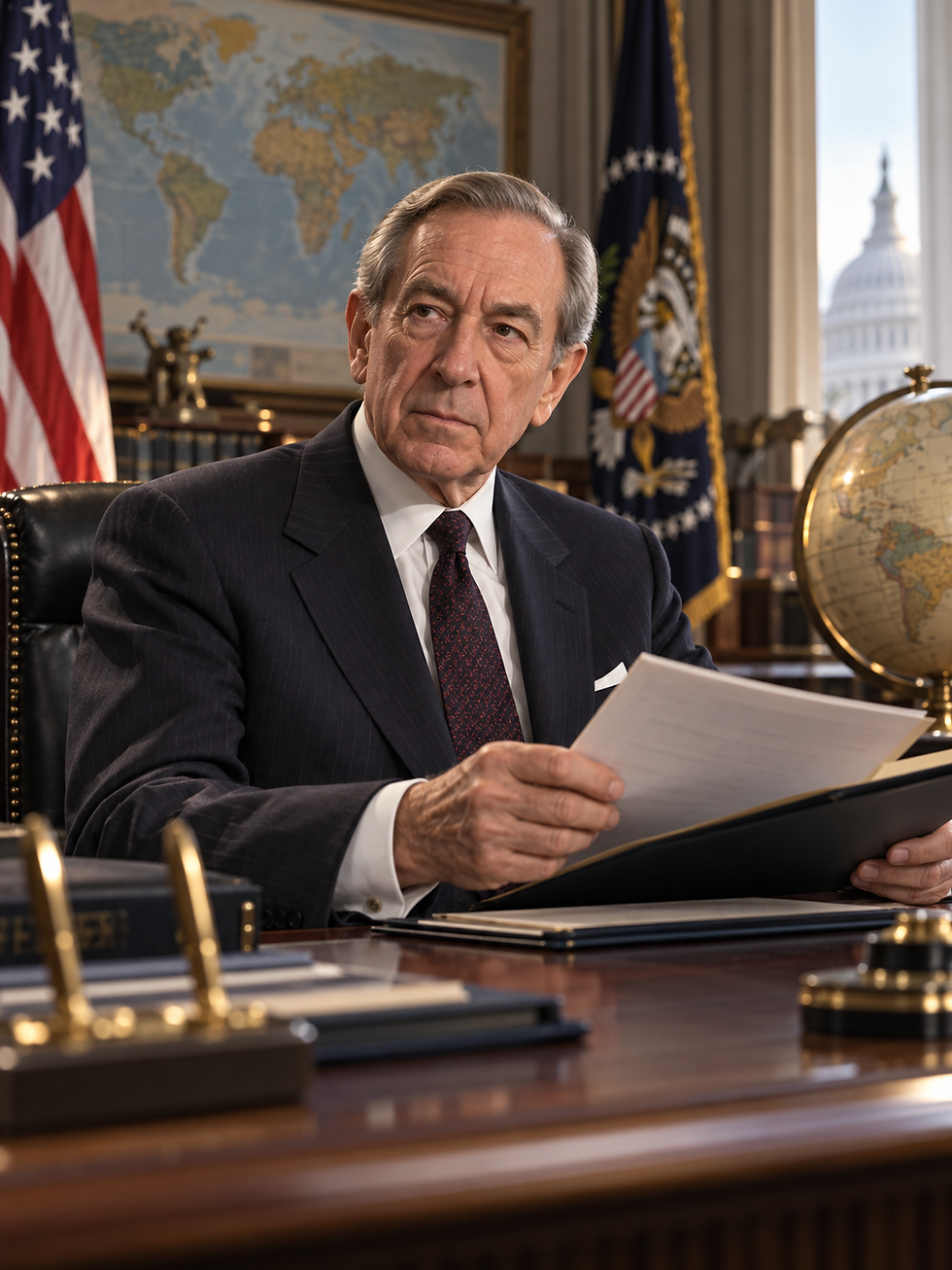
My Name is Warren Christopher: Diplomat Who Fought for Every Vote
I spent much of my life negotiating disputes, defending the rule of law, and representing the United States in some of the world's most difficult conflicts. I was born on October 27, 1925, in Scranton, North Dakota. After my father's death, my mother moved our family to California, where I discovered the value of education, discipline, and careful preparation. I served in the United States Navy during World War II, graduated from the University of Southern California, and earned my law degree from Stanford University in 1949. I subsequently clerked for Supreme Court Justice William O. Douglas. Those experiences shaped my conviction that patience, reason, and respect for legal institutions could resolve even the most difficult disagreements.
Learning the Art of Diplomacy
My career in public service began well before I became Secretary of State. President Lyndon Johnson appointed me Deputy Attorney General in 1967, and President Jimmy Carter appointed me Deputy Secretary of State in 1977. During the Iranian hostage crisis, I helped negotiate the agreement that secured the release of 52 American hostages in January 1981. The negotiations required persistence, confidentiality, and an understanding that emotional declarations rarely resolve international disputes. I learned that diplomacy is not simply the art of reaching agreements. It is the discipline of preserving opportunities for agreement when circumstances appear nearly hopeless.
Serving as America's Secretary of State
In January 1993, President Bill Clinton appointed me the 63rd United States Secretary of State. The Cold War had ended, but serious international challenges remained. I traveled extensively, working to advance peace in the Middle East, strengthen cooperation with former Soviet-bloc nations, and address conflicts in the Balkans. I supported negotiations that produced the 1995 Dayton Peace Accords, helping bring an end to the war in Bosnia. When I left office in January 1997, I returned to private legal practice, believing that effective leadership required something more enduring than personal recognition: an unwavering commitment to institutions, negotiation, and the peaceful resolution of disputes.
An Election Night That Changed Everything
On November 7, 2000, Americans went to the polls to choose between Republican Governor George W. Bush and Democratic Vice President Al Gore. The results were extraordinarily close, particularly in Florida, where the state's 25 electoral votes would determine the presidency. As election night turned into November 8, Gore's campaign chairman, William Daley, asked me to travel to Florida and oversee the campaign's recount efforts. I accepted. Although I had negotiated international crises, this dispute presented a different responsibility. Millions of Americans had cast ballots, and our immediate task was to determine whether those votes had been counted accurately under Florida law.
The Battle Over Florida's Ballots
Upon arriving in Florida, I encountered an election system struggling with uncertainty. Punch-card ballots contained hanging chads, partially detached pieces of paper that complicated the counting process. In Palm Beach County, the unusual butterfly ballot had apparently confused some voters. Florida law provided for an automatic recount because the margin was so narrow, but serious disagreements quickly developed over manual recounts, deadlines, and which ballots should be included. Working alongside the Gore campaign's attorneys, I argued that officials should be permitted to complete lawful recount procedures. Republicans, led in their recount efforts by former Secretary of State James Baker, maintained that recounts must follow established legal standards and deadlines. The disagreements soon moved from election offices into courtrooms.
When the Supreme Court Decided the Election
As November turned into December, the legal controversy intensified. The Florida Supreme Court ordered additional recounting of disputed ballots, but the United States Supreme Court intervened. On December 12, 2000, the Court ruled in Bush v. Gore that the recount procedures lacked constitutionally adequate uniform standards and that the recount could not continue under the circumstances and deadlines before the Court. The following evening, Gore conceded the election. Bush ultimately carried Florida by 537 votes and won the presidency. Although our campaign had advocated additional counting, the judicial process had reached its conclusion. For me, the central lesson was that democratic government depends not merely upon holding elections, but upon maintaining public confidence in the laws and institutions responsible for determining their results.
The Legacy of a Lifetime in Public Service
I continued practicing law and contributing to public affairs until my death on March 18, 2011, at the age of 85. My years in diplomacy taught me that disagreement need not become hostility and that a nation's strength depends upon its ability to resolve disputes peacefully. Looking back on the election of 2000, I recognized that our campaign's pursuit of selected county recounts, however firmly grounded in our understanding of Florida law, raised legitimate questions about consistency and fairness across the state. I regret that we could not achieve a resolution that commanded broader public confidence. If my life offers one lesson, it is that winning an argument is never more important than preserving the institutions that allow a free people to settle their differences without violence.
Hanging Chads and the Automatic Florida Recount - Told by Warren Christopher
On the morning of November 8, 2000, Americans awoke to discover that their presidential election had produced no clear winner. My name is Warren Christopher, and Vice President Al Gore had asked me to travel to Florida to help oversee his campaign's efforts to ensure that every legally cast vote was properly counted. I had spent years negotiating international disputes as Secretary of State, yet few situations required greater attention to detail than this election. Florida's initial statewide tally showed Republican George W. Bush leading Gore by just 1,784 votes out of nearly six million cast. Under Florida law, a margin of less than one-half of one percent required an automatic recount. Election officials across the state prepared to examine their results again. What appeared to be a routine legal safeguard would soon expose serious weaknesses in America's voting technology.
The Tiny Pieces of Paper That Changed History
Many Florida counties used punch-card voting machines, a technology that required voters to push a metal stylus through a designated section of a paper ballot. Each small perforated square was called a chad. When the voting machine functioned properly, the chad detached, leaving a hole that counting machines could recognize. Unfortunately, these machines did not always produce clean punches. Sometimes a chad remained attached by one or two corners, hanging from the ballot like a tiny paper door. Other times, the stylus merely pressed an indentation into the paper without breaking through. These became known as hanging chads and dimpled chads. To election officials, they presented a difficult question: Had the voter attempted to select a candidate, or had the ballot simply been damaged? The answer could determine which candidate became president.
An Automatic Recount Reveals a Troubling Problem
Florida's automatic recount began on November 8, as counties checked their vote totals, generally by running ballots through counting equipment again. This initial recount was not the same as a complete manual examination of every ballot. It was designed to verify the machine-generated results and identify counting discrepancies. By November 10, Bush's reported lead had narrowed dramatically, standing at only a few hundred votes in the updated statewide returns, with additional overseas absentee ballots still to be counted. The result remained extraordinarily close. As I worked with the Gore campaign, reports emerged that some ballots had not registered a presidential vote even though voters may have attempted to select one. These ballots were called undervotes. Others contained marks for more than one presidential candidate and were classified as overvotes. Both categories raised troubling questions about whether voting machines had accurately recorded the intentions of Florida's citizens.
When Machines Could Not Determine Voter Intent
The discovery of disputed ballots created a fundamental legal challenge. A counting machine could determine whether a hole had been fully punched, but it could not reliably answer whether a partially detached chad represented a deliberate vote. Some election officials believed a hanging chad demonstrated sufficient evidence of voter intent. Others argued that only a completely detached chad should count. Dimpled ballots were even more controversial because an indentation might have resulted from an attempted vote or from handling the ballot. Florida law emphasized the importance of determining voter intent, but the absence of a single statewide standard for evaluating these marks created disagreement among election officials. I believed that legally valid votes should not be discarded merely because outdated equipment had failed to recognize them. Our opponents raised an equally important concern: inconsistent interpretations could cause identical ballots to receive different treatment depending upon the county examining them.
From Automatic Recount to a National Legal Battle
As the automatic recount concluded, Gore's campaign requested manual recounts in four Democratic-leaning counties: Palm Beach, Broward, Miami-Dade, and Volusia. Florida law permitted candidates to request such recounts, although disputes quickly arose over the procedures, deadlines, and standards officials should apply. Republican representatives argued that selective recounts threatened fairness and that election results should be determined according to established rules. Meanwhile, journalists crowded into election offices, photographing workers holding ballots toward the light and examining tiny pieces of paper with extraordinary care. Americans who had scarcely heard the word chad a week earlier were suddenly watching national broadcasts explaining whether one, two, or three attached corners could affect a presidential election. The struggle had moved beyond simple arithmetic. It had become a disagreement about what constituted a valid vote and who possessed the authority to decide.
The Cost of an Imperfect Election System
The automatic recount did not resolve the presidency. Instead, it revealed how dangerously close elections could magnify flaws that had existed for years. Following weeks of litigation, the United States Supreme Court issued its decision in Bush v. Gore on December 12, effectively ending the remaining recount process. Bush ultimately won Florida by 537 votes and became president. The controversy demonstrated that election accuracy depends upon reliable machines, understandable ballots, consistent standards, and laws capable of resolving disputes fairly. Looking back, I regret that our nation's election procedures left so many citizens uncertain whether their votes had been properly recorded. I also recognize that resolving these disputes required fairness to both candidates and every voter, not simply recounting ballots in areas favorable to one campaign. The lesson was unmistakable: in a democratic republic, even the smallest piece of paper can carry the weight of an entire presidency.
The Battle Over Manual Recounts - Told by Warren Christopher
On November 9, 2000, just two days after Americans voted for their next president, I found myself in Tallahassee, Florida, confronting a dispute unlike any I had experienced in public service. My name is Warren Christopher, and Vice President Al Gore had asked me to help oversee his campaign's efforts to resolve the contested election. The automatic recount had revealed an extraordinarily narrow margin between Gore and Texas Governor George W. Bush. But our concern extended beyond the numbers. Thousands of punch-card ballots had not registered a presidential selection, raising the possibility that legitimate votes had gone uncounted. We believed Florida law permitted election officials to examine disputed ballots by hand to determine voters' intentions. Bush's representatives disagreed with our approach. What began as a recount was rapidly becoming a national struggle over election law, political authority, and the presidency itself.
Four Counties at the Center of the Dispute
On November 9, the Gore campaign requested manual recounts in four Florida counties: Palm Beach, Broward, Miami-Dade, and Volusia. These counties included substantial Democratic voting populations, and we believed closer examination of their ballots might reveal votes that machines had failed to recognize. Under Florida law, candidates could request manual recounts when they believed voting irregularities had affected the results. Yet our decision to concentrate on four counties quickly became controversial. Republicans argued that selectively recounting ballots in Democratic strongholds was unfair and could produce an inconsistent statewide result. I understood their argument, but I maintained that our requests followed procedures authorized by Florida law. The question was whether election officials should rely exclusively on machines that had demonstrably failed to register some ballots, or examine those ballots individually to determine whether a valid presidential choice could be identified.
James Baker and the Republican Counterattack
Leading the Bush campaign's recount effort was James A. Baker III, a former Secretary of State whom I knew from decades of American public service. Baker was an experienced negotiator, a formidable lawyer, and a determined advocate for his candidate. He maintained that Bush had won Florida and warned that repeated recounts threatened to undermine confidence in the election. On November 11, Bush's campaign sought federal court intervention to stop the manual recounts. The federal judge declined to halt them on November 13. Meanwhile, Florida Secretary of State Katherine Harris insisted that counties comply with the November 14 deadline for submitting election returns, although certain amended returns could be considered under state law. I argued that rigid enforcement of the deadline could prevent election officials from completing lawful recounts. Baker emphasized the importance of finality; I emphasized the importance of accuracy. Neither consideration was trivial. A democracy requires both reliable election results and a legitimate conclusion to the process.
The Florida Supreme Court Intervenes
As the recounts continued, legal disputes intensified over whether results completed after November 14 could be included in Florida's official totals. On November 15, I publicly supported asking the Florida Supreme Court to resolve the competing legal arguments quickly, rather than allowing the controversy to become trapped in prolonged lower-court proceedings. Our attorneys, including David Boies, maintained that Florida's recount laws should be applied as intended. On November 21, the Florida Supreme Court unanimously ruled that qualifying amended recount returns could be included and extended the certification deadline to November 26. For the Gore campaign, this represented an important victory. But legal permission to continue counting did not eliminate the practical difficulties. Election officials still faced enormous quantities of ballots, uncertain counting standards, and intense political pressure from both campaigns.
Miami-Dade and the Recount That Stopped
The struggle reached a dramatic turning point on November 22. In Miami-Dade County, election officials attempted to accelerate the recount by concentrating on approximately 10,750 undervotes—ballots on which machines had recorded no presidential selection. As officials worked, Republican protesters gathered outside the counting area, objecting to the process. The confrontation attracted national attention, but the county canvassing board cited its inability to complete the recount before the court-established deadline when it voted to stop counting. The Gore campaign objected, believing potentially valid votes were being left unexamined. On November 26, Secretary Harris certified Florida's election results, giving Bush a lead of 537 votes. The completed recounts in Broward and Volusia were included, but the unfinished recounts in Palm Beach and Miami-Dade were not. We had reached a decisive moment: the state had declared a winner, yet our campaign remained convinced that unresolved ballot questions justified further judicial review.
When Counting Votes Became a Constitutional Question
Following Florida's certification, Gore challenged the results through the state's election-contest procedures. What had started as an argument over punch-card ballots now involved fundamental questions about equal treatment, legal deadlines, and the authority of state and federal courts. Ultimately, the United States Supreme Court's December 12 decision in Bush v. Gore effectively ended the recount, and Gore conceded the next evening. Bush became president, but the controversy left Americans with difficult questions about how elections should be conducted. Looking back, I regret that our campaign did not pursue a broader statewide examination of disputed ballots from the beginning, which might have answered some concerns about unequal treatment. Our responsibility was to defend our candidate's lawful interests while preserving public confidence in the democratic process. The lesson I would leave students is that election integrity requires more than simply counting votes. It requires clear laws, consistent procedures, reasonable deadlines, and the determination to treat every eligible voter fairly, regardless of which candidate that voter supports.
From Election Dispute to Constitutional Crisis - Told by William H. Rehnquist
On November 7, 2000, Americans cast their ballots in a presidential election that would test the foundations of our constitutional system. My name is William H. Rehnquist, and as Chief Justice of the United States, I believed that the Constitution must remain the governing authority, particularly when political passions threatened to overwhelm established law. Republican George W. Bush and Democrat Al Gore had fought an extraordinarily close election, with Florida's 25 electoral votes determining the presidency. When the initial results showed Bush leading by just 1,784 votes, Florida law triggered an automatic recount. That recount narrowed his advantage, and the Gore campaign demanded additional manual recounts in several counties. What began as a dispute over vote totals soon became a struggle over a more fundamental principle: whether election rules could be reinterpreted or altered after Americans had already voted.
The Republican Argument: Election Rules Must Be Followed
The Bush campaign, represented by former Secretary of State James Baker and other experienced attorneys, maintained that elections must be governed by rules established before ballots are cast. Republicans argued that Florida's laws contained procedures and deadlines designed to ensure that every candidate competed under the same legal framework. Gore's campaign requested manual recounts in four counties with substantial Democratic populations: Broward, Miami-Dade, Palm Beach, and Volusia. Republicans questioned why ballots in these counties should receive additional examination while comparable ballots elsewhere might not. Their argument deserved serious constitutional consideration. If one county counted partially punched ballots while another rejected identical markings, citizens could receive different treatment under the same state's laws. The right to vote carries with it the expectation that lawful votes will be evaluated according to consistent standards. Republicans were correct to identify unequal recount procedures as a genuine legal problem, one that would ultimately influence the Supreme Court's decision.
The Florida Supreme Court and the Limits of Judicial Authority
The legal struggle intensified when Florida Secretary of State Katherine Harris sought to enforce the state's certification deadlines. Gore's attorneys argued that recounts authorized by Florida law should be completed before final results were accepted. On November 21, the Florida Supreme Court permitted certain late recount returns to be included and extended the certification deadline to November 26. Bush's legal team challenged that decision, maintaining that the state court had improperly departed from the election procedures established by Florida's legislature. Their argument rested partly upon Article II of the United States Constitution, which assigns state legislatures responsibility for determining how presidential electors are appointed. On December 4, our Court unanimously set aside the Florida Supreme Court's earlier judgment and returned the case for clarification. We had not declared the Republicans correct on every point, but their constitutional concerns were substantial enough to require careful examination.
Why Changing the Standards Raised Constitutional Concerns
One of the most troubling aspects of the recount involved the absence of uniform rules for determining voter intent. Florida counties used different voting equipment, and election officials sometimes applied different standards when examining disputed ballots. A hanging chad might be accepted in one county but rejected in another. Some officials considered indentations evidence of an attempted vote, while others required a partially or fully detached piece of paper. The Gore campaign reasonably maintained that legitimate votes should not be discarded because voting machines failed to recognize them. Republicans, however, correctly argued that counting disputed ballots without consistent standards could create unequal treatment. The Fourteenth Amendment guarantees equal protection of the laws, and that protection extends to the administration of elections. A recount intended to correct voting errors could itself introduce constitutional problems if similarly situated voters were treated differently. This was not simply a partisan complaint. It was a legitimate question about fairness under the Constitution.
The December 8 Order Brings the Crisis to Washington
On November 26, Florida certified Bush as the winner by 537 votes. Gore challenged the result, and on December 8, the Florida Supreme Court ordered additional examination of presidential undervotes throughout the state. Bush's attorneys immediately appealed, arguing that the recount lacked constitutionally adequate standards and that the state judiciary had exceeded its authority. On December 9, the United States Supreme Court temporarily halted the recount, and oral arguments followed on December 11. The deadline for Florida to obtain federal safe-harbor protection for its presidential electors was approaching on December 12. I believed that the constitutional concerns raised by the Republican campaign could not be ignored merely because the presidency was at stake. Indeed, the extraordinary consequences made faithful adherence to constitutional requirements even more important. The Supreme Court's task was not to favor either candidate, but to determine whether the procedures governing the election satisfied federal law.
The Republican Position Prevails in the Supreme Court
On December 12, our Court issued its decision in Bush v. Gore. Seven justices recognized equal-protection problems in the recount procedures, although only five agreed that the recount could not continue under the circumstances presented. I joined the five-justice judgment and wrote a separate concurring opinion, joined by Justices Antonin Scalia and Clarence Thomas. We concluded that the Florida Supreme Court had also departed impermissibly from the election framework established by the state legislature, raising an additional problem under Article II. That position was supported by three justices, not the entire Court. Four justices dissented from ending the recount, believing that Florida should have an opportunity to correct the procedural defects. The majority's ruling nevertheless vindicated an essential part of the Republican argument: recounting votes is not enough if the recount itself fails to provide constitutionally adequate and consistent treatment. The decision effectively ended Gore's legal challenge, and he conceded the following evening.
The Constitution Must Stand Above Political Victory
The election of 2000 demonstrated that fairness requires two responsibilities: counting legally valid votes and applying lawful, consistent procedures when determining those votes. Democrats were justified in raising concerns about ballots that machines had failed to record, while Republicans were justified in challenging inconsistent recount methods and asserting the importance of established election laws. Neither political party possessed an exclusive claim to defending democracy. The central constitutional question was whether the government could resolve its disputes without abandoning the principles that govern its authority. Looking back, I regret that the controversy left many Americans questioning the judiciary's impartiality, even though I believed our decision rested upon legitimate constitutional grounds. My lesson to future generations would be that the Constitution must govern elections before, during, and after the voting. A republic cannot preserve public trust if its laws become subordinate to the political outcome desired by either side.

My Name is William H. Rehnquist: Chief Justice Who Helped Decide the Election
I spent more than three decades on the United States Supreme Court, interpreting the Constitution and deciding cases that shaped American government. I was born on October 1, 1924, in Milwaukee, Wisconsin. As a young man, I developed a strong interest in government, law, and the limits of political authority. During World War II, I served in the United States Army Air Forces before attending Stanford University and Harvard University. I earned my law degree from Stanford in 1952 and subsequently served as a law clerk to Supreme Court Justice Robert H. Jackson. That experience introduced me to the demanding responsibility of constitutional interpretation. I came to believe that judges should apply the Constitution and laws as written rather than substitute their personal preferences for those of elected lawmakers.
My Appointment to the Supreme Court
After practicing law in Arizona, I joined President Richard Nixon's administration in 1969 as Assistant Attorney General in the Office of Legal Counsel. In 1971, Nixon nominated me to the Supreme Court, and I began serving as an associate justice in January 1972. My judicial philosophy emphasized federalism, the separation of powers, and the importance of respecting constitutional boundaries. I frequently dissented from decisions that I believed extended federal judicial authority beyond its proper limits. In 1986, President Ronald Reagan nominated me to become Chief Justice of the United States. As Chief Justice, I presided over the Court's proceedings, participated in its decisions, and worked to preserve the independence and institutional authority of the federal judiciary.
An Election Unlike Any Other
On November 7, 2000, Americans voted for their next president, choosing primarily between Republican George W. Bush and Democrat Al Gore. The election produced an extraordinary situation. Gore received more popular votes nationally, but the presidency depended upon the electoral votes of Florida, where the candidates were separated by only a few hundred ballots. Disputes arose over punch-card voting machines, hanging chads, and the standards used to determine voter intent. Florida officials conducted recounts, while the candidates challenged various procedures in court. The matter ultimately reached the United States Supreme Court. Our responsibility was not to select the candidate we preferred. It was to decide the federal constitutional questions properly presented to us, regardless of their political consequences.
The Constitution and Florida's Recount
The dispute raised two important constitutional questions. First, whether Florida's varying standards for examining disputed ballots violated the Equal Protection Clause of the Fourteenth Amendment. Second, whether the Florida Supreme Court had departed from election rules established by the state legislature, which the Constitution assigns a particular role in selecting presidential electors. Article II provides that each state shall appoint presidential electors in the manner directed by its legislature. I believed that this constitutional assignment deserved careful consideration. State courts ordinarily possess broad authority to interpret state law, but presidential elections involve specific federal constitutional requirements. In my judgment, the Florida Supreme Court's interpretation had departed impermissibly from the legislative scheme.
The Decision That Ended the Recount
On December 12, 2000, the Supreme Court issued its decision in Bush v. Gore. Seven justices concluded that the recount procedures presented constitutional problems under the Equal Protection Clause, although they disagreed about the proper remedy. By a vote of five to four, the Court determined that a constitutionally acceptable recount could not be completed within the applicable deadline. I joined that judgment and wrote a separate concurring opinion, joined by Justices Antonin Scalia and Clarence Thomas, explaining my additional concerns under Article II. Four justices dissented from the decision to end the recount. Among them, Justice John Paul Stevens warned that the Court's intervention could damage public confidence in the judiciary. The decision effectively ended the election contest, and Gore conceded the following evening. Bush subsequently became the forty-third president of the United States.
A Lifetime Defending Constitutional Government
I continued serving as Chief Justice after the election, including presiding over the Court during significant disputes involving federal authority and civil liberties. I had previously presided over President Bill Clinton's impeachment trial in 1999, an experience that demonstrated another constitutional responsibility assigned to the Chief Justice. In 2004, I was diagnosed with thyroid cancer, but continued carrying out my judicial duties. I died on September 3, 2005, at the age of eighty. Looking back, I understood that Bush v. Gore would remain one of the most disputed decisions associated with my tenure. I regretted that the outcome left so many Americans questioning the Court's impartiality, even though I believed our constitutional reasoning was justified. The lesson I would leave to future generations is that constitutional government requires more than agreement with judicial decisions. It requires citizens to study the law, examine competing arguments, and recognize that the independence of the courts must endure even when their judgments provoke profound disagreement.
Bush v. Gore: The Case Reaches the Supreme Court - Told by William H. Rehnquist
On December 11, 2000, the United States Supreme Court faced one of the most consequential constitutional disputes in American history. My name is William H. Rehnquist, and as Chief Justice of the United States, I had presided over difficult cases involving presidential authority, federalism, and the separation of powers. Yet this case presented extraordinary circumstances. More than a month after Americans voted for president, the outcome remained uncertain. Republican George W. Bush held a certified lead of just 537 votes in Florida, while Democrat Al Gore continued pursuing legal challenges to determine whether disputed ballots had been properly counted. The presidency depended upon Florida's 25 electoral votes. Our responsibility was not to decide which candidate deserved to win, but whether the recount procedures ordered by Florida's highest court complied with the United States Constitution.
The Florida Supreme Court Orders Another Recount
On December 8, the Florida Supreme Court had ordered a new statewide examination of undervotes, ballots on which voting machines had registered no presidential selection. The judges believed that election officials should attempt to determine whether these ballots contained legally recognizable votes. Their decision also addressed thousands of disputed ballots in Miami-Dade County. Bush's attorneys immediately challenged the ruling, arguing that the Florida court had exceeded its legal authority and that the recount lacked uniform standards. The following day, December 9, the United States Supreme Court voted five to four to temporarily halt the counting while considering the constitutional questions. The decision produced sharp disagreement among the justices. Those supporting the stay feared that continuing a potentially unconstitutional recount could cause harm that could not later be corrected. The dissenters argued that stopping the recount threatened to prevent legitimate votes from ever being counted.
Two Constitutional Questions That Could Decide an Election
The dispute placed two major constitutional principles before us. The first involved the Fourteenth Amendment's Equal Protection Clause, which requires states to provide equal protection under the law. Bush's attorneys argued that allowing different counties and election officials to apply different standards for interpreting partially punched ballots could result in unequal treatment of voters. One official might count a hanging chad as a valid vote, while another might reject an identical ballot. The second question involved Article II of the Constitution, which gives state legislatures authority to determine how presidential electors are appointed. Bush's representatives maintained that the Florida Supreme Court had improperly changed the legislature's election procedures. Gore's attorneys responded that Florida's judges were interpreting existing state law and attempting to ensure that lawful votes were counted. These questions reached beyond the interests of either presidential candidate. They concerned the constitutional boundaries of state election authority and federal judicial review.
December 11: The Lawyers Face Nine Justices
On the morning of December 11, attorneys entered the Supreme Court chamber in Washington, D.C., knowing that their arguments could determine the presidency. Theodore Olson represented Bush, while David Boies argued for Gore. Olson maintained that Florida's recount procedures violated constitutional protections because election officials lacked consistent rules for determining voter intent. Boies countered that examining disputed ballots was necessary to identify valid votes and that Florida courts possessed authority to interpret their own election laws. The justices questioned both sides vigorously. Some pressed Olson about the federal government's authority to intervene in a state election dispute. Others challenged Boies to explain how a recount could provide equal treatment without specific, uniform standards. Throughout the arguments, another issue remained unavoidable: time. The election had already consumed five weeks, and an important federal deadline was approaching.
The December 12 Deadline Creates Extraordinary Pressure
Under federal law in effect at the time, December 12 represented the so-called safe-harbor deadline, six days before the Electoral College would meet. States that resolved disputes over their presidential electors under qualifying laws by that date received special protection against challenges in Congress. The deadline did not automatically prohibit every later appointment of electors, but Florida's courts had treated meeting it as important to the state's election process. This created a practical dilemma. If the recount procedures were constitutionally defective, could Florida establish new standards and complete a lawful recount before the deadline expired? Some justices believed additional counting should be permitted, while others questioned whether sufficient time remained. The Court had to consider not only whether the Florida Supreme Court's order violated constitutional requirements, but also what remedy could realistically be provided.
A Decision That Would Change American History
On December 12, the Supreme Court issued its decision. Seven justices agreed that the recount procedures presented constitutional equal-protection problems, but they disagreed sharply over the appropriate remedy. By a vote of five to four, the Court concluded that a constitutionally acceptable recount could not be completed within the applicable deadline, effectively ending Gore's challenge. I joined that judgment and wrote a separate concurring opinion, joined by Justices Antonin Scalia and Clarence Thomas, explaining our additional concerns under Article II. Four justices dissented from terminating the recount, believing that Florida should have been permitted to continue under constitutionally adequate procedures. The following evening, Gore conceded, clearing the way for Bush to become president. Looking back, I recognized that our decision would remain controversial and regretted that the dispute had weakened public confidence in the judiciary. Nevertheless, I believed that constitutional principles could not be set aside merely because their application carried political consequences. The lasting lesson of Bush v. Gore is that even the most powerful office in the United States remains subject to the Constitution, and that the interpretation of constitutional law can sometimes determine the course of American history.

My Name is John Paul Stevens: Justice Who Challenged the Decision
I spent thirty-five years serving on the United States Supreme Court, defending the Constitution and examining the difficult questions that arise when law and government intersect. I was born on April 20, 1920, in Chicago, Illinois. My family owned the famous Stevens Hotel, one of the largest hotels in the world at the time. As a young boy, I met remarkable people, including Charles Lindbergh and Amelia Earhart, and even attended the 1932 World Series, where I witnessed Babe Ruth's legendary called-shot home run. Yet my family's fortunes changed during the Great Depression, and I learned that wealth and reputation could disappear remarkably quickly. Those experiences helped shape my belief that fairness and justice should never depend upon a person's social standing.
From World War II to the Practice of Law
After graduating from the University of Chicago in 1941, I joined the United States Navy during World War II, serving as an intelligence officer in the Pacific. My work in signals intelligence earned me a Bronze Star. Following the war, I attended Northwestern University School of Law, graduating with the highest academic standing in my class in 1947. I then clerked for Supreme Court Justice Wiley Rutledge, whose dedication to civil liberties influenced my understanding of constitutional law. Returning to Chicago, I practiced law and developed a reputation for independence, careful reasoning, and a willingness to challenge accepted assumptions. In 1970, President Richard Nixon appointed me to the United States Court of Appeals for the Seventh Circuit, beginning my career as a federal judge.
An Independent Voice on the Supreme Court
In 1975, President Gerald Ford nominated me to the Supreme Court, and the Senate confirmed my appointment unanimously. Although a Republican president had selected me, I never regarded myself as obligated to support either political party. Judges, in my view, must decide cases according to law and evidence, not partisan loyalty. Over the following decades, I became known for carefully reasoned opinions on individual rights, government authority, and constitutional protections. I frequently disagreed with my colleagues, but disagreement is an essential feature of a court whose members independently examine the law. A dissenting opinion is not merely an objection to a particular result. It preserves a legal argument that future generations may find persuasive.
The Election That Reached the Supreme Court
On November 7, 2000, Americans voted in a presidential election between George W. Bush and Al Gore. The outcome depended upon Florida, where faulty punch-card ballots, confusing ballot designs, and extraordinarily narrow vote totals produced weeks of legal disputes. Gore had received more popular votes nationally, but Bush held a narrow lead in Florida, whose electoral votes would determine the presidency. The Florida Supreme Court ordered a recount of certain disputed ballots, and Bush challenged that decision before the United States Supreme Court. The legal issues were undeniably serious, but so were the consequences of judicial intervention. In my judgment, determining the lawful votes cast by the people of Florida deserved careful consideration before the federal judiciary brought that process to an end.
My Dissent in Bush v. Gore
On December 12, 2000, the Supreme Court issued its decision in Bush v. Gore, effectively ending Florida's recount. Seven justices found constitutional difficulties with the recount standards, but the Court divided five to four over whether the counting could continue. I dissented, joined by Justices Ruth Bader Ginsburg and Stephen Breyer, while Justice David Souter wrote separately but agreed that the recount should not be terminated. I believed the Florida courts were entitled to substantial respect in interpreting their own election laws and that any constitutional defects could be corrected through fair and uniform procedures. My concern extended beyond the identity of the next president. By intervening in this manner, I feared the Court had endangered something essential to constitutional government: the public's confidence in judges as impartial guardians of the law.
My Final Years and the Importance of Judicial Independence
I continued serving on the Supreme Court until retiring in 2010 at the age of ninety. During my retirement, I wrote books, discussed constitutional history, and defended the importance of an independent judiciary. In 2012, President Barack Obama awarded me the Presidential Medal of Freedom. I died on July 16, 2019, at the age of ninety-nine. Looking back, I remained convinced that the Court had made a serious mistake in Bush v. Gore. Nevertheless, I recognized that reasonable judges could disagree over difficult constitutional questions, and I regretted that the controversy contributed to declining confidence in the judicial system. If there is one lesson I would leave future Americans, it is this: the authority of the Supreme Court does not rest upon the power to command armies or win elections. It rests upon the people's confidence that its justices place the Constitution and the rule of law above the interests of any political party.
The 5–4 Decision and the Stevens Dissent - Told by John Paul Stevens
On December 12, 2000, the United States Supreme Court delivered a decision that would determine the outcome of one of the closest presidential elections in American history. My name is John Paul Stevens, and after twenty-five years on the nation's highest court, I understood the extraordinary responsibility placed upon judges when constitutional law collided with political controversy. George W. Bush and Al Gore had spent five weeks contesting Florida's presidential election results, with Bush holding an officially certified lead of just 537 votes. The Florida Supreme Court had ordered further examination of disputed ballots, but our Court intervened. Five justices concluded that the recount could not continue under the circumstances presented. I disagreed. My concern was not which candidate would occupy the White House, but whether the Supreme Court had properly exercised its authority by preventing Florida from completing its election process.
Five Justices End the Recount
The majority concluded that Florida's recount procedures violated the Equal Protection Clause of the Fourteenth Amendment because different election officials could apply different standards when determining voter intent. Seven justices recognized constitutional concerns about the lack of uniform standards, although they did not all agree on the same reasoning. The decisive disagreement concerned the remedy. Five justices determined that there was insufficient time to establish constitutionally acceptable procedures before the December 12 deadline that Florida's courts had treated as necessary for obtaining federal safe-harbor protection. The result effectively ended the recount and secured Bush's narrow Florida victory. Chief Justice William Rehnquist, joined by Justices Antonin Scalia and Clarence Thomas, also argued that the Florida Supreme Court had departed from the election framework established by the state legislature. The majority believed federal constitutional intervention was necessary. I believed the Court had acted too hastily.
Why I Believed the Court Was Wrong
In my dissent, joined by Justices Ruth Bader Ginsburg and Stephen Breyer, I argued that the federal judiciary should show greater respect for Florida's courts as they interpreted their own state's election laws. The Constitution gives state legislatures an important role in presidential elections, but it does not ordinarily remove state courts from interpreting the laws those legislatures enact. I was unconvinced that the Florida Supreme Court's actions justified our intervention. Even assuming that differing recount standards presented constitutional problems, I believed the proper response was to allow Florida an opportunity to establish fair procedures rather than immediately terminate the counting. Justice David Souter, writing separately, also believed the recount should not have been brought to an end, although his reasoning differed from mine. We were not arguing that Gore should be declared president. We were arguing that the process of determining the lawful winner should be permitted to continue.
The Warning I Delivered in My Dissent
My deepest concern was not simply that the Court had stopped the counting of ballots. It was that the majority's reasoning expressed an unwarranted distrust of the judges responsible for interpreting Florida law. The American judicial system depends upon confidence that judges will act impartially, even when their decisions have political consequences. In my written dissent, I warned that the greatest casualty of the decision would be the nation's confidence in judges as impartial guardians of the rule of law. The Supreme Court possesses enormous authority, but that authority depends upon public respect for its independence. When federal judges appear to intervene unnecessarily in a political contest, they risk damaging the very institutions they are sworn to protect. I believed our Court should have demonstrated greater restraint and allowed Florida's judicial process to continue.
The Decision That Made George W. Bush President
The following evening, December 13, Vice President Gore addressed the nation and conceded the election. He made clear that he disagreed with the Supreme Court's ruling but accepted its finality. Bush would receive Florida's 25 electoral votes, giving him 271 electoral votes compared with Gore's 266, with one District of Columbia elector abstaining. The peaceful transition of presidential authority continued, despite the extraordinary bitterness of the election dispute. Yet the legal controversy did not disappear. Scholars, judges, politicians, and ordinary citizens would debate Bush v. Gore for years, particularly the Court's equal-protection reasoning and its decision to terminate the recount rather than return the case to Florida for further proceedings. The result demonstrated both the extraordinary power of the Supreme Court and the importance of carefully limiting its intervention in matters entrusted to other institutions.
A Lesson About Justice, Democracy, and Public Trust
I remained on the Supreme Court until 2010, continuing to write opinions that reflected my belief in judicial independence, constitutional protections, and respect for established legal institutions. Looking back on Bush v. Gore, I did not regret expressing my disagreement with the majority. A justice has a responsibility to dissent when convinced that the Court has departed from sound constitutional principles. I did, however, regret that the controversy left so many Americans questioning whether politics had influenced the judiciary. Our constitutional system permits judges to disagree, and reasonable legal minds can reach different conclusions about difficult cases. But the authority of the courts ultimately rests upon something more fragile than legal power: public confidence. The lesson of the 5–4 decision is that preserving the rule of law requires not only reaching decisions, but demonstrating that those decisions arise from impartial judgment, faithful constitutional interpretation, and respect for the democratic institutions of the United States.
Gore Concedes and America Transfers Power - Told by Peter Jennings
On the evening of December 13, 2000, Americans gathered around their television sets to witness the conclusion of an extraordinary presidential election. My name is Peter Jennings, and as the anchor of ABC's World News Tonight, I had spent more than five weeks reporting on a political contest that seemed unwilling to end. George W. Bush and Al Gore had fought over Florida's electoral votes through recounts, disputed ballots, and courtroom battles that reached the United States Supreme Court. The previous evening, the Court had issued its decision in Bush v. Gore, effectively bringing the recount to an end. Bush would receive Florida's 25 electoral votes and become the forty-third president of the United States. But one final moment remained. Vice President Al Gore, who had received more popular votes nationwide than his opponent, would have to tell the American people that he was conceding the presidency.
Al Gore Addresses a Divided Nation
Shortly after 9:00 p.m. Eastern Time, Gore appeared before television cameras in Washington, D.C., to deliver one of the most important speeches of his political career. He acknowledged that he strongly disagreed with the Supreme Court's decision, but accepted its finality. He announced that he had telephoned Bush to congratulate him and offer his support during the transition. Gore reminded Americans that political disagreements, however serious, must ultimately yield to the nation's constitutional institutions. His address drew upon the history of earlier disputed elections, including the presidential contest of 1876, which had also produced a national controversy. Gore's concession was not an admission that every aspect of the election had been handled correctly. It was a recognition that the legal struggle had reached its conclusion and that the country needed a peaceful transfer of power. For millions watching at home, the speech transformed weeks of uncertainty into a definitive political outcome.
George W. Bush Prepares to Lead
Less than an hour after Gore's address, George W. Bush spoke from the chamber of the Texas House of Representatives in Austin. Standing before a national audience, the president-elect called for unity and promised to represent Americans who had supported both candidates. Bush acknowledged Gore's service and recognized the bitterness of the election. He also understood that he would enter office under unusual circumstances. Gore had won approximately 50.99 million popular votes nationwide, compared with Bush's 50.46 million, yet Bush would prevail in the Electoral College by 271 votes to 266, with one District of Columbia elector abstaining. Florida's officially certified margin was just 537 votes out of nearly six million cast. These figures revealed how closely divided the country remained. Bush now faced the challenge of establishing legitimacy and building support beyond the voters who had elected him.
The Electoral College Makes the Result Official
Although Gore had conceded, the constitutional process was not yet complete. On December 18, 2000, presidential electors gathered in their respective states to cast their official votes. Bush received 271 electoral votes, while Gore received 266, with one elector from the District of Columbia abstaining. On January 6, 2001, Congress convened to count the electoral votes, with Gore himself presiding in his constitutional role as president of the Senate. Several members of the House of Representatives attempted to object to Florida's electoral votes, but no senator joined their objections, as required by law for a formal challenge. Gore ruled the objections out of order. It was a striking scene: the man who had lost the presidential election formally announced the electoral result confirming his opponent's victory. Whatever Americans believed about the Florida recount, the Constitution's process for selecting a president had reached its conclusion.
A New President Takes the Oath of Office
On January 20, 2001, George W. Bush stood outside the United States Capitol in Washington, D.C., and took the presidential oath of office, administered by Chief Justice William H. Rehnquist. President Bill Clinton attended the ceremony, as did Vice President Gore, who watched the man who had defeated him assume the nation's highest office. Bush's inaugural address emphasized national unity, personal responsibility, and the importance of citizenship. Yet the divisions exposed by the election had not disappeared. Many Democrats continued questioning the fairness of the Florida recount, while Republicans maintained that Bush had prevailed according to the Constitution and applicable election laws. The inauguration nevertheless demonstrated a fundamental characteristic of American government: political authority could pass peacefully from one administration to another, even after an election marked by intense disagreement and legal controversy.
The Lessons of an Election America Would Never Forget
The election of 2000 changed the way Americans understood presidential elections. The controversy exposed serious problems involving outdated voting equipment, confusing ballot designs, inconsistent recount procedures, and the relationship between the popular vote and the Electoral College. In 2002, Congress would respond by passing the Help America Vote Act, providing federal support and establishing new requirements intended to improve election administration. As a journalist, I believed the controversy also offered an important lesson to the news media. Our premature election-night projections had contributed to public confusion, and I regretted that television networks, including ABC, had announced conclusions before the evidence justified them. Yet the larger historical lesson extended beyond journalism. Americans had witnessed a presidential contest in which neither political disagreement nor legal uncertainty prevented the transfer of government authority. The election raised serious questions about electoral fairness that deserved continued examination, but it also demonstrated that democracy requires more than winning elections. It requires citizens, candidates, and public officials to respect constitutional procedures while continually working to make those procedures more accurate, transparent, and worthy of public trust.


Comments