

5. Heroes and Villains of the Modern Era: America’s Changing World — China’s Rise, Global Terrorism, and New Technology (2001–2008)


My Name is Richard Lugar: A Republican’s Life of Service
I was born in Indianapolis, Indiana, on April 4, 1932. Long before I entered the United States Senate, I learned that responsibility began close to home. I became an Eagle Scout, graduated from Denison University, and studied at Oxford as a Rhodes Scholar. In 1956, I married Charlene Smeltzer; we would raise four sons. Service in the United States Navy strengthened my appreciation for discipline and national defense. Returning to Indianapolis, I helped manage our family’s manufacturing business. Government decisions were never merely theories to me. They affected payrolls, families, and the prospects of an entire community.
A City That Needed to Work
My public service began on the Indianapolis school board. In 1967, voters elected me mayor, and I took office the following January. Like many American cities, Indianapolis faced divisions that made common problems difficult to solve. I championed Unigov, the consolidation of much of the city and county governments in 1970. It did not combine every municipality or school system, but it gave Indianapolis a broader framework for governing and development. My Republican convictions emphasized sound management, private enterprise, and responsible public spending. A mayor could deliver speeches about those principles, but residents expected functioning services and visible results.
Indiana’s Voice in Washington
After losing my first Senate race in 1974, I won election in 1976 and began serving in January 1977. Indiana remained the foundation of my work. Agriculture, trade, and the conditions facing American businesses mattered deeply to me. As chairman of the Agriculture Committee and, at different times, the Foreign Relations Committee, I approached legislation through preparation and careful examination. America required strong defenses, dependable alliances, and an understanding of events beyond its borders. Patriotism demanded more than confidence in our strength; it demanded judgment about how to use it.
Securing Weapons Before Disaster Struck
When the Soviet Union collapsed in 1991, its enormous weapons stockpile presented an urgent danger. Who would guard the nuclear warheads, materials, and facilities left behind? Democratic Senator Sam Nunn and I worked to establish the Cooperative Threat Reduction program. Helping former adversaries secure and dismantle dangerous weapons protected American families without requiring a war. This was practical national defense. After September 11, the possibility that terrorists might acquire catastrophic weapons made that work even more pressing. Party differences remained real, but preventing nuclear catastrophe required cooperation.
Defeat and the Work That Remained
I served six Senate terms before losing the Republican primary in 2012. My service ended in January 2013, but I continued advancing international cooperation through the Lugar Center. I remained a Republican, convinced that principled government required both conviction and the ability to reach workable agreements. Looking back, there were decisions that deserved hard scrutiny, including my vote authorizing force against Iraq in 2002. Public service carries responsibility for consequences, not simply intentions. My life ended on April 28, 2019, at eighty-seven. The obligation I leave to another generation is straightforward: study the problem, accept responsibility, and place the country’s security above political advantage.
Collision over the South China Sea - Told by Richard Lugar
On April 1, 2001, an American reconnaissance flight became a dangerous test of relations between two powerful countries. A United States Navy EP-3E aircraft, carrying twenty-four crew members, was gathering electronic intelligence over the South China Sea when a Chinese fighter collided with it. The Chinese aircraft crashed, and its pilot, Wang Wei, was lost at sea. The damaged American plane plunged before its pilot, Lieutenant Shane Osborn, regained control. Suddenly, the immediate question was whether the Americans could reach the ground alive.
Survival on an Unfriendly Runway
Osborn brought the aircraft to an emergency landing at a Chinese military airfield on Hainan Island. During the emergency, crew members worked to destroy classified information and sensitive equipment. Their aircraft contained intelligence technology that the United States wanted to protect. Landing saved their lives, but it placed them and their aircraft in Chinese custody. Chinese authorities detained the crew while officials in Washington and Beijing confronted a crisis neither government had planned. For the Americans’ families, every announcement carried the same urgent concern: when would their loved ones come home?
Two Governments, Two Accounts
The collision occurred outside China’s territorial airspace. American officials maintained that their aircraft had been flying steadily when the Chinese fighter approached dangerously close. China blamed the American plane for the collision and objected to surveillance near its coast. These competing accounts reflected a larger disagreement. Washington considered reconnaissance in international airspace a legitimate military activity. Beijing viewed such operations near important Chinese installations as threatening. As a Republican senator concerned with national security, I understood why reliable intelligence mattered. Yet an encounter between aircraft could create consequences far beyond the original mission.
The Importance of Carefully Chosen Words
President George W. Bush’s administration demanded the crew’s return while diplomats worked toward an agreement. Ambassador Joseph Prueher delivered a carefully negotiated letter on April 11. It expressed sorrow for the Chinese pilot’s loss and regret that the American aircraft had entered Chinese airspace and landed without verbal clearance during the emergency. It did not accept responsibility for causing the collision. This wording allowed both governments to move forward without resolving every disagreement. Diplomacy required patience, precision, and an understanding of what the other government needed to explain to its own people.
Bringing Americans Home
On April 12, local time, the twenty-four Americans departed Hainan after eleven days of detention. The aircraft remained behind until it could be dismantled and transported out later that summer. The immediate crisis ended, but the underlying tensions endured. China’s growing strength and America’s continuing military presence in Asia would require sustained attention. The lesson I would emphasize is practical: national defense includes the ability to manage dangerous encounters. Strong armed forces, clear communication, and capable diplomacy all help protect American lives. In this case, negotiation brought the crew home without turning a collision into an armed confrontation.

My Name is Steve Jobs: Building What Comes Next
I was born in San Francisco on February 24, 1955, and adopted by Paul and Clara Jobs. I grew up in California, surrounded by the engineers and electronics businesses that helped shape Silicon Valley. My father taught me to care about craftsmanship, including the parts nobody would see. That mattered. A product should be made well all the way through. I was curious, restless, and interested in how things worked—and how they might work better.
An Education Without a Straight Path
I entered Reed College in 1972, then dropped out after six months. Tuition was consuming my parents’ savings, and I could not see where the required courses were taking me. But I stayed around and attended classes that interested me, including calligraphy. Years later, that study influenced the Macintosh’s typography. I worked at Atari and traveled to India, exploring ideas beyond the world I knew. Technology interested me, but so did art and design. I wanted to bring those worlds together.
A Computer for Ordinary People
In 1976, Steve Wozniak and I cofounded Apple with Ronald Wayne, who soon departed. Woz was an extraordinary engineer. I saw an opportunity to bring his inventions to a much larger audience. The Apple II became a major success, helping move personal computers into homes, schools, and businesses. In 1984, we introduced the Macintosh, with a mouse and a graphical interface that made computing more approachable. I pushed hard because I wanted exceptional products. Working with me could be demanding, and my relationships inside Apple became increasingly strained.
Starting Again
In 1985, after a struggle with Apple’s leadership, I lost my operating responsibilities and left the company I had helped build. I was thirty. I started NeXT, pursuing advanced computers and software, and acquired the Lucasfilm computer graphics group that became Pixar. NeXT’s computers struggled commercially, but its technology proved valuable. Pixar helped transform animated filmmaking with Toy Story in 1995. During those years, I also married Laurene Powell. The future I had expected at Apple was gone, but there was still work worth doing.
Putting Technology into People’s Hands
Apple bought NeXT in 1996, bringing me back to the company. We narrowed the product lineup and concentrated on making fewer things exceptionally well. The iMac arrived in 1998, followed by the iPod in 2001, the iTunes Store in 2003, the iPhone in 2007, and the iPad in 2010. These products grew from the work of remarkable teams. My role was to insist that engineering, software, and design fit together into an experience people could understand.
What Success Could Not Solve
In 2003, I was diagnosed with a pancreatic neuroendocrine tumor. I underwent surgery in 2004 and a liver transplant in 2009. I resigned as Apple’s chief executive in August 2011 and died on October 5, aged fifty-six. My record also includes painful failures: I initially denied paternity of my daughter Lisa, and my treatment of people could be harsh. Those facts belong beside the achievements. Building successful products did not mean I had handled every human relationship well.
A Thousand Songs in Your Pocket - Told by Steve Jobs
Think about carrying your music collection in 2001. You could take a portable CD player and a stack of discs, but every additional album meant something else to carry. Digital music players already existed, yet many offered limited storage or awkward controls. At Apple, we saw an opportunity to bring storage, portability, and simplicity together. People cared about music. The challenge was to make the technology serve that experience—to let someone find a favorite song and take it along without thinking much about the machinery.
A Small Device with a Big Library
On October 23, 2001, we introduced the iPod. Its five-gigabyte hard drive could hold approximately one thousand songs, depending on their length and encoding. It fit in a pocket, offered up to ten hours of battery life, and used a scroll wheel to help people move through their music. The first model cost $399 and worked with Macintosh computers. That price made it a substantial purchase. But the idea was immediately understandable: a large personal music collection could now travel in one small device.
Making the Pieces Work Together
The iPod was part of a larger experience. Apple’s iTunes software let users organize songs on a computer, import music from CDs, and build playlists. Connecting the iPod allowed music and playlists to synchronize automatically. Fast FireWire transfers reduced the waiting. You could arrange music for a journey, an afternoon of work, or a particular mood, then carry those selections with you. The original iPod did not download songs wirelessly. The computer managed the library; the player made that library portable.
Buying a Song with a Click
There was another problem to solve: purchasing music online conveniently and legally. On April 28, 2003, we opened the iTunes Music Store with more than 200,000 songs from all five major record companies. Individual tracks cost ninety-nine cents, with no subscription required. Customers could preview music, buy a song, and download it into iTunes. Instead of buying an entire album to obtain a favorite track, listeners could often purchase that track alone. The store gave record companies a commercial outlet for digital music and customers a straightforward way to pay for it.
From Macintosh Owners to Millions More
In October 2003, we brought iTunes and its music store to Windows, greatly expanding the potential audience. By December, Apple reported that customers had purchased more than twenty-five million songs. Americans increasingly assembled personal libraries from individual downloads alongside music imported from their CDs. Albums and record stores remained, but buying and carrying music no longer required a physical disc. The achievement came from connecting the parts: a store for discovering and purchasing music, software for organizing it, and a player that made it easy to take along.

My Name is Jiang Zemin: Leading China into a Changing World
I was born on August 17, 1926, in Yangzhou, China. My youth unfolded amid foreign invasion and national upheaval. These experiences gave questions of national strength and independence great importance to my generation. I studied electrical engineering, joined the Communist Party in 1946, and graduated from Shanghai Jiao Tong University in 1947. China needed people who could build and operate modern industry. My early contribution would come through technical knowledge and practical work.
From Engineering to Leadership
After the People’s Republic was established in 1949, I worked in industrial management. Training in a Soviet automobile factory expanded my understanding of large-scale production. Over the following decades, I moved through engineering and government positions, eventually becoming minister of the electronics industry. In 1985, I became mayor of Shanghai, and in 1987, its Communist Party secretary. Here was a city with the capacity to connect China to world commerce. Modernization required trained workers, investment, technology, and leadership capable of putting them together.
Taking Command in a Time of Crisis
In June 1989, following the military suppression of the Tiananmen protest movement, I became general secretary of the Communist Party. China faced international condemnation and deep political tensions. I upheld the Party’s authority and treated stability as essential to national development. In 1993, I also became president. My government pursued economic reform while maintaining strict political control. We sought foreign trade and investment without accepting a competitive multiparty political system.
Opening the Economy to the World
Building on Deng Xiaoping’s reforms, I supported the development of a socialist market economy. Markets and private enterprise expanded, while the Communist Party retained its governing position. Factories multiplied, exports grew, and cities changed rapidly. Hong Kong returned to Chinese sovereignty in 1997, followed by Macao in 1999. China joined the World Trade Organization in 2001, strengthening its place in international commerce. These changes brought opportunities, but industrial restructuring also cost many workers their jobs. National development demanded difficult adjustments.
Adapting the Party
My theory of the Three Represents argued that the Party must advance modern production, cultural development, and the interests of the great majority of the people. It helped justify welcoming private entrepreneurs into the Party. I believed our organization had to adapt as Chinese society changed. I transferred the Party leadership to Hu Jintao in 2002 and the presidency in 2003, then relinquished the Party’s military chairmanship in 2004.
The Record I Leave Behind
I died in Shanghai on November 30, 2022, aged ninety-six. My leadership helped strengthen China’s economy and international influence, but that is not the whole record. My government imprisoned peaceful critics and launched the persecution of Falun Gong practitioners in 1999. I defended Party authority rather than publicly apologizing for those policies. Any honest assessment of my life must consider both the opportunities created by economic development and the suffering caused by political repression.
China Joins the World Trading System - Told by Jiang Zemin
On December 11, 2001, China became the 143rd member of the World Trade Organization. This achievement followed fifteen years of negotiations. Our country already traded extensively with the world, but membership placed those relationships within a broader system of agreed rules. As president, I supported this step as part of China’s modernization. Our factories needed markets, our industries needed advanced technology, and our people needed opportunities. Participation also brought obligations: China agreed to lower trade barriers, open additional markets, and accept international procedures for resolving trade disputes.
From Chinese Factories to American Homes
The effects reached far beyond negotiating rooms. Clothing, toys, furniture, and electronics produced in China increasingly appeared in American stores. Competitive production costs, expanding industrial capacity, and international supply networks helped make many goods affordable. American retailers purchased Chinese products, while families gained choices and lower prices for many manufactured items. WTO membership strengthened this integration. More predictable trading conditions encouraged businesses to make longer-term commitments. A purchase in an American shopping center could now support a chain of production stretching across the Pacific.
Competition Reaches the Factory Floor
For American manufacturers, however, inexpensive imports presented a different challenge. Businesses competing directly with Chinese production faced pressure to reduce costs, improve productivity, or move production abroad. Some factories closed, and workers lost jobs that had supported their families for years. Research later linked the removal of uncertainty about American tariffs on Chinese goods to increased imports and greater employment losses in exposed industries. Trade was not the only force changing American manufacturing, but its effects were substantial in particular communities. The benefits visible on store shelves did not erase the difficulties experienced on factory floors.
An Opportunity to Sell to China
Trade also offered opportunities for Americans to sell. China’s commitments included substantial tariff reductions on agricultural and industrial products and wider access for service businesses. American farmers and companies looked toward a vast market needing food, machinery, technology, and commercial expertise. Foreign businesses could participate in China’s development through exports, investment, and local operations. Yet an agreement did not automatically remove every obstacle. Businesses still needed dependable enforcement, protection for intellectual property, and fair treatment. Membership provided rules against which China’s conduct could be judged.
A Relationship Changed by Commerce
I regarded international trade as an instrument of national development under continued Communist Party leadership. China’s entry did not make our political system the same as America’s, nor did it eliminate disagreements. It made our economies more closely connected. During the years that followed, American consumers, workers, retailers, and exporters experienced that connection differently. Understanding this turning point requires examining each of them: the family buying an affordable product, the worker facing foreign competition, and the business seeking customers across the ocean. Together, their experiences reveal how a trade agreement could reshape everyday life.
The Toy That Came Off the Shelf — Who Was Responsible for Its Safety? (2007) - Told by Jiang Zemin and Steve Jobs
Jiang Zemin: Steve, suppose a child handed you a little green Sarge from the Pixar movie Cars. On August 14, 2007, an American parent had good reason to turn that toy over. The U.S. Consumer Product Safety Commission told families to look for two markings on the bottom, “7EA” and “China.” Together they helped identify the cars Mattel was recalling because their paint contained too much lead. Those markings answered the first question a parent would ask: Is this my child’s toy? They left a second question open. How had that paint reached the toy in the first place?
Steve Jobs: I’d follow the paint. Mattel hired a manufacturer in China, and that manufacturer hired another company to paint the cars. The painting company was supposed to use paint supplied by the manufacturer. Instead, it bought paint from an unauthorized source. On July 30, a Mattel test detected lead on a Sarge car. A rule about which paint to buy had existed all along. What mattered to the family holding that car was whether anyone had checked the paint before the toy reached the store.
What Made the Magnets Different?
Jiang Zemin: Then let me hand you a Polly Pocket play set. That same August day, Mattel expanded a recall covering about 7.3 million dolls and accessories. Small magnets could come loose, and three children whose injuries were reported in the earlier recall had each swallowed more than one. Inside the body, the magnets could pull toward each other through the walls of the intestine. All three children needed surgery. A factory could use the approved paint on every piece of that play set and still send a dangerous toy out the door. What would you ask its designer?
Steve Jobs: I’d ask the designer to show me what held the magnet in place after a child had played with the toy for months. Here the weakness was in the design, a decision Mattel controlled. The company changed how it secured the magnets. That distinction mattered because the remedies were different. Testing a batch of paint could catch lead. Finding out whether a magnet could work loose meant testing the finished toy and paying attention when families reported pieces falling out.
Who Had to Act?
Jiang Zemin: So a parent turning over that Sarge could learn where it was made, yet still know very little about who made each decision. The subcontractor chose the paint. Mattel set requirements for its suppliers and put its name on the toy. In the magnet case, Mattel also had the power to change the design. By September, members of Congress were asking Mattel’s chairman to explain what the company would check before another shipment left a factory.
Steve Jobs: And the families who already owned those toys needed an answer that afternoon. Mattel and the safety commission published pictures and identifying marks, told parents to take the affected Sarge cars away from children, and explained how to get a replacement. A parent could turn over a toy and read “7EA.” That was a reasonable thing to ask of a family. Detecting lead in the paint or proving that a magnet would stay in place was work the companies had to do before a child ever opened the box.
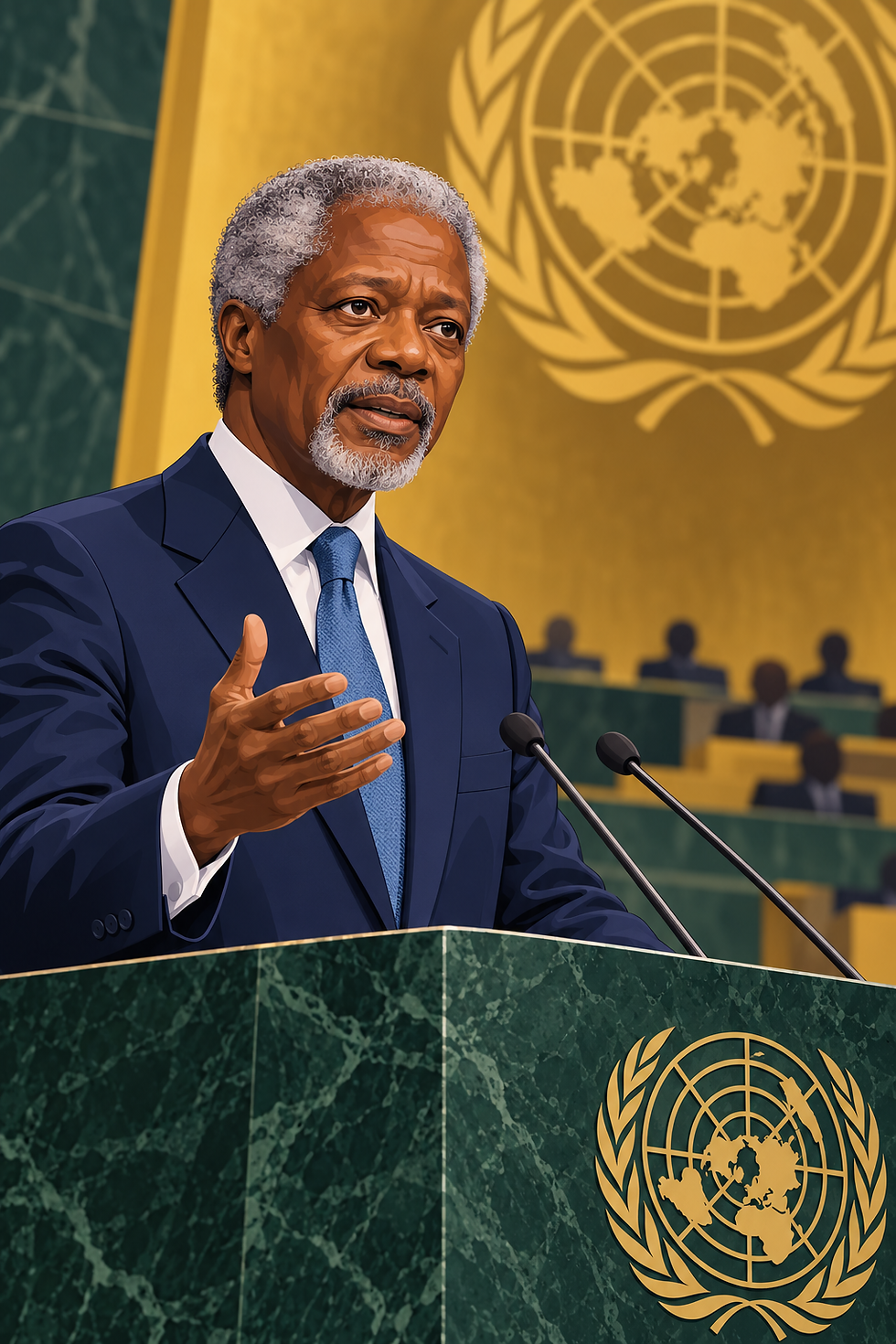
My Name is Kofi Annan: A Life in the Service of Peace
I was born on April 8, 1938, in Kumasi, in the British colony then called the Gold Coast. In 1957, my country became independent Ghana. I was eighteen, old enough to understand that decisions once made far away could now become our own responsibility. I studied in Ghana, the United States, and Switzerland, meeting people whose backgrounds differed greatly from mine. Those experiences strengthened a conviction that would guide my work: dignity belongs to every person, regardless of nationality or circumstance.
Learning How to Serve
I joined the United Nations system in 1962 as an administrative and budget officer at the World Health Organization in Geneva. My career began with the practical work of an international institution. Budgets, personnel, and organization might appear distant from peace, but good intentions require people and resources to become effective action. Over three decades, I worked in different parts of the UN system. In 1993, I became its head of peacekeeping, responsible for helping direct operations in a world experiencing dangerous upheaval after the Cold War.
Leading a World Organization
In January 1997, I became the seventh secretary-general of the United Nations, the first to rise to that position from its own staff. I wanted the organization to serve people more effectively and to make human rights central to its work. A secretary-general cannot simply command governments. He must listen, persuade, and sometimes speak uncomfortable truths. I believed that security, development, and human rights depended upon one another. A family living with hunger, disease, or persecution could hardly be described as secure.
Making Cooperation Matter
I championed the Millennium Development Goals, which directed international attention toward poverty, education, health, and other urgent needs. I also encouraged stronger action against HIV/AIDS and helped advance the creation of the Global Fund. In 2001, the United Nations and I jointly received the Nobel Peace Prize. After September 11, I urged cooperation against terrorism while defending human rights. Fighting violence required resolve, but abandoning our principles would weaken the peace we hoped to build.
Service Beyond Office
My second term ended in December 2006, but retirement from office did not mean retirement from responsibility. I established the Kofi Annan Foundation and continued working through mediation and public service. In 2008, I helped negotiate an agreement to end Kenya’s post-election crisis. Later, I sought a peaceful resolution to the conflict in Syria, where bitter divisions defeated those efforts. I died in Bern, Switzerland, on August 18, 2018, aged eighty.
The Failures I Carried
The gravest reflections concern Rwanda in 1994 and Srebrenica in 1995, when I headed UN peacekeeping. People who desperately needed protection were massacred. The failures involved governments, institutions, and decisions within the United Nations, including my department. I publicly expressed profound regret that we had not done more to prevent Rwanda’s genocide. Such sorrow must lead to responsibility. The measure of international cooperation is whether it protects human beings when protection is most urgently needed.
Bali and Terrorism’s International Reach - Told by Kofi Annan
On the evening of October 12, 2002, people gathered in Bali’s busy tourist district of Kuta. Visitors had come to Indonesia for holidays, while local residents worked in the businesses that welcomed them. Explosions at Paddy’s Bar and outside the Sari Club turned that ordinary evening into a catastrophe. The attacks killed 202 people, including 88 Australians and 38 Indonesians. Hundreds more suffered injuries. As secretary-general of the United Nations, I condemned the attack. The grief extended across national borders, reaching families who had expected their loved ones to return from a journey.
A Threat Beyond the Battlefields
Members of Jemaah Islamiyah, a Southeast Asian extremist organization associated with al-Qaeda, carried out the 2002 bombings. Their actions demonstrated that international terrorism could strike far beyond the fighting in Afghanistan. Restaurants, hotels, and places of entertainment brought together civilians from many nations, making a local attack an international tragedy. The perpetrators invoked religion, but responsibility belonged to the extremists who planned and committed the crimes. Blaming entire religious communities would deepen divisions and punish people who had no part in the violence.
The Damage Continued After the Explosions
For Bali, the consequences reached beyond the people killed or injured. Tourism supported hotel employees, drivers, shopkeepers, craftspeople, and farmers supplying food to restaurants. When travelers stayed away, income disappeared throughout those connected businesses. A World Bank assessment found that the bombings harmed livelihoods both on Bali and elsewhere in Indonesia, with poor and vulnerable households particularly affected. This is part of terrorism’s destructive reach: fear can empty a workplace far from the attack itself. Rebuilding required restoring confidence and helping communities recover their means of living.
Cooperation Becomes Essential
Indonesian investigators worked with Australian police and other international partners to identify victims and pursue those responsible. Forensic specialists examined evidence, while medical teams treated survivors and helped evacuate the seriously wounded. Such cooperation mattered because the victims, evidence, and extremist connections crossed borders. No government could manage every part of the response alone. The investigation strengthened regional policing relationships and encouraged further investment in counterterrorism capabilities. Protecting civilians required patient investigative work alongside emergency assistance and international diplomacy.
Another Attack, an Enduring Responsibility
On October 1, 2005, suicide bombers attacked restaurants in Kuta and Jimbaran, killing twenty victims, most of them Indonesians. Bali’s suffering again revealed how extremists could devastate the very communities whose livelihoods depended on welcoming others. For Americans, these attacks showed why international security extended beyond American territory and military operations. Travelers, local workers, and families shared the consequences. The responsibility of governments was to pursue those responsible, protect human rights, and help affected communities rebuild. Security would remain incomplete while ordinary people could not safely work, travel, or gather together.
Four Days in Mumbai — How Do You Investigate an Attack Across Borders? (2008) - Told by Kofi Annan and Jiang Zemin
Kofi Annan: On the evening of November 26, 2008, gunmen opened fire inside Mumbai’s Chhatrapati Shivaji Terminus, a railway station crowded with passengers. Elsewhere in the city, other gunmen attacked hotels, a café, and a Jewish community center. Ten attackers had arrived by sea and split into teams. By November 29, they had killed 166 people, including six Americans, and wounded hundreds more. Jiang, a witness at the station could tell police what happened on the platform. How could investigators discover who had chosen that platform as a target months before?
Jiang Zemin: I would begin with something a witness might have walked right past afterward. Among the evidence was a phone so badly smashed that FBI specialists had to wire it back together to recover its data. Other specialists lifted fingerprints from explosive devices. Each clue could answer a narrow question about who had handled an object or what a device still held. Indian investigators had the crime scenes. With India’s permission, American investigators could bring equipment and people trained to examine what the attackers had left behind.
The Man Who Came Before the Gunmen
Kofi Annan: That brings us back to the station. Long before the shooting, an American citizen named David Coleman Headley had visited it while scouting targets for Lashkar-e-Tayyiba, a terrorist organization based in Pakistan. In Chicago in March 2010, Headley pleaded guilty to helping plan the attacks. His account gave the station a second place in the history of those four days. It was both a scene where Indian police collected evidence and a place that a planner had already studied and reported on abroad.
Jiang Zemin: Headley also explained why he had taken boat rides around Mumbai’s harbor. He carried a camera and a GPS device, recorded possible landing sites, and shared what he learned with his contacts in Pakistan. Look at the harbor from the investigators’ point of view. They knew the gunmen had come ashore. Now someone who had surveyed that same coastline could explain who had sent him and what they wanted to know. But he was in American custody, and the Indian investigators had questions of their own.
Who Gets to Ask the Next Question?
Kofi Annan: In June 2010, Indian investigators were able to question Headley directly in the United States. Think what that meant for an officer who knew the Mumbai evidence. Reading another investigator’s summary leaves you with the questions that person thought to ask. Sitting across from the witness lets you stop at an unfamiliar name, return to a date, or ask him to explain a detail about the harbor. That opportunity depended on an agreement between the two countries.
Jiang Zemin: And that, Kofi, is how I would answer your question about the railway platform. A survivor in Mumbai could describe the shooting. A technician could recover evidence from a broken phone. In Chicago, a man who had scouted the station admitted what he had done before the gunmen arrived. Each knew a different part of the story. For the families who lost someone that night, the investigation established responsibility beyond the men they could see on the platform.
The Internet Becomes Social - Told by Steve Jobs
Think about waiting for a photograph to appear on a slow internet connection. Now imagine trying to watch a video. During the early 2000s, expanding broadband made those experiences much faster and more practical. By 2008, 55 percent of American adults had a high-speed connection at home. That change mattered because people could do more than read pages and send messages. Uploading photographs, watching clips, and sharing creative work became everyday possibilities for a growing audience. Better connections gave new ideas room to develop.
Friendship Becomes Part of the Website
Facebook began at Harvard in February 2004, founded by Mark Zuckerberg and fellow students. Members created profiles and connected with classmates; the service subsequently expanded beyond its original campus. In September 2006, Facebook opened registration more broadly and introduced News Feed, gathering friends’ updates in one place. People could follow changes in one another’s lives without visiting every profile separately. Earlier online communities had already connected people, but Facebook helped make personal relationships a central part of daily internet use. Its new visibility also prompted objections about privacy.
A Camera Finds an Audience
YouTube’s first uploaded video appeared on April 23, 2005. Called “Me at the zoo,” it showed cofounder Jawed Karim standing near elephants at the San Diego Zoo. It was a simple personal recording, and that simplicity revealed an important possibility. Ordinary people could put video online for others to watch. Musicians, hobbyists, teachers, and families gained a place to share performances, demonstrations, and moments from their lives. Reaching an audience no longer always required a television station or a film distributor.
The Audience Starts Publishing
I had spent years working to make computers useful for creative people. These services extended what someone could do after making a photograph, recording, or video. Blogs and earlier websites had already allowed individuals to publish; social platforms made sharing and responding easier for many more users. A viewer could become a creator, and a friend could help introduce that creator’s work to another audience. Entertainment became more participatory. Information also traveled through personal connections, with people choosing what to pass along instead of relying entirely on editors and broadcasters.
New Possibilities, New Questions
By 2008, faster connections and social websites were changing expectations about communication. People increasingly expected to share experiences, receive responses, and discover material through others. Yet ease of publication did not guarantee accuracy, permission, or good judgment. A misleading claim could circulate alongside a useful explanation, and a personal photograph could reach an unintended audience. The historical lesson is that easier tools expanded both opportunity and responsibility. Computers connected to the internet had become places where millions of people helped create what everyone else would see.
Madrid and London: Everyday Journeys Become Targets - Told by Kofi Annan
On March 11, 2004, commuters boarded trains in Madrid expecting to reach work, school, or another ordinary destination. During the morning rush, ten bombs exploded aboard four trains. More than 190 people were killed, and approximately two thousand were injured. The attackers had struck a system that depended on people moving freely through a busy city. As secretary-general of the United Nations, I expressed shock and indignation. These passengers had been attacked while carrying out the simple routines upon which peaceful societies depend.
London Faces the Same Horror
Sixteen months later, on July 7, 2005, four suicide bombers attacked London’s transportation network. Three explosions struck Underground trains, followed by another aboard a bus. Fifty-two victims died, and hundreds suffered injuries. Rescue workers and members of the public helped people escape damaged carriages and reach medical care. The attacks demonstrated how vulnerable crowded civilian spaces could be. They also revealed the courage of ordinary people who assisted strangers amid confusion and danger. Across both cities, families faced the unbearable news that someone who had left home that morning would never return.
Understanding Radicalization Without Excusing Murder
The four London bombers were British citizens. This forced difficult questions about how people living within a society could embrace violence against its civilians. Investigators examined their associations, travel, and exposure to extremist ideas; two had traveled to Pakistan and were assessed as likely to have met al-Qaeda figures. Understanding those pathways mattered for prevention. It did not excuse their actions. Nor did their crimes justify suspicion toward an entire religion or community. Effective prevention required evidence, public trust, and attention to individuals encouraging or preparing violence.
Protecting Freedom While Protecting Lives
Public transportation presents a demanding security problem: enormous numbers of people must travel quickly through accessible stations and streets. Governments faced pressure to strengthen intelligence work, emergency preparations, and policing while preserving ordinary movement. In Madrid in March 2005, before the London attacks, I outlined an approach to combating terrorism that included discouraging support for violence, denying terrorists resources, and strengthening governments’ capabilities. Defending human rights was essential to that approach. Abuses committed in the name of security could undermine trust and weaken the cooperation needed to prevent further attacks.
The Responsibility of an Open Society
Madrid and London showed Americans that terrorism could reach close allies through the daily journeys of civilians. Their experience made international cooperation, careful investigation, and support for survivors matters of shared concern. Security also required judgment: authorities had to distinguish genuine threats from rumor, prejudice, and fear. An open society must protect people while respecting their dignity. The purpose of prevention is to make ordinary life possible—to allow a student, a parent, or a worker to board a train with reasonable confidence that the journey will end safely.
Keeping Catastrophic Weapons Away from Terrorists - Told by Richard Lugar
When the Soviet Union broke apart in 1991, its government changed far more quickly than its enormous weapons stockpile could disappear. Nuclear weapons, chemical weapons, and sensitive materials remained across the former Soviet republics. Democratic Senator Sam Nunn and I recognized an urgent responsibility: help secure and dismantle these weapons before they could be stolen, diverted, or used without authorization. Our Cooperative Threat Reduction legislation provided American funding and expertise for that work. Protecting American families could begin thousands of miles from our shores, at a storage facility that needed stronger safeguards.
Prevention Becomes National Defense
After September 11, 2001, the possibility of terrorists obtaining catastrophic weapons demanded sustained attention. Military strength remained essential, but it could not replace the work of preventing dangerous materials from reaching violent groups. The Nunn–Lugar approach involved practical tasks: accounting for weapons, improving secure storage, and helping destroy weapons and delivery systems covered by agreements. It also supported peaceful employment for former weapons specialists. As a Republican senator, I regarded these efforts as investments in national security. Cooperation with former adversaries could reduce dangers that threatened us both.
The World Accepts a Common Obligation
On April 28, 2004, the United Nations Security Council unanimously adopted Resolution 1540. It required states to refrain from supporting non-state actors—groups or individuals acting outside governmental authority—seeking nuclear, chemical, or biological weapons and their delivery systems. Governments also had to adopt and enforce laws prohibiting such activities. This addressed an important problem: international security agreements among governments needed reinforcement against dangerous activity by private networks. Preventing catastrophe required governments to exercise responsibility within their own borders while cooperating beyond them.
Turning Commitments into Working Safeguards
A resolution alone could not secure a warehouse or train a customs officer. Resolution 1540 required effective controls over relevant materials, including accounting, physical protection, border measures, and export controls. Implementation depended on national laws, trained personnel, equipment, and consistent enforcement. Some countries needed assistance to build those capabilities. The resolution recognized that need and encouraged countries able to help to provide support. Its committee reviewed implementation and helped facilitate assistance. These responsibilities complemented existing arms-control agreements rather than replacing them.
Success Often Leaves No Headline
By 2008, the Security Council had extended the committee’s mandate, acknowledging that prevention required continuing work. The results could be difficult to see in ordinary life: securely stored material, a dismantled weapon, or an unlawful shipment stopped before reaching its destination. Yet those outcomes mattered profoundly. No program could guarantee that every danger would disappear. The practical lesson was to reduce opportunities for catastrophe wherever possible. American leadership, careful oversight, and international cooperation could strengthen our defenses long before an emergency reached an American city.
A Worldwide Strategy against Terrorism - Told by Kofi Annan
In March 2005, I went to Madrid, where families were preparing to mark one year since the bombings of their commuter trains. On the eve of the anniversary, I addressed a gathering on democracy and terrorism. As secretary-general, I could ask governments to work together, but each would have to decide what it was prepared to do. I urged them to begin with a principle the families in Madrid had every reason to expect the world to defend. Whatever cause a group claimed to serve, it could never justify deliberately killing civilians to frighten a population or force a government’s hand.
The Day 192 Countries Agreed
On September 8, 2006, all 192 members of the United Nations General Assembly adopted the Global Counter-Terrorism Strategy by consensus. For the first time, the entire membership had agreed on a common plan. It had four parts. Governments would address conditions that terrorists could exploit, work together to prevent and combat attacks, help countries develop the skills and resources they needed, and protect human rights and the rule of law throughout. That last commitment applied to every arrest, investigation, and prosecution undertaken in the name of public safety.
What a Border Officer Could Do
Consider a stolen passport. A police officer in one country could record the theft, yet a border officer in another might have no way to recognize the document. Sharing records through Interpol could put that information in the hands of the person who needed it. The same need for cooperation arose when investigators followed money across borders or prosecutors needed evidence held in another country. Some governments had the equipment and training to do this work. Others asked for assistance. The strategy gave those requests a common purpose: a warning issued in one country should reach the official in another who could act on it.
What Justice Meant for a Survivor
In Madrid, I also asked governments to consider whose voices people would hear after an attack. Extremists sought attention for their cause. Survivors and bereaved families deserved to be heard in their own right, and the strategy encouraged countries to support them. It also called attention to unresolved conflicts, discrimination, and political exclusion that recruiters could exploit. Addressing those conditions did nothing to diminish a perpetrator’s responsibility. A government could listen to a community’s grievances, protect a suspect’s right to a fair trial, and pursue justice for a murdered passenger’s family. In September 2006, the nations of the world agreed to undertake all three responsibilities together.
The Internet Moves into Your Hand - Told by Steve Jobs
On January 9, 2007, I stood onstage in San Francisco, found a Starbucks on a map, tapped its phone number, and jokingly ordered four thousand lattes to go. I quickly told the employee I was kidding. The audience laughed, but consider what had just happened. I had gone from wondering where to get coffee to speaking with someone who worked there, all on one screen. Nobody had to write down an address or remember a phone number. That little call showed what we meant when we introduced the iPhone.
A Screen That Changed with the Task
A physical keyboard takes up the same space whether you’re writing an email or looking at a photograph. We gave that space to the screen. A keyboard appeared when you needed to type. Turn the phone sideways to look at a photo, and the picture turned with it. Spread two fingers on a web page, and small print became readable. When the first iPhone went on sale in the United States in June 2007, someone meeting a friend across town could read a change of plans in an email, look up the new address, and call if the directions were unclear.
A Map That Could Find You
The original iPhone could show a street map and look up directions. In July 2008, the iPhone 3G added built-in GPS, which used signals from satellites to help determine where you were. Think about the difference that made when you stepped out of a station in an unfamiliar city. Knowing the address of your destination solved only half the problem. Now the phone could also help you find your starting point on the map. A faster cellular connection made it easier to look up what you needed while you were still on the street.
The Auction Came Along for the Ride
That same July, we opened the App Store with more than five hundred applications. One of them came from eBay. Suppose an auction was ending while you were away from your computer. You could take out your iPhone, check the price, and place a bid. For a shopper, that meant leaving the house without leaving the auction. For a developer, it meant being able to write a program and offer it directly to people carrying the phone. A year earlier, I had stood on a stage to show what our team had built. Now someone could open the store, choose an app our team had never designed, and give the same phone a new job.
Beijing’s Olympics: China on the World Stage - Told by Jiang Zemin
On July 13, 2001, the news came from Moscow: Beijing had won the right to host the 2008 Summer Olympics. I was then president of China. People gathered in Tiananmen Square to celebrate a decision that would bring athletes and visitors from around the world to our capital. For a generation that had seen China emerge from decades of relative isolation, the invitation carried particular meaning. We had seven years to build the venues, prepare the city, and decide what story China would tell when the television cameras arrived.
The Night the Drums Began
On August 8, 2008, the deep beat of 2,008 drummers filled Beijing’s National Stadium. By then I had left the presidency, and my successor, Hu Jintao, formally opened the Games. The stadium itself, nicknamed the Bird’s Nest for its interlaced steel beams, framed a ceremony that drew on Chinese calligraphy, printing, and music. I had spent my early career as an engineer. There was a particular satisfaction in seeing a modern structure serve as the setting for traditions centuries older than the Olympic movement itself. Television audiences abroad could see China’s industrial skill and encounter something of its history in the same evening.
The Air the Athletes Would Breathe
One test of Beijing’s preparations lay outside the stadium. Athletes training for endurance events had reason to care about the air with every breath they took. To reduce pollution, authorities restricted road traffic and temporarily curtailed factory operations in Beijing and the surrounding region. Measurements showed that the air grew cleaner, although much of the improvement faded as the restrictions eased. For a visiting runner, the concern lasted through race day. For a Beijing child walking to school, it continued long after the closing ceremony. Both experiences belonged in an honest account of our industrial growth.
What Else the World Could See
Our government placed a high value on political stability. Hosting the Games brought that policy under closer examination, especially after protests in Tibet in March 2008. Foreign reporters faced restrictions on travel to Tibet. Even during the Olympics, journalists in Beijing could watch events unfold in front of them while finding some websites about Tibet blocked on their computers. Human rights advocates also documented pressure on Chinese citizens who tried to draw attention to grievances. For China, hosting the Games was an exercise in international influence: people who had known our country chiefly through the goods it exported could now see its capital and hear its story. Once their attention turned to Beijing, however, what they chose to examine was beyond any host’s control.
Foreign Espionage: How Stolen Technology and Defense Secrets Crossed Borders - Told by Jiang Zemin and Richard Lugar
Jiang Zemin: I trained as an electrical engineer before I became China’s president. Consider what a manufacturer learns from a test that fails. Its engineers spend months discovering why a part breaks. A competitor who obtains their confidential test results may learn the same lesson in an afternoon. That is why a company guards more than its finished product. Drawings, manufacturing methods, and test results can all be trade secrets. A company can license that knowledge and collect a fee. When an insider secretly takes it for a foreign government, the company loses the power to decide who may use its work.
Richard Lugar: And sometimes we can identify exactly what the buyer received. From 2003 to 2005, Noshir Gowadia, a former Northrop engineer who had worked on America’s B-2 stealth bomber, made six trips to China. The Chinese government paid him at least $110,000 for work that included designing an exhaust nozzle for a cruise missile and analyzing test results. A hot exhaust plume can give away a missile’s position to an infrared sensor. His assignment was to make that heat signature harder to detect. His 2010 conviction established that he supplied design and testing assistance. Whether a particular missile entered service with his nozzle is a separate question.
When the Secret Is a Government Decision
Jiang Zemin: That engineer sold knowledge he could apply to a piece of equipment. A different case illustrates the value of knowing what equipment a neighbor expects to receive. Gregg Bergersen, an American Defense Department analyst, had access to secret information about proposed U.S. military sales to Taiwan. A businessman named Tai Shen Kuo cultivated his friendship with dinners, gifts, and cash. Bergersen gave him defense information. Kuo then passed it to a Chinese government official without Bergersen knowing the recipient’s identity. Bergersen pleaded guilty in 2008. For a government studying Taiwan’s defenses, advance knowledge of a planned sale could be valuable even without a single engineering drawing.
Richard Lugar: There is also a danger in assuming every attempted theft succeeded. In 2005, federal agents arrested a courier at Los Angeles International Airport carrying discs that contained, among other things, information about a U.S. Navy project on quiet electric propulsion. His brother, defense engineer Chi Mak, was convicted in 2007 on charges including attempted illegal exports. A quieter ship is harder for an adversary to hear underwater. That explains the military value of the information. The airport arrest tells us something equally important: investigators intercepted that shipment before it reached China.
Another Buyer, Another Outcome
Jiang Zemin: China was one destination for secret technology. Libya obtained centrifuge designs, machines, and components through the international supply network associated with Pakistani scientist A. Q. Khan. Centrifuges can enrich uranium, so acquiring them gave Libya a starting point for a nuclear program. Yet when Libya agreed to give up its prohibited weapons programs in December 2003, inspectors found considerable unfinished work. Purchased drawings could guide an engineer. They could not make thousands of precision parts operate reliably together.
Richard Lugar: As a senator responsible for judging threats, I would want three questions answered before drawing a conclusion. What information left its owner’s hands? Who actually received it? What did that recipient build or test? In one case, we can trace a payment to work on a missile component. In another, the evidence ends with discs in federal custody. That difference matters when Congress must decide whether American forces may face a new weapon or whether investigators have just helped prevent one.
The Missile That Hit a Weather Satellite — China’s 2007 Space Test - Told by Richard Lugar and Steve Jobs
Richard Lugar: Steve, on January 11, 2007, China launched a missile at one of its own weather satellites. Its target, Fengyun-1C, was circling Earth about 530 miles overhead. The missile carried an interceptor that shattered the satellite by striking it at high speed. For those of us in the Senate, the target raised an immediate question. If China could hit a weather satellite in low Earth orbit, what did that mean for an American satellite passing through the same region to photograph military activity below?
Steve Jobs: Richard, think about what the engineers had to accomplish. Aiming at the place where the satellite appeared in the sky would have been useless. By the time the interceptor got there, Fengyun-1C would have moved on. The two objects had to reach the same place at the same instant. China demonstrated that it could do that. But the moment the interceptor struck, the engineering problem changed. There had been one satellite whose path people could predict. Now there were thousands of pieces following paths of their own.
What the Radar Could See
Richard Lugar: And those pieces kept circling Earth. At that height, the air is so thin that it can take decades for fragments to slow down and fall back into the atmosphere. Tracking networks eventually identified more than 3,000 pieces large enough to follow. For a country operating a spacecraft nearby, the question was suddenly quite practical. How much warning would its flight controllers have if one of those pieces crossed their spacecraft’s path?
Steve Jobs: That depended partly on the size of the piece. In the weeks after the impact, NASA scientists used the Haystack radar to sample smaller fragments as they passed through its beam. Each radar echo helped the scientists estimate how much debris was up there. But detecting a tiny fragment once is different from knowing where it will be tomorrow. The scientists could give a spacecraft operator a better estimate of the danger even when they couldn’t tell that operator exactly when to move.
The Day an American Satellite Moved
Richard Lugar: On June 22, barely five months after the test, NASA did have enough information to act. A fragment roughly fourteen inches across was projected to pass within about sixty feet of Terra, an American satellite studying Earth. That was an uncomfortably small margin for a prediction made from hundreds of miles away. Flight controllers commanded Terra to change course. A weapons test aimed at a Chinese satellite in January had just altered the flight of an American science mission in June.
Steve Jobs: And the maneuver took a thruster firing of just 1.35 seconds. That detail tells you how much the warning mattered. Given time, a small change in speed could put Terra somewhere else when the fragment swept past. The controllers could then get back to observing Earth. The fragment, meanwhile, kept going. The next time its path approached a working satellite, another flight team might have to make the same calculation.


Comments