

9. Lessons from World War II: Operation Barbarossa (June–December 1941)

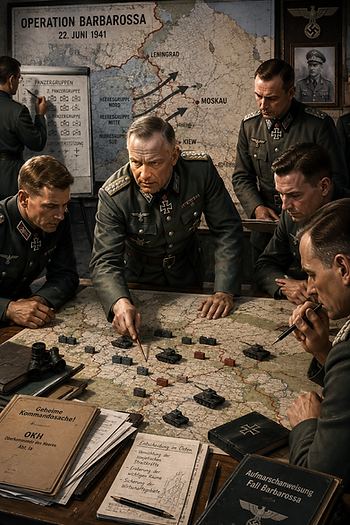
My Name is Heinz Guderian: German General and Pioneer of Armored Warfare
I was born in 1888 into a Prussian military family. From my earliest years, discipline, duty, and service to Germany were simply part of everyday life. My father was an army officer, and I followed the same path, attending military schools before receiving my commission in the Imperial German Army. I believed that a well-trained officer should constantly study, question, and improve the way wars were fought.
Lessons from the First World War
When the Great War erupted in 1914, I served primarily in communications and staff positions rather than leading troops in the trenches. While others watched attacks stall in endless mud and barbed wire, I studied how slow communications and poor coordination doomed even brave soldiers. I became convinced that future victories would belong to armies that could move quickly, communicate instantly, and strike before an enemy could react.
Building a New Way of War
After Germany's defeat, our army was greatly reduced, but that gave many of us time to think. I studied military theorists from many nations and became fascinated with tanks, radios, and motorized forces. I believed armored vehicles should never be scattered among infantry units. Instead, they should be concentrated into powerful formations that could break through enemy lines and race deep into the rear. I wrote these ideas in my book Achtung – Panzer!, hoping Germany would one day build such an army.
The Panzer Leader
When Germany began rebuilding its military during the 1930s, I was given opportunities to help organize armored divisions. I insisted that every tank should carry a radio so commanders could react instantly to changing conditions. Fast movement, surprise, and coordination became the foundation of our armored forces. Watching these divisions train convinced me that warfare had entered an entirely new age.
Victories Across Europe
In Poland, France, and the Low Countries, my Panzer forces advanced farther and faster than many believed possible. Bridges were seized before they could be destroyed, enemy armies became surrounded, and our columns rarely paused. Many soldiers called me "Schneller Heinz"—"Fast Heinz"—because I constantly urged my commanders forward. To me, speed created confusion, and confusion often decided battles before they were fully fought.
The Invasion of the Soviet Union
In June 1941, I led Panzer Group 2 during Operation Barbarossa, the invasion of the Soviet Union. At first, our advances seemed unstoppable as enormous Soviet formations were encircled. Yet I soon discovered that distance itself could become an enemy. Roads disappeared into mud, supplies struggled to keep pace, and Soviet resistance grew stronger with every passing week. The campaign I believed might end quickly became something entirely different.
Disagreements and Final Service
As the war continued, I increasingly disagreed with Adolf Hitler's military decisions. I argued that commanders needed flexibility and that military realities should outweigh political wishes. At times I was dismissed, later recalled, and eventually served as Chief of the General Staff. By then Germany was fighting battles on multiple fronts that became harder to win with each passing month.
After the war, I spent years reflecting upon my career and writing about the campaigns I had helped shape. I remained proud of many military innovations that changed modern warfare, yet I could not ignore the terrible destruction that followed the conflict. The invasion of the Soviet Union brought unimaginable suffering to soldiers and civilians alike. History should remember not only the lessons of strategy and technology but also the immense human cost that every war leaves behind.
Why Hitler Turned East – Told by General Heinz Guderian
When I looked toward the east in 1941, I knew we were preparing for the largest military operation Europe had ever witnessed. Adolf Hitler believed Germany's future depended upon defeating the Soviet Union. While many officers focused on military planning, Hitler's reasons reached far beyond strategy. His political beliefs, his economic ambitions, and his vision for Germany all pointed toward a massive invasion that he believed would reshape Europe forever.
An Ideological Crusade
Hitler did not view the coming campaign as simply another war between neighboring nations. He believed National Socialism and Soviet Communism represented opposing worldviews that could never coexist. In countless speeches and private discussions, he described Bolshevism as Germany's greatest ideological enemy and argued that the Soviet government had to be destroyed. This conviction shaped nearly every major decision leading to Operation Barbarossa.
The Search for Lebensraum
One word appeared repeatedly in Hitler's thinking: Lebensraum, or "living space." He argued that Germany required vast new lands for its growing population and believed those lands should be found in Eastern Europe and western regions of the Soviet Union. He expected conquered territory to provide room for future German settlement and agriculture. Many professional officers, including myself, concentrated on military operations rather than political theories, but there was no question that Lebensraum stood at the center of Hitler's long-term vision.
The Wealth of the East
The Soviet Union also possessed resources Germany desperately wanted. Rich farmland in Ukraine promised grain, while oil fields farther south offered the fuel needed to keep armies, factories, and aircraft operating. Coal, iron ore, and other raw materials were equally valuable. Germany had already experienced shortages caused by the British naval blockade, and many leaders believed controlling these resources would make the Reich economically self-sufficient during a long war.
Preparing for Operation Barbarossa
Military preparations consumed months of careful planning. Three enormous army groups were organized to strike toward Leningrad in the north, Moscow in the center, and Ukraine in the south. Millions of soldiers assembled along the frontier with thousands of tanks, artillery pieces, aircraft, trucks, and horses. As commander of Panzer Group 2, I focused on speed, coordination, and surprise. We believed rapid armored breakthroughs could shatter Soviet defenses before they had time to recover.
Confidence Before the Storm
Many German commanders expected a short campaign. Earlier victories in Poland and France had strengthened confidence in our methods of fast-moving armored warfare. Intelligence underestimated Soviet reserves, industrial capacity, and the determination of the Red Army to continue fighting despite enormous losses. We anticipated a decisive victory before winter arrived, believing that a series of encirclements would end organized resistance.
A Campaign Unlike Any Other
As history would reveal, the invasion became something far different from what had been expected. The ideological goals, economic ambitions, and military plans that launched Operation Barbarossa produced one of the largest and most destructive campaigns ever fought. It serves as a reminder that wars begun with great confidence can become conflicts whose costs far exceed anything their planners imagined.
Preparing the Largest Invasion in History – Told by General Heinz Guderian
In the months before June 1941, we prepared for an operation unlike anything Europe had ever witnessed. Never before had so many men, vehicles, aircraft, and supplies been gathered along a single frontier. The attack against the Soviet Union, known as Operation Barbarossa, demanded careful planning at every level. Every commander understood that success would depend not only upon courage but also upon organization, speed, and coordination.
Three Great Army Groups
The invasion force was divided into three massive Army Groups, each with a different objective. Army Group North would advance toward Leningrad, Army Group Center would drive toward Moscow, and Army Group South would capture Ukraine and its valuable farmland. My Panzer Group 2 served with Army Group Center, where rapid armored advances were expected to break through Soviet defenses and surround entire enemy armies before they could escape.
An Army of Millions
The scale of the invasion was difficult even for those of us who witnessed it firsthand. More than three million German soldiers, joined by hundreds of thousands of troops from allied nations, assembled along the frontier. Thousands of artillery pieces stretched for miles, while engineers prepared bridges, roads, and communications for the advance. The sheer number of men involved required months of planning before a single shot was fired.
The Power of the Panzer Forces
Germany's armored divisions formed the sharp point of the attack. Thousands of tanks, supported by motorized infantry, engineers, artillery, and reconnaissance units, were organized to move quickly and strike deeply behind Soviet lines. Every tank carried radios, allowing commanders to react almost instantly to changing conditions. I had long argued that concentrated armored formations could achieve breakthroughs impossible for slower armies, and now that theory would face its greatest test.
The Luftwaffe Takes to the Sky
Above us, the Luftwaffe prepared to support the invasion from the opening hours. German aircraft were assigned to destroy Soviet airfields, protect advancing troops, gather reconnaissance, and attack enemy supply lines. We expected control of the skies to help our armored columns maintain their momentum. Close cooperation between air and ground forces had contributed greatly to earlier victories, and we intended to use the same methods once again.
The Challenge of Supply
Moving an army is one thing; keeping it supplied is another. Fuel, ammunition, food, replacement parts, and medical equipment had to travel hundreds of miles behind the advancing front. Thousands of trucks, trains, horses, and supply depots were assigned to support the invasion. Yet even before the campaign began, many officers understood that the vast distances of the Soviet Union would place tremendous strain upon these supply lines. A fast-moving army could only advance as quickly as its fuel and ammunition could follow.
Ready for the Unknown
As June 22, 1941, approached, confidence filled many headquarters. Our preparations had been extensive, our forces well trained, and our previous campaigns highly successful. Yet no amount of planning could fully account for the immense size of the Soviet Union, the determination of its defenders, or the hardships that lay ahead. We believed we were prepared for history's largest invasion. Only the coming months would reveal whether our preparations were enough.
Engineering the Advance – Told by General Heinz Guderian
When people think of Operation Barbarossa, they often picture tanks racing across open fields or infantry advancing through smoke and dust. Yet our success depended upon another group of soldiers whose names rarely appeared in newspapers. The combat engineers were among the first men into danger and often among the last to leave it. Without their skill and determination, even the fastest Panzer division would have come to a halt.
Clearing the Way
As our armored columns advanced, engineers moved ahead to remove obstacles that blocked our path. Roads had been barricaded, bridges prepared for demolition, and defensive positions reinforced with wire and explosives. Minefields posed a constant threat to tanks and trucks alike. Working under enemy fire, engineers searched for hidden explosives, marked safe routes, and cleared passages so the main force could continue its advance. Every successful breakthrough owed something to their careful work.
Building Bridges at Remarkable Speed
Rivers presented another challenge. A single destroyed bridge could delay an entire army if no crossing remained. Combat engineers carried prefabricated pontoon bridges that could be assembled with surprising speed. Floating sections were connected, anchored in place, and covered with roadway panels strong enough to support tanks, trucks, artillery, and supply vehicles. Watching a bridge appear where only open water had existed hours before was one of the most impressive demonstrations of military engineering I witnessed during the war.
Crossing the Rivers
Major rivers such as the Bug, Dnieper, and Desna became natural defensive barriers. Engineers often crossed first in small boats to secure the opposite bank while infantry followed close behind. Once a bridgehead had been established, pontoon bridges or repaired permanent bridges allowed the armored columns to continue their advance. Every successful crossing required careful coordination between engineers, infantry, artillery, and aircraft working together under difficult conditions.
Keeping the Roads Open
The farther we advanced into the Soviet Union, the more important road construction became. Many existing roads were narrow, damaged, or little more than dirt tracks. Engineers repaired craters, strengthened weak bridges, filled holes, and improved muddy sections whenever possible. They also erected signs, directed military traffic, and built temporary bypasses around destroyed obstacles. Their efforts allowed supply convoys and combat units to maintain the momentum that was essential to our operations.
The Army Behind the Army
Combat engineers were only one part of a much larger support system. Mechanics repaired damaged vehicles, railway engineers converted Soviet rail lines to German gauge, and construction crews built supply depots and defensive positions. While the tanks received much of the attention, these specialists worked tirelessly behind the front to ensure that fuel, ammunition, food, and reinforcements reached the soldiers who depended upon them.
The Unsung Builders of Victory
Throughout my years commanding armored forces, I learned that victories are not won by tanks alone. Every bridge constructed, every minefield cleared, and every road repaired allowed another column to move forward. The engineers rarely sought recognition, yet their work often determined whether an offensive continued or came to a standstill. They remind us that in war, success belongs not only to those who fight on the front line but also to the skilled men whose labor quietly makes every advance possible.
June 22, 1941: Operation Barbarossa Begins – Told by General Heinz Guderian
Before dawn on June 22, 1941, silence stretched across much of the German-Soviet frontier. For months, millions of soldiers had assembled in secret, waiting for a single order. When that order came, one of the largest military operations in history began. Those of us commanding armored formations understood that every minute would matter. Speed and surprise were essential if our plans were to succeed.
The First Thunder
The opening moments were marked by tremendous artillery fire. Thousands of guns fired almost simultaneously against Soviet border positions, command posts, and defensive strongpoints. The intention was to disrupt communications and leave defending units confused before our ground forces reached them. The noise seemed endless, and columns of smoke quickly rose along the frontier as the attack unfolded across hundreds of miles.
The Luftwaffe Strikes
As the artillery continued, the Luftwaffe launched attacks against Soviet airfields. German pilots sought to destroy aircraft while they were still on the ground and to limit the Red Air Force's ability to respond. Reports reached headquarters describing damaged runways, burning hangars, and aircraft caught before many could take off. Air superiority was considered vital if our armored columns were to maintain their rapid advance.
Crossing the Border
Soon afterward, engineers cleared obstacles, bridges were secured or hastily constructed, and our forces crossed into Soviet territory. My Panzer Group 2 moved forward with tanks leading the advance, followed closely by motorized infantry, engineers, artillery, and supply units. The roads quickly filled with military traffic, and every commander worked to keep his column moving without delay. We believed that hesitation would only give the enemy time to recover.
Breaking Through the Front
During the opening days, many Soviet frontier units were overwhelmed by the speed of the assault. German armored formations exploited gaps in the defenses, bypassing isolated positions and driving deeper into the interior. The goal was not simply to capture ground but to surround large Soviet armies before they could withdraw. Rapid movement and close coordination between tanks, infantry, artillery, and aircraft made these early breakthroughs possible.
The Campaign Widens
Although the first advances appeared remarkably successful, it soon became clear that the campaign would not end in a matter of days. Fresh Soviet forces continued to appear, damaged roads slowed movement, and the distances before us seemed almost endless. The invasion that had begun with surprise and rapid gains was opening an entirely new theater of war—one that would become the largest, longest, and most destructive front of the Second World War. History would remember June 22, 1941, not only as the day Operation Barbarossa began, but also as the day the conflict entered a far more devastating chapter.
Intelligence Failures Before Barbarossa – Told by General Heinz Guderian
Long before the first German soldier crossed the Soviet frontier on June 22, 1941, another battle was already underway. It was fought not with tanks or artillery but with reports, reconnaissance flights, intercepted communications, spies, and educated guesses. Every commander depends upon intelligence to understand an enemy's strength and intentions. If that intelligence is incomplete or inaccurate, even the best military plans can rest upon dangerous assumptions.
Underestimating the Soviet Union
German intelligence gathered enormous amounts of information before Operation Barbarossa, yet one of its greatest mistakes was underestimating the Soviet Union itself. We believed the Red Army possessed fewer reserve divisions than it actually did, and we underestimated the Soviet Union's ability to raise new armies after suffering heavy losses. Likewise, we failed to appreciate how quickly Soviet factories could replace destroyed tanks, aircraft, and artillery. Our early victories reinforced the belief that the campaign would soon be won, but hidden reserves continued to appear throughout the summer.
Warnings That Went Unheeded
Across the border, Soviet intelligence received repeated indications that Germany was preparing for invasion. Reports arrived from diplomats, military observers, border patrols, and foreign agents warning that German forces were gathering in extraordinary numbers. Yet Joseph Stalin believed many of these warnings were attempts to provoke the Soviet Union into starting a war. Even as German divisions assembled along the frontier, he remained skeptical that an invasion would begin immediately. This hesitation delayed some defensive preparations during those critical final weeks.
Richard Sorge and the Spy Network
One of the most remarkable intelligence officers of the war was Richard Sorge, a Soviet spy operating in Tokyo under the cover of being a German journalist. Through his network of contacts, Sorge accurately reported that Germany intended to invade the Soviet Union. Although some of his warnings were initially doubted in Moscow, he later provided information suggesting Japan was unlikely to launch an immediate attack against Siberia. This intelligence eventually helped Soviet leaders move experienced divisions from the Far East to defend Moscow later in the year.
Reconnaissance and Deception
Both Germany and the Soviet Union relied heavily upon reconnaissance. Aircraft photographed enemy positions, scouts observed troop movements, and intelligence officers studied railway traffic and intercepted communications. At the same time, both nations practiced deception. German units concealed their movements whenever possible, while Soviet forces attempted to hide defensive preparations and reserve formations. No intelligence service ever possesses a complete picture, and commanders must often make decisions with only fragments of the truth.
Why Both Sides Made Mistakes
Looking back, it is clear that both nations made serious intelligence errors. Germany became overconfident after its rapid victories in Poland and Western Europe, leading many leaders to underestimate Soviet resilience, industrial capacity, and manpower. The Soviet leadership, meanwhile, allowed political assumptions and distrust to influence its interpretation of reliable warnings. Intelligence is valuable only when it is both accurate and believed. Even the finest reports accomplish little if leaders dismiss them or draw incorrect conclusions.
Operation Barbarossa reminds us that wars are influenced as much by information as by firepower. Intelligence officers, reconnaissance pilots, codebreakers, and spies all shaped the decisions made before the first shot was fired. The successes and failures of both Germany and the Soviet Union demonstrate that misunderstanding an opponent can be just as dangerous as underestimating his army. The lessons learned from these intelligence failures continue to be studied by military leaders around the world today.

My Name is Georgy Zhukov: Marshal of the Soviet Union
I was born in 1896 in the small village of Strelkovka, west of Moscow. My parents were poor peasants, and from an early age I understood that life rewarded hard work, discipline, and endurance rather than comfort. As a young apprentice in Moscow, I learned to work long hours without complaint. Those lessons stayed with me throughout my life, for a commander who cannot endure hardship cannot expect his soldiers to endure it either.
Forged in Revolution and Civil War
The First World War drew me into military service, where I learned the harsh realities of combat as a cavalry soldier. Soon afterward, the Russian Revolution changed my country forever. I joined the Red Army during the Civil War and fought to defend the new Soviet state. Those years taught me that victory belonged not only to courage but to organization, leadership, and determination. Every campaign sharpened my understanding of command.
Preparing for a New Kind of War
During the years between the wars, I devoted myself to studying military science. I believed that armies must constantly adapt or risk destruction. In 1939, I commanded Soviet forces against Japan at Khalkhin Gol on the Mongolian frontier. There, careful planning, coordinated armor, artillery, and air power brought us victory. That campaign proved to me that modern warfare demanded speed, cooperation, and overwhelming force at the decisive moment.
Facing Germany's Greatest Blow
When Germany invaded the Soviet Union in June 1941, our nation faced its darkest hour. Entire armies were surrounded, cities were threatened, and millions of our people found themselves under attack. I was called upon to organize defenses wherever the danger was greatest. There was little time for hesitation. Decisions had to be made quickly, and every hour mattered. Our task was simple to describe but difficult to accomplish: hold the line until the nation could recover.
Holding the Motherland Together
As the war continued, I helped direct the defense of Moscow, where we stopped the German advance before the capital fell. Later came the long struggles at Stalingrad, Kursk, and the great offensives that pushed our armies westward. Victory required enormous sacrifice from soldiers, workers, engineers, farmers, and families across the Soviet Union. No commander wins a war alone. Success belongs to an entire nation willing to endure hardship together.
The Road to Berlin
By 1945, our armies had crossed Eastern Europe and stood before Berlin itself. The fighting was fierce, but the city eventually fell, bringing the war in Europe to its conclusion. I accepted Germany's military surrender on behalf of the Soviet Union and later had the honor of leading the Victory Parade through Red Square. Those moments represented not personal triumph but the survival of our homeland after years of unimaginable suffering.
Life After the War
Peace did not bring a quiet life. I continued serving my country, though politics often proved as difficult as warfare. At times I was trusted with great responsibility, and at other times I found myself pushed aside. Such changes mattered less to me than knowing I had done my duty as I understood it. A soldier serves the nation, not his own ambition.
When I look back upon my life, I remember not only victories but also the tremendous cost that came with them. Millions of soldiers and civilians never returned home, and entire cities were left in ruins. We defended our homeland and defeated a terrible enemy, but every battlefield reminds us that even necessary victories demand a painful price. My greatest hope is that future generations will study these events carefully so they understand both the importance of defending freedom and the tragedy that accompanies war.
The Collapse of the Soviet Frontier – Told by Marshal Georgy Zhukov
On the morning of June 22, 1941, Germany launched an attack of enormous scale against the Soviet Union. Reports poured into headquarters from every direction, each more alarming than the last. Entire sectors of the frontier were under heavy bombardment, aircraft were striking deep behind our lines, and armored columns were crossing the border at great speed. The attack came with such force that many commanders struggled to understand its full extent during the first critical hours.
Confusion Along the Front
The opening days were marked by uncertainty and confusion. Telephone lines were cut, radio stations fell silent, and many frontline commanders found themselves unable to contact neighboring units or higher headquarters. Orders often arrived too late—or not at all. In war, information is as valuable as ammunition, and without reliable communications, even experienced soldiers can find themselves fighting blindly.
Headquarters Under Attack
German aircraft and artillery concentrated many of their first attacks on command centers. Headquarters that coordinated divisions and armies were damaged or destroyed, and staff officers were forced to relocate while the battle was already underway. Maps, equipment, and communications were lost, making it even harder to direct troops. Every interruption delayed decisions, and in those first days, every hour carried enormous consequences.
Early Defeats
German armored formations advanced with remarkable speed, breaking through parts of the frontier and surrounding large Soviet formations. Many of our units fought bravely, but bravery alone could not overcome poor coordination, surprise, and disrupted communications. Entire armies became isolated, and countless soldiers were forced to retreat, surrender, or continue fighting while completely cut off from support. These were painful losses that revealed how unprepared we were for the scale of the invasion.
Building a New Defense
Despite these setbacks, the Soviet Union did not collapse. Officers, soldiers, engineers, and civilians worked tirelessly to form new defensive lines farther east. Reserve armies were mobilized, damaged units were reorganized, and every available resource was directed toward slowing the German advance. Our task was no longer to hold every mile of frontier but to preserve enough fighting strength to defend the nation in the battles still to come.
Determination Beyond Defeat
The first weeks of Operation Barbarossa were among the darkest in our country's history. We lost territory, equipment, and many brave men, yet the spirit of resistance remained. As commanders, we learned difficult lessons about modern warfare, communications, and preparedness. Those lessons came at a terrible cost, but they helped shape the army that would eventually halt the invasion, reclaim our homeland, and carry the war all the way to Berlin.
Blitzkrieg Across the Soviet Union – Told by General Heinz Guderian
When Operation Barbarossa began, our objective was not simply to push the Soviet Army backward but to destroy its ability to continue fighting. I had long believed that speed could be as decisive as firepower. If armored forces moved fast enough, they could strike deep behind enemy lines before defenders had time to reorganize. The opening weeks of the campaign became the greatest test of these ideas.
The Panzer Spearheads
My Panzer Group formed one of the armored spearheads driving into Soviet territory. Tanks led the advance, followed closely by motorized infantry, engineers, reconnaissance units, and self-propelled artillery. Radios inside nearly every tank allowed commanders to react immediately to changing conditions. Rather than advancing evenly across the entire front, we concentrated our strongest forces at selected points, broke through the defenses, and continued moving before the enemy could recover.
The Great Encirclements
One of our principal goals was to surround Soviet armies rather than fight every unit head-on. After armored formations broke through, they drove deep into the enemy's rear while infantry advanced behind them. Eventually the advancing columns met, creating enormous pockets that trapped thousands of Soviet soldiers. Battles around places such as Białystok, Minsk, and Smolensk demonstrated how these encirclements could eliminate large formations, though each victory required considerable coordination and effort.
The March of the Infantry
While the tanks attracted most of the attention, victory depended just as much upon the infantry. Once the armored units moved ahead, infantry divisions secured roads, captured towns, cleared isolated resistance, and protected supply routes. Many soldiers marched long distances on foot, often under exhausting conditions. Without their steady advance, the fast-moving Panzer formations could have become isolated far ahead of the main army.
The Power of Motorized Warfare
Motorized warfare combined tanks, trucks, artillery, engineers, aircraft, and radio communications into a single coordinated force. Instead of waiting days for orders to travel through headquarters, commanders could communicate almost instantly. Aircraft reported enemy movements, engineers repaired bridges, and supply vehicles attempted to keep pace with the advancing columns. Every branch of the military had to work together if rapid operations were to succeed.
Why We Advanced So Quickly
Several factors contributed to our rapid advance during the opening weeks. Surprise disrupted Soviet defenses, many command centers lost communication with frontline units, and our forces had gained valuable experience during earlier campaigns in Poland and Western Europe. At the same time, Soviet armies were reorganizing after the initial shock and often lacked clear information about where the main attacks were developing. These circumstances allowed our armored formations to cover remarkable distances during the early phase of the invasion.
The Limits of Speed
Yet even the fastest army cannot outrun geography. As we moved farther into the Soviet Union, roads deteriorated, supply lines stretched across hundreds of miles, and Soviet resistance steadily increased. Blitzkrieg had delivered astonishing early successes, but I began to realize that the vastness of Russia would test every assumption upon which our plans had been built. The campaign was becoming something far larger and more difficult than any we had previously fought.
Military Communications – Told by Marshal Georgy Zhukov
When people study great battles, they often notice tanks, aircraft, artillery, and soldiers. Yet one of the most important battles cannot be seen at all. It is the struggle to send and receive information. A commander who knows where his own troops are—and where the enemy is moving—possesses an enormous advantage. During the opening months of Operation Barbarossa, communications often determined success or failure before the first shots of a battle were fired.
Germany's Advantage in Radio Communication
The German Army entered the campaign with an impressive system of radio communications. Many tanks carried radios, allowing commanders to change direction, respond to enemy movements, and coordinate attacks almost immediately. Armored units, infantry, artillery, and aircraft could communicate far more effectively than in many earlier wars. This flexibility helped German forces exploit opportunities quickly and contributed greatly to their rapid advances during the first weeks of the invasion.
The Soviet Communication Crisis
The Red Army faced far greater difficulties. Many frontline units had too few radios, and those they possessed were sometimes unreliable or vulnerable to attack. German artillery and aircraft frequently destroyed communication centers, while advancing armored units cut telephone lines connecting headquarters with the front. As a result, commanders sometimes received reports hours too late or lost contact with entire formations. An army that cannot communicate cannot maneuver effectively, no matter how courageous its soldiers may be.
Telephone Lines Under Fire
Before the widespread use of secure radio networks, telephone lines remained essential for directing military operations. Field telephone crews worked constantly to lay new wire, repair damaged cables, and reconnect headquarters after bombardments. These men often carried heavy spools of wire across dangerous ground while shells exploded nearby. Their work rarely received public attention, but every repaired telephone line restored the ability of commanders to direct the battle.
The Riders Who Carried Orders
When radios failed and telephone lines were cut, messages still had to reach the front. Dispatch riders on motorcycles, horseback, or in light vehicles carried written orders between headquarters and combat units. These journeys were often dangerous, requiring them to travel through artillery fire, damaged roads, and areas threatened by enemy patrols. Many important decisions reached frontline commanders because one determined messenger refused to stop until the orders had been delivered.
Speaking in Secret
Every army also relied upon codes to protect its communications. Messages sent by radio or telephone could be intercepted, so coded language helped prevent the enemy from learning plans and troop movements. Both Germany and the Soviet Union devoted considerable effort to developing secure communication systems while attempting to gather intelligence from intercepted enemy transmissions. Protecting information became almost as important as collecting it.
Why Communication Wins Battles
As the war continued, I became convinced that communication was one of the foundations of modern warfare. Weapons and manpower are essential, but without reliable information they cannot be used effectively. A commander who receives accurate reports can reinforce a weak position, launch a counterattack, or avoid disaster. During Operation Barbarossa, the successes of the German Army and the early struggles of the Red Army demonstrated just how much a battle can depend upon a single radio message, a repaired telephone line, or a dispatch rider arriving at precisely the right moment.

My Name is Vasily Zaitsev: Soviet Sniper of the Red Army
I was born in 1915 in the Ural Mountains of Russia. My family lived simply, and from a young age I learned to hunt with my grandfather. He taught me patience, careful observation, and respect for every shot. Ammunition was valuable, so missing was never an option. Long before I wore a military uniform, I had learned that success belonged to the person who remained calm while others hurried.
Learning Discipline Before War
As a young man, I joined the Soviet Navy and worked as a clerk in the Pacific Fleet. My duties involved records and finances rather than combat, but I never lost the habits I had learned as a hunter. I believed that every task should be done carefully and correctly. Although I lived far from Europe's growing conflict, I knew that one day my country might need every capable man.
Answering the Call
When Germany invaded the Soviet Union in 1941, I volunteered for transfer to the front. I did not wish to spend the war behind a desk while others defended our homeland. After many requests, I was finally sent west, where I found myself among the soldiers fighting in one of history's greatest battles. The city of Stalingrad had become more than a place on a map—it had become a symbol that neither side was willing to surrender.
The Sniper at Stalingrad
The ruins of Stalingrad became my battlefield. Broken buildings, shattered factories, and piles of rubble offered both danger and opportunity. I learned to wait for hours without moving, studying every window, every shadow, and every sound. A sniper does not fight with speed but with patience. Every careful shot could protect fellow soldiers or slow an enemy advance. Soon my successes encouraged others, and more snipers were trained to defend the city.
Teaching Others to Hunt
I never believed that victory depended upon one marksman. I spent much of my time teaching younger soldiers the skills that had served me so well. They became known as my "leverets," young hares learning to survive from an older hunter. If one sniper could defend a street, ten trained snipers could defend an entire district. Passing on knowledge became as important as firing my rifle.
Surviving the War
During the Battle of Stalingrad, I was seriously wounded by enemy mortar fire and nearly lost my eyesight. Skilled doctors restored my vision, allowing me to return to service before the war ended. Germany was eventually defeated, and like millions of others, I returned to civilian life. The battlefield had shaped me forever, but it no longer defined my purpose.
Life Beyond the Battlefield
After the war, I studied engineering and worked in the city of Kyiv. I lived quietly, raising a family and sharing my experiences only when asked. From time to time, I wrote about the lessons I had learned during the war, hoping future generations would understand what ordinary soldiers had endured. I never considered myself extraordinary; I believed I had simply done my duty when my country needed me most.
As I remember those years, I think less about the number of targets I struck and more about the friends who never came home. Every ruined building in Stalingrad held stories of courage, sacrifice, and loss. We fought because we believed our homes and families depended upon it. If history remembers me, I hope it also remembers the countless ordinary soldiers whose names were never recorded but whose determination helped save their nation from destruction.
Fighting as a Soviet Soldier – Told by Vasily Zaitsev
When Germany invaded the Soviet Union in June 1941, everything changed in a single morning. Like countless others serving in the Soviet armed forces, I understood that our country faced an enemy unlike any we had known before. Reports arrived of cities under attack, aircraft destroyed on the ground, and entire frontier units fighting desperately to slow the advance. Those first days were filled with uncertainty, but they also strengthened the resolve of many who believed there could be no surrender when our homeland was threatened.
The First Days of Combat
The opening weeks were unlike anything most Soviet soldiers had expected. German tanks moved quickly, aircraft appeared overhead without warning, and artillery struck positions before many units had fully organized their defenses. Orders changed rapidly as commanders tried to understand where the enemy was advancing. Soldiers often found themselves fighting under difficult conditions with little time to prepare, relying upon discipline, determination, and the comrades beside them.
Making Do with What We Had
The invasion exposed serious shortages throughout the Red Army. Some units lacked enough rifles, ammunition, radios, transport vehicles, or medical supplies. Equipment was sometimes abandoned during hurried withdrawals, while replacement weapons arrived slowly as factories struggled to meet the demands of war. Yet soldiers learned to adapt. Captured equipment was occasionally put to use, damaged weapons were repaired whenever possible, and every available resource was used to keep fighting.
The Hard Road of Retreat
No soldier enjoys giving ground, yet during the first months of the invasion many Soviet units were forced to retreat. These withdrawals were often dangerous, with roads crowded by soldiers, civilians, and supply columns while German aircraft searched for targets overhead. Retreat did not always mean defeat. Sometimes it was the only way to preserve enough men to establish a stronger defensive line farther east, where fresh forces could continue the fight.
Finding Courage Under Fire
Courage is not the absence of fear. Every soldier feels fear when shells explode nearby or aircraft dive overhead. What matters is continuing to do one's duty despite that fear. I saw men carry wounded comrades to safety, defend positions against overwhelming odds, and volunteer for dangerous missions because others depended upon them. Those acts of quiet bravery were repeated thousands of times across the Eastern Front and became the foundation of our resistance.
Defending Our Homeland
For many of us, the war became deeply personal. Behind us were our homes, our families, and the towns where we had grown up. Every village lost reminded us what was at stake. That determination gave Soviet soldiers the strength to continue fighting through hardship, hunger, exhaustion, and bitter weather. The opening months of the invasion brought painful losses, but they also revealed a spirit of endurance that would help carry the Soviet Union through the long years of war that still lay ahead.
Stalin's Response to the Invasion – Told by Marshal Georgy Zhukov
When Germany invaded on June 22, 1941, the Soviet Union faced the greatest military crisis in its history. Reports arrived faster than they could be verified. Entire frontier armies were under attack, communications were breaking down, and German armored formations were advancing with alarming speed. Even at the highest levels of government, the scale of the invasion was difficult to grasp during those first terrible days.
Recovering from the Initial Shock
The opening blows stunned our leadership. Decisions that might once have taken days now had to be made within hours. As commanders, we worked constantly to gather accurate information while units fought desperate delaying actions along the frontier. Once the reality of the situation became clear, there could be no hesitation. Every available resource had to be directed toward defending the Soviet Union.
Mobilizing an Entire Nation
The government ordered one of the largest military mobilizations in history. Millions of reservists were called into service, factories increased production around the clock, and civilians volunteered for construction, transportation, and medical work. Railways carried soldiers toward the front while moving equipment and industries farther east. It became clear that defeating the invasion would require the efforts of the entire nation, not merely the Red Army.
A New Command Structure
As the crisis deepened, Stalin assumed a more direct role in directing the war. New organizations were established to coordinate military operations and national defense, including the State Defense Committee and the Stavka, the high command responsible for planning major campaigns. Commanders were assigned to the sectors where the fighting was most critical, and decisions increasingly focused on restoring order and slowing the German advance before greater disasters could occur.
Holding the Line at All Costs
During those first months, a new determination spread throughout both the army and the country. We understood that continued retreat threatened not only military positions but also cities, factories, and millions of civilians. Although the famous Order No. 227 with its words "Not One Step Back!" would not be issued until the following year, the determination behind that message was already taking shape in 1941. Wherever possible, soldiers were expected to stand, delay the enemy, and buy time for new defenses to be prepared.
Organizing National Resistance
Resistance extended far beyond the battlefield. Engineers built defensive fortifications around major cities, workers produced weapons under exhausting conditions, and civilians dug trenches, transported supplies, and cared for the wounded. In occupied regions, partisan groups began organizing to disrupt German communications and gather intelligence. Every contribution, whether made by a soldier at the front or a factory worker far behind the lines, became part of the nation's struggle for survival.
The Beginning of a Long War
The summer of 1941 brought painful defeats and enormous sacrifices, yet it also revealed the resilience of the Soviet people. The initial shock gave way to determined resistance, and a nation that had been caught by surprise began reorganizing for a long and difficult conflict. Those early decisions to mobilize our resources, strengthen our command, and unite the country laid the foundation for the victories that would eventually follow.

My Name is Harrison E. Salisbury: Journalist and Foreign Correspondent
I was born in Minneapolis, Minnesota, in 1908. From an early age, I was fascinated by newspapers and the stories they carried from around the world. While some dreamed of becoming soldiers or politicians, I wanted to understand why nations rose, why wars began, and how ordinary people survived extraordinary times. I learned that asking careful questions often revealed more than making loud speeches.
Learning the Craft of Journalism
I studied journalism at the University of Minnesota and began my career reporting local news. Every assignment, no matter how small, taught me that facts mattered. A reporter's greatest responsibility is not to tell people what to think but to provide them with enough truthful information that they can reach their own conclusions. Accuracy, fairness, and persistence became the principles that guided my work.
Reporting on a Changing World
As my career grew with United Press and later The New York Times, I found myself covering some of the twentieth century's greatest events. The Soviet Union especially captured my attention because so much about it remained hidden from the outside world. I spent years studying its leaders, its military, and its people. I discovered that understanding a nation required looking beyond official speeches and listening carefully to the experiences of ordinary citizens.
Witness to the Cold War
Following the Second World War, I reported from Moscow during the tense early years of the Cold War. It was a challenging assignment. Every conversation had to be approached carefully, and reliable information was often difficult to obtain. Yet I believed that journalism served its highest purpose when it explained unfamiliar places honestly rather than relying on rumor or fear. The more I learned, the more I realized how complicated history truly is.
Telling the Story of the Eastern Front
Although I was not a soldier during Operation Barbarossa or the great battles that followed, I devoted years to researching the conflict. I interviewed veterans, studied military records, and examined the enormous sacrifices made on the Eastern Front. I wanted readers in the West to understand that the war between Germany and the Soviet Union was fought on a scale almost beyond imagination, affecting millions of soldiers and civilians alike.
Writing History for Future Generations
Books became another way to share what I had learned. I wrote about the Soviet Union, the Siege of Leningrad, and many other defining moments of the twentieth century. My goal was never simply to list dates and battles. I wanted readers to see history through the eyes of the people who lived it, because statistics alone can never capture hunger, fear, courage, or hope.
Following the Story Wherever It Led
Throughout my career, I traveled widely and reported from places experiencing conflict, political change, and social upheaval. Journalism demanded long hours, careful research, and the willingness to ask difficult questions. Governments sometimes disliked what I wrote, but a reporter's loyalty must always be to the truth as best it can be discovered through honest investigation and reliable evidence.
As I reflect on my life, I remain convinced that truthful reporting is one of the strongest defenses against misunderstanding and conflict. Wars are often remembered through the decisions of generals and presidents, yet they are endured by ordinary people whose voices deserve to be heard. If my work has any lasting value, I hope it encourages future generations to seek evidence carefully, think critically, and remember that behind every headline are real human lives.
Civilians Caught in the Invasion – Told by Harrison E. Salisbury
When people study Operation Barbarossa, they often focus on armies, tanks, and battles. As a journalist and historian, I found myself drawn to another story—the lives of ordinary civilians who suddenly found war arriving at their front doors. For millions of families across the Soviet Union, the invasion was not measured by military victories or defeats but by the loss of homes, loved ones, and the routines of everyday life.
The Long Columns of Refugees
As German forces advanced, roads quickly filled with refugees. Families packed whatever possessions they could carry onto wagons, bicycles, trucks, or simply onto their backs. Elderly grandparents walked beside young children while livestock wandered among the crowds. Many people had no clear destination. Their only goal was to move farther away from the fighting, hoping to find safety somewhere beyond the next horizon.
Evacuating a Nation
The Soviet government organized one of the largest evacuations in modern history. Factories were dismantled piece by piece and loaded onto trains bound for the east. Skilled workers and their families often traveled with the machinery they would later reassemble beyond the Ural Mountains. Schools, hospitals, government offices, and cultural treasures were also relocated whenever possible. It was an extraordinary effort to preserve both industry and the nation's future while the front moved ever closer.
Life Under Occupation
For those unable to escape, life changed almost overnight. Villages found themselves under military occupation, and familiar local leaders were replaced by occupying authorities. Food became scarce as crops, livestock, and supplies were seized or destroyed. Curfews, restrictions, forced labor, and constant uncertainty became part of daily existence. Many civilians quietly resisted by hiding neighbors, sharing food, or passing information to partisan fighters despite the enormous risks involved.
A Landscape of Destruction
As the campaign continued, countless towns and villages were left damaged or destroyed. Bridges collapsed, railways were torn apart, fields were burned, and homes became battlefields. The destruction affected far more than buildings. Harvests were interrupted, transportation failed, and entire communities struggled simply to survive the coming winter. Every ruined village represented hundreds of individual stories that rarely appeared in official military reports.
The Human Cost
The Eastern Front became the largest and most devastating theater of the Second World War, and civilians bore an enormous share of its suffering. Millions were displaced from their homes, separated from their families, wounded, imprisoned, or killed as the fighting spread across vast regions. Studying these events reminds us that wars are never experienced only by soldiers. Behind every map showing advancing armies are ordinary people whose lives are forever changed by decisions made far from their homes.
Remembering the People Behind the History
As I researched the Eastern Front, I became convinced that understanding history requires listening not only to generals and political leaders but also to teachers, farmers, factory workers, children, and parents. Their courage rarely appeared in battle reports, yet it shaped the survival of entire communities. If we remember only the movements of armies and forget the civilians who endured the invasion, we have overlooked one of the most important truths about Operation Barbarossa.
The Soviet Union Moves Its Industry East – Told by Marshal Georgy Zhukov
When the German invasion began in 1941, it quickly became clear that defending our factories was as important as defending our armies. Tanks, aircraft, artillery, rifles, and ammunition could not be produced if our industrial centers fell into enemy hands. Rather than allow these factories to be captured, the Soviet leadership made an extraordinary decision: move much of our industry thousands of miles to the east, beyond the reach of the advancing German Army.
Taking Apart an Industrial Giant
The evacuation of factories was a remarkable undertaking. Entire production lines were dismantled piece by piece. Heavy machines were lifted onto railcars alongside tools, blueprints, and spare parts. Engineers carefully labeled equipment so that it could be reassembled after reaching its destination. Every locomotive, crane, and freight car became part of a race against time as German forces pushed deeper into Soviet territory.
The Railways Become Lifelines
Our rail network became the backbone of this massive effort. Trains carried factory equipment eastward while transporting soldiers, civilians, raw materials, and military supplies in both directions. Railway workers labored day and night to keep traffic moving despite overcrowded lines and the constant pressure of wartime demands. Without their dedication, the evacuation of Soviet industry could never have succeeded.
Building New Industrial Cities
Many of the evacuated factories found new homes beyond the Ural Mountains, in Siberia, and in other regions far from the fighting. Empty fields and unfinished buildings quickly became busy industrial centers. Machinery was often assembled before roofs had been completed, allowing production to begin as soon as possible. These new factories soon produced tanks, aircraft, artillery, trucks, and ammunition in enormous numbers, supplying the Red Army throughout the remainder of the war.
The Sacrifice of the Workers
The success of this effort depended upon millions of ordinary workers. Men, women, and even older children endured exhausting hours, shortages of food, and harsh weather while building and operating new factories. Many families lived in temporary housing until permanent communities could be established. Their contribution rarely appeared on battlefield maps, yet every tank, rifle, and artillery shell reaching the front represented countless hours of labor behind the lines.
A Turning Point for Victory
The decision to move Soviet industry east proved to be one of the most important strategic achievements of the war. Although Germany captured large areas of territory, it failed to destroy our ability to produce the weapons needed to continue fighting. As production increased year after year, the Red Army became stronger while Germany struggled to replace its own growing losses. The factories beyond the Urals became as vital to victory as any battlefield.
When historians study the Eastern Front, they often focus on great battles such as Moscow, Stalingrad, and Kursk. Yet those victories were made possible because workers, engineers, railway crews, and factory managers accomplished what many believed impossible. They demonstrated that a nation's industrial strength, determination, and willingness to sacrifice can shape the outcome of a war just as surely as the courage of soldiers on the front lines.
The Challenge of Distance and Supply – Told by General Heinz Guderian
When people study Operation Barbarossa, they often think first of battles between armies. Yet one of our greatest opponents was neither a soldier nor a general. It was distance itself. As my Panzer forces drove deeper into the Soviet Union, I came to appreciate that even the finest army can advance no faster than its supplies. Fuel, ammunition, food, spare parts, and replacement vehicles had to travel hundreds of miles simply to keep us moving.
Roads That Stopped an Army
Western Europe possessed many paved highways, but the Soviet Union was different. Many roads were narrow dirt tracks that became clouds of dust during dry weather and seas of mud after rain. Heavy trucks, artillery pieces, and supply wagons frequently became stuck or moved at painfully slow speeds. Every delay allowed the Soviet Army more time to regroup while our front-line units waited for the supplies they desperately needed.
The Problem of the Railways
Another challenge soon appeared beneath the wheels of every train. Soviet railroads used a wider track gauge than Germany's rail system. Our locomotives could not simply continue east after crossing the border. Railway engineers had to capture rail lines, repair damaged bridges, and convert thousands of miles of track before supplies could move efficiently by train. This enormous task required time, manpower, and equipment that were already in short supply.
Fuel Becomes Precious
Armored warfare depended upon fuel more than any previous form of combat. Tanks, trucks, half-tracks, and motorcycles consumed vast quantities of gasoline every day. The farther we advanced, the farther fuel had to be transported from depots in the west. A tank without fuel is little more than a heavy steel obstacle, and many operations slowed because our supply columns simply could not keep pace with the rapid advance of the Panzer divisions.
Machines Under Constant Strain
The campaign also tested our vehicles beyond what many engineers had anticipated. Tanks and trucks traveled over rough terrain for weeks at a time, wearing out engines, suspensions, and tracks. Dust clogged air filters, mud damaged moving parts, and constant use increased the need for repairs. Our mechanics worked tirelessly, often repairing vehicles close to the front so they could quickly return to service, but replacement parts became increasingly difficult to obtain.
The Hidden Battle of Logistics
Many people imagine that wars are decided only by soldiers firing rifles or tanks engaging one another. In truth, every fighting unit depended upon thousands of drivers, mechanics, engineers, railway workers, and supply officers. Their efforts determined whether ammunition reached the front, whether wounded soldiers were evacuated, and whether armored formations could continue advancing. Logistics was not a secondary concern—it was one of the foundations upon which every military operation depended.
During the opening months of Operation Barbarossa, our armored forces achieved remarkable successes, yet those victories gradually slowed as supply difficulties increased. Geography, transportation, weather, and mechanical wear proved just as influential as enemy resistance. The Eastern Front taught me that brilliant tactics alone cannot overcome failing logistics. An army may win battles through skill and determination, but it can only sustain a campaign if its supplies continue to reach the soldiers who need them.
The First Signs Germany Would Not Win Quickly – Told by Marshal Zhukov
During the first weeks of the German invasion, the situation appeared desperate. Entire Soviet armies had been surrounded, vast territories were lost, and the enemy advanced with astonishing speed. Yet as I studied reports from across the front, I began to notice small but important changes. Germany was still advancing, but the easy victories of June were becoming harder to achieve. The character of the campaign was beginning to change.
Resistance Grows Stronger
The Red Army learned quickly from its early defeats. New defensive positions were established, commanders adapted to German tactics, and soldiers fought with increasing determination. Every town, river, and forest offered another opportunity to delay the advance. German units still captured territory, but they often had to fight harder for every mile than they had only weeks before. Time itself was becoming one of our greatest allies.
Fresh Armies Enter the Fight
One of the Soviet Union's greatest strengths was its ability to raise new armies even after suffering enormous losses. Reservists were called into service, training schools accelerated their programs, and units from distant regions of the country were sent toward the front. Factories continued producing weapons while replacement soldiers filled newly organized formations. Each fresh army forced Germany to fight another battle instead of celebrating a final victory.
The Burden of Long Supply Lines
As German forces advanced farther east, they moved farther from their own supply depots. Every mile gained meant fuel, food, ammunition, and replacement parts had to travel greater distances. Roads deteriorated, railway conversions required time, and vehicles wore out under constant use. While our armies fought to slow the advance, logistics quietly worked against the invaders. A fast-moving army cannot remain fast if its supplies fail to arrive.
The Cost of Constant Fighting
The German Army had won many impressive victories, but those victories came at a price. Experienced officers and soldiers were lost in battle, tanks required repair, and equipment became increasingly difficult to replace. Casualties mounted with every engagement, reducing the strength of units that had crossed the border only weeks before. Germany still possessed a formidable army, but it was no longer advancing without significant cost.
The Beginning of a Strategic Turning Point
By late summer and early autumn of 1941, I believed Germany's greatest opportunity for a swift victory was slipping away. The Soviet Union had survived the opening blow, new armies continued to appear, and our industrial evacuation ensured that weapons would keep reaching the front. The war remained dangerous, and much suffering still lay ahead, but the conflict had become a contest of endurance rather than a brief campaign. That change favored the nation that could continue fighting the longest.
Hope Through Endurance
No one in our headquarters imagined that victory would come easily. We understood that many difficult battles still awaited us. Yet the first signs had appeared that Germany's expectations of a quick triumph were fading. The courage of Soviet soldiers, the sacrifices of our workers, and the determination of an entire nation had begun to slow an invasion that once seemed unstoppable. Sometimes history changes not in a single dramatic moment but through countless small acts of perseverance that gradually alter the course of a war.
Operation Barbarossa Changes World War II – Told by Harrison E. Salisbury
When Germany invaded the Soviet Union on June 22, 1941, the Second World War entered an entirely new phase. As a journalist and historian, I have often found that certain events divide history into "before" and "after." Operation Barbarossa was one of those moments. What had already been a terrible European conflict suddenly expanded into a struggle of almost unimaginable size, changing the course of the war for every nation involved.
The Eastern Front Opens
The invasion created the Eastern Front, a battlefield stretching from the Baltic Sea to the Black Sea. Never before had such vast armies fought across such enormous distances. Cities, forests, rivers, and open plains became part of a continuous front that shifted hundreds of miles over the coming years. Decisions made on this front would eventually influence nearly every major military and political development in Europe.
The Largest Theater of the War
No other theater of the Second World War matched the Eastern Front in its scale. Millions of soldiers served on both sides, supported by countless aircraft, tanks, artillery pieces, trains, and supply vehicles. Entire industries worked to sustain the fighting, while civilians lived amid constant danger. The battles fought across the Soviet Union became some of the largest and most destructive military operations in human history.
Millions Drawn Into the Conflict
The invasion affected far more than the armies themselves. Millions of civilians became refugees, factory workers, nurses, engineers, railway laborers, and partisan fighters. Families were separated, communities uprooted, and industries relocated to continue supporting the war effort. The conflict reached nearly every aspect of daily life, reminding us that modern war extends far beyond the battlefield and touches entire societies.
Germany's Expanding Burden
Although Germany had already been fighting Britain in the west, Operation Barbarossa required an enormous commitment of men and resources to the east. As the campaign continued, German leaders faced the growing challenge of sustaining military operations over vast distances while remaining engaged against Britain and preparing for the possibility of additional enemies. In practice, Germany found itself dividing its strength across multiple major fronts, a burden that became even heavier after the United States entered the war later in 1941.
A War Reshaped Forever
Operation Barbarossa transformed the remainder of the Second World War. The Eastern Front became the central arena where Germany committed much of its army, while the Soviet Union emerged as one of the principal Allied powers. The campaigns that followed—Moscow, Stalingrad, Kursk, and the advance to Berlin—were all consequences of the invasion launched in June 1941. The decisions made during those first months echoed through every remaining year of the conflict.
History's Lasting Lesson
As I have studied this period, I have come to believe that Operation Barbarossa cannot be understood simply as another military campaign. It reshaped alliances, redirected economies, altered political decisions, and affected the lives of tens of millions of people. It reminds us that a single decision to begin a war can unleash consequences far beyond what its planners imagine, leaving a legacy that historians continue to examine decades after the guns have fallen silent.


Comments