

8. Heroes and Villains of the Cold War: Spies, the CIA, KGB, and the Secret Cold War


My Name is Elizabeth Bentley: Soviet Courier Turned American Informant
I was born in New Milford, Connecticut, in 1908, and nothing about my childhood suggested that I would someday carry secrets for Soviet intelligence. I was educated at Vassar College and later studied languages in Europe and at Columbia University. I was intelligent, ambitious, and searching for something larger than myself. During the Great Depression, capitalism appeared to many Americans to be failing. Communism promised equality, purpose, and a world without poverty. I listened. Eventually, I did more than listen.
I Entered the Communist Underground
During the 1930s, I joined the Communist Party of the United States. That decision opened a door into a world most Americans never saw. I became involved with Jacob Golos, an experienced Communist operative who worked closely with Soviet intelligence. Through him, I learned that espionage was rarely as dramatic as novels made it appear. The work depended upon discipline, secrecy, ordinary meetings, coded names, trusted contacts, and people willing to carry information without asking unnecessary questions.
I Became a Courier
My usefulness was simple: I could move through American society without attracting much attention. Government employees and other contacts supplied information, and I helped carry material through the underground network toward Soviet handlers. Documents could pass from one person to another until their original source disappeared behind layers of secrecy. I learned names, meeting places, schedules, and signals. I was not standing on street corners wearing a disguise. I was doing something more effective—I was appearing ordinary.
The Network Grew
After Golos died in 1943, much of his network fell into my hands. I suddenly found myself responsible for maintaining contact with numerous sources and intermediaries. Information connected to American government departments traveled through these networks. Moscow wanted political, military, diplomatic, and economic intelligence—anything that might reveal what American leaders knew, planned, or feared. Remember, the United States and Soviet Union were supposedly allies against Nazi Germany. But intelligence services do not stop watching one another merely because politicians shake hands.
Moscow Tightened Its Grip
The Soviet officers overseeing the operation increasingly wanted greater control. They wanted contacts separated, networks reorganized, and information moved through channels they controlled directly. I resented it. I had spent years managing people and taking risks, yet Soviet officials could issue instructions from behind the protection of their positions. Espionage depended upon loyalty, but loyalty did not mean trust. In our world, everyone watched everyone else.
I Walked Into the FBI
By 1945, I had reached my breaking point. I approached the FBI and began describing what I knew. I supplied names, relationships, methods, meeting arrangements, and information about Soviet espionage networks operating within the United States. Investigators did not simply accept every statement I made; they had to compare my claims with surveillance, documents, interviews, and other intelligence. But I had opened a door into an underground world that American authorities desperately wanted to understand.
VENONA Confirmed a Hidden War
Unknown to the public, American cryptanalysts were also working on what became known as the VENONA project, deciphering portions of Soviet intelligence communications. Over time, decrypted messages helped corroborate important parts of the larger picture of Soviet espionage that investigators were assembling. The Cold War was beginning, but beneath the speeches, armies, and diplomatic conferences another conflict had already been underway—one fought with coded messages, secret couriers, informants, intercepted communications, and betrayal.
The Price of the Secret Life
Looking back, I understand something I did not fully understand when I first entered that underground world. I believed I was serving an idea that promised a better society. Instead, I became part of a system built upon deception, secret obedience, and the theft of information from my own country. I cannot erase the documents I carried or the trust that was violated. In the end, I chose to tell American authorities what I knew, but that choice came only after years of participation. If my life teaches anything, it is that powerful ideas can persuade ordinary people to cross extraordinary lines—and sometimes we recognize the true cost only after we have already crossed them.
The Secret War Begins Before World War II Even Ends - Told by Elizabeth Bentley
In 1945, Americans saw Soviet soldiers as allies marching toward victory over Nazi Germany. I saw something different. My name is Elizabeth Bentley, and by then I had spent years working as a courier within Soviet espionage networks in the United States. While Roosevelt, Churchill, and Stalin met publicly as wartime partners, another struggle was taking place behind closed doors. Soviet intelligence was already collecting information from inside the American government. The Cold War had not yet been given its name, but part of its secret battlefield already existed.
Allies, But Never Completely Trusting
The United States and Soviet Union had been brought together by a common enemy, not by common beliefs. Hitler's invasion of the Soviet Union in 1941 made Moscow and Washington partners against Nazi Germany, but Soviet intelligence did not stop gathering information about its American ally. Moscow wanted to know what American officials were thinking, what policies Washington might pursue after the war, and what military and diplomatic information could strengthen the Soviet position. Nations may fight beside one another while their intelligence services continue watching each other.
I Carried Information Through an Invisible Network
My role was that of a courier and organizer. I worked closely with Jacob Golos, a Communist operative with connections to Soviet intelligence, and after his death in 1943 I became increasingly important in maintaining contacts. The people involved did not gather in some enormous secret headquarters. Espionage worked through compartments. One person knew another; information passed through intermediaries; aliases protected identities. Documents and reports could travel from government offices through several hands before reaching Soviet intelligence. The strength of the system was that few participants needed to understand the entire network.
Moscow Wanted More Than Military Secrets
People sometimes imagine espionage as nothing more than stealing weapons plans. Moscow's interests were considerably broader. Soviet intelligence sought political, diplomatic, economic, scientific, and military information. Sources associated with American government agencies could provide insight into discussions and decisions that were never intended for foreign governments. Knowing what another nation might do tomorrow can sometimes be more valuable than knowing how many tanks it possesses today.
The Atomic Bomb Made Secrets Even More Valuable
Nothing demonstrated the value of intelligence more dramatically than the Manhattan Project. I was not a courier for the atomic spy network itself, but Soviet intelligence penetrated the American atomic program through other sources, most famously physicist Klaus Fuchs and courier Harry Gold, among others. Stalin knew about the secret American bomb project before the American public did. When Truman informed Stalin at Potsdam in July 1945 that the United States possessed a powerful new weapon, Stalin's restrained reaction was partly understandable because Soviet intelligence had already provided information about the project. The atomic age and the intelligence war were developing together.
Then the War Ended
Germany surrendered in May 1945. Japan surrendered in August. The celebrations were enormous, but beneath them the alliance was already deteriorating. The Red Army occupied much of Eastern Europe. American officials worried about Soviet expansion. Moscow feared American power and intentions. Both sides began considering what the postwar world would look like. Intelligence that had been useful during wartime became even more important when yesterday's ally started looking like tomorrow's rival.
I Went to the FBI
By 1945, my relationship with Soviet intelligence had deteriorated badly. Soviet officers wanted tighter control over the networks I had helped manage, and I had become frightened and disillusioned with the system in which I was involved. In November, I approached the FBI. Over many interviews, I described people, contacts, methods, and networks connected to Soviet espionage. The investigators now faced an enormous problem: allegations alone were not enough. They needed surveillance, corroborating evidence, intercepted communications, and investigations that could determine which parts of what I told them were true.
A War the Public Could Not See
At almost the same time, American cryptanalysts were working on intercepted Soviet communications through the highly secret program later called VENONA. Over the following years, portions of Soviet messages were decrypted and provided important evidence about Soviet espionage operations. Most Americans knew nothing about this. They saw victory parades, soldiers returning home, and families celebrating the end of World War II. Behind that public world, intelligence officers, cryptanalysts, couriers, informants, and counterintelligence investigators were already fighting another kind of conflict.
World War II Ended—The Secret Cold War Did Not
That is what makes 1945 so important. There was no morning when Americans awoke to a newspaper announcing, "The Cold War Begins Today." The transformation happened gradually. Allies became suspicious rivals while espionage networks that had operated during the wartime alliance suddenly took on far greater significance. I had watched secrets move through that hidden world before most Americans understood that another struggle was beginning. The armies of World War II were coming home, but another war—one fought with information, deception, codes, spies, and betrayal—was only beginning.
Couriers, Dead Drops, Code Names, and Secret Networks - Told by Bentley
1945–1948 - You probably imagine a spy as someone carrying a pistol through a dark alley. That was rarely the world I knew. My name is Elizabeth Bentley, and I served as a courier in Soviet espionage networks operating in the United States. Our most useful weapons were far less dramatic: ordinary envelopes, memorized addresses, carefully arranged meetings, false names, coded messages, and people who knew when not to ask questions. The most successful secret network was one that could operate directly in front of you without ever looking secret.
The Courier Connected the Pieces
A courier was valuable because important sources often could not safely meet Soviet intelligence officers themselves. My job was to help bridge that distance. A source might obtain information, which could then pass through intermediaries before reaching Soviet representatives. This system created separation between the person supplying intelligence and the officer ultimately receiving it. If one person was discovered, investigators might still struggle to identify everyone else. Espionage depended on information, but survival depended on compartmentation.
Never Use a Name When a Code Name Will Do
Real names were dangerous. Soviet intelligence therefore used cover names and code names in communications to conceal the identities of agents and sources. A message intercepted by American authorities might mention individuals without making immediately clear who those people actually were. Addresses, occupations, relationships, and seemingly insignificant details could become pieces of a much larger puzzle. Years later, decrypted Soviet communications from the VENONA project would help American investigators connect some of those code names to real people.
Dead Drops and Secret Meetings
Not every exchange required two spies to sit together at a table. Intelligence officers could use clandestine techniques such as dead drops—prearranged locations where material could be hidden for another person to retrieve later. Other systems used recognition signals, carefully chosen meeting locations, concealed containers, or coded instructions. These techniques reduced direct contact. A park bench, stairwell, telephone call, or ordinary street could become part of an intelligence operation without anyone nearby realizing it.
The Best Spy Might Look Completely Ordinary
Secrecy also depended upon appearance. A successful operative did not necessarily dress differently, speak mysteriously, or carry obvious equipment. The best cover was often an ordinary life. Soviet intelligence recruited or cultivated people who had legitimate jobs and access to information. Some were motivated by Communist ideology, others by personal relationships or different pressures. When they walked into their offices in the morning, their coworkers might see nothing unusual. That was precisely what made an insider so valuable.
The Network Was Designed to Survive
One of the most important principles was that everyone should not know everything. Intelligence professionals call this compartmentation. A courier might know several contacts without knowing every person connected to those contacts. A source might know the person receiving information but not the Soviet officer farther along the chain. Moscow understood that arrests, defections, and surveillance were always possible. The fewer connections any individual could reveal, the better chance the larger organization had of surviving.
Then People Began Talking
That system was powerful, but it had one weakness that no code could completely eliminate: human beings. In November 1945, I went to the FBI and began describing the underground world in which I had operated. Suddenly investigators possessed something extraordinarily valuable—not merely an isolated document, but a person who could explain how contacts and networks were connected. Even then, my information had to be investigated and corroborated. Intelligence officers know better than most that an informant's statement is not automatically proof.
America Began Connecting the Names
Between 1945 and 1948, American counterintelligence increasingly investigated Soviet espionage while cryptanalysts secretly worked on intercepted Soviet communications. The VENONA decryptions gradually provided another window into Soviet intelligence activity. Investigators could compare names, aliases, relationships, dates, meetings, intercepted messages, and testimony. What had once appeared to be disconnected individuals could sometimes be recognized as pieces of larger networks.
The Real Weapon Was Trust
That is the lesson I learned from the secret networks of the 1940s. Espionage technology mattered, but the entire system ultimately rested upon trust: a source trusted a courier, the courier trusted a handler, and Moscow trusted that everyone would remain silent. Break that trust at one point, and investigators might begin following the chain. During the early Cold War, both the United States and Soviet Union learned the same uncomfortable truth: the most dangerous battlefield might not be across an ocean. It might be inside your own government, hidden behind an ordinary office door.
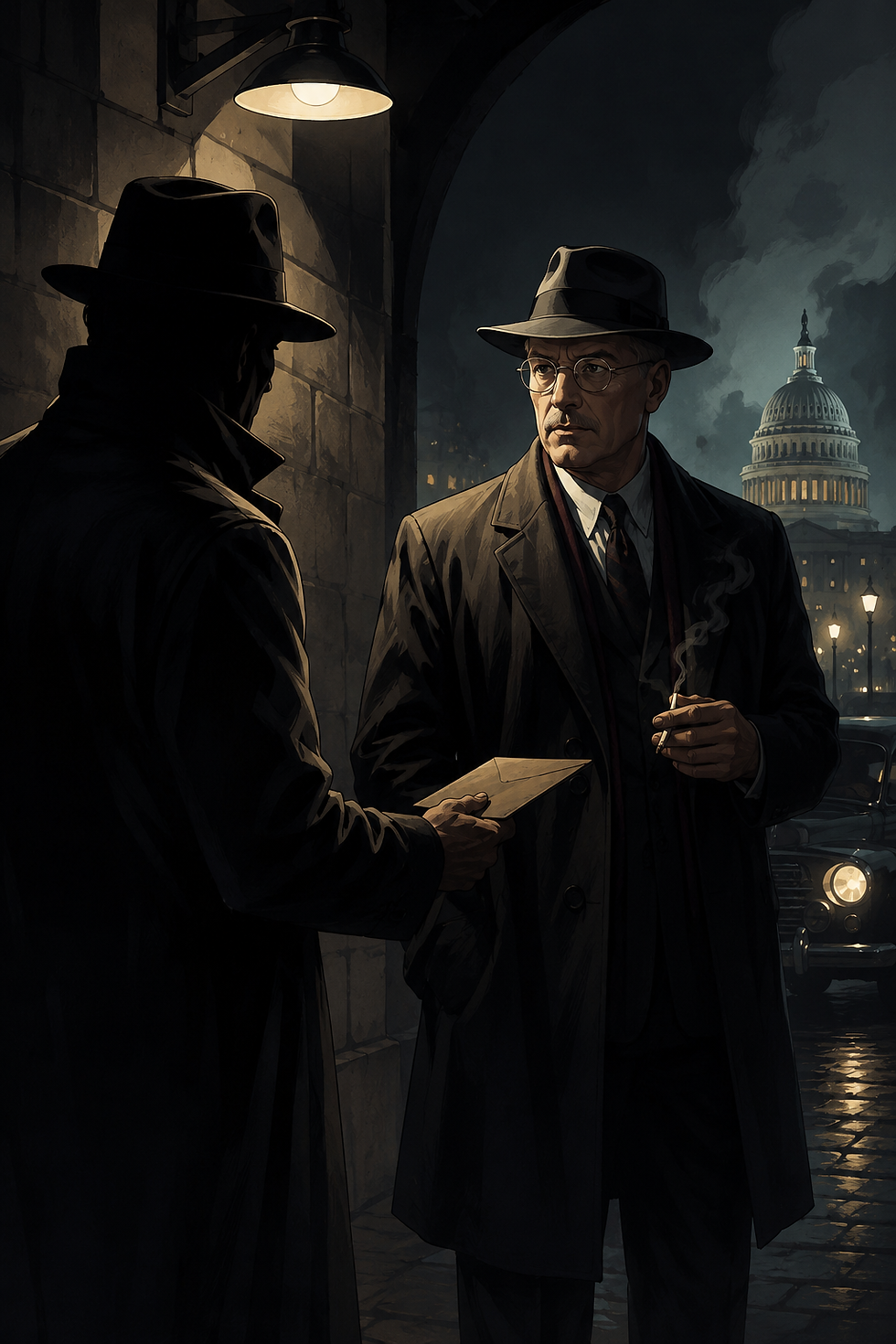
My Name is Allen Dulles: America’s Master of Intelligence
I was born in Watertown, New York, in 1893, into a family where diplomacy and international affairs were common conversation. My grandfather and uncle had served as U.S. secretaries of state, and my older brother, John Foster Dulles, would eventually do the same. I learned early that nations rarely reveal everything they intend to do. What governments say publicly is important. What they say privately can be considerably more important.
Diplomacy Taught Me to Watch
I entered the American diplomatic service during the First World War and served in Europe and the Middle East. Diplomacy taught me to listen carefully, study personalities, and recognize that information could alter the course of events. Later, I practiced international law, but when another world war erupted, my experience made me useful for another profession—the gathering of intelligence.
My War Was Fought in the Shadows
During World War II, I joined the Office of Strategic Services, the OSS, America's wartime intelligence organization. Stationed in neutral Switzerland, I cultivated contacts throughout Nazi-controlled Europe. Diplomats, resistance members, businessmen, military officers, and Germans opposed to Hitler brought information to us. Intelligence work was not simply stealing documents. It was determining which person could be trusted, which rumor was valuable, and which apparent friend might be feeding you exactly what the enemy wanted you to believe.
A New Enemy Emerged
The defeat of Nazi Germany did not produce the peaceful world many Americans expected. The Soviet Union extended its influence across Eastern Europe, and Communist movements gained strength elsewhere. Washington needed reliable information about governments that deliberately concealed their military strength, political intentions, and intelligence operations. In 1947, the United States created the Central Intelligence Agency. America had decided that intelligence could no longer be something assembled hurriedly whenever war began.
I Took Command of the CIA
I became Director of Central Intelligence in 1953 under President Dwight D. Eisenhower. I believed intelligence should provide America's leaders with knowledge before crises became disasters. But the CIA was not merely watching the Soviet world. Under my leadership, it developed networks of agents, intercepted information, analyzed foreign governments, conducted psychological operations, and undertook covert actions intended to influence events without openly deploying American armies.
The Weapon No One Was Supposed to See
Covert action became one of our most controversial instruments. The CIA participated in operations connected to political changes in Iran in 1953 and Guatemala in 1954. From Washington's Cold War perspective, Communist expansion and Soviet influence could not always be confronted by conventional military force. Sometimes governments preferred an operation whose American fingerprints could be denied. Success strengthened confidence in covert action—but success could also make intelligence officers believe that methods effective in one country would work just as well in another.
We Needed Eyes Over the Soviet Union
The Soviet Union remained extraordinarily difficult to penetrate. One answer was technology. The U-2 reconnaissance aircraft could fly at tremendous altitude and photograph Soviet military installations. These missions gave American leaders information they could obtain in few other ways. Yet secrecy never eliminates risk. In May 1960, a Soviet missile brought down Francis Gary Powers and his U-2. Moscow captured the pilot alive, and an operation intended to remain secret became an international humiliation.
Intelligence Was a War Without Front Lines
Throughout those years, the CIA and Soviet intelligence services hunted one another across the world. We recruited agents; they recruited agents. We searched for their spies while they searched for ours. Defectors brought secrets, double agents brought uncertainty, and every intelligence service faced the same uncomfortable question: Is the person giving me information actually working for the other side? The Cold War had armies and nuclear weapons, but it also had an invisible battlefield fought in hotel rooms, embassies, safe houses, and quiet meetings between people whose real names might never be spoken.
The Bay of Pigs
Then came Cuba. The CIA developed a plan using Cuban exiles to overthrow Fidel Castro's government. President Eisenhower authorized preparations, and President John F. Kennedy inherited the operation. When the invasion occurred at the Bay of Pigs in April 1961, it ended disastrously. The assumptions behind the plan proved badly mistaken. Castro remained in power, America's involvement became obvious, and the United States suffered a serious political defeat. Kennedy later accepted public responsibility, but within the government there was no escaping the consequences for the CIA. I resigned later that year.
What Intelligence Taught Me
I spent much of my life believing that America needed an intelligence service willing to operate in places where conventional diplomacy could not reach. I still believe intelligence was essential during the Cold War. Yet age provides a different perspective on power. Secret organizations can accomplish things governments cannot openly undertake, but secrecy can also shelter faulty assumptions from sufficient challenge. Iran, Guatemala, the U-2 affair, and especially the Bay of Pigs demonstrated that covert power carries consequences far beyond the operation itself. Intelligence can protect a nation, but those entrusted with secret power must remember that possessing the ability to intervene is not the same as possessing the wisdom to do so.
The Birth of the CIA - Told by Allen Dulles
When World War II ended in 1945, Americans naturally wanted their soldiers home and their wartime organizations dismantled. President Harry Truman abolished the Office of Strategic Services, the OSS, that September. I understood the desire to return to normal life, but I had spent the war gathering intelligence from Switzerland and knew something uncomfortable: America's enemies would not stop keeping secrets merely because America had stopped fighting. Within two years, the United States would create something it had never possessed in peacetime—a permanent central intelligence agency.
What the OSS Had Taught Us
During the war, General William "Wild Bill" Donovan built the OSS into an organization capable of espionage, sabotage, analysis, propaganda, and support for resistance movements. I ran intelligence operations from Bern, Switzerland, where information reached us from sources inside Nazi-controlled Europe. We learned an essential lesson: armies could tell you where an enemy was fighting, but intelligence might tell you what he intended to do next. When Truman dissolved the OSS, however, its responsibilities were divided among other parts of the government. America again faced the question of how intelligence should operate during peacetime.
A New Enemy Was Taking Shape
The answer became increasingly urgent. Relations with the Soviet Union deteriorated rapidly. Soviet power expanded across Eastern Europe, Communist movements gained influence, and American leaders struggled to understand Moscow's intentions. The Soviet system was especially difficult to observe from the outside. Its government controlled information, guarded its institutions, and operated extensive intelligence services of its own. If Washington waited for a crisis before trying to understand the Soviet Union, it might already be too late.
The Central Intelligence Group Comes First
Before there was a CIA, there was the Central Intelligence Group. In January 1946, Truman created the CIG under the authority of the National Intelligence Authority. Its purpose was to coordinate intelligence gathered by different parts of the American government. That sounds simple, but it addressed a serious problem. The Army, Navy, State Department, and other agencies possessed pieces of information, yet pieces scattered across Washington were not enough. Someone had to assemble them into a picture that the president could actually use.
1947: The CIA Is Created
The decisive change came with the National Security Act of 1947. The same legislation that reorganized America's military establishment and created the National Security Council also established the Central Intelligence Agency. The CIA officially came into existence on September 18, 1947. Its responsibilities included correlating and evaluating intelligence concerning national security and performing additional intelligence-related functions as directed by the National Security Council. America now possessed a permanent civilian intelligence organization at the center of its emerging Cold War security system.
Information Was Only the Beginning
There was another question, however: should an intelligence service merely observe events, or should it secretly influence them? The Soviet Union was supporting Communist organizations and conducting political and intelligence operations beyond its borders. American leaders increasingly concluded that the United States needed covert capabilities of its own. The National Security Council authorized covert psychological and political activities, and organizations within the emerging CIA structure began undertaking operations that could be conducted without openly acknowledging American involvement.
A Different Kind of Battlefield
This meant the Cold War would be fought on two levels. On the visible battlefield were presidents, diplomats, soldiers, treaties, and speeches. Beneath them was another contest involving recruited agents, intercepted communications, propaganda, secret financing, resistance organizations, surveillance, and covert operations. The objective was often to gain an advantage without creating the open military confrontation that could lead to another world war.
The Agency I Would Eventually Lead
I did not become Director of Central Intelligence until 1953, but the institution I inherited had been born from the experiences of World War II and the uncertainties that followed it. The creation of the CIA reflected a fundamental change in American thinking. The oceans could no longer provide the protection they once seemed to offer, and Washington could not afford to remain ignorant of developments inside distant governments.
America Had Entered the Intelligence Age
The birth of the CIA was therefore more than the creation of another government department. It represented America's decision that intelligence would become a permanent instrument of national power. That decision would help the United States uncover threats and understand its adversaries, but it would also lead the CIA into secret operations whose consequences would be debated for generations. In 1947, however, the immediate question was simpler: in a world filled with secrets, could the United States afford not to have an organization devoted to discovering them?

My Name is Kim Philby: The Spy Inside British Intelligence
My name is Harold Adrian Russell Philby, though nearly everyone called me Kim. I was born in India in 1912, the son of a British colonial official, and educated at Westminster School and Trinity College, Cambridge. Britain expected young men of my background to enter respectable professions and serve the establishment. Outwardly, that is precisely what I did. Inwardly, however, I had reached a very different conclusion about the world.
Cambridge Changed My Direction
At Cambridge during the early 1930s, politics was impossible to ignore. Fascism was advancing in Europe, capitalism appeared deeply wounded by depression, and communism presented itself as an alternative to both. I moved toward the political left and eventually came into contact with Soviet intelligence. I was not recruited to become a noisy revolutionary. Quite the opposite. I was encouraged to conceal my beliefs, establish respectable credentials, and become useful from inside the British establishment.
I Built the Perfect Cover
I worked as a journalist and reported from Spain during the Spanish Civil War, publicly appearing increasingly conservative. That appearance was useful. If one wishes to penetrate an organization, announcing one's true loyalties is generally a poor beginning. When World War II came, I entered Britain's Secret Intelligence Service, commonly known as MI6. The remarkable thing was that the organization charged with discovering enemy secrets had admitted a Soviet agent into its own ranks.
I Became an Intelligence Officer
I proved competent at my work and advanced. Eventually, I became involved in counterespionage against the Soviet Union itself. Consider the position: British intelligence trusted me to help understand Soviet operations while I was secretly supplying information to Moscow. Reports, identities, plans, and assessments could pass through my hands. I did not need to break into MI6 headquarters. I had an office there.
Washington Trusted Me Too
In 1949, I was sent to Washington as Britain's intelligence liaison with American agencies. I developed relationships with officials in the newly created CIA and FBI and gained access to sensitive Anglo-American intelligence. Western governments were constructing an enormous intelligence apparatus against the Soviet Union, yet some of what they discussed could find its way back to Moscow through me. Espionage is often less about stealing a secret than placing the right person where secrets naturally arrive.
Burgess and Maclean Fled
My position became increasingly dangerous when Donald Maclean, another Soviet agent, came under suspicion. Guy Burgess and Maclean fled Britain for the Soviet Union in 1951. Their disappearance created an obvious question: Who had warned them? Suspicion soon settled upon me. I was questioned and forced to leave the intelligence service. Yet suspicion is not proof, and no sufficient evidence was publicly produced to prosecute me.
I Returned From the Dead
In 1955, Foreign Secretary Harold Macmillan told Parliament there was no evidence establishing that I had betrayed Britain. I even held a press conference denying that I had been a Soviet agent. For a time, I appeared to have survived. I later worked in Beirut as a journalist while maintaining connections with British intelligence. The old world of secrecy had not entirely released me.
The Net Finally Closed
By the early 1960s, new information pointed toward me again. In 1963, British intelligence confronted me in Beirut. I understood what was happening. Years of deception were collapsing around me, and this time there might be no escape through another denial. So I disappeared. I traveled through the Middle East and eventually reached Moscow. The British intelligence officer who had spent years hunting Soviet spies had finally revealed himself as one of them.
Moscow Was Not Quite the Dream
I spent the remainder of my life in the Soviet Union. I was celebrated publicly as an important intelligence officer, although my first years there were not always what I had imagined. The Soviet system I had served from afar looked different when I actually lived inside it. Yet I continued defending the decision I had made decades earlier. I had chosen a side, penetrated Britain's intelligence establishment, and supplied Moscow with information for years.
The Cambridge Spy Ring and Soviet Penetration of Britain - Told by Kim Philby
By 1948, Britain believed men such as myself were helping defend it against Soviet espionage. The uncomfortable truth was that some of us were already working for Moscow. My name is Kim Philby, and I had been recruited by Soviet intelligence in the 1930s before entering Britain's Secret Intelligence Service, MI6. I was not standing outside the British establishment trying to break through its defenses. I was sitting comfortably inside it, trusted with some of the very secrets those defenses were intended to protect.
Cambridge Was Where It Began
The group later called the Cambridge Five did not begin as five men sitting together and agreeing to betray Britain. During the 1930s, Soviet intelligence recruited several young men associated with Cambridge University who were sympathetic to communism. Among those later identified were Guy Burgess, Donald Maclean, Anthony Blunt, John Cairncross, and myself. Moscow recognized something important: young men from respectable British backgrounds might eventually enter government, diplomacy, and intelligence. Rather than using us immediately, Soviet handlers encouraged us to build conventional careers and conceal our Communist sympathies.
We Entered the Establishment
The strategy worked remarkably well. Maclean entered the diplomatic service. Burgess worked in broadcasting, diplomacy, and intelligence. Blunt served in MI5 during the war and later became Surveyor of the King's Pictures. Cairncross worked in government and intelligence-related positions. I entered MI6 and rose through its ranks. Britain did not merely have Soviet agents attempting to steal secrets from outside government buildings. Soviet intelligence had cultivated men who could enter through the front doors.
I Was Supposed to Hunt the Soviets
My position became particularly extraordinary. Within MI6, I eventually headed Section IX, which dealt with Soviet and Communist intelligence matters. Think about that arrangement. Britain had placed a Soviet agent in a position concerned with understanding Soviet espionage. I received information about British operations, intelligence sources, and Western plans while maintaining my secret loyalty to Moscow. The Soviets did not need to guess everything British intelligence knew about them. In certain cases, I could help tell them.
Then Britain Sent Me to Washington
In 1949, I was posted to Washington as the principal British intelligence liaison with American intelligence organizations. The CIA was still young, and cooperation between Britain and the United States was becoming crucial as the Cold War intensified. I met American officials and had access to sensitive Anglo-American intelligence. From Moscow's perspective, the placement could scarcely have been better. Soviet intelligence had an agent positioned where British and American secrets came together.
A Code Name Began to Unravel Everything
But secret networks leave traces. American cryptanalysts working on what became known as VENONA had begun deciphering portions of wartime Soviet intelligence traffic. Among the Soviet code names investigators encountered was "Homer," eventually linked to Donald Maclean. By 1951, British authorities were closing in on him. For Moscow, the danger was obvious: if Maclean were interrogated and confessed, other agents could be exposed.
Burgess and Maclean Disappear
Maclean needed to escape. Guy Burgess helped him do so, and in May 1951 the two men vanished from Britain and eventually surfaced in the Soviet Union. Their disappearance created a scandal. Investigators immediately wanted to know how Maclean had been warned. Burgess had recently been staying in my Washington home, which made my own position exceedingly uncomfortable. Suspicion began moving in my direction.
Was I the Third Man?
British intelligence questioned me repeatedly. I denied being a Soviet agent. There was suspicion but insufficient evidence to prosecute me, and in 1951 I was forced to resign from MI6. Newspapers began asking whether an unidentified "Third Man" had warned Burgess and Maclean. My career as a senior British intelligence officer had effectively collapsed, but my secret had not yet been publicly proven.
The Damage Was Larger Than Five Men
The Cambridge spies mattered because of where we had been placed. This was not simply a story about five individuals stealing documents. It was a counterintelligence catastrophe. Soviet intelligence had penetrated British diplomacy, security, and intelligence while Britain was becoming one of America's most important Cold War partners. Every compromised operation created another question: Which agents had been exposed? Which plans did Moscow know? Which apparent failures had really been caused by betrayal?
The Greatest Weakness Was Trust
By 1953, Burgess and Maclean were safely inside the Soviet Union while I remained under suspicion in Britain. My story was far from finished; I would not finally flee to Moscow until 1963. But the events of these years had already demonstrated one of espionage's most disturbing truths. Intelligence agencies can build stronger locks, invent better codes, and watch their borders carefully. None of those protections are sufficient if the enemy has already earned a chair at your table. The Cambridge network penetrated Britain because we did not look like outsiders. We looked exactly like the men Britain had been taught to trust.
From Intelligence Gathering to Covert Operations - Told by Allen Dulles
By 1948, Washington had reached an uncomfortable conclusion: knowing what the Soviet Union was doing might not be enough. My name is Allen Dulles, and I would eventually become Director of Central Intelligence. The CIA had been created only the year before, principally to collect, coordinate, and evaluate intelligence. Yet the Cold War was developing into a struggle fought through elections, newspapers, labor organizations, resistance movements, propaganda, and secret political networks. American leaders began asking a more dangerous question: if Moscow was secretly influencing events abroad, should we merely watch—or secretly act ourselves?
The CIA Moves Into the Shadows
In 1948, the National Security Council authorized covert political, economic, and psychological activities. Within the CIA, the Office of Policy Coordination became a major instrument for such operations. These missions were intended to advance American interests while keeping official U.S. involvement hidden. Funds could be secretly provided to organizations, propaganda could be distributed, political groups could receive assistance, and resistance networks could be supported behind Communist-controlled borders. "Plausible deniability" became an important concept: an operation was most useful politically when Washington could avoid openly acknowledging responsibility.
The Battle Could Be an Election
One early proving ground was Italy. In the 1948 Italian election, American leaders feared that the powerful Communist-led Popular Democratic Front might gain control through the ballot box. The United States openly provided economic assistance and encouraged Italian Americans to contact relatives, while the CIA secretly supported anti-Communist political forces. The Christian Democrats won decisively. To officials in Washington, Italy appeared to demonstrate that covert political action could help contain Communist influence without sending American soldiers into battle.
We Fought With Words as Well as Agents
The contest also moved into newspapers, radio broadcasts, cultural organizations, labor movements, and intellectual circles. The United States supported information and cultural efforts designed to challenge Communist influence, while CIA-backed organizations secretly assisted some publications and groups. Radio Free Europe began broadcasting into Communist-controlled Eastern Europe in 1950, supported covertly by the CIA during its early years. The objective was simple: if governments controlled what their citizens could hear, information itself could become a weapon.
Then Came Iran
In 1953, covert action became considerably more ambitious. Iran's prime minister, Mohammad Mosaddegh, had nationalized the Anglo-Iranian Oil Company, producing a confrontation with Britain amid growing American fears about instability and Communist influence. British and American intelligence cooperated in Operation TPAJAX, supporting efforts that contributed to Mosaddegh's overthrow and strengthened Shah Mohammad Reza Pahlavi's position. The operation appeared successful from Washington. A government viewed as increasingly dangerous to Western interests had been removed without an American invasion.
Guatemala Reinforced Our Confidence
The following year brought Guatemala. President Jacobo Árbenz pursued land reform that affected the American-owned United Fruit Company, while Washington also feared Communist influence within his government. In Operation PBSUCCESS, the CIA supported Carlos Castillo Armas and a small rebel force while using propaganda, diplomatic pressure, and psychological warfare to magnify the appearance of the threat against Árbenz. In June 1954, Árbenz resigned. Once again, covert action seemed to have achieved a political objective at relatively low immediate cost to the United States.
Success Could Be Dangerous
Iran and Guatemala strengthened confidence inside the American intelligence establishment. Why fight a conventional war if a relatively small covert operation could alter events? But that reasoning contained a danger. A successful operation could tempt policymakers to believe that foreign societies were pieces on a board and that intelligence officers could reliably predict what would happen after governments fell. Covert operations might produce immediate victories while creating political resentments and consequences that would emerge years later.
The CIA Had Become Something New
By 1956, the CIA was no longer simply an organization collecting secret reports and placing intelligence summaries on the president's desk. It had become an instrument through which the United States could secretly influence events overseas. We gathered information, recruited agents, supported anti-Communist organizations, conducted psychological operations, and helped shape political struggles that most Americans knew nothing about at the time.

My Name is William Fisher: The Soviet Spy America Called Rudolf Abel
My name is William Genrikhovich Fisher, although the world came to know me as Rudolf Abel. I was born in Newcastle upon Tyne, England, in 1903, to Russian revolutionary parents who opposed the rule of the czar. My family eventually returned to Russia after the Bolshevik Revolution. I grew up between two worlds, speaking English and Russian, understanding Western society while becoming committed to the Soviet state. Those abilities would eventually make me useful in a profession where being unnoticed was often more valuable than being famous.
I Learned the Language of Signals
I possessed a talent for languages, electronics, and radio communications. After serving in the Red Army, I entered Soviet intelligence. Radio was one of the essential weapons of espionage. An intelligence officer operating thousands of miles from Moscow needed a secure means of communicating with headquarters, and coded radio transmissions could cross oceans while revealing very little to anyone listening. I learned that intelligence work demanded patience, precision, and an ability to remain calm when a single mistake could expose an entire network.
War and Intelligence
During World War II, my knowledge of radio communications remained valuable to the Soviet Union. Intelligence organizations required people capable of training radio operators and maintaining secret communications with agents behind enemy lines. When Nazi Germany was defeated, however, cooperation between the Soviet Union and Western Allies quickly deteriorated. A different conflict was emerging, and in this war information would often be as valuable as tanks.
I Was Sent to America
In the late 1940s, Soviet intelligence sent me secretly into the United States. I eventually established myself in New York under false identities, including that of Emil Goldfus. I was what intelligence professionals call an illegal—an officer operating without diplomatic protection. If a diplomat is exposed as a spy, his government may send him home. If an illegal is captured, there is no embassy position to protect him. Your defense is your identity, your preparation, and your silence.
The Ordinary Man Was My Disguise
I lived quietly and presented myself as an artist and photographer. That was precisely the point. A successful intelligence officer should not look like the public's idea of a spy. Behind that ordinary existence were coded communications, concealed messages, secret meetings, and contacts with other Soviet operatives. Moscow wanted information concerning American military capabilities and technology. My responsibility was not to attract attention. It was to make information move while remaining invisible myself.
One Man Broke the Network
My downfall came through another Soviet intelligence officer, Reino Häyhänen. He had worked within the network but proved unreliable. In 1957, instead of returning to the Soviet Union as ordered, he defected to the Americans and supplied information about our operations. Espionage depends upon secrecy, but secrecy ultimately depends upon people. Codes may be excellent and hiding places ingenious, yet one frightened or disloyal man can destroy years of careful work.
The FBI Came for Me
American investigators followed the information they received and located me in New York. The FBI arrested me in June 1957. When authorities questioned me, I refused to cooperate against the Soviet Union. I also gave them the name Rudolf Abel—the name of a deceased Soviet intelligence colleague. That name entered the newspapers, the courtroom, and eventually history. William Fisher disappeared behind the identity America had been given.
America Put a Spy on Trial
I was prosecuted in federal court for espionage. My attorney, James Donovan, argued that even an accused Soviet spy was entitled to the protections of American law. I was convicted and received a lengthy prison sentence rather than execution. Donovan had made another argument as well: keeping me alive might someday prove useful if the Soviet Union captured an American intelligence officer. Governments remember valuable prisoners.
The Exchange on Glienicke Bridge
In 1960, the Soviets shot down an American U-2 reconnaissance aircraft and captured its pilot, Francis Gary Powers. Suddenly, the Americans possessed a Soviet intelligence officer while Moscow possessed an American pilot. On February 10, 1962, I was taken to Glienicke Bridge between West Berlin and Potsdam. Powers approached from the opposite side. We passed one another, and I returned to the Soviet world after nearly five years in American custody.
The KGB's Global Intelligence Machine - Told by Rudolf Abel / William Fisher
The KGB did not suddenly appear with a network of spies scattered around the world. Its methods had been built over decades by earlier Soviet intelligence organizations. My name is William Fisher, although Americans would come to know me as Rudolf Abel. I served Soviet intelligence before the KGB formally existed in 1954, and I belonged to one of its most secret traditions: the illegal intelligence officer. We did not operate behind embassy gates. We were trained to disappear into another society and live as though we belonged there.
Moscow Built Intelligence Across the World
The Soviet Union considered intelligence essential to its survival. Its foreign intelligence organizations sought political, military, scientific, technological, and economic information from governments across Europe, North America, Asia, and elsewhere. Soviet officers operated under diplomatic cover in embassies, but Moscow also developed clandestine networks that could continue functioning even when diplomats were being watched. The objective was not merely to steal documents. Moscow wanted to understand what foreign governments planned before those plans became public.
Then Came the KGB
In March 1954, the Soviet government established the Committee for State Security—the KGB. It combined several security responsibilities under one powerful institution. Foreign intelligence became the responsibility of the KGB's First Chief Directorate, while other branches handled counterintelligence, communications security, border security, and internal surveillance. Westerners usually imagined the KGB simply as a spy agency. In reality, it was much larger: it defended the Soviet state from enemies abroad while also helping the Communist government control threats at home.
The Illegal Was Built to Disappear
My work represented one of the more difficult forms of foreign intelligence. An illegal operated without an acknowledged position in a Soviet embassy. I entered the United States secretly and eventually lived under the identity of Emil Goldfus, presenting myself as an artist and photographer in New York. There was no sign on my door identifying me as a Soviet intelligence officer. That was the point. The longer an illegal could appear ordinary, the more useful he might become.
Every Agent Needed a System
Espionage required communication, and communication created danger. Intelligence networks therefore relied upon coded radio transmissions, concealed messages, secret meeting arrangements, couriers, and dead drops. Miniature photographs could reduce documents to tiny images. Hollow objects could conceal messages. One famous device associated with my network was a hollow nickel discovered accidentally in New York in 1953; inside was microphotographed coded material. At first, American investigators could not determine where it had come from. A small coin had become part of an international intelligence operation.
People Were More Valuable Than Gadgets
The public remembers secret cameras and ingenious hiding places, but intelligence ultimately depends upon people. A foreign official, scientist, soldier, clerk, or engineer with access to useful information could be worth more than the finest surveillance device. Intelligence officers therefore searched for individuals who might cooperate because of ideology, money, resentment, personal circumstances, or other motives. Once recruited, a source had to be protected. Meetings were minimized, communications concealed, and identities compartmented whenever possible.
The Americans Were Hunting Us
We were not operating unopposed. The CIA sought intelligence about the Soviet Union while the FBI conducted counterintelligence investigations inside the United States. British and other Western services joined the contest. Each side recruited agents while simultaneously searching for penetrations within its own ranks. That created the peculiar logic of the intelligence world: the person offering you extraordinary information might be your greatest source—or an enemy sent specifically to deceive you.
One Defector Could Destroy Everything
For all our precautions, no intelligence system could eliminate the human weakness at its center. Reino Häyhänen, a Soviet intelligence officer who had worked with me in America, was ordered back to Moscow. Instead, in 1957 he defected to the United States and provided the FBI with information about our operations. Codes, false identities, and carefully arranged procedures could not protect a network once someone from inside began explaining how the pieces fitted together.
The Secret War Had No Front Line
That was the intelligence struggle the KGB inherited and expanded during the Cold War. There were no trenches separating the Soviet and Western intelligence services. The battlefield might be an embassy in Washington, an apartment in New York, a government ministry in London, or a radio transmission crossing the Atlantic at night. The KGB's global strength came from combining officers, recruited sources, communications systems, diplomatic stations, illegals, and decades of accumulated intelligence experience.
The Machine Was Still Made of People
We liked to think of intelligence as a profession of discipline and calculation. Yet even the most elaborate organization remained dependent upon human beings who could become frightened, greedy, careless, disillusioned, or simply exhausted. I served the Soviet state because I believed that was my duty, and for many years I saw the contest in professional terms: they hunted us, and we hunted them. Looking back, however, there was something colder beneath it. The global intelligence machine required people to deceive friends, manipulate trust, and sometimes sacrifice others for information. The machinery may have belonged to governments, but human beings always paid the price when its gears began to turn.
Covert Action Becomes a Weapon of the Cold War - Told by Allen Dulles
By 1953, President Dwight Eisenhower faced a dangerous problem. The Soviet Union possessed nuclear weapons, Communist influence was spreading beyond Soviet borders, and direct military confrontation could escalate into catastrophe. My name is Allen Dulles, and that year I became Director of Central Intelligence. We believed America required another option between diplomatic protest and sending an army. Covert action offered one. A government could secretly influence events abroad while attempting to keep the struggle below the level of open war.
Eisenhower Wanted Another Kind of Weapon
President Eisenhower understood the terrible cost of conventional warfare better than most politicians; he had commanded Allied forces in Europe during World War II. His administration embraced covert operations as one instrument within a broader Cold War strategy. The CIA could support friendly political organizations, distribute propaganda, cultivate foreign contacts, assist resistance groups, and sometimes participate in efforts to change governments. Such operations appeared cheaper and less dangerous than deploying American divisions. The attraction was obvious—but so were the risks.
Iran Became the Great Test
Our first major test came in Iran in 1953. Prime Minister Mohammad Mosaddegh had nationalized the Anglo-Iranian Oil Company, creating a severe confrontation with Britain. American officials also became increasingly concerned about political instability and the possibility that Iran might become vulnerable to Communist influence. Working with British intelligence, the CIA carried out Operation TPAJAX. The operation involved propaganda, political contacts, financial support, and efforts to strengthen opposition to Mosaddegh while supporting Shah Mohammad Reza Pahlavi.
The First Attempt Faltered
Covert operations rarely unfold exactly as planned. An initial attempt to remove Mosaddegh failed, and the Shah fled Iran. For a moment, the operation appeared to be collapsing. But demonstrations, political maneuvering, military action, and opposition to Mosaddegh changed the situation. On August 19, forces supporting the Shah gained the upper hand, Mosaddegh's government fell, and the Shah eventually returned. The CIA had played an important role, although Iranian political actors and circumstances on the ground were also essential to the outcome.
Then Came Guatemala
In 1954, our attention turned to Guatemala. President Jacobo Árbenz was carrying out an ambitious land-reform program that affected large landowners, including the American-owned United Fruit Company. More important to the Eisenhower administration was the presence and influence of Communists within Guatemala's political system during a period of intense Cold War anxiety. Washington feared that Guatemala might become a foothold for Communist influence in the Western Hemisphere.
Operation PBSUCCESS
The CIA supported a small force led by Carlos Castillo Armas. But military strength alone was not the principal weapon. Radio broadcasts, propaganda, diplomatic pressure, psychological warfare, and misinformation were used to make the rebel force appear more formidable than it actually was. The objective was psychological as much as military: convince Árbenz, his commanders, and the Guatemalan population that his government could not survive. In June 1954, Árbenz resigned, and Castillo Armas eventually took power.
Success Changed How Washington Thought
Iran and Guatemala appeared to prove that covert operations could accomplish major political objectives without the expense of conventional war. That was enormously appealing. A relatively small number of intelligence officers, local allies, money, propaganda, and carefully applied pressure seemed capable of producing results that might otherwise require military intervention. Inside Washington, confidence in the CIA grew. So did confidence in covert action itself.
But Hungary Revealed Our Limits
Then came 1956. In Hungary, an uprising challenged Soviet domination. Radio Free Europe, which received covert CIA funding, had for years broadcast news and anti-Communist programming into Eastern Europe. When Soviet forces crushed the Hungarian Revolution, however, the United States did not intervene militarily. Whatever hopes Hungarians may have drawn from Western rhetoric, Eisenhower was unwilling to risk a direct war with the Soviet Union. Covert influence could encourage resistance, but it could not erase the realities of Soviet military power.
The Invisible Weapon Had Consequences
By the end of 1956, covert action had become firmly established as a weapon of the Cold War. We believed secret operations could contain Communist expansion while avoiding a much larger conflict. Sometimes they achieved immediate American objectives. But Iran and Guatemala also demonstrated a problem that would become clearer with time: overthrowing or weakening a government is much easier than controlling everything that follows. Secret operations may remain hidden for years, but their consequences do not necessarily remain secret.
We Had Changed the Cold War
The CIA I led was no longer simply gathering intelligence about America's enemies. We were attempting to shape events before those events could threaten the United States. In the nuclear age, that seemed both necessary and practical. Yet covert action created a temptation—the belief that because something could be done secretly, it should be done. During 1953–1956, America discovered a powerful new instrument of foreign policy. The harder question, one that would follow us throughout the Cold War, was when not to use it.
Rudolf Abel Is Captured: Counterintelligence Hunts the Spies - Told by Rudolf Abel
By 1957, I had lived secretly in the United States for years. My real name was William Fisher, although America would soon know me as Rudolf Abel. I had operated as a Soviet illegal—an intelligence officer without diplomatic protection—using false identities and an ordinary civilian life as camouflage. The FBI knew Soviet spies were operating in America, but finding an intelligence officer trained specifically to disappear into society was another matter. Then one of my own colleagues gave them what they needed.
A Defector Walks Into the West
His name was Reino Häyhänen. He was a Soviet intelligence officer who had worked in the United States and had been ordered to return to Moscow. Instead, fearing what might await him there, he defected in Paris in May 1957 and approached American representatives. This was the nightmare every intelligence service feared. A captured agent might remain silent. A defector chooses to talk. Häyhänen began explaining our communications, identities, procedures, and operations to American intelligence officials.
The Hollow Nickel Suddenly Made Sense
Häyhänen's information helped solve a mystery the FBI had been investigating for years. In 1953, a Brooklyn newspaper delivery boy had received a nickel that accidentally split open. Inside was a tiny piece of microphotographed material containing rows of numbers. The FBI examined it but could not initially decipher the message or determine who had created it. Häyhänen eventually explained the communications system and helped investigators understand the significance of the hollow coin. A child's accidental discovery had preserved evidence from an intelligence network.
The FBI Followed the Trail
Counterintelligence is rarely one dramatic chase. Investigators collect fragments and slowly connect them. Häyhänen supplied information that helped the FBI identify me as the man living under the name Emil Goldfus. Agents placed me under surveillance. They watched where I went, studied my activities, and gathered evidence. Years of careful cover began collapsing because someone who understood the network was now helping the other side reconstruct it.
They Came to My Hotel Room
On June 21, 1957, federal agents confronted me at the Hotel Latham in Manhattan. Immigration officers took me into custody, and investigators searched locations associated with me. They recovered espionage equipment and materials, including items connected with coded communications and concealed messages. My career as an illegal in the United States was finished. But the Americans still wanted something more valuable than the equipment. They wanted cooperation.
I Gave Them the Name Rudolf Abel
I refused to betray Soviet intelligence. When asked my identity, I gave the name Rudolf Ivanovich Abel, the name of a deceased Soviet intelligence colleague. I knew Moscow might eventually recognize the signal that I had been captured. The name stayed. American newspapers called me Rudolf Abel, prosecutors used it, and history remembered it. The irony is that one of the Cold War's most famous Soviet spies became famous under a name that was not actually his.
America Put Me on Trial
The United States charged me with espionage. My court-appointed attorney, James B. Donovan, faced criticism simply for defending me, but he insisted that American law applied even to an accused Soviet spy. The government presented evidence of my clandestine activities, and in October 1957 I was convicted. I faced the possibility of execution, but Donovan argued that keeping me alive might someday benefit the United States. What if the Soviet Union captured an American agent and Washington needed someone to exchange?
Counterintelligence Was a War of Patience
My capture demonstrated how the secret Cold War was actually fought. The FBI did not discover me because I wore a suspicious coat or carried a sign announcing my allegiance. Investigators combined surveillance, physical evidence, information from a defector, and years of accumulated clues. Intelligence services built networks one person at a time; counterintelligence dismantled them much the same way.
Every Network Has a Weak Point
We depended upon codes, false identities, dead drops, hollow objects, secret radio communications, and disciplined procedures. Yet the weakness that destroyed my position was not technological. It was human. Häyhänen knew enough to give the Americans a path into our network, and once investigators knew where to look, every small clue became more dangerous. That is the uncomfortable truth of espionage: the strongest code may remain unbroken and the best hiding place undiscovered, but if one trusted man changes sides, an entire secret world can begin to collapse.
Spy Planes, Double Agents, and the Abel–Powers Exchange - Told by Allen Dulles, Kim Philby, and Rudolf Abel
Allen Dulles: By 1960, the United States faced a problem that every intelligence officer understands: we needed information about an adversary determined to hide it. The Soviet Union concealed much of its military strength, particularly its missiles and strategic installations. As Director of Central Intelligence, I supported the use of the U-2 reconnaissance aircraft to photograph Soviet territory from extraordinary altitude. These flights supplied intelligence that satellites could not yet provide. We knew the missions carried risks, but President Eisenhower needed reliable information. Guessing about Soviet nuclear strength was more dangerous than knowing it.
A Missile Reaches the U-2
Rudolf Abel: You Americans believed altitude might protect your aircraft, but on May 1, 1960, Soviet air defenses brought down the U-2 flown by Francis Gary Powers near Sverdlovsk. Powers survived. That changed everything. Had the pilot died and the aircraft been completely destroyed, Washington might have maintained its explanation that a weather aircraft had gone missing. Instead, the Soviet government possessed both wreckage and a living American pilot. Premier Nikita Khrushchev waited while Washington issued its initial explanation, then revealed that Powers was alive. An intelligence operation had suddenly become a public humiliation.
The Summit Collapses
Allen Dulles: The timing could scarcely have been worse. Eisenhower and Khrushchev were preparing for a summit in Paris intended to address Cold War tensions. Once Khrushchev revealed the evidence, Eisenhower acknowledged responsibility for the reconnaissance program but refused to give the apology Khrushchev demanded. The Paris Summit collapsed in May 1960. This was the danger of intelligence operations: a mission designed to provide information quietly could suddenly alter international diplomacy before the entire world.
Meanwhile, Another Kind of Spy Remained Hidden
Kim Philby: Aircraft were only one way of obtaining intelligence. I represented another, considerably more personal method. While Washington and Moscow argued publicly about Powers, the West still had not completely resolved the question of my loyalty. I had been suspected after Guy Burgess and Donald Maclean fled to Moscow in 1951, yet I had survived the immediate investigation. By the early 1960s, however, information from defectors and renewed scrutiny was drawing British intelligence closer to the truth. Machines could be photographed and aircraft tracked. A double agent was more troublesome because he might spend years sitting among trusted colleagues.
Powers Goes to Prison
Rudolf Abel: Powers was tried in Moscow in August 1960, convicted of espionage, and sentenced to ten years, including three years in prison. I understood his position rather well. I had been convicted in an American courtroom three years earlier and was serving my sentence in a federal penitentiary. My attorney, James Donovan, had argued against executing me partly because an imprisoned Soviet intelligence officer might someday be exchanged for an American captured by Moscow. Now the Soviet Union had Powers. Donovan's prediction no longer seemed theoretical.
A Negotiation Through the Shadows
Allen Dulles: Exchanges between hostile governments require their own kind of diplomacy. Donovan became involved in negotiations concerning Abel and Powers, communicating through intermediaries while East German and Soviet interests complicated the discussions. There was also an American student, Frederic Pryor, being held in East Germany. Nothing about the negotiations was simple. Yet both sides possessed something the other wanted. Intelligence officers might spend their careers stealing secrets from one another, but captured personnel could themselves become valuable pieces in negotiation.
The Bridge
Rudolf Abel: On February 10, 1962, I was brought to Glienicke Bridge, connecting West Berlin with Potsdam in East Germany. At the opposite end was Francis Gary Powers. American and Soviet representatives watched carefully as the exchange proceeded. Powers crossed toward the West. I crossed toward the East. At roughly the same time, Pryor was released separately at Checkpoint Charlie. There was no need for celebration on the bridge. Professionals understood the transaction. Two governments had recovered men who had served them in the secret war.
But Philby's Secret Was Still Alive
Kim Philby: And while Abel and Powers crossed that bridge, I remained free. That is what makes espionage so difficult to measure. The United States could count lost aircraft. Governments could negotiate over captured intelligence officers. But how does an intelligence service calculate the damage caused by a trusted man who has been secretly passing information to its enemy? By 1962, evidence against me was growing. The following year I would finally disappear from Beirut and reach Moscow. The spy plane had been visible in the sky. I had been hidden inside the system.
Three Weapons of the Secret Cold War
Allen Dulles: Those years revealed three different forms of intelligence warfare. The U-2 represented technology—the attempt to see what an enemy concealed. Abel represented the professional clandestine officer operating under a false identity. Philby represented perhaps the most dangerous possibility of all: penetration from within. Each method sought the same prize—knowledge the other side desperately wanted to protect.
The War Beneath the War
Rudolf Abel: The Abel–Powers exchange did not end the secret conflict. Quite the opposite. Reconnaissance satellites would soon transform intelligence gathering, while the CIA, KGB, MI6, and other services continued recruiting agents and hunting double agents around the world. We had entered an age in which nuclear weapons made direct war increasingly dangerous, so governments fought beneath the surface instead. Dulles tried to look inside the Soviet Union. I operated inside America. Philby operated inside British intelligence itself. That was the peculiar battlefield of the Cold War: sometimes the enemy was thousands of miles away, and sometimes he was sitting in the office beside you.


Comments