

8. Heroes and Villain of the War of 1812 - The Area of Lake Erie and It’s Importance in the War of 1812


My Name is Matthew Elliott: British Indian Agent and Frontier Diplomat
I was born in Ireland in the mid-eighteenth century, far from the forests and rivers that would define my life. I came to North America as part of Britain’s expanding empire, and there I learned that power on the frontier did not rest solely with armies or governors, but with relationships, trust, and the ability to navigate cultures that Europeans barely understood.
Life on the Early American Frontier
Before the War of 1812, I lived among settlers, traders, and Native nations along the Ohio Valley and the Great Lakes. The frontier was not a clear border but a shifting world of alliances and rivalries. I learned Native languages, customs, and politics, understanding that diplomacy often mattered more than force. These connections placed me at the center of Britain’s efforts to maintain influence in the region after the American Revolution.
Serving the British Indian Department
My work as an Indian agent required constant travel, negotiation, and persuasion. I acted as a bridge between British officials and Native leaders who sought protection from American expansion. Promises of trade, weapons, and support flowed through men like me. Yet I also knew how fragile those promises were, dependent on distant governments and uncertain supply lines.
Lake Erie as a Lifeline
When war erupted in 1812, Lake Erie became the backbone of British influence in the west. Through its waters passed food, ammunition, and goods that sustained forts and Native allies alike. Without the lake, diplomacy failed, alliances weakened, and trust dissolved. I saw clearly that control of Lake Erie meant control over loyalty and survival on the frontier.
War and the Strain of Alliance
As fighting intensified, Native nations were drawn deeper into the conflict. Many believed Britain would shield their lands from American settlement. I carried their expectations alongside Britain’s demands, often knowing that resources were insufficient to fulfill either fully. The strain of war exposed how dependent our entire system was on uninterrupted access to Lake Erie.
The Collapse After 1813
When British naval power on Lake Erie fell, the consequences were immediate and devastating. Supplies vanished, forts were abandoned, and Native allies were left vulnerable to retaliation and displacement. Relationships I had spent decades building unraveled in months. The loss of the lake was not just a military defeat; it was the collapse of Britain’s entire western strategy.
After the War
Following the war, I remained in British territory, witnessing the reshaping of the Great Lakes region. American settlement surged westward, and Native nations faced increasing pressure and loss. I carried the knowledge that promises made in wartime often fade in peace, leaving those who trusted them to bear the cost.
Reflection and Legacy
My life was not marked by famous battles or public honors, but by the quiet work of diplomacy on a dangerous frontier. I saw empires rise and retreat along rivers and lakes that decided far more than politicians realized. I am Matthew Elliott, and my story reminds history that wars are often won or lost through supply, trust, and the fragile bonds between cultures that once shared the land around Lake Erie.
Why the United States Could Not Match the British Navy – Told by Humphreys
I spent my life designing ships for a nation that dreamed of naval security but lived within strict limits. From my drafting table, I understood a truth that many citizens and politicians struggled to accept: the United States could not hope to match Britain ship for ship, sailor for sailor, or port for port. Britain’s navy was not merely a fleet—it was a global system built over centuries. Its ships guarded trade routes from the Caribbean to India, its sailors were trained from boyhood, and its dockyards never slept. America, by contrast, was young, divided in priorities, and cautious with its treasury.
Britain’s Global Fleet Versus America’s Reality
The Royal Navy was the backbone of the British Empire. It possessed hundreds of warships, experienced admirals, and an industrial base capable of repairing and replacing losses almost without pause. The United States entered the War of 1812 with only a handful of ocean-going warships and almost no reserve of trained seamen. Our ports were vulnerable, our commerce exposed, and our coastline impossibly long to defend. Matching Britain in raw numbers would have bankrupted the republic before the first broadside was fired.
Why Numbers Were Never the Answer
From the beginning, I argued that America must not attempt to imitate Britain’s navy. Instead, we had to outthink it. A smaller force demanded better design, stronger hulls, heavier guns, and selective engagement. This philosophy shaped the frigates I helped design—ships meant to strike hard, endure punishment, and disengage when necessary. These were not tools for empire-wide dominance, but weapons of strategic disruption. One American ship could not control an ocean, but it could embarrass a fleet, protect commerce, or force Britain to divert resources.
Strategy Over Scale
The War of 1812 proved that naval power is not only measured in fleets assembled, but in decisions made. On inland waters like the Great Lakes, America could compete because the scale was limited and geography equalized the contest. On the open ocean, strategy mattered more than ambition. We avoided decisive fleet battles, relied on commerce raiding, and used carefully chosen engagements to gain leverage far beyond our numbers. This was not weakness—it was realism shaped into policy.
Lessons for a Young Nation
I believed then, and believe now, that the strength of the United States lay in understanding its limits and designing within them. Britain ruled the seas because its survival depended on it. America survived by choosing when and where to fight. Our navy was never meant to mirror Britain’s shadow, but to protect our independence until time, industry, and population allowed us to grow. That lesson—strategy before scale—is the true foundation of American naval power, and one that guided my work until the end of my days.
Geography of Lake Erie and the Old Northwest – Told by Matthew Elliott
I lived my life where maps meant survival, not scholarship. To understand Lake Erie, one must stop thinking of it as a lake and begin seeing it as a road. In the Old Northwest, forests were dense, roads were unreliable, and rivers often flowed in the wrong direction for easy travel. Lake Erie cut through these obstacles like a blade, offering the fastest and most dependable route across a vast interior. Whoever commanded its waters could move people, supplies, and influence farther and faster than any army marching through the wilderness.
The Gateway to Ohio and Michigan
To the south and west of Lake Erie lay Ohio and the Michigan territory, lands rich in soil, game, and promise, but difficult to reach by land alone. The lake connected these regions to the eastern seaboard through a chain of rivers and portages, turning remote settlements into reachable destinations. American settlers followed these water paths, and with them came soldiers, surveyors, and claims to land. Lake Erie was not merely adjacent to expansion—it made expansion possible.
Upper Canada and Imperial Survival
On the northern shore lay Upper Canada, thinly populated and heavily dependent on waterborne supply. Roads from Montreal were long and dangerous, especially in winter or wartime. Lake Erie became the lifeline that fed British forts, garrisons, and Native allies. Without it, Upper Canada could not be defended. Control of the lake determined whether British authority could be maintained west of the Niagara frontier or whether it would collapse under pressure from the south.
Native Homelands at the Crossroads
For Native nations, Lake Erie was not a border but a center. Villages, hunting grounds, and trade routes surrounded its shores long before Europeans arrived. The lake connected peoples across regions, enabling diplomacy, commerce, and shared defense. As American settlement pushed westward, these same waters became the front line of displacement. Control of Lake Erie meant control over access to Native lands, and with that control came the power to protect or destroy entire ways of life.
Why Geography Became Destiny
During the War of 1812, geography revealed its true authority. Armies could not remain in the field without supplies, and supplies could not move without the lake. Forts rose and fell not by courage alone, but by whether ships could reach them. When Lake Erie was secure, influence spread outward like ripples. When it was lost, alliances fractured and regions changed hands. I watched this unfold not from a map room, but from the ground, where geography decided loyalty, survival, and the future of the Old Northwest.

My Name is Peter Buell Porter: Soldier, Statesman, and Defender of the Niagara
I was born in 1773 in Salisbury, Connecticut, at a time when the American colonies were still shaping their identity. I came of age alongside the young republic, educated in law but drawn inevitably toward public service. My early years taught me that the survival of a nation depends not only on ideas written on paper, but on the willingness of its citizens to defend them when tested.
From Law to Public Service
Before war defined my life, I served as a lawyer and a representative in Congress. These roles gave me a deep understanding of the challenges facing the frontier—land disputes, Native relations, and the constant tension between expansion and security. When conflict with Britain erupted in 1812, I left the halls of government for the uncertainties of the battlefield, believing that leadership required presence, not distance.
The Niagara Frontier and Lake Erie
My service placed me along the Niagara frontier, one of the most volatile regions of the war. This land was inseparable from Lake Erie. Roads were few, rivers were slow, and armies could not survive without access to waterborne supply. I quickly learned that no victory on land could be sustained without control of the lake that fed the entire western theater.
Working with Militias and Native Allies
Unlike European armies, our forces were a mixture of regular soldiers, state militias, and Native allies. Command required patience, negotiation, and adaptability. These men fought for different reasons, yet depended on the same fragile supply lines. Lake Erie became the artery that kept this diverse force alive, armed, and mobile.
War Comes to the Frontier
The war along the Niagara was brutal and personal. Towns burned, farms were destroyed, and civilians fled ahead of advancing armies. I saw firsthand how naval control translated directly into human consequences. When supplies failed to arrive, soldiers went hungry and morale collapsed. When the lake was secure, entire campaigns became possible almost overnight.
The Turning Point After Lake Erie
Once American forces gained control of Lake Erie, everything changed. The frontier stabilized, British positions weakened, and the initiative shifted decisively. What had once been defensive survival became coordinated advance. The lake allowed us to move troops, protect settlements, and press the enemy where they were most vulnerable.
After the War
Following the war, I returned to public life, serving again in Congress and later as Secretary of War. The lessons of Lake Erie stayed with me. I understood that national defense was not limited to oceans and borders, but extended into rivers, lakes, and the interior heart of the nation. Infrastructure, preparedness, and coordination were as vital as courage.
Reflection and Legacy
My life bridged politics and war, theory and reality. The War of 1812 taught me that leadership demands both foresight and sacrifice. Lake Erie was not merely a battlefield—it was the hinge upon which the fate of the western frontier turned. I am Peter Buell Porter, and my story is one of service shaped by a belief that a nation must be defended wherever its future is decided.
Why Lake Erie Became a Military Priority in 1812 – Told by Peter B. Porter
When the war began, many in the east imagined campaigns decided by marching armies and set-piece battles. On the western frontier, we knew better. Roads were little more than muddy paths, often impassable for wagons and artillery. Rivers ran in directions that hindered rather than helped movement. In this landscape, Lake Erie was not simply water between shores—it was the only reliable highway capable of sustaining an army. Whoever controlled it could move faster, farther, and with far greater certainty than any force bound to land.
The Movement of Armies
An army cannot exist without movement. Soldiers must be transported, reinforced, and repositioned as conditions change. Lake Erie allowed entire units to be shifted along hundreds of miles of frontier in days rather than weeks. A force that could embark by ship could appear unexpectedly at another point on the shore, forcing the enemy to react or retreat. Without the lake, armies were isolated, slow, and vulnerable to collapse through exhaustion alone.
Food, Ammunition, and Survival
War is fed by supplies long before it is fed by courage. Flour, salted meat, gunpowder, shot, and spare equipment could not be hauled in sufficient quantity through wilderness roads. Lake Erie made sustained campaigning possible. A single vessel could carry what dozens of wagons could not, and do so with less risk of spoilage or loss. Control of the lake meant soldiers ate, forts remained stocked, and campaigns continued beyond a single season.
Weapons and Fortifications
Heavy weapons determined whether a position could be held or lost. Cannon, shot, and construction materials for fortifications depended almost entirely on water transport. Without Lake Erie, forts in the west became hollow symbols—strong on paper, weak in reality. With it, defenses could be reinforced and new positions established where none could exist before.
Why the War Turned on Water
By 1812, it became clear to those of us fighting in the region that Lake Erie was not a supporting element of the war—it was the war. Battles on land were consequences of control on water, not the other way around. When one side held the lake, the other struggled merely to survive. Strategy, logistics, and geography merged into a single truth: mastery of Lake Erie meant mastery of the western frontier. That is why every campaign, every plan, and every hope in this theater ultimately rose or fell with the fate of that inland sea.
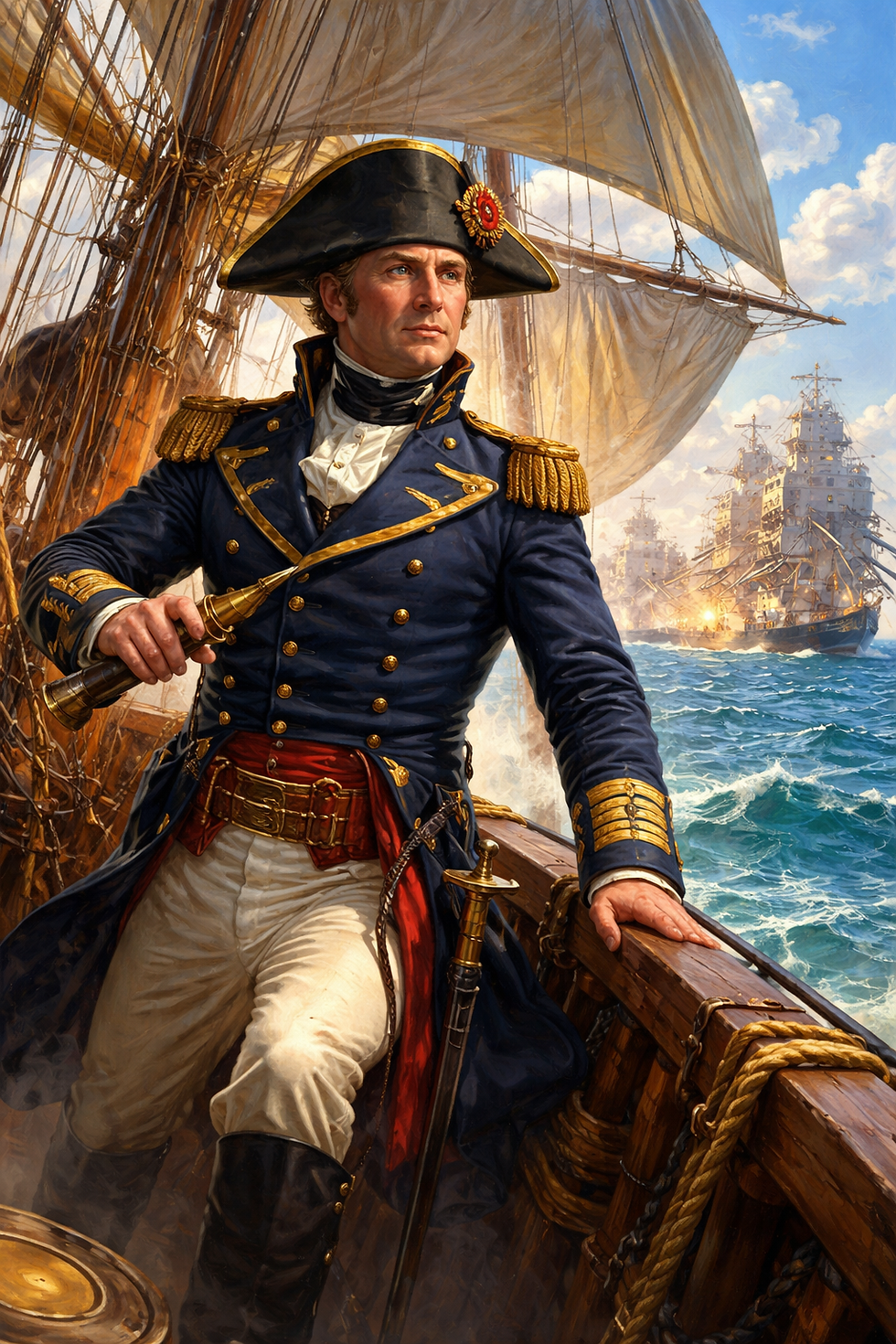
My Name is Robert Heriot Barclay: Commander of His Majesty’s Lake Squadron
I was born into the Royal Navy, shaped by war, discipline, and duty from a young age. The sea became my profession early, and like many officers of my generation, I learned my craft during the long struggle against Revolutionary and Napoleonic France. I did not rise through comfort or privilege alone, but through service, wounds, and perseverance in battles that tested the limits of men and ships alike.
Early Naval Service and the Price of War
As a young officer, I served aboard British warships in the Atlantic and Caribbean, where the Royal Navy was stretched across the globe. During the Battle of Trafalgar in 1805, I was severely wounded, losing my left arm in combat. That injury marked me physically for life, but it did not end my career. In the Royal Navy, sacrifice was expected, and I continued to serve with determination, carrying both the pride and the burden of survival.
Assignment to North America
When war broke out between Britain and the United States in 1812, I was sent to North America, far from the great fleets of the Atlantic. My assignment placed me in Upper Canada, where naval warfare did not involve massive ships of the line, but fragile squadrons built on inland waters. Lake Erie was unlike any sea I had known. It was isolated, shallow, unpredictable, and absolutely vital to the survival of British forces in the west.
The Importance of Lake Erie
From the moment I assumed command, I understood the stakes. Lake Erie was not merely water; it was a lifeline. Every soldier, cannon, sack of flour, and Native ally depended on control of that lake. If we lost it, our western forts would wither, and British influence among Native nations would collapse. Yet I faced this responsibility with limited ships, inexperienced crews, and constant shortages.
Struggles of Command
My greatest challenge was not the enemy alone, but supply. Guns were delayed, sailors were scarce, and replacements from the Royal Navy never came in sufficient numbers. While the Americans built ships at Presque Isle with growing momentum, I struggled to keep my squadron afloat with what little I had. I commanded brave men, but bravery cannot replace powder, provisions, or trained hands.
The Campaign of 1813
As summer turned to autumn in 1813, the pressure mounted. I knew I could not delay forever. Every day without action strengthened the American position and weakened ours. When the fleets finally met, I did my duty as an officer of His Majesty’s Navy. We fought with discipline and resolve, but we were outmatched in weight of guns and endurance.
Defeat and Its Consequences
Our defeat on Lake Erie was decisive. With the loss of the squadron, British supply lines collapsed almost overnight. Forts were abandoned, Native allies were left exposed, and American forces surged forward into territory we could no longer defend. I was wounded again and taken prisoner, bearing the weight of responsibility for a loss that reshaped the war in the west.
Reflection and Legacy
History often remembers victories more clearly than struggles, but I believe my story reflects the realities of imperial warfare far from home. I did not command with advantage, abundance, or ease. I commanded with what I had, under conditions that few naval officers ever faced. Lake Erie taught the world that inland waters could decide empires, and though I was defeated there, I served with honor to the limits of my strength.
Closing Thoughts
I am Robert Heriot Barclay, a naval officer shaped by duty rather than triumph. My life reminds students of history that wars are not only won by heroes, but also endured by those who face impossible odds. On Lake Erie, the future of a continent turned, and I stood at its center, bearing witness to the cost of command.
British Naval Supremacy at the Start of the War – Told by Robert H. Barclay
When war began in 1812, Britain did not arrive on Lake Erie unprepared. Our control of the lake was the result of years of presence, planning, and experience gained long before the first shots were fired. British posts, shipyards, and supply routes had been established across Upper Canada while the United States was still debating whether a navy on inland waters was worth the expense. This imbalance was not accidental; it reflected Britain’s long-standing understanding that water control, even on lakes, determined survival in contested territories.
Experience and Infrastructure
British naval supremacy on Lake Erie rested first on experience. Royal Navy doctrine emphasized discipline, coordination, and seamanship, and even when ships were small and crews limited, those principles carried weight. British-built vessels already operated on the lake, supported by dockyards, supply depots, and command structures tied into the broader imperial system. The United States, by contrast, had to build ships, train crews, and establish command almost simultaneously, all under threat of enemy interference.
Supply Lines and Strategic Depth
Our early control of Lake Erie allowed British forces to supply forts and garrisons deep in the interior with relative reliability. Food, ammunition, and reinforcements moved across the water far more efficiently than by land. This advantage shaped early campaigns by allowing British commanders to act with confidence, knowing their positions could be sustained. American forces, lacking similar access, often hesitated or advanced cautiously, aware that overextension could lead to isolation and collapse.
Shaping the Opening Campaigns
Because Britain held the lake, we dictated the tempo of operations in the west. American movements were constrained, their plans reactive rather than decisive. Forts that relied on water access remained secure, and Native alliances were reinforced through steady supply and visible British commitment. Control of Lake Erie did not guarantee victory, but it created stability—an invaluable asset in the opening phase of the war.
The Limits of Supremacy
Yet supremacy at the start of the war carried its own danger. Distance from Britain, shortages of men and materials, and the assumption that early advantage would persist all worked against us over time. Supremacy had to be maintained, not merely inherited. As the Americans committed fully to shipbuilding and preparation, the balance began to shift. What began as dominance would later become contest, reminding me that naval power on inland waters is always temporary, dependent on supply, resolve, and relentless effort.
At the war’s outset, British control of Lake Erie shaped every campaign that followed. It allowed us to defend, supply, and influence the western frontier when others could not. But it also revealed a deeper lesson: supremacy is not a fixed condition. On Lake Erie, the early advantage shaped the war’s opening chapters, even as it set the stage for the struggle that would decide the lake’s fate.

My Name is Jesse Elliott: United States Navy Officer on Lake Erie
I was born in Maryland in 1782, into a young nation still finding its place in the world. The sea called to me early, and I entered the United States Navy while America was still learning how to defend itself on the oceans. Ours was not a navy of long tradition or endless resources, but one built on urgency, innovation, and the determination to stand equal among powerful empires.
Early Naval Career and Rising Responsibility
In my early service, I learned seamanship the hard way—through long watches, harsh discipline, and constant danger. The Navy of my youth demanded adaptability, and officers were expected to act as sailors, engineers, and leaders all at once. By the time war with Britain erupted in 1812, I had already experienced combat and command, preparing me for responsibilities far greater than my rank might suggest.
The Call to Lake Erie
When I was assigned to duty on Lake Erie, I understood that this was no ordinary posting. Inland naval warfare was unlike anything most officers trained for. Ships had to be built from raw timber in the wilderness, crews were assembled from farmers and frontiersmen, and supplies were scarce. Yet Lake Erie was critical. Whoever controlled it controlled the movement of armies and the fate of the western frontier.
Shipbuilding at Presque Isle
My role placed me directly in the effort to build and arm a fleet at Presque Isle. There were days when progress seemed impossible. Shortages of iron, canvas, and skilled labor slowed everything. British forces watched closely, ready to strike if we failed. Every decision mattered, and every delay risked the entire American campaign in the west.
Service Under Command and the Weight of Expectation
When the fleet was finally ready, I served as second-in-command. Coordination between ships was vital, and trust between officers was essential. Inland battles allowed no room for error. Once engaged, retreat was nearly impossible. The lake itself became the battlefield, offering no shelter and no escape.
The Battle for Lake Erie
When battle came in September 1813, it was fierce, chaotic, and decisive. Smoke choked the air, masts splintered, and men fought at close range under relentless fire. Orders had to be interpreted quickly, and actions taken under pressure would later be judged by history. Victory was achieved, and with it came American control of Lake Erie, a turning point in the war.
Aftermath and Controversy
Success did not bring peace. In the years that followed, questions arose about decisions made during the battle. Accusations, courts-martial, and political rivalries followed me for much of my career. Naval service in the early republic was as much about reputation as it was about courage, and I learned that victory did not protect an officer from scrutiny or ambition.
Later Service and Reflection
I continued to serve my country, holding commands and responsibilities beyond Lake Erie. Yet that campaign remained the defining chapter of my life. It taught me that war is rarely clean or simple, and that leadership carries consequences long after the guns fall silent.
I am Jesse Elliott, a naval officer who helped shape America’s fight for control of its inland waters. My story is one of duty, controversy, and commitment to a nation still learning how to wield power. On Lake Erie, I stood at the crossroads of ambition and responsibility, and there, history forever tied my name to the fate of the American frontier.
American Shipbuilding at Presque Isle (1812–1813) – Told by Jesse Elliott
When I arrived at Presque Isle, there was no navy waiting to be commanded—only forest, mud, and uncertainty. The decision to build warships there was born of necessity rather than convenience. The location was isolated but defensible, shielded by a shallow bar that prevented British ships from entering the harbor. What protected us also trapped us. Every plank, spar, and cannon had to be brought in by routes barely worthy of the name, and every delay threatened the survival of the entire western campaign.
Logistics at the Edge of the Frontier
Nothing about shipbuilding at Presque Isle was efficient. Iron fittings, anchors, and rigging came from distant foundries, moving slowly over poor roads and unreliable waterways. Timber was plentiful, but skilled hands were not. Shipwrights had to be recruited from the coast, enticed to travel inland into a war zone where pay was uncertain and conditions harsh. Each delivery that arrived felt like a small victory against geography itself.
Manpower Shortages and Improvised Crews
Ships require more than wood and iron—they require men. Sailors were scarce on the frontier, and those who arrived often had little experience beyond river boats or merchant craft. Training crews while ships were still under construction became a necessity. Discipline had to be taught alongside seamanship, and confidence had to be built quickly. We were assembling not just a fleet, but an entirely new naval culture in the wilderness.
Raw Materials and Relentless Pressure
Even basic materials posed challenges. Nails, pitch, canvas, and powder were constantly in short supply. British control of the lake early in the war meant we worked under constant threat. If the enemy attacked before our ships were ready, the effort would be lost entirely. The pressure to build quickly sometimes clashed with the need to build well, forcing hard decisions that would later echo in battle.
From Timber to Warships
Against all odds, hulls took shape, masts were raised, and guns were mounted. Each finished vessel represented months of labor under strain. These ships were not perfect, but they were strong enough to fight, and that was all that mattered. Presque Isle proved that American naval power did not depend on established dockyards alone, but on determination, adaptability, and the willingness to build where necessity demanded.
The fleet that emerged from Presque Isle was more than a collection of ships—it was proof that the United States could respond to strategic crisis with innovation rather than imitation. Building warships in the wilderness taught us that naval strength is not measured only in tradition or resources, but in the resolve to overcome limits. On those muddy shores, we forged the tools that would change the balance of power on Lake Erie.
Supply Lines, Forts, and Frontier Survival – Told by Matthew Elliott
On the western frontier, survival was measured not by walls or weapons, but by whether supplies arrived on time. Forts scattered across the Great Lakes region were not self-sustaining strongholds; they were dependent outposts surrounded by wilderness. Roads were unreliable, slow, and often impassable for much of the year. Wagons broke, animals died, and convoys were easy targets. Lake Erie, by contrast, offered a dependable route that could carry in days what land transport could barely move in weeks. Without ships on that water, forts quickly became isolated islands.
Forts That Lived or Died by Water
Every fort along the western frontier depended on regular shipments of food, ammunition, tools, and clothing. Soldiers could endure hardship, but starvation and empty powder magazines ended resistance quickly. Lake Erie allowed garrisons to be sustained through long seasons, reinforced when threatened, and evacuated when positions became untenable. When shipping was secure, forts functioned as anchors of control. When it was disrupted, those same forts became liabilities, draining men and resources while offering little real protection.
Native Allies and the Reality of Dependence
Native nations who allied with Britain did so with expectations shaped by experience. They required trade goods not as luxuries, but as necessities for hunting, defense, and survival. Muskets, powder, lead, blankets, and tools flowed through the same lake routes that supplied British troops. When ships arrived, alliances held firm. When they did not, confidence eroded quickly. Promises meant little without deliveries, and Lake Erie was the only artery capable of sustaining those commitments.
The Fragility of the System
This entire frontier system was delicate. A single disruption in shipping could cascade into abandonment, retreat, and broken alliances. Unlike European theaters of war, there were no deep reserves nearby to compensate for loss. Every crate unloaded from a ship carried weight beyond its contents, signaling strength, reliability, and continued presence. Every missed shipment weakened morale and trust in equal measure.
When the Lake Was Lost
Once control of Lake Erie slipped away, the consequences were immediate and irreversible. Forts were abandoned not because walls had fallen, but because supply had vanished. Native allies were left exposed to retaliation and displacement, their faith in British protection shattered by empty storehouses. What collapsed was not just a military position, but an entire system of survival built upon waterborne movement.
Reflection from the Frontier
I learned that wars on the frontier are decided less by battles than by logistics. Lake Erie was not merely a route—it was the foundation of everything Britain attempted to hold in the west. Forts, soldiers, and alliances all depended on ships moving across that water. When those ships stopped sailing, the frontier itself changed hands, proving that survival in this land was carried not on roads, but on the lake.
British Supply Problems in Upper Canada – Told by Robert H. Barclay
From the moment I assumed command in Upper Canada, I understood that our greatest enemy was not the American fleet alone, but distance. Britain ruled the seas, yet Upper Canada lay far from the Atlantic ports that sustained imperial power. Every sailor, cannon, and barrel of provisions had to travel an immense chain of rivers, lakes, and rough roads before reaching the western frontier. What appeared strong on a global map often proved fragile when measured in miles of wilderness.
Shortages of Sailors
The Royal Navy’s strength rested on experienced crews, but few such men could be spared for inland service. Most sailors were committed to fighting France or guarding trade routes across the oceans. Those assigned to Lake Erie were often drafts pulled from other duties or local recruits unfamiliar with naval discipline. Training took time we did not have, and losses could not be easily replaced. Each sailor wounded or lost weakened the squadron disproportionately.
Guns Without Ships, Ships Without Guns
Weapons posed an equal challenge. Heavy naval guns were scarce, and transporting them inland was a slow and dangerous undertaking. There were times when ships were ready but under-armed, and other times when guns arrived too late to be properly mounted or tested. Powder and shot followed the same uncertain path. An empire capable of outfitting fleets across the world struggled to fully arm a handful of vessels on a remote lake.
Food and Daily Survival
Food shortages eroded strength quietly but relentlessly. Upper Canada could not easily sustain large garrisons, and imported provisions were vulnerable to delay or loss. Soldiers and sailors alike endured reduced rations, which affected morale and health long before battle began. Hunger does not announce itself dramatically, but it undermines endurance and confidence all the same.
The Absence of Reinforcements
Perhaps the most demoralizing reality was the knowledge that reinforcements would not arrive quickly, if at all. Requests sent east traveled slowly, and responses were shaped by priorities far removed from our immediate needs. Decisions made in London or Halifax could not account for conditions on Lake Erie. We fought knowing that what we had was likely all we would receive.
Consequences of Scarcity
These shortages shaped every decision I made. Strategy became cautious not from fear, but from necessity. Risks that might be acceptable with abundant supply became unacceptable when replacement was impossible. When the Americans increased their shipbuilding efforts, our inability to match them was not due to lack of will, but lack of means.
Reflection on Imperial Limits
Serving in Upper Canada taught me that empires are only as strong as their supply lines. Britain’s naval supremacy depended on proximity to its resources, and far from the Atlantic that supremacy thinned. On Lake Erie, shortages of sailors, guns, food, and reinforcements defined the contest as much as any engagement. It was there I learned that distance can humble even the greatest naval power in the world.
Training Crews and Preparing Fleets for Battle – Told by Jesse Elliott
When the ships on Lake Erie neared completion, a new challenge emerged that was every bit as demanding as construction itself: creating crews capable of fighting them. Many of the men who reported for duty had never served aboard a warship. Some were farmers, others laborers, and a few had experience only on rivers or merchant vessels. The urgency of war left no time for gradual learning. We were forced to turn civilians into sailors at a pace that tested both patience and leadership.
Discipline Without Tradition
Unlike the Royal Navy, the United States Navy on the frontier lacked generations of shared custom and discipline. Orders had to be explained as well as enforced, and respect had to be earned rather than assumed. Establishing authority among men unfamiliar with naval hierarchy required firmness balanced with restraint. Too much severity risked resentment; too little invited disorder. Every decision shaped the cohesion of crews who would soon depend on one another under fire.
Rapid Naval Education
Training became relentless. Men learned gunnery by constant drill, often firing until powder supplies ran low. Sail handling was practiced in all weather, because battle would not wait for calm conditions. Damage control, boarding procedures, and signaling were taught simultaneously, compressing years of experience into months. Mistakes were corrected quickly, not for perfection, but for survival.
Forging Crews Into Units
The greatest transformation occurred not in skill, but in identity. As weeks passed, scattered individuals began to think and act as crews. Trust formed through shared labor and shared hardship. Men learned that their lives depended not only on courage, but on coordination and obedience. By the time battle approached, these crews were no longer merely assembled—they were bonded.
Preparing for the Test Ahead
As the fleets prepared for engagement, I understood that training would determine everything. Ships could be well-built and well-armed, but without disciplined crews they were little more than floating timber. Our success would rest on whether inexperienced sailors could perform under the chaos of combat, following orders amid smoke, noise, and fear.
Preparing a fleet for battle on Lake Erie was an exercise in urgency and adaptation. We did not have the luxury of time or tradition. What we had was necessity, and necessity demanded rapid education, firm discipline, and trust earned through action. The battle that followed would prove whether such preparation could stand against experience, and whether resolve could bridge the gap between novice and veteran.
The Strategic Stakes of Naval Control – Told by Peter B. Porter
From the perspective of an army officer, it may seem strange to admit that the fate of land campaigns often rests on water. Yet on the western frontier during the War of 1812, this truth governed every plan I made. Armies marched only as far as their supplies could follow, and on that frontier, supplies followed ships. Lake Erie determined whether troops could be fed, reinforced, and repositioned, or whether they would be stranded and slowly weakened by distance and isolation.
Victory on the Lake and Freedom of Movement
Control of Lake Erie meant freedom of movement across an otherwise hostile landscape. When the lake was secure, forces could be transported rapidly to threatened points or used to exploit openings in enemy lines. Surprise became possible, and defensive positions could be bypassed rather than assaulted directly. A naval victory did not merely support land operations; it multiplied their effectiveness, allowing smaller forces to achieve results that would otherwise require overwhelming numbers.
Defeat and the Collapse of Campaigns
The opposite was equally true. Defeat on the lake did not simply limit options—it destroyed them. Without control of Lake Erie, armies became static, tied to dwindling supplies and unable to maneuver. Forts that depended on resupply by water turned into traps, and advances stalled before they truly began. In such conditions, even a well-led army could achieve little beyond survival.
Psychological and Political Consequences
Naval control carried psychological weight as well. Soldiers took confidence from secure supply lines, while uncertainty bred hesitation and doubt. Local populations, including militias and allied communities, watched the lake to judge which side would endure. Victory at sea strengthened political resolve and recruitment, while defeat undermined both, long before its military effects were fully realized.
Why the Lake Decided the Frontier
In the western theater, Lake Erie was not a secondary consideration—it was the hinge upon which the war turned. Land campaigns were reflections of naval reality, not the other way around. Victory on the lake opened paths for advance and influence; defeat closed them completely. From my experience, the lesson was clear: whoever controlled Lake Erie controlled the fate of the western frontier, and with it, the direction of the war itself.
The Lake Erie Naval Campaign (Summer 1813) – Told by Robert H. Barclay
By the summer of 1813, the war on Lake Erie had settled into a tense rhythm of movement and restraint. Each side understood that the coming battle would decide the western frontier, yet neither could afford to strike too early. My squadron operated under constant constraint—short of men, short of provisions, and dependent on supplies that arrived irregularly from distant sources. Every sail sighted on the horizon carried significance, and every day without action altered the balance in ways not immediately visible.
Scouting and the Limits of Information
Scouting on Lake Erie was an uncertain business. The lake was wide enough to conceal movements, yet narrow enough that news traveled quickly once ships were spotted. Small vessels were sent to observe enemy harbors and report on construction and readiness, but weather often obscured vision and delayed messages. Decisions had to be made with incomplete information, relying as much on judgment as on reports. Each patrol risked interception, yet without them we would have been blind.
Weather as an Unseen Adversary
The lake itself was never neutral. Sudden squalls, shifting winds, and heavy swells influenced when and where ships could move. A favorable wind might promise opportunity one hour and vanish the next. Calm weather could immobilize fleets, turning strategy into endurance. I learned quickly that planning on Lake Erie required humility; no order was final until the weather allowed it to be carried out.
Movements Under Constraint
Our movements were shaped by necessity rather than ambition. I sought to protect supply routes while denying the enemy freedom to act. Each sortie had to consider the condition of crews, the readiness of guns, and the remaining provisions aboard ship. Meanwhile, the American fleet grew stronger with each passing week, their shipbuilding efforts nearing completion. Time itself became a pressure, favoring the side that could wait the longest.
Mounting Pressure Before Battle
As summer wore on, pressure mounted from every direction. Supplies dwindled, allies grew anxious, and expectations rose beyond what circumstances allowed. Delay was dangerous, yet action carried grave risk. I knew that once we committed, there would be no retreat without consequence. The lake offered no margin for half measures. Every calculation pointed toward an inevitable confrontation, shaped as much by logistics and weather as by courage.
The Calm Before Decision
In those final days before battle, the lake felt unnaturally quiet. Ships lay ready, crews alert, and officers weighed their choices carefully. The campaign of movement and scouting had narrowed into a single outcome that could no longer be postponed. Summer on Lake Erie had been a campaign of pressure without release, and it was clear to all who sailed its waters that the coming clash would decide far more than a single engagement.
The Battle for Control of Lake Erie (September 1813) – Told by Jesse Elliott
By September of 1813, delay was no longer an option. Both fleets had maneuvered, watched, and prepared until circumstance demanded action. Ships were completed, crews trained as well as time allowed, and supplies stretched thin on both sides. When the fleets finally met, the battle was not simply an exchange of fire, but the culmination of months of coordination, planning, and pressure. Every decision made that morning carried consequences far beyond the lake itself.
Fleet Coordination Under Fire
Naval battle on inland waters allowed little room for error. Unlike ocean engagements, the confined space of Lake Erie meant fleets fought at close range, often within clear view of one another’s movements. Coordination between vessels was essential. Signals had to be interpreted quickly, formations maintained under fire, and timing aligned despite smoke, wind shifts, and damage. Once the first shots were fired, communication became imperfect, forcing officers to rely on judgment shaped by training rather than constant instruction.
Command Decisions in the Midst of Chaos
Command at sea is tested most severely when conditions refuse to follow plan. As the battle unfolded, unexpected developments demanded immediate decisions. Ships took damage, rigging failed, and gun crews were lost. Choices had to be made with incomplete information and under intense pressure. Whether to press forward, hold position, or reposition a vessel could determine the fate of the entire line. In such moments, hesitation could be as costly as error.
Tactical Execution and Endurance
Tactics on Lake Erie relied heavily on gunnery and endurance. Ships exchanged sustained fire at close range, where accuracy and rate of fire mattered more than maneuver alone. Crews worked through smoke and splintering wood, repairing damage while continuing to fight. Success depended not on a single bold action, but on the ability to maintain pressure until the enemy could no longer respond effectively.
The Moment Control Shifted
As the engagement progressed, the balance gradually shifted. British resistance weakened as damage accumulated and coordination faltered. Once their ability to maneuver and fire effectively was reduced, the outcome became clear. Control of Lake Erie passed not through a sudden collapse, but through the steady execution of coordinated action under fire.
Reflection on the Battle’s Meaning
The Battle for Lake Erie was not decided by numbers alone, but by preparation meeting opportunity. Fleet coordination, command decisions, and tactical execution combined to determine the result. When the guns fell silent, the lake belonged to the United States, and with it came the ability to move armies, supply forts, and shape the war in the west. From that day forward, land campaigns would follow the course set by victory on the water.
Immediate Aftermath: Collapse of British Supply Lines – Told by Matthew Elliott
The moment control of Lake Erie was lost, the effects rippled outward faster than any army could march. Supply lines that had sustained British forts and Native allies for years were cut almost overnight. Warehouses stood full of expectation but empty of deliveries. Promises that once traveled across the water with crates and barrels now arrived as words alone, and words could not feed garrisons or protect villages.
Abandoned Forts and Strategic Retreat
Forts that had once anchored British presence in the west became impossible to hold. Without reliable shipping, they could not be resupplied or reinforced. Commanders faced a brutal choice: abandon positions or watch their men starve and be surrounded. One by one, forts were evacuated, leaving behind structures that symbolized not defeat in battle, but defeat by isolation. Territory was not taken by force—it was surrendered to necessity.
Weakened Alliances Under Pressure
Native alliances were built on mutual obligation. Support was expected, not as charity, but as proof of commitment. When supplies failed to arrive, confidence collapsed. Warriors who had fought alongside British forces found themselves exposed, lacking ammunition and provisions at the very moment American pressure intensified. Trust eroded quickly, not from betrayal of intention, but from inability to deliver.
The Loss of Native Support
As the system unraveled, Native nations faced harsh reality. Without British supply and protection, continuing resistance became untenable. Some sought accommodation, others withdrew to protect what remained of their people. The loss of Lake Erie did not merely alter military plans; it shattered the foundation of Native resistance in the region. Entire communities bore the consequences of a naval defeat they had no power to prevent.
A Frontier Transformed
What followed was not a single dramatic collapse, but a steady retreat of influence. British authority receded from the western frontier, and American settlement advanced into spaces once contested. The lake had carried more than soldiers and supplies—it had carried stability. Once it was lost, the frontier reshaped itself with relentless speed.
Reflection from Experience
I had spent years building relationships and managing alliances, and I watched them unravel in a matter of weeks. The collapse of British supply lines taught a painful lesson: control of water determines the fate of those who depend on it. On Lake Erie, defeat was not confined to ships and sailors. It reached deep into the lives of forts abandoned, alliances broken, and peoples left to face a changed world alone.
American Advance into Upper Canada – Told by Peter B. Porter
Before control of Lake Erie was secured, American forces along the western frontier fought largely to survive. Movements were cautious, supply was uncertain, and every advance risked isolation. Naval victory transformed that reality almost immediately. With the lake open to us, what had been a defensive struggle became an opportunity to act with confidence and purpose. The frontier no longer constrained our plans; it enabled them.
Troop Movement Made Possible
Victory on the lake turned water into a highway for soldiers. Entire units could be transported quickly and safely to positions that would have taken weeks to reach by land. This mobility allowed us to concentrate force where it mattered most, reinforcing threatened points or striking at weakened ones before the enemy could respond. The ability to move troops by ship altered the rhythm of campaigning, replacing hesitation with initiative.
Sustaining the Advance
Movement alone was not enough. The same ships that carried soldiers also carried food, ammunition, and equipment, ensuring that advances could be sustained rather than abandoned. Forts could be supplied, wounded evacuated, and reserves brought forward without exhausting local resources. What had once been risky excursions became viable campaigns supported by steady logistics.
Territorial Gains Without Prolonged Siege
Naval control allowed us to bypass strongpoints that would have required costly sieges. Positions in Upper Canada became vulnerable not because they were stormed, but because they were isolated. As British supply lines collapsed, territory fell into American hands with less resistance than expected. Control of the lake turned geography itself into an ally.
Psychological Impact on the Frontier
The effect on morale was immediate. American troops gained confidence, militias rallied, and local support increased. Conversely, British forces and their allies faced uncertainty and retreat. Naval victory signaled permanence. It showed that American forces could not only hold the frontier, but push beyond it.
Reflection on Combined Power
The advance into Upper Canada proved that land and naval power are inseparable in frontier warfare. Ships did not fight battles alone, and armies did not advance independently. Together, they reshaped the war in the west. Lake Erie’s waters carried more than men and supplies—they carried momentum. Once that momentum shifted, territorial gains followed, and the balance of the war changed with it.
Long-Term Impact of Lake Erie on the War and the Region – Told by Robert H. Barclay, Peter B. Porter, and Matthew Elliott
Robert H. Barclay: The Limits of Imperial Reach: From my perspective, the loss of Lake Erie revealed the boundaries of imperial power when stretched too far from its source. Britain’s global navy remained dominant on the oceans, yet control of a single inland lake reshaped the war in North America. Once the lake passed out of British hands, our ability to project power west of the Niagara frontier diminished permanently. Diplomacy suffered as much as military strategy, for influence depends on presence, and presence depends on supply. In the years that followed, Britain adjusted its priorities, focusing on securing Canada rather than contesting expansion beyond it. Lake Erie marked the point where British ambitions in the Old Northwest ended not by treaty alone, but by geography and logistics.
Peter B. Porter: Borders Defined by Control: For the United States, control of Lake Erie did more than win a campaign—it clarified the nation’s future. The war ended without dramatic redrawing of borders on paper, yet the reality on the ground changed decisively. American control of the lake secured the Northwest Territory in practice, not just principle. It ensured that Ohio, Michigan, and surrounding regions would develop under American authority rather than remain contested ground. Diplomatically, the victory strengthened the United States’ position in negotiations, proving that it could defend its frontier and sustain operations far from the coast. The lake became a foundation for westward growth, commerce, and settlement that no longer faced serious foreign challenge.
Matthew Elliott: The Human Cost of Realignment: From where I stood, the long-term impact was measured in lives and displaced communities. Control of Lake Erie accelerated American expansion and solidified borders, but it also sealed the fate of Native nations whose homelands lay in its shadow. Alliances that once balanced power collapsed, leaving Native peoples exposed to pressure they could not resist alone. Diplomacy shifted from negotiation to removal, and the lake that had once connected cultures became a boundary marking loss. U.S. expansion followed the routes secured by naval victory, carrying settlers into regions that had been contested for generations.
A Shared Conclusion
Together, our experiences reveal that Lake Erie reshaped far more than a single war. It redefined borders without ink, altered diplomacy without proclamations, and redirected the future of a continent through control of water. The war passed, but the consequences endured. Lake Erie became the hinge upon which imperial retreat, national expansion, and regional transformation turned—quietly, decisively, and forever.


Comments