

7. Heroes and Villains of the Cold War: The Nuclear Arms Race and the Fear of World War III (1949–1963)


My Name is Nikita Khrushchev: Leader of the Soviet Union
I was born in 1894 in the village of Kalinovka, near the borderlands of Russia and Ukraine. I did not come from palaces, universities, or wealthy families. My father was a laborer, and I worked as a shepherd boy before becoming a metalworker and mechanic. I knew what it meant to work with my hands and live among ordinary people. When revolution swept through Russia, I saw the Bolsheviks as men who promised to overturn the old order and build a country where workers like me could rise.
Revolution Gave Me My Opportunity
During the Russian Civil War, I joined the Bolsheviks and served with the Red Army. Afterward, I became increasingly involved in Communist Party work. I was energetic, loyal, outspoken, and willing to take responsibility. Those qualities carried me upward through the Party. By the 1930s, I was working within the political world of Joseph Stalin. This was not a gentle world. Stalin demanded obedience, and those who fell under suspicion could disappear. I survived, advanced, and became one of the Soviet Union's important political leaders.
War Came to the Soviet Union
When Nazi Germany invaded the Soviet Union in 1941, politics became a struggle for national survival. I served as a political commissar alongside Soviet commanders at several fronts, including during the terrible fighting around Stalingrad. I saw cities destroyed, soldiers killed by the thousands, and civilians driven from their homes. The Soviet Union paid an enormous price for victory. After experiencing such destruction, Soviet leaders were determined that our country would never again be left weak before a powerful enemy.
I Rose After Stalin
Stalin died in 1953, and a struggle for leadership followed. I maneuvered carefully, built alliances, defeated my political rivals, and eventually emerged as the dominant Soviet leader. But I did something that shocked the Communist world. In 1956, I condemned Stalin's cult of personality and exposed some of his crimes and abuses. I did not reject communism. I believed Stalin had distorted it. I wanted the Soviet Union to become stronger without depending upon terror on the scale Stalin had used.
We Would Compete With America
The United States believed capitalism would triumph. I believed otherwise. I spoke of "peaceful coexistence," but do not mistake those words for surrender. I believed communism could outperform capitalism in factories, science, agriculture, technology, and influence throughout the developing world. I boasted that history was moving in our direction. When I told Western nations, "We will bury you," I meant that communism would outlast capitalism—not that I intended simply to launch nuclear war against them.
Nuclear Weapons Changed Everything
By the time I led the Soviet Union, the Americans possessed hydrogen bombs capable of destroying cities, and we developed powerful weapons of our own. We tested thermonuclear weapons, built missiles, and demonstrated that the Soviet Union could not be intimidated. In 1961, we tested the weapon later called the Tsar Bomba, the most powerful nuclear device ever detonated. Such weapons were instruments of power, but also of deterrence. If America knew that attacking us meant its own cities could be destroyed, then perhaps America would think twice before beginning a war.
I Pushed the World to the Edge
I could be loud, theatrical, impatient, and confrontational. I demanded that the Western powers recognize Soviet strength, particularly over Berlin. Then came Cuba. Fidel Castro's revolution gave the Soviet Union an ally close to the United States, and in 1962 we secretly placed nuclear missiles there. President John F. Kennedy discovered them, and suddenly Soviet and American forces faced one another during the most dangerous confrontation of the Cold War. Neither Kennedy nor I could know whether one mistake, one frightened commander, or one misunderstood order might begin World War III.
There Are Moments When a Leader Must Stop
We eventually reached an agreement. Soviet missiles were removed from Cuba, America publicly promised not to invade Cuba, and the United States later removed Jupiter missiles from Turkey under a secret understanding. Some called my decision weakness. I did not see it that way. What victory could there be if Moscow, Washington, New York, and countless other cities were burning? Afterward, communication between our governments improved, and in 1963 the Soviet Union, United States, and Britain signed the Limited Nuclear Test Ban Treaty.
1949 — The Soviet Union Gets the Atomic Bomb - Told by Nikita Khrushchev
When the Americans destroyed Hiroshima and Nagasaki in August 1945, every major government understood that warfare had changed. The United States possessed a weapon capable of destroying a city with a single bomb, while the Soviet Union did not. We had suffered enormously defeating Nazi Germany, yet military sacrifice meant little if another nation possessed a weapon against which we had no equal answer. Stalin understood this immediately. The Soviet atomic program, already underway during the war, became a matter of the highest national importance.
The Soviet Scientists Were Ordered to Catch America
The responsibility for the Soviet atomic project fell under the formidable supervision of Lavrentiy Beria, while physicist Igor Kurchatov directed much of the scientific work. Resources were provided on a tremendous scale despite the devastation our country had suffered during the war. Laboratories, reactors, mining operations, factories, and secret installations were developed across the Soviet Union. Uranium had to be obtained, plutonium produced, and an enormous network of scientists and engineers organized. Stalin did not intend for the American nuclear advantage to remain permanent.
Science Was Not Our Only Source
There is another part of this history that must not be hidden. Soviet intelligence obtained important information about the American Manhattan Project. Klaus Fuchs, a German-born physicist who worked on the Allied atomic program, secretly passed valuable nuclear information to the Soviet Union. Other espionage networks also provided intelligence. This did not mean Soviet scientists merely assembled an American bomb from stolen instructions; Soviet physicists still had to master extraordinarily difficult scientific and industrial problems. But espionage gave our program valuable information and helped Soviet planners avoid some uncertainties the Americans had faced.
August 29, 1949
Then came the moment that changed the balance of power. On August 29, 1949, at the Semipalatinsk testing site in Soviet Kazakhstan, the Soviet Union detonated its first atomic device, RDS-1. The explosion produced a yield of roughly 22 kilotons. Its design closely resembled the American plutonium implosion bomb tested at Trinity and used against Nagasaki. To those present within the Soviet program, it represented something larger than a successful scientific experiment. The United States no longer possessed a monopoly on atomic warfare.
The Americans Discovered Our Secret
We did not immediately announce the test to the world. But an atomic explosion leaves evidence behind. American monitoring aircraft detected radioactive material in the atmosphere, and Washington concluded that the Soviet Union had successfully tested a nuclear weapon. On September 23, President Harry Truman announced publicly that the Soviet Union had experienced an atomic explosion. Many Americans were stunned. Some had believed the Soviet Union would require considerably more time to develop the bomb. The nuclear age had suddenly become a competition between two superpowers.
One Bomb Led to a Much Bigger Bomb
The American response was predictable. If the Soviet Union possessed an atomic bomb, the United States wanted something more powerful. Debate intensified over developing the hydrogen bomb, a thermonuclear weapon potentially hundreds of times more powerful than the bombs used against Japan. President Truman approved an accelerated hydrogen-bomb program in January 1950. The Americans tested their first full-scale thermonuclear device in 1952. The Soviet Union answered with its own thermonuclear advances. Each side feared that allowing the other to move ahead could threaten its survival.
The Arms Race Had Begun
The significance of August 29, 1949, was therefore much greater than one explosion in the Kazakh steppe. Before that day, America could threaten atomic warfare without facing an equivalent Soviet atomic response. Afterward, that certainty began disappearing. Bombs became more powerful, arsenals grew larger, and new aircraft and missiles were developed to deliver them. Eventually both nations would possess enough nuclear firepower to devastate one another.
We Had Entered a Different Kind of War
The strange thing about nuclear weapons was that their usefulness increasingly depended upon convincing the enemy that we were willing to use them while desperately hoping that day never came. We built weapons because America possessed weapons; America built more because we possessed more. This was the logic that came to dominate the nuclear arms race. In 1949, the Soviet Union had demonstrated that it could enter the atomic age. We had achieved what we considered strategic equality—but we had also helped create a world in which a confrontation between Moscow and Washington could threaten far more than two armies. It could threaten civilization itself.

My Name is J. Robert Oppenheimer: Father of the Atomic Bomb
I was born in New York City in 1904. From an early age, I was fascinated by science, literature, languages, and the deeper questions hidden beneath ordinary things. I studied at Harvard and later traveled to Europe, where a revolution was taking place in physics. Quantum mechanics was changing our understanding of matter itself. I wanted to be part of that revolution, not merely observing it, but helping to discover what nature was capable of doing.
A New Generation of American Physics
I returned to the United States and taught primarily at the University of California, Berkeley, and the California Institute of Technology. American theoretical physics was still developing, and I wanted to help build it. My students and colleagues investigated quantum theory, cosmic rays, nuclear physics, and even the behavior of collapsing stars. Science seemed to be opening doors faster than humanity could walk through them. Then Europe descended into war, and one particular scientific possibility became terribly important.
Could Hitler Build the Bomb First?
Scientists had discovered nuclear fission—the splitting of atomic nuclei and the tremendous energy it could release. Once Nazi Germany was at war with the Allied powers, we had to confront an alarming question: could German scientists construct an atomic bomb? The possibility could not simply be ignored. The United States organized the Manhattan Project, an enormous secret effort to develop atomic weapons, and in 1942 I was selected to lead its scientific laboratory.
Los Alamos
We built our laboratory at Los Alamos, New Mexico. Some of the finest scientists in the world gathered there, including physicists, chemists, mathematicians, and engineers. My responsibility was to bring their different abilities together and transform theoretical possibilities into an actual weapon. We worked under extraordinary pressure. The problems were immense, the secrecy intense, and failure always possible. But we believed that if such a weapon could be made, America could not afford to discover its possibility after an enemy had done so first.
Trinity
On July 16, 1945, we tested the world's first atomic bomb in the New Mexico desert. The device exploded with a force humanity had never deliberately unleashed before. The desert illuminated beneath an artificial sun, and years of calculations suddenly became physical reality. I later recalled that a line from the Bhagavad Gita came to mind: "Now I am become Death, the destroyer of worlds." We had proven that atomic warfare was no longer theoretical.
The Bomb Enters History
Weeks later, atomic bombs were dropped on Hiroshima and Nagasaki. Japan surrendered soon afterward, and the Second World War ended. I became publicly identified with the weapon we had created and was sometimes called the "father of the atomic bomb." Yet the scientific achievement could not be separated from its military meaning. Humanity now possessed the ability to destroy a city with a single bomb. The question was no longer whether nuclear weapons were possible. The question was what nations would do with that knowledge.
The Hydrogen Bomb Debate
The Soviet Union tested an atomic weapon in 1949, and American officials debated building an even more powerful thermonuclear weapon—the hydrogen bomb. I opposed an immediate crash program and served on a committee that recommended against it. Others argued that if the United States refused, the Soviet Union might develop the weapon first. President Truman ordered the program forward. Soon both superpowers possessed weapons vastly more destructive than those used against Japan.
My Government Turned Against Me
Cold War suspicion reached into American scientific and political life. My earlier associations with people connected to the Communist Party, combined with my opposition to certain nuclear policies, made me vulnerable. In 1954, after a humiliating security hearing, my security clearance was revoked. I was not imprisoned, but my influence over nuclear policy was effectively ended. A scientist who had once been trusted with America's greatest military secret was now considered unsuitable to advise the government about it.
What Had We Created?
I spent my later years teaching, speaking, and thinking about the relationship between science and power. I never believed that knowledge itself could simply be erased. Once humanity understood the atom, there was no returning to ignorance. But I came to understand more deeply that scientists could not separate themselves entirely from the consequences of what they discovered. We had created the bomb because we feared what might happen if our enemies created it first. Then our enemies built their own, and each side answered fear with still greater weapons.
1949–1950 — Should America Build the Hydrogen Bomb? - Told by Oppenheimer
Four years after Hiroshima and Nagasaki, America confronted a question even more disturbing than the one we had faced during the Manhattan Project. The Soviet Union detonated its first atomic device on August 29, 1949, ending the American nuclear monopoly. Almost immediately, attention turned toward a weapon of almost unimaginable power: the hydrogen bomb. The question before us was no longer whether mankind could build such a weapon. Increasingly, it was whether we should.
A Bomb Beyond the Atomic Bomb
The weapons dropped on Japan depended upon nuclear fission, the splitting of heavy atomic nuclei. The proposed hydrogen bomb would rely principally upon nuclear fusion, the process that releases energy in stars. Physicists had discussed the possibility during the war, and Edward Teller had become its most determined advocate. In principle, a thermonuclear weapon could release vastly more energy than the first atomic bombs. We were contemplating a weapon whose destructive power might be measured not merely in thousands of tons of TNT, but eventually in millions.
The Soviet Test Changed Washington
When evidence arrived that the Soviet Union had successfully tested an atomic bomb, the political atmosphere changed immediately. American officials had hoped our nuclear advantage would last longer. Now policymakers feared that Moscow might not stop with the atomic bomb. If the Soviets developed a hydrogen bomb while we refused to do so, would the United States place itself in mortal danger? That argument was powerful because the Cold War was already intensifying. Few leaders wanted history to record that America had deliberately surrendered a decisive military advantage.
I Opposed the Crash Program
I served as chairman of the General Advisory Committee of the Atomic Energy Commission. In October 1949, our committee recommended against an immediate crash program to build what was then often called the "Super." Our objections were scientific, strategic, and moral. The weapon had not yet been proven practical, and its enormous destructive potential raised profound questions. Some members of the committee described such a weapon as primarily capable of destroying vast civilian areas. I believed we should examine whether building it would actually make the United States safer or merely begin another, more terrible competition.
Edward Teller Saw the Danger Differently
Edward Teller reached another conclusion. He believed that if such a weapon could be built, the Soviet Union might eventually build it whether America did or not. To him, refusing to proceed could leave the United States vulnerable. Other scientists and government officials agreed. This disagreement was not simply between men who wanted war and men who wanted peace. We were confronting the same frightening possibility from different directions: what happens when your enemy may develop a weapon capable of destroying you?
President Truman Made the Decision
On January 31, 1950, President Harry Truman announced that he had directed the Atomic Energy Commission to continue work on all forms of atomic weapons, including the hydrogen bomb. The decision had been made. The United States would pursue the Super. Scientific problems still had to be solved, however, and the decisive Teller-Ulam design breakthrough came in 1951. On November 1, 1952, the United States tested Ivy Mike in the Pacific. Its explosive yield was approximately 10.4 megatons—hundreds of times the explosive yield of the Hiroshima bomb.
There Would Be No Monopoly This Time
The Soviet Union was pursuing thermonuclear weapons as well. In August 1953, it tested a thermonuclear device of its own, although its design differed from the later full-scale hydrogen bombs. By 1955, the Soviets had tested a true two-stage thermonuclear weapon. The pattern was becoming unmistakable. One side developed a weapon because it feared the other side might develop it first. Then the other side answered. Each technological victory became the justification for the next technological race.
The Question Never Really Disappeared
We had entered an age in which scientific possibility and national survival had become dangerously intertwined. If America refused to build the hydrogen bomb and the Soviet Union built it, the consequences might be catastrophic. But if America built it, the Soviets would have even greater reason to build their own. That was the terrible logic confronting us in 1949 and 1950. I had helped create the atomic bomb because we feared Nazi Germany might obtain one first. Now, only a few years later, we were considering weapons vastly more destructive because we feared another enemy might obtain them first. The hydrogen bomb debate taught us something unsettling: in the nuclear age, fear itself could become one of the most powerful engines driving the arms race.

My Name is Bernard Brodie: American Nuclear Strategist
I was born in Chicago in 1910. I became a student of military history and international relations, earning my doctorate at the University of Chicago. My early work focused especially on naval warfare. I studied battleships, strategy, and the ways nations used military power to protect themselves and influence their enemies. Like other military thinkers of my generation, I assumed that weapons existed primarily to help nations win wars. Then the atomic bomb changed the meaning of that assumption.
Everything Changed in 1945
When atomic bombs destroyed Hiroshima and Nagasaki in 1945, I understood that military strategy had entered a different age. These were not simply larger artillery shells or more powerful bombs. Nuclear weapons could destroy cities in moments, and future weapons would become even more destructive. The old question had been: How do we win the next war? The nuclear age demanded another question: How do we prevent the next great war from beginning?
The Weapon Must Prevent Its Own Use
In 1946, I contributed to The Absolute Weapon, a book examining what atomic weapons meant for international affairs. I argued that America's military establishment had previously existed primarily to win wars. From now on, its chief purpose must be to avert them. If nuclear weapons could make the price of attacking the United States unbearably high, an enemy might decide never to attack at all. This idea became known as nuclear deterrence.
The Soviet Bomb Changes the Equation
The United States briefly possessed an atomic monopoly, but no serious strategist should have expected it to last forever. In 1949, the Soviet Union tested its first atomic bomb. Now two rival powers possessed weapons capable of unprecedented destruction. Many Americans saw only greater danger. I saw danger as well, but strategy required us to think beyond fear. If both sides understood that aggression could bring devastating retaliation, nuclear weapons might restrain the very governments that possessed them.
Then Came the Hydrogen Bomb
The development of thermonuclear weapons made the problem even more severe. Hydrogen bombs could produce explosions far beyond those of the first atomic weapons. Soon the United States and Soviet Union were accumulating growing arsenals of bombs and warheads. The numbers could become almost absurd. Once a nation possessed enough survivable weapons to destroy its opponent after being attacked, what strategic purpose was served by endlessly adding more?
Surviving the First Strike
This led to one of the most important ideas of nuclear strategy: the second-strike capability. A nuclear force could not deter an enemy if that enemy believed it could destroy all of your weapons in a surprise attack. Some of your forces therefore had to survive. Bombers could remain ready, missiles could be protected, and submarines could hide beneath the oceans. The objective was grim but logical: convince an enemy that even a successful first strike could never prevent retaliation.
The Balance of Terror
By the 1950s and 1960s, nuclear strategy increasingly rested upon a disturbing paradox. The more certain each superpower became that the other could retaliate, the more dangerous it became to begin a nuclear war. Eventually this condition became closely associated with what others called mutually assured destruction. I did not invent every concept later attached to that phrase, but my work helped establish the intellectual foundation of deterrence. Nuclear weapons were becoming weapons whose greatest usefulness might depend upon never being fired.
Strategy Could Not Depend Upon Emotion
I later worked with the RAND Corporation, where analysts studied nuclear war, military planning, economics, technology, and Soviet behavior. We dealt with questions that could sound cold because strategy demands precision. How many weapons could survive an attack? What targets would matter? What might convince an opponent not to strike? Emotional horror was understandable, but governments could not construct national policy from horror alone. Nuclear weapons existed. Therefore someone had to think carefully about how to prevent their existence from ending civilization.
The Limits of Strategy
I continued studying nuclear policy through later decades, watching missiles become faster, warheads more numerous, and military technology more sophisticated. Yet the central problem remained remarkably similar. Nuclear peace depended upon governments behaving rationally while operating weapons capable of extraordinary destruction. Strategy could reduce risks, but it could never eliminate human error, misunderstanding, mechanical failure, or political desperation.
What I Learned From the Nuclear Age
I died in 1978 after spending much of my career attempting to understand perhaps the strangest military problem humanity had ever created. I believed deterrence was necessary once nuclear weapons existed, and I make no apology for trying to understand how it worked. Yet there is something deeply unsettling about a peace maintained by threatening catastrophe. We learned to protect civilization by preparing ourselves to destroy enormous portions of it. If my work leaves students with one warning, it should be this: strategy can make terrible weapons less likely to be used, but no strategy can make those weapons harmless.
1950–1952 — The Hydrogen Bomb Changes the Meaning of War - Told by Brodie
When President Harry Truman ordered the United States to proceed with development of the hydrogen bomb on January 31, 1950, we entered a new stage of the nuclear age. I had already argued that atomic weapons had transformed military strategy. Now scientists were attempting to construct a weapon vastly more powerful. For a strategist, the question was unavoidable: what does "victory" mean when the weapons used to achieve it can destroy entire cities?
From Kilotons to Megatons
The atomic bombs of 1945 released energy through nuclear fission. A hydrogen bomb would use thermonuclear fusion, making possible explosions measured in megatons rather than merely kilotons. Scientists had discussed such a weapon for years, but making one practical proved extremely difficult. Then, in 1951, physicists Edward Teller and Stanislaw Ulam developed the basic concept that made a powerful staged thermonuclear weapon possible. Suddenly the theoretical "Super" was moving toward reality.
The Old Rules of Warfare Were Breaking
For centuries, military strategy had concentrated upon defeating armies, capturing territory, destroying fleets, and forcing governments to surrender. Even the terrible bombing campaigns of World War II required large numbers of aircraft dropping thousands of bombs. Thermonuclear weapons threatened to compress destruction onto an entirely different scale. A single weapon could potentially devastate a metropolitan area. A fleet of bombers armed with such weapons could threaten numerous cities in a matter of hours. War was no longer simply becoming more destructive. Its traditional political purpose was becoming harder to reconcile with the destruction it could unleash.
Could Anyone Actually Win?
This created a strategic paradox. Suppose the United States attacked the Soviet Union with nuclear weapons but Soviet forces survived long enough to destroy American cities in return. Could we call that victory? Suppose Moscow was destroyed but New York, Washington, Chicago, and other American cities were also devastated. A nation might technically defeat its enemy and still suffer losses beyond anything previous generations had imagined. Nuclear strategy therefore could not concentrate solely upon how to fight a war. Increasingly, it had to determine how to keep one from starting.
November 1, 1952
The theoretical debate became physical reality with Operation Ivy. On November 1, 1952, the United States detonated the device known as Ivy Mike at Enewetak Atoll in the Pacific. The explosion produced approximately 10.4 megatons of energy. The island of Elugelab, where the device had stood, was effectively obliterated, leaving a large crater. Mike was an enormous experimental device rather than a practical deliverable bomb, but that hardly diminished its significance. Humanity had demonstrated that thermonuclear destruction was possible.
Deterrence Became More Important Than Destruction
I had written shortly after World War II that the chief purpose of the American military establishment must increasingly be to avert wars rather than merely win them. The hydrogen bomb strengthened that argument. If an enemy believed that attacking the United States would guarantee devastating retaliation, perhaps he would decide that attacking was irrational. The weapon's greatest military value might therefore come precisely from not using it. This was deterrence: maintaining enough destructive power to persuade the enemy that beginning a war would cost more than he could possibly gain.
But Deterrence Required Survivable Weapons
There was an obvious weakness in this reasoning. What if an enemy believed he could destroy our nuclear forces before we could retaliate? Then he might be tempted to strike first. Nuclear forces therefore had to survive an initial attack. Bombers could be dispersed, warning systems improved, and eventually missiles protected and submarines hidden beneath the oceans. The enemy had to know that even after striking us, enough American weapons would remain to retaliate. Security increasingly depended upon guaranteeing the enemy that he could not escape destruction.
A New Meaning of Military Power
By the end of 1952, the hydrogen bomb had forced us to confront an uncomfortable truth. Military strength had traditionally been measured partly by how effectively a nation could use its weapons. Nuclear strength would increasingly be measured by whether possessing those weapons could prevent their use altogether. That was the strange world thermonuclear weapons created. We continued building weapons of extraordinary destructive power while hoping never to fire them in war. The hydrogen bomb had not merely given mankind a larger bomb. It had changed the fundamental meaning of military power—and perhaps the meaning of war itself.
1953 — Soviet Hydrogen Bomb and the Race for Superiority - Told by Khrushchev
In the early 1950s, the Americans believed they could remain ahead of us by building ever more powerful weapons. They had exploded the first atomic bomb in 1945, and we answered in 1949. Then, in November 1952, the United States tested Ivy Mike, an enormous thermonuclear device producing about 10.4 megatons. Once again, Washington possessed a weapon the Soviet Union did not yet have. Once again, we intended to close the gap.
The Race Did Not Stop With Stalin's Death
Joseph Stalin died on March 5, 1953, but the struggle between our countries did not die with him. A contest for leadership began inside the Soviet Union, while outside our borders the United States remained our greatest rival. Neither Soviet generals nor political leaders could simply ignore America's thermonuclear breakthrough. If the Americans possessed weapons capable of destroying Soviet cities on an unprecedented scale, then we believed the Soviet Union required weapons powerful enough to make America fear attacking us.
Our Scientists Had Their Own Ideas
Soviet physicists had been working on thermonuclear designs for years. Among the most important was Andrei Sakharov, working with scientists including Igor Tamm and others. Their 1953 design became known as the "Layer Cake" or "Sloika," combining layers of fusion fuel and fission material. It was not the same kind of full-scale, two-stage thermonuclear design represented by America's Ivy Mike, but it was a major Soviet achievement—and unlike the enormous American experimental apparatus, the Soviet device was compact enough to point toward a weapon that could actually be delivered.
August 12, 1953
On August 12, the Soviet Union detonated RDS-6s at the Semipalatinsk testing site in Kazakhstan. The explosion produced roughly 400 kilotons of explosive yield, dramatically greater than the atomic bombs used during World War II. Soviet authorities presented the test as proof that we had mastered the hydrogen bomb. From Moscow's perspective, the political message mattered enormously: America could not assume that its thermonuclear advantage would guarantee permanent superiority.
America Builds, We Build
This was the logic governing both sides. The Americans feared Soviet weapons, so they built more powerful ones. We saw those weapons and concluded that we needed our own. America then looked at ours and found another reason to increase its arsenal. Neither side wanted to be the nation that stopped first and discovered too late that its opponent had continued. Military technology had become a staircase, and each superpower feared what might happen if the other climbed one step higher.
Then the Americans Tested Castle Bravo
In March 1954, the United States detonated Castle Bravo at Bikini Atoll. The test yielded about 15 megatons, far more powerful than expected, and radioactive fallout contaminated inhabited islands and exposed people far from the explosion. A Japanese fishing vessel, the Lucky Dragon No. 5, was also contaminated. The test demonstrated not merely how powerful thermonuclear weapons could become, but how their radioactive consequences could extend far beyond the intended target.
We Reached the Next Stage
We continued working. On November 22, 1955, the Soviet Union tested RDS-37, our first successful two-stage thermonuclear weapon. Now the Soviet Union had demonstrated the same fundamental class of thermonuclear technology that could produce enormously powerful hydrogen bombs. The Americans had not escaped us. They had built the atomic bomb first, and we followed. They demonstrated the first full-scale thermonuclear explosion, and we followed again.
How Many Bombs Were Enough?
Soon the contest was no longer simply about whether we possessed a certain weapon. It became a question of how many bombs we had, how powerful they were, how far our bombers could fly, and eventually how rapidly our missiles could reach enemy territory. Each government wanted enough power to convince the other that it could not win a war. Yet this produced a dangerous contradiction: the more frightened we became of nuclear war, the more nuclear weapons we constructed to prevent it.
The Race for Superiority Had Become a Race for Survival
We did not build these weapons because we intended to wake one morning and destroy the United States. We built them because Soviet leaders believed weakness invited danger. The Americans reasoned much the same way about us. By the middle of the 1950s, therefore, the nuclear arms race had developed its terrible rhythm: invention, response, escalation, and fear. Every breakthrough promised security, yet every breakthrough also gave the other side a reason to build something greater. We were racing for superiority, but increasingly both nations were discovering that in the nuclear age, superiority might matter less than the terrifying ability to survive long enough to destroy the other side.
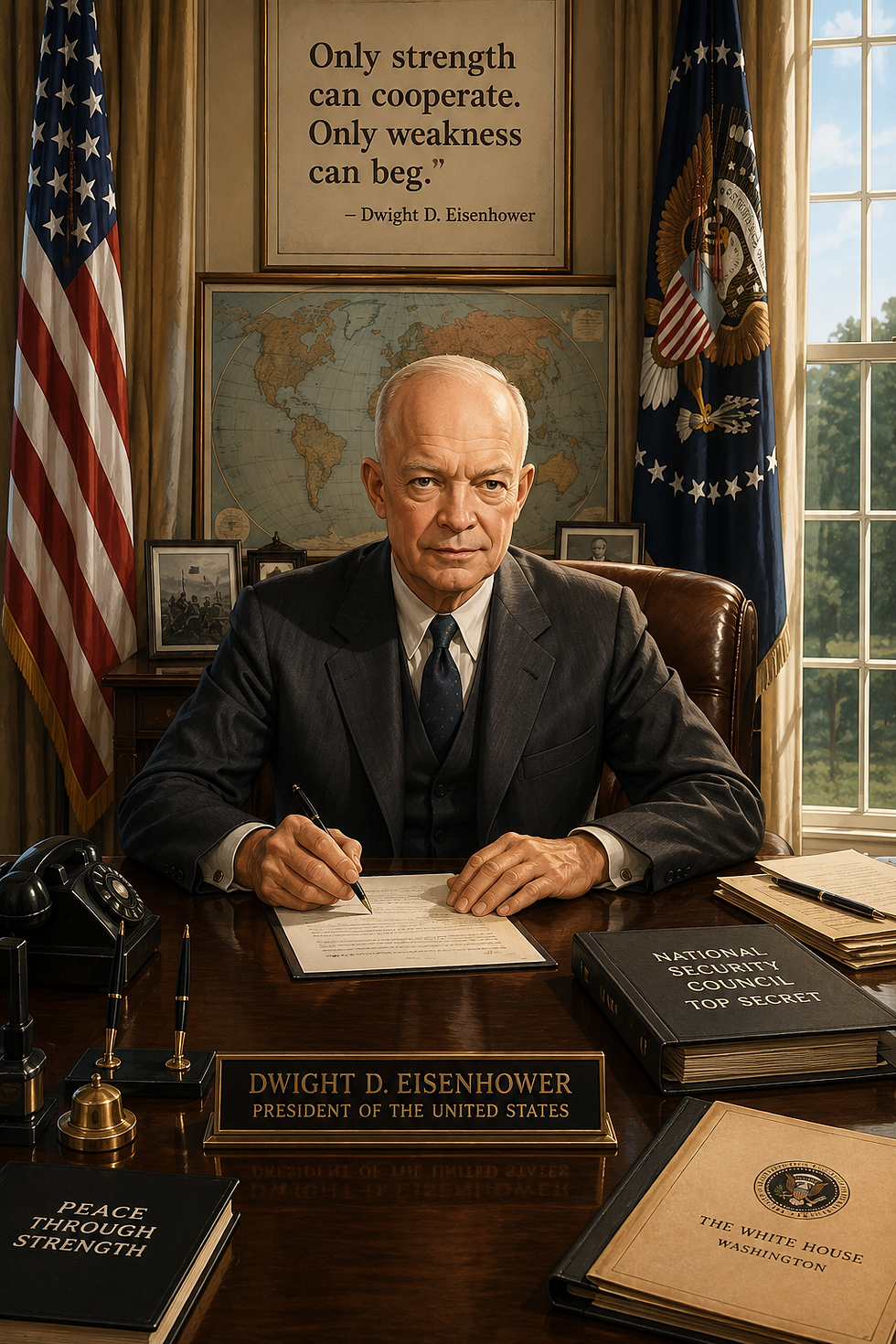
My Name is Dwight D. Eisenhower: President of the United States
I was born in Texas in 1890 but grew up in Abilene, Kansas. My family possessed little wealth, but we were taught discipline, responsibility, hard work, and faith in the future. I entered the United States Military Academy at West Point in 1911. I could not have known then that my military career would eventually place me in command of one of the greatest military operations in history.
I Became a Soldier
For many years, I served without becoming famous. I studied warfare, worked under experienced officers, and learned that command was about more than issuing orders. A commander must bring together people with different personalities, ambitions, and opinions and persuade them to work toward a common objective. Those lessons became invaluable when the United States entered the Second World War.
The Supreme Allied Commander
During World War II, I was appointed Supreme Commander of the Allied Expeditionary Force in Europe. My responsibility was enormous. American, British, Canadian, French, and other Allied forces had to work together against Nazi Germany. On June 6, 1944, we launched the Normandy invasion. Before the troops landed, I prepared a message accepting responsibility if the invasion failed. Fortunately, I never had to issue it. Germany was defeated the following year, but victory had shown me the terrible cost of modern war.
From General to President
After the war, I served as Army Chief of Staff, president of Columbia University, and the first Supreme Allied Commander of NATO's military forces. In 1952, the American people elected me president. I entered office in January 1953 while the Cold War was becoming increasingly dangerous. The Soviet Union possessed atomic weapons, communist power had expanded, and the Korean War was still being fought. My responsibility was no longer commanding armies in battle. It was preventing another world war.
Peace Through Strength
I believed America had to remain strong enough that no enemy would mistake restraint for weakness. My administration relied heavily upon nuclear deterrence, and Secretary of State John Foster Dulles publicly described a policy of "massive retaliation." The United States could not maintain unlimited conventional armies everywhere communist expansion might occur. Nuclear power provided a terrible but powerful warning: aggression against America or its allies could bring consequences far greater than an enemy was willing to accept.
Living With the Nuclear Bomb
During my presidency, both the United States and Soviet Union developed increasingly destructive nuclear weapons. Hydrogen bombs made the atomic bombs of World War II appear small by comparison. Long-range bombers were joined by increasingly capable missiles. Americans built fallout shelters and practiced civil-defense drills. The purpose of our arsenal, however, was not simply to prepare for nuclear war. The greater objective was to convince our enemies that such a war could never be won at an acceptable price.
War Was Not the Only Answer
Some people assumed that because I had spent my life as a soldier, I would readily use military force. The opposite was closer to the truth. I had seen war. I knew what casualty reports meant because I had signed orders that sent young men into battle. During my presidency, we ended the fighting in Korea and avoided directly committing American forces to several conflicts that might have expanded into larger wars. A president must sometimes demonstrate strength by refusing to be drawn into a fight.
Atoms for Peace
I also believed nuclear science should represent more than destruction. In 1953, I addressed the United Nations and proposed what became known as "Atoms for Peace." Nuclear knowledge could be directed toward electricity, medicine, agriculture, and scientific advancement. Humanity had discovered extraordinary power within the atom. Whether that power became primarily an instrument of destruction or human progress depended upon what governments chose to do with it.
I Warned America Before Leaving Office
By the end of my presidency, America's defense establishment had become enormous. Weapons, military bases, research laboratories, government agencies, and private defense companies had become closely connected. In my 1961 farewell address, I gave this relationship a name: the "military-industrial complex." I believed a strong military was necessary, but I warned Americans that military power and government spending could acquire influence far beyond what a free society should accept without careful oversight.
The Burden of Command
I died in 1969 after spending much of my life in uniform and eight years as president. I remain convinced that America needed strength during those dangerous years. Yet I also knew that leaders can become prisoners of the weapons they create and the fears they encourage. Perhaps there were moments when we relied too heavily upon nuclear threats or allowed the arms race to advance farther than wisdom required. A soldier understands that weapons sometimes preserve peace—but after seeing enough war, he should also understand that the greatest victory is the battle mankind never has to fight.
“Massive Retaliation” and A New American Nuclear Strategy - Told by Eisenhower
1953–1955 - When I entered the presidency in January 1953, I inherited a dangerous problem. The United States was fighting in Korea, the Soviet Union possessed atomic weapons, communist power had expanded, and our defense expenditures had risen enormously. I had commanded armies large enough to know what war costs—in money, equipment, and human lives. America needed to contain Soviet power without maintaining a wartime economy forever. We needed strength, but strength that the nation could sustain.
America Could Not Fight Everywhere
The Soviet Union and Communist China possessed enormous conventional military forces. The United States had commitments stretching from Europe to Asia. We could not station enough American soldiers everywhere that communism might advance. Nor did I believe our economy could indefinitely support the massive conventional mobilization created by the Korean War. My administration therefore developed what became known as the "New Look," placing greater reliance upon America's nuclear arsenal while maintaining alliances and conventional forces.
Dulles Delivers the Warning
In January 1954, my Secretary of State, John Foster Dulles, publicly explained one of the most controversial parts of our strategy. America needed the ability to respond to aggression "at places and with means of our own choosing." This policy soon became known as "massive retaliation." The message was intentionally serious. An enemy could not assume that it might attack an American ally in one place and force us to fight only on terms favorable to him. Soviet leaders had to consider that aggression could provoke a much larger American response.
Nuclear Weapons Became Part of Our Strategy
This represented an extraordinary change in warfare. Nuclear weapons were no longer regarded merely as unusual bombs reserved for some final emergency. They became increasingly integrated into American military planning. Strategic bombers of the Air Force's Strategic Air Command stood ready to carry nuclear weapons toward Soviet targets. Tactical nuclear weapons were also developed for possible battlefield use. We wanted Moscow to understand that the United States possessed both the weapons and the means to deliver devastating retaliation.
The Threat Had to Be Believable
Deterrence depends upon what your opponent believes. Possessing a thousand weapons means little if the enemy believes you will never use them under any circumstances. Yet threatening nuclear war over every minor dispute would also be foolish. We therefore faced an uncomfortable task: we had to convince Soviet leaders that certain acts of aggression could produce consequences so severe that they would choose not to take the risk. Nuclear power was intended to make the cost of starting a major war appear unbearable.
There Was a Practical Reason as Well
Our nuclear strategy was also connected to economics. I believed national security required a strong economy. A country that spends itself into weakness in the name of defense may eventually discover that it has damaged the very society it intended to protect. Nuclear weapons offered tremendous destructive power without requiring the United States to maintain enough conventional soldiers to match communist forces man for man throughout the world. The New Look attempted to balance military strength with long-term economic stability.
But What If Deterrence Failed?
Here lay the terrible weakness in massive retaliation. If the Soviet Union attacked somewhere and we responded with nuclear weapons, Moscow could answer with nuclear weapons of its own. By 1953, the Soviets had demonstrated a thermonuclear device, and their capabilities were improving rapidly. Every year made it more difficult to imagine a nuclear exchange remaining limited. We might begin by defending one country and finish by watching American and Soviet cities disappear beneath mushroom clouds.
We Needed More Than Bombs
For that reason, nuclear weapons were never the whole of American policy. We strengthened alliances, maintained military forces overseas, gathered intelligence, developed early-warning systems, and pursued diplomacy. In December 1953, I delivered my "Atoms for Peace" address before the United Nations, calling for peaceful international uses of atomic energy. We had discovered enormous power within the atom. I did not believe humanity should devote that discovery solely to preparing for its own destruction.
Duck and Cover: Preparing Americans for Nuclear War - Told by Eisenhower
1950s - Imagine an ordinary school morning interrupted by a warning. The teacher gives the command, children move away from windows, drop beneath their desks, cover their heads, and wait. Across America, scenes like this became symbols of the nuclear age. By the time I became president in 1953, the Soviet Union possessed atomic weapons and was developing thermonuclear weapons. We hoped deterrence would prevent war, but a responsible government also had to ask a frightening question: what should Americans do if deterrence failed?
Bert the Turtle Says "Duck and Cover"
The famous "Duck and Cover" campaign actually began before my presidency. In 1951, the Federal Civil Defense Administration commissioned a film featuring Bert the Turtle, who demonstrated how children should respond to the sudden flash of a nuclear explosion. The film reached schools beginning in 1952. Students were instructed to "duck and cover" by getting low and protecting their heads and necks. The advice may sound inadequate against a nuclear weapon, but distance mattered. Outside the immediate destruction zone, taking cover could reduce injuries from shattered glass, flying debris, and thermal burns.
The Bomb Was Becoming Far More Powerful
Unfortunately, the danger was rapidly changing. The bombs dropped on Hiroshima and Nagasaki were measured in kilotons. During the 1950s, the United States and Soviet Union developed thermonuclear weapons measured in megatons. In 1954, America's Castle Bravo test produced an explosion of about 15 megatons and spread radioactive fallout far beyond expectations. A nuclear attack now threatened people not only with blast and fire, but also with invisible radioactive contamination carried through the atmosphere.
America Began Preparing for the Unthinkable
Civil defense became part of American life. Communities developed evacuation plans and warning systems. Sirens were installed to alert populations to possible attacks. Government publications explained how families might find or construct shelter and store emergency supplies. Radio broadcasts and public information campaigns taught Americans about blast effects and radioactive fallout. Some cities practiced large-scale civil-defense exercises. We were attempting to prepare millions of people for a kind of attack no nation had ever experienced on such a scale.
Operation Alert
Beginning in 1954, the federal government conducted nationwide exercises known as Operation Alert. These drills imagined Soviet nuclear attacks against American cities and tested how government agencies and civil-defense organizations might respond. In later exercises during my administration, federal officials participated in relocation procedures intended to preserve the functioning of government after an attack. The scenarios could be grim because the purpose was not to pretend that nuclear war would be easy to survive. It was to discover what could still function after catastrophe.
Families Looked Underground
The possibility of radioactive fallout increased interest in shelters. Some Americans considered basement shelters or specially constructed underground spaces stocked with food, water, radios, medical supplies, and other necessities. Federal promotion of fallout shelters expanded especially after my presidency under President Kennedy, but the civil-defense groundwork and public concern were already well established during the 1950s. For families living far enough from the center of an explosion, adequate shelter could significantly reduce exposure to dangerous radiation.
Children Grew Up Beneath the Mushroom Cloud
Perhaps the most remarkable part of this period was how nuclear danger entered ordinary childhood. Students who had never experienced a battlefield practiced hiding beneath desks. Families discussed what they would do if warning sirens sounded. Newspapers reported nuclear tests, Soviet bombers, missile developments, and radioactive fallout. Americans continued going to baseball games, attending church, buying homes, and raising families, but behind normal life stood the possibility that another world war could begin with almost no warning.
Could Anyone Truly Prepare?
Civil defense had serious limitations. No school desk could save a child at the center of a thermonuclear explosion, and no simple emergency plan could make the destruction of a major city acceptable. But that did not make every precaution useless. Military planning teaches a hard lesson: you prepare for the circumstances in which action can make a difference, even when you cannot save everyone. A person several miles from an explosion might survive by knowing when to take cover, where to seek shelter, and how to avoid fallout.
The Goal Was Still to Prevent the War
As president, however, I never considered civil defense a substitute for preventing nuclear war. Our military strength, alliances, warning systems, diplomacy, and nuclear deterrent were intended to make an attack too dangerous for an enemy to attempt. "Duck and cover" became one of the most memorable phrases of the Cold War because it captured the strange reality Americans faced. We were teaching children how to survive a nuclear attack while building weapons intended to ensure that attack never occurred. That contradiction defined much of life in the nuclear age: prepare for the worst, remain strong enough to discourage it, and work so that the sirens never sound for real.
Fallout and the Growing Fear of Nuclear Testing - Told by J. Robert Oppenheimer
1954–1957 - By 1954, the nuclear question had changed. We were no longer asking whether mankind could build atomic weapons or even hydrogen bombs. We had answered those questions. Now another problem was becoming impossible to ignore: what happened after the fireball disappeared? Nuclear explosions produced radioactive material that could travel far beyond a test site, carried invisibly by winds across islands, oceans, farms, and communities. The bomb did not cease to be dangerous when the explosion ended.
Castle Bravo Surprised Even Its Creators
On March 1, 1954, the United States detonated Castle Bravo at Bikini Atoll in the Marshall Islands. Scientists expected a powerful thermonuclear explosion, but the device produced about 15 megatons—roughly two and a half times the anticipated yield. The fireball and mushroom cloud were spectacular, but the greater warning came afterward. Radioactive fallout spread across a much larger region than planners had expected, contaminating inhabited islands and exposing Marshallese people to dangerous radiation.
A Japanese Fishing Boat Entered the Story
More than 80 miles from the explosion, the Japanese fishing vessel Daigo Fukuryū Maru, known in English as the Lucky Dragon No. 5, encountered radioactive fallout. Fine particles descended upon the ship and its crew. The fishermen experienced radiation sickness, and crew member Aikichi Kuboyama died months later; his death was associated with complications following the exposure. News of the incident produced outrage in Japan, a country that already carried the memory of Hiroshima and Nagasaki. Nuclear testing was no longer an isolated military experiment. Its consequences could cross boundaries.
Fallout Could Travel
Radioactive fallout presented a particularly unsettling scientific problem because it was often invisible. A person did not have to see a mushroom cloud to encounter radioactive material from atmospheric testing. Certain radioactive isotopes could enter soil, water, plants, animals, and eventually food. Scientists became increasingly concerned about substances such as strontium-90, which could enter the human body and accumulate in bones. The public began hearing unfamiliar scientific terms that suddenly had very personal meanings.
The Tests Continued
The United States was not alone. The Soviet Union continued its own nuclear testing program, including increasingly powerful thermonuclear weapons. Britain conducted its first atomic test in 1952 and moved toward thermonuclear weapons during the later 1950s. Each government argued that testing was necessary to understand its weapons and maintain national security. Each also watched the others carefully. If one nation stopped while its rival continued developing new weapons, leaders feared they might surrender an advantage that could never be recovered.
Scientists Began Raising Their Voices
The dangers of fallout helped create a growing international movement against atmospheric nuclear testing. Scientists including Linus Pauling publicly warned about radiation exposure and the possible genetic and health consequences of continued testing. In 1955, Bertrand Russell and Albert Einstein lent their names to the Russell-Einstein Manifesto, which warned humanity about the dangers created by nuclear weapons. Einstein died shortly before its public release, making it one of his final public statements. Scientists who had helped open the nuclear age were increasingly asking political leaders what kind of world that knowledge was creating.
The Public Began Asking Questions
By the middle of the 1950s, nuclear fear had moved beyond military strategy. Parents wondered whether radioactive material could enter children's food. Citizens debated testing. Newspapers discussed fallout patterns and radiation. Scientists argued over acceptable exposure levels and long-term risks. Governments attempted to reassure their populations while simultaneously building larger arsenals. The very tests intended to demonstrate national strength were also demonstrating that nuclear consequences could not always be contained within national borders.
A Weapon That Could Not Respect Borders
By 1957, the world possessed more nuclear powers, more thermonuclear knowledge, and greater understanding of fallout than it had only a few years earlier. Yet there remained no comprehensive agreement stopping atmospheric tests. The arms race continued because neither Washington nor Moscow trusted the other enough to stop first. That was the central difficulty of the nuclear age: each side could recognize the danger while still believing that national survival required continuing the competition.
Science Had Given Us a Warning
I had spent much of my life believing that knowledge must be pursued, but knowledge also reveals consequences. Fallout taught us that a nuclear explosion could reach people who had never been consulted about the test and who lived far from its center. By the late 1950s, the evidence was forcing governments and citizens to confront a fact that should have been obvious from the beginning: the atmosphere recognizes no national frontier. We had learned how to release the energy inside the atom. The more difficult question was whether human judgment could learn to control what we had released.
ICBMs Make Nuclear War Almost Instantaneous - Told by Nikita Khrushchev
1957–1959 - By the middle of the 1950s, both the Soviet Union and the United States possessed nuclear weapons capable of destroying cities, but a bomb is useful as a military weapon only if you can deliver it to your enemy. Strategic bombers could cross oceans, but they required hours to reach their targets and could potentially be intercepted. We wanted something faster—something that could cross continents at tremendous speed. The answer was the intercontinental ballistic missile, the ICBM.
The R-7 Changes the Competition
Our scientists and engineers, led by the brilliant rocket designer Sergei Korolev, developed the R-7 Semyorka. On August 21, 1957, an R-7 completed the first successful full-range flight of an ICBM. The achievement demonstrated that the Soviet Union possessed rocket technology capable of sending a payload across intercontinental distances. The military implications were obvious. If a rocket could carry a payload thousands of miles, it could eventually carry a nuclear warhead toward the territory of the United States.
From Hours to Minutes
This changed the mathematics of nuclear war. A bomber attack could provide hours of warning. An ICBM traveling along a ballistic trajectory could cross the distance between the Soviet Union and the United States in roughly half an hour. Political leaders might therefore have only minutes to determine whether warning systems were correct, decide whether an attack was real, and determine how to respond. In previous wars, armies sometimes mobilized for days or weeks. In the missile age, civilization could face decisions of enormous consequence before a meeting around a table had even finished.
Sputnik Sends Another Message
On October 4, 1957, the Soviet Union used an R-7-derived rocket to launch Sputnik 1, the world's first artificial satellite. I enjoyed reminding the Americans that Soviet science had accomplished something they had not yet done. Sputnik belonged to the beginning of the Space Race, but no military strategist could ignore what the rocket itself demonstrated. If we could place a satellite into orbit, Americans understood that Soviet rockets had the power needed for long-range missiles. A small beeping sphere passing overhead suddenly carried a much larger psychological message.
America Feared a Missile Gap
The American reaction was enormous. Newspapers, politicians, military officials, and citizens worried that the Soviet Union might be producing ICBMs faster than the United States. Talk of a "missile gap" spread through American politics. I encouraged perceptions of Soviet missile strength because appearing powerful had strategic value. In reality, our early operational ICBM force was far smaller than many Americans feared, and the R-7 itself was cumbersome, required extensive preparation, and was poorly suited for large-scale deployment.
The Americans Were Building Their Own
America was hardly standing still. The United States tested the Atlas missile successfully over intercontinental range in late 1958, and the Atlas became operational in 1959. Other American missile systems followed. Both countries also pursued submarine-launched ballistic missiles, which would make nuclear forces even more difficult to locate and destroy. The competition was no longer simply about who possessed the largest bomb. It was about who could deliver nuclear weapons fastest, farthest, and most reliably.
Warning Systems Became Essential
Missiles created another problem: how could you know they were coming? The United States began constructing the Ballistic Missile Early Warning System, using enormous radar installations to detect possible Soviet missile attacks. Both sides increasingly depended upon radar, communications networks, and later satellites to provide warning. But technology introduced its own danger. If a warning system made a mistake, leaders might have only a short period to decide whether the signal represented equipment failure—or the beginning of World War III.
There Was No Safe Distance Anymore
Geography had protected America through much of its history. Two great oceans separated it from many foreign enemies. ICBMs weakened that protection. Moscow and Washington were now connected by trajectories that nuclear warheads could cross in minutes. The Soviet Union faced the same reality from American missiles. Neither superpower could assume that distance alone would protect its cities.
The Missile Became Both Shield and Threat
We developed ICBMs because we believed they strengthened Soviet security. If the Americans knew that attacking us could bring nuclear missiles down upon their own cities, they would have powerful reasons not to attack. Yet every missile we built encouraged America to build another, and every American missile gave us reason to expand our forces. By 1959, the nuclear arms race had acquired something it had previously lacked: extraordinary speed. The greatest danger was no longer merely that leaders might decide to begin a nuclear war. It was that one day they might have only minutes to decide whether one had already begun.
Mutually Assured Destruction and the Balance of Terror - Told by Bernard Brodie
Late 1950s–Early 1960s - By the end of the 1950s, we faced a military situation unlike anything in previous history. The United States and Soviet Union possessed nuclear weapons capable of destroying cities, and increasingly they possessed ways to deliver those weapons rapidly across enormous distances. The central question was no longer simply which country had the larger arsenal. It was whether either country could attack the other without suffering catastrophic retaliation. If the answer was no, then fear itself might help preserve the peace.
The Most Important Weapons Were the Ones That Survived
I had argued since the beginning of the atomic age that nuclear weapons changed the purpose of military power. Deterrence required more than possessing bombs. Your enemy had to believe that enough of your weapons would survive his first attack to strike back. This became known as second-strike capability. If Moscow knew that destroying American cities would still leave surviving American forces capable of devastating the Soviet Union, then launching the first strike could become an act of national suicide.
The Nuclear Triad Makes Retaliation Harder to Stop
The United States increasingly spread its nuclear forces among different delivery systems: strategic bombers, land-based intercontinental ballistic missiles, and submarine-launched ballistic missiles. This combination became known as the nuclear triad. Each component had advantages and weaknesses, but together they made America's retaliatory force increasingly difficult to destroy in one surprise attack. Nuclear-armed submarines were particularly important because they could hide beneath the oceans. The Soviet Union developed its own increasingly survivable nuclear forces as well.
The Terrible Logic of Deterrence
Consider the calculation from the enemy's position. You might destroy many American missile sites and air bases, but what if you missed several bombers? What if submarines remained hidden at sea? What if surviving missiles were launched before your own warheads arrived? Even a small fraction of a large nuclear arsenal could inflict extraordinary destruction. A rational leader therefore had to assume that a first strike might produce the very catastrophe he was attempting to avoid.
A Balance of Terror
Winston Churchill had earlier used the phrase "balance of terror" to describe the developing nuclear situation, and it captured the paradox remarkably well. Peace was increasingly connected to mutual vulnerability. Neither superpower could confidently eliminate the other's ability to retaliate. The security of Washington depended partly upon Moscow's fear of American weapons, while the security of Moscow depended partly upon Washington's fear of Soviet weapons. It was hardly a comforting form of peace, but nuclear strategy was not designed to be comforting.
Mutually Assured Destruction
The condition later became widely known as mutually assured destruction, or MAD, although that specific terminology became established later than the period we are discussing. The underlying principle, however, was already developing: if both sides maintained sufficient survivable nuclear forces, a large-scale nuclear attack by either could result in unacceptable destruction for both. Nuclear weapons therefore produced a strange reversal of traditional military thinking. A weapon could become strategically useful precisely because actually using it would be disastrous.
But What If Someone Made a Mistake?
Deterrence depended upon assumptions about rational behavior, reliable communications, accurate warning systems, and leaders understanding one another's intentions. None of these could be guaranteed. Radar might produce a false warning. A commander might misunderstand an order. A political crisis could escalate more rapidly than leaders intended. ICBMs made the problem especially severe because leaders might have only minutes to evaluate warnings and make decisions involving millions of lives.
More Weapons Did Not Always Mean More Security
This led to another uncomfortable conclusion. Once both nations possessed secure retaliatory forces, simply building additional weapons did not necessarily make either country proportionately safer. In some circumstances, new weapons or strategies could make the situation less stable if they encouraged leaders to believe a first strike might succeed. The objective of nuclear strategy therefore could not simply be superiority. Stability mattered. Each side needed convincing evidence that attacking first would never provide an acceptable escape from retaliation.
A Peace Built Upon Fear
We had arrived at one of history's strangest military arrangements. For thousands of years, nations accumulated weapons so they could defeat their enemies in war. In the nuclear age, we accumulated weapons partly so that war would become too terrible to begin. This balance helped prevent direct nuclear conflict between the superpowers, but we should never confuse deterrence with safety. We constructed a peace in which millions of people survived partly because leaders in Washington and Moscow feared what the other could do. The balance of terror might prevent a deliberate attack—but it could never guarantee that human error, panic, or miscalculation would not someday upset that balance.
From Nuclear Brinkmanship Toward Arms Control - Told by Dwight D. Eisenhower and J. Robert Oppenheimer
1961–1963 - By 1961, the United States and Soviet Union had reached a frightening point in the nuclear age. Both possessed thermonuclear weapons, long-range bombers, and increasingly capable ballistic missiles. The question confronting the world was no longer whether mankind could destroy entire cities. We had demonstrated that repeatedly. The question was whether political leaders could control the weapons before fear, miscalculation, or ambition allowed those weapons to control them.
I Left Kennedy a Dangerous World
Eisenhower: When I left the presidency in January 1961, I understood that President John F. Kennedy was inheriting tremendous military power. During my administration, we had relied upon nuclear deterrence to discourage Soviet aggression, but I never considered nuclear war an ordinary extension of foreign policy. I had commanded armies in the greatest war mankind had yet fought. Nuclear war between the United States and Soviet Union would be something altogether different. That is one reason my farewell address warned Americans about the growing influence of the military-industrial complex. A strong defense was necessary, but military power must never be allowed to determine national policy merely because it existed.
The Weapons Had Outgrown the Battlefield
Oppenheimer: And that was precisely the scientific problem. By the early 1960s, nuclear weapons had become so powerful that many of the old distinctions between battlefield victory and national catastrophe were losing meaning. A thermonuclear exchange could kill civilians on an enormous scale, destroy infrastructure, and spread radioactive contamination. I had argued years earlier that nuclear weapons demanded international understanding and restraint. We could continue improving the machinery, certainly. Scientists and engineers are remarkably good at solving technical problems. The harder question was whether governments could solve the political problem of living with what science had made possible.
Berlin Showed How Easily Strength Could Become Brinkmanship
Eisenhower: Berlin remained one of the most dangerous points of confrontation. In 1961, after I had left office, tensions over the divided city intensified until the East German government, backed by the Soviet Union, closed the border and constructed the Berlin Wall. American and Soviet tanks even faced one another at Checkpoint Charlie that October before both sides withdrew. Neither Washington nor Moscow wanted to appear weak. Yet when nuclear powers confront one another directly, pride becomes extraordinarily dangerous. A local dispute can become a test of credibility, and a test of credibility can become a military confrontation.
Then Cuba Brought the Danger to America's Door
Oppenheimer: The Cuban Missile Crisis of October 1962 revealed the problem with terrifying clarity. The Soviet Union secretly placed nuclear missiles in Cuba, and American reconnaissance discovered the installations. President Kennedy ordered a naval quarantine while demanding the missiles' removal. For thirteen days, Washington and Moscow confronted the possibility of war. Military forces were placed at extraordinary levels of readiness, and events sometimes moved beyond the immediate control of the political leaders. The crisis demonstrated that deterrence could prevent aggression—but deterrence could also place civilization astonishingly close to catastrophe when both sides refused to retreat.
Kennedy and Khrushchev Found a Way Out
Eisenhower: Whatever our political disagreements, credit must be given when leaders avoid an unnecessary war. Kennedy and Soviet leader Nikita Khrushchev eventually reached an agreement. Moscow removed its nuclear missiles from Cuba, Washington publicly pledged not to invade Cuba, and Kennedy secretly agreed that American Jupiter missiles in Turkey would later be removed. Neither side obtained everything it wanted, but both obtained something more important: survival. The ability to compromise under pressure is not weakness when the alternative may be nuclear war.
Communication Became a Weapon Against Miscalculation
Oppenheimer: The Cuban crisis demonstrated how dangerous delayed and confused communications could be. In 1963, Washington and Moscow established a direct communications link—commonly remembered as the "hotline"—to allow their governments to exchange urgent written messages more rapidly during future crises. It was not the dramatic red telephone of popular imagination. Its significance was more practical. When leaders possess weapons that can cross continents in minutes, reducing misunderstanding may be as important as increasing firepower.
Strength Needed Limits
Eisenhower: I had always believed that agreements were useful only when supported by verification, realism, and national strength. But strength does not mean accumulating weapons without end. During my presidency, I had sought negotiations over nuclear testing, although disagreements prevented a lasting agreement. By 1963, after the Cuban confrontation, both governments had stronger reasons to find at least one area where the arms race could be restrained.
The Test Ban Was a Beginning
Oppenheimer: On August 5, 1963, the United States, Soviet Union, and United Kingdom signed the Limited Nuclear Test Ban Treaty. It prohibited nuclear explosions in the atmosphere, underwater, and in outer space, although underground testing remained permitted. The treaty did not end the nuclear arms race, eliminate existing arsenals, or remove the possibility of World War III. But it reduced atmospheric radioactive fallout and demonstrated that rival nuclear powers could establish meaningful limits when their interests overlapped.
Humanity Had Looked Over the Edge
Eisenhower: By 1963, the nuclear age had taught political leaders and scientists the same severe lesson from different directions. Military strength could deter an enemy, and scientific knowledge could create extraordinary power, but neither strength nor knowledge guaranteed wisdom. America and the Soviet Union had spent years approaching the edge because each feared what might happen if the other became stronger. After Cuba, they had seen how little room remained between brinkmanship and catastrophe. Arms control did not end the danger. It represented something more modest, but essential: an acknowledgment that in a world of thermonuclear weapons, sometimes national security required knowing not only how to confront an enemy, but when to stop.


Comments