

6. Lessons from the Globablization Era: Booming Economy: Jobs, Deficit Reduction, and a Balanced Budget

The Economy Clinton Inherited: Recession Recovery, Debt, and a $290 Billion Deficit
When Bill Clinton entered the White House in January 1993, the United States was not technically in a recession. The recession of 1990–1991 had already ended, and the economy was growing again. Yet for millions of Americans, the recovery did not feel particularly strong. Jobs had been slow to return, unemployment remained high, and Washington faced a federal budget deficit approaching $300 billion. Clinton had campaigned heavily on the economy, but now he had to confront a difficult question: how could the government encourage a stronger recovery while also bringing its own finances under greater control?
A Recession That Refused to Be Forgotten
The economic trouble had begun before Clinton's election. The United States entered a recession in July 1990, ending a long peacetime expansion. The downturn was relatively short, officially ending in March 1991, but the labor market recovered much more slowly. Nearly 1.5 million nonfarm jobs disappeared between the employment peak in June 1990 and April 1991. Even after the recession ended, businesses remained cautious about hiring, creating what many Americans experienced as a frustratingly weak recovery.
The Recovery Had Already Begun
It is important to understand that Clinton did not inherit an economy that was still shrinking. By 1992, economic output was expanding again, meaning the recovery began during President George H. W. Bush's administration. The problem was that improvements in production did not immediately translate into enough new jobs. The unemployment rate reached 7.8 percent in June 1992 and was still 7.4 percent in December. By January 1993, when Clinton took office, it had fallen slightly to 7.3 percent. The economy was moving forward, but millions of workers were still looking for jobs.
Washington's $290 Billion Problem
At the same time, the federal government faced a serious budget problem. In fiscal year 1992, the federal deficit reached roughly $290 billion. A deficit occurs when the government spends more money during a year than it collects in taxes and other revenues; the government generally finances that difference by borrowing. This was not a problem created by a single president or Congress. Years of persistent deficits had accumulated, influenced by tax and spending decisions, economic conditions, defense expenditures, entitlement programs, and interest payments. By 1993, federal debt held by the public had reached about $3.2 trillion, compared with $712 billion in 1980.
Debt and Deficit: An Important Difference
Students should not confuse the national debt with the annual deficit. Imagine a family that spends $5,000 more than it earns this year. The $5,000 shortfall is similar to a deficit. If the family borrows that money and already owes money from previous years, those accumulated obligations are more like its debt. The federal government faced both problems in 1993: a large annual deficit and a much larger accumulated debt. Reducing the deficit would therefore not automatically eliminate the national debt; it would first reduce how much additional borrowing was being added.
A Difficult Choice for a New President
Clinton therefore entered office facing competing economic pressures. The recovery was underway, but the labor market remained weak. Aggressive spending cuts or tax increases could reduce the deficit but might also affect economic activity; additional government spending might support particular investments or programs but could make deficit reduction harder unless offset elsewhere. Clinton's administration would soon propose a combination of tax increases, spending restraint, and targeted investments. Congress would fiercely debate whether that was the correct approach.
The Starting Line of the 1990s Boom
What makes January 1993 so important is what happened afterward. The sluggish recovery Clinton inherited eventually developed into one of the longest economic expansions in American history up to that time. The labor market began strengthening noticeably during 1993: nonfarm payroll employment increased by about 1.9 million that year, while unemployment declined. The enormous federal deficit would also begin shrinking. Understanding that transformation requires remembering where the story began—not with a booming economy and a balanced budget, but with an economy already recovering from recession, millions still searching for work, and Washington facing a $290 billion annual deficit.
The 1993 Economic Plan: Taxes, Spending Restraint, and Deficit Reduction
On February 17, 1993, less than a month after entering the White House, President Bill Clinton stood before Congress and presented an ambitious economic strategy. The United States was already recovering from recession, but unemployment remained high and the federal government had recently recorded a $290 billion annual deficit. Clinton argued that America needed to do two things that could seem contradictory: reduce government borrowing while encouraging investment and job creation. His answer would become one of the most consequential—and fiercely debated—economic decisions of his presidency.
A Plan Built Around Deficit Reduction
At the center of Clinton's strategy was a major reduction in projected federal deficits. Rather than trying to accomplish this entirely through spending cuts or entirely through higher taxes, the administration proposed a combination of both. Clinton argued that smaller deficits could reduce pressure on long-term interest rates, encourage private investment, and strengthen the economy over time. At the same time, he wanted the government to continue investing in areas such as education, worker training, infrastructure, technology, and programs intended to encourage business investment. The debate was therefore not simply about whether Washington should spend or save—it was about which programs should be reduced, who should pay more in taxes, and which investments might contribute to future growth.
Higher Taxes—and Who Would Pay Them
Taxes became the most controversial part of the plan. The legislation ultimately raised the top individual income-tax rates for higher-income taxpayers, increased the corporate income-tax rate for larger corporations, raised the taxable portion of Social Security benefits for some higher-income recipients, and increased the federal motor-fuels tax by 4.3 cents per gallon. At the same time, it expanded the Earned Income Tax Credit, providing greater tax relief for many lower-income working families. Clinton argued that the largest new burdens should fall on Americans with greater incomes, while opponents warned that higher marginal tax rates could discourage investment, work, and business expansion. The disagreement would become an important economic argument throughout the decade.
Cutting Spending While Still Investing
The plan was not simply a tax increase. Clinton also called for hundreds of billions of dollars in projected spending reductions and limits over several years, including savings affecting federal programs and Medicare. Yet he resisted the idea that deficit reduction should mean eliminating investment in America's future. His program included incentives for small-business investment and expanded assistance for working families, while his broader agenda emphasized education, training, research, and infrastructure. This combination was deliberate: the administration hoped to restrain the government's finances without abandoning programs it believed could increase America's productive capacity.
A Vote That Almost Failed
The political battle was extraordinarily close. Republicans strongly opposed the package, arguing that taxes were too high and spending reductions were insufficient. Some Democrats opposed it as well. The final budget legislation passed the House on August 5, 1993, by just 218–216. In the Senate, the vote ended in a 50–50 tie, forcing Vice President Al Gore to cast the deciding vote. No Republican in either chamber voted for the final bill. Clinton signed the Omnibus Budget Reconciliation Act of 1993 into law on August 10. The president had won his first great economic battle—but by the narrowest of margins.
A Giant Economic Experiment Begins
No one in August 1993 could know exactly what would follow. Supporters expected deficit reduction, lower interest rates, investment, and a stronger private economy. Critics feared that higher taxes would weaken growth and job creation. Those competing predictions make the legislation especially valuable for students of history: instead of beginning with what we now know happened later, we can examine what Americans actually faced at the time. The economy was about to provide years of evidence. Employment would rise, unemployment would fall, federal deficits would shrink dramatically, and eventually the government would record budget surpluses. But those developments resulted from many interacting forces—including fiscal policy, Federal Reserve policy, private investment, productivity growth, technological change, and the broader economic expansion—not from one law or one political leader alone.
America Goes Back to Work: The Great Job Expansion of the 1990s
In the early 1990s, millions of Americans were still feeling the effects of recession. Businesses had closed or downsized, workers had lost jobs, and unemployment remained stubbornly high even after the recession officially ended. Then something changed. Hiring accelerated, businesses expanded, and unemployment began a long decline. By the end of the decade, the United States had experienced one of the most impressive periods of job creation in its modern history. But the boom was not simply about creating more jobs—it was also transforming the kinds of work Americans did.
The Job Machine Starts Moving
When Bill Clinton entered office in January 1993, the unemployment rate stood at 7.3 percent. During 1993, the recovery finally began producing stronger employment gains, and the unemployment rate fell to 6.5 percent by December. The improvement continued: unemployment reached 5.5 percent at the end of 1994, dropped below 5 percent during 1997, and fell to 3.9 percent by the end of 2000. For employers, the tightening labor market increasingly meant competing for workers; for millions of Americans, it meant opportunities that had been much harder to find only a few years earlier.
Millions of New Jobs
The numbers became enormous as the expansion continued. From early 1993 through the end of 2000, total nonfarm payroll employment increased by more than 20 million jobs. This did not mean that every worker kept the same job or that every industry expanded. Instead, the American economy was constantly creating, eliminating, and changing positions. Businesses hired salespeople, nurses, technicians, construction workers, managers, programmers, restaurant employees, office workers, and countless others. By 1997 alone, private industry supported more than 102 million jobs.
The Rise of the Service Economy
One of the biggest changes was where Americans worked. Service industries became the great engine of employment growth during the 1990s. Seven of the ten industries that added the most jobs between 1989 and 1999 were in services. Business services expanded rapidly, while health care and other professional and personal services provided millions of employment opportunities. By 1997, services accounted for about one-third of private-sector employment, compared with about 18 percent in manufacturing. The American workplace was gradually shifting away from an economy dominated by factories and goods toward one increasingly built around providing services and information.
Factories Shared in the Recovery—but the Story Was Complicated
Manufacturing did not simply disappear during the boom. From the end of the recession through early 1998, employment among factory production workers increased, particularly in durable-goods industries. Yet different manufacturing sectors experienced very different fortunes. Apparel manufacturing, for example, fell from about 857,000 jobs in 1993 to roughly 484,000 in 2000. Manufacturing employment overall reached a late-decade high in 1998 before declining again. The lesson was becoming clear: a national employment boom could occur even while particular industries and communities were losing jobs.
Why Were So Many Jobs Being Created?
There was no single switch in Washington that produced the employment boom. The expansion reflected many forces working together: recovery from the 1990–1991 recession, growing consumer demand, business investment, technological change, relatively low inflation, Federal Reserve monetary policy, population and labor-force growth, and government fiscal policy. Rapid technological transformation also helped create new opportunities in service industries. Presidents and Congress influence economic conditions, but private businesses and consumers make millions of individual decisions about hiring, spending, borrowing, saving, and investing that ultimately shape the labor market.
A Different America by 2000
By the end of 2000, the employment landscape looked remarkably different from the one Americans had faced at the beginning of Clinton's presidency. Unemployment had fallen to 3.9 percent, a level the country had not sustained in decades. Yet the boom was not equally beneficial to every worker: some industries declined, workers could still be displaced, and the transition toward a service- and information-oriented economy created both opportunities and disruptions. The great job expansion of the 1990s therefore tells two stories at once—one about millions of Americans finding work, and another about an American economy rapidly changing beneath their feet.
The Federal Reserve, Low Inflation, and Alan Greenspan's Role in the Boom
While President Bill Clinton and Congress battled over taxes, spending, and the federal deficit, another powerful institution was influencing the economy from outside the White House: the Federal Reserve. Led by Chairman Alan Greenspan, the Fed controlled monetary policy and sought to balance two enormous goals—supporting maximum employment while keeping prices stable. During the 1990s, Greenspan and his colleagues faced a difficult challenge: allow the economy enough room to grow without letting inflation return. Their decisions became an important part of the remarkable economic expansion that followed.
The Powerful Institution Outside the White House
The Federal Reserve is the central bank of the United States, and its monetary-policy decisions are made independently rather than being controlled directly by the president. One of its most important tools is influencing short-term interest rates. Lower rates can encourage borrowing, business investment, home purchases, and other economic activity, while higher rates can restrain demand and help prevent inflation from accelerating. Greenspan had served as Fed chairman since 1987, meaning he worked with Presidents Ronald Reagan, George H. W. Bush, Bill Clinton, and later George W. Bush. His position gave him an unusually important role in the economic history of the 1990s.
Putting the Brakes on in 1994
By 1994, the economic recovery was gaining strength, and Fed officials became concerned that rapid growth could eventually reignite inflation. Beginning in February, the Fed started raising its target for the federal funds rate. Over roughly a year, the target climbed from 3 percent to 6 percent. The increases made borrowing more expensive and were intended to prevent inflationary pressures from becoming established before they became difficult to control. The strategy carried a serious risk: raise rates too much and the Fed could help push the economy into recession; raise them too little and inflation might accelerate.
The Economic "Soft Landing"
The feared recession did not arrive. After the aggressive rate increases, the Fed began easing policy in 1995 as economic growth moderated. Greenspan later described the episode as an attempt to achieve the elusive "soft landing"—slowing an economy enough to control inflation without causing a recession. The expansion survived and continued. It was an important moment because the Fed had tightened monetary policy substantially while the broader economic recovery remained intact.
Greenspan Notices Something Unusual
Then the economy presented Greenspan with a mystery. By the middle of the decade, unemployment was falling toward levels that many economists believed would cause wages and prices to accelerate rapidly. Conventional thinking suggested the Fed should respond with higher interest rates. Greenspan, however, suspected something fundamental was changing. Computers, telecommunications, new business practices, and other technological improvements appeared to be making American workers more productive. If workers could produce more in each hour, companies could expand faster without necessarily raising prices as rapidly. Later revisions to economic statistics supported the conclusion that productivity growth really had accelerated.
Wait and Watch
Rather than immediately raising rates every time unemployment fell, Greenspan persuaded his colleagues to watch the incoming evidence. From mid-1996 through late 1998, the Fed raised its federal funds rate target only once even as the economy expanded rapidly. The gamble worked during this period: unemployment continued falling while inflation remained subdued. From 1996 through 1998, the economy added about 9.3 million jobs while inflation actually declined. This combination challenged the assumption that very low unemployment would automatically produce rapidly rising inflation.
Who Created the Boom?
The success of the 1990s cannot accurately be credited to Alan Greenspan alone, just as it cannot be credited entirely to Clinton, Congress, or any single law. Federal deficit reduction, private investment, technological advances, rising productivity, consumer spending, global economic conditions, and decisions by millions of businesses and workers all contributed. The Federal Reserve nevertheless played an important role by helping maintain relatively stable prices while allowing the expansion to continue. Later Federal Reserve officials have pointed to the period as an example of how monetary stability can support economic growth, while emphasizing that the productivity revival and reduced economic volatility had many causes.
Walking an Economic Tightrope
Greenspan's experience demonstrates why managing monetary policy can be so difficult. The Federal Reserve must make decisions before anyone knows exactly what will happen next. During the 1990s, policymakers sometimes raised rates to guard against inflation and at other times resisted raising them despite strong growth. In both cases, they were making judgments using incomplete information. For students, the larger lesson is important: America's economic boom was not simply created in the White House. Behind the headlines about presidents, taxes, and budgets stood the Federal Reserve, quietly adjusting one of the most powerful controls in the American economy while trying to keep prosperity moving without allowing inflation to break loose.
Where Did the Deficit Go? Understanding Deficits, Debt, and Economic Growth
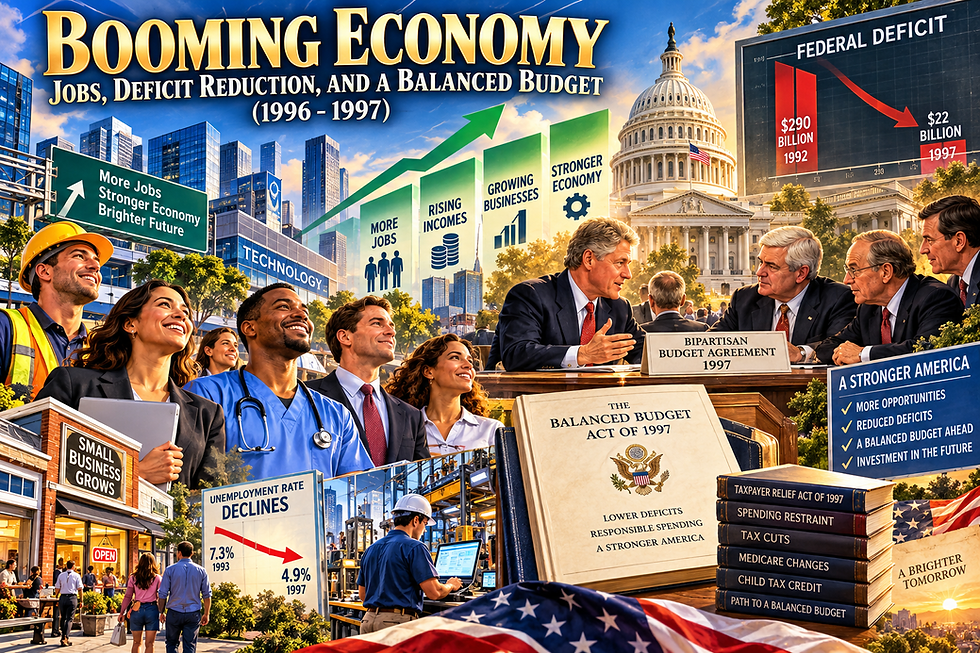
In 1992, the federal government ran a deficit of about $290 billion. Just four years later, it had fallen to about $107 billion. By 1997, it was roughly $22 billion—and the government was approaching something that had seemed almost unimaginable only a few years earlier: a balanced federal budget. Republicans and Democrats both wanted credit for the turnaround, but they disagreed sharply over why it happened. To understand the argument, students must follow the money.
Deficit and Debt Are Not the Same Thing
A deficit occurs when the federal government spends more during a fiscal year than it collects in revenue. The national debt is the accumulation of past borrowing, although economists often focus specifically on federal debt held by the public. That distinction matters because reducing the deficit does not mean the debt has disappeared. In 1993, debt held by the public stood at approximately $3.2 trillion, or 48 percent of the nation's GDP. The government could dramatically reduce its annual deficit while still carrying trillions of dollars of previously accumulated debt.
The Deficit Begins to Collapse
Something remarkable nevertheless happened after 1992. The deficit fell from approximately $290 billion in 1992 to $255 billion in 1993, $203 billion in 1994, $164 billion in 1995, $107 billion in 1996, and about $22 billion in 1997. Federal revenues were growing rapidly, while federal spending grew more slowly than revenues. A strengthening economy helped enormously: more people working and businesses earning profits meant more taxable income, while lower unemployment could reduce pressure on some government assistance programs. The government's finances were being transformed by both economic conditions and policy decisions.
The Clinton Argument: The 1993 Plan Changed the Direction
Clinton and congressional Democrats pointed first to the 1993 deficit-reduction legislation. It raised taxes, particularly on higher-income taxpayers, while also imposing spending restraints and making other budget changes. From their perspective, reducing projected borrowing helped establish fiscal discipline and contributed to conditions favorable to private investment and continued expansion. The economy then produced stronger revenues than earlier projections had anticipated. Because no Republican in Congress voted for the final 1993 legislation, Democrats later emphasized the falling deficits as evidence that Republican warnings about the plan had not been borne out by the subsequent expansion.
The Republican Argument: Spending Restraint Had to Go Further
Republicans told a different story. After winning control of both houses of Congress in the 1994 elections, Republican leaders made balancing the federal budget one of their central goals. House Budget Committee Chairman John Kasich and other Republicans argued that Washington needed deeper changes to federal spending rather than relying primarily on increased tax revenue. Their 1995 balanced-budget effort produced a major confrontation with Clinton, including vetoes and government shutdowns. By 1997, Republican lawmakers were still arguing that Congress had forced Washington to confront spending growth and make difficult choices necessary to achieve balance. Contemporary Republican statements specifically criticized Clinton's earlier proposals for postponing too much spending restraint into later years.
The Revenue Surprise
There was another crucial piece of the puzzle: Washington began collecting far more money. One contemporary congressional discussion citing CBO noted that between 1992 and 1996, federal spending had risen about 13 percent while revenues increased roughly 33 percent. A rapidly expanding economy, rising employment and incomes, strong corporate profits, and tax policy all contributed to federal receipts. This helps explain why neither "tax increases did it" nor "spending cuts did it" captures the entire story. Economic growth itself changed the government's finances because the federal budget responds automatically to what happens throughout the economy.
Two Parties, Two Different Lessons
The political argument therefore centered partly on which developments deserved the most weight. Clinton and Democrats emphasized the 1993 deficit-reduction package and the economic expansion that followed. Republicans emphasized their post-1994 drive to restrain spending and force a timetable toward a balanced budget, while generally favoring lower taxes than Democrats. Both parties also operated within economic circumstances neither controlled completely: Federal Reserve policy, technological advances, productivity, private investment, consumer behavior, and the business cycle all affected growth and federal revenue.
So Where Did the Deficit Go?
There is no need to give one politician or one party all the credit to explain what happened. Federal revenues rose rapidly, spending grew more slowly than revenues, the economy expanded, unemployment declined, and successive rounds of legislation changed taxes and spending. CBO's historical record shows what ultimately followed: beginning in 1998, strong economic growth, rapidly rising revenues, and declining outlays relative to GDP helped produce four consecutive federal budget surpluses through 2001. The disappearing deficit was therefore not one event but the result of several forces converging—and the political fight over which force mattered most became one of the defining economic debates of the 1990s.
Clinton and Congress Make a Deal: The Balanced Budget Act of 1997
Only two years earlier, President Bill Clinton and the Republican-controlled Congress had fought so bitterly over the federal budget that portions of the government shut down. Yet in 1997, the same political rivals accomplished something remarkable: they negotiated a bipartisan agreement designed to balance the federal budget by 2002. Neither side received everything it wanted. Republicans secured spending restraints and tax relief, while Clinton protected important domestic priorities and won funding for several initiatives. After years of confrontation, Washington finally had a deal.
Republicans Arrive Determined to Balance the Budget
The road to the agreement had begun with the Republican takeover of Congress following the 1994 elections. Speaker Newt Gingrich, House Budget Committee Chairman John Kasich, Senate Majority Leader Bob Dole and, later, Trent Lott made balancing the budget a central Republican objective. Republicans generally argued that Washington's fundamental problem was excessive spending and sought slower growth in major federal programs along with tax reductions. Their first attempts produced an enormous clash with Clinton in 1995 and 1996. Although Clinton rejected major portions of their proposals, Republicans continued pressing for a firm path toward balance. Congressional Republicans argued in 1997 that their pressure had helped make a balanced budget an achievable political goal.
Clinton Moves Toward Balance, Too
Clinton approached the issue differently. Democrats pointed to the 1993 deficit-reduction law, passed without Republican votes, as an important starting point for the rapidly falling deficit. By 1997, the strengthening economy and growing federal revenues had made balancing the budget considerably easier than projections had suggested only a few years earlier. Clinton now embraced balancing the budget while insisting that reductions should not undermine priorities such as education, health care, environmental protection, and assistance for working families. The argument was no longer primarily over whether the budget should eventually balance. It was over how to get there and what the federal government should look like afterward.
The Rivals Finally Negotiate
During early 1997, Clinton administration officials and congressional leaders entered intense negotiations. For Republicans, Kasich became one of the central architects of the congressional side of the agreement. For the administration, White House Chief of Staff Erskine Bowles and budget officials played important negotiating roles. On May 2, Clinton and Republican leaders announced that they had reached the framework of an agreement. The plan was designed to eliminate the projected deficit by fiscal year 2002 while combining spending reductions with tax relief and selected increases in domestic programs. It represented something increasingly rare after the battles of the previous two years: both sides accepting compromises they had previously resisted.
What Republicans Won
Republicans could point to several major achievements. The agreement placed the federal government on a legislated path toward a balanced budget, restrained projected spending in Medicare and other programs, and cleared the way for significant tax reductions. The companion Taxpayer Relief Act of 1997 created a $500-per-child tax credit, reduced capital-gains taxes, provided education-related tax benefits, and made other changes Republicans had long sought. Republican supporters saw the agreement as evidence that the political pressure begun with their 1994 congressional victory had helped force Washington toward spending restraint and tax relief.
What Clinton and Democrats Won
Clinton also secured important priorities. The agreement preserved much of the social-spending framework he had defended during the government shutdown battles and provided resources for education and health initiatives. One particularly lasting result was the creation of the State Children's Health Insurance Program, later known as CHIP, which expanded health coverage for children in families whose incomes were generally too high for Medicaid but who still faced difficulty obtaining private insurance. The agreement also included increases for Pell Grants and other education priorities. Clinton could therefore argue that Washington was moving toward balance without accepting the much deeper domestic reductions Republicans had originally proposed in 1995.
Not Every Republican Celebrated
The agreement did not unite conservatives. Some Republican lawmakers argued that party leaders had compromised too much with Clinton. Critics complained that important spending reductions were postponed until later years and that the tax cuts were much smaller than Republicans had previously proposed. One Republican critic told the House that the agreement put too many difficult reductions near 2001 and 2002 rather than making larger cuts immediately. Conservative organizations also attacked the agreement for failing to reduce the size of government as dramatically as they wanted. The Republican perspective in 1997 therefore was not one single position: party leaders defended the compromise as achievable progress, while some conservatives believed Republicans had surrendered too much.
The Deal Becomes Law
Congress eventually translated the compromise into major legislation. Clinton signed the Balanced Budget Act and the accompanying Taxpayer Relief Act on August 5, 1997. The agreement had been designed to reach balance by 2002, but events moved faster than Washington expected. Strong economic growth and unexpectedly robust federal revenues helped produce a unified federal budget surplus in fiscal year 1998. The political argument over credit never disappeared: Democrats emphasized the 1993 deficit-reduction program and Clinton's defense of domestic priorities, while Republicans emphasized the pressure their congressional majority had applied for spending restraint, tax relief, and a firm balanced-budget goal. What cannot be disputed is that after years of partisan warfare, the divided government of 1997 produced a major bipartisan budget agreement—and the federal government's fiscal position soon improved beyond what either side had originally projected.
From Deficit to Surplus: The Federal Budget Balances in 1998
Only six years earlier, the United States government had recorded a staggering $290 billion annual deficit. Washington had spent decades arguing about deficits, taxes, spending, and the growing national debt. Then, in fiscal year 1998, something happened that many Americans had almost stopped expecting: the federal government took in more money than it spent. The government recorded a unified budget surplus of about $69–70 billion, its first since 1969. Republicans and Democrats celebrated—but almost immediately began arguing over who deserved the credit.
The Numbers Cross Into the Black
The transformation had happened with remarkable speed. The $290 billion deficit of 1992 had fallen year after year until it nearly disappeared in 1997. Then revenues surged past expenditures. In fiscal 1998, federal receipts were approximately $1.72 trillion while outlays were about $1.65 trillion. The resulting surplus amounted to roughly 0.8 percent of the nation's economy. Even more significantly, debt held by the public declined in dollar terms for the first time in 29 years. Washington had crossed from borrowing to cover an annual shortfall to having money left over at the end of the fiscal year.
Why Did It Happen So Quickly?
The booming economy was a major reason. Millions more Americans were working and paying taxes, corporate profits and personal incomes had risen, and federal tax receipts increased rapidly. Between fiscal 1992 and 1998, federal receipts grew at an average annual rate of 7.9 percent, while federal outlays grew by only about 3 percent annually. Lower-than-expected growth in some government costs also helped. The combination was extraordinarily powerful: revenue was racing upward while spending was growing much more slowly.
The Clinton and Democratic Argument
Clinton and congressional Democrats pointed back to the 1993 deficit-reduction legislation. That law had raised taxes, especially on higher earners, while restraining projected spending. Democrats argued that the unpopular decisions made in 1993 had begun reducing the deficit years before Republicans gained control of Congress in January 1995. A Democratic House committee report in 1998 emphasized sustained economic growth, legislation enacted by the Democratic-controlled Congress in 1993 and 1994, and slower-than-expected medical spending as major contributors to the fiscal improvement. From this perspective, the surplus was the culmination of a process that had begun early in Clinton's presidency.
The Republican Argument
Republicans strongly disputed any suggestion that Clinton alone had balanced the budget. They pointed to the Republican Revolution of 1994, their subsequent control of Congress, their efforts to limit federal spending, welfare reform, and their repeated insistence on a definite timetable for balancing the budget. The Republican Congress had pushed a seven-year balanced-budget plan during its confrontations with Clinton, and Republicans viewed the bipartisan 1997 agreement as another important step toward fiscal restraint. Some Republicans argued that the change in congressional control fundamentally altered Washington's approach to spending and forced the administration toward balanced budgets.
An Interesting Republican Answer: Credit the American People
There was another Republican explanation that went beyond partisan credit. During an October 1998 House debate, Speaker Newt Gingrich argued that neither Republicans nor Clinton deserved most of the praise. He assigned only small portions of the credit to each and argued that the overwhelming credit belonged to Americans who worked, created businesses and jobs, and paid taxes. His larger point was economically important: government revenue does not appear from nowhere. A growing private economy, rising employment, investment, productivity, and higher taxable incomes helped generate the enormous increase in federal receipts that made the surplus possible.
But Was Everything Really Balanced?
There was an important complication hidden inside the headline. The $69–70 billion figure represented the unified federal budget, which included the Social Security system's surplus. Social Security was collecting more payroll-tax revenue than it was paying in benefits, and those excess receipts improved the government's overall balance. CBO's historical tables distinguish between these on-budget and off-budget components. This distinction became increasingly important as politicians debated whether the emerging surpluses should be spent, used for tax reductions, devoted to Social Security, or used to reduce federal debt.
A Victory With Many Parents
So who balanced the budget? The historical evidence makes a simple one-person explanation difficult. The deficit had already been declining for several years before Republicans captured Congress; Republicans subsequently intensified pressure for spending restraint and a balanced budget; Clinton and the Republican Congress reached the bipartisan agreement of 1997; and an unexpectedly strong economy generated enormous federal revenues. The result was bigger than any single politician. America had traveled from a $290 billion deficit in 1992 to its first unified federal surplus in nearly three decades—and fiscal year 1998 would not be the end. Larger surpluses were still ahead.
Was Everyone Sharing in the Boom? Wages, Poverty, Homeownership, Prosperity
By the end of the decade, the economic statistics looked extraordinary. Unemployment had plunged, millions of jobs had been created, wages were rising, poverty was falling, and homeownership was climbing. Yet national averages could hide enormous differences between families, occupations, regions, and communities. The boom was real, but Americans did not experience it equally—and Democrats and Republicans often disagreed about which policies deserved credit for the gains and what government should do for those still struggling.
Workers Finally Begin Seeing Bigger Paychecks
One of the most important developments came late in the expansion, when wages began rising faster than prices. In 1998, for example, average hourly earnings for production and nonsupervisory workers increased 3.7 percent, while inflation-adjusted hourly earnings rose 2.1 percent. That meant many workers were gaining actual purchasing power rather than receiving raises that merely kept pace with higher prices. A tight labor market helped: with unemployment falling and employers competing for workers, employees had greater opportunities to find jobs and seek better pay.
Poverty Falls—but Does Not Disappear
The improvement reached many lower-income Americans as well. In 1999, the official poverty rate fell to 11.8 percent, its lowest level since 1979, while the number of Americans classified as poor declined to 32.3 million. Child poverty fell to 16.9 percent. Poverty rates also declined among major racial and ethnic groups. Yet those numbers reveal the other side of prosperity: even near the height of the boom, tens of millions remained below the official poverty line. About 6.8 million people who spent at least 27 weeks working or looking for work were still classified as working poor in 1999.
More Americans Own Their Homes
Another visible sign of prosperity appeared in America's neighborhoods. The national homeownership rate, which had hovered around 64 percent in the early 1990s, climbed throughout the second half of the decade and reached 67.4 percent on an annual basis in 2000. Younger households also made gains. Low unemployment, rising incomes, mortgage-market conditions, and public and private efforts to encourage ownership all contributed to the trend. But homeownership remained uneven: in 2000, the rate was 73.8 percent among non-Hispanic White households, compared with 47.6 percent among Black households and 46.3 percent among Hispanic households.
The Clinton and Democratic View
Clinton and Democrats connected the improving living standards to the economic strategy pursued since 1993: deficit reduction, expanded tax assistance for lower-income workers through the Earned Income Tax Credit, increases in the federal minimum wage, investments in education and training, and continued economic expansion. From their perspective, the combination of fiscal discipline and policies directed toward working families helped produce a labor market strong enough to raise wages and reduce poverty. The statistics provided powerful evidence that conditions had improved, although they could not establish that any one policy was solely responsible.
The Republican View: Work, Welfare Reform, and the Private Economy
Republicans emphasized a different set of causes. After taking Congress in 1995, they pushed for lower taxes, spending restraint, regulatory limits, and changes to welfare. The bipartisan welfare law Clinton signed in 1996 replaced the old federal AFDC entitlement with Temporary Assistance for Needy Families and established stronger work requirements and state control over welfare programs. Republican supporters argued that employment and economic independence should replace long-term dependency and pointed to falling poverty and rising employment during the expansion as consistent with that approach. Democrats and other critics disputed how much credit welfare reform deserved and warned that reduced federal guarantees could leave some vulnerable families with less protection. The booming labor market itself also made the transition from welfare to employment easier than it might have been during a recession.
Prosperity Could Look Very Different Across America
Even homeownership demonstrated the gap between national success and individual experience. In late 1999, more than 81 percent of households earning at least the median family income owned their homes, compared with only about 51 percent of households below the median. Workers in expanding professional and technology-related occupations could experience the decade very differently from workers in declining industries. In 1999, low earnings remained the most common labor-market problem among full-time workers who were nevertheless poor. America could therefore be experiencing a historic economic expansion while individual Americans still faced job displacement, low wages, poverty, or difficulty buying a home.
The Boom Was Real—and Uneven
The fairest way to understand the late 1990s is to hold both realities together. Employment expanded, real wages rose, poverty declined, and homeownership increased. At the same time, millions remained poor, racial and income gaps persisted, and some workers and communities benefited much more than others. Republicans emphasized private enterprise, work incentives, welfare reform, spending restraint, and tax relief; Clinton and Democrats emphasized deficit reduction, investments, worker assistance, and policies aimed at lower- and middle-income families. Neither political explanation alone accounts for every change. Federal policy interacted with Federal Reserve decisions, technological advances, productivity growth, business investment, demographic changes, and one of the strongest labor markets in decades. The 1990s boom created remarkable prosperity—but prosperity was never the same thing as prosperity for everyone.
A World in Motion: Global Events Shaping America's Booming Economy
1996–1997 — World Trade Expands
International commerce continued expanding during the 1990s as countries lowered barriers and businesses built increasingly international supply chains. The relatively new World Trade Organization, established in 1995, became an important institution for negotiating and enforcing international trading rules. For the United States, expanding world markets created opportunities for American companies to sell aircraft, machinery, agricultural products, technology, financial services, and other goods and services abroad. At the same time, greater import competition placed pressure on some American manufacturers and workers. Globalization could therefore contribute to growth and lower consumer prices while creating disruption in particular industries and communities.
1996 — The Information Technology Agreement
One of the most important international economic agreements of the period emerged at the WTO's first ministerial conference in Singapore in December 1996. Governments negotiated the Information Technology Agreement, designed to eliminate tariffs on computers, semiconductors, telecommunications equipment, software-related products, and other technology. By March 1997, participating governments represented more than 90 percent of world trade in covered IT products, then worth roughly $600 billion annually. Tariff reductions began in July 1997. Lower barriers helped make technology cheaper to trade internationally and encouraged the development of global technology supply chains—important background to America's rapidly expanding technology sector and productivity gains.
1997 — Telecommunications Markets Open
Technology was not the only industry becoming more international. In February 1997, 69 governments reached a WTO agreement to liberalize basic telecommunications services. The affected telecommunications market generated roughly $600 billion in domestic and international revenue at the time. Greater international competition in telecommunications helped create conditions for cheaper and more widely available communications over the longer term. For American companies entering the information age, improvements in communications and declining costs were particularly important because businesses were increasingly relying on computers, data networks, telephones, and eventually the Internet to operate across national borders.
1996–1997 — Mexico Recovers from the Peso Crisis
Just south of the United States, Mexico was emerging from the severe peso crisis that had erupted in late 1994. The crisis had caused a deep Mexican recession in 1995, creating concerns for the United States because Mexico had become an increasingly important American trading partner following NAFTA. Mexico subsequently returned to economic growth, reducing one source of instability on America's border. The episode nevertheless demonstrated something important about the new global economy: financial trouble in one country could affect American exports, banks, investors, businesses, and policymakers. The Federal Reserve later described the Mexican crisis as one of the international shocks of the era that affected the United States, although its overall impact on the U.S. economy was relatively modest.
1997 — The Asian Financial Crisis Explodes
Then came a much more dramatic warning. In July 1997, Thailand abandoned its defense of the baht, and financial turmoil spread through several Asian economies. Investors withdrew money, currencies plunged, businesses struggled with debt, and economies that had previously been celebrated for rapid growth entered severe crises. Indonesia, South Korea, Thailand, and other countries were hit especially hard. The crisis revealed vulnerabilities created when enormous international capital flows entered economies whose financial systems were not always prepared to manage them.
1997 — Asia's Crisis Reaches American Shores
The Asian crisis did not end America's expansion, but it mattered to the United States. Economic weakness abroad could reduce foreign demand for American exports, while financial uncertainty could push international investors toward U.S. assets and strengthen the dollar. A stronger dollar made imported goods cheaper for Americans and helped restrain inflation, but it could also make American exports more expensive overseas and increase competitive pressure on U.S. manufacturers. Federal Reserve officials later concluded that the Asian crisis caused substantial economic damage in emerging markets but had only a modest overall effect on the American economy.
A Global Technology Revolution Accelerates
Meanwhile, computers, semiconductors, telecommunications equipment, and networking technology were becoming increasingly important throughout the world. The international agreements of 1996–1997 did not create the computer revolution, but they helped lower barriers around industries already expanding rapidly. The WTO later concluded that the Information Technology Agreement contributed to lower technology prices, greater specialization, larger global production networks, and productivity improvements. American businesses increasingly invested in computers and communications technology, helping workers process information, manage inventories, communicate, and conduct business more efficiently.
The Most Important People of the Booming Economy: Jobs, Deficit Reduction, Etc
Bill Clinton (1946– ) — President of the United States
Bill Clinton entered the presidency in 1993 facing a federal deficit of about $290 billion from fiscal 1992 and unemployment above 7 percent. His administration made deficit reduction a central part of its economic strategy, beginning with the controversial 1993 budget legislation that raised taxes on higher earners while reducing projected deficits. By 1996–1997, Clinton was governing alongside a Republican Congress and increasingly emphasizing the goal of balancing the budget while protecting spending he considered important for education, health care, and working families. In 1997, he negotiated with congressional Republicans over the agreement that eventually produced the Balanced Budget Act and Taxpayer Relief Act. Clinton himself acknowledged that the strong economy resulted from numerous forces, including American workers, businesses, entrepreneurs, and the Federal Reserve.
Newt Gingrich (1943– ) — Speaker of the House
Republican Newt Gingrich became Speaker of the House after the Republican Revolution of 1994 gave his party control of the House for the first time in four decades. Gingrich and congressional Republicans made balancing the budget, restraining federal spending, reforming welfare, and reducing taxes major goals. Their confrontation with Clinton contributed to the government shutdowns of 1995–1996, but by 1997 confrontation increasingly gave way to negotiation. Gingrich represented the Republican argument that controlling the growth of government spending and pushing Washington toward a firm balanced-budget timetable were essential components of the improving fiscal situation.
John Kasich (1952– ) — Chairman of the House Budget Committee
Ohio Republican John Kasich was one of the most important congressional figures in the balanced-budget fight. Elected to Congress in 1982, he became chairman of the powerful House Budget Committee after Republicans captured the House. Kasich helped develop Republican balanced-budget proposals and became deeply involved in the negotiations that eventually produced the 1997 agreement. While Gingrich was the nationally recognized Republican leader, Kasich worked closely with the numbers and details behind the Republican budget strategy. His role makes him especially useful for students studying how congressional committees can influence national economic policy.
Trent Lott (1941– ) — Senate Majority Leader
Mississippi Republican Trent Lott became Senate majority leader in June 1996 after Bob Dole left the Senate to campaign for president. Lott therefore occupied one of Washington's most powerful positions precisely when negotiations over the 1997 budget agreement intensified. He represented Senate Republicans during negotiations with Clinton and House Republican leaders. Because legislation had to pass both chambers of Congress, the balanced-budget agreement could not simply be a deal between Clinton and Gingrich; Senate Republicans also had to accept the compromise.
Robert Rubin (1938– ) — Secretary of the Treasury
Before entering government, Robert Rubin spent 26 years at Goldman Sachs and rose to become its co-chairman. Clinton brought him into the administration as the first director of the National Economic Council in 1993, and Rubin became Treasury secretary in 1995. He strongly supported deficit reduction, open international markets, and government investment in education and worker skills. During the budget confrontations, Rubin also had responsibility for managing federal finances during disputes over the debt ceiling. He later argued that fiscal discipline was central to the economic expansion, although he acknowledged that many forces contributed to America's economic strength.
Alan Greenspan (1926–2020) — Chairman of the Federal Reserve
Alan Greenspan possessed enormous influence even though he did not work for Clinton or the Republican leadership. Appointed Federal Reserve chairman by Ronald Reagan in 1987, Greenspan remained chairman throughout the Clinton years. The Federal Reserve influenced interest rates and attempted to keep inflation under control without unnecessarily stopping economic growth. During 1996–1997, Greenspan became increasingly interested in evidence that computers, technology, and productivity improvements might allow the economy to grow rapidly without producing the inflation economists traditionally expected. His monetary-policy decisions therefore formed an important part of the environment in which unemployment declined and the expansion continued.
Janet Yellen (1946– ) — Federal Reserve Governor and Economic Adviser
Long before Janet Yellen became Federal Reserve chair and later Treasury secretary, she was already helping shape economic policy during the 1990s. The Yale-trained economist joined the Federal Reserve Board of Governors in 1994 and served there until February 1997. Her academic work specialized partly in unemployment, making her particularly relevant as policymakers debated how low unemployment could fall without triggering inflation. In 1997, Clinton appointed her chair of the Council of Economic Advisers, placing her inside the administration as the balanced-budget agreement was completed and the economy continued expanding.
Life Lessons from the Booming Economy: Jobs, Deficit Reduction, Balanced Budget Big Successes Rarely Have One Cause
When something goes well, people naturally want to know who deserves the credit. The economic expansion of the 1990s demonstrates why that question can be difficult. Clinton's deficit-reduction policies, Republican efforts to restrain spending, Federal Reserve decisions, technological advances, productivity improvements, private investment, consumer spending, and millions of individual business decisions all influenced the economy. A valuable habit of historical thinking is therefore to resist explanations that attribute complicated events to one person or one decision. Before deciding what caused an outcome, identify all the forces that were moving at the same time.
Examine What Someone Inherited Before Judging the Results
A president, business leader, coach, or even student rarely begins with a blank slate. Clinton inherited an economy already recovering from the 1990–1991 recession, but with unemployment still above 7 percent and a recent federal deficit of approximately $290 billion. Republicans inherited a dramatically different fiscal situation when they took control of Congress in 1995 than Democrats had faced several years earlier. Good historical analysis therefore asks two questions: "What changed?" and "Where did it start?" Measuring only the ending can give a misleading picture of someone's performance.
Understand the Difference Between Spending and Debt
The budget battles provide a practical financial lesson. A deficit is the amount by which spending exceeds revenue during a particular period; debt represents accumulated borrowing from the past. Eliminating an annual deficit therefore does not automatically eliminate existing debt. The same principle applies to personal finances. Someone who stops adding new credit-card debt has made important progress, but the old balance still exists. Understanding the difference between income, expenses, deficits, savings, and debt is essential whether managing a household, a business, or a government.
Sometimes Opponents Have to Compromise
Clinton and congressional Republicans fought intensely over the budget, even enduring partial government shutdowns in 1995–1996. Yet in 1997, the opposing sides negotiated an agreement intended to balance the federal budget. Neither side received everything it wanted. Republicans obtained spending restraints and tax reductions; Clinton protected priorities and obtained support for initiatives including children's health coverage. Compromise does not mean that people suddenly agree. It means recognizing that obtaining part of what you want may sometimes accomplish more than refusing anything short of complete victory.
Test Predictions Against What Actually Happened
Economic debates frequently involve predictions. One side may claim a policy will create jobs, while another predicts it will destroy them. One group may expect inflation; another may expect stable prices. Students should record what leaders predicted and then compare those predictions with later evidence. But even when a prediction proves correct, that does not automatically prove why it was correct. Other conditions may have changed simultaneously. This method—prediction, observation, comparison, and revision—is useful in history, economics, science, business, and everyday decision-making.
Vocabulary to Learn While Studying the Economy, Jobs, Deficit Reduction, Budget
1. Federal Budget
Definition: The government's yearly plan showing how much money it expects to collect and how much it plans to spend.
Sample Sentence: Congress and President Clinton negotiated over the federal budget as they worked toward balancing it.
2. Budget Deficit
Definition: The amount by which government spending exceeds government revenue during a fiscal year.
Sample Sentence: The federal budget deficit declined dramatically during the 1990s.
3. Budget Surplus
Definition: The amount of money remaining when government revenue is greater than government spending during a fiscal year.
Sample Sentence: The United States recorded a unified federal budget surplus in fiscal year 1998.
4. Balanced Budget
Definition: A situation in which government revenues are approximately equal to government spending during a particular period.
Sample Sentence: Clinton and congressional Republicans reached an agreement in 1997 designed to achieve a balanced federal budget.
5. National Debt
Definition: The accumulated amount of money the federal government owes as a result of borrowing, although different measures of federal debt may be used.
Sample Sentence: Eliminating the annual deficit did not mean that the national debt disappeared.
6. Federal Revenue
Definition: Money collected by the federal government, primarily through taxes and other receipts.
Sample Sentence: Federal revenue increased rapidly as employment, incomes, and corporate profits grew during the economic expansion.
7. Fiscal Policy
Definition: Government decisions involving taxation and spending that affect the economy and federal finances.
Sample Sentence: Republicans and Democrats disagreed over the best fiscal policy for reducing the deficit.
8. Monetary Policy
Definition: Actions taken by the Federal Reserve to influence interest rates, credit conditions, inflation, and economic activity.
Sample Sentence: Alan Greenspan and the Federal Reserve used monetary policy as they attempted to maintain economic growth without allowing inflation to accelerate.
9. Federal Reserve
Definition: The central banking system of the United States, which conducts monetary policy and performs other financial responsibilities.
Sample Sentence: The Federal Reserve closely watched unemployment and inflation during the economic boom.
10. Interest Rate
Definition: The cost of borrowing money, usually expressed as a percentage of the amount borrowed.
Sample Sentence: Changes in interest rates can influence whether families and businesses decide to borrow and spend money.
11. Inflation
Definition: A general increase in the prices of goods and services over time, reducing the purchasing power of money.
Sample Sentence: Inflation remained relatively low even as unemployment declined during the late 1990s.
12. Unemployment Rate
Definition: The percentage of the labor force that does not have a job but is available for and actively seeking work.
Sample Sentence: The unemployment rate declined substantially as the economic expansion continued.
13. Economic Expansion
Definition: A period during which overall economic activity increases, often accompanied by rising production and employment.
Sample Sentence: The United States experienced a long economic expansion during the 1990s.
14. Gross Domestic Product (GDP)
Definition: The total market value of final goods and services produced within a country during a particular period.
Sample Sentence: Economists use changes in real GDP as one important measure of whether an economy is growing.
15. Productivity
Definition: The amount of output produced for a given amount of labor or other resources.
Sample Sentence: Improvements in technology contributed to stronger productivity growth during the late 1990s.
16. Capital Investment
Definition: Money spent by businesses on equipment, buildings, technology, and other resources intended to increase future production.
Sample Sentence: Businesses made large capital investments in computers and telecommunications equipment during the 1990s.
17. Tax Revenue
Definition: Money collected by a government through taxes on individuals, businesses, purchases, property, or other taxable activity.
Sample Sentence: Rising incomes and profits helped increase federal tax revenue during the economic boom.
18. Spending Restraint
Definition: An effort to limit or slow the growth of government expenditures.
Sample Sentence: Congressional Republicans emphasized spending restraint as an important part of their balanced-budget strategy.
19. Bipartisan
Definition: Involving cooperation or support from members of two major political parties.
Sample Sentence: Clinton and the Republican-controlled Congress reached a bipartisan budget agreement in 1997.
20. Capital Gains
Definition: Profits earned when an asset, such as a stock or property, is sold for more than its purchase price.
Sample Sentence: The 1997 tax legislation reduced certain federal tax rates on long-term capital gains.
Activities to Try While Studying a Booming Economy, Jobs, Deficit Reduction, Etc
Balance the Federal Budget
Recommended Age: Grades 6–12
Activity Description: Students become federal budget negotiators in 1997. They receive a fictional simplified federal budget with revenues and spending categories and must eliminate a deficit without exceeding available revenue.
Objective: Teach students the difference between revenue, spending, deficits, debt, and balanced budgets while demonstrating that every budget decision involves trade-offs.
Materials: Paper, pencils, calculators, a teacher-created budget sheet, and spending categories such as defense, Social Security, Medicare, education, transportation, environmental programs, law enforcement, and interest on the debt.
Instructions: Give each student or team a fictional government receiving $1,600 billion in revenue but spending $1,750 billion. Students must eliminate the $150 billion deficit. Allow them to reduce spending, increase selected taxes, or use a combination of both. Require students to explain every decision. Afterward, compare solutions. Discuss why different groups made different choices and relate the exercise to the negotiations between Clinton and the Republican-controlled Congress.
Learning Outcome: Students will understand that balancing a budget requires increasing revenue, reducing expenditures, or some combination of the two and that fiscal decisions often involve competing priorities.
Clinton and Congress: The 1997 Budget Negotiation
Recommended Age: Grades 8–12
Activity Description: Students reenact negotiations leading toward the 1997 budget agreement by representing different political and governmental perspectives.
Objective: Help students understand compromise, divided government, fiscal policy, and the competing priorities involved in the 1997 negotiations.
Materials: Role cards, budget worksheets, calculators, paper, and summaries of the major Democratic and Republican positions.
Instructions: Divide students into groups representing the Clinton administration, House Republicans, Senate Republicans, and optionally congressional Democrats. Give each group several priorities. Republican students might emphasize spending restraint, tax relief, and reaching a balanced budget; administration students might emphasize deficit reduction while protecting education, health, and other domestic priorities. Give students 20–30 minutes to negotiate one agreement. They cannot simply "win"; legislation must receive sufficient support to pass Congress and receive the president's signature. Finish by comparing their compromise with major elements of the actual 1997 agreement.
Learning Outcome: Students will discover why compromise becomes necessary under divided government and how competing political priorities can shape economic legislation.
Build the 1990s Jobs Graph
Recommended Age: Grades 5–10
Activity Description: Students use historical unemployment data to construct a graph showing how America's labor market changed during the 1990s.
Objective: Combine history, economics, and mathematics while teaching students to interpret economic statistics.
Materials: Graph paper, rulers, pencils or colored pencils, calculators, and annual unemployment data from the Bureau of Labor Statistics.
Instructions: Provide students with unemployment rates for each year from 1990 through 2000. Have them place years along the horizontal axis and unemployment percentages along the vertical axis. Students plot the data and connect the points. Mark important events such as the 1990–1991 recession, Clinton taking office in 1993, the Republican takeover of Congress in 1995, the 1997 budget agreement, and the 1998 budget surplus. Ask students which political events coincide with changes, while emphasizing that coincidence alone does not prove causation.
Learning Outcome: Students will learn how historians and economists use data while recognizing the important distinction between correlation and causation.
Who Gets Credit for the Boom?
Recommended Age: Grades 9–12
Activity Description: Students investigate competing explanations for the economic expansion and shrinking federal deficit instead of being given one predetermined answer.
Objective: Develop source evaluation, argumentation, and historical reasoning skills.
Materials: Short primary-source excerpts from Clinton administration officials, congressional Republicans, Federal Reserve officials, Congressional Budget Office reports, and economic statistics.
Instructions: Divide students into research teams. Assign each a possible contributor: Clinton-era fiscal policy, Republican congressional spending restraint and budget negotiations, Federal Reserve policy, technological innovation and productivity, businesses and investment, or workers and consumers. Students must find evidence supporting their assigned factor while also identifying evidence showing why it cannot explain everything. Have each team present its findings. Finish by constructing a class diagram connecting the different factors.
Learning Outcome: Students will understand that complicated historical outcomes frequently have multiple causes and learn to distinguish evidence from political claims about that evidence.


Comments