

6. Heroes and Villains of the Reconstruction Era: The Freedmen’s Bureau


My Name is Oliver Otis Howard: Commissioner of the Freedmen’s Bureau
I was not born into war, nor into politics, nor into fame. I was born into a modest farming family in Maine in 1830, and my earliest memories were not of battlefields or Congress, but of fields, family, and faith. Yet Providence would lead me through fire, through loss, and into one of the most complicated missions in American history: helping rebuild a shattered nation and guiding millions of newly freed men and women into the uncertain dawn of freedom.
Early Years in Maine
I was born in Leeds, Maine, into a hardworking New England household. My father died when I was young, and my mother carried the heavy responsibility of raising us with discipline and faith. From childhood, I believed deeply that my life belonged not only to myself, but to God. That conviction shaped every decision I later made.
Education became my path forward. I attended Bowdoin College, where I studied diligently and graduated with strong academic standing. I then entered the United States Military Academy at West Point. There I discovered both the discipline of the soldier and the burden of command. I graduated in 1854 and was commissioned into the Army, serving first as an instructor in mathematics. Even in those years, before the storm of civil war, I felt that the nation was drifting toward something terrible.
Faith and the Coming of War
My Christian faith was not a private matter to me; it guided my public life. I believed slavery to be morally wrong, and as sectional tensions grew, I understood that the coming conflict would test not only armies, but the soul of the Republic.
When the Civil War began in 1861, I volunteered eagerly for service in defense of the Union. I quickly rose through the ranks, commanding troops in several key battles. At the Battle of Fair Oaks in 1862, I was severely wounded, and my right arm had to be amputated. The loss of my arm was painful, but I did not view it as a tragedy. I believed that if the sacrifice helped preserve the Union and destroy slavery, then it was a price worth paying.
After recovering, I returned to command. I led troops at Antietam, Chancellorsville, and Gettysburg. War hardened me, but it also deepened my conviction that emancipation must mean more than the absence of chains.
The War Ends and a New Mission Begins
In 1865, as the Confederacy collapsed, President Abraham Lincoln and Congress faced an enormous question: what would freedom mean for four million formerly enslaved people? It was one thing to proclaim emancipation. It was another to secure its reality.
That year, Congress created the Bureau of Refugees, Freedmen, and Abandoned Lands—what the nation would call the Freedmen’s Bureau. I was appointed its Commissioner. It was not a position of glory. It was a position of overwhelming responsibility.
The South lay in ruins. Cities were burned. Farms were destroyed. Families were scattered. Freedmen had legal freedom but little land, little education, and no protection from hostile former masters. My task was to help provide food, medical aid, labor contracts, schools, and legal protection in an atmosphere of resentment and resistance.
Forty Acres and a Promise Deferred
One of the earliest and most controversial issues we faced was land. General Sherman had issued orders setting aside coastal land for freed families. Many believed that “forty acres and a mule” would be the foundation of independence.
Yet President Andrew Johnson reversed much of that policy, restoring land to former Confederates who swore loyalty. I was ordered to carry out that restoration. It was one of the most painful duties of my life. I had to inform freed families that land they had begun farming would be returned to former owners. I understood their anger and sorrow. I shared in their disappointment. But as a soldier and public servant, I followed the law as directed by the President.
Building Schools for Freedom
If land could not immediately be secured, education could be. I believed deeply that literacy was the cornerstone of lasting freedom. Under my leadership, the Bureau worked with Northern missionaries, Black teachers, and churches to establish thousands of schools throughout the South.
Freedmen and women hungered for learning. I saw elderly men bent over spelling books, young children reciting their letters by candlelight, and mothers determined that their sons and daughters would never again live in ignorance. From this effort emerged institutions like Howard University, founded in 1867 and later named in my honor. I did not seek such recognition, but I rejoiced in the creation of a university that would train Black ministers, lawyers, and leaders for generations.
Violence and Resistance
Our work did not proceed peacefully. Bureau agents were threatened. Schools were burned. Teachers were attacked. Former Confederates often saw the Bureau as an instrument of Northern control and racial upheaval. Secret organizations arose to intimidate freedmen from voting, organizing, or asserting their rights.
I faced criticism from many sides. Some in the South called me a tyrant. Some in the North thought I moved too cautiously. Freedpeople sometimes felt we did too little, while white Southerners believed we did too much. To stand between these forces required patience, resolve, and a steady belief that justice, even if delayed, was still worth pursuing.
The Creation of the Freedmen’s Bureau (March 1865) – Told by Oliver Otis Howard
In March of 1865, as the Civil War drew to its weary conclusion, Congress established the Bureau of Refugees, Freedmen, and Abandoned Lands—what history now calls the Freedmen’s Bureau. The guns had not yet fully fallen silent when lawmakers recognized that emancipation, though morally necessary and militarily secured, had created a vast responsibility. Freedom had broken chains, but it had not built homes, provided food, restored families, or secured wages. The Bureau was born not out of political convenience, but out of urgent necessity.
Why Congress Created the Bureau
By early 1865, the Union had effectively crushed Confederate resistance, yet the humanitarian crisis across the South was unmistakable. Millions of formerly enslaved people stood on uncertain ground. They were free, yet landless; liberated, yet unprotected by stable local courts; hopeful, yet surrounded by hostility. At the same time, white Southern civilians—many impoverished and displaced—also faced hunger and dislocation. The old slave-based labor system had collapsed almost overnight, leaving both former masters and former slaves without a functioning economic structure.
Congress understood that if the federal government did not act, chaos would harden into injustice. Lawmakers feared that Southern states, once restored to civil authority, might enact measures to limit or undermine Black freedom. They had already seen signs of this in early efforts to control labor and restrict movement. Thus, the Bureau was conceived as a federal safeguard—a mechanism to stabilize society during the fragile transition from slavery to freedom. It would provide relief, supervise labor contracts, assist refugees, and help establish schools. In truth, it was an unprecedented experiment: never before had the national government assumed such direct responsibility for the welfare of civilians on this scale.
Its Placement in the War Department
When Congress debated how to structure this new institution, they chose to place it within the War Department. This decision was not accidental. The South remained under military occupation, and the Army was the only organized authority with the manpower and logistical capacity to operate effectively in devastated regions. Civil government in many Southern states was either nonexistent or unreliable. By attaching the Bureau to the War Department, Congress ensured that its agents would have the backing of military authority.
I was a Union general when I was appointed Commissioner of the Bureau. My background as a soldier influenced the shape of our operations. We relied upon Army officers to serve as assistant commissioners across the former Confederate states. Military posts became centers of distribution for rations and protection for freedpeople negotiating labor agreements. Without the support of the Army, our efforts would have been easily thwarted by local resistance. The War Department’s involvement lent both discipline and force to our mission, though it also caused critics to accuse us of imposing federal will through military power.
An Institution Meant to Be Temporary
From its inception, the Freedmen’s Bureau was designed as a temporary measure. Congress did not intend to create a permanent welfare department. The Bureau’s original mandate was limited to one year after the war’s end, reflecting the belief that Southern society would stabilize and resume civil governance within a reasonable period. The Bureau was conceived as a bridge—an emergency scaffold to support a collapsing structure until it could stand again on its own.
This temporary nature shaped both our authority and our limitations. We were to provide immediate relief: food for the hungry, clothing for the destitute, medical care for the sick. We were to assist freedpeople in securing fair labor contracts and to oversee abandoned or confiscated lands. We were to help establish schools and courts where local justice failed. Yet we were not granted unlimited power, nor indefinite time. Our mission existed within political constraints, dependent upon congressional renewal and public support.
Many believed that once freedom was declared and Confederate armies surrendered, reconciliation would proceed swiftly. Those of us on the ground soon realized that deeper transformation would require more than a single year of oversight. Hostility toward the freed population did not vanish with the war’s end. Resistance to federal intervention persisted. The Bureau’s temporary design, though practical in theory, often collided with the stubborn realities of postwar Southern life.
Early Goals: Food, Clothing, and Medical Aid – Told by Oliver Otis Howard
When the Freedmen’s Bureau began its work in 1865, our earliest and most urgent goals were painfully simple: food for the hungry, clothing for the destitute, and medical care for the sick. The collapse of the Confederacy had left the South physically shattered and economically paralyzed. Freedom had arrived for millions, but freedom did not fill empty stomachs or heal festering wounds. Before we could speak of contracts, schools, or civil rights, we had to confront a humanitarian emergency of staggering proportions.
Hunger Across a Broken Land
In the months immediately following surrender, I received reports from nearly every Southern state describing alarming food shortages. Farms had been abandoned during the war, crops destroyed, livestock seized by armies, and transportation networks rendered useless. Freedmen who had left plantations in search of family or opportunity often found themselves without provisions. White Southern civilians, too, faced hunger as Confederate currency became worthless and supply lines collapsed.
The Bureau worked alongside the Army to distribute rations where need was greatest. Military depots became centers of relief. Cornmeal, salt pork, and basic staples were issued to families who would otherwise have starved. Critics later accused us of fostering dependency, but they did not stand where I stood. They did not see children weakened by malnutrition or elderly men unable to work because years of forced labor had broken their bodies. Our intention was never permanent charity; it was immediate survival. Without temporary relief, there would be no stability upon which to rebuild.
Clothing the Dispossessed
Clothing, too, became a pressing necessity. Freedpeople often possessed only what they wore when they walked away from bondage. Many Confederate households had been stripped of goods during the war, and entire communities were left with little more than rags. The coming winters threatened to deepen suffering.
Through the Bureau’s network and with assistance from Northern charitable organizations, we distributed garments and blankets wherever possible. Donations flowed from churches and aid societies in the North, reflecting a national recognition that emancipation demanded material support. The task, however, was immense. Roads were damaged, rail lines incomplete, and communication unreliable. Every shipment required coordination, military protection in some regions, and careful oversight to prevent corruption or diversion. Even the act of handing out coats and shoes became an exercise in administration and endurance.
Medical Aid Amid Disease and Despair
Perhaps the most heartbreaking aspect of our early mission was medical care. War had left not only wounds from battle but widespread disease. Camps of displaced persons were breeding grounds for illness. Smallpox, dysentery, and other infectious diseases spread quickly in overcrowded and unsanitary conditions. Freedpeople, who had long been denied adequate medical attention under slavery, suffered disproportionately.
The Bureau established hospitals and clinics where possible, often converting abandoned buildings into makeshift treatment centers. We hired physicians, secured medicines, and attempted to coordinate vaccination efforts. Yet resources were limited. Many Southern doctors had served the Confederate cause and were reluctant to assist freedmen. Supplies had to be transported over great distances. Each medical station represented both hope and frustration—hope in the lives saved, frustration in the lives we could not reach in time.
The Logistical Challenge of Rebuilding
Administering relief across the former Confederacy was unlike any peacetime effort the federal government had ever attempted. The South was vast, its infrastructure damaged, its political loyalties divided. Bureau agents operated in environments where civil courts were unreliable and hostility toward federal authority ran deep. We had to establish regional offices, appoint assistant commissioners, and rely heavily on Army personnel for enforcement and transportation.
Communication was slow and often uncertain. Reports traveled by horseback or along partially restored rail lines. Decisions had to be made with incomplete information. In some counties, one Bureau officer oversaw tens of thousands of people spread across wide rural districts. The scale of need consistently outpaced the manpower available to address it. Yet we pressed forward, believing that even imperfect relief was better than abandonment.
Relief as the Foundation of Reconstruction
These early efforts—food, clothing, and medical aid—were not the entirety of Reconstruction, but they were its foundation. Without addressing immediate suffering, broader reforms would have collapsed under the weight of desperation. Hungry men cannot negotiate fair labor contracts. Sick children cannot attend school. Communities ravaged by disease and deprivation cannot easily embrace new political realities.
I understood that our mission was temporary, yet the necessity was urgent. Relief work did not generate headlines like constitutional amendments or impeachment trials, but it represented the daily, unglamorous labor of stabilizing a shattered society. We sought not to create dependence, but to prevent chaos. We aimed to sustain life long enough for opportunity to take root.
The Promise and Controversy of “Forty Acres and a Mule” – Told by Oliver Otis Howard
In the closing months of the Civil War, a phrase began to circulate among the freedpeople of the South that would come to symbolize both hope and heartbreak: “forty acres and a mule.” It was rooted in General William Tecumseh Sherman’s Special Field Order No. 15, issued in January 1865, which set aside vast stretches of coastal land in Georgia and South Carolina for settlement by formerly enslaved families. For many freedmen, this order represented more than land; it represented independence, dignity, and the tangible fruit of emancipation. Yet the promise proved fragile, and its reversal would become one of the most painful episodes of early Reconstruction.
Sherman’s Field Order No. 15
As Sherman’s armies marched through Georgia during the war’s final phase, thousands of formerly enslaved people followed in their wake, seeking protection and opportunity. Their presence created logistical challenges for the military, but it also forced Union leaders to confront a pressing question: what would freedom mean in practical terms? In response, Sherman met with Black ministers in Savannah to hear their views. They spoke clearly—freedom required land, the means to work for themselves rather than under former masters.
Sherman’s Field Order No. 15 designated approximately 400,000 acres of confiscated or abandoned coastal land to be divided into plots of up to forty acres for Black families. Army mules might be loaned to assist in cultivation, giving rise to the phrase that echoed through freed communities. As Commissioner of the Freedmen’s Bureau, I was tasked with helping implement federal policy regarding such lands once the war concluded. The early signs suggested that land redistribution might become a cornerstone of Reconstruction.
The Meaning of Land to the Freedpeople
For those who had endured generations of bondage, land was not merely property. It was security, autonomy, and proof that freedom was real. I witnessed freed families working soil they believed would soon belong to them, building modest homes, and planning futures that did not depend upon former masters. The psychological transformation was profound. No longer bound to labor without wages, they imagined themselves as independent farmers, citizens rooted in their own soil.
The expectation of land ownership spread rapidly. Rumors traveled faster than official proclamations, and many came to believe that the federal government had permanently guaranteed them acreage. The phrase “forty acres and a mule” carried moral weight, as if it were a covenant forged by sacrifice and suffering. It symbolized compensation for centuries of unpaid labor and the beginning of economic justice.
The Painful Reversal Under President Johnson
Yet the political winds shifted swiftly. After President Abraham Lincoln’s assassination, President Andrew Johnson assumed office. Johnson favored rapid restoration of Southern states and the return of property to former Confederates who swore loyalty to the Union. Under his policies, much of the land set aside under Sherman’s order was returned to its previous white owners.
As Commissioner, I bore the responsibility of communicating and enforcing this reversal. It remains one of the most difficult duties of my career. I traveled to coastal regions where freed families had begun to establish communities and informed them that legal title would not remain in their hands. Many listened in disbelief; others wept or protested. They had interpreted the government’s earlier actions as a binding commitment. Now, they were told that the land would revert to men who had once claimed ownership over both soil and human lives.
I understood their anguish. I shared their sense that an opportunity for lasting stability was slipping away. Yet as a soldier and federal officer, I was bound to execute national policy. The Bureau sought to mitigate the consequences by encouraging fair labor contracts and continued occupancy where possible, but the promise of widespread land redistribution had effectively ended.
Consequences for Reconstruction
The reversal of Sherman’s order shaped the trajectory of Reconstruction. Without land of their own, many freedpeople entered into sharecropping arrangements that often left them in cycles of debt and dependency. Though technically free, they lacked the economic foundation that might have secured lasting independence. The dream of small farms owned by those who had once labored without pay gave way to compromise and hardship.
Critics later argued that had land reform been sustained, the South’s economic and racial history might have unfolded differently. I cannot say with certainty how events would have evolved, but I know that the moment carried immense possibility. The gap between expectation and outcome fostered distrust toward federal promises and deepened resentment among freed communities.

My Name is Salmon P. Chase: Chief Justice of the United States and Antislavery Statesman
I was born in 1808 in Cornish, New Hampshire, into a young republic still defining itself. My father died when I was a boy, and my mother struggled to provide stability for our family. From those early years, I learned discipline, independence, and the belief that character is forged in adversity. I did not begin life with great wealth or powerful connections, but I carried within me a deep conviction that slavery was incompatible with the principles of our nation.
Education and Early Ambition
As a young man, I pursued education with determination. I studied at Dartmouth College and graduated with honors. Law drew my attention because it stood at the intersection of power and principle. I moved west to Cincinnati, Ohio, a city perched on the edge of slave territory across the Ohio River. There, I established my legal practice.
It was in Cincinnati that slavery ceased to be an abstract debate and became a daily moral confrontation. I defended fugitive slaves who had crossed the river seeking freedom. These cases earned me the nickname “Attorney General for the Runaway Slave.” I wore it with quiet pride. I believed that the Constitution, properly understood, did not demand blind obedience to injustice.
The Rise of an Antislavery Politician
My legal advocacy soon led me into politics. I joined movements that opposed the expansion of slavery, first aligning with the Liberty Party and later the Free Soil Party. I argued that slavery must not spread into new territories. I believed that restricting its growth would place it on the path to extinction.
In 1849, I was elected to the United States Senate from Ohio. There, I opposed the Compromise of 1850 and the Fugitive Slave Act. I insisted that freedom was national and slavery sectional. I spoke not as a radical seeking chaos, but as a constitutionalist demanding consistency between American ideals and American law.
Governor of Ohio and National Leadership
After my Senate service, I became Governor of Ohio. In that role, I continued to advocate for reform and modernization. My ambition was no secret. I believed I could lead the nation, and I sought the presidency more than once. Though I did not achieve that office, history would place me in a different and equally consequential position.
When Abraham Lincoln was elected president in 1860, he appointed me Secretary of the Treasury. Some were surprised by the choice. Lincoln and I had been political rivals. Yet he understood that unity within the Republican Party was essential during the coming storm.
Financing a Nation at War
As Secretary of the Treasury during the Civil War, my task was immense. The Union required money—vast sums of it—to equip armies and sustain the war effort. I reorganized the nation’s financial system, introduced a national banking system, and oversaw the issuance of paper currency known as “greenbacks.” For the first time, the phrase “In God We Trust” appeared on American coins under my administration.
Financing the war was not simply about numbers; it was about survival. Without a stable financial structure, the Union could not endure. I considered this work as vital as any battle fought on the field.
Chief Justice of the United States
In 1864, after the death of Chief Justice Roger B. Taney, President Lincoln appointed me Chief Justice of the United States. It was a remarkable turn of events. Taney had authored the Dred Scott decision, which declared that Black Americans could not be citizens. Now I presided over a Court in a nation transformed by war and emancipation.
As Chief Justice, I guided the Court through the turbulent years of Reconstruction. We addressed questions of federal power, citizenship, and the meaning of the newly adopted amendments. In cases such as Texas v. White, we affirmed that the Union was indissoluble—that no state could simply withdraw at will.
Presiding Over Impeachment
One of the most solemn duties of my tenure was presiding over the impeachment trial of President Andrew Johnson in 1868. The Constitution required that the Chief Justice oversee such proceedings when the President stands trial before the Senate. I understood the gravity of the moment. The nation was divided not only over policy but over the direction of Reconstruction itself.
I conducted the trial with seriousness and restraint. Johnson ultimately survived removal by a single vote. The episode revealed how fragile the balance between branches of government could be in times of crisis.
Reconstruction and Its Limits
I believed that the 13th, 14th, and 15th Amendments marked a new birth of constitutional liberty. They abolished slavery, defined national citizenship, and extended voting rights to Black men. Yet I also saw how fragile those gains were. Enforcement required political will. Without it, rights could be undermined.
The Court during Reconstruction walked a difficult line. We sought to interpret new amendments faithfully while maintaining constitutional structure. Critics from various sides accused us either of overreach or timidity. Such is the burden of judicial responsibility.
Restoring Land to Former Confederates – Told by Salmon P. Chase
In the turbulent aftermath of the Civil War, one of the most difficult questions confronting the nation was whether land confiscated or abandoned during the conflict should remain in the hands of newly freed families or be restored to former Confederate owners. The issue was not merely administrative; it was constitutional, moral, and deeply symbolic. At its heart lay a conflict between long-standing American principles of property rights and the urgent demand for justice from millions who had labored without compensation under slavery.
The Constitutional Weight of Property
American law had long placed immense importance upon the protection of private property. Even during wartime, confiscation required legal justification. Congress had passed Confiscation Acts allowing certain properties belonging to rebels to be seized, yet the extent and permanence of such seizures were debated. When the Confederacy collapsed, President Andrew Johnson issued proclamations granting pardons to many former Confederates who swore loyalty to the Union. With those pardons came restoration of property rights, excluding enslaved persons who had already been emancipated.
From a constitutional perspective, this raised immediate concerns. If the federal government permanently redistributed land without clear statutory authority, critics argued that it undermined fundamental protections embedded in the Fifth Amendment. The law had to distinguish between punishment for treason and wholesale restructuring of property ownership. The courts, including the one over which I presided, were mindful that revolutionary impulses must be balanced against constitutional continuity.
The Moral Claim of the Freedpeople
Yet the freedpeople advanced a claim not rooted solely in sentiment, but in lived experience. For generations, they had cultivated those lands without wages, their labor enriching those who now sought restoration. Many believed that justice demanded more than emancipation; it demanded economic independence. Sherman’s Field Order No. 15 had briefly kindled hope that confiscated lands would be divided among formerly enslaved families. That hope was not irrational. It was born of sacrifice and necessity.
The argument from justice was compelling. Without land, freedmen would be forced into labor arrangements that could replicate old hierarchies under new names. Sharecropping and contract labor, absent ownership, risked perpetuating dependency. Those advocating redistribution contended that property rights, when tied to rebellion and built upon slavery, should not be shielded unconditionally.
Presidential Policy and Legal Restoration
President Johnson’s policy favored swift reconciliation. By restoring property to pardoned Confederates, he sought to stabilize Southern society and hasten its political reintegration. Legally, his authority derived from executive clemency and existing statutes. In practice, restoration often meant that lands temporarily occupied or cultivated by freed families were returned to former owners.
This placed federal officials in an unenviable position. They were required to enforce restoration orders even when doing so displaced freedpeople who had begun to establish homes. The conflict revealed a tension between two visions of Reconstruction: one emphasizing legal continuity and reconciliation, the other emphasizing structural transformation and economic redress.
As Chief Justice, I was acutely aware that the judiciary could not simply rewrite property law to reflect moral outrage. Courts interpret statutes and constitutional provisions; they do not legislate sweeping reforms absent authority. Yet the Constitution itself had just been amended to abolish slavery and redefine citizenship. The nation stood at a crossroads between tradition and transformation.
My Name is George T. Ruby: Freedmen’s Bureau Agent and Reconstruction Leader
I was born a free Black man in New York around 1841, in a nation that proclaimed liberty yet denied it to millions who looked like me. From my earliest years, I understood that freedom was fragile, and that education and organization would be our strongest defenses. My life would carry me from the North to the war-torn South, from classrooms to courtrooms, and into the halls of political power during one of the most dangerous and hopeful periods in American history.
Early Life in the North
I grew up in the North, where slavery did not legally bind me, but prejudice still shadowed my steps. Being free did not mean being equal. I learned quickly that literacy and learning were tools no one could easily take from you. I sought education not only for personal advancement but as preparation for leadership.
As a young man, I became involved in teaching and in the struggle for Black advancement. The outbreak of the Civil War confirmed what many of us already believed: the fate of the nation and the fate of our people were inseparable. When the Union fought, it fought not only for territory but for the meaning of freedom itself.
Journey to the South and the Freedmen’s Bureau
When the war ended in 1865, freedom arrived suddenly for millions in the South—but it arrived without land, without protection, and without opportunity. I traveled to Louisiana and later Texas, working with the Freedmen’s Bureau to assist formerly enslaved people as they navigated their new and uncertain lives.
In Texas, I served as a Bureau agent and educator in Galveston. My work was not simply administrative. It was deeply personal. I helped negotiate labor contracts between freedmen and former slaveholders, attempting to prevent exploitation disguised as employment. I listened to the fears of freed families who faced violence and intimidation. I worked to establish schools, believing that literacy was the foundation of true independence.
The resistance was fierce. Many white Southerners saw men like me not as public servants, but as intruders. Threats were common. Intimidation was constant. Yet I remained because the freed people needed advocates who would not retreat at the first sign of danger.
Education as Liberation
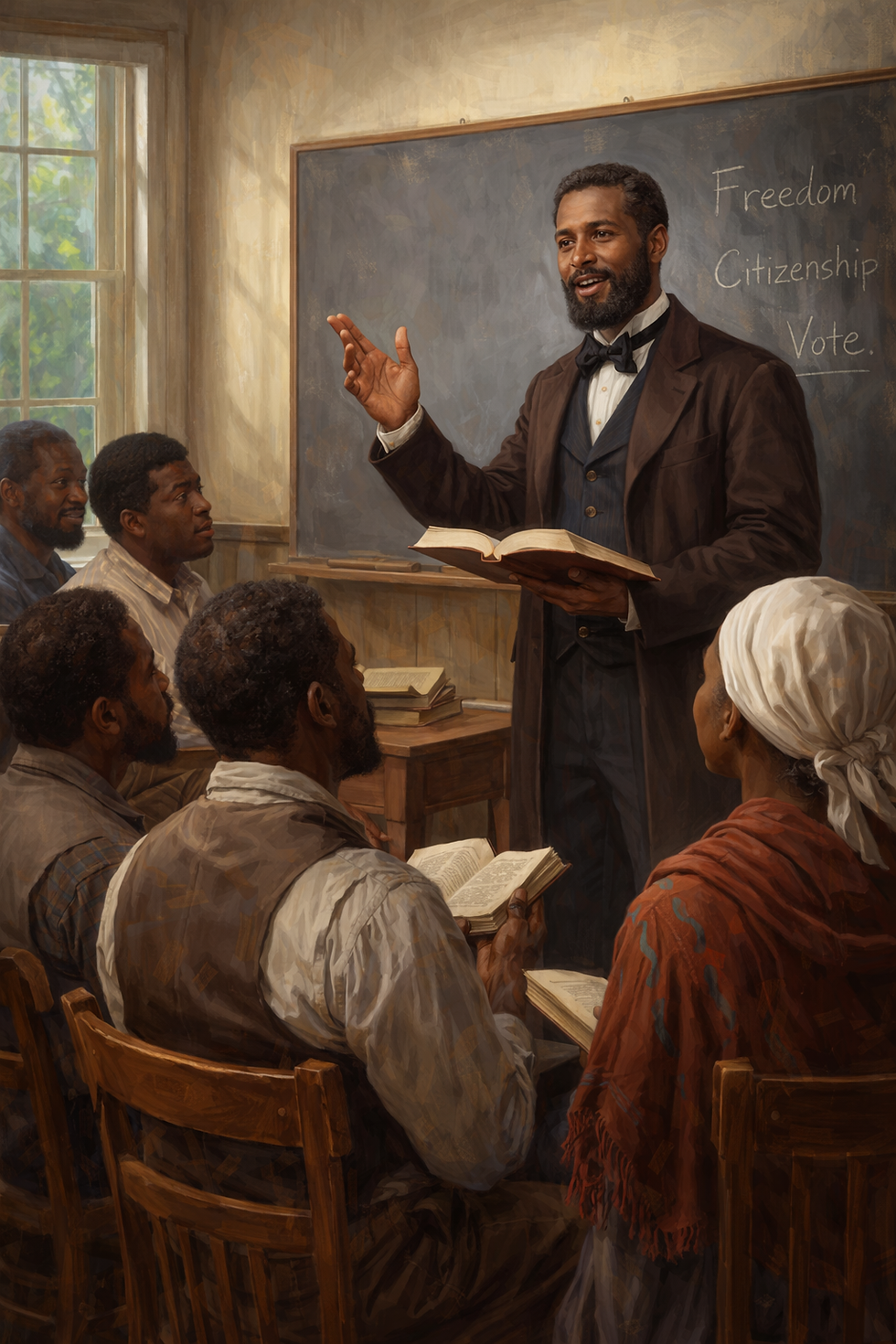
I believed deeply that education was the surest path to long-term empowerment. In Galveston, I helped organize schools for freed children and adults. It was a remarkable sight to see elderly men and women, once denied the alphabet under threat of punishment, now sitting upright in classrooms determined to learn their letters.
Schools were more than places of study. They were centers of community organization. They were spaces where freedmen discussed politics, labor rights, and the responsibilities of citizenship. Education was not only about reading and writing; it was about preparing a people to participate fully in American democracy.
Political Awakening and Leadership
Reconstruction opened doors that had long been bolted shut. With the passage of the 14th and 15th Amendments, Black men gained citizenship and the right to vote. I recognized that without political representation, all other gains would be fragile.
I became active in Republican politics in Texas and helped organize Black voters along the Gulf Coast. In 1869, I was elected to the Texas State Senate, becoming one of the first Black legislators in the state’s history. It was an extraordinary moment—not because of personal triumph, but because it symbolized what emancipation had made possible.
In the Senate, I advocated for public education, civil rights protections, and fair labor laws. I supported measures to rebuild the state’s infrastructure and economy while ensuring that freedmen were not pushed back into a condition resembling slavery. The political battles were intense. Many white Texans viewed Reconstruction governments as illegitimate. Violence and threats against Black officeholders were real and ever-present.
Confronting Violence and White Supremacy
The rise of organized resistance groups sought to undo everything Reconstruction had attempted to build. Freedmen were beaten or killed for voting. Black leaders were targeted for intimidation. Political meetings required vigilance and courage.
Serving in office under such conditions required more than ambition; it required resolve. I knew that if we withdrew from political life, the gains of freedom would evaporate. So we stood firm. We debated. We legislated. We voted. Each act of participation was itself a declaration that citizenship could not be revoked by terror.
The End of Reconstruction and Exile
As Northern support for Reconstruction faded in the 1870s, so too did federal enforcement of civil rights in the South. White Democratic “Redeemers” regained control of many state governments, including Texas. The space for Black political leadership narrowed rapidly.
By the mid-1870s, I left Texas and eventually relocated to New Orleans. The promise of Reconstruction was retreating, replaced by segregation, voter suppression, and the slow construction of what would become the Jim Crow system. Though the political climate changed, I did not regret the struggle. For a brief and powerful moment, we demonstrated that democracy in the South could include us.
Labor Contracts & The Struggle for Fair Wages (1865–1866) – Told by Ruby
In the first years after emancipation, the question that echoed across plantations, towns, and Bureau offices was simple yet profound: how would freedmen earn a living in a world no longer governed by slavery? Freedom had broken legal chains, but it had not yet defined the terms of labor. Between 1865 and 1866, labor contracts became the battleground upon which the meaning of freedom was tested, negotiated, and often contested. I witnessed firsthand how freedmen asserted their rights and how Bureau agents, myself included, struggled to mediate disputes in an atmosphere thick with tension and mistrust.
From Slavery to Contract Labor
Under slavery, labor had been enforced by law and violence. Wages were nonexistent, and the enslaved had no legal standing to challenge mistreatment. Emancipation transformed this system overnight. Former masters could no longer compel work without pay. Freedmen, in turn, sought to define the conditions under which they would labor. Many left plantations temporarily to search for family members sold away years earlier. Others tested their mobility simply because they could. The old order expected immediate compliance; the new reality required negotiation.
Planters quickly realized that without a stable workforce, their lands would remain idle. Cotton, rice, and sugar could not be harvested by memory alone. Yet they resisted offering wages that reflected the new legal status of their former laborers. Many proposed contracts that preserved strict supervision, limited movement, and imposed harsh penalties for perceived idleness. Freedmen, aware of their newfound rights, resisted terms that resembled bondage. Thus began a period of bargaining that was at once hopeful and fraught.
The Role of the Freedmen’s Bureau
The Freedmen’s Bureau entered this arena as mediator and, at times, referee. Bureau agents were tasked with reviewing labor contracts to ensure fairness and legality. In Texas, where I served, freedmen and planters often arrived at Bureau offices to present agreements or to dispute existing arrangements. Our responsibility was not to dictate every term but to prevent exploitation that would undermine emancipation itself.
We insisted that contracts specify wages, hours of work, and the provision of food or housing where applicable. Payment might be structured as monthly wages or as a share of the crop at season’s end. We discouraged provisions that allowed arbitrary punishment or withheld wages without due cause. Yet enforcement was uneven. Our authority depended upon local military backing, and in many rural areas, one Bureau officer oversaw vast territories. The scale of oversight required exceeded our manpower.
Negotiation and Resistance
Freedmen demonstrated remarkable agency during this period. They negotiated collectively, often refusing to sign contracts that paid too little or demanded excessive control. Some families chose to work smaller plots independently, even if that meant lower initial income, because autonomy carried value beyond wages. Others formed labor associations to strengthen their bargaining power. Their determination revealed that freedom was not a passive condition; it required assertion.
Disputes were frequent. Planters accused freedmen of laziness or breach of contract; freedmen accused planters of withholding wages or failing to honor agreed terms. Bureau offices became forums where grievances were aired and investigated. I recall long hours spent listening to testimony, examining written agreements, and attempting to render judgments that balanced legal fairness with practical realities. Each case was a microcosm of Reconstruction’s larger struggle.
The Limits of Mediation
Despite our efforts, structural inequalities persisted. Freedmen often lacked access to capital, tools, or independent land. Many contracts bound them to plantations through debt for supplies advanced at the beginning of the season. When harvests were poor or accounting opaque, freed families found themselves with little profit. The transition from slavery to wage labor was not smooth; it was marked by suspicion and unequal power.
The Black Codes & Bureau Intervention – Told by George T. Ruby
In the months following emancipation, Southern legislatures moved swiftly to pass what became known as the Black Codes—laws designed to regulate, restrict, and control the lives of freedmen. Though slavery had been abolished, these statutes sought to preserve as much of the old social order as possible under new legal language. I witnessed firsthand how these measures attempted to narrow freedom into something fragile and conditional, and how the Freedmen’s Bureau worked—often imperfectly but earnestly—to resist their enforcement and defend the rights of the newly freed.
The Emergence of the Black Codes
When Confederate governments collapsed, new state governments were formed under Presidential Reconstruction. Many of these legislatures, dominated by former Confederates, faced a transformed labor system and a population of freedmen determined to assert autonomy. Rather than embrace full equality, they enacted laws that limited Black mobility, labor rights, and civil standing.
The Black Codes varied by state, but their purpose was unmistakable. Some required freedmen to sign annual labor contracts, and failure to do so could result in arrest for vagrancy. Others imposed fines or forced labor for minor infractions. Apprenticeship laws allowed Black children to be bound to white employers, sometimes against the wishes of their parents. Restrictions on property ownership, firearms possession, and testimony in court further undermined the promise of freedom. These laws attempted to recreate dependency and subordination without openly restoring slavery.
Freedom Confronts Restriction
Freedmen quickly recognized that the Black Codes threatened to reduce emancipation to a hollow declaration. Having tasted liberty, they resisted efforts to confine them once again. Many refused to accept labor terms that resembled coercion. They challenged arrests for alleged vagrancy and sought federal protection when local courts proved hostile.
In Texas, where I served, I encountered freedmen who came to Bureau offices carrying copies of contracts or notices of fines imposed under state statutes. They asked not for special treatment, but for fairness consistent with their new status as free citizens. Their resolve strengthened my own. The gap between the nation’s constitutional amendments and local enforcement became painfully clear.
The Role of the Freedmen’s Bureau
The Freedmen’s Bureau operated as both mediator and defender in this tense environment. Our authority derived from federal law and military presence. Bureau agents reviewed labor contracts to ensure they were not instruments of coercion. When local officials attempted to enforce vagrancy laws unjustly, we intervened where possible. We insisted that freedmen be allowed to testify in cases involving their own rights and that punishments not revert to conditions resembling forced labor.
Yet our power was neither absolute nor universally respected. In some regions, resistance to Bureau oversight was fierce. White officials accused us of overstepping federal authority. Hostility sometimes escalated into threats or violence. Nevertheless, we sought to uphold the principle that emancipation meant legal personhood and the right to move, work, and contract freely.
Political and Federal Response
The widespread enactment of Black Codes did not go unnoticed in the North. Reports of restrictive laws and abuses reached Congress, fueling debate over the direction of Reconstruction. Many lawmakers concluded that Presidential Reconstruction had failed to secure the rights of freedmen. The Black Codes became a powerful argument for stronger federal intervention.

My Name is Charlotte Forten Grimké: Abolitionist, and Voice of Reconstruction
I was born free in 1837 in Philadelphia, into a family that believed education and activism were sacred duties. Though I never knew the sting of slavery upon my own back, I felt its shadow upon my people. I grew up in a household where freedom was cherished, defended, and constantly discussed. My life would be devoted to learning, teaching, and lifting the voices of those who had long been silenced.
A Childhood of Privilege and Responsibility
I was born into the prominent Forten family, a respected free Black family in Philadelphia. My grandfather, James Forten, was a successful sailmaker and a committed abolitionist. From him and from my father, I learned that freedom must be used in service of others.
Yet my childhood was not untouched by sorrow. My mother died when I was young, and I was sent to live with relatives and attend schools outside of Philadelphia. I studied in Salem, Massachusetts, where I became one of the few Black students in integrated classrooms. Even there, prejudice whispered in corners and sometimes shouted openly. Still, I pressed forward. Education was not merely my right; it was my calling.
The Awakening of Purpose
As a young woman, I kept detailed journals. In those pages, I wrestled with questions of faith, duty, race, and womanhood. I longed to contribute meaningfully to the abolitionist cause. The writings of poets and reformers stirred my heart, but it was the suffering of enslaved men and women that stirred my conscience most deeply.
When the Civil War began, I understood that history was turning. With the Emancipation Proclamation and the advance of Union forces, opportunities emerged to teach formerly enslaved people in the South. I felt drawn—compelled, even—to go.
Teaching Among the Freed People
In 1862, I traveled to the Sea Islands of South Carolina, where Union forces had occupied former plantations. There, thousands of formerly enslaved people lived in a fragile experiment in freedom. Northern teachers were invited to help educate them, and I became the first Black Northern teacher sent to the region.
The experience transformed me. I taught children and adults who had been denied literacy under threat of punishment. I watched elderly men trace letters with trembling fingers. I listened to hymns rise from voices once confined to whispered spirituals in fields.
Teaching in the Sea Islands was not easy. Illness swept through camps. Supplies were scarce. Hostility from nearby white Southerners lingered like a storm cloud. Yet the thirst for learning among the freed people gave me strength. Education was not simply instruction; it was a declaration that freedom must include the mind.
A Writer for the Cause
I continued to write throughout my life. My journals, later published in part, offered insight into the emotional landscape of a Black woman navigating war and Reconstruction. I also contributed poetry and essays to abolitionist publications such as The Liberator.
Writing allowed me to express both hope and sorrow. I celebrated the resilience of freed families, yet I mourned the persistence of racism even in the North. I confronted the painful truth that emancipation did not immediately bring equality. Still, I believed that words could stir hearts and shape minds.
Marriage and Partnership in Reform
In 1878, I married Francis James Grimké, a Presbyterian minister and a powerful advocate for civil rights. Together, we served congregations in Washington, D.C., where we labored not only for spiritual growth but for social justice.
Our home became a center of intellectual and reform activity. We discussed the setbacks of Reconstruction and the growing rise of segregation. We faced the discouragement of watching federal protections weaken. Yet we did not surrender to despair. We believed that faith demanded engagement.
Education for Freedom: The Rise of Freedmen’s Schools – Told by Grimké
When emancipation came, it brought with it a yearning that I had rarely witnessed in such concentrated form—a hunger not for bread alone, but for letters, books, and the written word. Education for freedom became one of the most powerful movements of the Reconstruction era. Freedmen’s schools rose from the ashes of war, built through the efforts of Northern missionary teachers, Black educators, and the relentless determination of newly freed men and women who understood that literacy was inseparable from liberty.
A Thirst Born in Bondage
Under slavery, education had been denied by law in many Southern states. Enslaved people caught reading or writing risked severe punishment, for literacy was rightly seen by slaveholders as a path to resistance and independence. When freedom arrived, that long-suppressed desire for learning surfaced immediately. I saw elderly men, their backs bent from years in the fields, trace the alphabet with trembling fingers. I saw mothers who could not yet read insist that their children would. Literacy was not treated as a pastime; it was treated as a sacred right.
The freedpeople understood that contracts must be read to be fair, that ballots must be understood to be meaningful, and that Scripture must be examined personally to deepen faith. Education promised protection against deception and empowerment in civic life. In this way, the classroom became an extension of emancipation itself.
Northern Missionary Teachers Arrive
In the early days of Reconstruction, societies in the North organized missionary efforts to send teachers into the South. Many were young women—white and Black—who felt called by conscience and faith to assist in this monumental transition. They traveled into regions still marked by hostility and uncertainty. Schoolhouses were often little more than abandoned cabins or makeshift shelters. Supplies were scarce. Yet the teachers came with books, slates, and conviction.
These Northern teachers faced suspicion and sometimes open intimidation from those who resented federal intervention and racial equality. Schools were threatened or burned. Insults were common. Still, they persisted. Their presence signaled that the nation had not abandoned the freedpeople to ignorance or neglect. They worked in partnership with the Freedmen’s Bureau, which provided limited support and protection where possible.
Black Teachers and Community Leadership
While Northern assistance was vital, the growth of freedmen’s schools depended equally upon Black educators. Free Black teachers from the North, like myself, traveled South with a sense of shared destiny. We did not merely teach subjects; we embodied the possibility that learning could elevate an entire people. In many communities, literate freedmen stepped forward to instruct neighbors until more formal arrangements could be made.
Black churches often became centers of instruction. Ministers encouraged literacy as a means of spiritual and civic growth. Communities pooled scarce resources to erect simple school buildings. Parents who possessed little money contributed labor, wood, or food for teachers. Education became a communal enterprise rather than a distant service provided from above.
Challenges and Resilience
The establishment of freedmen’s schools was neither swift nor smooth. Hostility lingered from those who feared that educated Black citizens would disrupt long-standing hierarchies. In some areas, violence sought to extinguish the light of learning. Yet the determination of students and teachers alike proved stronger than intimidation. Attendance frequently exceeded expectations. Adults attended classes after long days of labor, refusing to surrender the opportunity that had been denied them for generations.
Financial limitations constrained expansion. The Bureau’s funds were finite, and Northern aid societies depended on donations. Still, by the late 1860s, thousands of schools had been established across the South. Institutions of higher learning, including what would become historically Black colleges and universities, emerged from this early foundation. What began as simple lessons in spelling and arithmetic grew into enduring educational systems.
Education as the Foundation of Citizenship
To teach during Reconstruction was to participate in a quiet revolution. Each lesson reinforced the idea that freedom required preparation. Literacy empowered freedmen to read contracts, engage in political debate, and understand the laws shaping their lives. Schools nurtured not only intellect but dignity. The act of holding a book openly, without fear of punishment, symbolized a break with the past.
Education for freedom did not eliminate prejudice or secure permanent equality. Yet it planted seeds that would endure beyond the formal end of Reconstruction. In classrooms scattered across the South, men and women who had once been denied letters learned to read the language of their nation. In that act, they asserted their place within it.
Founding of Howard University & Other Institutions – Told by Oliver Otis Howard
In the wake of war and emancipation, as the Freedmen’s Bureau struggled to meet immediate needs of food and shelter, it became increasingly clear to me that relief alone would not secure the future of the freedpeople. If freedom were to endure, it required institutions—schools strong enough to cultivate leadership, discipline, and intellectual growth for generations. The founding of Howard University and other educational institutions during Reconstruction marked a decisive step from emergency aid toward long-term infrastructure, laying the foundation for Black higher education in America.
From Elementary Schools to Enduring Institutions
The early years of the Freedmen’s Bureau were devoted largely to establishing primary schools across the South. Yet as these schools multiplied, a pressing question arose: who would train the teachers, ministers, lawyers, and physicians that the newly freed communities so desperately needed? Elementary instruction could ignite literacy, but without advanced education, leadership would remain scarce and dependent upon outside assistance.
I became convinced that we must move beyond temporary schooling to create permanent institutions of higher learning. Freedmen displayed remarkable dedication to study. They sought not merely to read but to lead. Churches, aid societies, and federal authorities began to collaborate on establishing colleges that would prepare Black men and women for professional life. Such institutions would not only serve the freedpeople but strengthen the Republic itself by cultivating educated citizens.
The Birth of Howard University
In 1867, in Washington, D.C., we founded what would become Howard University. It was named in my honor, a gesture that humbled me deeply, though the work belonged to many hands. The institution was conceived as more than a college; it was envisioned as a comprehensive university, offering training in theology, medicine, law, and the liberal arts.
The idea was bold for its time. Many doubted whether formerly enslaved people were prepared for higher education. Such doubts revealed lingering prejudice rather than reality. From the beginning, students demonstrated discipline and intellectual hunger. The campus became a symbol of Reconstruction’s aspirations—a place where education, faith, and civic duty converged.
Howard University represented a departure from charity toward empowerment. It signaled that the freedpeople were not to remain perpetual wards of the state but to become leaders shaping their own communities. Ministers would preach from pulpits, lawyers would argue in courts, and teachers would return to rural districts armed with knowledge and confidence.
Partnerships and Broader Growth
Howard University was not alone. Across the South, other institutions emerged through the combined efforts of missionary societies, churches, and local communities. Schools that began as modest academies grew into colleges dedicated to training Black educators and professionals. These institutions varied in size and resources, yet they shared a common purpose: to provide access to advanced education long denied.
The Freedmen’s Bureau, though limited in duration and funding, supported these efforts where possible. We facilitated land grants, coordinated with philanthropic organizations, and lent administrative support. Our role was not to control these institutions but to encourage their establishment during the fragile years of transition. The long-term success of Reconstruction depended upon cultivating self-sustaining centers of learning.
Education as Reconstruction’s Lasting Legacy
Political battles often dominate discussions of Reconstruction, yet I believe education stands as one of its most enduring achievements. Laws can be amended, and policies reversed, but institutions built upon learning possess resilience. Even as federal commitment to Reconstruction waned in the 1870s, colleges founded during those years continued to operate, adapt, and expand.
The birth of Black higher education represented a profound transformation in American society. It challenged assumptions about race and intellect. It provided avenues for social mobility and professional development. It fostered leaders who would advocate for civil rights long after Reconstruction formally ended.
Violence Against Bureau Agents & Teachers – Told by Charlotte Forten Grimké
In the years immediately following emancipation, as Freedmen’s Bureau agents and teachers labored to build schools and protect the rights of the newly freed, we quickly learned that our work would not go unchallenged. Violence against Bureau officials and educators became a grim and recurring reality. Burned schoolhouses, threats whispered in the night, and open intimidation sought to extinguish the fragile light of learning. Yet even amid danger, we persisted, for we understood that education and protection were essential pillars of freedom.
Schools as Symbols of Change
To many freedpeople, a schoolhouse represented hope, dignity, and the promise of a different future for their children. To many of those who opposed Reconstruction, it represented disruption. A literate Black population would be harder to control, more capable of organizing, and more likely to assert political rights. Thus, schools became symbolic targets in a broader struggle over the meaning of freedom.
I recall the anxiety that accompanied even the simplest classroom routines. Lessons in spelling and arithmetic unfolded beneath the shadow of hostility. In some districts, white residents resented Northern teachers and Black educators alike, viewing them as agents of federal intrusion. The mere presence of a teacher who affirmed Black equality could provoke anger.
Burned Schoolhouses and Night Riders
Incidents of arson were tragically common. School buildings—often modest structures built by freed communities with limited resources—were set ablaze under cover of darkness. The destruction was intended not only to eliminate physical spaces of instruction but to intimidate those who dared to gather there. To rebuild required both courage and scarce funds.
Threatening letters arrived, warning teachers to leave town. Armed men sometimes rode at night, spreading fear among students and instructors. Freedmen who attended school risked reprisal from employers or neighbors who disapproved of their pursuit of education. The violence was calculated, meant to send a message that social hierarchies would not be surrendered without resistance.
The Vulnerability of Bureau Agents
Freedmen’s Bureau agents faced similar hostility. Charged with overseeing labor contracts, investigating abuses, and supporting schools, they often stood between freedpeople and local authorities resistant to federal oversight. In rural areas especially, one agent might represent the sole visible arm of federal power. Such isolation made them targets.
Some agents endured physical assault; others encountered persistent obstruction from local officials unwilling to enforce fair practices. The Bureau’s authority relied in part on military support, yet as federal troops withdrew over time, protection diminished. The reduction of military presence emboldened those who opposed Reconstruction policies.
Courage in the Classroom
Despite these dangers, many teachers remained steadfast. They understood that leaving would signal defeat, and staying affirmed commitment. I witnessed remarkable resilience among both educators and students. When a schoolhouse burned, classes sometimes resumed in churches or private homes. When threats were issued, communities gathered to offer protection.
The freedpeople themselves often displayed extraordinary bravery. Parents escorted children to school despite warnings. Ministers spoke from pulpits about the necessity of learning. In these acts, I saw a profound truth: violence could destroy buildings, but it could not extinguish the desire for knowledge once awakened.
The Freedmen’s Bureau Bill of 1866 & Johnson’s Veto – Told by Salmon P. Chase
In 1866, the debate over extending and strengthening the Freedmen’s Bureau became one of the earliest and most revealing constitutional struggles of Reconstruction. The war had ended, yet peace had not secured equality. Reports from the South described restrictive Black Codes, violence against freedpeople, and resistance to federal oversight. Congress sought to reinforce the Bureau’s authority and prolong its existence, while President Andrew Johnson opposed such expansion. The resulting veto and override marked a profound clash between the legislative and executive branches over the direction of national policy and the meaning of federal power.
Congress Seeks to Extend Protection
The original Freedmen’s Bureau had been established in 1865 as a temporary measure within the War Department, intended to assist refugees and newly freed men and women during the transition from slavery to freedom. However, conditions in the South soon revealed that one year of oversight would be insufficient. State governments, reorganized under Presidential Reconstruction, enacted Black Codes that limited labor rights and civil standing for freedpeople. Violence and intimidation undermined efforts at fair labor contracts and education.
In response, Congress introduced the Freedmen’s Bureau Bill of 1866. The measure aimed to extend the Bureau’s life, expand its jurisdiction, and grant it greater authority to protect civil rights. It authorized military tribunals in areas where civil courts failed to administer justice impartially. It strengthened the Bureau’s ability to supervise labor agreements and safeguard property rights for freedpeople. For many in Congress, this legislation was essential to ensure that emancipation would not be hollow.
President Johnson’s Constitutional Objections
President Johnson vetoed the bill in February 1866. His message to Congress argued that the legislation exceeded constitutional bounds. He contended that placing extensive authority in the hands of federal agents during peacetime encroached upon states’ rights and disrupted the balance of federalism. Johnson maintained that Southern states, having begun the process of reorganization, should resume control over their own civil affairs without prolonged military oversight.
He further asserted that the Bureau’s expanded powers created inequality before the law by establishing protections specifically for freedpeople rather than applying uniformly to all citizens. Johnson framed his objection as a defense of constitutional restraint and national reconciliation. He believed that rapid restoration of the Southern states would heal divisions more effectively than continued federal supervision.
Congress Overrides the Veto
Congress, however, viewed the situation differently. Lawmakers argued that the federal government bore responsibility for securing the rights guaranteed by emancipation. The Black Codes and widespread violence convinced many that local authorities could not be trusted to protect freedmen impartially. The Reconstruction amendments under consideration further underscored the federal role in defining citizenship and civil rights.
In a significant assertion of legislative authority, Congress overrode Johnson’s veto in July 1866, making the expanded Freedmen’s Bureau Act law. This override represented more than policy disagreement; it demonstrated that Congress was prepared to challenge the executive branch directly in shaping Reconstruction. It was one of the first major veto overrides in American history, signaling a shift in the balance of power during this tumultuous period.
Black Political Mobilization & Community Building – Told by George T. Ruby
In the years following emancipation, as the Freedmen’s Bureau worked to stabilize labor and protect civil rights, a deeper transformation began to unfold across the South. Black political mobilization and community building rose not from federal decree alone, but from the determination of freedmen and women who understood that freedom required organization. Churches, political conventions, voter registration drives, and local leadership networks formed the backbone of this movement. I witnessed how these institutions grew, often with support or protection from the Bureau, and how they reshaped the political landscape of the Reconstruction South.
The Church as the Center of Community
Long before Reconstruction, the Black church had served as a sanctuary of spiritual resilience. After emancipation, it became the heart of civic organization. Freedmen gathered not only to worship but to discuss labor contracts, education, and political rights. Ministers often emerged as community leaders, trusted voices capable of guiding collective action. Churches hosted meetings where newly freed citizens debated the meaning of citizenship and prepared to exercise it.
In Texas and elsewhere, I saw how these congregations fostered solidarity. They provided spaces where freedpeople could speak freely, share information, and cultivate confidence. The church offered both moral grounding and practical organization. Through sermons and assemblies, the language of freedom and responsibility spread from pulpit to pew and into public life.
Conventions and Collective Voice
Political conventions became another powerful instrument of mobilization. Freedmen convened at county and state gatherings to articulate shared demands: equal protection under the law, fair labor practices, access to education, and the right to vote. These assemblies were remarkable in their order and seriousness. Men who had been denied legal standing only months earlier now drafted resolutions and addressed large audiences with eloquence and resolve.
The Freedmen’s Bureau did not orchestrate these conventions, but its presence often provided a measure of protection that made them possible. Bureau agents sometimes advised participants on legal matters or ensured that meetings could proceed without intimidation. The conventions strengthened networks among leaders across regions, linking local concerns to state and national politics.
Voter Registration and the Exercise of Citizenship
The Reconstruction Acts and the 15th Amendment opened the door for Black men to register and vote. This development transformed mobilization from discussion into direct political participation. Registration drives became organized efforts, often coordinated through churches and community groups. Freedmen traveled to registration sites together, reinforcing solidarity and reducing vulnerability to intimidation.
I observed the seriousness with which newly enfranchised voters approached this responsibility. They studied party platforms, attended speeches, and debated issues affecting their communities. The act of casting a ballot was treated not as routine, but as historic. Many understood that political power was essential to securing gains made in education and labor reform.
The Bureau’s networks—through schools, legal mediation, and communication channels—helped circulate information about registration procedures and election dates. While federal authority could not eliminate all threats, its presence deterred some forms of overt suppression during the early years of Reconstruction.
Emergence of Black Leadership
Out of these networks emerged a generation of Black leaders who would serve as legislators, local officials, and advocates. Teachers, ministers, and former soldiers stepped forward to represent their communities. Their leadership did not arise suddenly; it was cultivated through participation in schools, conventions, and civic organizations supported in part by Bureau infrastructure.
When I entered public office in Texas, I did so alongside others shaped by this environment of collective effort. Our leadership reflected not personal ambition alone, but community endorsement. We understood that representation carried responsibility—to defend civil rights, promote public education, and encourage economic opportunity.
Community Building Beyond Politics
Political mobilization was inseparable from broader community building. Mutual aid societies formed to assist members in times of illness or hardship. Schools became gathering points for civic dialogue. Newspapers written by and for Black audiences began to circulate ideas and information. Each institution reinforced the others, creating a web of support that extended beyond immediate federal oversight.
These networks fostered resilience. Even as opposition intensified in later years, the relationships forged during early Reconstruction endured. Community organization became a safeguard against isolation and fear.
Decline and Closure of the Freedmen’s Bureau (1872) – Told by Ruby and Chase
By 1872, the Freedmen’s Bureau—once the central instrument of federal protection for the newly freed—came to its official end. What began in the emergency of war had gradually diminished under political fatigue, constitutional debate, and shifting national priorities. In reflecting upon its decline, we speak not as adversaries but as men who viewed Reconstruction from different vantage points: one from the field among freed communities, the other from the bench of constitutional authority.
George T. Ruby: Waning Northern Support: When the Bureau first operated with vigor, it did so under the moral momentum of Union victory. Northern citizens, having sacrificed blood and treasure, believed that emancipation must be defended. Yet as the years passed, attention drifted. Economic concerns in the North grew pressing. Political scandals weakened public confidence in federal leadership. Many who had once championed Reconstruction began to question how long military supervision and federal intervention should continue.
In Southern communities, freedmen still depended upon Bureau mediation in labor disputes and protection from intimidation. Schools required funding. Violence had not vanished. Yet in Northern newspapers and congressional debates, I sensed a growing weariness. The urgency that had animated early Reconstruction gave way to calls for reconciliation and fiscal restraint. As public enthusiasm cooled, so too did the willingness to allocate resources to an agency seen by some as temporary from the beginning.
Salmon P. Chase: Constitutional Boundaries: The Bureau’s decline cannot be understood without recognizing the constitutional framework within which it operated. From its inception, it was conceived as a temporary wartime measure, housed within the War Department and justified by the extraordinary conditions of rebellion. As the South’s formal resistance ended and states were readmitted to representation, questions naturally arose regarding the extent of federal authority in peacetime civil administration.
The Constitution establishes a delicate balance between national power and state sovereignty. While the Reconstruction amendments expanded federal responsibility for protecting civil rights, the long-term maintenance of an agency exercising quasi-military authority over local affairs raised concerns. Many lawmakers, even those sympathetic to freedpeople, believed that civil government should eventually resume primary responsibility. The Bureau’s legal footing, though strengthened by congressional acts, was never intended to be permanent.
George T. Ruby: Unfinished Protection: From the vantage point of freed communities, however, the closure felt premature. Legal equality existed on paper, yet enforcement remained uneven. Economic independence was fragile. Sharecropping arrangements often trapped families in debt. Intimidation persisted in some regions, particularly as federal troops were gradually reduced. The Bureau had provided a visible symbol of federal commitment. Its agents served as intermediaries when local justice faltered.
When the Bureau’s operations wound down, many feared that the shield it provided would disappear entirely. Schools continued, sustained by churches and philanthropic societies, but oversight of labor and legal disputes shifted increasingly to state systems not always sympathetic to freedpeople’s claims. The promise of Reconstruction had not been fully secured, yet the institutional support underpinning it receded.
Salmon P. Chase: Political Realities and National Fatigue: Political will is as essential to reform as legal authority. By the early 1870s, Northern voters exhibited signs of fatigue. The nation sought economic recovery and political stability. Elections reflected shifting priorities. While the constitutional amendments remained in force, the appetite for sustained federal intervention diminished.
Courts, too, were called upon to interpret the scope of new rights. Decisions in subsequent years would narrow certain federal protections, reflecting judicial caution about centralization of power. Such developments were shaped not only by legal reasoning but by the broader political climate. The Bureau’s closure in 1872 thus marked both the end of an agency and the beginning of a new phase in which Reconstruction’s gains would depend more heavily on local and state implementation.
George T. Ruby: What Remained and What Was Lost: Despite its closure, the Bureau left enduring marks. Schools established under its supervision continued to educate future leaders. Networks formed through its mediation strengthened community bonds. Freedmen who had learned to negotiate contracts and assert rights did not forget those lessons. Yet it is also true that many aspirations remained incomplete. Land reform had faltered. Economic inequality persisted. Protection against violence proved inconsistent once federal oversight waned.
The Bureau’s decline revealed the fragility of reform dependent upon temporary institutions. When national attention shifts, unfinished work risks being abandoned. The challenge for freed communities became sustaining progress without the same level of federal backing.
Salmon P. Chase: Legacy Within Constitutional Development: In constitutional terms, the Bureau’s existence demonstrated the federal government’s capacity to intervene decisively in defense of civil rights. Its closure underscored the limits of temporary solutions to structural problems. The Reconstruction amendments would endure, yet their enforcement would vary according to political currents and judicial interpretation.
The story of the Bureau’s decline is not solely one of retreat; it is also one of transition. The nation moved from emergency administration toward reliance on constitutional guarantees and political participation. Whether those guarantees were fully realized is a question history continues to examine.
Shared Reflection
In conversation, we find agreement on this point: the Freedmen’s Bureau did not fail because it lacked purpose, but because its mission exceeded the lifespan allotted to it. Northern support waned as immediacy faded. Constitutional limits constrained permanence. Yet the work it began—education, civic engagement, legal recognition—did not vanish entirely with its closure.


Comments