

4. Lessons from Cold War: Berlin: The First Great Cold War Showdown (1948–1949)

Berlin After World War II: One City Divided Among Four Powers
Berlin was a shattered capital at the center of a defeated nation. Years of Allied bombing and the final Battle of Berlin had damaged or destroyed enormous sections of the city, while hundreds of thousands of residents faced shortages of food, fuel, housing, and basic necessities. Nazi Germany surrendered in May, but peace did not mean that Berlin immediately returned to normal. Instead, the former German capital became one of the most unusual cities in the world: four victorious Allied powers would govern different sections of the same city, even though Berlin itself was located deep inside territory occupied by the Soviet Union.
Germany Becomes an Occupied Nation
After Germany's defeat, the United States, Great Britain, France, and the Soviet Union divided Germany into four occupation zones. Their stated goals included eliminating Nazi institutions, disarming Germany, punishing major war criminals, and determining how the country would eventually be governed. The Soviet Union controlled eastern Germany, while the American, British, and French zones covered much of western Germany. Yet Berlin created a special problem. Because it had been Germany's capital and carried enormous political importance, the Allies agreed that no single nation would control it. Berlin was therefore divided separately into four occupation sectors.
An Island Inside the Soviet Zone
Berlin's geography made the arrangement especially dangerous. The entire city was located more than 100 miles inside the Soviet occupation zone. West Berlin—the American, British, and French sectors—was therefore surrounded by Soviet-controlled territory. Supplies, travelers, military personnel, food, and fuel moving between western Germany and West Berlin had to cross territory controlled by the Soviet Union. At first, this arrangement reflected the cooperation that had defeated Nazi Germany. But as relations between the Soviet Union and the Western Allies deteriorated, Berlin's location gave Soviet leaders enormous leverage.
Four Powers, Four Sectors, One City
Life in Berlin could change depending on which sector a person entered. Soviet authorities controlled the eastern sector, while American forces administered the southwest, British forces controlled the west, and French forces administered the northwest. The four powers were supposed to cooperate through an Allied governing authority, but disagreements became increasingly common. The Western Allies favored rebuilding economic and political institutions that would eventually support democratic government, while Soviet authorities reshaped their zone according to a communist system dominated by Soviet-backed political leaders. The differences between the two sides were becoming visible within the streets of a single city.
Former Allies Become Suspicious Rivals
The soldiers occupying Berlin had recently fought against the same enemy, but the alliance that defeated Hitler had been built largely on necessity. Once Nazi Germany disappeared, old disagreements between the communist Soviet Union and the Western democracies became increasingly important. Soviet leaders feared another powerful Germany and wanted friendly governments protecting the Soviet Union's western frontier. American and British leaders increasingly feared Soviet domination of Eastern Europe. Each side interpreted many of the other's actions as evidence of dangerous expansion. Berlin became one of the few places where American, British, French, and Soviet forces stood almost face-to-face every day.
Berlin Becomes a Cold War Pressure Point
By 1947 and 1948, the division of Germany was becoming harder to reverse. The American and British occupation zones were economically combined, with the French zone later joining the growing Western system. Western leaders increasingly discussed rebuilding Germany and establishing a functioning West German state. Soviet leaders viewed these developments with suspicion, fearing that a revived western Germany could become economically and strategically aligned against them. Berlin now presented an extraordinary contradiction: Western governments controlled part of a city completely surrounded by Soviet-controlled eastern Germany.
A City About to Become a Battlefield Without Bullets
Berlin's strange postwar arrangement turned the city into a test of determination. If the Soviet Union could pressure the Americans, British, and French into leaving West Berlin, Soviet influence could potentially extend across the entire city. If the Western Allies refused to leave, they would have to find a way to support millions of West Berliners despite their vulnerable position. By 1948, arguments over Germany's political future, economic recovery, transportation routes, and currency were pushing the former Allies toward their first great Cold War confrontation. Berlin had survived the destruction of World War II, but its next struggle would be very different. Instead of armies fighting street by street, the coming battle would be fought with blockades, airplanes, supplies, diplomacy, and the determination to see which side would give way first.
Two Different Futures for Germany: East Versus West
When Nazi Germany surrendered in May 1945, Germany did not simply have to rebuild its ruined cities—it had to determine what kind of country it would become. The United States, Great Britain, France, and the Soviet Union had defeated Hitler together, but they had very different political and economic systems. As their wartime cooperation disappeared, Germany found itself caught directly between them. Within only a few years, the defeated nation was moving toward two dramatically different futures: a democratic, market-oriented West and a communist East aligned with the Soviet Union.
The Allies Disagree Over Germany's Future
At first, the four occupying powers agreed on several broad goals, including disarming Germany, removing Nazi influence, prosecuting major war criminals, and preventing another German war of aggression. But agreement became much more difficult when the Allies considered Germany's long-term future. Soviet leaders remembered the enormous destruction Germany had inflicted on their country and wanted security, reparations, and political influence in Eastern Europe. Western leaders increasingly believed that rebuilding Germany's economy and developing representative political institutions were necessary for European recovery. These competing goals gradually pulled the occupation zones apart.
Western Germany Begins to Rebuild
The United States and Britain combined their occupation zones economically in 1947, creating an area commonly called Bizonia; the French zone later became closely integrated with them. Western authorities encouraged economic reconstruction, increased industrial production, and supported political parties committed to parliamentary democracy. American economic assistance under the Marshall Plan also contributed to the recovery of Western Europe, including the western German occupation zones. Western leaders increasingly believed that a stable and prosperous Germany could help prevent both economic chaos and the further spread of communism.
A Communist System Takes Shape in the East
The Soviet occupation zone followed a very different path. Soviet authorities seized or transferred many large estates and businesses, collected reparations, and encouraged economic structures based increasingly on state control. In 1946, under strong Soviet pressure, the Communist Party and Social Democratic Party in the Soviet zone merged to form the Socialist Unity Party, or SED. Although other political parties continued to exist, the SED steadily gained dominant power. The Soviet zone was being transformed into a political and economic system increasingly modeled on the Soviet bloc.
The Battle Over Germany's Economy
Money soon became one of the most explosive issues dividing the Allies. Germany's wartime and postwar economy was badly disrupted, and the old Reichsmark had lost much of its usefulness. Black markets flourished, and cigarettes, food, and other goods sometimes functioned almost like currency. Western officials concluded that economic recovery required currency reform. In June 1948, they introduced the Deutsche Mark in the western occupation zones. The Soviet Union responded with its own currency reform in the East. The dispute was about much more than banknotes—it represented the creation of separate economic systems.
Berlin Caught Between Two Worlds
Nowhere was the growing division more dangerous than Berlin. Although the city was located inside the Soviet occupation zone, the United States, Britain, and France still controlled sectors of western Berlin. When Western currency reform was extended into the western sectors of the city, Soviet authorities strongly objected. Berlin had become a place where two competing visions for Germany collided within the boundaries of a single city. Streets, railways, factories, government offices, and neighborhoods were suddenly part of a much larger struggle over Europe's future.
One Germany Moves Toward Two Countries
The confrontation of 1948 accelerated a division that soon became official. In May 1949, the western occupation zones became the Federal Republic of Germany, commonly called West Germany. In October, the Soviet occupation zone became the German Democratic Republic, commonly called East Germany. Germany would remain divided for more than four decades. What began as temporary military occupation after World War II had become one of the defining divisions of the Cold War—and Berlin, trapped between those two futures, was about to become the place where the determination of East and West would be tested before the world.
The Currency Crisis: The Spark That Ignited the Berlin Showdown
In June 1948, pieces of paper printed with new numbers and symbols helped push the United States, Britain, France, and the Soviet Union toward one of the most dangerous confrontations of the early Cold War. Germany's economy was struggling, its old currency had lost much of its usefulness, and black markets had become common. Western leaders believed a new currency could help revive the economy. Soviet leaders feared that the change was another major step toward creating a separate western German state. A battle over money was about to become a battle over Berlin.
Germany's Broken Money
After World War II, Germany's Reichsmark remained the official currency, but severe shortages and inflationary pressures had weakened confidence in it. Many Germans preferred trading goods directly, while cigarettes, coffee, food, and other scarce products sometimes became informal forms of payment. Black markets flourished because official prices often did not reflect what goods were actually worth. Western occupation officials believed Germany could not achieve lasting economic recovery without a dependable currency that people trusted enough to save, spend, and use in normal business transactions.
The Western Allies Introduce the Deutsche Mark
On June 20, 1948, the Western Allies introduced a new currency, the Deutsche Mark, into the American, British, and French occupation zones. Germans exchanged limited amounts of old currency for the new money, and the reform quickly changed economic behavior. Goods that had been hidden or traded through black markets increasingly appeared in regular shops as sellers became willing to accept the new currency. To Western officials, currency reform was an essential part of rebuilding the economy. To Soviet leaders, however, it appeared to confirm that the Western powers were constructing a separate German economic system without Soviet agreement.
The Soviet Union Responds
The Soviet government reacted quickly. On June 23, Soviet authorities introduced a new currency for their occupation zone and attempted to make it the currency used throughout Berlin. The Western Allies refused to accept Soviet economic control over their sectors and introduced the Deutsche Mark in West Berlin as well. Suddenly, two competing currencies represented two competing political systems inside one divided city. The argument was no longer simply about which banknotes Germans would carry. Control over money meant influence over businesses, wages, prices, government finances, and ultimately the direction in which Germany would develop.
Berlin Becomes the Pressure Point
Berlin's geography made the dispute especially dangerous. The American, British, and French sectors were located more than 100 miles inside the Soviet occupation zone and depended heavily upon transportation routes connecting them with western Germany. Soviet authorities had already imposed increasing restrictions on Western transportation in the months before the currency crisis. Now they possessed an opportunity to apply far greater pressure. If normal transportation into West Berlin could be stopped, the Western Allies would face a terrible choice: abandon their position or find another way to sustain the city.
The Blockade Begins
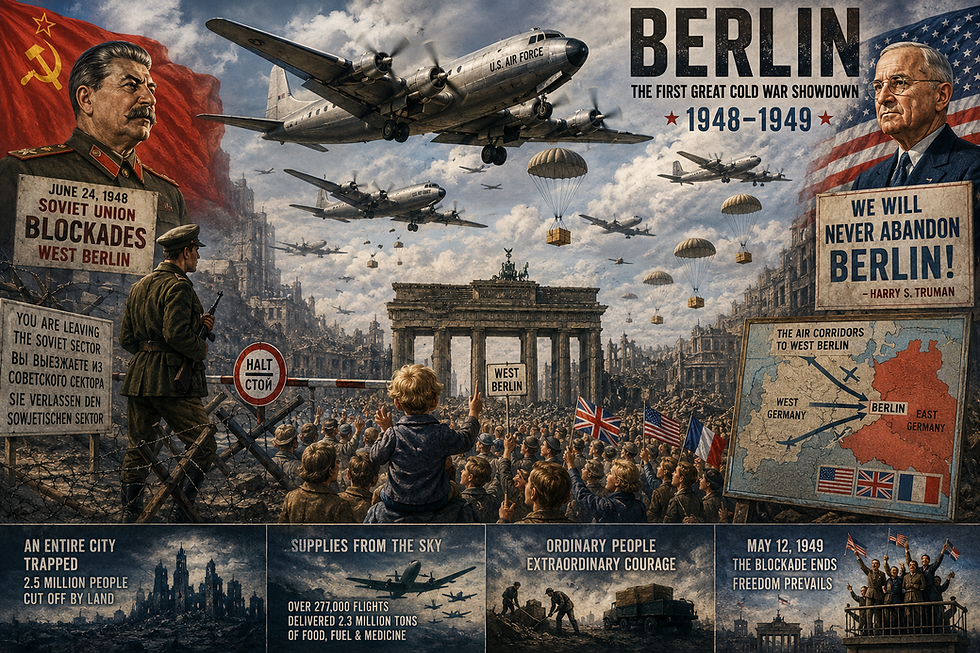
On June 24, 1948, one day after the Soviet currency reform in the East, Soviet authorities cut off virtually all surface transportation between the western occupation zones and West Berlin. Rail traffic stopped, roads and waterways were restricted, and electricity supplied from the Soviet sector was also curtailed. More than two million people in the Western sectors suddenly faced the possibility of severe shortages of food, coal, medicine, and other necessities. Soviet leaders hoped that pressure on West Berlin would force the Western powers to reconsider their policies concerning Germany and Berlin.
A Crisis Over Money Becomes a Test of Power
The currency dispute had ignited something much larger than an economic disagreement. Neither side wanted another world war, yet neither wanted to appear weak. President Harry Truman and other Western leaders rejected the idea of abandoning West Berlin, but forcing armed convoys through Soviet-controlled territory could have triggered military confrontation. Instead, the Western Allies turned toward an extraordinary alternative: supplying the city through the air. Within days, transport aircraft began arriving with desperately needed supplies. What had started with a dispute over German currency was about to become the Berlin Airlift—and one of the greatest tests of determination in the early Cold War.
Stalin Closes the Roads: The Berlin Blockade Begins
On June 24, 1948, the Cold War suddenly became frighteningly real for the people of Berlin. Soviet authorities halted nearly all surface transportation connecting the American, British, and French sectors of Berlin with western Germany. Railways stopped carrying supplies, roads were closed or restricted, and barge traffic was blocked. West Berlin, an island of Western-controlled territory surrounded by the Soviet occupation zone, was suddenly isolated. Joseph Stalin had created an enormous challenge for the Western Allies: leave Berlin, surrender important political ground, or somehow keep a city of more than two million people supplied without starting a war.
Why Stalin Applied the Pressure
The blockade did not appear without warning. The United States, Britain, and France were moving toward closer economic and political cooperation within their German occupation zones, while the Soviet Union feared the creation of a strong Western-aligned German state. The introduction of a new Western currency in June 1948 brought the dispute to a breaking point. Soviet leaders argued that Western actions violated earlier agreements concerning Germany and Berlin. By cutting transportation links, Stalin could place enormous pressure on the Western powers without ordering Soviet troops to attack them directly.
A City Suddenly Cut Off
West Berlin depended heavily on supplies arriving from outside the city. Food, medicine, gasoline, raw materials, and especially coal had to be brought across Soviet-controlled territory. The blockade therefore threatened nearly every part of daily life. Without coal, factories could not operate normally and homes would struggle to stay warm when winter arrived. Electricity was also restricted, forcing severe conservation. Residents faced uncertainty about whether enough food and fuel could reach them. Berlin had survived bombing, invasion, and the collapse of Nazi Germany only three years earlier; now its people faced another crisis.
The West Faces a Dangerous Choice
President Harry Truman and other Western leaders understood that simply abandoning Berlin could have consequences far beyond Germany. Leaving under Soviet pressure might weaken confidence in American commitments throughout Western Europe. Yet sending armed convoys down the blocked roads could result in Soviet soldiers confronting American or British troops. A single gunshot could potentially turn a political crisis into a military conflict between the world's most powerful nations. Truman made clear that the United States intended to remain in Berlin, but the question was how to do so without beginning another war.
The Open Roads in the Sky
Although Soviet authorities could restrict roads, railways, and waterways, the Western powers possessed access to agreed air corridors connecting western Germany with Berlin. American and British officials began considering whether aircraft could keep the city alive. The challenge was enormous. Transport planes would need to carry not merely emergency medicine or a few bags of food but thousands of tons of supplies day after day. Coal presented an especially difficult problem because it was heavy, dirty, and required in tremendous quantities. What initially seemed like a temporary emergency operation would soon become one of history's greatest logistical achievements.
A Gamble That Could Change Europe
Stalin's blockade was intended to pressure the Western Allies, but it also placed the Soviet Union under the attention of the world. If West Berlin collapsed, Soviet influence could expand across the entire city. If the Western Allies successfully resisted without firing a shot, the blockade could instead strengthen Western unity and determination. Neither side could easily retreat without political consequences. Berlin had become a giant Cold War chessboard, with more than two million civilians caught in the middle.
The First Great Cold War Showdown
The Berlin Blockade transformed the growing rivalry between the Soviet Union and the Western powers into a direct confrontation. Tanks were not charging across borders and armies were not exchanging artillery fire, yet the stakes were enormous. Every day that West Berlin remained supplied became evidence that Soviet pressure might fail. Every day the blockade continued increased the danger that an accident or miscalculation could escalate the crisis. The Western Allies now prepared their answer to Stalin's blockade—not by attacking through the closed roads, but by filling the skies above Germany with transport aircraft. The Berlin Airlift was about to begin.
Operation Vittles: Feeding a City From the Sky
In the summer of 1948, West Berlin faced a problem that seemed almost impossible to solve. Soviet authorities had blocked most road, rail, and canal connections between the Western occupation zones and the city, leaving more than two million West Berliners dependent on supplies that could no longer arrive normally. Instead of abandoning Berlin or attempting to break the blockade by force, the United States and Britain chose an extraordinary solution: they would supply the city by air. The American effort became known as Operation Vittles, while the British called their operation Plainfare. What began as an emergency response would become one of the greatest logistical achievements in aviation history.
The Airlift Takes Flight
The first American flights of the Berlin Airlift began on June 26, 1948, only two days after the blockade began, with British operations starting around the same time. Aircraft flew through established air corridors connecting the Western occupation zones with Berlin. At first, the operation was far from capable of delivering everything the city needed. West Berlin required thousands of tons of food, fuel, medicine, and other supplies every day. American C-47 transports could carry relatively small loads, so larger C-54 Skymasters increasingly became the workhorses of the American operation. Every additional aircraft meant more food and coal reaching the isolated city.
Turning the Sky Into a Conveyor Belt
Under the leadership of Major General William H. Tunner, who took command of the American-British Combined Airlift Task Force in October 1948, the operation became remarkably organized. Aircraft followed carefully controlled schedules, flying at assigned altitudes and intervals through the air corridors. Pilots were instructed to make their approach, land, unload, and depart as efficiently as possible. If weather or another problem prevented a safe landing, an aircraft generally returned to its base rather than circling and disrupting the flow. The sky above Berlin became something like an invisible conveyor belt carrying supplies into the city around the clock.
Coal: The Cargo Berlin Could Not Live Without
Food was essential, but coal became one of the airlift's most important and difficult cargos. Berlin needed fuel to generate electricity, heat buildings, and keep parts of its economy functioning. Coal was heavy, dusty, and difficult to transport aboard aircraft, but enormous quantities were flown into the city. Ground crews developed increasingly efficient methods for unloading planes quickly. Bags sometimes tore and coal dust worked its way into aircraft, equipment, and clothing. Yet flight after flight continued arriving because the approaching German winter made maintaining supplies of fuel a matter of survival.
Berlin Builds an Airport at Incredible Speed
As the number of flights increased, Berlin needed more landing capacity. Tempelhof Airport served the American sector, while Gatow served the British sector, but another airfield could greatly expand operations. French authorities and German workers therefore helped construct Tegel Airport in the French sector. Thousands of Berliners participated in the project, much of it completed with limited equipment in only about three months. Tegel gave the airlift another major destination and demonstrated that Berliners were not simply waiting to be rescued—they were actively helping keep their city connected to the West.
The Airlift Breaks Records
By 1949, the airlift had grown into a massive operation. On April 16, during the famous "Easter Parade" demonstration of the system's capacity, Allied aircraft delivered nearly 13,000 tons of supplies to Berlin in a single 24-hour period. At peak periods, aircraft were arriving in Berlin at intervals of roughly a minute or less. Pilots flew in darkness, rain, fog, snow, and freezing conditions. Accidents occurred, and lives were lost, reminding everyone that the airlift was not without danger. Yet the supply system kept becoming more efficient rather than collapsing under the enormous workload.
More Than Two Million Tons From the Sky
The Soviet blockade was lifted on May 12, 1949, but the Western Allies continued the airlift until September to build reserves and demonstrate that Berlin could be supplied if another blockade occurred. During the operation, American and British aircraft made hundreds of thousands of flights and delivered more than two million tons of supplies, with coal making up a large share of the cargo. The Berlin Airlift proved that the Western powers could resist Soviet pressure without forcing their way through the blockade with soldiers and tanks. Operation Vittles had accomplished something that once appeared impossible: an isolated city had been sustained from the sky, and airplanes carrying flour, coal, medicine, and food had become powerful weapons of Cold War determination.
The People Who Made the Airlift Work: Pilots, Ground Crews, and Berliners
The Berlin Airlift is often remembered through photographs of transport aircraft filling the skies, but airplanes alone could not save West Berlin. Behind every flight stood pilots, navigators, mechanics, radio operators, air-traffic controllers, loaders, engineers, cooks, weather specialists, and thousands of German civilians. Together they created an enormous human machine that operated day and night. The airlift succeeded not because of one famous leader or one brilliant decision, but because tens of thousands of people performed thousands of difficult jobs over and over again.
Pilots Flying the Berlin Corridors
Flying into Berlin demanded concentration and discipline. American, British, and other Allied aircrews traveled through narrow, agreed-upon air corridors surrounded by Soviet-controlled territory. They flew during rain, fog, snow, darkness, and icy winter conditions while maintaining tightly organized schedules. Many crews made repeated trips between western Germany and Berlin, sometimes spending long hours flying the same routes. The goal was not dramatic aerial combat. It was something equally demanding: arriving safely, unloading quickly, taking off, and doing it again without interrupting the constant stream of aircraft behind them.
The Ground Crews Who Kept the Planes Moving
Once an aircraft landed, another race began. Ground crews had to unload sacks of flour, crates of food, medicine, and tons of coal as rapidly as possible. Mechanics inspected and repaired aircraft because a mechanical failure could remove desperately needed carrying capacity from the operation. Refueling crews prepared planes for their next missions, while radio operators and air-traffic controllers coordinated the constant movement overhead. The success of the airlift depended on reducing wasted minutes. A delay affecting one aircraft could disrupt others following closely behind it.
Berliners Join the Fight for Their City
The people of West Berlin were not simply passive recipients of Allied aid. German workers unloaded aircraft, repaired facilities, handled supplies, and helped construct Tegel Airport in the French sector. Thousands worked on the airfield project, which was completed with remarkable speed in 1948. Berliners also endured electricity restrictions, limited heating, food shortages, and the uncertainty of not knowing how long the blockade would continue. Their willingness to remain in the city and support the airlift strengthened the Western determination not to withdraw.
The Candy Bomber
One pilot became especially famous for a small act that carried enormous symbolic power. American pilot Gail Halvorsen met German children near Tempelhof Airport and was struck by their behavior and circumstances. He began dropping small bundles of candy attached to homemade parachutes as he approached Berlin, wiggling his aircraft's wings so children could recognize his plane. Other Americans joined the effort, which became known as Operation Little Vittles. Halvorsen became known as the "Candy Bomber," and the candy drops helped show Berlin's children a friendlier side of Americans they had known only a few years earlier as wartime enemies.
Former Enemies Become Partners
One of the most remarkable parts of the airlift was how quickly relationships had changed. Only three years earlier, American and British aircraft had bombed German cities during a terrible war. Now Western pilots were risking their lives to bring food and fuel to German civilians, while Germans worked beside Allied personnel to keep the operation running. The airlift did not erase the horrors or responsibility of World War II, but it demonstrated how rapidly international relationships could change when circumstances and common interests changed.
The Human Cost of Keeping Berlin Alive
The airlift was dangerous, and accidents claimed lives. Aircraft crashed because of weather, mechanical problems, and other hazards, killing American, British, and German participants during the operation. Their deaths remind us that the Berlin Airlift was more than an impressive collection of statistics about airplanes and tons of cargo. Real people accepted real risks to keep the city supplied. By the time the airlift ended in September 1949, its success belonged not only to governments and generals but to the thousands of people who loaded one more sack, repaired one more engine, guided one more aircraft through the darkness, and helped keep Berlin alive one flight at a time.
A Dangerous Game of Brinkmanship: Why Berlin Did Not Become World War III
In 1948, only three years after the most destructive war in history had ended, the United States and Soviet Union confronted each other over Berlin. Soviet authorities had blocked most surface routes into West Berlin, while President Harry Truman refused to abandon the city. American, British, French, and Soviet troops occupied different parts of Germany, and a violent confrontation could have escalated quickly. Yet neither side fired the shot that began another major war. Instead, Berlin became an early example of a dangerous Cold War strategy: pushing an opponent toward the edge of conflict while carefully trying not to cross it.
Truman Refuses to Leave Berlin
When the blockade began, one possible Western response was withdrawal. Truman rejected that option and declared that the United States intended to remain in Berlin. Leaving under Soviet pressure could weaken Western influence in Germany and make other European governments question whether the United States would defend its commitments. Yet Truman also faced a frightening problem. West Berlin was surrounded by Soviet-controlled territory, where the Soviet Union possessed enormous military strength. Remaining in Berlin was one thing; keeping the city supplied without provoking a battle was another.
Why Not Send an Armed Convoy?
Some American officials considered sending armed convoys along the highways into Berlin. Such a convoy might demonstrate Western determination, but it carried tremendous risks. What would happen if Soviet troops blocked the road? American commanders might have to stop and retreat or attempt to force their way through. If soldiers exchanged gunfire, leaders in Washington and Moscow would suddenly face decisions about retaliation and escalation. Instead of challenging Soviet forces directly on the ground, Western leaders chose the airlift, using established air corridors to supply Berlin without deliberately forcing a military confrontation.
Stalin Pushes Without Attacking
Joseph Stalin was also taking a calculated risk. The blockade placed enormous pressure on West Berlin, but Soviet forces generally did not attempt to shoot down the American and British transport aircraft supplying the city. Soviet aircraft sometimes flew close to Western planes, and other forms of harassment and interference occurred, adding tension to the operation. But destroying an American or British transport could have transformed the crisis. Stalin could pressure the West by controlling access through Soviet territory, yet directly attacking Western aircraft risked provoking the very war he was trying to avoid.
The Shadow of the Atomic Bomb
The crisis unfolded at a time when the United States still possessed an atomic monopoly; the Soviet Union would not successfully test its first atomic bomb until August 1949. During the Berlin crisis, the United States sent B-29 bombers to Britain, a move that demonstrated American military power, although those particular aircraft were not equipped to carry atomic bombs. The existence of American atomic weapons nevertheless added another frightening dimension to any possible superpower war. Political leaders understood that another major conflict could eventually become unlike anything the world had experienced before.
Signals, Restraint, and Careful Decisions
Berlin demonstrated that Cold War confrontations were not simply contests of military strength. They were also contests of communication and interpretation. Each side watched the other's actions and tried to determine how far its opponent was willing to go. The Western Allies demonstrated determination by maintaining the airlift, but they avoided deliberately attacking Soviet forces. The Soviet Union maintained the blockade, but it stopped short of opening fire on the airlift. This combination of pressure and restraint helped prevent a political crisis from becoming a shooting war.
Winning Without Firing the First Shot
By the spring of 1949, it was clear that the airlift was successfully sustaining West Berlin. The blockade had failed to force the Western Allies from the city, and on May 12, 1949, the Soviet Union lifted it. The crisis demonstrated one of the central realities of the coming Cold War: the United States and Soviet Union could become bitter enemies without fighting each other directly. Berlin showed how easily miscalculation might have produced disaster, but it also demonstrated that determined leaders could resist pressure while leaving their opponents a way to retreat. The first great Cold War showdown had reached the brink—but neither side took the final step into war.
The Blockade Ends: Berlin Becomes a Symbol of the Cold War
On May 12, 1949, trains and trucks once again began moving toward West Berlin after nearly eleven months of Soviet restrictions on surface access. Joseph Stalin's attempt to pressure the Western Allies had failed to force them from the city. Instead, American and British aircraft had kept more than two million West Berliners supplied through one of history's most remarkable air operations. The roads had reopened, but Berlin would never again be simply Germany's former capital. It had become one of the most important symbols of the Cold War.
Why Stalin Ended the Blockade
By the spring of 1949, the Berlin Airlift had demonstrated that the Western Allies could continue supplying West Berlin despite the blockade. Aircraft were delivering thousands of tons of food, coal, medicine, and other supplies each day, and the operation was becoming more efficient rather than collapsing. Meanwhile, negotiations continued between the Soviet Union and the Western powers. With the blockade failing to achieve its central purpose of forcing major Western concessions or withdrawal from Berlin, an agreement was reached to restore surface access. The Soviet Union lifted the blockade at 12:01 a.m. on May 12.
The Airlift Does Not Stop
The reopening of roads and railways did not cause the airlift to disappear immediately. Western leaders worried that the blockade could return, so aircraft continued delivering supplies while reserves were built inside West Berlin. The airlift finally ended on September 30, 1949. During the entire operation, American and British aircraft and their partners had made more than 270,000 flights and delivered over two million tons of supplies. What had originally seemed like a desperate emergency measure had proven that a modern city could be sustained largely through an enormous, carefully organized aerial supply system.
Germany Becomes Two Countries
Even as the blockade ended, Germany's political division was becoming permanent. On May 23, 1949, the western occupation zones became the Federal Republic of Germany, commonly called West Germany. On October 7, the Soviet occupation zone became the German Democratic Republic, commonly called East Germany. Berlin remained divided as well, although its legal and political status was more complicated than that of the two German states. The temporary occupation arrangements created after World War II had hardened into a geographic and political division that would last for decades.
A Victory of Determination and Perception
The end of the blockade was widely viewed in the West as a major political success. The United States, Britain, and France had remained in Berlin without attempting to shoot their way through Soviet-controlled territory. For many West Berliners, the airlift strengthened their connection to the Western powers. The Soviet Union had demonstrated that it could place tremendous pressure on the isolated city, but it had also failed to drive the Western Allies out. Berlin now represented something larger than itself: whether the Western powers could resist Soviet pressure in the heart of Europe.
Berlin Becomes the Front Line
The blockade ended, but the struggle over Berlin did not. West Berlin remained surrounded by East German territory and would continue to be a vulnerable Western outpost throughout the Cold War. Future disputes over access and migration would produce new crises, eventually contributing to the construction of the Berlin Wall in 1961. For Americans, Soviets, Germans, and Europeans, Berlin became a place where the differences between communist Eastern Europe and the democratic West could be seen with unusual clarity.
The City That Defined a Global Struggle
The Berlin Blockade established a pattern that would appear repeatedly during the Cold War. The United States and Soviet Union would compete aggressively, threaten one another, support opposing governments, and test each other's determination while usually avoiding direct warfare between their own forces. Berlin showed both the danger and the strange restraint of this new conflict. A disagreement over occupation policies and currency had grown into an international showdown involving millions of civilians and thousands of aircraft, yet it ended without a battle between American and Soviet armies. Berlin had survived its first great Cold War crisis, but for the next four decades, the divided city would remain one of the world's clearest reminders that the Cold War was never far from becoming hot.
Around the World During Berlin: The First Great Cold War Showdown
February 1948 — Communists Take Control in Czechoslovakia
Only months before the Berlin Blockade began, Czechoslovakia experienced a political crisis that ended with the Communist Party gaining control of the government in February 1948. President Edvard Beneš accepted a new government dominated by Communists after non-Communist ministers resigned and Communist leaders mobilized their supporters. The takeover shocked many people in Western Europe and the United States because Czechoslovakia had possessed a strong democratic tradition before World War II. It increased Western fears that Soviet influence was continuing to expand westward across Europe.
The Czechoslovak crisis directly affected how Western leaders viewed Berlin. When Soviet pressure increased against West Berlin only months later, American and British officials had additional reason to fear that retreating could encourage further Soviet advances. Berlin therefore became more than a dispute over one city; it became a test of whether the Western powers would resist additional communist expansion in Europe.
April 1948 — The Marshall Plan Begins
On April 3, 1948, President Harry Truman signed the legislation establishing the European Recovery Program, better known as the Marshall Plan. The United States would provide billions of dollars in economic assistance to help European countries rebuild factories, transportation networks, trade, agriculture, and other parts of their devastated economies. American leaders believed that economic recovery would strengthen democratic governments and reduce the appeal of communist movements in struggling European societies.
The Marshall Plan contributed to the growing dispute over Germany. Western leaders increasingly regarded the economic reconstruction of western Germany as essential to the recovery of Europe, while Soviet leaders viewed the American program as an attempt to expand Western economic and political influence. The Berlin confrontation therefore developed alongside a much larger struggle over whether postwar Europe would become economically connected to the United States or politically and economically tied to the Soviet Union.
May 1948 — Israel Is Created and the First Arab-Israeli War Begins
On May 14, 1948, the State of Israel declared independence as the British Mandate for Palestine ended. Neighboring Arab states intervened militarily, beginning the first Arab-Israeli war. The conflict drew international attention and required both Washington and Moscow to consider their policies toward the rapidly changing Middle East. The United States recognized Israel shortly after its declaration, while the Soviet Union also supported recognition of the new state.
The conflict had little direct role in causing the Berlin Blockade, but it demonstrates how many international challenges American and Soviet leaders faced simultaneously. Washington could not concentrate exclusively on Germany. The emerging Cold War was becoming global at the same moment that decolonization and regional conflicts were reshaping areas far beyond Europe.
June 1948 — Yugoslavia Breaks With Stalin
Only days after the Berlin Blockade began, another dramatic event shook the communist world. On June 28, 1948, the Communist Information Bureau publicly expelled Yugoslavia after a growing dispute between Soviet leader Joseph Stalin and Yugoslav leader Josip Broz Tito. Tito was a communist, but he refused to accept the degree of Soviet control Stalin expected. Yugoslavia remained communist while pursuing a course increasingly independent of Moscow.
The Tito-Stalin split revealed something important about the developing Cold War: the communist world was not completely united. Stalin had to worry about maintaining Soviet influence within Eastern Europe at the same time he was challenging the Western powers over Berlin. For Western observers, Yugoslavia demonstrated that disagreements within the communist bloc could potentially limit Soviet power.
1948–1949 — The Greek Civil War Continues
While Berlin was being supplied from the air, Greece remained caught in a civil war between the internationally recognized Greek government and communist-led insurgents. Britain had previously supported Greece but could no longer bear the financial burden alone, helping lead Truman to announce the Truman Doctrine in 1947. By 1948 and 1949, American financial and military assistance was helping the Greek government gain the advantage.
The Greek Civil War strengthened the belief among many American policymakers that communist expansion had to be resisted in several places at once. Berlin seemed to reinforce that lesson. Whether Soviet pressure came through political influence, insurgency, economic coercion, or blockade, Western leaders increasingly interpreted these struggles as connected parts of a broader confrontation.
1948–1949 — The Chinese Civil War Approaches Its Conclusion
Across Asia, an even larger conflict was approaching a dramatic conclusion. Mao Zedong's Communist forces won a series of decisive victories against Chiang Kai-shek's Nationalist government during 1948 and 1949. Major cities and territories fell under Communist control, and on October 1, 1949, shortly after the Berlin Airlift ended, Mao proclaimed the People's Republic of China. Chiang and the Nationalist government withdrew to Taiwan.
China's transformation did not cause the Berlin crisis, but it dramatically changed the international environment surrounding it. American leaders were discovering that the Cold War would not remain primarily a European struggle. The emergence of a communist government ruling the world's most populous country intensified American concerns about communism and helped shift Cold War attention toward Asia, where the Korean War would begin the following year.
April 1949 — NATO Is Created
While the Berlin Blockade was still underway, the United States, Canada, and ten Western European nations signed the North Atlantic Treaty on April 4, 1949. The treaty created a collective security alliance in which members agreed that an armed attack against one or more of them in Europe or North America would be considered an attack against them all. For the United States, joining NATO represented a historic commitment to the continuing defense of Western Europe.
The Berlin crisis was not the sole reason NATO was created, but Soviet actions in Eastern Europe and the blockade strengthened Western fears and helped demonstrate why collective defense seemed necessary. Rather than dividing the Western powers, pressure on Berlin contributed to a climate that encouraged them to cooperate more closely. Stalin's attempt to challenge the Western position was occurring just as a stronger Western alliance was taking shape.
August 1949 — The Soviet Union Tests an Atomic Bomb
On August 29, 1949, shortly before the Berlin Airlift officially ended, the Soviet Union successfully tested its first atomic bomb. Until then, the United States had been the only nation possessing atomic weapons. The Soviet test ended the American atomic monopoly and opened a frightening new stage of the Cold War.
The test occurred after the blockade had been lifted, so it did not determine Stalin's decision to begin or end the Berlin Blockade. Nevertheless, its timing is historically important. The next major confrontation between the United States and Soviet Union would occur in a world in which both superpowers possessed atomic weapons. Berlin had demonstrated how close the two powers could come to direct confrontation; nuclear weapons would make future confrontations potentially far more dangerous.
The Most Important People of Berlin: The First Great Cold War Showdown
Lucius D. Clay (1898–1978) — American Military Governor in Germany
General Lucius D. Clay was one of the most important American officials in occupied Germany. An engineer and military administrator, Clay became military governor of the American occupation zone and strongly believed the United States could not surrender its position in Berlin. During the blockade, he became a leading advocate for maintaining West Berlin and helped oversee the American response to Soviet pressure. Clay's determination made him a powerful symbol of American resolve during the crisis, and he later became closely associated with the defense of Berlin.
William H. Tunner (1906–1983) — Mastermind of Airlift Operations
Major General William H. Tunner was an American aviation officer with extensive experience organizing large transport operations, including the dangerous "Hump" airlift over the Himalayas during World War II. He was brought into the Berlin operation in July 1948 and later commanded the Combined Airlift Task Force. Tunner transformed the airlift into a highly organized transportation system by emphasizing precise schedules, standardized procedures, rapid unloading, maintenance, and continuous aircraft movement. His logistical expertise helped turn what seemed like a desperate temporary measure into a sustainable operation capable of supplying an entire city.
Ernst Reuter (1889–1953) — The Voice of West Berlin
Ernst Reuter had opposed the Nazis, lived in exile during part of Hitler's rule, and returned to German politics after World War II. During the blockade he emerged as the leading political voice of West Berlin and became governing mayor in December 1948. In September, speaking before an enormous crowd near the Reichstag, Reuter appealed to the people of the world not to abandon Berlin. His speeches and leadership helped strengthen civilian morale and international support. Reuter demonstrated that West Berliners themselves were active participants in resisting Soviet pressure rather than merely people waiting for Western rescue.
Gail Halvorsen (1920–2022) — The "Candy Bomber"
Lieutenant Gail Halvorsen was an American transport pilot whose small personal gesture became one of the most memorable stories of the airlift. After meeting German children near Tempelhof Airport, Halvorsen began dropping candy attached to small homemade parachutes as he approached Berlin. He signaled his arrival by wiggling his aircraft's wings, earning him nicknames including the "Candy Bomber." The idea expanded into Operation Little Vittles, with support from other Americans. Halvorsen was important not because candy affected the strategic outcome of the blockade, but because his actions humanized the airlift and helped transform relationships between Americans and German civilians only a few years after they had been wartime enemies.
Sir Brian Robertson (1896–1974) — Britain's Commander in Germany
General Sir Brian Robertson served as Britain's military governor in Germany during the Berlin crisis and was an important participant in Allied decision-making. Britain controlled one of Berlin's Western sectors and contributed enormously to the airlift through Operation Plainfare. British aircraft carried food, coal, fuel, and other essential supplies, while British officials worked with their American and French counterparts to coordinate policy. Robertson represents an important reminder that the Berlin Airlift was not an American operation alone; British participation was essential to keeping the city supplied.
Louise Schroeder (1887–1957) — Berlin's Leading Female Political Figure
Louise Schroeder was a German Social Democratic politician who had served in the Reichstag during the Weimar Republic and opposed the political direction of Nazi Germany. After World War II, she became one of Berlin's most prominent political leaders. She served as acting mayor of Greater Berlin from 1947 into 1948 and continued holding important municipal responsibilities during the blockade period. At a time when senior political leadership was overwhelmingly male, Schroeder demonstrated the significant role women played in rebuilding German democratic institutions. Her career also connected postwar Berlin with Germany's earlier democratic traditions.
Elly Heuss-Knapp (1881–1952) — Rebuilding German Civic Life
Elly Heuss-Knapp was an educator, writer, broadcaster, social activist, and wife of Theodor Heuss, who became the first president of West Germany in 1949. She had been involved in social and political causes long before the Berlin crisis and became associated with rebuilding German civic life after the destruction of Nazism and World War II. Although she did not direct the Berlin Airlift, figures such as Heuss-Knapp are important for understanding the broader reconstruction occurring around the crisis. In 1950 she founded the Müttergenesungswerk, an organization devoted to supporting mothers' health and recovery. Her work illustrates the social rebuilding that accompanied Germany's political reconstruction.
Life Lessons from Berlin: The First Great Cold War Showdown (1948–1949)
When the Obvious Choices Are Bad, Find Another Choice
When Soviet authorities blocked most surface access to West Berlin, Western leaders appeared to have two obvious options: abandon the city or attempt to force their way through the blockade. Retreat could weaken Western credibility, while an armed convoy could trigger fighting with Soviet forces. The airlift offered another possibility. Instead of accepting the choices placed before them, Western planners changed the problem by supplying Berlin through the air. This teaches students an important problem-solving habit: when every available choice seems unacceptable, ask whether there is another approach that has not yet been considered.
Strength Does Not Always Require Violence
The Western Allies wanted to demonstrate that they would not be forced from Berlin, but firing on Soviet troops could have produced a much larger war. The airlift allowed them to resist while avoiding a direct military attack. Aircraft carrying flour, coal, medicine, and fuel became instruments of political determination. Students can learn that strength and aggression are not the same thing. In disagreements between nations, communities, or individuals, the strongest response may sometimes be the one that protects an important principle while preventing unnecessary escalation.
Think About What Happens After Your Decision
One of the most useful ways to study the Berlin crisis is to ask, "And then what?" Suppose American troops had attempted to force a convoy through Soviet checkpoints. What if Soviet soldiers refused passage? What if someone fired? What would Washington do next? What would Moscow do? Leaders had to consider not simply the immediate consequences of their decisions but the second, third, and fourth consequences that might follow. This type of thinking is valuable in everyday life because good decisions require considering where a choice may lead rather than focusing only on what happens first.
Understand What Your Opponent Wants
The Berlin crisis also teaches the importance of viewing a problem from more than one perspective. Western leaders needed to understand why Stalin was applying pressure, while Soviet leaders had to determine how strongly the Western powers were committed to Berlin. Understanding an opponent does not require agreeing with that person. It means asking what they want, what they fear, what pressures influence them, and what they might do next. This kind of perspective-taking is essential to diplomacy, negotiation, business, leadership, and resolving everyday disagreements.
Big Problems Can Be Solved Through Small Improvements
The Berlin Airlift did not become successful because someone discovered one miraculous solution. It improved through thousands of smaller decisions. Aircraft schedules became more efficient. Unloading times were reduced. Maintenance procedures improved. Larger aircraft carried greater loads. Additional airport capacity was created. Each improvement increased the amount of material reaching Berlin. Students can apply the same principle to difficult assignments, businesses, athletic goals, or personal challenges. An enormous problem often becomes manageable when it is divided into smaller problems that can be improved one at a time.
Vocabulary to Learn While Studying Berlin: The First Great Cold War Showdown
1. Blockade
Definition: An action taken to prevent people, supplies, or goods from entering or leaving a particular place.Sample Sentence: The Soviet Union used the Berlin Blockade to restrict surface access to West Berlin.
2. Airlift
Definition: The transportation of people or supplies by aircraft, especially when normal transportation routes are unavailable.Sample Sentence: The Western Allies organized the Berlin Airlift to deliver food, coal, medicine, and other supplies to West Berlin.
3. Occupation Zone
Definition: An area of a defeated country temporarily controlled and administered by a foreign military power.Sample Sentence: After World War II, Germany was divided into American, British, French, and Soviet occupation zones.
4. Sector
Definition: A specific section of a city or territory placed under the control of a particular authority.Sample Sentence: Berlin was divided into four sectors controlled by the United States, Britain, France, and the Soviet Union.
5. Communism
Definition: A political and economic ideology that seeks collective or state control of major economic resources and was implemented in the Soviet Union through a one-party communist government.Sample Sentence: The Soviet Union supported communist governments throughout much of Eastern Europe.
6. Capitalism
Definition: An economic system in which most businesses and property are privately owned and goods and services are exchanged through markets.Sample Sentence: West Germany developed a market-oriented economy during the Cold War.
7. Currency Reform
Definition: A major change to a country's monetary system, often involving the introduction or replacement of currency.Sample Sentence: Western currency reform in Germany became one of the immediate causes of the Berlin crisis.
8. Deutsche Mark
Definition: The currency introduced into the western occupation zones of Germany in June 1948 and later used by West Germany.Sample Sentence: The introduction of the Deutsche Mark helped stabilize the economy in western Germany.
9. Brinkmanship
Definition: The strategy of pushing a dangerous confrontation close to conflict in an effort to make an opponent give way.Sample Sentence: The Berlin crisis involved brinkmanship because both sides applied pressure while trying to avoid direct war.
10. Air Corridor
Definition: A designated route through the sky that aircraft are authorized to use.Sample Sentence: Allied transport aircraft used established air corridors to reach West Berlin.
11. Rationing
Definition: Controlling the amount of scarce goods that each person is allowed to receive.Sample Sentence: Rationing helped Berliners manage limited supplies during the blockade.
12. Logistics
Definition: The detailed planning and organization required to move people, equipment, and supplies efficiently.Sample Sentence: Careful logistics allowed thousands of tons of supplies to reach Berlin by aircraft.
13. Containment
Definition: The American Cold War policy of attempting to prevent communism and Soviet influence from expanding into additional countries or territories.Sample Sentence: American determination to remain in Berlin fit the broader policy of containment.
14. Federal Republic of Germany
Definition: The official name of West Germany, established in the western occupation zones in May 1949.Sample Sentence: The Federal Republic of Germany was established as the division between eastern and western Germany became more permanent.
15. German Democratic Republic
Definition: The official name of East Germany, the Soviet-aligned communist state established in October 1949.Sample Sentence: The German Democratic Republic was created in the Soviet occupation zone several months after West Germany was established.
16. Superpower
Definition: A nation possessing enough military, economic, and political strength to influence events around the world.Sample Sentence: The United States and Soviet Union emerged as the two dominant superpowers of the early Cold War.
17. Diplomacy
Definition: The process by which governments communicate, negotiate, and attempt to resolve disagreements without warfare.Sample Sentence: Diplomacy helped the United States and Soviet Union navigate the Berlin crisis without beginning a direct war.
18. Escalation
Definition: The process by which a disagreement or conflict becomes increasingly serious or dangerous.Sample Sentence: Western leaders worried that an armed attempt to break the blockade could cause a dangerous escalation.
Activities to Try While Studying Berlin: The First Great Cold War Showdown
Save Berlin — Design Your Own Airlift
Title: Save Berlin — Design Your Own Airlift
Recommended Age: 10–18
Activity Description: Students become Allied logistics planners responsible for keeping West Berlin supplied after Soviet authorities block most surface transportation. They must determine how to transport enough food, coal, medicine, and other necessities into the city using a limited number of aircraft.
Objective: Understand why the Berlin Airlift was an extraordinary logistical challenge and how organization helped make it successful.
Materials: Paper, pencils, calculator, map of divided Germany and Berlin, index cards, and teacher-created aircraft and supply cards.
Instructions: Give students several aircraft cards showing different fictional carrying capacities, such as 3, 5, and 10 tons. Next, provide supply cards representing food, coal, medicine, and other necessities. Give students a required daily supply goal and ask them to develop a flight schedule capable of reaching it. Add challenges such as bad weather, mechanical problems, runway closures, or increased winter coal requirements. Afterward, compare their solutions with the actual Berlin Airlift and discuss how Allied planners improved efficiency.
Learning Outcome: Students will understand that the airlift succeeded through mathematics, planning, organization, teamwork, and repeated improvements rather than simply through having large numbers of airplanes.
Build a Candy Parachute: How Would You Deliver Joy
Title: The Candy Bomber Parachute Challenge
Recommended Age: 7–14
Activity Description: Students learn about American pilot Gail Halvorsen and his famous candy drops by designing miniature parachutes capable of safely carrying a small piece of candy or another lightweight object.
Objective: Connect the human story of the Berlin Airlift with basic principles of engineering, gravity, air resistance, and experimentation.
Materials: Tissue paper, lightweight plastic or paper, string, tape, scissors, small candy pieces or similarly weighted objects, ruler, and stopwatch.
Instructions: Tell students the story of Halvorsen meeting Berlin children and beginning his candy drops. Students then construct a parachute using their chosen materials. Drop each parachute from the same safe height and time its descent. Allow students to modify the parachute's size, shape, string length, or cargo placement before testing again. Discuss why Halvorsen's small act became such a memorable symbol of the airlift.
Learning Outcome: Students will connect an important human-interest story from the Berlin Airlift with experimentation and engineering while recognizing how small acts of kindness can influence relationships between people.
The Berlin Crisis Decision Room
Title: What Would You Do About Berlin?
Recommended Age: 12–18
Activity Description: Students enter a simulated 1948 emergency meeting in which they must decide how the Western Allies should respond to the Soviet blockade.
Objective: Develop critical thinking by requiring students to evaluate historical options without knowing the outcome in advance.
Materials: Berlin map, paper, pencils, role cards, and decision cards.
Instructions: Assign students roles such as President Harry Truman, General Lucius Clay, a military adviser, diplomat, airlift planner, West Berlin leader, or British representative. Present the crisis: surface access to West Berlin has been blocked. Give students four possible responses—withdraw from Berlin, negotiate immediately, send armed ground convoys, or attempt an airlift. Students must identify the advantages, disadvantages, and possible Soviet reaction to each choice before selecting their strategy. Only after the decision should the teacher explain what actually happened.
Learning Outcome: Students will understand the difficult choices facing Western leaders and learn to evaluate risk, consequences, and alternative solutions before making decisions.
Divide Berlin on the Map
Title: Trapped Inside the Soviet Zone
Recommended Age: 9–16
Activity Description: Students create a map showing postwar Germany's four occupation zones and Berlin's American, British, French, and Soviet sectors.
Objective: Help students understand the geography that made the Berlin crisis possible.
Materials: Blank maps of Germany and Berlin, colored pencils, ruler, atlas or reference map, and labels.
Instructions: Students identify the American, British, French, and Soviet occupation zones in Germany. Next, locate Berlin and emphasize that the entire city lay deep inside the Soviet occupation zone. On a separate Berlin map, mark the city's four occupation sectors. Students then draw the transportation routes connecting West Berlin with western Germany and the air corridors used during the airlift. Ask students why West Berlin's location gave the Soviet Union such leverage.
Learning Outcome: Students will be able to explain why geography was one of the most important factors behind the Berlin Blockade and why supplying West Berlin was so difficult.


Comments