

4. Heroes and Villains of the Cold War: Berlin: The First Great Cold War Showdown (1948–1949)


My Name is Lucius D. Clay: The General Who Would Not Abandon Berlin
I was born in Marietta, Georgia, in 1898, the son of a United States senator. I entered West Point and graduated in 1918, but my career would not be defined by battlefield glory. I became an engineer, and I learned early that wars and nations are won not only with rifles, but with roads, supplies, factories, transportation, and organization. An officer must understand how things work, how people work together, and how to solve a problem when failure is unacceptable.
Preparing America for War
During World War II, I was given enormous responsibilities involving military production and supply. Armies cannot fight without weapons, fuel, transportation, and functioning industries behind them. I worked to overcome production shortages and later served under General Dwight D. Eisenhower in Europe. By the time Germany surrendered in 1945, Europe was devastated. Cities were shattered, transportation systems were broken, millions of people were displaced, and Germany itself had ceased to function as a normal nation.
Governing a Defeated Germany
In 1947, I became the American military governor in Germany. This was no ordinary military command. We had defeated Nazi Germany, but now we had to determine what would replace it. I believed Germany needed to become peaceful, economically stable, and eventually democratic. Starving people surrounded by ruins would not easily build a free society. At the same time, relations with our former Soviet allies were deteriorating rapidly. Germany was becoming the dividing line between two competing visions of Europe's future.
Berlin Becomes the Test
Berlin presented our greatest problem. The city was divided among the Americans, British, French, and Soviets, but it sat deep within the Soviet occupation zone. In June 1948, Soviet authorities blocked the major land routes leading into the Western sectors of Berlin. More than two million people depended upon us. Some believed remaining in Berlin was too dangerous. I disagreed. If pressure alone could force us from Berlin, where would that pressure stop? I believed we had a responsibility to remain.
An Army Through the Sky
Directly forcing our way through Soviet lines could have started another war, so we turned to the air. American and British aircraft began flying food, medicine, coal, and other supplies into Berlin. At first, many doubted whether an entire city could be sustained this way. Yet aircraft kept arriving. Pilots flew through fog, storms, ice, and exhaustion. Ground crews unloaded planes and sent them back into the sky. Under men such as General William Tunner, the operation became an extraordinary system of precision and determination.
The People of Berlin Stand Firm
The Berliners themselves were essential to our success. They endured shortages, cold apartments, limited electricity, and constant uncertainty. Yet they did not surrender. Mayor Ernst Reuter became a powerful voice for their determination. I had entered Germany as an officer representing a victorious occupying power, but during those difficult months I watched Germans who had recently been our enemies stand beside Americans and British citizens against political coercion. The relationship between us was changing before our eyes.
The Blockade Is Broken
On May 12, 1949, the Soviet blockade was lifted. We had remained in Berlin without firing our way through Soviet forces and without abandoning the people who depended upon us. The airlift continued for several months afterward to build supplies and ensure the routes would remain open. The crisis had shown something important about this new Cold War: strength did not always mean attacking. Sometimes strength meant refusing to move.
Four Powers, One Germany: Occupation Begins to Break - Told by Lucius D. Clay
When Germany surrendered in May 1945, Americans could be forgiven for believing the greatest danger had passed. Hitler was dead, Nazi Germany had collapsed, and American, British, French, and Soviet soldiers occupied the defeated country. But I soon discovered that winning the war had been easier than agreeing on the peace. Germany lay devastated before us, and the four victorious powers had very different ideas about what should happen next.
One Country Divided Among Four Powers
Germany was divided into four occupation zones controlled by the United States, Britain, France, and the Soviet Union. Berlin presented an even stranger arrangement. Although the capital stood roughly 100 miles inside the Soviet occupation zone, it too was divided into American, British, French, and Soviet sectors. The Western Allies therefore maintained positions inside a city surrounded by Soviet-controlled territory. At first, this arrangement was supposed to be temporary. Germany was still officially treated as a single economic unit, and the Allied Control Council was intended to allow the four powers to govern major questions together. On paper, cooperation remained alive. In practice, it was becoming increasingly difficult.
What Should Be Done With Germany?
We agreed that German militarism and Nazism had to be destroyed, but agreement weakened when we discussed Germany's economic and political future. The Soviet Union had suffered catastrophic destruction during the war and demanded reparations and security against another German invasion. The Western powers also wanted Germany prevented from threatening Europe again, but we increasingly worried that economic collapse would create hunger, political instability, and dependence upon outside aid. From my perspective, Germany could not become peaceful simply by remaining poor. A functioning economy was becoming part of European security.
Different Germanys Begin to Appear
The occupation zones gradually developed differently. In the Soviet zone, Soviet authorities carried out land reform, transferred or seized industries, and supported the growing power of German communists. In 1946, the Communist Party and Social Democratic Party in the Soviet zone were merged under Soviet pressure into the Socialist Unity Party. In the Western zones, political parties and local democratic institutions were also being rebuilt, but along increasingly different lines. We were supposed to be governing one defeated Germany together, yet two political systems were beginning to emerge.
The Argument Over Reparations
Economic disagreements made the situation worse. The Potsdam agreements had established a complicated system under which the Soviet Union could receive some industrial equipment from the Western zones in exchange for goods from the Soviet zone. But Germany's economy was struggling, and cooperation over reparations deteriorated. We increasingly believed that removing too much industrial capacity would make German economic recovery impossible. Soviet leaders believed the West was retreating from commitments made after Germany's defeat. Every disagreement produced another layer of suspicion.
America and Britain Join Their Zones
By 1946, the Americans and British concluded that administering their zones separately made little economic sense. On January 1, 1947, the American and British occupation zones were economically combined into what became known as Bizonia. This was not yet the creation of West Germany, but it was an important step in that direction. From our standpoint, it was a practical attempt to restore production, trade, transportation, and food distribution. From Moscow's standpoint, it could look like the Western powers were beginning to construct a separate German state.
Former Allies Become Competitors
By the end of 1947, the atmosphere had changed dramatically. Meetings among the four powers increasingly ended in disagreement. Arguments over reparations, political parties, economic recovery, and Germany's future were no longer technical disputes between allies. They had become part of a much larger struggle between the Soviet Union and the Western democracies. Each side suspected the other of using Germany to expand its influence in Europe.
Berlin Waits at the Center
The most dangerous part of this arrangement was Berlin. American, British, and French forces remained inside their sectors of the city, surrounded by Soviet-controlled territory and dependent upon transportation routes crossing the Soviet occupation zone. As long as cooperation continued, that arrangement could function. But what would happen if cooperation collapsed completely? By the end of 1947, that was no longer an academic question. Germany was separating politically and economically, and Berlin sat directly on the fault line. Soon, the disagreement over Germany would become a confrontation over whether the Western powers could remain in Berlin at all.

My Name is Vasily Sokolovsky: Soviet Marshal at the Center of the Berlin Crisis
I was born in 1897 near Grodno, then part of the Russian Empire, into a poor peasant family. My early ambition was to become a teacher, but revolution and civil war changed the direction of my life. In 1918, I entered the Red Army. Russia was being torn apart, and the new Soviet state required officers who could organize armies as well as command them. I devoted myself to military service and became particularly interested in planning, strategy, and the movement of large forces.
Learning the Art of Command
During the years between the Russian Civil War and the Second World War, I studied military science and rose through the Red Army. I became known less as a dramatic battlefield personality than as a careful staff officer. Modern warfare demanded preparation. Railroads, reserves, artillery, communications, intelligence, and timing could decide a campaign before soldiers reached the battlefield. I believed military victory depended upon understanding the entire struggle rather than simply winning individual engagements.
The German Invasion
In June 1941, Germany invaded the Soviet Union. The war that followed was unlike anything our country had experienced. Soviet cities were destroyed, villages burned, and millions of our citizens died. I served in senior command and staff positions during some of the most important operations of the war, including the defense and counteroffensive around Moscow. Later I served closely with Marshal Georgy Zhukov and helped plan operations as Soviet armies drove German forces westward.
Victory Over Germany
By 1945, the Red Army had fought its way into Germany. I participated in the final campaigns that destroyed Hitler's regime and brought the European war to an end. To Americans and British citizens, Germany was a defeated enemy across an ocean or channel. To us, Germany was the country whose armies had invaded Soviet territory and caused destruction on an almost unimaginable scale. When Soviet leaders demanded security after the war, those demands were shaped by what we had just endured.
Commanding Soviet Forces in Germany
In 1946, I became commander in chief of Soviet forces in Germany and head of the Soviet Military Administration. Germany had been divided into occupation zones controlled by the Soviet Union, United States, Britain, and France. Berlin was also divided, although it stood inside our occupation zone. Cooperation among the victorious Allies became increasingly difficult. The Western powers began combining their zones and rebuilding their portions of Germany. From our position, these actions appeared to be creating a new Western German state directly on the Soviet Union's frontier.
The Currency Crisis
The confrontation became especially serious in 1948. The Western powers introduced a new currency, the Deutsche Mark, into their occupation zones and then their sectors of Berlin. We opposed this action. Currency was not merely paper; whoever controlled the money possessed enormous influence over the economy and political future of Germany. Soviet authorities introduced their own currency in the eastern zone while restrictions on Western transportation into Berlin increased. The struggle over Germany had now become a struggle over Berlin.
Berlin Under Pressure
In June 1948, road, rail, and water connections between the Western occupation zones and West Berlin were severely restricted and then blocked. The intention was to force the Western governments to reconsider their policies and their position in Berlin. Yet the Americans and British did not withdraw. Instead, aircraft began arriving with supplies. What began as an emergency operation grew into the Berlin Airlift, carrying food, coal, medicine, and other necessities into the Western sectors day after day.
A Confrontation Without Battle
This was a strange kind of military confrontation. Soviet and Western forces stood close to one another, yet neither side wanted another world war. We applied pressure; they answered through the air. Each decision had to be considered carefully because a collision between aircraft, soldiers, or military convoys might have produced consequences far beyond Germany. Eventually negotiations produced a way out. On May 12, 1949, the blockade was lifted, although the political division of Germany continued.
Two Different Visions for Germany Collide (1947–Early 1948) - Told by Sokolovsky
When I looked across Germany in 1947, I did not see an ordinary defeated country. I saw the land from which German armies had marched eastward and brought destruction into the Soviet Union. Only two years had passed since the fighting ended. Millions of Soviet citizens were dead, towns and villages had been destroyed, and memories of occupation remained fresh. When Western governments spoke about rebuilding Germany, therefore, Soviet leaders asked a question that Americans and Britons did not always understand: what would prevent a powerful Germany from threatening us again?
We Had Agreed to Control Germany Together
At the end of the war, Germany had been divided into American, British, French, and Soviet occupation zones, with Berlin divided in the same manner. Yet Germany was not originally intended simply to become four separate countries. The victorious powers had agreed to cooperate in governing the defeated nation through the Allied Control Council. We all supported eliminating Nazism and German military power. The problem was that agreement became much more difficult when we began deciding what political and economic system should replace them.
The West Begins Joining Together
One development particularly concerned Moscow. In January 1947, the American and British occupation zones were economically combined into what became known as Bizonia. Western officials argued that this was necessary to make Germany's economy function more efficiently and reduce the enormous cost of supporting the population. But from our headquarters, the consequences appeared larger. Two occupation zones were beginning to operate as one economic territory. If political institutions followed economic integration, a separate Western German state might eventually emerge.
Recovery or a New German Power?
The Americans increasingly argued that European recovery required German recovery. Their reasoning was understandable: Germany had been one of Europe's great industrial economies, and coal, steel, factories, railroads, and trade crossed national borders. Yet Soviet leaders viewed the same factories through different eyes. German industrial strength had helped create the military machine that invaded our country. We wanted reparations to help rebuild what had been destroyed in the Soviet Union, while Western officials increasingly wanted German industrial production directed toward economic recovery. We were looking at the same machinery and seeing two different futures.
Politics Divide the Occupation Zones
Political developments widened the separation. In the Soviet occupation zone, the Communist Party and Social Democratic Party had been merged in 1946 into the Socialist Unity Party, or SED, under strong Soviet pressure. In the Western zones, political parties and elected institutions developed differently. Neither side believed the other's political direction was neutral. Western leaders feared Soviet expansion and communist domination. Soviet officials believed the Western powers were creating political institutions that would eventually attach western Germany to an anti-Soviet bloc.
The Marshall Plan Raises the Stakes
Then came another development that Moscow considered dangerous. In 1947, the United States proposed the European Recovery Program, better known as the Marshall Plan. Western leaders presented it as a massive program for rebuilding Europe's shattered economies. The Soviet government rejected participation and prevented the Soviet-controlled countries of Eastern Europe from joining. We feared that American economic assistance would also increase American political influence. Western Germany was becoming increasingly tied to the economic recovery of Western Europe, making Germany's division still more difficult to reverse.
The Meetings Lead Nowhere
The foreign ministers of the major powers repeatedly attempted to reach agreement over Germany, but negotiations stalled. One particularly important meeting took place in London during November and December 1947. The United States, Britain, France, and Soviet Union remained divided over reparations, economic organization, political reconstruction, and Germany's eventual government. The conference ended without agreement. Increasingly, the question was no longer how four powers would govern Germany together. It was what each side would do when joint government became impossible.
Germany Approaches the Breaking Point
By early 1948, I could see the confrontation sharpening. The Western powers believed they could not wait indefinitely for four-power agreement while Germany remained economically weak and politically uncertain. Soviet leaders believed Western consolidation threatened to create exactly what we feared: a powerful German state connected economically and politically to the United States, Britain, and France. Neither side intended to surrender its position.
And in the middle of this dispute stood Berlin. Western troops occupied three sectors of a city located entirely within the Soviet occupation zone. As Germany divided, Berlin could not remain untouched. The argument over Germany's future was approaching a point where speeches and conferences would no longer be enough. Soon, trains would stop, roads would close, aircraft would fill the skies—and Berlin would become the place where these two visions finally collided.
London Conferences and Plans for a West Germany - Told by Lucius D. Clay
By early 1948, I had spent years watching the four-power occupation of Germany become increasingly difficult. The United States, Britain, France, and Soviet Union had defeated Hitler together, but we could not agree on the Germany that should replace him. Factories remained disrupted, political authority was fragmented, and millions of Germans were trying to rebuild their lives. From my position as American military governor, I believed we were approaching a decision: either the four powers found a workable agreement, or the Western zones would have to move forward without the Soviets.
The Failure That Brought Us to London
The immediate background was the failure of the Council of Foreign Ministers meeting in London in late 1947. The four powers remained divided over reparations, Germany's economic reconstruction, political organization, and the country's future. Washington and London increasingly believed that waiting indefinitely for Soviet agreement could leave Germany economically crippled and politically unstable. France remained more cautious about rebuilding German power, having suffered German invasions within living memory. But the Western governments were gradually reaching the conclusion that their occupation zones needed a more permanent political structure.
Six Nations Meet Without the Soviets
Beginning in February 1948, representatives of the United States, Britain, and France met in London with Belgium, the Netherlands, and Luxembourg. The Soviet Union was not invited to these talks. The meetings became known as the London Six-Power Conference. We discussed how western Germany might participate in European recovery while still remaining under Allied supervision. The question was no longer merely how to administer occupied territory. We were considering the foundations of a future German government.
France Must Be Convinced
Do not imagine that the Western powers agreed easily. France feared that rebuilding Germany could recreate the danger it had faced twice in a generation. French leaders wanted safeguards concerning German industry and security, particularly in the Ruhr, the industrial heartland of western Germany. The negotiations therefore attempted to balance two seemingly contradictory objectives: Germany had to become strong enough economically to support itself and contribute to European recovery, yet restrained enough that it could never again dominate its neighbors through military force.
A New Political Structure Takes Shape
By June, the London talks produced recommendations that fundamentally changed Germany's future. The three Western military governors would authorize the leaders of the German states in the Western occupation zones to begin preparing a constitution for a federal government. The Western Allies would retain important occupation powers, so Germany would not immediately regain complete sovereignty. Nevertheless, this was a decisive step. We were moving toward giving Germans in the Western zones greater responsibility for governing themselves.
How Moscow Saw Our Decision
I understood that Soviet officials would interpret these developments very differently. From our perspective, four-power cooperation had repeatedly failed, and we could not allow that failure to prevent political and economic recovery forever. From Moscow's perspective, however, the Western Allies were meeting separately, integrating their occupation zones, connecting western Germany with Western European recovery, and now preparing the foundations of a separate government. Soviet leaders could argue that the West was transforming a temporary occupation into the permanent division of Germany.
Berlin Becomes More Dangerous
That disagreement made Berlin especially vulnerable. The American, British, and French sectors of Berlin remained more than one hundred miles inside the Soviet occupation zone. Our access depended upon routes crossing Soviet-controlled territory, while Soviet authorities possessed enormous power to interfere with transportation. Every step toward creating a western German political system therefore raised another question: what would the Soviet Union do about the Western presence in Berlin?
The Road Toward Confrontation
The final London recommendations were announced in June 1948. We had not yet created the Federal Republic of Germany—that would come in 1949—but the direction was becoming unmistakable. The Western occupation zones were moving toward political union, economic recovery, and eventual self-government. Moscow strongly opposed the process.
The next confrontation would come almost immediately, and the spark would be something carried in every person's pocket: money. A new Western currency was about to be introduced. Within days, the dispute over Germany's future would move from conference rooms in London to railway lines, highways, checkpoints, and air corridors surrounding Berlin.
Currency Reform: The Spark That Ignites the Berlin Crisis - Told by Sokolovsky
In June 1948, the struggle over Germany suddenly centered upon something that could be folded and carried in a man's pocket: money. To someone outside Germany, a new banknote might have seemed like an ordinary economic reform. To those of us commanding the occupation zones, it represented something much greater. Control the currency, and you influence wages, prices, trade, taxes, savings, and ultimately the government itself. Germany's money was about to become a weapon in the growing Cold War.
Germany's Money Was Failing
The old Reichsmark remained Germany's official currency after Hitler's defeat, but it had lost much of its usefulness. Too much money chased too few goods, official prices often meant little, and black markets flourished. Cigarettes, food, coffee, and other scarce goods sometimes functioned as unofficial currency. Everyone understood that monetary reform was necessary. The great disagreement was whether Germany would receive one reform negotiated by all four occupying powers—or separate reforms imposed by the rival occupation authorities.
The Western Allies Make Their Move
On June 18, 1948, the Western Allies announced a currency reform for the American, British, and French occupation zones. Beginning June 20, Germans there received a new currency, the Deutsche Mark. Every resident initially received a limited amount of the new money while old Reichsmarks were converted under rules intended to reduce the enormous amount of currency in circulation. Western officials hoped this would weaken the black market, restore confidence, encourage goods back into shops, and help restart the economy.
From the Soviet perspective, however, the decision carried an unmistakable political meaning. The Western zones were already being economically integrated, and plans for a West German government had recently emerged from the London conferences. Now they would possess their own currency as well.
We Answer With Our Own Currency
The Soviet occupation zone could not simply continue using the old Reichsmark while western Germany adopted a new monetary system. Old currency could flood eastward and destabilize our zone. Soviet authorities therefore introduced a separate currency reform beginning June 23. At first, existing notes were marked with special adhesive coupons while new banknotes were prepared. Germany now effectively had competing monetary systems.
The economic division that had been developing for years was becoming visible in the money people used every day.
Then Came the Question of Berlin
Berlin made everything more dangerous. The city was divided into four occupation sectors but stood entirely inside the Soviet occupation zone. We maintained that the Soviet-backed currency should serve Berlin as a whole. The Western Allies refused to accept Soviet monetary control over their sectors. On June 24, they introduced the Deutsche Mark into West Berlin as well, initially with a distinctive marking on the notes.
Now two currencies circulated within one divided city. This was no longer merely a dispute among economists. Which currency Berlin used raised the question of who possessed authority over Berlin itself.
Why We Considered It a Threat
Western officials argued that they were rescuing their economy from disorder. But consider how events appeared from our headquarters. The American and British zones had been combined economically. France was moving closer to them. Six Western governments had discussed establishing a West German political structure without Soviet participation. The Marshall Plan was connecting western Germany with the economies of Western Europe. Then came a separate Western currency.
One action could perhaps be explained as temporary. Taken together, they appeared to us as the construction of a separate West German state aligned with the Western powers.
The Railways and Roads Tighten
Transportation restrictions around Berlin had already been increasing during the confrontation. Soviet authorities cited technical and administrative reasons for some disruptions, while the political struggle was unmistakable. After the currency crisis erupted, the pressure became decisive. On June 24, Soviet authorities halted major rail and road traffic connecting the Western occupation zones with the Western sectors of Berlin. Electricity supplied from the Soviet zone was also sharply restricted.
More than two million West Berliners were suddenly living inside a city whose normal supply lines had been cut.
Money Had Lit the Fuse
The Western powers faced a difficult choice. They could withdraw from Berlin, negotiate from a weakened position, attempt to force armed convoys through Soviet-controlled territory, or find another method of supplying the city. None of these choices was simple. A confrontation between Soviet and American soldiers could escalate far beyond Germany.
That is why the currency reform of June 1948 matters. The Deutsche Mark did not single-handedly cause the Berlin crisis; years of disagreements over reparations, security, political control, and Germany's future had prepared the ground. But currency reform brought those disputes together at precisely the most dangerous place in Europe. Within days, the argument over banknotes had become the Berlin Blockade—and soon the skies above Germany would fill with Western transport aircraft.

My Name is Ernst Reuter: The Voice of a Free Berlin
I was born in 1889 in Apenrade, then part of the German Empire, and grew up in a Protestant family. I studied at universities in Marburg, Munich, and Münster and became deeply interested in politics and society. Like many young Europeans of my generation, I believed Germany was changing and that ordinary people deserved a greater voice in government. But before I could build a political career, Europe marched into the catastrophe of the First World War.
War, Russia, and Revolution
I served in the German Army during World War I and was wounded and captured by Russian forces in 1916. As a prisoner, I witnessed the Russian Revolution and for a time became involved with the Bolsheviks. I believed socialism might create a more just society, but experience taught me to distrust dictatorship. After returning to Germany, I eventually broke with communism and joined the Social Democratic Party. I came to believe that social reform must be joined with democracy, free elections, and individual liberty.
Politics and Hitler's Germany
I entered public service and eventually became mayor of Magdeburg and a member of the Reichstag. Then Adolf Hitler and the Nazis seized power in 1933. As a Social Democrat and political opponent of the regime, I was arrested and imprisoned in concentration camps. I understood firsthand what happens when political power is permitted to destroy opposition. Eventually, I escaped Germany and found refuge in Turkey, where I taught and advised the government on transportation and urban planning.
Returning to a City in Ruins
After Hitler's defeat, I returned to Germany. Berlin was devastated. Buildings had been destroyed, families divided, and political institutions had to be rebuilt almost from nothing. I wanted Berlin to become democratic again. In 1947, Berlin's elected city assembly chose me as lord mayor, but Soviet authorities prevented me from taking office over the entire city. Berlin was already becoming the place where the Western democracies and Soviet communism confronted one another most directly.
A City Surrounded
Then came June 1948. Soviet authorities blocked the major land and water routes connecting the Western sectors of Berlin with western Germany. More than two million people suddenly found themselves surrounded. Food had to be rationed. Coal became precious. Electricity was limited. Winter was approaching. The question was not simply whether Berlin could survive. The question was whether fear and hunger could be used to force a city to surrender its political freedom.
People of the World, Look Upon This City
On September 9, 1948, hundreds of thousands of Berliners gathered near the ruined Reichstag. I stood before them and appealed beyond Berlin—to America, Britain, France, and the democratic world. "People of the world, look upon this city," I declared. Do not abandon us! Berliners had experienced dictatorship before. Now I wanted the world to understand that we were prepared to endure hardship rather than accept another government imposed upon us without our consent.
The Airlift Keeps Berlin Alive
Above us came the aircraft. American and British pilots flew food, medicine, coal, and other supplies into Berlin day and night. Every aircraft approaching Tempelhof or Gatow meant more than another shipment. It told Berliners that they had not been forgotten. Our people unloaded aircraft, repaired streets, rationed supplies, and endured cold homes. What Soviet pressure was intended to weaken instead strengthened the connection between West Berlin and the Western democracies.
Berlin Holds
On May 12, 1949, the blockade ended. The Western powers had not abandoned Berlin, and Berliners had not surrendered. But our city remained divided. I became governing mayor of West Berlin in 1951 and worked to rebuild a city that now stood like an island surrounded by Soviet-controlled territory. I died in 1953, never seeing Germany reunified or the Berlin Wall rise and eventually fall. Yet I had already seen what Berlin could represent.
What I Would Tell You
I would tell you that freedom becomes most visible when someone attempts to take it away. Berlin survived because pilots flew, governments remained committed, and ordinary citizens refused to surrender to intimidation. Yet I would also acknowledge that political struggles between powerful nations placed terrible burdens upon families who simply wanted food, warmth, peace, and security. I once believed revolutionary communism could improve society, and I was wrong about what unchecked revolutionary power could become. My life taught me something different: democracy can be frustrating and imperfect, but freedom must never be surrendered merely because defending it becomes difficult.
The Berlin Blockade Begins (June 24, 1948) - Told by Ernst Reuter
On the morning of June 24, 1948, Berliners awoke inside one of the strangest traps in modern history. Our city was already divided among the United States, Britain, France, and the Soviet Union, but Berlin itself stood deep inside the Soviet occupation zone. Now the major land connections between the Western sectors and western Germany were being closed. Trains stopped. Roads were blocked. Barge traffic was interrupted. Electricity supplied from the Soviet zone was restricted. More than two million people in West Berlin suddenly had to wonder: how long could our city survive?
An Island Without an Ocean
Imagine our position on a map. The American, British, and French sectors of Berlin formed what amounted to a Western island surrounded by Soviet-controlled territory roughly one hundred miles from the Western occupation zones. Almost everything a modern city needed had to cross that surrounding territory: food, coal, fuel, medicine, industrial materials, and countless ordinary necessities. Soviet authorities possessed the ability to interfere with those routes. When they did, geography itself became a weapon.
The Blockade Tightens
The confrontation had been building for months, especially over Western plans for Germany and the introduction of new currencies. On June 24, the Soviet authorities halted major rail and road traffic into West Berlin. Barge shipments were also stopped. The Soviet government maintained that Western actions concerning Germany and currency had violated previous agreements, while the Western powers regarded the transportation restrictions as an attempt to force them from Berlin. Whatever arguments governments made, we Berliners experienced the consequences immediately.
How Much Food Did We Have?
The numbers were frightening. West Berlin had stocks of essential supplies, but not enough for a long siege. Food could be rationed, but people still needed calories every day. Hospitals required medicine. Factories needed raw materials. Trucks needed fuel. Most serious of all was coal. Coal heated homes, powered industries, and helped produce electricity. Summer gave us some time, but every Berliner knew that autumn would come, followed by a German winter. If the blockade continued, cold could become as dangerous as hunger.
Darkness Comes to Berlin
Electricity became another reminder that we were surrounded. Much of West Berlin's power depended upon generating facilities and supplies affected by Soviet control. Electricity had to be severely rationed, and homes and businesses experienced long periods without power. Imagine cooking according to the hours when electricity happened to be available or sitting in a dark apartment wondering whether the political struggle surrounding you would end before winter. The blockade was not fought with artillery, but it entered people's kitchens and bedrooms.
Would the Americans Leave?
That was the question whispered throughout the city. The Western Allies had military forces in Berlin, but their position was difficult. They could attempt to force their way through Soviet territory, perhaps risking armed confrontation with Soviet troops. They could negotiate. Or they could leave. For Berliners who opposed communist rule, withdrawal was frightening. I had already experienced dictatorship under Hitler and had spent years in exile. I did not want Berlin exchanged from one dictatorship to another simply because defending our freedom had become inconvenient.
We Would Have to Stand Together
As a political leader in Berlin, I understood that survival required more than supplies. We needed confidence. If Berliners panicked, if the Western governments lost determination, or if either side resorted recklessly to violence, the crisis could become catastrophic. I urged our people to remain firm. We would ration what we had. We would organize distribution. We would endure inconvenience. Most importantly, we would show the world that the people of Berlin were not merely pieces on a political chessboard.
Then We Heard the Airplanes
The Soviet authorities could close roads and railways, but there remained another route into Berlin: the sky. The Western powers possessed agreed air corridors connecting their occupation zones with the city. On June 26, American transport aircraft began what became Operation Vittles, while British aircraft joined the expanding supply effort. At first, no one could know whether airplanes could possibly carry enough supplies to sustain more than two million people. But the aircraft kept coming.
For Berliners, the sound overhead began to mean something entirely new. An approaching transport plane carried flour, medicine, coal, or milk—but it also carried a message. We had not yet been abandoned. The blockade had begun as an attempt to isolate Berlin. Instead, it was about to turn our divided, battered city into the first great battlefield of determination in the Cold War.
Stay or Leave? The West Faces a Dangerous Decision (June 1948) - Told by Clay
When the Soviet blockade tightened around Berlin in June 1948, I faced one of the most serious questions of my career: would the United States remain in Berlin, or would Soviet pressure force us out? We had soldiers there, responsibilities there, and more than two million people living in the Western sectors. But Berlin stood deep inside the Soviet occupation zone. Staying could mean confrontation with the Red Army. Leaving could convince Moscow that pressure was enough to make the Western powers retreat.
Berlin Was Difficult to Defend
No military officer looking honestly at the map could ignore our weakness. The Western garrisons in Berlin were small compared with the enormous Soviet military presence surrounding the city and across eastern Germany. If a shooting war began, our troops in Berlin could not simply fight their way west. The United States possessed great military power, but geography favored the Soviets. That made every decision dangerous. A single clash at a checkpoint could become a firefight, and a firefight between American and Soviet soldiers could become something far greater.
My Position Was Clear
I believed we had to remain. We had entered Berlin under wartime agreements among the victorious Allied powers. The Soviets did not have the right simply to pressure us out because political disagreements had developed. I feared the consequences of withdrawal beyond Germany as well. If we abandoned Berlin when challenged, governments throughout Europe might begin questioning whether American promises meant anything when fulfilling them became dangerous. This was not merely a question of territory. It was a question of credibility.
Could We Send an Armed Convoy?
One possibility was to challenge the blockade on the ground. I supported consideration of sending a convoy along the highway toward Berlin, prepared to insist upon our access rights. But President Truman and officials in Washington understood the terrible risk. What happened when that convoy reached a Soviet roadblock? If Soviet soldiers refused passage, would Americans push through? Would warning shots be fired? Would tanks appear? Once bullets began flying, neither side could easily control what followed. The United States wanted to resist Soviet pressure. It did not want to start World War III.
Truman Makes the Essential Decision
President Truman nevertheless settled the most important question. The United States would not abandon Berlin. The challenge was finding a method of remaining there without deliberately forcing an armed confrontation. Fortunately, the Western powers still possessed access to agreed air corridors connecting western Germany with Berlin. Aircraft were already carrying some supplies into the city. What if we expanded that effort enormously?
The British Had Already Seen the Possibility
Our British allies were essential. British aircraft were already flying supplies, and British commanders recognized that an air operation could avoid the immediate confrontation an armed ground convoy might cause. On June 26, American aircraft began Operation Vittles. What started as an emergency measure soon became something much larger. Food, medicine, fuel, and other necessities would be carried into Berlin through the air. There was only one enormous problem: no one had ever sustained a modern city of more than two million people this way.
Firmness Without Firing
This became one of the defining lessons of the early Cold War. We did not surrender our position, but neither did we deliberately send American soldiers crashing through Soviet barricades. Instead, we found another method of resistance. Every transport aircraft entering Berlin said that we intended to stay. Yet every aircraft also demonstrated that confrontation did not automatically require combat. There would still be danger. Aircraft could crash. Soviet fighters could interfere. Miscalculation remained possible. But the airlift gave both sides something extremely valuable: room to compete without immediately shooting at one another.
The Gamble Moves Into the Sky
Our decision had been made. We would stay in Berlin, and we would attempt to keep its population supplied by air. At first, even many experienced officers doubted whether it could work. A city needed thousands of tons of supplies every day, including an enormous amount of coal. Aircraft would have to arrive continuously through good weather and bad.
But withdrawal was not an acceptable solution to me. If the Soviets expected hunger and isolation to drive us from Berlin, then we would answer with organization, aircraft, and persistence. Soon the skies over Germany would become an aerial highway, and the world would watch to see which side lost its determination first.
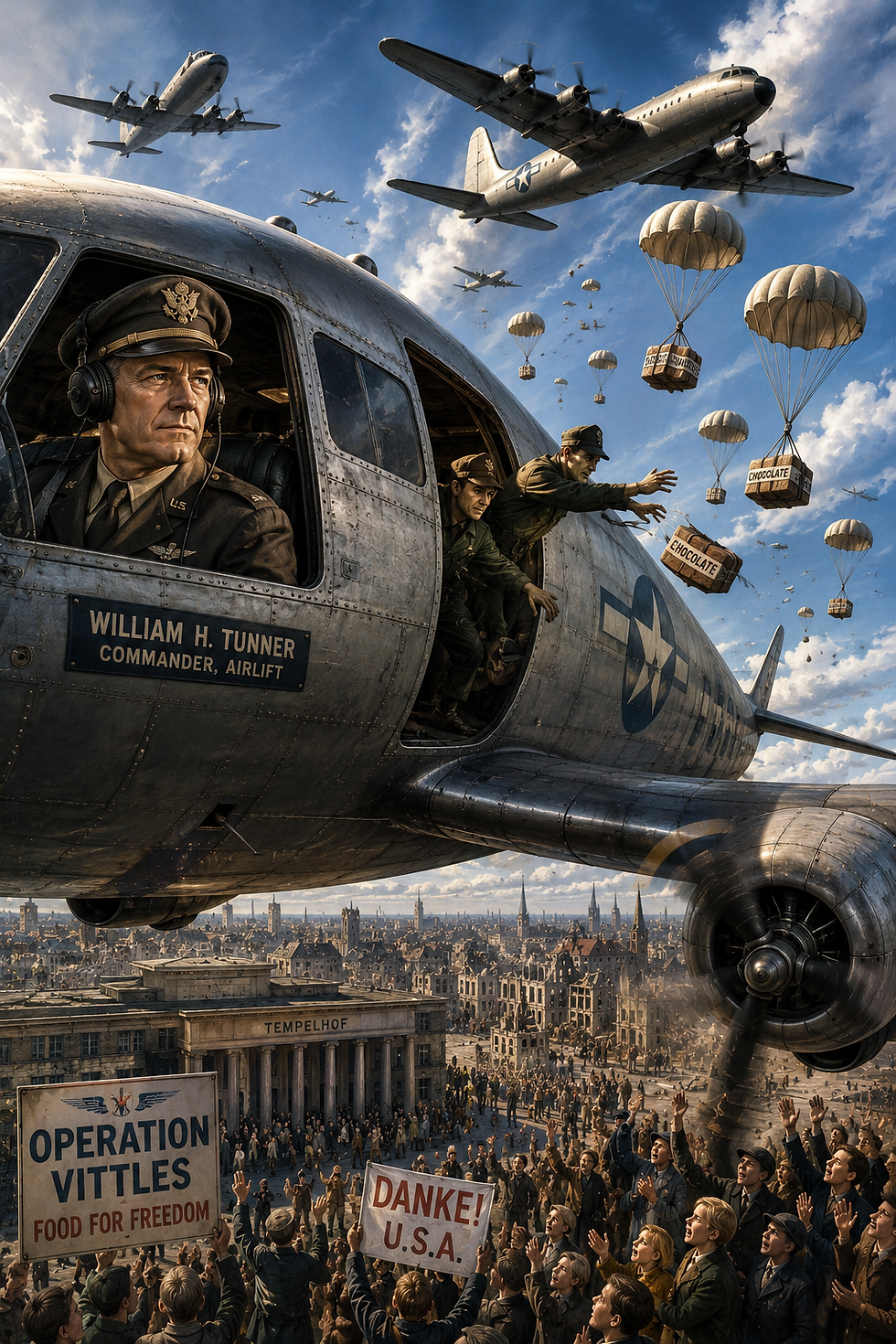
My Name is William H. Tunner: The Man Who Made the Berlin Airlift Work
I was born in Elizabeth, New Jersey, in 1906, and from an early age I was drawn toward military service and aviation. I graduated from the United States Military Academy at West Point in 1928 and eventually earned my wings as an Army pilot. Flying was exciting, but I discovered that my greatest ability was not simply handling an airplane. I understood organization. Aircraft, crews, mechanics, supplies, schedules, and airfields had to work together. When they did, airplanes could accomplish things armies once considered impossible.
Learning to Move an Army
During World War II, I became deeply involved in military air transport. Eventually, I commanded the difficult air supply operation known as the Hump, flying desperately needed supplies from India across the Himalayan region into China. Mountains, violent weather, mechanical failures, and exhaustion killed men. That experience taught me a lesson I never forgot: courage alone was not enough. A commander who cared about his people had to build a system that reduced unnecessary risks while still accomplishing the mission.
Berlin Is Surrounded
In 1948, Berlin became the center of a dangerous confrontation. Soviet authorities blocked the major land routes into the Western sectors of the city, leaving more than two million people dependent upon supplies from outside. The Americans and British responded by flying those supplies into Berlin. Many people wondered whether an entire city could really be supported by aircraft. I knew it could be done—but not if we treated the operation as a collection of individual heroic flights.
I Arrive in Germany
In July 1948, I was ordered to Germany, and soon I took operational control of the American and British airlift effort. I saw immediately that we needed greater precision. Aircraft could not wander through the skies waiting for an opportunity to land. Every minute mattered. We developed strict schedules and carefully controlled traffic patterns. Pilots flew established air corridors into Berlin and another route out. If a pilot missed his landing approach, he generally returned with his cargo rather than circling and disrupting the aircraft following behind him.
An Assembly Line in the Sky
I wanted the airlift to operate like a great conveyor belt. Aircraft took off, climbed into assigned positions, entered Berlin, landed, unloaded, and departed again. Then another came behind it. And another. Day and night, the rhythm continued. C-54 Skymasters became the backbone of the American operation, carrying flour, dried foods, medicine, machinery, and especially coal. We measured success not by dramatic stories but by tonnage delivered safely and consistently.
The People Behind the Airplanes
People sometimes remember an airlift by remembering its pilots, but thousands of others made Berlin possible. Mechanics kept exhausted aircraft flying. Air traffic controllers guided airplanes through crowded corridors. German workers unloaded cargo. Weather forecasters studied dangerous conditions, while radio operators and ground crews worked through long nights. I believed every person mattered. A successful commander does not simply give orders; he creates conditions in which people can perform their jobs well and return home safely.
The Easter Parade
By the spring of 1949, we wanted to demonstrate just how powerful the airlift had become. During the Easter Parade operation in April, we concentrated our resources and delivered nearly 13,000 tons of supplies to Berlin in a single twenty-four-hour period. Aircraft were landing at astonishing intervals. The message was unmistakable: the airlift was no temporary emergency measure. We had built a transportation system capable of sustaining Berlin for as long as necessary.
Berlin Survives
The Soviet blockade ended on May 12, 1949, although we continued flying supplies for several more months to build reserves. I later commanded major air transport operations during the Korean War and continued working to improve America's military airlift capabilities. By the time I retired from the Air Force in 1960, air transportation had become an essential part of modern American military power. I died in 1983, but Berlin remained one of the defining achievements of my career.
Operation Vittles: Supplying a City Through the Sky (June–October 1948) - Told by William H. Tunner
When Soviet authorities closed the major land routes into West Berlin in June 1948, the Western Allies faced a problem that sounded almost impossible: keep more than two million people alive without regularly bringing their supplies by road, railway, or canal. The answer was above us. If we could not move enough supplies across the ground, we would move them through the sky. What began as an emergency operation would become one of the greatest achievements in the history of military air transportation.
The First Aircraft Head for Berlin
The American operation, called Operation Vittles, formally began on June 26, 1948. The British organized their own airlift, known as Operation Plainfare. Transport aircraft carried flour, dried foods, medicine, fuel, and other necessities into the Western sectors of Berlin. Early American flights relied heavily on C-47 Skytrains, but these aircraft could carry only a few tons at a time. We increasingly turned to the larger C-54 Skymaster, which could carry considerably more cargo. If Berlin needed thousands of tons every day, every additional ton carried by each aircraft mattered.
I Am Called to Germany
I arrived in Germany in July and took command of the Combined Airlift Task Force in October. I had already commanded the difficult wartime airlift over the Himalayan region known as the Hump, and I had learned that an operation this large could not depend upon individual heroics. Heroism is admirable, but schedules keep cities alive. I wanted aircraft moving through the system continuously, predictably, and safely. Pilots, mechanics, loaders, air traffic controllers, weather crews, and German workers all had to function as parts of one enormous machine.
Tempelhof and Gatow Become Lifelines
In Berlin, Tempelhof Airport in the American sector and Gatow in the British sector became critical lifelines. Aircraft descended over a crowded city, landed, unloaded rapidly, and departed so another could follow. The goal was not to keep airplanes sitting safely on the ground. The goal was to keep them moving. Every unnecessary minute at an airfield meant fewer supplies delivered that day. Soon Berliners could look upward and see transport aircraft arriving with remarkable regularity.
Then Came the Problem of Coal
Food was only part of our problem. Berlin needed coal for electricity, industry, and heating, particularly with winter approaching. Coal is heavy, dirty, and hardly the cargo an airplane was designed to carry continuously. Yet we loaded it aboard by the ton. Special procedures and containers helped control coal dust and protect aircraft. A sack of flour could feed a family, but a load of coal could help keep homes warm and power operating. We needed both.
Building Tegel at Astonishing Speed
Two major airfields were not enough. In the French sector, Berliners and Allied personnel constructed a new airport at Tegel. Work began in August 1948, and thousands of German workers participated, including many women. In roughly three months, they transformed difficult ground into an operational airfield with a long runway. The achievement demonstrated something important about the airlift: Berliners were not simply waiting for Americans and British forces to rescue them. They were helping build the system that kept their own city alive.
Weather Becomes the Enemy
Aircraft schedules looked orderly on paper. German weather did not. Fog could hide runways. Clouds reduced visibility. Rain, ice, and snow complicated flying. One badly positioned aircraft could delay those behind it. After a disastrous period of congestion at Tempelhof on July 28—an episode remembered as Black Friday—I became even more determined to impose strict procedures. If a pilot missed his approach, he would not circle endlessly over Berlin. He would generally return to his home base and enter the system again later. Regularity was safer than improvisation.
A Conveyor Belt Across the Sky
By October 1948, the airlift was becoming a carefully organized transportation network. Aircraft entered Berlin through designated air corridors, landed at tightly controlled intervals, unloaded, and departed along another corridor. Crews on the ground learned to turn airplanes around rapidly. Maintenance schedules were improved. Cargo loads were standardized wherever possible. The objective was simple: eliminate wasted minutes.
Turning the Airlift into an Aerial Conveyor Belt - Told by William H. Tunner
By the fall of 1948, our problem was no longer proving that airplanes could reach Berlin. We had already done that. The question was whether we could transform hundreds of individual flights into something as dependable as a railroad. West Berlin required thousands of tons of food, coal, fuel, medicine, and other necessities every day. I did not want occasional spectacular flights. I wanted an aerial conveyor belt that never stopped moving.
Every Minute Had a Purpose
The airlift had to run according to strict schedules. Aircraft flew through three agreed air corridors connecting western Germany with Berlin, with traffic organized so that planes could enter and leave safely. Pilots were assigned precise procedures, altitudes, speeds, and intervals. Aircraft approached Berlin one after another, day and night. If a pilot missed his landing approach, we generally sent him back rather than allowing him to circle and interfere with the aircraft behind him. It could seem harsh, but congestion in the sky could kill men.
The C-54 Becomes Our Workhorse
Standardization made everything easier. The four-engine C-54 Skymaster became the principal American aircraft of the airlift. It could carry roughly ten tons under typical airlift conditions, considerably more than the smaller C-47s used early in the operation. Using large numbers of similar aircraft also simplified maintenance, loading, spare parts, and crew training. When you are trying to operate an enormous transportation system around the clock, predictability is one of your greatest weapons.
The Men on the Ground Kept Us Flying
Pilots received much of the attention, but an aircraft sitting on the ground delivered nothing. Mechanics inspected engines, repaired damaged equipment, changed parts, and worked through cold nights to keep airplanes available. Air traffic controllers guided streams of aircraft through crowded corridors. Radio operators, weather forecasters, loaders, dispatchers, and fuel crews performed their jobs according to tightly coordinated schedules. Thousands of German civilians also unloaded cargo and helped maintain the airfields. The airlift succeeded because an enormous number of people did their jobs correctly at the right moment.
Coal Was Our Greatest Burden
Berlin needed food, but the city's largest requirement by weight was often coal. Coal heated buildings, powered industries, and helped generate electricity. Unfortunately, coal was heavy, bulky, and dirty. Bags could tear, filling aircraft with abrasive coal dust. Yet there was no avoiding it. During the cold months, aircraft carried load after load into Berlin. Every ton mattered because a German winter did not care about politics. If we failed to deliver enough fuel, homes would become cold and parts of the city's economy could stop.
The Weather Tried to Break the System
Winter became one of our most persistent enemies. Fog could cover Berlin's runways. Ice accumulated on aircraft. Snow complicated operations, and low clouds made approaches dangerous. But the city could not stop eating because the weather was poor. We improved instrument flying procedures, weather forecasting, navigation, and ground-controlled approaches. The solution was not to pretend bad weather did not exist. It was to build a system capable of continuing despite it.
Three Airports Feed a City
Tempelhof in the American sector and Gatow in the British sector remained essential, while the newly constructed Tegel airport in the French sector gave us additional capacity. Each airfield became part of the same transportation network. Aircraft landed, taxied into position, were unloaded rapidly, and departed. Trucks carried cargo away so another airplane could take its place. Berlin's survival depended upon what happened during those few minutes between touchdown and takeoff.
The Easter Parade
By April 1949, I wanted to demonstrate what our system could accomplish when pushed to maximum efficiency. During the operation known as the Easter Parade, beginning at noon on April 16, the airlift delivered nearly 13,000 tons of supplies to Berlin in twenty-four hours through about 1,400 flights. At peak efficiency, aircraft were arriving at remarkably short intervals. What had once been dismissed as an impossible emergency operation had become an industrial transportation system in the sky.
Berliners Refuse to Give In (September 1948–Spring 1949) - Told by Ernst Reuter
By September 1948, the blockade had become more than a struggle between governments. It had entered our homes. Berliners lived with rationing, interrupted electricity, shortages of fuel, and the knowledge that almost everything keeping the Western sectors alive had to arrive aboard an airplane. Soviet leaders could exert tremendous pressure on our city, but there was one thing they could not command: whether Berliners would surrender their political will.
A City Already Knew Dictatorship
You must understand what Berlin had recently experienced. Only three years earlier, Adolf Hitler's dictatorship had collapsed amid ruins. Many of us had lived under a government in which political opposition could bring imprisonment or death. I had been arrested by the Nazis and imprisoned in concentration camps before escaping Germany. When Soviet-backed political pressure increased after the war, I did not regard the question merely as a dispute between America and the Soviet Union. To me, the issue was whether Berliners would be allowed to choose their political future.
Pressure From Inside the City
The struggle was taking place inside Berlin as well as around it. The Soviet sector and the three Western sectors were increasingly moving in different political directions. Communist-led demonstrators disrupted meetings of Berlin's elected city assembly, which eventually moved its meetings into the Western sectors. Soviet authorities supported a separate administration in East Berlin. Our city government was being divided while the blockade divided the city economically. Berlin was becoming two cities before anyone built a wall.
September 9, 1948
Then came the day I will never forget. On September 9, an enormous crowd gathered near the ruined Reichstag. Estimates commonly place the gathering at around 300,000 people. They stood among the scars of a war that had destroyed much of their city. I looked across that crowd and understood that I was not speaking only to Berlin. I was speaking to the world.
"People of the World"
I called upon the nations watching us: "People of the world, look upon this city." I appealed especially to America, Britain, France, and other democratic nations not to abandon Berlin. My message was simple. If free nations surrendered this city because pressure had become inconvenient, what confidence could other threatened peoples have in their promises? The crowd answered with determination. Berlin was hungry and battered, but it was not silent.
Surviving the Winter
Speeches, however, do not heat apartments. Winter brought the hardest test. Coal remained scarce. Electricity was rationed. Berliners sometimes lived and worked in cold rooms and adjusted daily life around limited power. Food remained restricted. Yet American and British aircraft continued arriving at Tempelhof, Gatow, and eventually Tegel. Flour came through the sky. Coal came through the sky. Medicine came through the sky. Berliners also worked beside the Allies. German laborers unloaded aircraft, repaired facilities, and helped construct Tegel Airport in extraordinary time. We were not simply waiting to be rescued. We were participating in our own survival.
Enemies Become Protectors
There was something remarkable about what was happening. Only a few years earlier, American and British aircraft had appeared over Berlin carrying bombs. Now Berlin children could look upward and see Western aircraft carrying food. Americans who had recently fought German soldiers were risking their lives to supply German civilians. The relationship between occupier and occupied was changing before our eyes. The blockade was accomplishing something its architects surely had not intended: it was pushing West Berlin closer to the Western democracies.
Berlin Chooses Its Direction
In December 1948, elections were held in the Western sectors after the political administration of the city had effectively split. Despite communist calls to boycott the election, turnout was extraordinarily high—more than 86 percent of eligible voters participated. My Social Democratic Party received a clear majority of the vote, and I was finally able to serve as mayor in the Western sectors. Berliners had answered political pressure not only with demonstrations but with ballots.
We Would Endure
By the spring of 1949, the mood had changed. Life remained difficult, but the airlift was delivering greater quantities of supplies, and the Western Allies had demonstrated that they were not leaving. The question was increasingly whether maintaining the blockade could still accomplish its political purpose.
Berlin had once been known around the world as the capital of Hitler's Germany. Now the same ruined city was becoming a symbol of resistance to Soviet pressure. That transformation did not happen because Berliners suddenly forgot their country's past. It happened because ordinary people demonstrated something about their future: they were willing to endure darkness, cold, hunger, and uncertainty rather than allow outside pressure to decide how they would be governed.
The Blockade Ends—and Germany Becomes Two Countries (May–October 1949) - Told by Lucius D. Clay and Vasily Sokolovsky
By the spring of 1949, we had confronted one another across Germany for nearly a year without our armies opening fire. I, Lucius Clay, commanded the American occupation in Germany, while Marshal Vasily Sokolovsky represented Soviet military power on the other side. We disagreed profoundly about Germany's future, but both of us understood what was at stake. Berlin had become a contest of political determination in which one serious mistake could transform a blockade into a war.
The Airlift Had Changed the Calculation
Clay: By April 1949, the situation was very different from the desperate days of the previous summer. The airlift was delivering thousands of tons of supplies into Berlin every day, and General William Tunner's organization had made the operation increasingly efficient. During the Easter Parade of April 16–17, nearly 13,000 tons reached Berlin in twenty-four hours. The Soviet blockade had not forced us from the city. If anything, it had strengthened American determination to remain. From my position, there was no reason to withdraw when the airlift was proving that Berlin could be sustained.
The Dispute Was Larger Than Berlin
Sokolovsky: You Americans saw the success of the airlift; we Soviets saw the political transformation occurring across Germany. The Western occupation zones were being integrated economically and politically, and plans for a separate West German government were moving forward. Soviet objections had not stopped that development. By 1949, the blockade had become only one part of a much larger dispute. Negotiations between the governments therefore became increasingly important. Neither side wanted a military collision merely to prove that it could remain stubborn longer than the other.
An Agreement Finally Emerges
Clay: In early May, American, British, French, and Soviet representatives reached an agreement in New York. The restrictions imposed on transportation, trade, and communications between Berlin and the Western zones would be removed. In return, the Western powers agreed to lift countermeasures they had imposed on the Soviet zone, and the four governments would meet again to discuss Germany. At 12:01 a.m. on May 12, 1949, the blockade officially ended. Trains and vehicles could once again travel toward Berlin. After 322 days, the great confrontation was over.
But Germany Had Not Been Reunited
Sokolovsky: The lifting of the blockade did not solve the problem that had caused the confrontation. Germany remained divided between competing occupation systems. The Soviet Union still opposed the Western plans for a separate German government, while the Western powers were unwilling to abandon them. The crisis ended without either side achieving everything it wanted. The Western powers remained in Berlin, but Germany was now moving faster toward formal division.
We Kept the Aircraft Flying
Clay: We did not immediately stop the airlift on May 12. That would have been foolish. We had learned how quickly access to Berlin could become uncertain, so American and British aircraft continued carrying supplies into the city while large reserves were accumulated. The airlift finally ended on September 30, 1949. During the entire operation, American and British aircraft together had made more than 270,000 flights and delivered more than two million tons of supplies. The impossible had become routine.
West Germany Appears
Sokolovsky: Only days after the blockade ended, the political map changed. On May 23, 1949, the Basic Law came into effect, establishing the Federal Republic of Germany in the Western occupation zones. Bonn became the seat of the new West German government, and Konrad Adenauer became its first chancellor in September. To the Western powers, this represented the construction of a democratic German state. To Moscow, it confirmed what we had warned about: the Western zones had become a separate political system tied increasingly to Western Europe.
Then Came East Germany
Clay: The Soviet response followed. On October 7, 1949, the German Democratic Republic was established in the Soviet occupation zone. Germany, which four years earlier had been placed temporarily under four-power occupation, now contained two rival German states. The Federal Republic looked westward; the German Democratic Republic looked eastward. Berlin itself remained divided and occupied, leaving one of the Cold War's most dangerous unresolved problems sitting directly between them.
Neither Side Fired the First Shot
Sokolovsky: There is another reason Berlin deserves to be remembered. Soviet and Western forces possessed enormous military power, and their soldiers sometimes stood only a short distance apart. Yet the Berlin crisis did not become a shooting war. Pressure was answered with aircraft. Economic restrictions were answered with countermeasures. Diplomats continued negotiating even while the confrontation continued. Neither government trusted the other, but both understood the danger of allowing the struggle to escape political control.
A New Kind of Conflict
Clay: Berlin taught the West that Soviet pressure could be resisted without automatically beginning a war. We stayed, supplied the city, and avoided forcing an armed passage through Soviet positions.
Sokolovsky: And Berlin demonstrated that the struggle between our systems would not always resemble the wars that came before it. Governments could compete through economics, political pressure, alliances, propaganda, technology, and military threats while deliberately stopping short of direct battle.
Clay: The blockade ended, but the Cold War did not.
Sokolovsky: Instead, Germany became one of its great dividing lines.
Clay: Two German states now faced different directions.
Sokolovsky: And between them stood Berlin—a divided city that would remain one of the most dangerous symbols of the Cold War for another four decades.


Comments