

20. Heroes and Villains from World War II: D-Day and the Liberation of Europe (1944–1945)


My Name is General Dwight D. Eisenhower: Supreme Allied Commander
I was born in 1890 in Denison, Texas, but I grew up in Abilene, Kansas, in a hardworking family where discipline and responsibility were expected. As a boy, I loved history, competition, and stories of great military leaders. In 1911, I entered the United States Military Academy at West Point. I could not have known then that my greatest responsibility would someday involve commanding millions of men in the largest war the world had ever known.
Learning to Command
I graduated from West Point in 1915 and entered an Army that was changing rapidly. During the First World War, I trained soldiers for tank warfare but was never sent into combat overseas. That disappointed me greatly. Yet the years between the wars became my education in leadership. I served under accomplished officers, studied military strategy, attended the Command and General Staff School, and learned that commanding an army required more than battlefield courage. A commander must organize people, understand logistics, listen to specialists, and make decisions when every available choice carries risk.
A World at War
When the United States entered World War II after Pearl Harbor, my responsibilities grew rapidly. General George C. Marshall brought me to Washington, where I helped develop American war plans. Soon I was sent overseas. I commanded Allied operations in North Africa and later helped direct the invasion of Sicily. These campaigns taught me one of the central realities of coalition warfare: Americans, British, Canadians, Frenchmen, and other Allies might disagree fiercely, but victory required us to fight toward the same objective.
Preparing for D-Day
By 1943, I was appointed Supreme Commander of the Allied Expeditionary Force and given responsibility for Operation Overlord—the invasion of German-occupied Western Europe. Nothing about the task was simple. We assembled enormous numbers of soldiers, ships, aircraft, vehicles, fuel, ammunition, and supplies in Britain. We planned deception operations to confuse the Germans and prepared landings across five beaches in Normandy. Thousands of decisions had to come together at precisely the right moment.
The Decision of June 6
The weather nearly defeated us before the Germans had the opportunity. Heavy winds and rough seas threatened the invasion. My commanders and meteorologists presented their reports, but ultimately the decision belonged to me. I approved the attack for June 6, 1944. Before the men departed, I told them that the eyes of the world were upon them. Privately, I prepared another statement accepting full responsibility should the invasion fail. Command means accepting responsibility before knowing whether history will call your decision wise or disastrous.
The Battle for Europe
Our airborne troops descended into Normandy during the darkness, and at dawn Allied soldiers approached Utah, Omaha, Gold, Juno, and Sword beaches. The fighting was terrible, particularly at Omaha. Yet the soldiers held their positions and pushed inland. Over the following weeks, the Allies expanded the beachhead, captured vital ports, broke through German defenses, and drove across France. Paris was liberated in August 1944, and our armies continued toward Germany.
Victory and the Presidency
Germany surrendered in May 1945. I returned home knowing that victory belonged not to any one general but to millions of soldiers, sailors, airmen, workers, families, and Allied citizens who had endured the war. Years later, Americans elected me the 34th President of the United States. I served from 1953 to 1961, confronting the Cold War, supporting the Interstate Highway System, and trying to preserve peace in a world now threatened by nuclear weapons.
Operation Overlord: Preparing the Amphibious Invasion - Told by Eisenhower
By the beginning of 1944, we understood that defeating Nazi Germany required something enormously difficult: we had to cross the English Channel, land an army on a defended coastline, and then keep that army supplied long enough to fight its way across Europe. Britain had become an immense military staging ground. American, British, Canadian, Free French, Polish, and other Allied personnel crowded camps, ports, airfields, and training grounds. Hundreds of thousands of individual preparations had to become one coordinated operation.
Why We Chose Normandy
The shortest route across the Channel pointed toward Pas-de-Calais, and the Germans understood that as well as we did. Its defenses were formidable, and the enemy expected an invasion there. Normandy offered us important advantages. Its beaches could support large-scale landings, it was within range of Allied fighter aircraft based in Britain, and the Germans considered it a less obvious target. We would still face Hitler's Atlantic Wall—bunkers, artillery, mines, obstacles, and fortified positions—but Normandy offered us a better opportunity to establish the foothold we needed.
Building an Army Across the Channel
Before one soldier could fight his way inland, an extraordinary transportation system had to be assembled. We required thousands of ships and landing craft to carry infantry, tanks, artillery, trucks, ammunition, fuel, food, medical supplies, and engineering equipment across the Channel. Aircraft would carry paratroopers behind German defenses while fighters and bombers attacked transportation networks and enemy positions. Every unit required a place in the invasion schedule. A landing craft arriving too early, a tank landing on the wrong beach, or ammunition reaching shore too late could have consequences far beyond a single unit.
Ports We Could Bring With Us
One of our greatest concerns was supply. Capturing a major French port quickly was uncertain, and the Germans could destroy port facilities before we could use them. Our engineers therefore developed the remarkable Mulberry harbors—prefabricated artificial harbor components that could be transported across the Channel and assembled off Normandy. We also planned pipelines and an enormous system for moving supplies from ships onto the beaches. An invasion army consumes staggering quantities of fuel, ammunition, food, and equipment. Landing in France would mean little if we could not sustain the men after they arrived.
Knowing the Battlefield Before We Reached It
Intelligence was another weapon. Allied aircraft photographed the French coastline. Intelligence officers studied German fortifications, troop positions, roads, bridges, tides, beaches, and terrain. Resistance networks supplied information from occupied Europe. Specialists even examined beach conditions because the wrong type of sand or soil could trap heavy vehicles. At the same time, deception operations encouraged the Germans to believe that our principal invasion might come at Pas-de-Calais. We wanted the enemy looking in the wrong direction when the real blow fell.
Commanding an Alliance
Perhaps my greatest responsibility was keeping the Allied effort together. General Bernard Montgomery commanded the ground forces during the initial assault phase, Admiral Bertram Ramsay directed the naval operation, and Air Chief Marshal Trafford Leigh-Mallory oversaw the expeditionary air forces. Beneath them were Americans, British, Canadians, Frenchmen, Poles, Norwegians, and personnel from other Allied nations. These officers did not always agree—and neither did their governments. My responsibility was not to eliminate disagreement. It was to ensure disagreement never prevented us from carrying out the mission.
Five Beaches and One Objective
The invasion would strike five beaches: Utah and Omaha for American forces, Gold and Sword for the British, and Juno for the Canadians. Airborne troops would descend behind the beaches to seize important roads, bridges, and positions. Naval vessels would bombard German defenses while aircraft attempted to isolate the battlefield from reinforcements. Once ashore, our forces had to link the separate beachheads together and begin expanding into Normandy. Every part depended upon the others.
The Weight of the Plan
By June 1944, southern England seemed almost unable to contain the military force we had assembled. Men waited in sealed camps. Aircraft filled airfields. Ships crowded ports. Vehicles stood bumper to bumper along roads. Mountains of supplies waited to cross the Channel. Yet I understood something that no map could conceal: once I gave the order, thousands of young men would be moving toward defenses specifically designed to kill them. We had planned carefully, gathered overwhelming strength, and coordinated forces on a scale rarely attempted before. Soon planning would end. The next decision would determine whether this enormous Allied army remained in Britain—or began the liberation of Western Europe.
Convincing Germany the Attack Would Come Elsewhere - Told by Eisenhower
Before we could defeat the German Army on the beaches of France, we needed German commanders to make mistakes about where those beaches would be. The Germans knew an Allied invasion of Western Europe was coming. They could see our forces gathering in Britain, and they were strengthening what they called the Atlantic Wall. We could not hide an army of this size. Instead, we attempted something more ambitious: we would let Germany see preparations for an invasion, but encourage them to prepare for the wrong one.
Operation Bodyguard
The larger Allied deception effort was called Operation Bodyguard. Its purpose was not simply to hide Normandy. We wanted German leaders uncertain about Allied intentions across Europe, including where and when major operations might occur. Every German division held away from Normandy because its commanders feared an attack somewhere else was one less division available to meet our troops. Deception, therefore, was not a theatrical trick. Properly used, it could change the balance of forces on the battlefield before the shooting began.
Why Pas-de-Calais Made Sense
Our greatest advantage was geography. Pas-de-Calais lies across the narrowest section of the English Channel and offered the most direct route from Britain toward Germany. Hitler and his commanders already considered it a logical invasion site. Rather than invent an unbelievable story, we reinforced something the enemy was already inclined to believe. The real invasion would strike Normandy, farther west. We wanted Germany watching Pas-de-Calais while our ships approached another coast.
Creating an Army That Did Not Exist
Operation Fortitude South became one of the most important parts of the deception. The Allies created the impression that a powerful formation called the First U.S. Army Group was assembling in southeastern England opposite Pas-de-Calais. General George S. Patton was publicly associated with this supposed force. The Germans respected Patton as an aggressive commander, which made his presence particularly convincing. The deception included controlled radio traffic and visible military preparations designed to support the picture German intelligence expected to find.
Giving Germany Something to See
We used dummy equipment and other misleading indicators, but no single trick made Fortitude successful. The strength of the operation came from many pieces reinforcing one another. German reconnaissance and intelligence needed to encounter enough believable evidence that their analysts could reach the conclusion we wanted them to reach. Meanwhile, the real invasion force prepared across southern Britain. We were constructing not merely a false location, but an entire false military story.
The Most Important Part of the Deception
Our objective went beyond convincing Germany that Normandy was not the invasion site. We wanted German commanders to believe that even after troops landed in Normandy, those landings might be a diversion preceding the main attack at Pas-de-Calais. That distinction was critical. Once our soldiers were ashore on June 6, the deception still had work to do. If Germany immediately moved every available reserve against Normandy, our vulnerable beachhead could face an even greater threat. If German forces remained near Calais waiting for another invasion, we gained precious time.
When the Real Invasion Began
On June 6, 1944, Allied troops landed in Normandy. Even then, German uncertainty did not disappear. The threat against Pas-de-Calais continued to be presented after D-Day, helping reinforce the possibility that Normandy was not our principal effort. German formations, including powerful units of the Fifteenth Army, remained positioned in the Calais region rather than immediately being committed against our beachhead. Our deception had helped create hesitation at precisely the moment when speed mattered most.
The Final Decision: Weather, Risk, and June 6, 1944 - Told by Eisenhower
By early June 1944, years of planning had brought us to the edge of the English Channel. Thousands of ships and landing craft were prepared. Aircraft waited at British airfields. Paratroopers had studied their objectives, and soldiers destined for Normandy were gathered in sealed camps. Nearly 160,000 Allied troops were expected to cross the Channel or enter Normandy by sea and air on D-Day. We had assembled the greatest amphibious invasion force yet attempted. Then the weather turned against us.
A Storm Over the Channel
The invasion had originally been planned for June 5, but strong winds, rough seas, heavy clouds, and poor visibility made conditions dangerous. Landing craft could be swamped. Bombers might be unable to identify their targets. Paratroopers could become even more widely scattered. Naval gunfire and air support could be disrupted. I could order men to fight the German Army, but I could not order the English Channel to become calm. On June 4, after hearing the forecasts, I postponed the invasion for twenty-four hours.
One Man's Forecast Could Change History
Our chief meteorological adviser, Group Captain James Stagg, and his team studied reports from across the Atlantic. Their forecasts indicated that a brief improvement might arrive on June 6. The conditions would still be far from perfect, but they might be good enough. German meteorologists, working with less complete Atlantic weather information, did not anticipate the same opportunity. Some German commanders believed the poor weather made a major invasion unlikely. Field Marshal Erwin Rommel even left Normandy to travel to Germany.
The Meeting That Decided the Invasion
At Southwick House near Portsmouth, my senior commanders gathered to consider the forecast. Admiral Bertram Ramsay had to think about thousands of vessels crossing rough water. Air Chief Marshal Trafford Leigh-Mallory worried about aircraft and airborne troops. General Bernard Montgomery had to consider the soldiers who would actually fight their way inland. We discussed the risks, listened to the weather experts, and examined our choices. I wanted my commanders' opinions, but there comes a point when discussion must end. As Supreme Commander, the final responsibility was mine.
Why We Could Not Simply Wait
Postponement sounded safer, but waiting carried dangers of its own. The invasion depended upon moonlight, tides, weather, and the element of surprise. Soldiers had already been briefed and concentrated for departure. Ships were loaded. Continued delay increased the possibility that German intelligence might discover our intentions. A long postponement could force us to wait for another suitable combination of tides and moon conditions, while the enormous invasion force remained crowded in southern England. There was no risk-free decision.
"OK, We'll Go"
During the early hours of June 5, we met again. Stagg reported that the temporary improvement remained likely. I considered what my commanders had said and walked away briefly to think. Then I made the decision. Accounts of the meeting record my words in slightly different forms, but the meaning was simple: we would go. With that decision, an enormous military machine began moving toward France. There was no dramatic celebration. Men went back to their duties. Orders moved through headquarters. Ships headed into the Channel.
A Message I Hoped No One Would Read
I had confidence in our forces, but confidence is not certainty. Before the invasion, I wrote a short note to be used if the landings failed. In it, I accepted responsibility for the decision to attack. I even accidentally dated the note July 5 instead of June 5, an indication perhaps of the strain of those hours. I kept it folded in my wallet. A commander cannot ask soldiers to accept the consequences of his decision while preparing to place the blame somewhere else if it fails.
The Armada Moves Toward France
During the night, airborne troops began flying toward Normandy. Behind them came an immense naval force carrying soldiers toward Utah, Omaha, Gold, Juno, and Sword beaches. The weather remained difficult, and many men became violently seasick during the crossing. Yet the break in the storm was sufficient. Shortly after midnight on June 6, Allied airborne operations were underway, and at dawn the landings began.

My Name is Major General James M. Gavin: American Airborne Commander
I was born in Brooklyn, New York, in 1907 and placed in an orphanage as a young child before being adopted by Martin and Mary Gavin of Pennsylvania. Life was not easy, and I learned early that if I wanted a different future, I would have to pursue it myself. At seventeen, I left home and eventually joined the United States Army. The Army offered something I desperately wanted: discipline, education, responsibility, and the opportunity to prove what I could become.
From Soldier to West Point
I enlisted as a private, but I wanted to become an officer. Through determination and study, I earned an appointment to the United States Military Academy at West Point, graduating in 1929. I became fascinated with modern warfare and particularly with the possibilities of airborne forces. War was changing. Aircraft could carry soldiers over enemy defenses and place them directly behind enemy lines. It was dangerous, certainly, but properly used, airborne troops could strike with speed and surprise where an enemy least expected them.
Becoming an Airborne Commander
When World War II began, I joined America's developing airborne forces. I believed officers should share the hardships and dangers they expected their soldiers to face. I became known for carrying an M1 rifle rather than simply a pistol and for jumping with my men. In 1943, I commanded the 505th Parachute Infantry Regiment during the invasion of Sicily. The drops were scattered and confused, but our soldiers adapted. Airborne warfare taught me an enduring lesson: once the battle begins, plans rarely survive exactly as written. Soldiers must understand the mission well enough to continue even when everything around them goes wrong.
Jumping Into Normandy
Before dawn on June 6, 1944, I parachuted into Normandy with the 82nd Airborne Division. Our mission was to secure important roads, bridges, and approaches behind Utah Beach so German forces could not easily attack the soldiers landing from the sea. Darkness, enemy fire, flooded fields, and navigation problems scattered our paratroopers across the countryside. I landed far from where I expected. There was no time to complain about the map. We gathered whoever we could find and went to work.
Holding the Ground
The fighting around Sainte-Mère-Église and the Merderet River was fierce. Small groups of American paratroopers fought independently, sometimes without knowing exactly where neighboring units were located. We captured crossroads, defended bridges, attacked German positions, and disrupted enemy movements. What impressed me most was not perfect military organization—it was the ability of young soldiers to take responsibility when officers were absent and communications had failed. Normandy proved that initiative could be as important as orders.
The Young General
Later in 1944, I became commander of the 82nd Airborne Division and was promoted to major general while still only thirty-seven years old. My men called me the "Jumping General" because I continued making combat jumps rather than directing them entirely from the rear. During Operation Market Garden, we jumped into the Netherlands and fought to capture important bridges. That campaign did not achieve everything Allied planners had hoped, but once again our airborne soldiers demonstrated extraordinary courage under difficult conditions.
The Battle of the Bulge
In December 1944, Germany launched a massive surprise offensive through the Ardennes. The 82nd Airborne was rushed into Belgium to help stop it. Winter conditions were brutal, and the Germans attacked fiercely, but American forces held. By then we understood that the war was moving toward Germany itself. The road had been long—from Sicily to Normandy, Holland, Belgium, and finally into Germany—but the airborne divisions had helped open that road.
After the War
I remained in the Army after victory and eventually became a lieutenant general. I also became deeply interested in how technology, missiles, aircraft, and nuclear weapons were changing warfare. After retiring from military service in 1958, I served as the United States ambassador to France. Whether as a soldier or diplomat, I remained convinced that America needed strong defenses but also thoughtful leaders who understood the terrible consequences of modern war.
Into the Darkness: Airborne Forces Arrive First - Told by James M. Gavin
In the final hours of June 5, 1944, thousands of paratroopers climbed aboard transport aircraft in England knowing that when they next touched the ground, they would be behind German lines. I was serving as assistant division commander of the 82nd Airborne Division. Before the invasion fleet reached Normandy's beaches, American and British airborne forces would descend from the darkness to seize bridges, roads, crossroads, and other positions that could determine whether the landings succeeded.
The Airborne Mission
The American 82nd and 101st Airborne Divisions were assigned objectives behind Utah Beach, while Britain's 6th Airborne Division operated east of the main landing area near the Orne River and Caen Canal. Our purpose was straightforward but dangerous. We had to disrupt German movement, secure important routes, and protect the flanks of the invasion. If German reinforcements could reach the beaches quickly, they might attack Allied troops while those men were still struggling ashore. We intended to make that journey as difficult as possible.
The Jump Into Normandy
As our aircraft crossed France shortly after midnight on June 6, German antiaircraft fire, clouds, darkness, and confusion disrupted the formations. Pilots maneuvered to avoid fire, and many paratroopers jumped far from their planned drop zones. I jumped with my men and came down in a flooded field, with water reaching high around me. Equipment was scattered. Units were mixed together. Some officers could not locate their soldiers, and soldiers could not locate their officers. The carefully prepared maps suddenly seemed much less important than determining where we actually were.
When the Plan Falls Apart
Airborne soldiers had been trained for precisely this kind of confusion. We gathered whoever we could find and moved toward known objectives. Men from different companies and even different units formed improvised groups. This was one of the great strengths of American airborne forces: soldiers understood the mission, not merely their individual orders. If a lieutenant disappeared, a sergeant continued. If a sergeant was missing, a private might take responsibility. Normandy became a battlefield of small groups making decisions in darkness.
Sainte-Mère-Église
One of the most important objectives was Sainte-Mère-Église, a town controlling key roads through the Cotentin Peninsula. Paratroopers of the 82nd Airborne entered the town during the early morning, and it became one of the first French towns liberated by American forces on D-Day. The fighting around it continued, however, because German troops understood its importance. Holding Sainte-Mère-Église meant controlling roads that could otherwise be used to move German forces toward Utah Beach.
The Fight for the Merderet
My own attention became focused on the crossings over the Merderet River. The Germans had flooded large portions of the surrounding lowlands, turning fields into dangerous expanses of water. Causeways and bridges became critically important because soldiers and vehicles could not simply move wherever they pleased. Around places such as La Fière, American paratroopers fought desperately to control crossings while German forces counterattacked. Some of the fiercest fighting experienced by the 82nd Airborne occurred there.
Holding the Doors Shut
Across Normandy, airborne troops were doing more than capturing territory. We were interfering with the German response. Bridges were seized or destroyed according to Allied plans. Roads were blocked. Communications were disrupted. German commanders received confusing reports about where Allied troops had landed and how many were present. On the eastern flank, British airborne forces captured key bridges, including the bridge later famous as Pegasus Bridge, and destroyed crossings that German forces might have used against the invasion.
The Beaches Behind Us
As dawn arrived, we could hear the tremendous bombardment from the coast. Somewhere beyond the fields and hedgerows, Allied soldiers were approaching Utah and Omaha beaches while British and Canadian forces struck farther east. We could not see most of that battle. Our war was among farms, villages, flooded fields, bridges, and narrow roads. But the two battles were inseparable. Every German unit delayed behind the beaches gave the men landing from the sea more time to establish themselves.
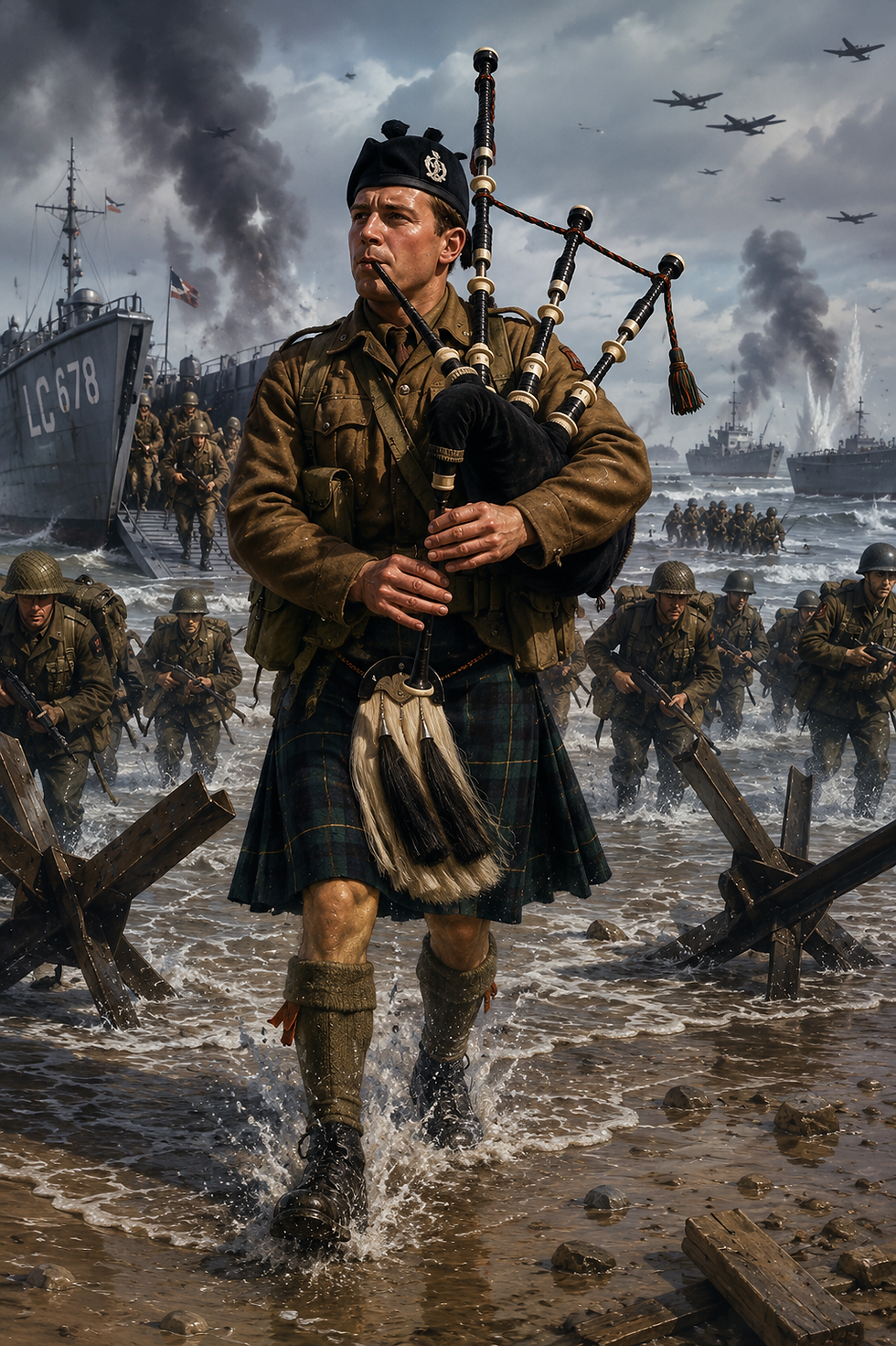
My Name is Bill “Mad Piper” Millin: Piper on Sword Beach
I was born in Regina, Canada, in 1922 to Scottish parents, but my family returned to Scotland while I was still young. I grew up in Glasgow and learned to play the Highland bagpipes. I certainly never imagined that one day I would be standing on a French beach, with bullets flying about, playing those pipes while an army invaded Europe. But war has a peculiar habit of putting a fellow in places he never expected to be.
Joining the Commandos
When the Second World War came, I joined the British Army and eventually became part of the commandos. I served as the personal piper of Brigadier Simon Fraser, Lord Lovat, commander of the 1st Special Service Brigade. Lord Lovat was quite a character himself. Before D-Day, I pointed out that regulations discouraged pipers from playing in battle. Lovat informed me, in effect, that those regulations were English and that we were Scottish. That settled the matter.
Heading for Normandy
On the morning of June 6, 1944, our landing craft approached Sword Beach in Normandy. The sea was rough, explosions were everywhere, and men were preparing themselves for whatever waited ashore. I was twenty-one years old. Lord Lovat turned to me and told me to play. So I did. There are moments when thinking too much does you no good whatsoever. I stepped into the water carrying my pipes and started playing as we moved toward the beach.
Playing Under Fire
Once ashore, I walked back and forth playing tunes including "Highland Laddie" and "The Road to the Isles." Men around me carried rifles, ammunition, radios, and medical equipment. I carried bagpipes. Mortar shells exploded, machine guns fired, and soldiers fell. Looking back, people have sometimes asked whether I was frightened. Of course there was danger. But when you are given a job in the middle of such confusion, sometimes the simplest thing is to get on with it. My job was to play, so I played.
Why Didn't They Shoot the Piper?
Years later, I heard that captured German soldiers had seen me on the beach. According to the story, their sharpshooters did not fire because they thought I had gone mad. Perhaps that is where the idea of the "Mad Piper" fits rather nicely. Whether every detail of that tale grew in the telling, I cannot say. I only know that somehow I crossed Sword Beach carrying nothing more threatening than a set of pipes and survived.
The Road to Pegasus Bridge
Our commandos pushed inland toward Pegasus Bridge, which British airborne troops had captured earlier that morning. Lord Lovat's brigade was supposed to reinforce them. When we arrived, I was still playing. The sight and sound of the pipes told the men holding the bridge that reinforcements had reached them. It was an extraordinary moment: airborne soldiers, commandos, tanks, shattered buildings, gunfire—and somewhere in the middle of it all, Scottish music.
The War Continued
Normandy was not the end of my war. Later in 1944, while serving in the Netherlands, I was wounded by enemy fire. A bullet damaged part of my bagpipes, and I was evacuated. Eventually the war ended, and unlike so many others, I was fortunate enough to return home. I had gone into Normandy as a young man carrying pipes and came away understanding just how quickly ordinary lives could be changed forever.
D-Day: The Five Normandy Beaches - Told by Bill “Mad Piper” Millin
On the morning of June 6, 1944, I was approaching the French coast with Lord Lovat's commandos, carrying a set of bagpipes instead of a rifle. From where I stood, D-Day looked like rough water, landing craft, smoke, aircraft, warships, and a coastline growing larger by the minute. But we were only one small part of an enormous invasion. Allied forces were attacking approximately 50 miles of Normandy coastline at five landing areas—Utah, Omaha, Gold, Juno, and Sword. The experiences at those beaches would be very different.
Utah: The Americans Land in the Wrong Place
On the western end of the invasion area, American troops of the 4th Infantry Division headed toward Utah Beach. Currents carried the first waves roughly 2,000 yards south of their intended landing point. Sometimes war provides a useful accident. The unexpected location proved comparatively favorable, and Brigadier General Theodore Roosevelt Jr., who had landed with the first waves, famously decided that the troops would begin the war from where they had arrived. American forces pushed inland and began making contact with airborne troops who had parachuted behind the coast during the night.
Omaha: The Bloodiest Beach
Farther east, the Americans encountered an entirely different battle at Omaha Beach. German defenses there were formidable, with troops firing from elevated positions overlooking the landing areas. Strong currents scattered landing craft, many amphibious tanks were lost before reaching shore, and bombardment had failed to destroy many German positions. Soldiers of the U.S. 1st and 29th Infantry Divisions suffered severe casualties. Small groups eventually worked their way through or around German defenses and climbed off the exposed beach. Omaha came frighteningly close to disaster, but the Americans held on and forced their way inland.
Gold: The British Push Inland
British troops of the 50th Infantry Division landed at Gold Beach near the center of the invasion. They faced German strongpoints, mines, obstacles, and artillery but gradually broke through the coastal defenses. Specialized armored vehicles helped engineers and infantry overcome obstacles. British forces moved inland and later linked with Canadians advancing from Juno. They also moved toward Bayeux, which would soon become one of the first significant French towns liberated following the landings.
Juno: The Canadians Fight Through
At Juno Beach, the Canadian 3rd Infantry Division encountered rough seas and strong German defenses. Landing delays meant that rising water covered some beach obstacles, making them especially dangerous to approaching craft. Canadian troops suffered heavily in the opening waves, but once through the coastal defenses, they advanced farther inland than many Allied units achieved that day. The Canadians had come a long way to fight in France, and on June 6 they demonstrated that this invasion belonged to far more than Britain and the United States.
Sword: Where I Came Ashore
Then there was Sword Beach, the easternmost of the five landing areas and the beach I knew personally. British troops of the 3rd Infantry Division landed there, accompanied by commandos and a small Free French commando force. My commander, Lord Lovat, told me to play the pipes. Regulations might have discouraged pipers from playing in battle, but Lovat had his own view of regulations. So I stepped into the water and began playing "Highland Laddie" as men moved past me toward the fighting. Machine-gun fire, explosions, shouting—and bagpipes. It was an unusual concert.
Frenchmen Return to France
Among the forces landing at Sword were Free French commandos under Commandant Philippe Kieffer. Imagine what that meant. France had been occupied for four years, and now French soldiers were coming ashore alongside British troops to help liberate their own country. Elsewhere in the invasion were Americans, Canadians, Poles, Norwegians, Dutchmen, Belgians, Czechoslovaks, and other Allied personnel serving at sea or in the air. D-Day may have taken place on the French coast, but the force arriving there represented an international alliance.
Off the Beaches
Our commandos did not intend to remain at Sword. Lord Lovat's brigade pushed inland toward the bridges over the Caen Canal and Orne River that British airborne troops had captured during the night. When we approached what became known as Pegasus Bridge, I was still playing. The airborne men had been holding their position for hours, waiting for reinforcements from the beaches. Our arrival helped connect the soldiers who had come from the sea with those who had arrived from the sky.
One Foothold in Europe
By nightfall, the Allies had not achieved every D-Day objective. Caen remained in German hands, some beachheads were not yet fully connected, and thousands of Allied troops had been killed, wounded, or reported missing. But all five landing areas had been held. That was what mattered most. The Germans had failed to throw the invasion back into the Channel. From Utah to Sword, soldiers had established the foothold from which the liberation of Western Europe could continue. I happened to arrive carrying bagpipes. The men around me carried the far heavier responsibility of making certain we never had to turn around and march back into the sea.
Bagpipes Under Fire: The Human Experience of D-Day - Told by “Mad Piper”
When people study D-Day, they see maps covered with arrows and names like Utah, Omaha, Gold, Juno, and Sword. I remember sounds. Aircraft passed overhead. Naval guns thundered from behind us. Shells exploded along the coast. Men shouted orders above engines and gunfire. Landing craft struck the beach and dropped their ramps. And somewhere in that tremendous noise came the sound of my bagpipes, because Brigadier Lord Lovat had decided his commandos were going ashore with a piper.
The Ramp Goes Down
I was twenty-one years old when our landing craft approached Sword Beach on June 6, 1944. The Channel had been rough, and many soldiers were seasick before they ever saw the enemy. Then the coastline appeared through smoke and spray. Once the ramp came down, there was no longer an invasion plan spread across a headquarters table. There was only the beach in front of us. Men carried rifles, ammunition, radios, medical supplies, explosives, and heavy equipment through the water. I carried my pipes.
"Give Us a Tune"
Lord Lovat ordered me to play. I had been told that British Army regulations restricted pipers from playing at the front, but Lovat dismissed the problem in his characteristically Scottish fashion. So I played. Among the tunes I performed on D-Day were "Highland Laddie" and "The Road to the Isles." I walked along the beach as troops moved forward. I was not charging a machine-gun position or carrying a wounded man. My task was simpler: keep playing while everyone around me was trying to do his own job.
What Courage Actually Looked Like
There was nothing simple about what the ordinary soldier faced. Men had to move forward while artillery and small-arms fire threatened them, often without knowing what waited beyond the next obstacle. Engineers cleared mines and beach defenses. Medics treated wounded men while the battle continued around them. Officers tried to organize units that had become separated during the landing. Sailors repeatedly brought landing craft toward a hostile shore. Courage on D-Day was rarely a grand speech. More often, it was a frightened man continuing to move because the men beside him were moving too.
Fear Did Not Mean Running Away
People later asked whether I was afraid. Of course there was danger, and I understood perfectly well that a bullet does not care whether the man it strikes carries a rifle or a musical instrument. But fear behaves strangely when you have something specific to do. You concentrate on the next step, the next order, the next tune. Soldiers did the same with their own duties. Training gave men something to hold onto when the battlefield became confusing. They might be frightened, exhausted, wet, seasick, or wounded, but the mission still demanded another step forward.
Why Was the Piper Still Standing?
One of the most famous stories about me came later. I was told that German soldiers had seen me playing but had not deliberately shot at me because they believed I was mad. It is a wonderful story, and it contributed to my nickname, the "Mad Piper." But I cannot personally tell you what individual German soldiers were thinking while I played. What I can tell you is that I crossed Sword Beach with my pipes and survived while many men around Normandy were not so fortunate.
Moving Inland
We did not remain on the beach. Lord Lovat's commandos moved toward the bridges captured earlier by British airborne troops near the Caen Canal and Orne River. The farther inland we went, the more D-Day changed. The wide beach gave way to roads, villages, fields, walls, and buildings. French civilians began appearing. Some had lived under German occupation for four years. For them, the soldiers passing their homes represented something they had been waiting years to see: liberation had finally begun.
Why We Remember Individual Stories
More than 150,000 Allied troops entered Normandy by sea and air on D-Day, and every one of them had a story. History cannot preserve all of those moments equally, so certain images remain with us: paratroopers dropping through darkness, soldiers struggling ashore at Omaha, Canadians advancing beyond Juno, French commandos returning to their homeland, medics treating wounded men, and perhaps one young Scotsman playing bagpipes on Sword Beach. These stories matter because they remind us that armies are made of individuals.
Beyond the Beaches: The Battle for Normandy - Told by James M. Gavin
When daylight faded on June 6, 1944, the invasion had succeeded in its first essential task: the Allies had established themselves on the European mainland. But no soldier in Normandy believed the war had been won. The Germans still controlled much of the countryside, important towns remained in their hands, and our beachheads were vulnerable. Now we had to turn several strips of captured coastline into a position strong enough to support an army capable of driving across France.
A Battlefield Made of Hedgerows
Normandy presented us with terrain that favored the defender. Much of the countryside was divided into small fields surrounded by thick earthen banks covered with hedges, trees, and tangled vegetation—the bocage. These were not ordinary garden hedges. Some had existed for centuries and formed substantial barriers. German soldiers could hide machine guns, mortars, and antitank weapons behind them. An American unit might capture one field only to discover that the next hedgerow concealed another defensive position. Every few hundred yards could become another battle.
Holding the Roads Behind Utah
For the airborne forces, controlling roads and causeways remained vital. The 82nd and 101st Airborne Divisions had landed behind Utah Beach to secure routes through flooded areas and prevent German troops from reaching the coast. Around Sainte-Mère-Église and the Merderet River, German forces repeatedly counterattacked. The fighting at La Fière was especially severe as both sides struggled for control of an important crossing. We had arrived by parachute, but now we fought as infantry—holding ground until the forces coming from Utah Beach could expand inland.
The Race for Cherbourg
One of the most important Allied objectives was Cherbourg, a major port at the northern end of the Cotentin Peninsula. An army of millions could not depend indefinitely on supplies being unloaded across open beaches. American forces therefore fought westward to cut the peninsula and then turned north. Cherbourg fell on June 26, although the Germans had badly damaged its harbor facilities before surrendering. Engineers immediately began the difficult work of restoring the port. Capturing a city was one thing; making its docks useful to an advancing army was another.
The Germans Fight Back
The German Army remained extremely dangerous. Experienced units, including armored formations, launched counterattacks and used Normandy's terrain effectively. German commanders hoped to contain the beachhead and, if possible, drive the Allies back toward the Channel. The British and Canadians fought particularly hard around Caen, tying down powerful German armored formations. The Americans battled through the western bocage. These struggles were connected. Pressure in one sector could prevent German forces from being transferred to another.
Building an Army Through the Beaches
Meanwhile, something extraordinary was happening behind us. Every day, more soldiers, tanks, trucks, artillery pieces, ammunition, fuel, food, and medical supplies crossed the Channel. Engineers repaired roads and constructed facilities. Landing ships continuously unloaded cargo. Artificial Mulberry harbor components helped support this flow, although the American Mulberry at Omaha was wrecked by a severe storm later in June. Despite the destruction, supplies continued coming ashore directly over the beaches. What had begun as a precarious foothold was becoming an enormous military base.
A Battle of Endurance
The Normandy campaign moved more slowly than many people expected. Caen did not fall immediately, the hedgerows restricted movement, and German resistance remained fierce. But time increasingly worked in our favor. Allied air power attacked German transportation and reinforcements. Our beachhead expanded. More divisions arrived. More supplies accumulated. The Germans could replace neither men nor equipment as easily as we could build our strength. Every day we remained in Normandy made throwing us back into the Channel more difficult.
From Foothold to Launching Ground
By July, the nature of the battle was changing. We were no longer merely defending the land won on D-Day. The Cotentin Peninsula had been secured, Cherbourg had been captured, and the Allied armies were preparing for larger offensive operations. The soldiers who survived June 6 had opened the door, but thousands of others had spent the following weeks forcing it wider.
Breaking Out of Normandy and Collapse of German Forces - Told by Eisenhower
By July 1944, we had accomplished something extraordinary in Normandy, but we were not yet where we needed to be. Allied armies had landed, survived German counterattacks, captured Cherbourg, and built a powerful position in France. Yet much of our army remained trapped in difficult Norman countryside. The Germans still held strong defensive positions, and every hedgerow could become a fortress. We had not crossed the Channel merely to occupy Normandy. We needed to break into the open country beyond it.
Operation Cobra
The breakthrough came with Operation Cobra, launched by the U.S. First Army under Lieutenant General Omar Bradley on July 25. Allied aircraft struck German positions near Saint-Lô with an enormous aerial bombardment before American infantry and armor attacked. The bombing caused terrible destruction, although some bombs fell short and killed or wounded American troops, including Lieutenant General Lesley McNair. Once the German defenses began to fracture, however, American forces exploited the opening. The slow battle of hedgerows was about to become a war of movement.
Patton's Army Breaks Loose
On August 1, Lieutenant General George S. Patton's Third Army became operational and poured through the opening. American armored columns raced west into Brittany and east toward the Seine. Tanks and trucks could now move across terrain far more suitable for rapid operations than Normandy's bocage. But speed created its own problem: every advancing tank required fuel, every artillery battery needed shells, and every soldier needed food. The farther we advanced, the longer our supply lines became.
Air Power Over the Battlefield
Our air superiority gave the advancing armies an enormous advantage. Allied aircraft attacked German transportation, armored vehicles, troop concentrations, and supply routes. German units often found daylight movement dangerous. Air power alone did not win the campaign—the infantry still had to capture and hold ground—but it restricted the enemy's freedom of movement while allowing our own forces to advance with greater confidence. The campaign demonstrated what could happen when air, ground, naval, intelligence, and logistical forces worked toward the same objective.
Hitler Orders a Counterattack
The Germans recognized the danger of the American breakout. In early August, Hitler ordered a counterattack around Mortain intended to cut through to Avranches and sever the American forces that had broken out of Normandy. It failed. German armored formations committed to the attack instead became increasingly vulnerable as Allied forces moved around them. What Germany intended as a blow against our breakthrough helped create the conditions for an even greater disaster.
The Falaise Pocket
American forces advanced from the south while British, Canadian, and Polish troops pressed from the north. German forces in Normandy were increasingly squeezed into an area around Falaise, Trun, and Chambois. The encirclement was not perfectly sealed, and significant numbers of German troops escaped eastward. But many thousands were killed or captured, and enormous quantities of German vehicles, artillery, and equipment were destroyed or abandoned. The battlefield revealed the scale of the collapse. Normandy had consumed much of the German Army's strength in the west.
France Opens Before Us
Once the German position in Normandy broke apart, the Allied advance accelerated dramatically. Town after town was liberated. French civilians appeared along roads to welcome soldiers who only weeks earlier had been fighting desperately for individual fields. American, British, Canadian, French, Polish, and other Allied forces moved eastward while German units attempted to retreat toward the Seine and eventually toward Germany itself. By late August, the liberation of Paris was underway.
The Enemy Was Retreating—Our Supplies Were Racing
Our success created a difficulty commanders are usually pleased to have: the armies were advancing faster than our supply system had originally expected. Fuel became especially important. Trucks traveled enormous distances from Normandy carrying gasoline, ammunition, food, and spare parts toward the front. Ports, roads, railroads, bridges, and transportation networks became almost as important as battlefield victories. A tank without fuel is simply a very heavy piece of machinery. Our ability to continue the pursuit depended upon keeping the supply columns moving.
From Invasion to Liberation
In June, our greatest concern had been whether we could hold a few miles of French coastline. By the end of August, the strategic picture had been transformed. German forces in France had suffered a major defeat, Paris was liberated, and Allied armies were advancing toward Belgium and Germany. That transformation was not produced by one weapon or one commander. Infantry held the ground, armor exploited openings, aircraft restricted German movement, engineers crossed obstacles, and logisticians kept the entire force supplied.
The Meaning of the Breakout
The success of D-Day would have meant little if we had remained trapped near the beaches. Operation Cobra and the battles that followed converted our Normandy foothold into a campaign of liberation. Yet rapid victory created a temptation every commander must resist—the belief that a retreating enemy is already defeated. Germany remained capable of fighting, and ahead of us stood rivers, fortified positions, supply problems, approaching winter, and the German frontier itself. France was opening before us, but the war was not finished. We would have to keep moving east.

My Name is General Philippe Leclerc de Hauteclocque: Free French Commander
I was born Philippe François Marie de Hauteclocque in Belloy-Saint-Léonard, France, in 1902. I came from an old French family, but a name alone does not make a soldier. I chose military service and attended Saint-Cyr, France's great military academy. I served in Morocco and learned that command demanded decisiveness, endurance, and the ability to continue when circumstances seemed determined to defeat you.
France Falls
In 1940, the German Army invaded France. I fought during the campaign and was wounded and captured, but I escaped. France's defeat was a terrible blow. Our army had been broken, Paris occupied, and an armistice signed with Germany. Yet defeat on the battlefield did not mean that France had ceased to exist. I made my way to Britain and joined the Free French forces. To protect my family still living in occupied France, I adopted the name Leclerc.
France Would Fight On
General Charles de Gaulle sent me to Africa, where France still possessed colonies whose allegiance could determine whether our nation continued the struggle. In French Equatorial Africa, I helped rally territories to the Free French cause. From there, we prepared to carry the war north across some of the most unforgiving country on earth. We possessed limited equipment and faced enormous distances, but we possessed something equally important: the conviction that French soldiers would return to the fight.
The Oath at Kufra
In 1941, my forces captured the Italian-held oasis of Kufra in Libya. After the victory, my men and I made a promise that became known as the Oath of Kufra. We would not lay down our arms until the French flag flew once again over Strasbourg Cathedral. Strasbourg, in Alsace, represented French territory taken by Germany. At the time, it was an ambitious promise. We were standing in the Sahara, thousands of kilometers away. But soldiers need objectives worthy of their sacrifices.
Across Africa
We continued fighting across North Africa, moving through the Sahara and eventually joining the larger Allied campaign against Axis forces. These operations helped transform a small Free French force into a serious fighting formation. Our men came from many backgrounds and territories. What united us was the determination to restore France's honor and independence. Eventually, my command became the French 2nd Armored Division, equipped for the battles that would return us to Europe.
Returning to France
In August 1944, two months after D-Day, my division landed in Normandy. After years of fighting abroad, French soldiers were once again fighting on French soil. We joined the Allied drive against German forces and participated in the fierce fighting around the Falaise Pocket. But another objective soon appeared before us—Paris. The French capital was rising against its occupiers, and the opportunity had come to bring French troops back into the city.
Paris Is Free
On August 24, elements of my division entered Paris. The following day, German forces in the city surrendered. For four years, Paris had lived under occupation. Now French soldiers, Resistance fighters, and civilians filled its streets. The liberation belonged to many forces, but it mattered deeply that French troops were among those entering their own capital. France was not simply being rescued. France was returning to the fight for its own liberation.
The Promise Is Fulfilled
We did not stop at Paris. My division drove eastward through France toward Alsace. In November 1944, we liberated Strasbourg. Years earlier, standing at Kufra in the African desert, we had sworn that our flag would fly there again. Now it did. The promise had been fulfilled. We continued into Germany, and by the spring of 1945, the Third Reich was collapsing. The long road from Africa had finally reached its destination.
The Liberation of Paris and the Return of Free France - Told by Leclerc
For four years, Paris had lived beneath German occupation. The swastika flew over buildings that belonged to France. Families endured shortages, arrests, censorship, forced labor policies, persecution, and the constant presence of an occupying army. I had spent those same years fighting with the Free French across Africa and preparing for the day when French soldiers would return home. By August 1944, that day had arrived. My 2nd Armored Division was fighting on French soil, and Paris lay ahead.
Paris Rises Before We Arrive
The liberation did not begin when our tanks entered Paris. Inside the city, the French Resistance was already moving. Following strikes by railway workers, police, and other groups, an uprising erupted on August 19. Resistance fighters seized public buildings, erected barricades, exchanged fire with German troops, and attempted to take control of the capital. The French Forces of the Interior, associated with many different political and resistance movements, were determined that Parisians would participate directly in their own liberation. But the German garrison remained armed, and the uprising could become a catastrophe if help did not arrive.
The Allied Dilemma
From a purely military perspective, Paris was not necessarily our next objective. General Eisenhower's Allied armies were pursuing German forces eastward, and a battle for a city containing millions of civilians could consume fuel, food, troops, and time. There was also concern that German forces might destroy bridges or important parts of Paris. General Charles de Gaulle, however, understood that Paris was more than a military objective. Whoever restored authority in the capital would have enormous influence over the political future of France. Liberation and government could not be separated.
"We Must Go to Paris"
I wanted my division moving toward the capital. General de Gaulle pressed the Allied command to permit French forces to enter Paris, and General Eisenhower ultimately agreed that the city should be liberated. My 2nd Armored Division, operating with the U.S. Third Army, was ordered toward Paris alongside the American 4th Infantry Division. We advanced rapidly, but German resistance, roadblocks, damaged roads, and crowded approaches slowed us. Every kilometer seemed too long. Paris was fighting, and we knew it.
The First French Forces Enter
On the evening of August 24, I sent an advance force under Captain Raymond Dronne into Paris. His column included soldiers of the 9th Company—La Nueve—a unit composed largely of Spanish Republicans who had continued their fight against fascism after the Spanish Civil War. Their armored vehicles reached the Hôtel de Ville that night. The bells of Paris began ringing. After years of occupation, French armored troops had entered the capital.
August 25: Paris Is Liberated
The main elements of my division entered Paris on August 25, while the American 4th Infantry Division advanced into the city from another direction. Fighting continued at German strongpoints. The German military governor, General Dietrich von Choltitz, eventually surrendered. I received his capitulation at the Paris police headquarters and later at the Gare Montparnasse. Hitler had demanded that Paris not fall intact, but the destruction he envisioned did not occur. Paris had survived.
A Nation Appears in the Streets
The following day, General de Gaulle walked down the Champs-Élysées through immense crowds. The scene carried a political message as important as the military victory. France was presenting itself not merely as territory liberated by foreign armies but as a nation restoring its own government. De Gaulle moved quickly to establish the authority of the Provisional Government of the French Republic rather than permit Allied military administration of France. After occupation, collaboration, resistance, and civil division, restoring legitimate government would itself be a battle.
Liberation Was Complicated
The crowds celebrated, but liberation did not erase what had happened since 1940. France had been divided between resistance and collaboration, courage and accommodation. Jewish families and other persecuted people had been deported, many never to return. Resistance organizations contained competing political visions for France's future. Accusations against collaborators brought trials, punishments, and sometimes uncontrolled acts of revenge. The country was free, but it now had to confront what occupation had done to its people and institutions.
France Returns to the War
For my soldiers, Paris was not the end of our campaign. We had sworn years earlier at Kufra that we would continue until the French flag flew again over Strasbourg Cathedral. Paris was liberated, but Strasbourg remained ahead, and Germany remained undefeated. My division soon turned eastward again. French troops would fight through Alsace and eventually into Germany itself.
What Paris Meant
I had traveled from Africa to Normandy and finally into the capital of my own country. Yet Paris belonged to more than those of us who arrived in tanks. It belonged to the Resistance fighters who risked their lives inside the city, to the civilians who survived four years of occupation, to the Allied soldiers who had fought from Normandy, and to those who had continued believing that France would return. On August 25, 1944, we did more than remove an occupying army from Paris. We helped give France the opportunity to govern itself again—and then we turned east, because the liberation of Europe was not yet complete.
From Liberation to Germany: Allied Push East - Told by Leclerc and Eisenhower
Leclerc: When Paris was liberated in August 1944, there was every reason for the French people to celebrate. But a soldier could not look at the crowds and imagine the war was finished. German armies were retreating eastward, and much of France remained occupied. My 2nd Armored Division had returned to French soil for a purpose greater than reaching Paris. We had made an oath years earlier in the African desert that our flag would fly again over Strasbourg. Germany was still fighting, so we continued east.
Eisenhower: From my headquarters, the change since D-Day was astonishing. In June we had fought desperately to establish a narrow foothold in Normandy. By September, Allied armies were advancing hundreds of miles across Western Europe. But rapid success created a new problem. Our soldiers could move faster than our supplies. Fuel, ammunition, food, replacement vehicles, and spare parts still had to travel from ports and beaches far behind the front. We were learning that pursuing a defeated army could strain an army almost as severely as fighting one.
Across France and Into Belgium
Leclerc: France was changing before our eyes. Towns that had lived under occupation saw French, American, British, Canadian, and other Allied vehicles moving through their streets. Resistance fighters emerged openly. French flags appeared from windows. Yet the enemy remained dangerous. German forces were retreating toward positions closer to their own frontier, and every kilometer east brought us nearer to territory they would defend with increasing determination.
Eisenhower: In the north, the advance carried Allied forces rapidly into Belgium. British troops liberated Brussels on September 3, and Antwerp was captured the following day with its great port largely intact. That appeared to be an enormous logistical prize. But possessing a port and using it were two different things. German forces still controlled approaches along the Scheldt estuary, preventing Allied shipping from immediately reaching Antwerp. The Canadian-led campaign to clear the Scheldt became essential before the port could fully support our armies.
The Advance Reaches Luxembourg
Leclerc: While the northern armies moved through Belgium, American forces advanced farther south. Luxembourg was liberated in September as the Germans withdrew toward their frontier. To civilians who had endured occupation, the Allied advance represented freedom. To us as soldiers, however, every liberated town also lengthened the road behind us. Trucks had to follow tanks, engineers had to repair bridges, and military police had to keep enormous columns moving along roads never designed for such traffic.
Eisenhower: Precisely. The pursuit across France demonstrated that logistics could determine the speed of victory. We created systems such as the Red Ball Express, using thousands of trucks to carry supplies from Normandy toward the advancing American armies. Drivers worked long hours along designated routes. Without them, our tanks could not move and our artillery could not fire. The public naturally noticed the armored columns racing toward Germany. I often thought just as much about the fuel trucks racing behind them.
A Dangerous Belief
Leclerc: After the speed of the summer advance, it was tempting to believe Germany was collapsing completely. We had seen German columns destroyed in Normandy and watched their armies retreat across France. But as we approached Alsace and the German frontier, resistance stiffened. The geography changed. Rivers, forests, fortified positions, and increasingly difficult weather favored the defender. We had liberated Paris, but we had not destroyed the German Army.
Eisenhower: That was the danger. Victory can make soldiers and civilians believe the next victory will come automatically. In September, Operation Market Garden attempted to seize a series of bridges through the Netherlands and create a rapid route toward Germany. The operation achieved some objectives but failed to secure the crucial bridge at Arnhem. It was a reminder that the enemy retained the ability to resist fiercely. We would not simply drive unopposed into Germany.
The Promise of Strasbourg
Leclerc: My thoughts increasingly returned to Strasbourg. In March 1941, after capturing Kufra in Libya, my men and I had sworn not to lay down our arms until our colors flew over Strasbourg Cathedral. At the time, we were standing in the Sahara. Strasbourg seemed almost impossibly distant. Now, in November 1944, my 2nd Armored Division advanced through the Vosges Mountains, broke through the Saverne Gap, and approached the city.
Eisenhower: Leclerc's advance formed part of the larger Allied pressure against the German frontier. To the north, our forces were approaching the Rhine and Germany's western defenses. Farther south, French and American forces were advancing through eastern France. We were attempting to maintain pressure across a broad front while solving the continuing problems of supply, weather, terrain, and German resistance.
The Flag Over Strasbourg
Leclerc: On November 23, 1944, my division entered Strasbourg. French forces raised the Tricolor over the city. The oath made at Kufra more than three years earlier had been fulfilled. It was difficult not to think of the distance we had traveled: from the deserts of Africa to Normandy, Paris, the Vosges, and finally Strasbourg. Yet even then I knew the promise fulfilled did not mean the mission was complete. Germany lay immediately beyond us.
Eisenhower: Strasbourg demonstrated how far the Allied campaign had come, but it also showed what remained. By late 1944, France was largely liberated, Belgium and Luxembourg had been freed from most German occupation, and our armies had reached Germany's borders and penetrated German territory in places. Then, in December, the Germans launched a massive counteroffensive through the Ardennes. Anyone who thought the war was practically over would soon learn otherwise.
Toward Germany
Leclerc: For the people we passed, liberation meant German occupation ending at their doorstep. For soldiers, liberation meant moving to the next town where occupation had not yet ended. Paris could celebrate while Strasbourg still waited. Strasbourg could celebrate while other Europeans remained under German control. That was the nature of our advance: each victory revealed the next responsibility.
Eisenhower: The road from Normandy had carried us through France, Belgium, and Luxembourg to the German frontier in only a few months. It had been one of the fastest advances of the war, but Germany remained undefeated. Ahead stood the Ardennes, the Rhine, Germany's cities and industrial regions, and finally the struggle to destroy the Nazi regime itself. D-Day had opened the door to Western Europe. The liberation campaign had carried us through it. Now Allied soldiers were approaching the final road—the road into Germany.


Comments