

2. Heroes and Villains of the Cold War: Iron Curtain: Communism Takes Hold in Eastern Europe


My Name is Clement Attlee: British Prime Minister
I served as Prime Minister of the United Kingdom during the difficult years immediately following the Second World War. I was never a man given to theatrical speeches or grand displays. I preferred careful work, plain language, and practical results. Yet I found myself governing Britain at one of the great turning points of modern history, when an exhausted world emerged from one terrible war only to discover that another kind of struggle was beginning.
From London to Public Service
I was born in London in 1883 into a comfortable middle-class family and educated at Haileybury and Oxford. As a young man, I studied law, but my experiences working with poor families in London's East End profoundly altered my understanding of society. Poverty was not merely a consequence of laziness or bad character, as some supposed. I saw hardworking families trapped by circumstances they could scarcely control. Those experiences drew me toward socialism and eventually toward the Labour Party.
War and Politics
When the First World War came, I served in the British Army and fought at Gallipoli, in Mesopotamia, and on the Western Front. I was wounded more than once and rose to the rank of major. War taught me something politicians should never forget: decisions made in government offices eventually become realities for soldiers and families. After the war, I entered Parliament in 1922 and gradually rose through the Labour Party until I became its leader in 1935.
Standing Against Hitler
When another European war erupted in 1939, political disagreements had to give way to national survival. In 1940, Labour joined Winston Churchill's coalition government, and I eventually became Deputy Prime Minister. Churchill became the great public voice of British resistance, while much of my work concerned the machinery of government at home. We disagreed on many matters, but defeating Nazi Germany came first. Britain could not afford political vanity while fighting for its existence.
Victory—and a Surprising Election
Germany surrendered in May 1945, but Britain's voters soon faced another decision: who should lead the country in peace? Many expected Churchill to win the general election. Instead, Labour achieved a remarkable victory, and I became Prime Minister in July 1945. The British people had endured bombing, rationing, separation, and death. They now wanted homes, employment, healthcare, and greater security. My government set about creating substantial social reforms, including the National Health Service, while nationalizing several major industries.
Potsdam and a Changing Alliance
Almost immediately after becoming Prime Minister, I traveled to Potsdam, where the victorious Allies were deciding how defeated Germany and Europe should be governed. During the conference, I replaced Churchill as Britain's representative after the election results became known. Sitting across from Joseph Stalin, alongside American President Harry Truman, I could see that the alliance forged against Hitler was changing. The common enemy that had held Britain, America, and the Soviet Union together was gone.
Eastern Europe Changes
The Soviet armies had driven Hitler's forces westward at enormous cost, but they now occupied much of Eastern Europe. Communist influence expanded in Poland, Romania, Bulgaria, Hungary, and elsewhere. Governments that Moscow considered hostile were unacceptable to Stalin, who believed the Soviet Union required friendly states along its western frontier. Britain and other Western governments, however, increasingly feared that "friendly" governments were becoming governments controlled by communist parties and backed by Soviet power.
The Iron Curtain Descends
Poland was particularly troubling. Britain had entered the war in 1939 after Germany invaded Poland, yet the Poland emerging from the war was increasingly dominated by Soviet-backed communists. Similar developments occurred elsewhere. Opposition parties were pressured or eliminated, newspapers were controlled, elections were manipulated, and communist officials gained command of crucial institutions. Europe was being divided—not by a single wall stretching across the continent, but by competing political systems and spheres of power.
Eastern Europe in Ruins: The Red Army Arrives - Told by Clement Attlee
By the closing months of the Second World War, victory over Nazi Germany was becoming increasingly certain. Yet victory created a question almost as consequential as the war itself: who would control the lands left behind as Hitler's armies retreated? From my position in Britain's wartime government, I watched the Soviet Red Army advance across Eastern Europe. Its soldiers were liberating millions from Nazi occupation, but they were also establishing a military presence that would profoundly influence the political future of Europe.
The Red Army Moves West
In June 1944, the Soviet Union launched Operation Bagration, a tremendous offensive that shattered Germany's Army Group Centre in Belarus. Soviet forces surged westward toward Poland and the borders of Germany. Romania changed sides in August, Bulgaria came under Soviet pressure and occupation, and Soviet forces entered Hungary later that year. By early 1945, the Red Army stood across an enormous portion of Eastern and Central Europe. This was not a diplomatic theory discussed around conference tables. It was a military fact visible on the map.
Liberators from Nazi Rule
We must understand why many Europeans initially welcomed Soviet soldiers. Nazi occupation had brought mass murder, deportation, forced labor, starvation, and destruction. Poland had suffered terribly. The Jewish communities of Eastern Europe had been devastated by the Holocaust. Soviet prisoners and civilians had been murdered by the millions. When German forces retreated, the Red Army genuinely liberated concentration and extermination camps and helped destroy one of history's most murderous regimes. The Soviet Union had also paid an extraordinary human price for that victory.
But the Soldiers Did Not Simply Leave
Liberation and political independence, however, were not necessarily the same thing. Soviet forces remained throughout much of the territory they captured. Behind the advancing armies came Soviet security organizations and communist political groups, including local communists who had spent years in Moscow or underground resistance movements. Their presence gave communist parties an advantage their political opponents could rarely match. A government supported by the army occupying the country possessed considerably more leverage than a government supported only by votes or promises from distant allies.
Poland Becomes the Great Question
Poland demonstrated the problem with particular clarity. Britain had gone to war in 1939 after Germany invaded Poland, and an internationally recognized Polish government-in-exile operated from London. Stalin, however, supported a rival communist-dominated authority established in Soviet-liberated Poland. As the Red Army advanced westward, the question became unavoidable: which Polish government would actually rule? The answer increasingly depended not upon which government Britain recognized in London, but upon which political authorities possessed power on the ground.
An Uncomfortable Reality
This was the harsh lesson of 1944 and 1945. Diplomats could negotiate borders and leaders could issue declarations, but armies determined much of the immediate political reality. American and British forces liberated Western Europe. Soviet armies liberated most of Eastern Europe. Neither side could easily dictate political conditions inside territories occupied by the other's millions of soldiers without risking confrontation among the very powers still fighting Germany.
From Military Control to Political Influence
The Soviet government insisted that it needed friendly governments along its western frontier. Stalin could point to repeated invasions of Russia and the Soviet Union from the west, particularly Hitler's catastrophic invasion of 1941, as justification for demanding security. Yet there was an important question hidden inside the word "friendly." Would Eastern European nations merely maintain good relations with Moscow, or would they be required to adopt governments acceptable to Moscow? During 1945, that distinction became increasingly important.
The Map That Shaped the Cold War
By the time Germany surrendered in May 1945, Europe had already acquired the basic geographical shape that would influence the Cold War for decades. American, British, and allied armies occupied much of Western Europe and western Germany, while Soviet forces occupied much of the east. The Iron Curtain had not yet fully descended, and communist governments did not seize complete control everywhere immediately. But the essential condition was already present: Soviet soldiers stood across Eastern Europe, and military occupation gave Moscow enormous influence over what came next.
Victory Creates a New Struggle
We had defeated Hitler together, but the disappearance of our common enemy exposed disagreements that wartime necessity had temporarily concealed. The great question was no longer simply how Germany would be defeated. It was what sort of Europe would replace Hitler's empire. In the ruined cities and villages stretching from Poland to Hungary and beyond, that struggle had already begun. The armies had drawn the first boundaries; politicians would soon determine whether those boundaries became permanent.
Yalta, Potsdam, and Question of Eastern Europe's Future - Told by Clement Attlee
By 1945, the defeat of Nazi Germany was approaching, but victory presented Britain, the United States, and the Soviet Union with an immense problem: what sort of Europe would emerge afterward? I did not attend the Yalta Conference in February, but as Britain's Deputy Prime Minister I belonged to the government represented there by Winston Churchill. Six months later, I would sit across the negotiating table from Joseph Stalin myself at Potsdam. Between those two conferences, the political map of Europe was already beginning to harden.
The Leaders Meet at Yalta
In February 1945, Churchill, Franklin Roosevelt, and Stalin met at Yalta in Soviet Crimea. Germany was not yet defeated, and Soviet armies were already deep inside Eastern Europe. The Allies discussed Germany's occupation, Poland's borders and government, Soviet participation in the war against Japan, and the creation of the United Nations. But perhaps the most important question for Europe's future concerned what would happen to countries liberated from Nazi rule.
A Promise for Liberated Europe
The three governments issued the Declaration on Liberated Europe. They pledged to assist liberated peoples in creating democratic institutions through governments broadly representative of democratic elements and, as soon as possible, through free elections. On paper, this appeared reassuring. Britain and America expected Europeans to have meaningful choices among competing political parties. Stalin also agreed to the declaration, but Soviet ideas about legitimate democracy were increasingly different from ours.
The Polish Problem
Nowhere was the disagreement more obvious than Poland. Britain had entered the war after Germany invaded Poland in 1939, and the Polish government-in-exile remained in London. Stalin, however, backed a different Polish authority dominated by communists and their allies. At Yalta, the Allies agreed that this existing Soviet-backed government would be reorganized on a broader democratic basis and that free elections would follow. The wording offered compromise. The question was whether the reality would do the same.
What Did "Democratic" Mean?
Here lay one of the fundamental problems of the emerging Cold War. To British and American leaders, democracy generally required genuinely competitive elections, opposition parties, political debate, and the possibility that those governing might lose power. Soviet leaders viewed matters differently. Stalin regarded governments hostile to Soviet interests along his western frontier as a security danger. After Germany's invasion had killed millions of Soviet citizens, he was determined that Eastern Europe would never again become an avenue through which an enemy could strike the Soviet Union.
The War Ends, but Suspicion Grows
Germany surrendered in May 1945. Roosevelt had died the previous month and was succeeded by Harry Truman. In Britain, our own general election took place in July. Churchill traveled to Potsdam while the votes were being counted. When Labour won, I became Prime Minister and replaced him midway through the conference. I therefore entered Potsdam not merely as an observer of Britain's foreign policy, but as the man now responsible for conducting it.
My Arrival at Potsdam
The scene was extraordinary. Germany lay defeated and devastated around us. Stalin represented a Soviet Union whose armies occupied much of Eastern Europe. Truman represented an America possessing enormous industrial and military strength. I represented a victorious Britain that had endured nearly six years of exhausting warfare. We discussed Germany, reparations, borders, and the postwar settlement, but behind nearly every discussion stood the same reality: the wartime alliance was becoming increasingly difficult to maintain.
Promises Meet Power
The Western Allies continued pressing for representative government and political freedom in Eastern Europe, but the Soviet Union possessed something declarations could not easily overcome—troops on the ground. Romania, Bulgaria, Poland, and other countries were already falling increasingly within Moscow's political orbit. We could protest Soviet actions, negotiate, and demand that earlier promises be honored. What we could not easily do was force Stalin to change conditions in territories occupied by the Red Army without risking another catastrophic war.

My Name is Stanisław Mikołajczyk: Polish Political Leader
I was a Polish political leader who fought for an independent and democratic Poland during one of the darkest periods in my nation's history. I was not born into wealth or political privilege. I came from a farming family, and throughout my political life I believed that ordinary Poles—farmers, workers, and families—should have a voice in deciding how their country was governed.
A Farmer Becomes a Politician
I was born in 1901 to Polish parents in Westphalia, Germany, where my father worked in the coal mines. My family later returned to Poland, and I became involved in agriculture and the Polish Peasant movement. I served in the Polish-Soviet War as a young man and later entered politics, eventually becoming a member of the Polish parliament. Poland had regained its independence only in 1918, and to my generation that independence was something precious. We knew how easily it could disappear.
Poland Is Invaded
In September 1939, Germany invaded Poland from the west. Only weeks later, the Soviet Union invaded from the east. Our country was crushed between two powerful neighbors. I escaped through Hungary and eventually reached the West, where the Polish government continued operating in exile. We had lost our territory, but we had not surrendered our claim to be Poland's legitimate government.
Leading Poland from Exile
In 1943, I became Prime Minister of the Polish government-in-exile in London. The position carried a terrible responsibility. Polish soldiers were fighting alongside the Western Allies, while inside occupied Poland resistance fighters risked their lives against Nazi rule. Yet another problem was growing. The Soviet army was moving westward toward Poland, and Joseph Stalin intended to have considerable influence over whatever Polish government emerged after the war.
A Dangerous Journey to Moscow
I traveled to Moscow in 1944 hoping to negotiate with Stalin. I understood that geography could not be ignored. Poland would have the Soviet Union as a powerful neighbor whether we wished it or not, and I believed some form of agreement was necessary. But cooperation was one thing; surrendering Poland's political independence was another. Stalin supported Polish communists who were building an alternative government under Soviet protection.
I Return to Poland
After Germany's defeat, I made a decision that many considered dangerous: I returned home. In June 1945, I joined the Provisional Government of National Unity as Deputy Prime Minister and Minister of Agriculture. I hoped that participation might provide a peaceful path toward genuinely representative government. My Polish People's Party quickly became the strongest organized political opposition to the communists. Large numbers of Poles wanted an alternative, and that made us powerful—but it also made us targets.
The Battle for Poland's Ballot Box
The struggle was increasingly fought through political pressure rather than open warfare. Opposition activists faced intimidation, arrest, censorship, and violence. During the 1946 referendum, the authorities claimed an overwhelming victory, but evidence later demonstrated extensive falsification. I nevertheless continued preparing for the parliamentary election of January 1947. If Poland's people were permitted to choose freely, I believed they would reject communist domination.
An Election That Was Not Free
The election did not provide Poland with that choice. Opposition candidates and organizers were harassed, some were arrested, and the results were falsified to ensure victory for the communist-dominated bloc. The government announced an overwhelming triumph. I knew what had happened. Democratic institutions remained in appearance, but the political competition necessary to make them meaningful was being destroyed.
Escape from My Homeland
By autumn 1947, I learned that my own arrest was likely approaching. Remaining in Poland would not preserve democracy if I were imprisoned or killed. With assistance from Western diplomatic personnel, I secretly escaped the country and eventually reached Britain before later settling in the United States. The communist authorities then tightened their grip further. The independent political movement for which we had struggled was dismantled.
Poland: The First Great Test — 1945–1947 - Told by Stanisław Mikołajczyk
When the Second World War ended in Europe, Poland was technically among the victorious Allied nations. Yet for many Poles, victory did not feel like freedom. Our country had been invaded by Germany and the Soviet Union in 1939, occupied with terrible brutality, and devastated by six years of war. Britain had declared war on Germany after the invasion of Poland. Now, in 1945, we faced an extraordinary question: after everything sacrificed in Poland's name, would the Polish people actually be permitted to choose their own government?
A Country Liberated but Not Free
The Red Army drove German forces from Poland in 1944 and 1945, ending the horrors of Nazi occupation. No honest account should ignore the enormous Soviet contribution to Germany's defeat. But Soviet soldiers did not simply defeat the Germans and return home. Moscow supported the Polish Committee of National Liberation and then the Provisional Government established in Warsaw, while the Polish government-in-exile, which I had led in London, found itself increasingly pushed aside. The German occupation was ending, but Soviet power now stood behind Poland's new political order.
The Promise of Yalta
At Yalta in February 1945, Britain, the United States, and the Soviet Union agreed that Poland's Soviet-backed provisional government should be reorganized on a broader democratic basis. Free and unfettered elections were supposed to follow. Those promises mattered enormously to me. I knew that Stalin possessed the military advantage in Poland, but I hoped agreements among the great Allied powers could still provide enough political space for Poles to determine their own future.
I Decide to Go Home
I therefore made one of the most difficult decisions of my life. In June 1945, I returned to Poland and joined the new Provisional Government of National Unity as Deputy Prime Minister and Minister of Agriculture. Some of my former colleagues believed participation gave legitimacy to a government already under Soviet influence. I saw the situation differently. Poland was my country. If there remained even a possibility of preserving democratic political life from within, I believed we had an obligation to try.
The Polish People's Party Rises
I became leader of the Polish People's Party, or PSL, which developed into the principal legal opposition to communist domination. Its strength came particularly from Poland's enormous rural population. Farmers understood independence. They owned or worked their land, remembered foreign occupation, and were suspicious of concentrated state power. Membership in our movement grew rapidly. For a moment, it appeared that an election might demonstrate just how limited communist popular support actually was.
Politics Under Pressure
But we were not competing under ordinary democratic conditions. Communist leaders and their allies held important positions within the government and security apparatus. Opposition activists faced surveillance, intimidation, arrest, and sometimes violence. Newspapers and political campaigning operated under restrictions. The security services could reach into communities where our organizers were attempting to build support. A political party might technically remain legal while finding its ability to compete steadily strangled.
The 1946 Referendum
Before parliamentary elections came a national referendum in June 1946, remembered as the "Three Times Yes" referendum. The communist-dominated bloc campaigned for three yes votes, while my party urged a no vote on the first question concerning abolition of the Senate. The authorities announced a decisive victory for their position. Evidence that later emerged, however, demonstrated extensive falsification of the results. The referendum became more than a political contest—it was a rehearsal for controlling the election that would follow.
The Election That Would Decide Poland
Parliamentary elections were finally held on January 19, 1947. By then, the contest was profoundly unequal. PSL activists had been arrested and harassed, candidates had been prevented from standing in some districts, and the security apparatus worked against the opposition. The official results awarded an overwhelming victory to the communist-dominated Democratic Bloc and only a small portion of the vote to my party. We rejected those results as fraudulent.
The First Great Test
Poland became one of the first great tests of the promises made for liberated Europe. Elections had occurred, political parties had existed, and a government possessed the outward appearance of constitutional legitimacy. Yet democracy requires more than placing ballots into boxes. It requires citizens to organize without fear, opposition parties to campaign freely, votes to be counted honestly, and governments to accept the possibility of losing.

My Name is Mátyás Rákosi: Hungarian Communist Leader
I became one of the most powerful communist leaders in Hungary after the Second World War. I believed that Hungary's old political and economic order had failed and that socialism offered a different future. My methods would eventually make my name synonymous with political repression, but to understand my rise, you must first understand the revolutions, wars, imprisonment, and ideological struggles that shaped my generation.
Revolution Becomes My Cause
I was born Mátyás Rosenfeld in 1892 in what was then Austria-Hungary. As a young man, I became attracted to socialist ideas and served in the Austro-Hungarian Army during the First World War. I was captured by Russian forces and spent years as a prisoner of war. The Russian Revolution transformed the political world around me. When I returned to Hungary, I joined the communists and participated in Béla Kun's short-lived Hungarian Soviet Republic of 1919. Its defeat forced me into exile.
Prison and the Communist Struggle
I returned secretly to Hungary during the 1920s to help organize the illegal Communist Party. The Hungarian authorities arrested me in 1925, and I spent many years in prison. To me, imprisonment confirmed that Hungary's existing government would never willingly permit a communist revolution. In 1940, I was released and allowed to travel to the Soviet Union, where I remained until the final stages of the Second World War.
I Return Behind the Red Army
The destruction of Nazi Germany changed everything. Soviet troops entered Hungary in 1944 and 1945, and I returned with the opportunity to rebuild the Hungarian Communist Party. Yet there was a problem: most Hungarians did not initially support us. In the November 1945 parliamentary election, the Independent Smallholders' Party won an absolute majority while the communists received only about 17 percent of the vote. We could not simply depend upon popularity. Political power would have to be acquired through control of the institutions that determined who could organize and govern.
Taking the Important Positions
Although the communists had lost the election, Soviet pressure helped ensure that we remained inside the coalition government. Most importantly, my communist colleague László Rajk became interior minister, giving our movement influence over the police and internal security apparatus. Political opponents could now be investigated, accused of conspiracy, arrested, or removed. Control of the state could accomplish what election results had not.
My "Salami Tactics"
My strategy became associated with what I called "salami tactics." Rather than attempting to destroy every opponent at once, we isolated them piece by piece. One faction was accused of being fascist. Another was branded reactionary. Another was accused of plotting against democracy. Each could then be removed while the remaining opposition was temporarily left alone. Slice after slice, Hungary's independent political organizations became weaker.
Hungary Becomes a Communist State
By 1948 and 1949, the remaining Social Democrats were forced into a merger with the communists, opposition parties were neutralized, and Hungary was transformed into a one-party communist state. Industries were nationalized, agriculture was increasingly brought under state control, and economic planning followed the Soviet model. Schools, newspapers, cultural institutions, and much of public life were expected to serve the construction of socialism.
Fear Becomes a Political Weapon
I considered myself one of Stalin's most loyal pupils, and Hungary adopted many Stalinist methods. The secret police arrested thousands of suspected opponents. Show trials publicly condemned supposed enemies of the state. Even loyal communists were vulnerable. László Rajk, once my own interior minister, was arrested, forced into a confession, convicted in a show trial, and executed in 1949. Fear reached beyond our enemies and entered the Communist Party itself.
The System Turns Against Me
Stalin's death in 1953 changed the political climate. Soviet leaders increasingly criticized the excesses associated with his rule, and my own position weakened. Imre Nagy temporarily replaced me as head of government, although I remained powerful within the party. By 1956, however, Moscow had grown tired of the instability surrounding my leadership. I was removed and sent to the Soviet Union. Only months later, Hungary erupted in revolution.
How Communists Took Power Without Immediate Revolution - Told by Rákosi
When I returned to Hungary near the end of the Second World War, I understood a difficult political fact: the Communist Party was not strong enough to take power through elections alone. The Red Army had driven the Germans from Hungary, giving communists an opportunity that years of underground struggle had never provided. Yet most Hungarians were not communists. If we attempted an immediate revolution against the wishes of much of the population, we might provoke resistance. Power would therefore be accumulated gradually.
The Red Army Changes the Political Equation
Hungary emerged from the war devastated. Budapest had endured a terrible siege, the German occupation had collapsed, and Soviet troops occupied the country. Under these conditions, a new political system began taking shape. Several parties were permitted to operate, including the Independent Smallholders' Party, Social Democrats, National Peasant Party, and my Hungarian Communist Party. Outwardly, Hungary appeared to be moving toward multiparty parliamentary government. But the presence of the Soviet army meant that political power was never determined by elections alone.
The Election We Did Not Win
The parliamentary election of November 1945 revealed our weakness. The Independent Smallholders' Party won about 57 percent of the vote. My Communist Party received roughly 17 percent. In an ordinary parliamentary system, such a result should have given the Smallholders tremendous control over the government. But Soviet authorities insisted upon a coalition, ensuring that communists received important government positions despite our poor electoral performance. We had lost the election, but we had not lost our opportunity to control the state.
Control the Important Ministries
One position was particularly valuable: the Ministry of the Interior. Communist Imre Nagy initially held the ministry briefly, and in February 1946 my colleague László Rajk became interior minister. The ministry supervised the police and internal security system. Political power is not measured only by how many seats one possesses in parliament. Control over the organizations capable of investigating, arresting, and intimidating opponents can be far more important. Hungary still had opposition parties, but the communists were acquiring tools that could restrict what those parties were able to do.
Find an Enemy Within the Opposition
We increasingly accused opponents of connections to fascists, reactionaries, or conspiracies against the republic. These accusations were especially powerful after a war in which Hungary had fought alongside Nazi Germany for much of the conflict. Genuine fascists and war criminals certainly existed and needed to be confronted. But accusations of reaction and conspiracy could also be extended to political rivals whose real danger was that they stood between the Communist Party and greater power.
Break the Opposition into Pieces
The Smallholders had defeated us overwhelmingly, but they were not one perfectly united organization. That weakness could be exploited. Rather than attacking the entire party at once, pressure could be directed against particular leaders and factions. In early 1947, prominent Smallholder politician Béla Kovács was arrested by Soviet authorities and taken to the Soviet Union. Prime Minister Ferenc Nagy was later forced from office while abroad. Each removal weakened the party without requiring one dramatic communist seizure of power.
Control the Political Story
Political control also depended upon information. Newspapers, radio, public meetings, and propaganda shaped how Hungarians understood the enormous changes occurring around them. Communists presented ourselves as builders of a new democratic Hungary and defenders of workers and peasants against fascism and reaction. At the same time, opponents could be portrayed as enemies of reconstruction. When one political movement increasingly influences both the security apparatus and the public explanation of events, genuine competition becomes much harder.
The Meaning of "Salami Tactics"
The method later became associated with my expression "salami tactics." Imagine an opposition too large to destroy in one confrontation. Instead of confronting it whole, divide it. Remove one group as fascists, another as conspirators, another as reactionaries. Pressure moderates to cooperate while isolating those who resist. Slice after slice, the opposition becomes smaller until there is little left capable of challenging you.
A Revolution Without One Revolutionary Day
This is why students should not imagine the communist takeover of Eastern Europe as one sudden moment when soldiers stormed every parliament and declared communist rule. Hungary demonstrates something more complicated. Elections continued. Coalitions existed. Ministries operated. Parliament met. Yet underneath these institutions, the balance of power was steadily changing.
Intimidation and the Destruction of Opposition - Told by Stanisław Mikołajczyk
An election can look democratic without actually being democratic. There may be ballots, candidates, campaign posters, polling stations, and announced results. But if opposition leaders are arrested, newspapers are censored, voters are frightened, and authorities can manipulate the count, the ballot box becomes little more than a stage prop. I learned this lesson in Poland between 1946 and 1947, when my Polish People's Party attempted to challenge the growing power of the communists.
The Promise of Free Elections
The agreements reached by the Allied powers had promised Poland free and unfettered elections. I had returned from exile in 1945 partly because I believed those promises offered us an opportunity. My Polish People's Party, known as the PSL, rapidly became the principal legal opposition to the communist-dominated political bloc. Our support was particularly strong among farmers and rural communities. If elections were genuinely competitive, the communists faced the possibility of defeat. That made control of the electoral process enormously important.
The Referendum Before the Election
Before holding parliamentary elections, the government organized a referendum on June 30, 1946. Voters were asked three questions concerning the abolition of the Senate, economic reforms, and Poland's new western frontier. The communist-dominated Democratic Bloc urged voters to answer "yes" to all three. My party encouraged voters to answer "no" to the first question. The referendum therefore became an unofficial measurement of the government's actual popularity.
Three Times Yes
Communist propaganda filled the country with the slogan "Three Times Yes." But propaganda was only one weapon. Opposition meetings and publications faced restrictions, PSL activists were intimidated or arrested, and the security apparatus closely watched our organization. When the government announced the results, it claimed overwhelming support for its position. Yet surviving documentation, including records made available after communist rule ended, confirmed that the referendum results were extensively falsified. The authorities had learned how to manufacture electoral victory.
The Opposition Comes Under Attack
The months afterward became increasingly dangerous for the PSL. Our organizers faced arrests, beatings, threats, and interference with political meetings. Some activists were killed. Local party offices were obstructed, and censorship limited our ability to communicate freely with voters. Candidates could be removed from electoral lists. Meanwhile, the government possessed the police, security services, administrative machinery, and enormous influence over public information. We were permitted to compete, but the field upon which we competed was being deliberately tilted against us.
January 19, 1947
The parliamentary election finally arrived on January 19, 1947. On paper, Poland was holding the election promised to the world. In reality, intimidation surrounded the process. Opposition representatives could not freely observe every stage of voting and counting, and thousands of PSL supporters and activists had experienced detention or political pressure during the campaign. The communist-controlled authorities possessed both the means and the determination to ensure the result they desired.
A Victory Manufactured on Paper
The official results gave the communist-dominated Democratic Bloc roughly 80 percent of the vote, while the PSL was credited with only about 10 percent. We rejected the results. Evidence indicates extensive electoral fraud and manipulation, although historians cannot reconstruct with certainty what the exact honest nationwide totals would have been. What was clear was that the election did not meet the standard of the free and unfettered political contest that had been promised.
Democracy Without a Choice
This was the cleverness of the system taking shape. The communists did not initially abolish every democratic institution. They could point to an election and say, "The people have voted." They could point to opposition parties and say, "Other parties exist." But democracy is not merely the existence of institutions. It depends upon what those institutions are permitted to do. A newspaper that cannot criticize freely is not a free press. An opposition party whose members fear arrest cannot campaign freely. An election whose count can be manipulated cannot reliably express the will of the people.
My Escape from Poland
By autumn 1947, I understood that the struggle had entered another stage. I received warnings that my arrest was approaching. Remaining in Poland would likely mean imprisonment and perhaps a staged political trial. In October, with assistance from Western diplomatic personnel, I secretly escaped Poland, eventually making my way to Britain and later the United States.
Hungary and Rákosi's "Salami Tactics" — 1945–1949 - Told by Mátyás Rákosi
When I returned to Hungary as the Second World War ended, I faced a simple political reality: most Hungarians had not chosen communism. The Communist Party had Soviet support and increasing influence, but support at the ballot box was another matter. Rather than attempt one sudden seizure of power, we gradually weakened those who stood against us. Later, this process became known by a memorable expression associated with me—"salami tactics." An opposition too powerful to eliminate whole could be removed slice by slice.
The Election We Lost
Hungary's parliamentary election of November 1945 produced an unmistakable result. The Independent Smallholders' Party received about 57 percent of the vote and won an absolute majority. My Communist Party received roughly 17 percent. Under ordinary circumstances, the Smallholders should have possessed enormous political authority. Yet Hungary was occupied by the Soviet Red Army, and the Soviet-dominated Allied Control Commission wielded tremendous influence. A coalition government was formed in which the communists obtained positions far more important than our electoral showing suggested.
Power Is More Than Parliamentary Seats
We understood that controlling certain institutions could matter more than holding a majority in parliament. The Ministry of the Interior was particularly important because it oversaw the police. In February 1946, communist László Rajk became interior minister. The political police, which evolved into the feared ÁVO and later ÁVH, became an increasingly powerful instrument against those accused of threatening the new order. If your party can investigate its opponents while your opponents cannot investigate you, the political contest has already changed.
Find the "Reactionaries"
Our opponents were not attacked simultaneously. Instead, communist leaders distinguished between those supposedly willing to cooperate with democracy and those branded "reactionaries," fascists, or conspirators. Hungary had indeed possessed genuine fascist movements, including the murderous Arrow Cross regime, so accusations of fascism carried enormous weight after the war. But such labels could also be used against political opponents who threatened communist ambitions. By separating alleged enemies from their parties, we could weaken those parties without immediately banning them.
Slice by Slice
This was the essence of what became known as salami tactics. Imagine a large political movement standing in your way. Attacking the entire organization might unite its members against you. Instead, isolate one faction. Remove it. Then identify another group as unacceptable. Remove that one as well. Each time, persuade those remaining that cooperation will protect them. Eventually they discover that nearly everyone capable of defending them has already disappeared.
The Smallholders Are Broken Apart
The Independent Smallholders' Party became the principal target. In February 1947, Béla Kovács, its general secretary, was arrested by Soviet authorities and deported to the Soviet Union after accusations of conspiracy. Prime Minister Ferenc Nagy was abroad in Switzerland when pressure was placed upon him; he resigned in May rather than return under conditions that threatened his freedom. Other politicians fled or were pushed from public life. The party that had overwhelmingly defeated us in 1945 was being dismantled without one dramatic announcement abolishing it.
The 1947 Election
New elections were held in August 1947. By then, the political environment had changed dramatically. Opposition parties were divided, communist influence over government institutions had grown, and election abuses—including the notorious use of transferable voter certificates known as "blue ballots"—helped the communists. Even then, my party received only about 22 percent of the vote, making it the largest single party but still far short of a majority. Yet electoral weakness no longer prevented political dominance.
One Party Absorbs Another
The next major obstacle was the Social Democratic Party. Rather than simply banning it, communists pressured its leaders and expelled opponents of cooperation. In June 1948, the Social Democrats were forced to merge with the Communist Party, creating the Hungarian Working People's Party. I became its leading figure. The distinction between communist and independent socialist politics had effectively disappeared.
The Slices Are Gone
By 1949, Hungary's multiparty political system had been reduced to a communist-controlled front. The May election offered voters a single approved list rather than meaningful competition among independent parties. A new constitution adopted that August formally established the Hungarian People's Republic, modeled heavily upon the Soviet system.
There had been no single day in 1945 when I announced, "Hungary is now communist." That is precisely what makes our experience important to study. Institutions were captured, opponents isolated, parties divided, leaders removed, and political choices narrowed until communist control became overwhelming. Revolutions can arrive with gunfire and crowds in the streets. Hungary demonstrated that political freedom could also be sliced away quietly, one piece at a time.
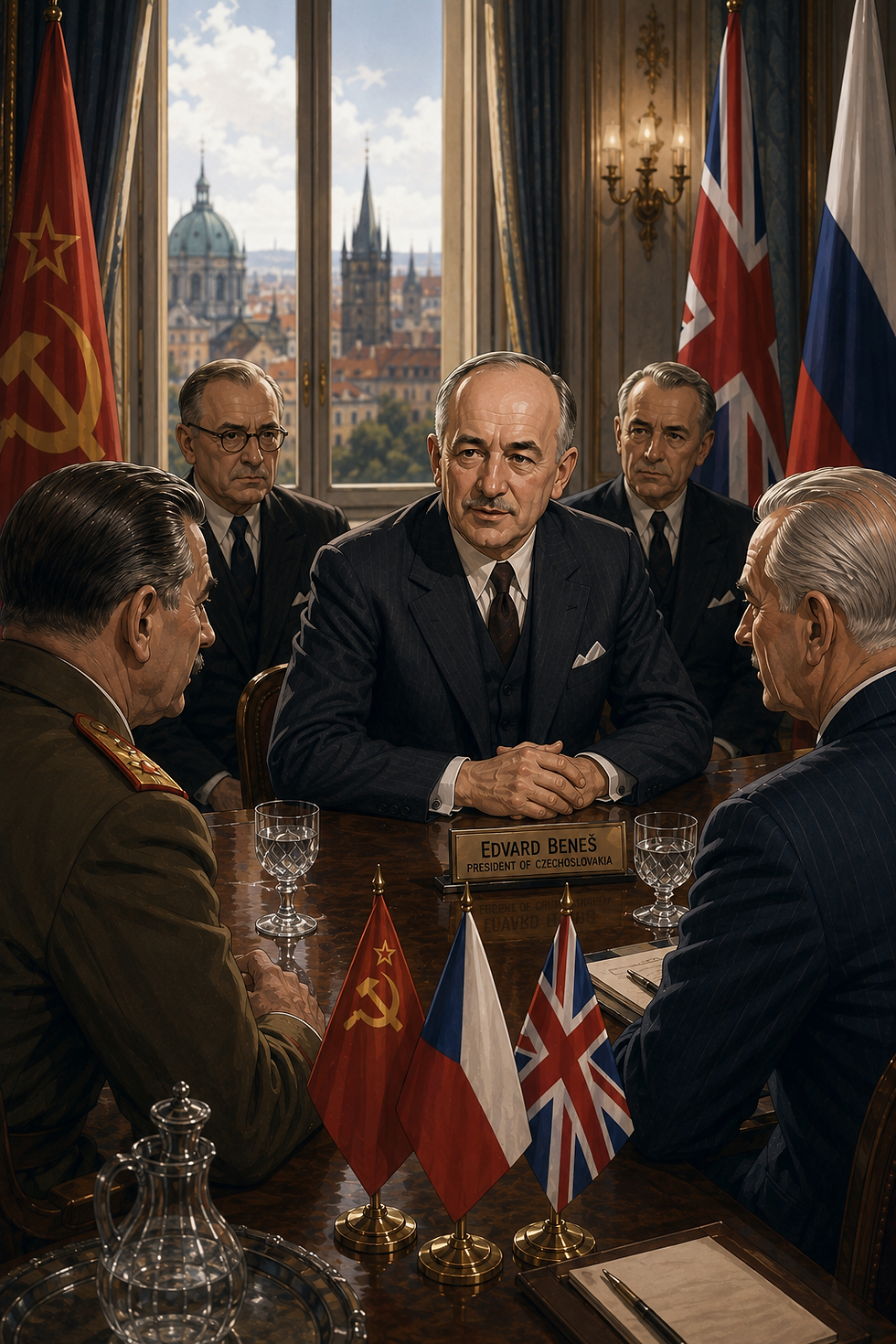
My Name is Edvard Beneš: President of Czechoslovakia
I served twice as President of Czechoslovakia during some of the most dangerous years my country ever faced. I was a diplomat by training and temperament. I believed that small nations could survive among powerful neighbors through alliances, international law, negotiation, and careful diplomacy. Yet during my lifetime, I watched Czechoslovakia gain its independence, lose it to Nazi Germany, regain it after a devastating war, and finally fall under communist domination.
Building a New Country
I was born in 1884 in Bohemia, then part of Austria-Hungary. I studied in Prague, Paris, and Dijon and became deeply involved in the Czech independence movement during the First World War. Working alongside Tomáš Garrigue Masaryk and Milan Rastislav Štefánik, I helped gain Allied support for an independent Czechoslovakia. When Austria-Hungary collapsed in 1918, our new republic emerged. I became foreign minister and devoted myself to protecting its independence.
Diplomacy as Our Defense
Czechoslovakia was surrounded by larger powers, and I knew we could not rely upon military strength alone. I supported the League of Nations, cultivated our alliance with France, helped construct the Little Entente with Romania and Yugoslavia, and eventually sought improved relations with the Soviet Union. I believed collective security could deter aggression. In 1935, I succeeded Masaryk as president. Within three years, however, Adolf Hitler would put everything we had built in danger.
Munich and the Loss of Czechoslovakia
In 1938, Hitler demanded the Sudetenland, a heavily fortified region of Czechoslovakia with a large German-speaking population. Britain and France met Germany and Italy at Munich without Czechoslovakia participating in the final negotiations and agreed that the territory should be transferred to Germany. France, despite its alliance with us, would not fight. Britain urged acceptance. Faced with the possibility of fighting Germany largely alone, I accepted the settlement and resigned shortly afterward. It was one of the bitterest decisions of my life.
Exile and Another War
I eventually went to London, where I led the Czechoslovak government-in-exile during the Second World War. My objective was clear: Czechoslovakia must be restored. Our soldiers and airmen fought with the Allies, while resistance continued inside our occupied homeland. As the war progressed, I also sought cooperation with Joseph Stalin's Soviet Union. Geography could not be wished away. The Red Army was advancing into Central Europe, and I believed a restored Czechoslovakia needed workable relations with both East and West.
Returning Home
Germany was defeated in 1945, and I returned to Czechoslovakia as president. Prague celebrated liberation, but the country that emerged from war was politically different from the republic I had known. The Communist Party had gained enormous prestige through its association with resistance and the Soviet victory over Germany. We formed the National Front, a coalition of approved political parties. I hoped Czechoslovakia could preserve its democratic traditions while maintaining friendship with Moscow.
Caught Between East and West
For a time, such a balance appeared possible. Elections were held in 1946, and the Communist Party of Czechoslovakia emerged as the largest party, although it did not win a majority. Its leader, Klement Gottwald, became prime minister. Communists also controlled important ministries, particularly the Ministry of the Interior and therefore much of the police apparatus. I remained president, convinced that constitutional government could hold the competing political forces together.
The February Crisis
In February 1948, the fragile balance collapsed. Twelve noncommunist ministers resigned, hoping that I would refuse their resignations and force a political confrontation or new elections. Instead, the communists mobilized supporters, organized action committees and workers' militias, and increased pressure upon the government. Gottwald demanded that I accept the resignations and approve replacements favorable to the communists. Czechoslovakia stood at the edge of an internal confrontation, with the Soviet Union looming behind events.
The Decision That Changed My Country
On February 25, I accepted the resignations and approved Gottwald's reconstructed government. The communists rapidly consolidated their control. Political opponents were pushed aside, independent organizations were brought under communist authority, and the democratic system we had built after 1918 effectively ended. Foreign Minister Jan Masaryk died under mysterious circumstances shortly afterward. In May, a new constitution institutionalizing communist rule was presented to me. I refused to sign it and resigned as president in June.
I died on September 3, 1948, only months after leaving office. Twice in my presidency I faced overwhelming pressure from stronger powers—Hitler's Germany in 1938 and communist forces backed by Soviet power in 1948. I spent much of my life believing that diplomacy and compromise could preserve Czechoslovakia when military confrontation threatened its destruction. I must nevertheless acknowledge that some of my decisions failed to protect the democratic republic I had helped create. I regret that the nation whose independence I spent my life building entered the Cold War behind the Iron Curtain.
Czechoslovakia: Democracy's Last Stand — February 1948 - Told by Edvard Beneš
When I returned to Czechoslovakia after the defeat of Nazi Germany, I believed our republic had been given a second life. Hitler had destroyed the country I helped build, but Germany had been defeated and our independence restored. Unlike much of Eastern Europe, Czechoslovakia still possessed strong democratic traditions and noncommunist political parties with genuine public support. I believed we might accomplish something extraordinarily difficult: cooperate with the Soviet Union without surrendering our democracy.
A Republic Returns from the Dead
Czechoslovakia had been one of Central Europe's strongest parliamentary democracies before Hitler dismantled it. After years of occupation and war, I returned as president in 1945 determined to rebuild the country. But we could not simply recreate the republic exactly as it had existed before 1938. The Soviet Red Army had helped liberate much of our territory, communist influence had grown enormously, and many Czechoslovaks admired the Soviet Union for its role in defeating Nazi Germany.
Between Moscow and the West
Geography shaped every decision I made. Germany had destroyed our independence once, and I was determined that Czechoslovakia would never again stand isolated between greater powers. Before the war, our reliance upon France and the Western democracies had failed us at Munich. I therefore believed postwar Czechoslovakia needed friendly relations with Moscow while maintaining connections with Western Europe. My objective was not to choose East or West. I hoped we could build a bridge between them.
The National Front
Our postwar government was organized through the National Front, a coalition of approved political parties. The Communist Party participated alongside noncommunist parties, including the National Socialists, People's Party, and Slovak Democrats. Certain prewar parties, particularly those associated with the political right, were excluded. This was therefore a more restricted democracy than the prewar republic, but real political competition remained within the National Front. For a time, communists and noncommunists genuinely shared government.
The Election of 1946
The parliamentary election of May 1946 revealed why Czechoslovakia seemed different from some neighboring countries. The Communist Party of Czechoslovakia performed remarkably well, receiving about 38 percent of the vote in the Czech lands and becoming the largest party nationwide, although it did not win a majority. Communist leader Klement Gottwald became prime minister. His success was not simply imposed by Soviet soldiers; communists possessed substantial genuine support, strengthened by their role in resistance and the prestige of the Soviet victory.
A Dangerous Balance of Power
Yet the coalition contained a weakness. Communists controlled several important ministries, including the Ministry of the Interior under Václav Nosek. That meant considerable influence over the police and security forces. Noncommunist ministers increasingly worried that communists were using government institutions to strengthen their party and weaken opponents. I remained president above the competing parties, attempting to preserve constitutional government while preventing a confrontation that might invite direct Soviet intervention.
The Marshall Plan Crisis
In the summer of 1947, our fragile balance was tested dramatically. Czechoslovakia initially accepted an invitation to participate in discussions concerning the American Marshall Plan for European recovery. I believed economic cooperation with the West could coexist with friendship toward Moscow. Stalin disagreed. After Czechoslovak leaders were summoned to Moscow, our government reversed its decision and withdrew from participation. The episode demonstrated something deeply troubling: our freedom to conduct an independent foreign policy was narrowing.
Could Communists and Democrats Govern Together?
Even then, the outcome was not obvious to everyone. Parliament still existed. Noncommunist ministers remained in government. Newspapers representing different political viewpoints continued to operate, although pressures were growing. Elections were expected again in 1948. Many Czechoslovaks still hoped socialism, democracy, and cooperation with the Soviet Union could coexist. That possibility made our country one of the most important political experiments in postwar Europe.
February Approaches
By early 1948, however, tensions inside the government were becoming severe. Noncommunist ministers accused Interior Minister Nosek of placing communists into important police positions. They feared that the security apparatus was gradually becoming an instrument of one political party. The dispute concerned more than police appointments. It raised the fundamental question of whether Czechoslovakia would continue to possess institutions independent of communist control.
In February, twelve noncommunist ministers decided to resign, expecting that I would reject their resignations or that the crisis would force new elections. They believed constitutional procedure could halt the communist advance. Gottwald and the Communist Party saw an opportunity.
For nearly three years, I had attempted to keep Czechoslovakia democratic while maintaining friendship with the Soviet Union. Now that balance was collapsing. What happened during the next several days would determine whether our country remained one of Eastern Europe's last functioning parliamentary democracies—or joined the communist bloc forming around us.


Comments