

16. Lessons from World War II: Women and Minorities During World War II

Women Enter the Wartime Workforce
After the United States entered World War II in December 1941, millions of men left civilian employment for military service while American factories received enormous orders for aircraft, ships, vehicles, weapons, uniforms, and supplies. The nation suddenly needed workers—and women became essential to keeping America's wartime economy running.
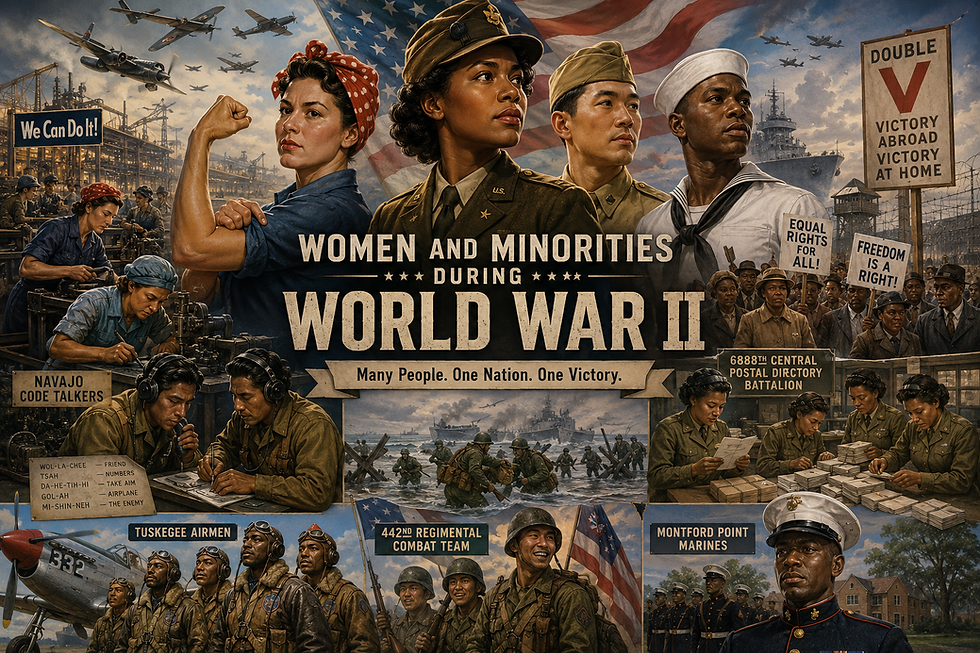
A Nation Running Out of Workers
As military mobilization accelerated, employers could no longer depend primarily on male workers. Women who had previously worked mainly in teaching, nursing, domestic service, clerical jobs, agriculture, or the home began entering industries that had often excluded them. They became welders, machinists, riveters, electricians, inspectors, crane operators, laboratory workers, truck drivers, and aircraft workers. Women also filled thousands of government and office positions. By 1945, roughly 19 million American women were in the civilian labor force, millions more than before the war.
Rosie the Riveter
The most famous symbol of this transformation became "Rosie the Riveter." Rosie was not one specific woman but a cultural character representing female defense workers. A popular 1943 song helped spread the name, while wartime artwork and advertising reinforced the image of a confident woman doing industrial work. Norman Rockwell's Rosie appeared on the cover of The Saturday Evening Post in 1943, while J. Howard Miller's famous "We Can Do It!" poster—later strongly associated with Rosie—was originally created for Westinghouse workers. These images helped communicate a powerful wartime message: women were capable of doing difficult industrial jobs and were urgently needed.
Building the Arsenal of Democracy
Women worked throughout the enormous American war-production system. In aircraft plants, they assembled fuselages, installed wiring, inspected components, and riveted metal panels. In shipyards, women welded and fitted parts onto vessels that would carry soldiers and supplies across the oceans. Others produced ammunition, military vehicles, radios, uniforms, and countless pieces of equipment. Women also worked on farms through programs such as the Women's Land Army, helping compensate for agricultural labor shortages. Their work helped make possible America's extraordinary wartime production.
Opportunity Did Not Mean Equality
The wartime workforce was not a world of instant equality. Women frequently earned less than men and faced skepticism about whether they belonged in industrial occupations. African American women often encountered the additional barrier of racial discrimination and were sometimes restricted to lower-paying positions even as labor shortages grew. Mothers faced another enormous challenge: finding childcare while working long shifts. The federal government supported wartime childcare centers in some communities, but assistance was uneven and could not meet every family's needs.
When the Soldiers Came Home
Victory brought another dramatic change. As servicemen returned, many women were encouraged—or expected—to leave wartime jobs so veterans could reclaim civilian positions. Some willingly returned home, while others wanted to continue careers they had discovered they enjoyed and could perform successfully. Women's participation in the labor force declined immediately after the war, but it did not return completely to its prewar pattern. Millions of women had gained skills, wages, confidence, and experience that could not simply be erased.
A Door That Could Not Completely Close
World War II did not create equality between men and women, but it demonstrated on an enormous national scale that women could successfully perform jobs once widely considered unsuitable for them. The women who built bombers, welded ships, managed offices, harvested crops, and kept factories operating helped win a global war while quietly changing American society at home. Rosie the Riveter became famous because she represented something larger than a poster: millions of ordinary women had stepped into unfamiliar roles, proved what they could accomplish, and helped open a door that future generations would push even farther.
Women in the Armed Forces
More than 350,000 American women served in or with the U.S. military during World War II, taking on responsibilities that helped transform women's place in national defense. As millions of men were sent overseas, the military urgently needed people to handle communications, administration, medicine, transportation, maintenance, intelligence, and countless other jobs. Women answered that need, putting on uniforms and entering a military world that had traditionally offered them few opportunities outside nursing.
Women Join the Army
In 1942, Congress created the Women's Army Auxiliary Corps, which became the Women's Army Corps (WAC) in 1943, giving its members full military status. WACs served in hundreds of types of assignments, including communications, clerical work, mechanics, weather observation, photography, intelligence, and aircraft maintenance. Thousands served overseas. Their work allowed more male soldiers to be reassigned to combat positions while demonstrating that women could successfully handle important military responsibilities.
WAVES, Marines, and SPARS
The Navy established the WAVES—Women Accepted for Volunteer Emergency Service—in 1942. Women served as radio operators, aviation mechanics, parachute riggers, instructors, clerks, and technicians. The Marine Corps Women's Reserve followed in 1943, with its members famously serving under the idea of "Free a Marine to Fight." The Coast Guard created its women's reserve, known as SPARS, whose members performed communications, administrative, and technical duties at stations throughout the United States.
Nurses Near the Battlefields
Army and Navy nurses faced some of the war's harshest realities. Tens of thousands of military nurses cared for wounded and sick servicemen in hospitals, aboard hospital ships, and in medical facilities close to combat zones. Some served under enemy fire, while others endured disease, exhaustion, and dangerous conditions. Army nurses captured in the Philippines even became prisoners of war after Japanese forces overran American positions in 1942.
The Women Who Flew Military Aircraft
One of the most remarkable wartime programs was the Women Airforce Service Pilots, or WASP. More than 1,000 women served as WASP pilots, ferrying military aircraft between bases, towing targets for gunnery practice, transporting equipment, and testing aircraft. They flew many types of American military airplanes, allowing male pilots to concentrate on combat assignments. Thirty-eight WASP members died during their service, yet they were considered civilians rather than military personnel at the time and did not receive veteran status until decades later.
Serving Without Complete Equality
Women in uniform still encountered restrictions. Most were prohibited from direct combat roles, leadership opportunities were limited, and military culture often treated their service as temporary. African American women faced both racial segregation and discrimination, even while serving their country. Yet units such as the all-Black, all-female 6888th Central Postal Directory Battalion proved their abilities overseas by tackling an enormous backlog of military mail in Europe.
African Americans and the Double V Campaign
During World War II, Black Americans served in the armed forces, worked in defense industries, purchased war bonds, and supported the national war effort. Yet segregation and racial discrimination remained widespread. This contradiction inspired a powerful question: If America was fighting tyranny abroad, shouldn't it also defend equality at home?
Two Victories, One Campaign
The idea became known as the "Double V" campaign—victory against America's enemies abroad and victory against racism at home. The campaign gained national attention after James G. Thompson, a young Black cafeteria worker in Wichita, Kansas, wrote a letter to the Pittsburgh Courier in early 1942 asking whether African Americans should fight for a "double victory." The newspaper embraced the idea, and the Double V symbol quickly became a rallying cry in Black communities across the country.
Fighting for Freedom in a Segregated Military
More than one million African Americans served in the U.S. armed forces during World War II, but the military remained segregated for most of the conflict. Black servicemen were frequently assigned to separate units and often given support or labor duties rather than combat assignments. Black officers faced restrictions, and military facilities could be segregated. Nevertheless, African American units repeatedly demonstrated their abilities when given opportunities to serve in demanding assignments.
The Power of the Black Press
Black newspapers became an important force behind wartime demands for equality. Publications such as the Pittsburgh Courier, Chicago Defender, and Baltimore Afro-American reported discrimination that much of the mainstream press ignored. They celebrated Black military achievements, challenged segregation, and encouraged readers to participate fully in the war effort while continuing to demand their constitutional rights. Their message reached communities throughout the country.
Pressure for Change at Home
Civil-rights leaders also challenged discrimination in America's growing defense industries. Labor leader A. Philip Randolph threatened to organize a massive march on Washington in 1941 unless the federal government acted against discrimination in defense employment. President Franklin D. Roosevelt responded by issuing Executive Order 8802, prohibiting racial discrimination in the national defense industry and creating the Fair Employment Practice Committee. Discrimination continued, but the order represented an important federal step toward workplace equality.
A War That Changed Expectations
World War II exposed a contradiction that became increasingly difficult to ignore. African Americans were defending democracy overseas while confronting segregation, discrimination, and sometimes racial violence at home. Veterans returned having worn their country's uniform and served alongside a generation that had fought a war described as a struggle for freedom. Many were less willing to accept second-class citizenship after coming home.
Victory Abroad—and a Fight Continuing at Home
The defeat of Nazi Germany and Imperial Japan brought one half of the Double V goal closer to completion, but the struggle against racial discrimination continued. Wartime activism, military service, migration, and the growing influence of the Black press helped build momentum for the modern Civil Rights Movement. The Double V Campaign therefore became more than a wartime slogan. It represented a demand that America's promises of liberty and equality should apply not only to the people it claimed to defend overseas, but also to its own citizens at home.
African Americans in the Armed Forces
The U.S. military itself was largely segregated, and Black servicemen and women frequently faced limited opportunities, separate facilities, and discrimination. Yet when given the opportunity to serve in demanding roles, African American units built extraordinary records that challenged assumptions about race and military ability.
The Tuskegee Airmen Take to the Sky
Before World War II, many military leaders doubted whether African Americans should serve as military pilots. The Tuskegee aviation program in Alabama helped prove those assumptions wrong. Black pilots, navigators, mechanics, instructors, and support personnel trained for the Army Air Forces, and units including the 332nd Fighter Group eventually flew combat missions overseas. The Tuskegee Airmen escorted bombers, attacked enemy positions, and earned a distinguished combat record while demonstrating that segregation—not ability—had been restricting opportunity.
The Black Panthers Roll into Battle
The 761st Tank Battalion, nicknamed the "Black Panthers," became one of the best-known African American armored units of the war. After extensive training in the United States, the battalion entered combat in Europe in 1944 and fought for more than 180 consecutive days as American forces pushed toward Germany. Its soldiers participated in hard fighting during the Battle of the Bulge and the final campaigns into Germany and Austria. Their motto captured their determination in two simple words: "Come Out Fighting."
Breaking Barriers in the Marine Corps
For generations, the Marine Corps had excluded African Americans from its ranks. That began changing during World War II. Starting in 1942, Black Marines trained at Montford Point, a segregated facility near Camp Lejeune, North Carolina. Approximately 20,000 African Americans trained there between 1942 and 1949. Many served in ammunition and supply units in the Pacific, performing dangerous work supporting combat operations on islands such as Saipan, Peleliu, Iwo Jima, and Okinawa.
The Women of the 6888th
African American women also served overseas. In 1945, the 6888th Central Postal Directory Battalion arrived in Europe under the command of Major Charity Adams. The roughly 850 women of the "Six Triple Eight" faced warehouses filled with millions of pieces of delayed mail intended for American servicemembers. Working around the clock in shifts, they developed systems to locate soldiers and clear the backlog. Their motto—"No Mail, Low Morale"—reflected how important letters from home were to troops fighting far away.
Fighting Two Battles
Even decorated Black servicemembers could return to an America where segregation remained part of everyday life. Black soldiers sometimes traveled on segregated transportation, encountered discrimination near military bases, and returned from overseas to communities where many restaurants, schools, theaters, and other public facilities remained separated by race. Their service made the contradiction increasingly visible: how could Americans risk their lives defending democracy overseas while being denied equal treatment in their own country?
Service That Helped Change America
The achievements of the Tuskegee Airmen, 761st Tank Battalion, Montford Point Marines, 6888th, and countless other Black servicemembers helped challenge arguments used to defend military segregation. In 1948, President Harry S. Truman issued Executive Order 9981, declaring equality of treatment and opportunity in the armed services and beginning the process of military desegregation. The veterans of World War II had helped defeat America's enemies overseas, but their service also strengthened another struggle—the long campaign to make the freedoms they defended abroad more fully available at home.
Japanese Americans: Internment and Military Service
After Japan attacked Pearl Harbor on December 7, 1941, fear of invasion and espionage swept across the West Coast. Japanese Americans suddenly found themselves viewed with suspicion because of their ancestry. While the United States fought against authoritarian governments overseas, the federal government removed approximately 120,000 people of Japanese ancestry from their homes and confined them in camps—while thousands of other Japanese Americans put on American uniforms and fought for the same nation.
Executive Order 9066
On February 19, 1942, President Franklin D. Roosevelt signed Executive Order 9066, authorizing military commanders to exclude people from designated military areas. The order did not specifically name Japanese Americans, but it became the basis for their mass removal from much of the West Coast. About two-thirds of those incarcerated were American citizens. Families were given limited time to prepare, often forcing them to sell businesses, farms, homes, and possessions quickly or leave them behind.
Life Behind Barbed Wire
Families were transported first to temporary assembly centers and then to camps operated by the War Relocation Authority in isolated areas of states including California, Arizona, Wyoming, Colorado, Utah, Idaho, and Arkansas. Families lived in simple barracks surrounded in many locations by fences and guard towers. They created schools, newspapers, sports teams, gardens, and community organizations as they attempted to maintain normal lives under extraordinary circumstances. No mass program of espionage by Japanese Americans was ever uncovered to justify incarcerating an entire population based on ancestry.
A Uniform for the Country That Confined Their Families
The injustice produced an extraordinary contradiction when Japanese Americans volunteered or were drafted into the U.S. military. Some soldiers left families who remained confined in camps while they went overseas to fight. The 442nd Regimental Combat Team, composed primarily of Japanese American soldiers, fought in Europe alongside the 100th Infantry Battalion. They battled through Italy, France, and Germany and became famous for their courage and sacrifice, including their costly rescue of the surrounded "Lost Battalion" in France.
Fighting a Different War in the Pacific
Japanese Americans also performed vital intelligence work. Thousands served in the Military Intelligence Service, where their knowledge of the Japanese language and culture proved invaluable in the Pacific. They translated captured documents, interrogated prisoners, monitored communications, and sometimes entered dangerous areas near the front lines. Their work provided American commanders with intelligence that helped military operations against Japan—the country their families' ancestry had caused some Americans to suspect them of supporting.
Freedom, Security, and the Constitution
The incarceration raised difficult constitutional questions. Could the government restrict the liberty of citizens because of wartime fears? The Supreme Court upheld the exclusion policy in Korematsu v. United States in 1944, a decision that became widely condemned in later decades. That same year, in Ex parte Endo, the Court ruled that the government could not continue detaining a citizen whom it conceded was loyal. The exclusion orders were soon lifted, and Japanese Americans began returning to communities where many discovered that homes, businesses, and property had been lost.
Native Americans and the War Effort
Native communities represented only a small portion of the American population, yet their participation was substantial. By war's end, more than 24,000 Native American men had served in the U.S. armed forces, along with Native women who served in military and medical roles. Their contributions reached far beyond one of the war's most famous stories—the Code Talkers.
Answering the Call to Serve
Native Americans enlisted and were drafted into the Army, Navy, Marine Corps, and other services, serving in nearly every theater of the war. Men from tribes including the Cherokee, Choctaw, Comanche, Sioux, Hopi, Navajo, and many others became infantrymen, sailors, pilots, scouts, mechanics, medics, and communications specialists. Native servicemen fought in Europe, North Africa, and across the Pacific. Their service was especially striking because many came from communities that had endured generations of broken treaties, forced relocation, and federal policies designed to suppress Indigenous cultures.
The Navajo Code Talkers
Among the best-known Native servicemen were the Navajo Code Talkers of the U.S. Marine Corps. Beginning in 1942, Navajo Marines developed a military communications code based on their language. They created special Navajo terms for military words that had no direct traditional equivalent and transmitted messages rapidly by radio and telephone. During major Pacific campaigns, including Guadalcanal, Saipan, Iwo Jima, and Okinawa, Code Talkers communicated troop movements, artillery instructions, and battlefield information. Their code was never successfully deciphered by Japanese forces during the war.
More Than the Navajo
The Navajo were not the only Indigenous people who used Native languages for military communications. Members of several tribes, including Comanche, Choctaw, Hopi, Meskwaki, and others, also served as code talkers or military communicators. Comanche Code Talkers, for example, served during the Normandy invasion and European campaign. These programs demonstrated how languages that government policies had once attempted to suppress could become valuable national-security resources.
The War Comes to Native Communities
The war effort also transformed life at home. Native Americans left reservations and rural communities for jobs in shipyards, aircraft factories, railroads, agriculture, and other defense industries. Native women were among those entering wartime employment and military nursing. Tribal lands and natural resources also contributed to the war effort. This movement exposed many Native Americans to cities, industrial employment, and new opportunities, but it also separated families and accelerated cultural and economic changes within Native communities.
Coming Home to an Unequal Nation
Returning Native veterans sometimes discovered that military service had changed their expectations. They had traveled around the world, carried weapons in defense of the United States, commanded responsibilities, and fought beside Americans from very different backgrounds. Yet many returned to reservations struggling with poverty, inadequate housing, limited employment, and complicated relationships with the federal government. Their experiences contributed to debates over Native citizenship, tribal sovereignty, veterans' rights, and the future of reservation communities.
A Contribution Larger Than the Code
The Code Talkers became celebrated symbols of Native American participation in World War II, but their remarkable story represents only part of a much larger contribution. Native Americans fought on battlefields, cared for the wounded, built military equipment, produced food and resources, and worked throughout America's wartime economy. Their service demonstrated an important truth about World War II: victory depended not only upon famous generals and enormous armies, but upon communities across the country whose contributions were sometimes overlooked long after the fighting ended.
Hispanic Americans and Other Minority Communities at War
Mexican Americans, Puerto Ricans, Chinese Americans, Filipino Americans, and other communities entered the armed forces, worked in defense plants, produced food, purchased war bonds, and supported families serving overseas. Their experiences showed both the diversity of America's war effort and the unfinished struggle over what equal citizenship should mean.
Mexican Americans Go to War
Hundreds of thousands of Hispanic Americans served in the U.S. armed forces during World War II, including large numbers of Mexican Americans. They served throughout the Army, Navy, Marine Corps, and Army Air Forces, generally in integrated ethnic terms because the military did not officially segregate Hispanics as a separate racial category. Mexican American soldiers fought in major campaigns across Europe and the Pacific, while families at home worked in factories, shipyards, farms, and other essential industries. Their service challenged stereotypes even as discrimination remained common in housing, employment, schools, and public accommodations in parts of the country.
Puerto Ricans Defend the Americas
Puerto Ricans also served extensively in the American military. The 65th Infantry Regiment, composed largely of Puerto Rican soldiers, performed important wartime assignments, including protecting strategic installations in the Caribbean and later serving overseas. Thousands of Puerto Rican men and women contributed through military service, nursing, communications, and wartime employment. Puerto Rico's position in the Caribbean also made the island strategically important for protecting shipping routes and approaches to the Panama Canal.
Chinese and Filipino Americans Answer the Call
Chinese Americans served in every branch of the armed forces, including Chinese American women who joined organizations such as the Women's Army Corps. Their wartime service occurred while Chinese communities were still confronting decades of discriminatory immigration policies, although Congress repealed the Chinese Exclusion Act in 1943. Filipino Americans likewise served with distinction. After Japan invaded the Philippines, Filipino and American forces fought together, and Filipino Americans in the United States pushed for opportunities to join units such as the 1st and 2nd Filipino Infantry Regiments.
The Zoot Suit Riots
The war also exposed serious tensions at home. In Los Angeles in June 1943, groups of U.S. servicemen and others attacked young Mexican Americans and other youths associated with the distinctive "zoot suit" style. Victims were beaten and, in some cases, stripped of their clothing while authorities struggled or failed to stop the violence. The Zoot Suit Riots revealed how racial prejudice, sensational newspaper coverage, wartime tensions, and conflicts between servicemen and local youths could erupt into violence even while Americans were fighting overseas.
Fighting the War from the Home Front
Minority communities were equally important to wartime production. Men and women entered shipyards, aircraft plants, farms, railroads, and factories as labor shortages created new opportunities. The wartime Bracero Program brought Mexican laborers to the United States to work primarily in agriculture and later other industries under temporary contracts. These workers helped maintain food production and transportation, although many experienced poor working conditions, discrimination, and violations of promised protections.
Service, Sacrifice, and a Demand for Equality
World War II did not end discrimination, but military service and wartime employment changed expectations within many communities. Veterans returned home knowing they had fought for their country, while workers had proven themselves in industries that once excluded them. These experiences strengthened later campaigns against segregation and discrimination and for voting rights, fair employment, and equal treatment. For many minority Americans, victory in 1945 therefore marked not the end of a struggle, but the beginning of a stronger demand that the freedoms defended overseas should also be honored at home.
How World War II Changed the Fight for Civil Rights
Women had operated factories and served in uniform. African Americans had fought in segregated military units. Native Americans, Hispanic Americans, Japanese Americans, and other groups had made enormous contributions to victory. When the war ended in 1945, many Americans began asking a powerful question: if they were capable of defending their country, why should they accept unequal treatment within it?
Veterans Come Home
Millions of American servicemembers returned home after the war, including hundreds of thousands of minority veterans. African American soldiers who had fought fascism overseas returned to segregation, discriminatory voting practices, and unequal opportunities in many parts of the country. Japanese American veterans returned from military service while many of their families were rebuilding lives disrupted by wartime incarceration. Native American and Hispanic veterans also encountered discrimination. Military service had given many veterans new experiences and expectations, strengthening their determination to claim the rights of American citizenship.
The Double V Continues
For African Americans, the wartime Double V campaign—victory against enemies abroad and racism at home—did not simply disappear when the fighting ended. Black veterans, newspapers, churches, civil-rights organizations, and community leaders increased pressure for change. Organizations such as the NAACP expanded their membership dramatically during the 1940s. The contradiction between America's claims to champion democracy internationally and the reality of segregation at home became increasingly difficult to defend.
Truman Challenges Military Segregation
One major breakthrough came in 1948. President Harry S. Truman issued Executive Order 9981, declaring that there should be equality of treatment and opportunity for members of the armed forces regardless of race, color, religion, or national origin. Military integration took time to implement, but the order represented an important use of presidential authority against institutional segregation. The military that had fought World War II largely segregated would fight the Korean War while moving increasingly toward integration.
Women Face a Different Postwar World
Women experienced their own complicated transition. Many wartime workers lost industrial jobs as returning servicemen reentered the workforce, and popular culture often encouraged women to return to domestic roles. Yet millions of women had earned wages, learned specialized skills, managed households independently, and discovered occupations previously considered men's work. Women did not immediately achieve workplace equality, but wartime experiences helped weaken assumptions about what kinds of careers women could pursue.
From Wartime Service to Civil Rights Activism
The war also helped set the stage for the larger Civil Rights Movement of the 1950s and 1960s. Veterans were among those who challenged discrimination, while wartime migration had moved millions of Americans into cities where communities could organize politically and economically. Court cases, protests, voter-registration campaigns, and challenges to segregation gathered momentum. World War II was not the beginning of America's struggle for civil rights, but it accelerated changes already underway.
A Victory That Raised a New Question
America emerged from World War II celebrating victory over regimes that had denied freedom and human dignity on an enormous scale. Yet victory forced Americans to examine inequalities within their own society. Change would be slow, difficult, and fiercely contested, but the experiences of women and minority Americans during the war had demonstrated abilities and sacrifices that could no longer easily be dismissed. World War II helped transform the fight for civil rights by turning a wartime question into a lasting national challenge: would the freedoms America defended abroad be equally protected for its citizens at home?
Important People: Women and Minorities During World War II
Oveta Culp Hobby (1905–1995): Building the Women's Army Corps
Oveta Culp Hobby was a journalist, government official, and military leader who became one of the most influential American women of World War II. She helped organize the Women's Army Auxiliary Corps in 1942 and became its first director. When it became the Women's Army Corps in 1943, Hobby became its first commanding officer and eventually achieved the rank of colonel. Under her leadership, women served in communications, administration, intelligence, mechanics, and many other military occupations. Hobby helped demonstrate that women could perform vital responsibilities within the armed forces.
Charity Adams Earley (1918–2002): Leading the Six Triple Eight
Charity Adams became the highest-ranking African American woman in the Women's Army Corps during World War II. She commanded the 6888th Central Postal Directory Battalion, the only predominantly Black WAC unit sent overseas during the war. Arriving in Europe in 1945, the approximately 850 women confronted an enormous backlog of military mail. Adams organized her soldiers into round-the-clock shifts, helping reconnect servicemembers with families at home while challenging assumptions about both African Americans and women in military leadership.
Benjamin O. Davis Jr. (1912–2002): Commander of the Tuskegee Airmen
Benjamin O. Davis Jr. entered West Point in 1932 and endured severe racial isolation from many fellow cadets. During World War II, he became one of the central leaders associated with the Tuskegee Airmen and commanded the 99th Fighter Squadron and later the 332nd Fighter Group. Davis and the Black airmen serving under him built a distinguished combat record in Europe. His career challenged claims that African Americans lacked the ability to become successful military pilots and commanders. He later became the first African American general officer in the U.S. Air Force.
A. Philip Randolph (1889–1979): Challenging Discrimination at Home
Labor leader A. Philip Randolph understood that wartime production created an opportunity to challenge racial discrimination. In 1941, he threatened to organize a massive march on Washington to protest discrimination against African Americans in defense employment and the military. President Franklin D. Roosevelt responded by issuing Executive Order 8802, which prohibited racial discrimination in defense industries and created the Fair Employment Practice Committee. Randolph demonstrated how organized political pressure could force the federal government to confront discriminatory practices.
Daniel Inouye (1924–2012): A Japanese American Soldier
Daniel Inouye was a Japanese American from Hawaii who joined the U.S. Army after restrictions on Japanese American military service were changed. He served with the famous 442nd Regimental Combat Team and fought in Europe, where he lost his right arm during combat in Italy in 1945. His extraordinary actions eventually earned him the Medal of Honor. After the war, Inouye entered politics and eventually served nearly five decades in the U.S. Senate, making his life a remarkable connection between wartime service and later public leadership.
Ira Hayes (1923–1955): Native American Marine
Ira Hayes was a member of the Gila River Indian Community and a Marine who fought in the Pacific. During the Battle of Iwo Jima in 1945, Hayes became one of the six servicemen photographed raising the American flag on Mount Suribachi. The photograph became one of the most recognizable images of World War II. Hayes participated in a war-bond tour after returning home, but struggled with the attention and with life after combat. His story provides students with an opportunity to examine both Native American military service and the difficult experiences some veterans faced after returning home.
Joseph Medicine Crow (1913–2016): Warrior and Historian
Joseph Medicine Crow, a member of the Crow Nation, served in the U.S. Army in Europe during World War II. During combat against German forces, he completed several actions traditionally associated with becoming a Crow war chief, including touching an enemy without killing him, taking an enemy weapon, leading a successful war party, and capturing enemy horses. After the war, Medicine Crow became an important historian and educator who preserved Crow history and traditions. His life connected Native military service with the survival of Indigenous cultural traditions.
Activities for Learning About Women and Minorities During World War II
Build It Like Rosie
Recommended Age: Grades 3–6
Activity Description: Students become workers in a simulated World War II defense factory. Their challenge is to create simple paper airplanes or another classroom product while experiencing how factories used assembly lines to increase production. The activity introduces students to women entering aircraft plants, shipyards, and factories during wartime.
Objective: Understand why women entered industrial employment in large numbers and how their labor contributed to wartime production.
Materials: Paper, pencils, scissors, tape, timer, and optional pictures of wartime factories.
Instructions: Divide students into small "factory teams." Assign each student one production job, such as folding, cutting, assembling, inspecting, or recording completed products. Give teams five minutes to produce as many acceptable products as possible. Afterward, discuss what would happen if millions of experienced workers suddenly left for military service. Explain how women filled many of these positions during WWII and discuss "Rosie the Riveter" as a symbol of these workers.
Learning Outcome: Students will understand how labor shortages created new opportunities for women and why female workers became essential to American wartime production.
Become a Code Talker
Recommended Age: Grades 4–8
Activity Description: Students investigate the importance of Native American Code Talkers by developing a simple classroom code and attempting to transmit military-style messages without another team understanding them.
Objective: Understand how secure communication worked and why Indigenous languages were valuable to American military operations.
Materials: Paper, pencils, index cards, and teacher-created messages such as "Supplies arrive tomorrow" or "Move to the northern position."
Instructions: Divide students into teams and give them time to create code words for approximately 10–15 common terms. Teams then encode a message and give it to another group to decipher without the code key. After several attempts, reveal the key and discuss how Navajo and other Native American servicemen used Indigenous languages as the foundation for military communications systems during WWII.
Learning Outcome: Students will understand the importance of the Code Talkers while recognizing that Native Americans contributed to the war in many additional military and civilian roles.
Many Americans, One War
Recommended Age: Grades 5–9
Activity Description: Create stations around the classroom representing groups such as the Tuskegee Airmen, Women Airforce Service Pilots, Navajo Code Talkers, 442nd Regimental Combat Team, Montford Point Marines, and 6888th Central Postal Directory Battalion.
Objective: Compare the contributions and challenges of different groups during World War II.
Materials: Short biographies, photographs or primary sources if desired, information cards, notebooks, and pencils.
Instructions: Place information about one group at each station. Students rotate every five to seven minutes and record three things: what the group contributed, what obstacles its members faced, and one fact they found surprising. After completing the stations, students select the two groups they believe most changed American attitudes and explain their choices using historical evidence.
Learning Outcome: Students will understand that America's victory depended upon people from many backgrounds who did not always receive equal opportunities or recognition.
Freedom on Trial
Recommended Age: Grades 9–12
Activity Description: Students hold a classroom hearing examining whether wartime emergencies justify restricting individual rights. Japanese American incarceration serves as the central case, while students investigate arguments involving military security, constitutional protections, racial prejudice, and government authority.
Objective: Develop historical reasoning by evaluating competing wartime arguments using evidence.
Materials: Executive Order 9066 excerpts, constitutional amendments, short primary-source excerpts, notebooks, and evidence sheets.
Instructions: Divide students into government officials, Japanese American citizens, military representatives, civil-liberties advocates, journalists, and judges or congressional investigators. Students research their assigned historical perspectives and present evidence at a hearing. The judges then issue a written decision explaining which arguments were best supported. Finish by comparing students' conclusions with later government acknowledgment of the injustice.
Learning Outcome: Students will learn that historical decisions should be evaluated using evidence, context, constitutional principles, and an understanding of the pressures people faced at the time.


Comments