

16. Heroes and Villains of the Great Depression: From Depression to World War

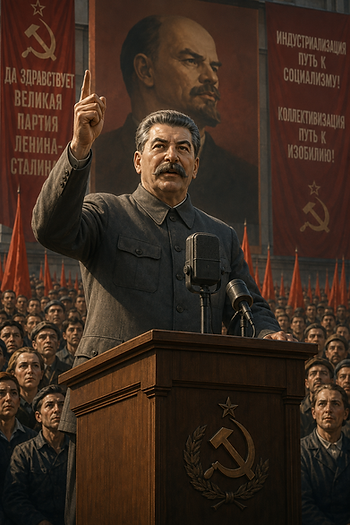
My Name is Joseph Stalin: Leader of the Soviet Union
I ruled the Soviet Union during some of the most dangerous years of the twentieth century. I was born in 1878 in the town of Gori, Georgia, then part of the Russian Empire. My father was a shoemaker with a violent temper, and my mother worked tirelessly so I could receive an education. Poverty taught me early that strength was respected, while weakness was ignored. Those lessons stayed with me for the rest of my life.
From Seminary Student to Revolutionary
My mother hoped I would become a priest, and I entered a religious seminary. Instead, I became fascinated by revolutionary ideas that promised to tear down the old order. I read forbidden books, joined underground political groups, and challenged the government. Before long I was expelled from the seminary. I chose revolution over religion, believing history belonged to those willing to seize it.
Forged by the Underground
The years that followed were filled with arrests, exile, secret meetings, and dangerous work. I adopted the name "Stalin," meaning "Man of Steel," because I intended to be unbreakable. While others gave speeches, I organized, recruited supporters, and built networks. The struggle demanded discipline, secrecy, and determination. Those who hesitated rarely survived in revolutionary politics.
Building a New Soviet State
After the Bolshevik Revolution of 1917, I worked beside Vladimir Lenin as the new communist government fought to survive civil war and foreign intervention. When Lenin died, many expected another man to lead. Instead, I steadily gained control of the Communist Party and removed my rivals one by one. I believed divided leadership invited disaster, while absolute authority created stability.
Industry Before All Else
Our nation remained poor and vulnerable. I ordered rapid industrialization and forced collectivization of agriculture because I believed the Soviet Union had only a short time to prepare for future enemies. New factories, railroads, steel mills, and power stations transformed the country into an industrial giant. The cost was enormous, and millions suffered through famine, repression, imprisonment, and fear, yet I convinced myself that survival required sacrifice.
Preparing for the Storm
As Germany, Japan, and Italy expanded their military power, I watched Europe grow increasingly unstable. I strengthened Soviet industry and expanded our armed forces, believing another great war was inevitable. Distrusting both Hitler and the Western democracies, I sought every possible advantage for my country. The agreement Germany and I signed in 1939 delayed conflict with the Soviet Union, though only for a short time.
The Great Patriotic War
When Germany invaded the Soviet Union in 1941, the struggle became one of survival. Entire cities were destroyed, millions of soldiers and civilians died, and every factory capable of producing weapons worked without rest. The Soviet people fought with extraordinary determination, and together we pushed the German armies back until they reached Berlin. Victory came at a terrible human cost, but it secured the Soviet Union as one of the world's greatest powers.
Power and Legacy
After the war, much of Eastern Europe fell under Soviet influence, and a new rivalry with the United States began. I believed strict control protected the revolution from enemies both within and beyond our borders. History, however, judges leaders not only by what they build but also by what they destroy. While my government transformed the Soviet Union into a global superpower, it also ruled through fear, imprisoned countless people, and caused immense suffering. If there is one lesson future generations should remember, it is that even achievements measured in steel, factories, and military victories cannot erase the human cost of unchecked power.
The Great Depression Leaves Nations Desperate (1933–1935) - Told by Joseph Stalin
By 1933, the Great Depression had become far more than an economic crisis. Factories stood silent, banks had failed, farms produced little profit, and millions of men and women searched each day for work that could not be found. Entire governments feared collapse as angry citizens questioned whether their leaders could solve the disaster. Around the world, desperate nations began searching for solutions that only a few years earlier would have seemed impossible.
Watching the Capitalist World Falter
From Moscow, I observed events with great interest. The Soviet Union was largely isolated from the international capitalist financial system, and while our people endured tremendous hardships from forced industrialization and collectivization, we did not experience the banking failures that swept through many Western nations. Across Europe and the Americas, businesses closed by the thousands, international trade shrank dramatically, and confidence in free-market economies weakened. To many observers, the old economic order appeared to be failing before their very eyes.
Fear Creates New Leaders
Economic suffering rarely remains confined to factories and farms. It spreads into politics, where frightened people begin searching for leaders who promise certainty instead of debate. Across Europe, extremist political movements gained followers by offering quick solutions to unemployment, inflation, and national humiliation. Some citizens embraced communism, believing government ownership would provide stability. Others turned toward fascism, placing their faith in strong rulers, military strength, and aggressive nationalism. Desperation often causes people to accept promises they might once have rejected.
The Race to Build Industry
I believed that a nation's survival depended upon its industrial strength. If the Soviet Union remained weak, foreign powers would eventually destroy us. Our government expanded steel production, coal mining, railroads, factories, and electric power at an astonishing pace. Elsewhere, Germany, Japan, Italy, Britain, France, and the United States also increased industrial production, though often for different reasons. What began as economic recovery increasingly became preparation for future conflict, as factories capable of making tractors could also produce tanks, and steel mills that built bridges could manufacture battleships.
Military Power Becomes Economic Policy
As unemployment remained painfully high, many governments discovered that military spending created jobs. New shipyards hired workers, aircraft factories reopened, and arms manufacturers received large contracts. Roads, railways, and ports expanded to support growing armies. While these projects stimulated struggling economies, they also increased military power on a scale not seen since the First World War. Economic recovery and military expansion became closely connected, making future conflict increasingly likely.
The Collapse of International Cooperation
The Depression also weakened trust between nations. Countries raised tariffs to protect their industries, restricted trade, and competed fiercely for markets and raw materials. Instead of cooperating to solve shared problems, many governments focused almost entirely on their own survival. International organizations proved unable to stop growing political tensions. Every nation became more suspicious of its neighbors, believing scarce resources had to be secured before someone else claimed them.
A Dangerous Turning Point
By 1935, the world had recovered neither its prosperity nor its confidence. Economic hardship had transformed political debate into ideological struggle, strengthened authoritarian governments, encouraged military expansion, and weakened diplomacy. Looking back, it is clear that the Great Depression did not simply impoverish nations—it changed the decisions they were willing to make. When people lose hope in peaceful solutions, they often begin believing that force, conquest, or revolution can solve problems that cooperation could not. Those beliefs carried the world ever closer to another global war.

My Name is Charles de Gaulle: Soldier and Leader of Free France
I devoted my life to the service of France. I was born in Lille in 1890 into a family that cherished learning, faith, and love of country. From an early age I believed France was more than a nation on a map. She was a civilization with a destiny. I resolved that whatever course history might take, my life would be spent defending her honor.
Learning the Profession of Arms
I entered the French Military Academy at Saint-Cyr and embraced the profession of a soldier. During the First World War I fought at Verdun, where I was wounded and captured by the Germans. Though imprisoned for years, I never accepted defeat in spirit. I studied history, military strategy, and the changing nature of warfare, convinced that future wars would demand speed, mobility, and bold leadership rather than the slow battles of the past.
Preparing for Tomorrow's War
After returning home, I wrote books urging France to modernize its army. I believed armored divisions, aircraft, and coordinated attacks would replace the static trench warfare that had consumed Europe a generation earlier. Many respected officers dismissed my ideas, preferring familiar methods over new thinking. I feared that ignoring change would someday place France in grave danger.
France Falls, But Does Not Die
In 1940 my fears became reality as German forces swept through France with astonishing speed. Our government chose surrender, but I refused to believe France had ceased to exist. From London I spoke over the radio, calling upon soldiers, sailors, workers, and citizens to continue the struggle. A government may fall, but a nation endures as long as its people refuse to abandon it.
Leading Free France
Throughout the war I worked to unite French resistance movements and preserve France's place among the Allied powers. At times I disagreed strongly with my allies, believing that France must remain independent in both thought and action. Leadership required confidence, persistence, and an unwavering belief that my country deserved to stand once again among the great nations of the world.
Restoring the Republic
When France was liberated, I helped establish a provisional government and sought to rebuild institutions weakened by war and occupation. Though I eventually stepped away from office, I returned years later when political instability threatened the nation. Together we established the Fifth Republic, strengthening the presidency while preserving democratic government. I believed stability was essential if France were to flourish.
France's Place in the World
As president, I worked to restore French influence without allowing my nation to become dependent upon any foreign power. During the Cold War I often pursued policies independent of both the United States and the Soviet Union. I believed true allies could cooperate while still preserving their own sovereignty and dignity. A nation should always chart its own course.
Governments Turn Toward Massive Rearmament - Told by Charles de Gaulle
When the guns of the First World War finally fell silent in 1918, much of the world believed such destruction must never happen again. International agreements sought to limit the size of armies, reduce the construction of warships, and discourage future conflicts. Many people hoped diplomacy alone could preserve peace. Yet peace is strongest when supported by preparedness, and that lesson was too often forgotten during the years that followed.
The Lessons Many Ignored
As a French officer, I devoted much of my career to studying how warfare had changed. The trenches of the First World War had shown the terrible cost of fighting yesterday's battles with yesterday's ideas. I became convinced that future wars would be won not by slow-moving armies, but by fast-moving tanks, coordinated aircraft, mobile artillery, and reliable radio communication. Unfortunately, many military leaders remained committed to strategies that had belonged to an earlier generation.
Quiet Rearmament Begins
During the early 1930s, governments quietly began rebuilding their military forces. Some expanded their armies openly, while others concealed their activities behind civilian industries or training programs. Germany dramatically increased its armed forces after Adolf Hitler came to power, openly rejecting the military restrictions imposed after the First World War. Italy strengthened its military for campaigns in Africa, while Japan expanded both its army and navy to support its ambitions in Asia. Across the world, factories that had once produced civilian goods increasingly turned toward military production.
The Race for Air and Sea Power
The skies and seas became as important as the battlefield itself. Britain expanded the Royal Air Force and invested heavily in modern fighter aircraft and radar technology. Germany rapidly built the Luftwaffe into one of the most advanced air forces in Europe. Naval powers such as Britain, Japan, the United States, Italy, and France modernized battleships, aircraft carriers, submarines, and destroyers. Military planners understood that the next war would reach far beyond the trenches of the previous generation.
France Searches for Security
France also sought protection, though in a different way. We invested enormous resources into the Maginot Line, a vast system of fortifications stretching along much of our eastern border. Many believed these defenses would discourage invasion and prevent another catastrophe like 1914. While the forts themselves were impressive feats of engineering, fixed defenses alone could not answer the challenge posed by fast-moving armored armies. I argued repeatedly that mobility was just as essential as protection.
Treaties Lose Their Strength
International agreements intended to prevent another arms race steadily lost their influence. Nations grew increasingly unwilling to trust one another, believing that disarmament was dangerous if rivals continued expanding their own forces. Conferences produced speeches, but factories produced tanks, aircraft, and warships. The League of Nations lacked both the authority and military strength to enforce its decisions, leaving each nation to pursue its own security through greater military power.
Preparing for an Uncertain Future
Looking back, it becomes clear that rearmament was not merely the construction of weapons—it was a sign that confidence in diplomacy was fading. Governments no longer believed that promises alone could guarantee peace. Some armed themselves for defense, others for conquest, and many for both. By the late 1930s, Europe had become a continent preparing for a war that many still hoped would never come, even as nearly every nation quietly made ready for the day when hope would no longer be enough.

My Name is Hideki Tōjō: General and Prime Minister of Japan
I was born in Tokyo in 1884 into a military family. Discipline, loyalty, and duty were not merely virtues in my household—they were expectations. From childhood I was taught that the strength of Japan depended upon the honor and sacrifice of its people.
The Soldier's Path
I entered the Imperial Japanese Army Academy and devoted myself to military service. My superiors valued careful planning, strict organization, and unwavering discipline. I was never known for dramatic speeches or reckless decisions. I believed success belonged to those who prepared thoroughly, obeyed orders, and expected the same dedication from every man under their command.
Japan Faces New Challenges
During my years as an officer, Japan grew into a powerful industrial nation, but our islands possessed few natural resources. Many leaders feared that foreign powers could strangle our economy by cutting off supplies of oil, iron, and rubber. I came to believe that Japan must become self-sufficient if it hoped to remain secure and independent in an increasingly dangerous world.
Expansion and War
As the 1930s unfolded, our army expanded its operations in China, believing that military strength would protect Japan's future. When I became Prime Minister in 1941, tensions with the United States, Britain, and other nations had reached a breaking point. Negotiations continued, but many of us believed conflict had become unavoidable. War, once begun, demanded complete commitment from the nation.
The Pacific Conflict
The attack on Pearl Harbor brought Japan into a vast conflict stretching across the Pacific and Asia. At first our forces achieved remarkable victories, capturing territory with astonishing speed. Yet the industrial strength of the United States and its allies soon changed the course of the war. Every new campaign became more difficult, and each defeat weakened our ability to continue the struggle.
The Burden of Leadership
As military fortunes declined, criticism grew within both the government and the armed forces. I accepted responsibility for leading the nation during these difficult years and resigned as Prime Minister in 1944 after a series of defeats. Others continued the war, but it had become clear that Japan faced overwhelming odds against enemies with greater resources and production.
Judgment After the War
After Japan surrendered, I was arrested and placed on trial by the International Military Tribunal for the Far East. I accepted responsibility for my role as Japan's wartime leader, though I maintained that many decisions had been made in what we believed were the interests of the nation. In 1948 I was convicted of war crimes and sentenced to death.
I believed throughout my life that duty to one's nation stood above personal comfort or ambition. History, however, measures leaders not only by their intentions but also by the consequences of their decisions. The war brought devastation across Asia and the Pacific, leaving millions dead and countless families forever changed. Looking back, I cannot ignore that the pursuit of national strength through war carried a terrible price that no victory could have justified.
Japan's Military Expansion in East Asia - Told by Hideki Tōjō
As I saw it, Japan was a rapidly growing industrial nation with limited natural resources. Our islands contained too little oil, iron ore, coal of the highest quality, and many other materials required to sustain modern factories, transportation, and armed forces. While other great powers controlled vast colonies rich in resources, Japan depended heavily upon imports that could easily be interrupted during times of international tension.
The Great Depression Changes Everything
The worldwide economic collapse of the 1930s struck Japan as it did many other nations. Exports fell sharply, factories slowed production, unemployment increased, and farmers struggled to survive. Many military leaders concluded that relying upon international trade left Japan dangerously vulnerable. They argued that if our nation controlled resource-rich territories directly, our industries would no longer depend upon foreign governments or unstable world markets.
Looking Toward Manchuria
Manchuria, in northeastern China, became the first major target of this strategy. The region possessed fertile farmland, extensive forests, rich coal deposits, iron ore, and an expanding railway system. In 1931, Japanese forces occupied the area following the Mukden Incident and soon established the state of Manchukuo. Many within Japan believed this territory would provide the raw materials and economic security needed to strengthen both the nation and the military for generations to come.
Industry and the Military Grow Together
As new territory came under Japanese control, factories expanded production of steel, machinery, ships, aircraft, and military equipment. Railroads were improved, mines increased production, and industries supporting the armed forces grew rapidly. Military leaders viewed economic development and national defense as inseparable. They believed that a powerful economy required secure access to resources and that only a strong military could guarantee that access.
Conflict Expands Across China
The fighting did not end in Manchuria. In 1937, full-scale war erupted between Japan and China after the Marco Polo Bridge Incident. Japanese leaders expected a quick victory that would secure additional resources and eliminate what they viewed as threats to regional stability. Instead, the conflict became a long and costly war that consumed enormous amounts of manpower, equipment, and supplies while drawing increasing criticism from other nations.
International Pressure Increases
Japan's expansion alarmed countries around the world. The League of Nations condemned the occupation of Manchuria, though it lacked the power to reverse it. As Japanese forces advanced farther into China, relations with the United States, Britain, and other nations steadily worsened. Economic sanctions and restrictions on exports, particularly oil and strategic materials, increased the very shortages Japanese leaders had hoped territorial expansion would solve.
A Decision That Changed History
Looking back, it is clear that many of us believed territorial expansion offered the quickest path to economic security and national independence. We saw control of resources as essential to Japan's survival in a competitive world. Yet each new conquest brought new enemies, greater military commitments, and deeper international isolation. What began as an effort to solve economic instability gradually expanded into a conflict that stretched across East Asia and eventually became part of the Second World War. The lesson history teaches is that while conquest may appear to offer immediate solutions, it often creates challenges far greater than those it was intended to overcome.

My Name is Neville Chamberlain: Prime Minister of the United Kingdom
I served as Prime Minister of the United Kingdom during one of the most uncertain moments in modern history. I was born in Birmingham, England, in 1869, the son of Joseph Chamberlain, a respected statesman. Politics surrounded me from an early age, yet I did not rush into public life. Instead, I learned the value of careful planning, business, and local government, believing that sound administration was as important as grand speeches.
Serving My Community
For many years I devoted myself to improving the city of Birmingham, where I worked to strengthen housing, public health, and local services. I believed government should solve practical problems with patience and reason rather than passion. Those years taught me that compromise often achieved more than conflict, a lesson I carried with me into national politics.
A Growing Responsibility
I entered Parliament later in life and eventually became Chancellor of the Exchequer, responsible for Britain's finances during difficult economic times. The Great Depression forced governments everywhere to make difficult decisions, and I believed that stability, careful budgeting, and gradual recovery were essential. By 1937 I was asked to become Prime Minister, inheriting a Europe that seemed to drift closer to another terrible war with every passing month.
Searching for Peace
The memories of the First World War weighed heavily upon Britain. Nearly every family had suffered loss, and few wished to witness another generation march into battle. I believed it was my duty to exhaust every peaceful solution before accepting war. I met repeatedly with Adolf Hitler, hoping that negotiation and compromise could settle Europe's disputes. When the Munich Agreement was signed in 1938, I sincerely believed we had gained valuable time to preserve peace.
The Limits of Diplomacy
Events soon proved that promises alone could not restrain aggression. Germany occupied the remainder of Czechoslovakia, revealing that further expansion had always been intended. Britain responded by guaranteeing Poland's independence, and when Germany invaded Poland in September 1939, diplomacy had reached its end. With great reluctance, I announced that Britain was once again at war with Germany.
Leading During Uncertainty
The opening months of the war were difficult and uncertain. Our nation expanded its armed forces, strengthened its industries, and prepared for a long struggle, but military setbacks weakened confidence in my leadership. I believed that the country needed complete unity to face the challenge ahead, and in 1940 I resigned, making way for Winston Churchill to lead Britain through the darkest years of the conflict.
My Final Months
Although I stepped down as Prime Minister, I remained in government for a time to support the national effort. Soon afterward, illness overtook me, and I retired from public life. I died later that same year, before seeing how the war would ultimately end. My service ended, but Britain's determination continued.
History remembers me most often for the policy of appeasement, and many have judged my decisions harshly. I understand why. Yet my purpose was never surrender or weakness; it was to spare Europe from another catastrophic war while giving Britain precious time to prepare should peace fail. In the end, I learned that goodwill alone cannot preserve peace when confronted by relentless aggression. Even so, I remain convinced that every honorable leader must first seek peace before asking a nation to bear the terrible burden of war.
Italy and Germany Test the World's Resolve - Told by Neville Chamberlain
The First World War had left Europe exhausted, and nearly every government wished to avoid another conflict at almost any cost. While many leaders recognized the growing dangers, they also understood that their own citizens had little appetite for another generation of war. This hesitation shaped nearly every decision that followed.
Early Challenges to the International Order
Throughout the decade, Germany openly rejected several of the restrictions imposed after the First World War. Its armed forces expanded rapidly, and in 1936 German troops entered the Rhineland, a region that international agreements had required to remain demilitarized. Italy had already demonstrated its willingness to use military force by invading Ethiopia in 1935. These actions tested whether the international community would respond with firm resistance or continued restraint.
The League of Nations Struggles
The League of Nations had been created to prevent future wars through diplomacy and collective action. Yet when confronted with determined aggression, it possessed neither its own military forces nor the unanimous political support needed to enforce its decisions. Economic sanctions were imposed against Italy, but they proved too limited to alter events. Many governments feared that stronger action might widen the crisis rather than contain it.
Balancing Peace and Preparedness
When I became Prime Minister, Britain faced difficult realities. Our armed forces were improving but were not yet fully prepared for a major European war. At the same time, many citizens still carried painful memories of the trenches, the losses, and the destruction of the First World War. Every decision required balancing immediate resistance against the need to continue strengthening Britain's defenses. Delay, if used wisely, could provide valuable time for rearmament.
One Crisis After Another
As the years passed, each new crisis seemed more serious than the last. Germany united with Austria in the Anschluss of 1938 and later demanded control of the Sudetenland in Czechoslovakia. Each dispute raised the same difficult question: should Britain and France risk immediate war, or should negotiations continue in hopes that reasonable settlements might preserve peace? These choices were rarely as simple as later generations sometimes imagine.
The Limits of Patience
The Munich Agreement temporarily resolved the Sudetenland dispute through negotiation, and many hoped it would satisfy Germany's territorial ambitions. Yet only months later, German forces occupied the remainder of Czechoslovakia, demonstrating that agreements alone would not halt continued expansion. At that moment, it became increasingly clear that diplomacy without mutual trust could not guarantee lasting peace.
The Final Test
Britain and France then pledged to defend Poland if its independence were threatened. When Germany invaded Poland on September 1, 1939, the long period of hesitation came to an end. Two days later, Britain declared war. Looking back, the lesson is not that diplomacy was mistaken, but that diplomacy succeeds only when all parties are willing to honor their commitments. Peace is always worth pursuing, yet it must ultimately be supported by both resolve and the willingness to defend it when every peaceful path has been exhausted.
The Spanish Civil War: A Preview of World War II - Told by Charles de Gaulle
When fighting erupted in 1936 between the Republican government and the Nationalist forces led by General Francisco Franco, many nations viewed the conflict as a warning of greater dangers ahead. What appeared to be a civil war quickly became an international contest in which foreign powers tested their weapons, military strategies, and political ambitions while the rest of Europe watched with growing concern.
Foreign Powers Choose Sides
Although many governments publicly declared neutrality, several major powers became deeply involved. Germany and Italy provided aircraft, tanks, artillery, military advisers, and thousands of volunteers to support Franco's Nationalists. The Soviet Union supplied weapons, aircraft, tanks, advisers, and military assistance to the Republican government. Volunteers from dozens of countries also joined the International Brigades, believing that the outcome in Spain could influence the future of Europe itself.
A Laboratory for Modern Warfare
Military leaders carefully observed the fighting because Spain offered an opportunity to test new methods of war under real battlefield conditions. Germany's Condor Legion experimented with coordinated attacks using aircraft, artillery, and ground forces. Tanks operated alongside infantry while radio communications improved battlefield coordination. Pilots gained valuable combat experience that would later influence air campaigns across Europe. The lessons learned in Spain would soon be applied on a much larger and far more destructive scale.
The Bombing of Guernica
One event shocked the world more than any other. In April 1937, German aircraft supporting the Nationalists bombed the Basque town of Guernica. Although military targets existed nearby, much of the destruction fell upon civilians and the town itself. News reports and photographs spread around the world, demonstrating the devastating effects that modern air power could inflict upon cities. The attack became a symbol of the growing danger civilians would face in future wars.
Lessons That Could Not Be Ignored
As a French officer, I followed these developments closely. The conflict reinforced my belief that warfare had changed dramatically since the trenches of the First World War. Speed, mobility, air power, armored vehicles, and coordinated attacks were becoming decisive advantages. Armies that failed to modernize would find themselves overwhelmed by opponents who embraced these new methods. Unfortunately, too many military leaders still placed greater confidence in fixed defenses than in rapid movement.
The Democracies Hesitate
Britain and France largely followed policies of non-intervention, hoping to prevent the Spanish conflict from expanding into a wider European war. While understandable, this approach allowed Germany, Italy, and the Soviet Union to gain valuable military experience with relatively little interference. Spain became a proving ground where future enemies refined tactics, tested equipment, and measured the strengths and weaknesses of their forces before facing one another on a continental battlefield.
A Warning Before the Storm
Looking back, the Spanish Civil War stands as one of history's clearest warnings that a larger conflict was approaching. It demonstrated how ideological divisions, foreign intervention, advanced technology, and modern military doctrine could transform a regional conflict into an international concern. Those who studied Spain carefully could already glimpse the shape of the war that would soon engulf Europe. Sadly, the lessons were recognized more quickly by those preparing to wage war than by many who still hoped it could be avoided.
New Weapons and Modern Military Thinking - Told by Charles de Gaulle
The terrible battles of the First World War convinced many military leaders that future conflicts could not be fought in the same manner. Endless trench lines and slow offensives had cost millions of lives while producing only limited gains. I became convinced that victory in the next war would belong to armies that could move quickly, think creatively, and strike with speed before an enemy had time to respond.
The Rise of the Tank
The tank had first appeared during the First World War, but it was still slow, unreliable, and often used merely to support infantry. I believed this wasted its true potential. Rather than scattering tanks among infantry divisions, I argued they should be concentrated into powerful armored formations capable of breaking through enemy lines and advancing deep into hostile territory. Properly organized, tanks could restore movement to battlefields that had once become hopelessly bogged down.
The Sky Becomes a Battlefield
Aircraft also evolved rapidly during the 1920s and 1930s. No longer used simply for observation, airplanes became capable of fighting enemy aircraft, bombing factories and transportation networks, and supporting troops on the ground. Fighters protected bombers while dive bombers attacked bridges, roads, and enemy positions with remarkable precision. Control of the skies increasingly determined whether armies below could move safely and effectively.
Mechanized Armies on the Move
The modern army became far more mobile than those of previous generations. Trucks replaced horse-drawn wagons, allowing infantry to travel alongside tanks and artillery at much greater speeds. Engineers, fuel convoys, repair crews, and supply vehicles became essential parts of every advancing force. An army could no longer depend solely upon courage; it also required efficient logistics to keep thousands of vehicles moving across great distances.
The Invisible Weapon
One of the most revolutionary developments could not be seen at all. Portable radio communications allowed commanders to direct moving units almost instantly. Tank crews could receive new orders while advancing, aircraft could coordinate with ground forces, and commanders could react to changing battlefield conditions in minutes rather than hours. Information itself became a weapon, allowing flexible leaders to seize opportunities before slower opponents even understood what was happening.
The Power of Combined Arms
No single weapon guaranteed victory. The greatest success came when tanks, infantry, artillery, engineers, aircraft, and communications worked together as one coordinated force. This approach became known as combined-arms warfare. Each branch supported the others, creating a military force far stronger than the sum of its individual parts. Nations that mastered this coordination gained a tremendous advantage over armies that continued to fight with outdated methods.
Throughout the 1930s, military thinkers debated these new ideas while conflicts such as the Spanish Civil War demonstrated many of them in practice. Some governments embraced modernization, while others placed greater confidence in defensive fortifications or traditional organization. Looking back, the coming war would prove that technology alone never determines victory. Success belongs to nations whose leaders are willing to recognize change, adapt their thinking, and prepare not for the last war they remember, but for the next war that awaits.
Appeasement and the Search for Peace - Told by Neville Chamberlain
Millions had been killed, entire towns had lost a generation of young men, and families across Britain and France still carried the grief of that terrible conflict. By the late 1930s, few people wished to see Europe descend into another catastrophe. Nearly every statesman understood that if war came again, it would likely be even more destructive than the last.
The Hope That Compromise Could Succeed
Many believed that some of Germany's complaints about the Treaty of Versailles deserved discussion. The treaty had imposed territorial losses, military restrictions, and heavy reparations after the First World War, leaving bitterness that endured for years. It seemed possible that peaceful negotiations and carefully considered concessions might satisfy legitimate grievances while preserving stability. Diplomacy, after all, exists to settle disputes before armies begin to march.
Britain and France Face Difficult Choices
Britain and France were also rebuilding their own military strength. Although both nations had capable armed forces, neither believed it was fully prepared for another major European war during the middle years of the 1930s. Air defenses were still expanding, new aircraft were entering production, and armies continued to modernize. Every month gained through successful diplomacy allowed additional soldiers to be trained, more equipment to be manufactured, and stronger defenses to be completed.
The Munich Conference
The greatest test of appeasement came in 1938 during the crisis over the Sudetenland, a region of Czechoslovakia with a large German-speaking population. Leaders from Britain, France, Germany, and Italy met in Munich to seek a peaceful settlement. The agreement permitted Germany to annex the Sudetenland in exchange for assurances that no further territorial demands would follow. Many citizens greeted the agreement with relief, believing Europe had stepped back from the edge of another war.
When Trust Was Broken
That hope did not last. In March 1939, Germany occupied the remainder of Czechoslovakia, demonstrating that its ambitions extended far beyond the promises made at Munich. This action convinced many leaders that further concessions would not preserve peace. Britain and France responded by guaranteeing Poland's independence, making clear that future aggression would meet military resistance rather than additional negotiations.
Why Appeasement Remains Debated
Historians have debated appeasement for generations. Some argue that it encouraged further aggression by showing weakness. Others point out that Britain and France used the extra time to strengthen their armed forces, expand aircraft production, improve radar defenses, and prepare their economies for the conflict that eventually came. The policy must therefore be understood within the fears, limitations, and uncertainties facing leaders at the time rather than judged only by its ultimate outcome.
I understand why appeasement has become one of history's most discussed policies. My purpose was never to surrender principles, but to spare Europe another unimaginable war if peaceful negotiation remained possible. Sadly, diplomacy depends upon honesty from every participant, and peace cannot endure when agreements are viewed merely as opportunities to gain time for further expansion. The greatest lesson is not that peace should never be sought, but that lasting peace requires both sincere negotiation and the resolve to defend it when all other paths have failed.
The Soviet Union's Strategic Gamble - Told by Joseph Stalin
The Soviet Union stretched across vast distances, but size alone offered little protection against modern armies. I believed our greatest danger came not from today's enemies alone, but from the certainty that another great European war would eventually arrive. The question was not whether conflict would come, but whether we would be ready when it did.
Building an Industrial Giant
To prepare for that future, we transformed the Soviet economy through rapid industrialization. New steel mills, coal mines, hydroelectric dams, railroads, and factories rose across the country. Entire cities were built around industrial centers, while production of machinery, locomotives, and heavy equipment expanded dramatically. These industries strengthened our economy, but they also created the foundation for producing tanks, artillery, aircraft, and other weapons on an enormous scale should war become unavoidable.
Modernizing the Red Army
Industrial growth alone could not defend the Soviet Union. The Red Army also required modernization. New generations of tanks, aircraft, armored vehicles, and artillery entered production as military planners studied how warfare had evolved since the First World War. Training exercises explored mechanized operations and coordinated attacks involving infantry, armor, and air support. While political purges during the late 1930s severely weakened the army's experienced leadership, military production itself continued to expand at an extraordinary pace.
Between Two Hostile Worlds
Diplomacy proved no less difficult than military preparation. The Soviet Union distrusted the Western democracies, while Britain and France remained suspicious of communist intentions. At the same time, Adolf Hitler openly condemned communism and declared his desire for German expansion into Eastern Europe. We faced the dangerous reality of being distrusted by governments on both sides, making every diplomatic decision a careful calculation rather than a matter of friendship.
Seeking Time Through Diplomacy
As Europe moved steadily toward war, negotiations took place with both Western governments and Germany. When discussions with Britain and France failed to produce a firm military alliance, we turned toward Germany. In August 1939, the Soviet Union and Germany signed the Molotov-Ribbentrop Pact, a non-aggression agreement that surprised much of the world. Publicly, both nations promised not to attack one another. Secret protocols divided spheres of influence across parts of Eastern Europe. My calculation was straightforward: delay war with Germany while strengthening Soviet industry and military power.
The Gamble Unravels
The agreement provided only temporary security. Germany invaded Poland days later, beginning the Second World War in Europe. Less than two years afterward, in June 1941, Hitler broke the pact by launching Operation Barbarossa, the largest invasion in history. German armies surged deep into Soviet territory, proving that the agreement had never guaranteed lasting peace. The time we had gained, however, allowed many new factories, weapons, and military formations to contribute to our nation's defense.
The Nazi-Soviet Pact Changes Everything (1939) - Told by Joseph Stalin
Nazi Germany openly denounced communism, while the Soviet Union condemned fascism as a dangerous enemy. Most observers believed our governments would eventually fight one another. Yet by the summer of 1939, Europe stood on the edge of war, and every nation searched for ways to improve its own position before the first shots were fired.
A Dangerous Diplomatic Situation
For months, Soviet diplomats negotiated with Britain and France about forming a military alliance against Germany. Those discussions progressed slowly and were burdened by years of distrust. I questioned whether the Western powers truly intended to oppose German aggression or whether they hoped Germany and the Soviet Union would weaken one another in a future conflict. Faced with uncertainty, I sought another course that might provide the Soviet Union with valuable time.
The Non-Aggression Pact
On August 23, 1939, German Foreign Minister Joachim von Ribbentrop arrived in Moscow to sign a treaty with Soviet Foreign Minister Vyacheslav Molotov. The agreement stated that Germany and the Soviet Union would not attack one another and would remain neutral if either nation became involved in war with a third country. Around the world, newspapers reported the astonishing news. Governments that had viewed our two nations as bitter ideological enemies struggled to understand how such an agreement could exist.
The Secret Protocols
Hidden from the public were additional agreements that divided parts of Eastern Europe into separate spheres of influence. These secret protocols outlined how Germany and the Soviet Union expected to divide influence over territories including eastern Poland, the Baltic states, and parts of Romania. Ordinary citizens knew nothing of these arrangements at the time. Only after the war did the full details become widely known, revealing how extensively both governments had planned for territorial change before hostilities began.
Europe Is Stunned
The pact sent shockwaves throughout Europe. Germany no longer feared fighting a war on two fronts at the outset, while the Soviet Union temporarily avoided immediate conflict with Germany. Britain and France suddenly found themselves facing a far more dangerous strategic situation. Many smaller nations realized that decisions affecting their future had been made without their participation. The balance of power across Europe shifted almost overnight.
War Begins
Only days after the agreement was signed, Germany invaded Poland on September 1, 1939. Britain and France declared war two days later, marking the beginning of the Second World War in Europe. Later that month, Soviet forces entered eastern Poland in accordance with the secret agreements. The map of Eastern Europe began changing rapidly, demonstrating that diplomacy could alter borders just as dramatically as armies on the battlefield.
Time Purchased at a Cost
From my perspective, the pact delayed what I believed would eventually become an unavoidable war with Germany, allowing additional time to strengthen Soviet industry and military production. Yet the agreement did not eliminate the danger. In June 1941, Germany launched Operation Barbarossa, violating the treaty and invading the Soviet Union on a massive scale. Looking back, the Nazi-Soviet Pact remains one of history's most controversial diplomatic agreements. It shocked Europe because it demonstrated that even governments separated by bitter ideological hostility could make temporary arrangements when national strategy and survival took precedence over political doctrine.
The Final Steps Toward Global War - Told by Neville Chamberlain
For years, Britain's leaders had worked to preserve peace through diplomacy while strengthening the nation's defenses. We understood that another European war would bring enormous suffering, and every honorable effort was made to avoid it. Yet events soon demonstrated that peaceful agreements could survive only if every nation chose to respect them.
The Occupation of Czechoslovakia
In September 1938, the Munich Agreement allowed Germany to annex the Sudetenland, where many ethnic Germans lived. The agreement rested upon assurances that no further territorial demands would follow. Only a few months later, in March 1939, German forces occupied the remainder of Czechoslovakia. This action transformed the political situation across Europe. It became increasingly difficult to believe that Germany's objectives were limited to revising old borders established after the First World War.
A New British Commitment
The occupation of Czechoslovakia convinced Britain and France that stronger measures were necessary. If aggression continued unchecked, other independent nations would soon face similar threats. Britain therefore pledged to guarantee Poland's independence, declaring that if Poland were attacked, we would come to its defense. This commitment marked a significant change in British policy. Diplomacy would continue, but it would now be backed by a clear promise to resist further expansion.
Europe Holds Its Breath
Throughout the summer of 1939, negotiations continued while military preparations accelerated across Europe. Armies mobilized, factories increased production, and governments prepared for the possibility that diplomacy might fail. Then came another unexpected development: Germany and the Soviet Union signed the Nazi-Soviet Pact. The agreement removed the immediate danger of Germany fighting on two fronts and greatly increased fears that Poland would soon become the next target.
The Invasion of Poland
On September 1, 1939, German forces crossed the Polish frontier, launching a massive invasion by land and air. Fast-moving armored divisions, supported by aircraft and coordinated communications, overwhelmed many Polish defenses with remarkable speed. The attack demonstrated the effectiveness of modern mechanized warfare and confirmed that Europe had entered a dangerous new era. Diplomatic protests alone could no longer stop events already in motion.
Britain Declares War
Britain and France demanded that Germany withdraw its forces from Poland. When those demands were ignored, there remained little room for further negotiation. On September 3, 1939, I addressed the British people by radio and announced that Britain was at war with Germany. It was one of the most solemn moments of my life. Every peaceful avenue had been exhausted, and the conflict we had hoped to prevent had finally begun.
The World Crosses a Threshold
Looking back, those final months remind us how rapidly international crises can escalate when trust disappears and agreements are repeatedly broken. The occupation of Czechoslovakia weakened confidence in diplomacy, the invasion of Poland transformed regional tensions into open warfare, and Britain's declaration of war marked the beginning of a conflict that would soon spread across continents and oceans. The world had crossed a threshold from which there would be no easy return, and the greatest war in human history had begun.
From Regional Conflicts to a World at War - Told by Hideki Tōjō
From Regional Conflicts to a World at War was not the result of a single battle or one nation's decision. During the 1930s, separate conflicts unfolded across Europe, Africa, and Asia, each driven by its own political and economic circumstances. At first, these struggles appeared largely independent of one another. Yet as alliances formed and military campaigns expanded, the boundaries between regional wars gradually disappeared, creating a conflict that would involve nearly every major power on Earth.
Japan's War in China
From Japan's perspective, our largest military commitment began long before the attack on Pearl Harbor. Following the occupation of Manchuria in 1931, full-scale war with China erupted in 1937. Japanese leaders believed that securing East Asia would strengthen our economy, protect vital resources, and establish long-term security. Instead, the conflict became prolonged and costly, consuming enormous numbers of soldiers and vast quantities of equipment while drawing increasing international attention.
Europe Descends into War
At nearly the same time, Germany pursued expansion across Europe. The annexation of Austria, the occupation of Czechoslovakia, and the invasion of Poland in 1939 transformed political crises into open warfare. Britain and France declared war on Germany, beginning the European phase of the Second World War. Although the fighting occurred thousands of miles from East Asia, both conflicts increasingly affected the same global trade routes, diplomatic relationships, and military strategies.
Empires Become Involved
The great colonial empires ensured that no conflict remained isolated for long. Britain, France, the Netherlands, and the United States possessed territories throughout Asia and the Pacific. Military operations in one region influenced decisions in another. Oil from Southeast Asia, rubber from Malaya, tin from the Dutch East Indies, and shipping lanes across the Pacific became matters of strategic importance. Economic competition and military planning became inseparable.
The Pacific War Expands
As economic sanctions and embargoes reduced Japan's access to vital resources, many Japanese leaders believed that time was working against us. The attack on Pearl Harbor in December 1941 was intended to weaken American military power while Japan secured resource-rich territories throughout Southeast Asia. Instead, it brought the United States fully into the war. Within days, Germany and Italy declared war on the United States, linking the European and Pacific conflicts into one immense global struggle.
War Across Continents and Oceans
From that moment onward, battles were fought across Europe, North Africa, the Atlantic Ocean, the Pacific islands, China, Southeast Asia, and the Soviet Union. Troops from dozens of nations served on battlefields far from their own homes. Merchant ships crossed dangerous oceans carrying food, fuel, weapons, and supplies, while factories on multiple continents worked continuously to support armies fighting thousands of miles away. The conflict had become truly worldwide.
The Consequences of Global War
Looking back, it is evident that no nation could remain untouched once regional conflicts merged into a single international war. Decisions made in Berlin influenced battles in China, actions taken in Tokyo affected events in Europe, and industrial production in North America shaped campaigns around the globe. What began as separate disputes over territory, security, and resources ultimately united into the largest war in history. It stands as a reminder that in an increasingly connected world, local conflicts can grow into global crises when diplomacy fails and military ambitions continue unchecked.
Standing at the Edge of History - Told by Hideki Tōjō, Charles de Gaulle, Joseph Stalin, and Neville Chamberlain
Neville Chamberlain began, "When I entered office, Europe was still recovering from wounds that had never fully healed. The Great Depression had shaken confidence in governments, businesses, and international cooperation. Nations became increasingly concerned with their own survival. Every economic crisis made political compromise more difficult, and every year the hope of lasting peace seemed to grow weaker."
Joseph Stalin replied, "Economic hardship changes more than markets. It changes governments. It changes armies. It changes what people are willing to accept. Throughout the 1930s, every major nation searched for security. Some pursued industry, others alliances, and many expanded their militaries. No government wished to find itself unprepared when the next crisis arrived."
Different Roads, Similar Destinations
Hideki Tōjō nodded. "Japan believed that survival required resources. Without oil, steel, and other raw materials, our industries and military could not endure. Expansion appeared to many of us to be the practical solution. Looking back, what seemed like regional decisions gradually connected us to events unfolding thousands of miles away."
Charles de Gaulle answered, "France viewed those same developments with growing concern. Military thinkers observed the rapid changes in technology while politicians struggled to preserve peace. Tanks, aircraft, mechanized armies, and radio communications transformed warfare faster than many governments adapted. The danger did not arrive suddenly; it grew year after year."
When Diplomacy Begins to Fail
Chamberlain spoke thoughtfully. "Diplomacy remained our first choice because the memory of the First World War was still vivid. Every conference, every negotiation, every agreement represented another attempt to spare Europe another catastrophe. Yet diplomacy depends upon mutual trust. Once agreements were repeatedly broken, confidence disappeared, and peaceful solutions became increasingly difficult to achieve."
Stalin responded, "Trust had become a scarce resource. Nations negotiated while simultaneously preparing for war. Every government wondered whether today's ally might become tomorrow's enemy. Diplomatic agreements became temporary calculations rather than lasting commitments."
The Gathering Storm
De Gaulle continued, "The warning signs appeared everywhere. Spain became a proving ground for modern weapons. Germany rebuilt its armed forces. Italy expanded its ambitions. Japan fought across China. Factories produced aircraft and tanks instead of merely consumer goods. Each individual event appeared manageable, but together they revealed that the international order was slowly unraveling."
Tōjō added, "Many leaders believed they were responding to immediate problems—economic instability, resource shortages, or national security. Few expected those separate decisions to merge into one worldwide conflict. Yet every new campaign widened the circle of nations that became involved."
A World Connected by Conflict
Stalin folded his hands. "Once war began in Europe, it affected Asia. Once conflict expanded across Asia, it affected the Pacific. Colonial empires, international trade, and military alliances connected continents that had once seemed distant from one another. A decision made in Berlin influenced Moscow. Events in Tokyo affected London. Production in American factories would eventually determine battles across oceans."
De Gaulle agreed. "The modern world had become too interconnected for regional wars to remain regional. Military innovation, industrial production, global trade, and political alliances transformed separate crises into a single worldwide struggle."
The Threshold of World War
Chamberlain concluded, "By September 1939, diplomacy had yielded to war. Yet that declaration was not the true beginning. The road had been built over many years through economic collapse, political extremism, military expansion, competing ideologies, and repeated international crises."
Stalin nodded solemnly. "History rarely changes in a single day."
Tōjō added, "Small decisions accumulated into global consequences."
De Gaulle looked toward the future. "And now, having reached the edge of history, the next chapter begins. The armies have mobilized. The alliances have been tested. The first campaigns are about to unfold, and the world will witness a conflict unlike any it has ever known."


Comments