

15. Heroes and Villains of the Great Depression: Rise of Fascism (Politics, Rearmament, and International Tensions)

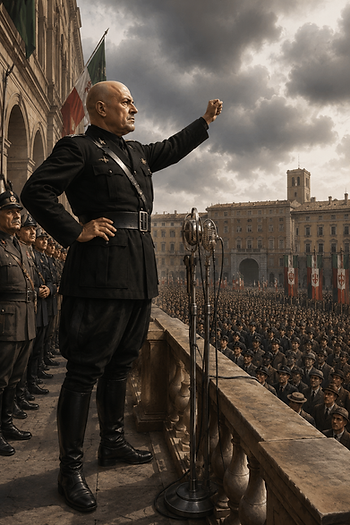
My Name is Benito Mussolini: Founder of Fascism and Dictator of Italy
I am a man who believed that nations rise or fall by the strength of their will. Some called me Il Duce—"The Leader." I sought to restore Italy's pride, build a disciplined society, and revive what I believed was the greatness of the Roman past. Many followed me with enthusiasm, while others feared the path I chose. My life became one of the most influential—and ultimately one of the most controversial—stories of the twentieth century.
A Childhood Filled with Strong Opinions
I was born on July 29, 1883, in Predappio, Italy. My father was a blacksmith who admired revolutionary politics, while my mother was a devoted schoolteacher who valued education and order. Their opposing influences shaped me. As a young man, I was outspoken, stubborn, and often quick to argue. I became a teacher for a short time, but the classroom could never contain my ambitions.
Finding My Voice in Politics
Journalism became my weapon. I wrote fiery articles criticizing the government and calling for dramatic change. At first, I embraced socialism and rose quickly through its ranks because of my speeches and writing. Yet I believed movements must adapt to changing times. When the First World War erupted, I supported Italy's entry into the conflict, a decision that shattered my relationship with the Socialist Party and forced me onto a new political path.
Forging Fascism
The war convinced me that unity, discipline, and national strength mattered more than endless political arguments. I founded the Fascist movement, arguing that Italy needed decisive leadership instead of weak coalition governments. To many Italians exhausted by strikes, inflation, and instability, my promises of order sounded appealing. In 1922, after the March on Rome, King Victor Emmanuel III invited me to become Prime Minister. I viewed that moment as the beginning of a new Italy.
Building a Powerful State
I worked to centralize authority and demanded loyalty to the nation above all else. Roads, railways, public projects, and military expansion became symbols of what I believed was national renewal. I insisted that Italians think of themselves first as servants of the state. Newspapers, schools, and public life increasingly reflected my government's message. I believed that a divided people could never become a great nation.
Dreams of a New Roman Empire
My ambitions reached beyond Italy's borders. I looked to the glory of ancient Rome and believed Italy deserved an empire of its own. The conquest of Ethiopia and involvement in Spain reflected those ambitions. As Europe grew more unstable, I found myself increasingly aligned with Adolf Hitler and Nazi Germany. Though our governments shared authoritarian ideas, our alliance drew Italy ever deeper into conflicts that became impossible to control.
War and Collapse
When the Second World War began, I believed Italy could secure new victories and strengthen its place among the world's great powers. Instead, military defeats mounted, resources disappeared, and confidence in my leadership collapsed. In 1943 I was removed from power, rescued by German forces, and briefly led a puppet government in northern Italy. As the war ended, I attempted to flee, but I was captured by Italian partisans and executed in April 1945. My body was publicly displayed, a dramatic symbol of my regime's downfall.
Looking Back
I spent my life convinced that strength, unity, and decisive leadership could overcome weakness and division. Many Italians initially believed those promises, but concentrating power in one leader destroyed freedom, silenced opposition, and helped lead my nation into disastrous wars. History remembers me not only for reshaping Italy's government but also for helping establish a model of dictatorship whose consequences brought suffering across Europe. My story serves as a warning that ambition without respect for liberty, human dignity, and accountability can bring ruin to both leaders and nations.
Europe After the Great Depression – Told by Benito Mussolini
When the Great Depression swept across the world after 1929, it struck Europe with tremendous force. Factories closed, banks failed, international trade collapsed, and millions of hardworking men and women found themselves without jobs. Families who had once believed in steady progress suddenly faced hunger, uncertainty, and despair. Across the continent, confidence in old institutions began to crumble. A nation can endure many hardships, but when people lose faith in tomorrow, they begin searching for anyone who promises a better future.
The Economy Falls Apart
The world's economies had become connected through trade, banking, and investment, so when financial markets collapsed in the United States, the shock spread rapidly across Europe. Businesses could no longer borrow money, industries reduced production, and governments struggled to balance shrinking budgets with growing demands for relief. Germany suffered especially severe unemployment, while many other nations endured falling wages and rising poverty. Everywhere, ordinary citizens questioned whether the economic systems that had guided Europe since the First World War were capable of solving such enormous problems.
Political Storms Gather
Economic suffering soon became political unrest. Demonstrations filled city streets, workers organized strikes, extremist parties gained followers, and elected governments often rose and fell before they could accomplish much. Parliament after parliament debated while unemployment continued to rise. Many citizens became frustrated with compromise, believing that endless discussion produced very little action. As confidence in democratic governments weakened, movements promising swift decisions and national renewal gained increasing attention.
Why Democracies Struggled
From my point of view at the time, democracies appeared slow because they depended upon negotiation between many competing political parties. Coalition governments often disagreed about taxes, spending, military policy, and economic recovery. Elections could replace leaders before long-term plans had a chance to succeed. To many Europeans living through crisis, decisive leadership seemed more attractive than prolonged debate. Whether that judgment was wise is another question, but it explains why authoritarian governments found willing audiences during those difficult years.
The Rise of Strong Leaders
Across Europe, different nations searched for different answers. Some expanded government programs to assist struggling citizens. Others strengthened democratic institutions despite the hardships. Still others, including my own Italy, embraced authoritarian rule. I argued that discipline, national unity, and loyalty to the state could restore confidence and rebuild society. Similar promises appeared elsewhere, though each nation followed its own path according to its history, traditions, and political circumstances.
The Lessons History Revealed
Looking back, it is clear that economic collapse can do more than empty factories and banks—it can reshape governments and alter the course of history. Fear, unemployment, and uncertainty created opportunities for leaders who promised simple solutions to complex problems. Some democracies survived because their institutions adapted and retained public trust. Others gave way to dictatorships that concentrated power in the hands of a few. Europe emerged from the Great Depression deeply divided, increasingly armed, and moving steadily toward another catastrophic war. The crisis demonstrated that protecting a nation's economy and preserving public confidence are essential if freedom itself is to endure.
The Birth and Growth of Fascism – Told by Benito Mussolini
When the First World War ended, Italy stood among the victors, yet many Italians believed we had been denied the rewards we had earned. Inflation soared, unemployment spread, veterans returned to uncertain futures, and strikes filled our cities. Confidence in parliamentary government weakened as one coalition after another struggled to solve the nation's problems. I believed Italy required more than another election or another compromise—it required a movement capable of restoring confidence, unity, and national purpose.
The Origins of Fascism
In 1919 I founded the Fasci Italiani di Combattimento, a political movement that eventually became known simply as Fascism. The name came from the ancient Roman fasces, a bundle of rods surrounding an axe, symbolizing authority and strength through unity. I argued that individuals should see themselves first as members of a greater national community rather than competing groups divided by class or political party. My supporters believed that discipline, action, and loyalty to the state could overcome the disorder that had consumed postwar Italy.
Nationalism Above All
Nationalism stood at the center of my philosophy. I often spoke of restoring Italy's greatness and drawing inspiration from the achievements of the Roman Empire. I believed a nation became powerful when its people shared common goals, respected authority, and placed the interests of their country above personal ambitions. Public ceremonies, patriotic education, military pride, and national symbols became important tools for encouraging Italians to think of themselves as part of one united people.
One Party, One Leader
As Fascism grew stronger, I became convinced that multiple political parties weakened a nation by encouraging endless disagreement. After becoming Prime Minister in 1922, my government gradually dismantled democratic institutions. Opposition parties were suppressed, elections lost their competitive nature, censorship expanded, and the Fascist Party became the only legal political organization. I argued that one government speaking with one voice could act more quickly and decisively than a parliament divided by constant debate. This concentration of power fundamentally transformed Italy from a constitutional monarchy into a dictatorship.
The Corporatist State
My government rejected both unrestricted capitalism and socialist control of the economy. Instead, I promoted what became known as corporatism. Under this system, industries were organized into corporations that included representatives of employers, workers, and the government. In theory, these groups would cooperate rather than compete, with the state acting as the final authority to resolve disputes and direct national economic goals. Although presented as a partnership between labor and business, the government maintained ultimate control over decisions and limited the independence of both workers' unions and employers.
Standing Against Communism
One of Fascism's strongest appeals to many Italians was its firm opposition to communism. After the Russian Revolution, many feared that violent class conflict and revolution could spread across Europe. I argued that Fascism offered a different path—one that rejected class warfare and instead united workers, business leaders, and the government under the banner of the nation. Industrialists, landowners, and many members of the middle class supported Fascism because they believed it could prevent communist revolution and restore public order.
Dictators Build Strong Central Governments – Told by Benito Mussolini
When I came to power in Italy in 1922, I believed the nation had been weakened by years of political division, unstable governments, and endless debate. To me, a country could not become strong if every political party pulled in a different direction. I argued that Italy needed one purpose, one government, and one leader capable of making decisions without waiting for competing factions to agree. Across Europe, other dictators would adopt similar ideas, each believing that concentrated authority offered the quickest path to national strength.
Removing Political Opposition
A government determined to rule without interruption cannot allow rivals to challenge its authority. My administration gradually restricted opposition newspapers, outlawed many political parties, and arrested or intimidated critics. Some opponents fled the country, while others found themselves imprisoned or silenced. Elections continued for a time, but they no longer offered genuine competition. I maintained that these measures preserved national unity, while my critics argued they destroyed the freedoms that allow citizens to hold leaders accountable.
Watching Through Secret Police
Maintaining control required more than changing laws. Governments also relied on organizations that gathered information and monitored suspected opponents. In Fascist Italy, the secret police known as OVRA investigated those believed to threaten the regime. Similar organizations appeared in other dictatorships, often with even greater powers. Their presence created an atmosphere in which many people feared speaking openly, uncertain whether neighbors, coworkers, or even friends might report them to the authorities.
Shaping the Next Generation
I believed the future of Italy depended upon its youth. Fascist youth organizations encouraged boys and girls to participate in athletic training, military-style drills, patriotic ceremonies, and lessons promoting loyalty to the state. Uniforms, parades, songs, and symbols helped build a shared identity among young Italians. Schools increasingly reflected government priorities, teaching students that service to the nation stood above personal ambition. Similar youth movements later emerged in other authoritarian governments, each seeking to shape future generations according to official ideology.
Government at the Center of Society
As Fascism expanded, the government reached into nearly every aspect of public life. Newspapers faced censorship, radio broadcasts promoted official policies, and cultural organizations were expected to support national goals. Labor unions became controlled by the state, and many economic decisions were directed by government officials. I argued that such coordination created unity and efficiency. In reality, it also reduced independent voices and limited the ability of citizens to question those in power.
The Cost of Absolute Authority
History has shown that strong central governments can sometimes act quickly during moments of crisis, but speed comes with dangers when checks and balances disappear. When political opposition is eliminated, the press is silenced, and citizens fear criticizing their leaders, mistakes become harder to correct and abuses become easier to hide. My government believed concentrated power would secure Italy's future, yet it also weakened the institutions that protect individual liberty. The experience of Fascist Italy reminds us that the strength of a nation is measured not only by the power of its government, but also by the freedoms its people are allowed to keep.

My Name is Carl Goerdeler: German Statesman and Leader of the Resistance
I believed Germany deserved honor, law, and justice—not fear and tyranny. My life was not spent leading armies or seeking fame. Instead, I worked through government, reason, and ultimately resistance, convinced that true patriotism sometimes demands standing against one's own rulers.
A Life of Duty
I was born on July 31, 1884, in Schneidemühl, in the German Empire. From an early age, I believed that public service was an honorable calling. I studied law and entered government, where I developed a reputation for careful administration and financial responsibility. Order mattered to me, but order had to be built upon law rather than intimidation. A nation could only remain strong if its institutions remained trustworthy.
Serving My Country
After the First World War, Germany faced political upheaval, economic hardship, and national humiliation. Like many Germans, I wished to see my nation recover from these difficult years. I served as Mayor of Leipzig, where I focused on rebuilding the city's finances, improving public services, and encouraging responsible government. My hope was that Germany could regain its strength through honest work, sound leadership, and respect for its citizens.
Watching Germany Change
When Adolf Hitler rose to power in 1933, many Germans welcomed promises of stability and national revival. At first, I believed some reforms might restore confidence after years of crisis. But I soon became deeply troubled as the government ignored constitutional limits, persecuted political opponents, and increasingly targeted Germany's Jewish citizens. I could not accept a government that demanded obedience while abandoning justice. My disagreements became impossible to hide, and I resigned from public office.
Choosing Resistance
Leaving office did not end my responsibility. I met with military officers, civil servants, church leaders, and others who believed Germany was heading toward catastrophe. We discussed how the nation might be saved if Hitler were removed from power. I was even considered to become Chancellor should a new government be established. We did not seek Germany's defeat; we sought Germany's rescue before even greater destruction arrived.
The July Plot
As the Second World War continued, opposition within Germany grew more desperate. In July 1944, Colonel Claus von Stauffenberg carried a bomb into Hitler's headquarters in an attempt to end the dictatorship. Although I was not present during the explosion, I was closely connected to those planning for Germany's future afterward. The attempt failed, and the Nazi government responded with swift and ruthless vengeance. Thousands were arrested as investigators searched for everyone involved.
Capture and Final Days
I was captured after weeks in hiding and subjected to harsh interrogation. Even then, I refused to abandon my conviction that Germany deserved a government guided by law rather than terror. In February 1945, only months before the war ended, I was tried before the People's Court, sentenced to death, and executed. I never witnessed Germany's liberation, but I believed others would one day rebuild the nation on stronger foundations than fear.
Germany Rejects the Treaty of Versailles – Told by Carl Goerdeler
When the First World War ended, Germany was defeated, but the Treaty of Versailles that followed in 1919 left many Germans believing the conflict had not truly ended. I watched my country struggle under territorial losses, military restrictions, and heavy reparations. Many accepted that Germany bore responsibility for the war, yet countless others believed the treaty punished an entire nation far beyond what justice required. That feeling did not disappear with time. Instead, it became one of the strongest political forces shaping the years that followed.
Growing Dissatisfaction
The treaty reduced Germany's armed forces, limited industrial production related to the military, transferred important territories to neighboring countries, and required large financial payments. Inflation, unemployment, and the economic crises of the 1920s and early 1930s made these burdens seem even heavier. Ordinary families often connected their daily hardships with the treaty, whether or not it was the sole cause. Across Germany, conversations in homes, schools, and businesses increasingly focused on restoring national pride and overturning what many viewed as an unfair settlement.
Politics Becomes More Extreme
When people lose confidence in moderate leaders, they often begin listening to voices promising dramatic change. Germany was no exception. Political parties on both the far left and the far right gained support by claiming they alone could rescue the nation. Street violence between rival groups became more common, governments rose and fell in rapid succession, and faith in parliamentary democracy weakened. Many citizens did not necessarily seek dictatorship, but they desperately sought stability, employment, and hope for the future.
The Promise of National Revival
Adolf Hitler and the National Socialist Party understood these frustrations well. They promised to reject Versailles, restore Germany's military strength, rebuild the economy, and unite the nation behind a common purpose. Millions of Germans found these promises appealing after years of hardship and uncertainty. Factories reopened, public construction projects expanded, and unemployment declined for many workers. These improvements convinced increasing numbers of people that Germany was finally recovering, even as political freedoms steadily disappeared.
The Power of Public Opinion
Public opinion is rarely shaped by one event alone. Economic recovery, patriotic speeches, mass rallies, newspapers, radio broadcasts, and carefully crafted propaganda all influenced how Germans viewed their government. Many celebrated the return of confidence and national pride, while others quietly worried about growing intolerance, censorship, and the concentration of power. Speaking openly against the government became increasingly dangerous, making it difficult to know how many people truly supported the regime and how many simply remained silent out of fear.
Rearmament Begins Across Europe – Told by Carl Goerdeler
When Adolf Hitler came to power in 1933, Germany was still bound by the military restrictions imposed after the First World War. The Treaty of Versailles had limited the size of our army, prohibited an air force, and placed strict controls on weapons production. Yet many Germans believed these restrictions had humiliated the nation and left it vulnerable. As the government openly rejected these limitations, military rebuilding became one of its highest priorities. To many citizens, rearmament appeared to symbolize Germany's return as a respected European power.
Building a New Military
Factories that had once stood quiet began producing weapons, vehicles, ammunition, and military equipment. The Reichswehr, Germany's small postwar army, expanded into the much larger Wehrmacht. Officers trained new recruits while engineers developed modern tanks, artillery, and communications systems. Public works projects, such as the expanding autobahn network, also improved transportation that could later serve military purposes. Many Germans welcomed these changes because they created jobs and restored confidence after years of economic hardship.
The Return of Conscription
In 1935, the government announced the return of compulsory military service. Young German men were once again required to serve in the armed forces, directly violating the Treaty of Versailles. Military training became an important part of preparing a new generation for service to the nation. To supporters, conscription strengthened discipline and national unity. To critics, it signaled that Germany was preparing not simply to defend itself, but to pursue far greater ambitions.
The Rise of Air and Sea Power
One of the clearest signs that Europe was changing came with the rapid expansion of military technology. Germany secretly developed, and then openly revealed, the Luftwaffe under Hermann Göring. Modern aircraft promised to change warfare forever, allowing attacks far beyond traditional battlefields. At sea, Germany also rebuilt its navy despite treaty limitations. Battleships, cruisers, destroyers, and especially submarines became central to long-term military planning. Other nations watched these developments with growing concern and began strengthening their own armed forces.
An Arms Race Spreads Across Europe
Germany was not the only nation increasing its military strength. France modernized its defenses and relied heavily on the Maginot Line. Britain expanded the Royal Air Force and began constructing new warships while modernizing its army. Italy invested in its military as it pursued imperial ambitions, and the Soviet Union dramatically increased industrial production and military development under Joseph Stalin. Each nation pointed to the actions of its neighbors as justification for its own preparations. Fear and suspicion fed a cycle in which every new weapon encouraged another nation to build even more.
When Strength Replaces Trust
As I watched these events unfold, I understood why many Germans wanted security after years of weakness. Every nation has the right to defend itself. Yet I also saw how quickly military expansion became intertwined with aggressive political ambitions. Rearmament alone does not cause war, but when nations lose confidence in diplomacy and place their faith primarily in armies, the chances of peaceful solutions grow smaller. Europe entered the late 1930s with stronger militaries than ever before, but with far less trust between its governments. That dangerous combination helped set the stage for the greatest conflict the world had yet witnessed.

My Name is Vyacheslav Molotov: Foreign Minister of the Soviet Union
I believed that governments survive through discipline, preparation, and unwavering loyalty. While others sought popularity, I sought efficiency. My work was rarely done before cheering crowds. Instead, it took place across conference tables, behind government doors, and through carefully chosen words that shaped the fate of nations during some of history's most dangerous years.
A Revolutionary Beginning
I was born Vyacheslav Mikhailovich Skryabin on March 9, 1890, in the Russian Empire. As a young man, I became attracted to revolutionary ideas and joined the Bolsheviks while still a student. My political activities led to arrest and exile, but hardship only strengthened my commitment. I believed the old imperial system was collapsing and that only a disciplined revolutionary movement could build a stronger future.
Building a New Government
The Russian Revolution transformed my life. After the Bolsheviks seized power in 1917, I accepted responsibility wherever the Party needed me. Organization mattered more than speeches. Loyalty mattered more than personal recognition. Over the years I worked closely with Vladimir Lenin and later Joseph Stalin, becoming known as someone who carried out difficult assignments without hesitation. I earned a reputation for calm determination and strict obedience to Party decisions.
Serving Beside Stalin
As the Soviet Union expanded its industries and strengthened its government, I rose through its highest ranks. Eventually I became Chairman of the Council of People's Commissars, a position similar to prime minister, before later serving as Foreign Minister. My duty was always the same: defend the interests of the Soviet Union. Personal feelings had little place in government. States survived by acting according to necessity rather than sentiment.
Diplomacy in Dangerous Times
Europe grew increasingly unstable during the 1930s. Fascist governments expanded while democratic nations struggled to respond. My greatest diplomatic responsibility came in 1939 when I signed the German-Soviet Non-Aggression Pact with Nazi Germany. Many around the world viewed this agreement with shock. From our perspective, the Soviet Union needed time to strengthen its military after years of uncertainty. The agreement delayed direct conflict, though it did not eliminate it.
The Great Patriotic War
In 1941 Germany invaded the Soviet Union, proving that treaties alone could not guarantee peace. During what we called the Great Patriotic War, I worked closely with Stalin and Allied leaders to secure military cooperation and supplies. Diplomacy became another battlefield. Every negotiation, every conference, and every agreement aimed to help ensure that the Soviet Union survived and ultimately defeated Nazi Germany. The cost in human lives was beyond imagination.
Representing a Superpower
After the war, I continued serving as Foreign Minister as the Soviet Union emerged as one of the world's two great superpowers. The Cold War replaced open conflict with political rivalry, military competition, and constant diplomatic maneuvering. My work involved negotiating with former allies who had become strategic competitors. I believed firmness projected strength, and strength preserved peace better than weakness ever could.
Looking Back
I spent my life believing that governments must make difficult decisions in an uncertain world. Many of those decisions remain deeply controversial, and history continues to debate their consequences. I served a government responsible for immense achievements as well as immense suffering, and I defended its policies with unwavering loyalty. Looking back, I recognize that loyalty without questioning authority can carry a nation—and those who serve it—into actions whose human cost becomes painfully clear only with time.
The Soviet Union Watches Europe Change – Told by Vyacheslav Molotov
From Moscow, we observed Europe with increasing concern during the 1930s. Governments rose and fell, dictators gained power, and nations openly rebuilt their militaries. The Soviet Union could not afford to ignore these developments. Our country stretched across thousands of miles, bordered numerous nations, and remembered well the devastation brought by invasion during the First World War and the Russian Civil War. We believed that preparing for danger before it arrived was not merely wise—it was necessary.
The Communist View of the World
The Soviet Union was founded upon communist ideology, which taught that history was shaped by struggles between economic classes. We believed that capitalism would eventually give way to socialism and, ultimately, communism. This worldview also led us to expect hostility from many capitalist governments, which feared the spread of communist revolution. While we sought diplomatic relations with other countries when it served our interests, we never assumed ideological disagreements had disappeared. We viewed international politics as a constant balance between cooperation and suspicion.
The Rise of Fascism
The emergence of Fascist Italy and Nazi Germany deeply concerned Soviet leaders. Fascism rejected communism completely and often portrayed it as one of its greatest enemies. Adolf Hitler made his hostility toward the Soviet Union unmistakably clear in speeches and writings, arguing that Germany needed territory in Eastern Europe and condemning Bolshevism as a threat to his vision for Germany. These public declarations were studied carefully in Moscow. We understood that hostile words, when combined with growing military strength, could eventually become hostile actions.
Preparing the Nation's Defenses
Under Joseph Stalin, the Soviet government launched ambitious industrial programs that transformed the nation's ability to produce steel, machinery, tanks, aircraft, and weapons. New factories rose across the country, railroads expanded, and military production increased dramatically. The Red Army also grew in size, although political purges during the late 1930s removed many experienced officers and weakened its leadership. Even so, the government continued preparing for the possibility that one day the Soviet Union might have to defend itself against a major European power.
The Constant Fear of Invasion
Russia's history had taught painful lessons. Napoleon's armies had marched toward Moscow in 1812, and Germany had invaded during the First World War. Geography offered little protection across the broad plains of Eastern Europe. Every report of German rearmament, every military parade, and every territorial expansion increased concern within the Kremlin. We sought diplomatic agreements where possible, including the 1939 German-Soviet Non-Aggression Pact, believing it might delay conflict and provide valuable time to strengthen our defenses. It was never viewed as a permanent friendship but as a temporary calculation in a dangerous world.
Lessons from a Changing Europe
Looking back, Europe in the 1930s became a continent where fear often drove decision-making. Fascist governments feared communism. Democratic nations feared another devastating war. The Soviet Union feared invasion from increasingly aggressive neighbors. Those fears shaped alliances, military planning, and diplomatic agreements in ways that often confused outside observers. History reminds us that nations rarely act based on ideals alone. They also act from their understanding—right or wrong—of the dangers surrounding them. During those uncertain years, every major power believed it was preparing for survival, even as Europe moved steadily closer to catastrophe.

My Name is Anthony Eden: British Statesman and Foreign Secretary
Throughout my career I stood at the crossroads of negotiation and conflict, where every decision carried consequences far beyond a single nation. I spent much of my life trying to prevent war, though I eventually learned that peace requires more than hopeful intentions.
Growing Up in an Uncertain World
I was born on June 12, 1897, in County Durham, England, into a family with a long military tradition. My youth was interrupted by the First World War, where I served as an officer in the British Army. I witnessed terrible losses and earned the Military Cross for bravery. Those years convinced me that war should always be the last choice of civilized nations, but also that weakness could invite even greater disasters.
Entering Public Service
After the war I entered Parliament as a Conservative Member of Parliament. International affairs fascinated me because I believed Britain's future depended not only on its own strength but also on stable relationships with other nations. I studied foreign languages, learned about European politics, and quickly found myself working on diplomatic matters. Careful preparation and thoughtful negotiation became the foundation of my career.
Facing the Rise of Dictators
During the 1930s I served as Foreign Secretary while Europe grew increasingly unstable. Dictators expanded their power, treaties were ignored, and international institutions struggled to respond. I believed Britain should seek peace whenever possible, but I also believed there were limits to compromise. When Prime Minister Neville Chamberlain pursued policies that I felt made too many concessions to Benito Mussolini's Italy, I resigned from my position rather than support a course I believed endangered Britain's long-term security.
War Changes Everything
When the Second World War began, diplomacy gave way to survival. I returned to government under Winston Churchill and once again became Foreign Secretary. I worked with leaders from around the world, including the United States and the Soviet Union, helping to coordinate the Allied partnership. Conferences, negotiations, and agreements became essential weapons alongside soldiers, ships, and aircraft. Victory required nations with very different political systems to work toward a common goal.
Leading Britain
Years later I succeeded Winston Churchill as Prime Minister. It was both an honor and an enormous responsibility. My greatest challenge came during the Suez Crisis of 1956, when Egypt nationalized the Suez Canal. Believing Britain's strategic interests were threatened, my government joined France and Israel in military action. International pressure, especially from the United States and the Soviet Union, forced Britain to withdraw. The crisis damaged Britain's standing and brought my premiership to an early end.
Life Beyond Office
After resigning, I withdrew from frontline politics and reflected on decades spent in government. I had witnessed two world wars, the decline of the British Empire, and the emergence of a new international order led by global superpowers. Public service had never been simple, and history rarely offered leaders perfect choices. Every decision involved balancing principles, national interests, and uncertain consequences.
The Failure of Collective Security – Told by Anthony Eden
When the First World War ended, many believed the nations of the world had learned a painful lesson. The League of Nations was created with the hope that future disputes could be settled through discussion rather than battlefields. The idea was known as collective security: if one nation threatened the peace, the others would stand together to discourage aggression. It was an admirable vision, and many of us who entered public service wanted it to succeed. Unfortunately, noble ideas alone could not guarantee determined action.
The League's Growing Weaknesses
The League of Nations faced serious obstacles from the very beginning. The United States, whose president had championed the organization, never joined it after the U.S. Senate rejected membership. Important decisions often required unanimous agreement, making swift action extremely difficult. The League possessed no army of its own and depended upon member nations to enforce its decisions. When powerful countries ignored League resolutions, there was little practical means of compelling obedience beyond economic sanctions or diplomatic protests.
Diplomacy Tested by Aggression
Throughout the 1930s, diplomacy was repeatedly tested. Japan seized Manchuria in 1931 despite international objections. Italy invaded Ethiopia in 1935, and although the League imposed economic sanctions, they were incomplete and failed to stop the conquest. Germany openly violated the Treaty of Versailles by rearming, remilitarizing the Rhineland, and later expanding into Austria and Czechoslovakia. Each crisis weakened confidence that international agreements alone could preserve peace. Every successful act of aggression encouraged the belief that determined dictators could act without suffering serious consequences.
Why Democracies Hesitated
Many people have since asked why Britain, France, and other democratic nations did not act more forcefully. The answer is more complicated than simple unwillingness. The memory of the First World War remained vivid, with millions of lives still mourned by families across Europe. Public opinion strongly favored avoiding another devastating conflict. Many military leaders warned that their armed forces were not fully prepared for war, while governments struggled with the lingering effects of the Great Depression. In such circumstances, negotiation often appeared to be the least dangerous option.
The Difficult Balance of Leadership
As Foreign Secretary, I believed diplomacy remained essential, but I also understood that diplomacy succeeds only when agreements are respected. I became increasingly concerned that repeated concessions to aggressive governments would encourage further demands rather than preserve peace. This conviction contributed to my resignation in 1938 after disagreements over Britain's approach toward Benito Mussolini's Italy. My hope was not to rush toward war, but to prevent one by demonstrating that international promises carried real meaning.
The Lessons of Collective Security
Looking back, the failure of collective security was not caused by a single nation or one mistaken decision. It resulted from a combination of economic hardship, political divisions, military weakness, and an understandable desire to avoid another catastrophe. The League of Nations showed that international cooperation requires more than treaties and speeches—it requires member nations willing to uphold their commitments even when doing so is costly. The tragedy of the 1930s was that by delaying difficult decisions in the hope of preserving peace, Europe ultimately faced an even greater war than the one everyone had sought to prevent.
Italy's Expansion and the Weak International Response – Told by Benito Mussolini
By the mid-1930s, I believed Italy deserved a place among the world's great powers. Britain and France possessed vast colonial empires that stretched across continents, while Italy's overseas possessions were comparatively small. I argued that our growing population, expanding industries, and national pride demanded new territories. To many Italians, building an empire was presented as restoring the glory once enjoyed by ancient Rome. My attention turned toward Ethiopia, one of the few independent nations remaining in Africa.
The Invasion of Ethiopia
In October 1935, Italian forces crossed into Ethiopia from our neighboring colonies of Eritrea and Italian Somaliland. Our military possessed overwhelming advantages in modern weapons, aircraft, tanks, and artillery. Ethiopian forces fought courageously but were far less equipped. During the campaign, Italian forces also employed chemical weapons, including mustard gas, despite international agreements that prohibited their use. By May 1936, Italian troops entered Addis Ababa, and I proclaimed the creation of Italian East Africa, presenting the conquest as a triumph of Fascist strength and national achievement.
The World's Response
The invasion shocked many governments. The League of Nations declared Italy the aggressor and voted to impose economic sanctions. However, the sanctions were incomplete. Critical materials such as oil were excluded, and the Suez Canal remained open to Italian shipping, allowing supplies to continue reaching our forces. Britain and France condemned the invasion publicly, yet neither wished to risk a larger European conflict by taking military action. Their response demonstrated that the League possessed resolutions but lacked the means—and often the political will—to enforce them against determined powers.
Lessons Other Nations Observed
Leaders across Europe carefully studied what happened in Ethiopia. Adolf Hitler watched as Italy violated international agreements, endured limited economic penalties, and successfully conquered another nation without military intervention from the world's leading democracies. The message appeared unmistakable: if a nation acted boldly enough, international protests might remain only words. The weakness of collective security encouraged other aggressive governments to test the limits of treaties and diplomacy during the years that followed.
A Turning Point for Europe
The Ethiopian campaign also changed Italy's place in Europe. Relations with Britain and France deteriorated sharply after the invasion, while Germany offered political support rather than condemnation. Over time, this growing cooperation contributed to the formation of the Rome-Berlin Axis, bringing our two governments into increasingly close alignment. What had begun as a colonial war in East Africa helped reshape the balance of power across Europe.
Appeasement and Britain's Difficult Choices – Told by Anthony Eden
When people today discuss Britain's policy of appeasement, it is easy to forget the world in which those decisions were made. I belonged to a generation that had witnessed the unimaginable destruction of the First World War. Nearly every family in Britain had lost someone they loved. Cities mourned their dead, veterans carried lifelong wounds, and an entire nation hoped never to experience such suffering again. Every discussion about foreign policy was shaped by one overriding question: how could another world war be avoided?
A Nation Unprepared
During much of the 1930s, Britain was still recovering from the Great Depression. Military budgets had been reduced after the First World War, and many believed another large conflict was unlikely. As Germany openly rebuilt its armed forces, Britain gradually began strengthening its own military, but this process required years. New aircraft had to be designed, factories expanded, pilots trained, and warships constructed. Many leaders believed diplomacy could buy valuable time while Britain's defenses improved.
The Voice of the Public
Government decisions are rarely made in isolation from the people. Throughout Britain, public opinion strongly favored peace. Newspapers, churches, veterans' organizations, and ordinary citizens often urged leaders to settle disputes through negotiation rather than war. The memory of the trenches remained vivid. Parents who had lost sons in one generation feared losing another. Many believed that if reasonable compromises could preserve peace, they should at least be attempted before resorting to military force.
The Policy of Appeasement
Appeasement did not begin as an act of surrender. It was based on the belief that some of Germany's complaints about the Treaty of Versailles could be addressed peacefully through negotiation. Prime Minister Neville Chamberlain hoped that satisfying limited demands would prevent broader conflict. As Foreign Secretary, I respected the importance of diplomacy, but I became increasingly concerned that repeated concessions to Benito Mussolini's Italy and other aggressive governments would encourage further demands instead of creating lasting peace. This disagreement eventually led me to resign from my position in 1938.
When Diplomacy Meets Determination
Diplomacy succeeds only when all sides genuinely seek peaceful solutions. Unfortunately, agreements become fragile when one government views negotiations as opportunities for further expansion rather than final settlements. Each successful violation of international agreements—from the remilitarization of the Rhineland to the annexation of Austria and the demands over Czechoslovakia—made future negotiations more difficult. Britain continued searching for peaceful solutions, but each concession narrowed the remaining options.
Lessons from Britain's Choice
History has judged appeasement with the benefit of hindsight, knowing that another world war could not ultimately be avoided. Yet those making decisions during the 1930s did not possess that certainty. They faced incomplete information, limited military readiness, economic challenges, and a public desperate to avoid another catastrophe. Appeasement reminds us that leaders must often choose between difficult alternatives rather than perfect solutions. It also demonstrates that diplomacy remains one of civilization's greatest tools—but only when it is supported by credibility, preparedness, and the willingness to defend peace if negotiations fail.
Germany Expands Without Major Resistance – Told by Carl Goerdeler
As the 1930s unfolded, I watched Germany move step by step beyond the restrictions imposed after the First World War. Each action was carefully observed not only by Germans, but also by governments across Europe. What surprised many was not simply that Germany challenged international agreements, but that those challenges often met little direct resistance. Every successful gamble strengthened the confidence of Adolf Hitler's government and convinced many Germans that their nation was reclaiming its rightful place among Europe's great powers.
The Rhineland Returns
In March 1936, German troops entered the Rhineland, a region that the Treaty of Versailles and the Locarno Treaties had required to remain demilitarized. The move was risky. German military commanders understood that if France responded with force, Germany might have been compelled to withdraw. Yet no military response came. France hesitated without British support, and Britain viewed the move as German troops entering German territory. To many Germans, this bloodless success appeared to erase one of Versailles' most humiliating restrictions.
The Union with Austria
Two years later, Germany turned its attention to Austria. In March 1938, German forces crossed the border during what became known as the Anschluss, uniting Austria with Germany. Many Austrians welcomed the union, while others opposed it or feared its consequences. A later plebiscite organized under Nazi control reported overwhelming support, though it took place in an atmosphere where political opposition had already been suppressed. Once again, Britain and France protested but did not intervene militarily. Germany had expanded its territory without fighting a major war.
The Sudetenland Crisis
Later that same year, Adolf Hitler demanded the Sudetenland, a border region of Czechoslovakia with a large ethnic German population. He argued that these Germans should become part of the Reich. Britain, France, Germany, and Italy met in Munich to seek a peaceful solution. Czechoslovakia itself was not invited to the negotiations. The resulting Munich Agreement transferred the Sudetenland to Germany in hopes of preserving peace. Many celebrated the agreement at the time, believing war had been avoided, while others feared it rewarded aggression and weakened international trust.
Confidence Grows Inside Germany
Each peaceful victory transformed public opinion within Germany. Many citizens concluded that Hitler possessed remarkable political skill, achieving goals that earlier governments had considered impossible. National pride increased as territories once lost after the First World War returned to German control. Economic improvements, military successes without bloodshed, and carefully orchestrated propaganda further strengthened support for the government. Those of us who questioned the regime saw a troubling pattern: every success made opposition more difficult, while confidence within the Nazi leadership continued to grow.
The Road Becomes More Dangerous
I believed Germany had legitimate concerns regarding aspects of the Treaty of Versailles, but I also believed those concerns should have been addressed through law, diplomacy, and mutual agreement rather than intimidation. The peaceful nature of these early territorial gains concealed a growing danger. Each concession convinced Hitler that Britain and France were unlikely to resist future demands. By the time Germany occupied the rest of Czechoslovakia in 1939, it had become clear that expansion would not stop voluntarily. Europe had delayed conflict repeatedly, but with every delay, the coming war became more difficult to prevent.
The Nazi-Soviet Pact – Told by Vyacheslav Molotov
In August 1939, I signed one of the most surprising diplomatic agreements of the twentieth century. Around the world, many asked how the Soviet Union, founded upon communist principles, could sign a non-aggression pact with Nazi Germany, a government that openly condemned communism. To outside observers, the agreement seemed impossible. Yet diplomacy is often driven not by friendship, but by national interest. Governments sometimes cooperate with rivals when they believe doing so will improve their chances of survival.
Why Ideological Enemies Cooperated
The Soviet Union and Nazi Germany held fundamentally different political beliefs. Adolf Hitler had repeatedly attacked Bolshevism in his speeches and writings, while the Soviet government regarded Fascism as a dangerous ideological enemy. Despite these differences, both governments believed a temporary agreement could serve their immediate objectives. Germany hoped to avoid fighting a war on two fronts while preparing to invade Poland. The Soviet Union sought additional time to strengthen its military and avoid immediate conflict with Germany after years of watching Europe's political situation deteriorate.
Strategic Calculations
From Moscow's perspective, Europe had demonstrated that collective security had largely failed. Britain and France had not stopped Germany's reoccupation of the Rhineland, the Anschluss with Austria, or the annexation of the Sudetenland. Negotiations with Britain and France during the summer of 1939 progressed slowly and produced little confidence that they would effectively oppose German expansion. Faced with uncertainty, Joseph Stalin's government concluded that a temporary agreement with Germany might delay war and provide valuable months—or perhaps years—to continue industrial production, military modernization, and defensive planning.
The Secret Protocols
Publicly, the agreement was presented as a simple non-aggression pact in which Germany and the Soviet Union promised not to attack one another. Hidden from the world, however, were secret protocols dividing much of Eastern Europe into spheres of influence. These confidential agreements outlined how territories including Poland, the Baltic states, Finland, and parts of Romania might be divided or influenced if political circumstances changed. When Germany invaded Poland on September 1, 1939, the Soviet Union entered eastern Poland later that month under the terms of these secret understandings, dramatically reshaping the map of Eastern Europe.
Europe Reacts
The announcement stunned governments across the continent. Britain and France had hoped ideological hostility between Germany and the Soviet Union would prevent such cooperation. Instead, the pact removed one of Hitler's greatest strategic concerns and cleared the way for the invasion of Poland, prompting Britain and France to declare war on Germany. Many communist parties outside the Soviet Union struggled to explain the agreement, while Germany temporarily celebrated what appeared to be a major diplomatic victory. Across Europe, trust between nations became even more fragile as governments realized that international alliances could change with remarkable speed.
A Temporary Partnership with Lasting Consequences
The agreement was never built upon mutual trust. It was a calculated pause between rivals who expected future conflict. That expectation proved correct when Germany launched Operation Barbarossa in June 1941, invading the Soviet Union with millions of soldiers and ending the pact after less than two years. Looking back, the Nazi-Soviet Pact remains one of history's clearest examples of realpolitik—the practice of placing strategic interests above ideological differences. It delayed war between our two nations for a short time, but it could not prevent the devastating conflict that both governments had long believed was ultimately unavoidable.
Europe on the Edge of War – Told by Vyacheslav Molotov, Anthony Eden, Benito Mussolini, and Carl Goerdeler
The Last Days of Peace
Anthony Eden: As I looked across Europe during the late 1930s, I saw diplomacy growing weaker with each passing crisis. Agreements that once promised stability were ignored, and each territorial demand seemed greater than the last. Britain still hoped another terrible war could be avoided, but many of us worried that every concession made future negotiations more difficult. Peace depends upon trust, and that trust was rapidly disappearing.
Benito Mussolini: I viewed those same events quite differently. I believed Europe was entering an age in which decisive nations would shape history while hesitant governments would simply react. Italy had expanded its influence, Germany had overturned many of the restrictions imposed after the Great War, and I argued that strong leadership accomplished what endless conferences never could. To me, diplomacy was useful only when it advanced national interests.
Alliances Begin to Shift
Vyacheslav Molotov: From Moscow, we watched every new alliance with careful attention. Germany and Italy drew closer together through the Rome-Berlin Axis, while Japan joined them in the Anti-Comintern Pact. At the same time, Britain and France searched for ways to preserve the balance of power. The Soviet Union found itself surrounded by uncertainty, forcing us to calculate which agreements might best delay a conflict we increasingly believed was coming.
Carl Goerdeler: Inside Germany, many citizens celebrated these diplomatic victories as proof that the nation had regained its strength. Yet I feared something different. Alliances formed around military power rather than mutual trust often become unstable. They encourage leaders to believe that force will solve problems more effectively than negotiation. Every successful gamble made another gamble seem easier to attempt.
Preparing for the Inevitable
Anthony Eden: Britain could no longer ignore the growing danger. Our factories increased aircraft production, new radar stations appeared along the coast, and the Royal Navy expanded its preparations. None of us desired another war, but responsible governments must prepare for dangers they hope never arrive. Diplomacy remained our first choice, yet military readiness became an unfortunate necessity.
Vyacheslav Molotov: The Soviet Union reached similar conclusions, though for different reasons. Our industries accelerated the production of tanks, aircraft, artillery, and ammunition while the Red Army expanded its planning. We believed that geography alone would not protect our nation. History had taught Russia that invasions came when preparations were insufficient, and we intended not to repeat those lessons.
Confidence and Concern
Benito Mussolini: Across Fascist Italy, military strength became a symbol of national pride. We held parades, expanded our armed forces, and spoke confidently about Italy's future. Many believed Europe respected only those nations willing to demonstrate power. Looking back, I recognize that confidence can sometimes blind leaders to the true costs of the conflicts they believe they can control.
Carl Goerdeler: While crowds celebrated military victories and patriotic speeches, I worried about what was happening beneath the surface. Independent courts, free newspapers, and open political debate had largely disappeared within Germany. Success abroad increased support for the regime at home, making resistance even more difficult. A nation may appear stronger than ever while quietly losing the institutions that protect its people.
The World Stands at the Threshold
Anthony Eden: By 1939, diplomacy had reached its breaking point. Germany's invasion of Poland finally convinced Britain and France that further negotiations alone could no longer preserve peace. The declarations of war that followed did not begin suddenly; they marked the end of years of failed agreements, unanswered aggression, and growing mistrust.
Vyacheslav Molotov: Europe had spent the decade preparing for a conflict that many hoped would never occur. Every government believed it was acting to secure its future, yet those competing ambitions collided with devastating consequences. The Great Depression had shaken economies and governments alike, but the years that followed transformed economic crisis into military confrontation. The story now moves beyond political tensions and rearmament into the greatest conflict the world had ever known—the Second World War.
My Name is Fumimaro Konoe: Prince, Prime Minister, and Military Leader
I am a prince of one of Japan’s oldest noble families and a man who served as prime minister while my country moved deeper into war. I was raised to believe that public service was not simply a career but an inherited obligation. Yet rank and education did not give me command over the forces surrounding Japan. I entered government hoping to guide the nation’s direction, only to discover that leadership without firm control can become little more than an attempt to manage events already in motion.
Born Near the Center of Power
I was born in Tokyo on October 12, 1891, into the highest ranks of the Japanese aristocracy. My family had served near the imperial household for centuries, and my father was a prominent political figure. I studied philosophy and law at Kyoto Imperial University, where I became interested in the changing balance between Japan and the Western powers. I believed Japan deserved equal treatment among the world’s leading nations and resented international arrangements that appeared to preserve Western empires while limiting Asian ambitions.
From Nobleman to Statesman
In 1916, I entered the House of Peers, taking the place traditionally associated with my family. I later joined Japan’s delegation to the Paris Peace Conference after the First World War. There I observed international diplomacy at close range and became convinced that noble language about equality often concealed the interests of powerful nations. During the following years, I rose steadily through government and eventually became president of the House of Peers. My manner was quiet and formal, but I was increasingly drawn toward the belief that Japan required national unity and a stronger political direction.
A Prime Minister Facing War
I became prime minister in June 1937. Only weeks later, fighting between Japanese and Chinese forces near the Marco Polo Bridge expanded into a full-scale war. My government chose escalation rather than withdrawal, believing that determined military action could force China to accept Japan’s demands. Instead, the conflict widened and became a long, destructive struggle. Japanese forces captured major cities, but victory remained distant, while terrible violence committed during the war brought immense suffering to Chinese civilians.
Creating a Mobilized State
As the war continued, my government expanded state control over industry, labor, information, and national resources. The National Mobilization Law of 1938 gave the government broad authority to direct the economy for war. I later helped establish the Imperial Rule Assistance Association, hoping to bring political factions together under a single national organization. I imagined coordinated leadership rather than disorder, but the result further weakened independent political debate and strengthened a system in which military priorities increasingly dominated civilian government.
Alliance and Isolation
When I returned as prime minister in 1940, Japan’s relations with the United States and Britain were deteriorating rapidly. My government approved the Tripartite Pact with Germany and Italy, linking Japan to the European Axis powers. Japanese expansion into French Indochina brought economic sanctions, including restrictions that threatened our oil supplies. I attempted to arrange a direct meeting with President Franklin Roosevelt, believing that personal diplomacy might prevent war. The meeting never occurred, and negotiations became trapped between American demands for withdrawal and military leaders who refused to abandon Japan’s position in China.
Losing Control of the Decision
By October 1941, I could no longer reconcile the demands of the army with the conditions required for peace. I resigned, and General Hideki Tojo became prime minister. I had not ordered the attack on Pearl Harbor, but the policies pursued during my governments had helped place Japan upon the road leading there. During the final years of the war, I became increasingly convinced that defeat was unavoidable. In February 1945, I urged Emperor Hirohito to seek an end to the conflict before military collapse produced revolution and national destruction.
My Final Judgment
After Japan surrendered, occupation authorities ordered my arrest as a suspected war criminal. On December 16, 1945, before I could be taken into custody, I ended my life by swallowing poison. I had once believed that moderation, prestige, and careful negotiation would allow me to guide Japan between military ambition and diplomatic restraint. I was mistaken. I accepted decisions that widened war, strengthened authoritarian rule, and caused suffering far beyond Japan’s borders. My failure was not merely that I could not control the forces around me. It was that I repeatedly compromised with them until there was almost nothing left to control.
The Rise of Japanese Imperialism: Why Japan Sought an Empire – Told by Konoe
When I was born, Japan had already begun one of history's most remarkable transformations. After the Meiji Restoration of 1868, our nation modernized with astonishing speed. Railroads crossed the countryside, factories multiplied, modern schools educated new generations, and a powerful army and navy emerged. Within a few decades, Japan had become an industrial nation capable of competing with the great powers of Europe. Yet this rapid progress created new challenges that many of us believed could not be solved within the borders of our islands alone.
The Problem of Limited Resources
Japan's industries demanded enormous quantities of raw materials, but our homeland possessed only limited supplies. We lacked sufficient oil to fuel our growing navy and factories, iron ore to manufacture steel, rubber for vehicles and machinery, and coal reserves adequate for long-term industrial expansion. At the same time, our population continued to grow, placing increasing pressure on farmland, employment, and food supplies. Many leaders concluded that unless Japan secured reliable access to these essential resources, our economic strength—and perhaps even our independence—would be endangered.
Nationalism and Military Honor
During these years, nationalism became a powerful force throughout Japanese society. We believed our nation possessed a unique culture, an unbroken imperial tradition, and a special responsibility to lead Asia into a new era. Military victories over China in 1895 and Russia in 1905 strengthened confidence that Japan had earned its place among the world's leading powers. Many officers argued that national greatness required continued expansion, while military service became closely associated with honor, sacrifice, and loyalty to the Emperor.
Manchuria and the League of Nations
In 1931, Japanese forces occupied Manchuria following the Mukden Incident. The region offered fertile farmland, valuable minerals, and opportunities for economic development. However, the League of Nations investigated the occupation and concluded that Japan had acted aggressively. Rather than withdraw, Japan rejected the League's criticism and withdrew from the organization in 1933. Many Japanese believed the League treated Western empires differently from Japan, reinforcing the conviction that our nation could rely only upon its own strength rather than international approval.
The War in China Expands
What began as limited fighting near the Marco Polo Bridge in 1937 soon grew into the Second Sino-Japanese War. Many leaders believed China could be defeated quickly, securing resources and creating stability throughout East Asia. Instead, the conflict became a prolonged and exhausting war. Japanese forces captured major cities, but Chinese resistance continued year after year. The war consumed tremendous resources and drew Japan into an even greater struggle than many had anticipated.
The Greater East Asia Co-Prosperity Sphere
As the conflict widened, Japanese leaders promoted the idea of the Greater East Asia Co-Prosperity Sphere. Officially, it promised cooperation among Asian nations free from Western colonial rule. Many sincerely believed Japan could lead Asia toward economic development and mutual prosperity. Yet in practice, territories occupied by Japan often experienced strict military control, exploitation of resources, forced labor, and harsh treatment of local populations. The ideal presented in speeches frequently differed from the realities experienced by those living under occupation.
Why Expansion Seemed Necessary
From the viewpoint of many Japanese leaders, imperial expansion appeared to offer practical solutions to nearly every challenge facing the nation. It promised access to oil, iron, rubber, coal, food, and new markets while strengthening national security against foreign powers. Economic dependence on imported resources, combined with growing nationalism and military influence, convinced many that expansion was not merely desirable but essential for Japan's survival. Looking back, I understand why so many intelligent men reached that conclusion. Yet I also recognize that pursuing security through conquest ultimately drew Japan into a wider war against nations with far greater industrial resources. The empire we sought to build instead led our country toward devastation, proving that national survival cannot be secured by military expansion alone.
The Debate Inside Japan: Diplomacy or Military Expansion? – Told by Konoe
Many people today imagine that Japan marched toward empire with one united voice. That was not the Japan I knew. Throughout the 1920s and early 1930s, our government contained vigorous debates over the nation's future. Some believed Japan's security depended upon diplomacy, trade, and cooperation with other nations. Others argued that only military strength and territorial expansion could guarantee our survival. Those competing visions shaped nearly every important decision made before the Second World War.
Civilian Leaders and Military Officers
Japan's constitutional system included both elected civilian governments and powerful military institutions. Prime ministers and cabinet ministers often sought practical solutions through negotiation and economic development, while many officers in the army believed politicians moved too slowly and failed to recognize the dangers facing the nation. As international tensions increased, disagreements between these groups became sharper. The military enjoyed considerable independence and, in many cases, possessed enough influence to bring down governments that no longer enjoyed its confidence.
Trade Instead of Conquest
Not every Japanese leader believed that territorial expansion offered the best path forward. Many argued that Japan's industries could obtain the resources they needed through international commerce rather than military conquest. They believed peaceful trade with the United States, Britain, China, and other nations would strengthen Japan's economy while avoiding costly wars. Diplomacy, they argued, preserved stability and allowed Japan to prosper without risking conflict against larger industrial powers.
Working with the World
For a time, Japan actively participated in international diplomacy. The Washington Naval Conference of 1921–1922 sought to prevent an expensive naval arms race by limiting the size of major fleets, and Japan accepted restrictions as part of that agreement. Our nation also joined the League of Nations after the First World War, hoping to play a respected role in maintaining international peace. These efforts reflected a belief that cooperation with other nations could protect Japan's interests as effectively as military force.
Violence Changes Politics
The balance began to shift during the 1930s. Political assassinations shocked the nation as extremist officers targeted civilian leaders they believed stood in the way of national strength. Prime Minister Inukai Tsuyoshi was assassinated in 1932, and other attempted coups and acts of violence created an atmosphere of fear. Even when the conspirators were punished, many received surprisingly sympathetic treatment from parts of the public. Such events discouraged politicians from openly challenging military leaders.
The Decline of Moderate Voices
As Japan expanded into Manchuria and later entered full-scale war with China, military influence steadily increased. Civilian governments found it increasingly difficult to oppose army policies, and many politicians concluded that compromise offered the only practical means of preserving stability. I myself sought to balance diplomacy with military demands, believing cooperation between both sides remained possible. In truth, each concession strengthened those who believed force offered better answers than negotiation. Gradually, the voices calling for moderation became fewer, quieter, and less influential.
A Lesson for Every Generation
Looking back, I do not believe Japan's path toward imperial expansion was inevitable. Different decisions remained possible at many moments along the way. The tragedy is that fear, political violence, economic uncertainty, and growing nationalism weakened the institutions designed to encourage open debate. Democracies and constitutional governments depend upon citizens who can disagree peacefully without intimidation. When moderate voices disappear—not because they have been persuaded, but because they have been silenced—a nation's choices become increasingly narrow. Japan's experience reminds us that preserving free institutions requires constant vigilance, especially during times of crisis when the loudest voices often call for the most extreme solutions.


Comments