

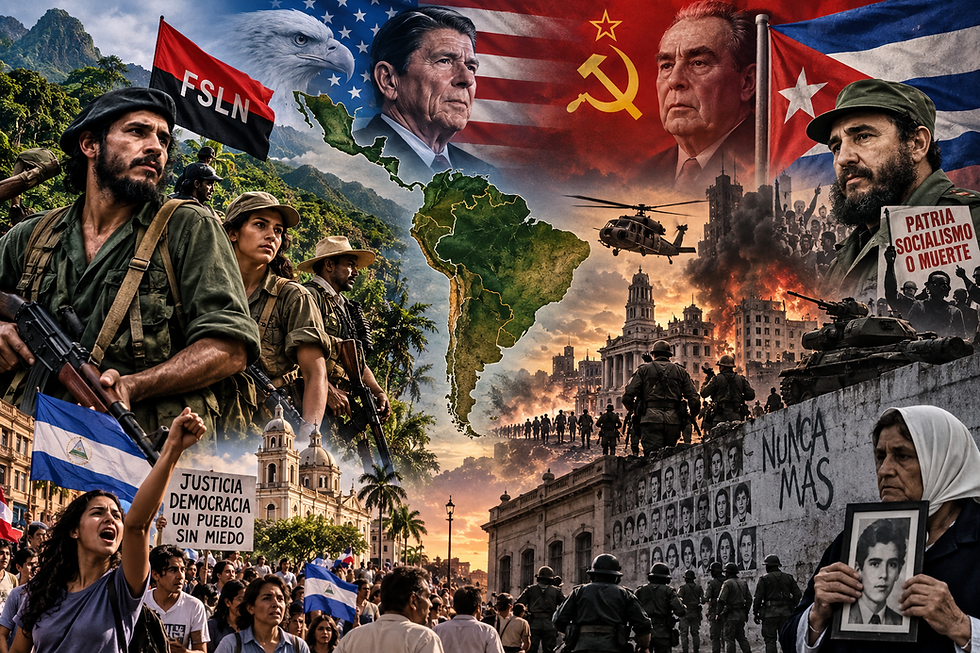
14. Lessons from Cold War: Revolution and Proxy Wars in Latin America

Guatemala: The CIA-Backed Coup and the Beginning of a New Cold War Battlefield
1954 - Long before American troops fought in Vietnam, the United States was already confronting governments and movements it feared could move toward communism. In Guatemala, that confrontation would help overthrow a president and leave consequences lasting for decades.
A Country Trying to Change
Guatemala had long been dominated by wealthy landowners and powerful businesses while many rural and Indigenous families lived in poverty and possessed little land. After the overthrow of dictator Jorge Ubico in 1944, Guatemala entered a period of political reform sometimes called the Guatemalan Revolution. In 1951, Jacobo Árbenz became president and promised economic modernization and land reform. His most controversial measure, Decree 900, allowed the government to redistribute certain large areas of unused land to landless farmers, with compensation provided to the owners.
The United Fruit Company and American Concerns
One company particularly affected was the United Fruit Company, an enormous American corporation with extensive landholdings and business interests in Guatemala. The company strongly opposed Árbenz's policies and lobbied against his government in the United States. But the Eisenhower administration's concerns extended beyond protecting an American corporation. Communist Party members had gained influence within Guatemala's labor and political movements, and Washington feared that Guatemala could become a foothold for Soviet influence in the Western Hemisphere. Historians continue to debate the relative importance of economic interests and genuine Cold War security concerns, but both contributed to the growing confrontation.
Operation PBSUCCESS
President Dwight D. Eisenhower authorized the CIA to organize a covert operation known as PBSUCCESS. Rather than launch a conventional American invasion, the CIA trained and supported a small rebel force commanded by Guatemalan exile Carlos Castillo Armas. Radio broadcasts, propaganda, diplomatic pressure, and psychological warfare were used to exaggerate the rebels' strength and convince Guatemalans that a much larger attack was underway. In June 1954, Castillo Armas's forces crossed into Guatemala. Although the invading army was relatively small, the psychological campaign helped create confusion and fear within the Guatemalan government and military.
Árbenz Falls
President Árbenz attempted to rally the country, but Guatemala's military leadership refused to fully support him as pressure increased. On June 27, 1954, Árbenz resigned, declaring that foreign intervention had made it impossible for his government to continue. Castillo Armas eventually became president, reversed many of the previous government's reforms, outlawed communist organizations, and restored significant amounts of redistributed land. What appeared to Washington as a successful operation had demonstrated something important: the United States could use intelligence agencies, local allies, economic pressure, and propaganda to influence political outcomes without openly declaring war.
A Victory with a Long Shadow
The coup did not create all of Guatemala's political and social problems, but it contributed to instability that deepened during the following years. In 1960, Guatemala descended into a civil war between government forces and left-wing guerrillas that lasted until 1996. The conflict ultimately killed or disappeared more than 200,000 people, with Indigenous Maya communities suffering especially devastating violence. A later United Nations-backed truth commission concluded that state forces and related paramilitary groups were responsible for the overwhelming majority of documented violations.
Latin America Becomes a Cold War Battlefield
Guatemala became an early example of how the Cold War would be fought across Latin America. Washington increasingly feared that revolutionary governments might expand Soviet or communist influence near the United States, while left-wing movements increasingly viewed American intervention as evidence of foreign domination. Over the following decades, revolutions, coups, guerrilla wars, covert operations, dictatorships, and proxy conflicts would spread throughout the region. The events of 1954 therefore became more than a Guatemalan political crisis—they became an early warning of how the global struggle between communism and anti-communism could collide with local struggles over land, power, poverty, and political freedom.
Che Guevara and the Attempt to Export Communist Revolution
1959–1967 - Guevara, an Argentine-born Marxist revolutionary who had fought alongside Fidel Castro, believed guerrilla fighters could help ignite uprisings against governments throughout Latin America and eventually beyond it. To supporters, he became a symbol of resistance to foreign influence and inequality. To opponents, he represented an armed revolutionary movement willing to use violence, executions, and one-party rule to achieve communist goals.
From Cuba to International Revolution
After Castro's forces seized power in Cuba in 1959, Guevara became one of the new government's most powerful figures. He served in several senior positions and helped move Cuba toward an alliance with the Soviet Union. He also played a role in revolutionary tribunals and executions at La Cabaña fortress following the revolution, where people associated with the previous Batista government and others accused of serious crimes were tried. Guevara increasingly argued that Cuba should not remain an isolated revolution. He believed revolutionary warfare could create additional communist or Marxist governments across Latin America, weakening American influence in the Western Hemisphere.
The Strategy of Guerrilla Warfare
Guevara promoted a revolutionary strategy often associated with the foco theory: a relatively small group of committed guerrillas could establish itself in the countryside, gain support among local people, challenge government forces, and help create conditions for a wider revolution. His writings on guerrilla warfare circulated internationally. The Cuban government also provided various revolutionary movements with training, weapons, financial assistance, or political support. Yet Guevara's strategy depended heavily upon local conditions. A revolution that had succeeded in Cuba could not simply be recreated everywhere.
1965 — Revolution Moves to Africa
Guevara's ambitions extended beyond Latin America. In 1965, he secretly traveled to the Congo, where he attempted to assist rebels following the Congo Crisis and the death of independence leader Patrice Lumumba. Guevara and a contingent of Cuban fighters hoped to strengthen the rebellion, but the mission became a failure. Poor organization, disagreements among rebel leaders, weak discipline, difficult local conditions, and military pressure undermined the campaign. Guevara eventually withdrew, frustrated that revolutionary determination alone could not overcome these problems.
1966 — Guevara Disappears into Bolivia
Instead of abandoning his revolutionary mission, Guevara secretly entered Bolivia in 1966. From a remote guerrilla camp, he hoped to create a revolutionary movement that might eventually spread into neighboring countries. But the Bolivian campaign quickly encountered serious difficulties. Guevara's fighters struggled to gain widespread support from local peasants, suffered communication problems, and became increasingly isolated. Bolivia's military, assisted by American intelligence and U.S.-trained personnel, hunted the guerrillas through the mountains and forests.
1967 — The Capture and Death of Che Guevara
On October 8, 1967, Bolivian soldiers captured Guevara after a battle near the village of La Higuera. He was wounded and taken to a small schoolhouse. The following day, October 9, Bolivian authorities ordered his execution, and Sergeant Mario Terán shot him. Guevara was thirty-nine years old. His body was publicly displayed to demonstrate that the famous revolutionary was dead, but the attempt to destroy his influence had an unexpected result: his death helped transform him into an international revolutionary icon.
A Revolution That Outlived the Revolutionary
Guevara failed to ignite the chain of communist revolutions he envisioned, yet his ideas continued to influence armed movements throughout Latin America and elsewhere. His image became famous among revolutionary organizations, student movements, and political activists, while critics emphasized his support for political violence, executions, Marxist-Leninist government, and armed revolution. His story illustrates one of the central realities of the Cold War in Latin America: Cuba's revolution did not remain confined to one island. It inspired revolutionary movements, frightened governments, encouraged American countermeasures, and helped turn struggles within Latin American countries into battles connected to a much larger global Cold War.
Guerrilla Movements, Communist Insurgencies, and the Battle for Latin America
1960s–1970s - Inspired partly by the Cuban Revolution, Marxist and communist revolutionary organizations emerged or expanded in countries including Colombia, Guatemala, Nicaragua, Uruguay, El Salvador, Bolivia, and Argentina. Yet these conflicts were not simply imported from Moscow or Havana. Poverty, unequal land ownership, political exclusion, authoritarian governments, and longstanding social divisions created local grievances that revolutionary movements attempted to turn into armed rebellion.
The Cuban Revolution Sends a Shockwave
Fidel Castro's victory in Cuba in 1959 demonstrated that a relatively small revolutionary movement could overthrow an established government. Cuba subsequently provided training, weapons, money, or other assistance to selected revolutionary organizations abroad, while the Soviet Union supported communist governments and movements according to its own strategic interests. Revolutionary leaders hoped that guerrilla warfare could gradually weaken governments and inspire farmers, workers, and students to join them. The possibility of additional communist revolutions alarmed Washington, which feared that Soviet-aligned governments could spread throughout the Western Hemisphere.
Colombia and the Rise of FARC
Colombia became home to one of Latin America's longest-running insurgencies. Following years of political violence and rural conflict, the Revolutionary Armed Forces of Colombia, better known as FARC, formally emerged in 1964 as a Marxist-Leninist guerrilla organization. It claimed to represent impoverished rural communities and sought revolutionary political change. Over the following decades, however, the conflict became increasingly complicated as guerrillas, government forces, paramilitary organizations, and drug traffickers battled for territory and influence. FARC itself became notorious for kidnappings, attacks, extortion, and later deep involvement in the illegal drug economy.
Guerrillas Move into the Cities
Not every revolutionary movement fought from mountains and jungles. In Uruguay, the Tupamaros became famous for urban guerrilla warfare during the 1960s and early 1970s. They carried out robberies, kidnappings, bombings, and political operations while presenting themselves as revolutionaries fighting an unjust political and economic system. Similar organizations appeared elsewhere, including Argentina's Montoneros and People's Revolutionary Army. These groups demonstrated that Cold War insurgencies could strike inside cities, bringing political violence directly into neighborhoods, businesses, police stations, and government offices.
Governments Strike Back
Latin American governments responded with police operations, military campaigns, intelligence networks, arrests, and emergency powers. The United States supplied many governments with military assistance, intelligence cooperation, equipment, and counterinsurgency training as part of its broader strategy to prevent communist expansion. Some security forces successfully weakened guerrilla organizations, but counterinsurgency also produced serious abuses. Torture, extrajudicial killings, disappearances, political imprisonment, and attacks against suspected sympathizers occurred in several countries. Civilians could find themselves trapped between revolutionary violence and brutal government retaliation.
Nicaragua and the Sandinistas
One revolutionary movement eventually accomplished what many others could not. Nicaragua's Sandinista National Liberation Front, founded in 1961, fought the government of the Somoza family, which had dominated Nicaragua for decades. Combining Marxist influences with Nicaraguan nationalism and opposition to dictatorship, the Sandinistas gradually built support. By the late 1970s, widespread anger against President Anastasio Somoza Debayle helped transform the insurgency into a broader rebellion. In July 1979, the Somoza government collapsed and the Sandinistas entered Managua victorious, creating another revolutionary government in the Americas.
A Continent Caught in the Cold War
By the end of the 1970s, Latin America had become one of the Cold War's most complicated fronts. Communist and Marxist revolutionaries committed kidnappings, assassinations, bombings, and armed attacks, while governments and anti-communist forces committed their own killings, disappearances, torture, and massacres. The United States, Cuba, and the Soviet Union influenced these struggles, but local people ultimately fought and suffered through them. The result was not one single Latin American Cold War but many interconnected conflicts in which ideology, poverty, dictatorship, nationalism, foreign intervention, and the struggle for political power collided—often with civilians paying the greatest price.
Military Coups, Anti-Communism, and the Rise of Latin American Dictatorships
1964–1976 - Communist revolution in Cuba, expanding guerrilla movements, economic instability, political polarization, and fears of social revolution convinced many military officers and their civilian supporters that traditional governments could no longer maintain order. Between the 1960s and 1970s, military governments ruled Brazil, Argentina, Chile, Uruguay, Bolivia, Paraguay, and other countries, transforming Latin America into one of the Cold War's most politically turbulent regions.
1964 — Brazil's Military Takes Power
Brazil became one of the most important early examples. President João Goulart supported economic and social reforms, including changes involving land, taxation, and labor, while opponents accused his government of moving dangerously toward the political left. In March and April 1964, Brazilian military forces moved against Goulart, who fled the country rather than risk a civil war. The United States supported Goulart's opponents and prepared Operation Brother Sam to assist the anti-Goulart forces if necessary, although direct American military intervention proved unnecessary. Brazil then entered more than two decades of military rule.
The Fear of Another Cuba
The Cuban Revolution haunted governments throughout the region. Military leaders increasingly portrayed themselves as defenders of their nations against communist revolution, while Washington often viewed anti-communist governments as strategic partners. The United States provided military assistance and counterinsurgency training to numerous Latin American countries. Yet not everyone supporting military intervention was motivated solely by the Cold War. Business leaders, landowners, conservative politicians, religious figures, and portions of the middle class sometimes feared economic disorder, revolutionary violence, nationalization of property, or radical political change.
Democracy Gives Way to Military Rule
As political violence and economic crises intensified, additional governments fell. Bolivia experienced repeated coups beginning in the 1960s. Uruguay's democratic institutions collapsed into a civilian-military dictatorship in 1973. Chile's armed forces overthrew socialist president Salvador Allende that same year. Argentina's military seized power in 1976 after years of political instability and violence involving left-wing guerrillas, right-wing groups, and security forces. By the mid-1970s, much of South America was governed by authoritarian regimes rather than elected civilian governments.
The Price of Fighting Communism
Many military rulers claimed extraordinary measures were necessary to defeat insurgencies and restore stability, but their campaigns frequently went far beyond fighting armed guerrillas. Governments censored newspapers, dissolved legislatures, restricted political parties, arrested opponents, and imprisoned people without normal judicial protections. Security organizations in several countries tortured prisoners and carried out forced disappearances and extrajudicial killings. Students, journalists, labor organizers, intellectuals, clergy, political activists, and sometimes people only suspected of opposition could become targets.
Washington's Difficult Cold War Choice
American policy toward these governments changed over time and differed from country to country, but Cold War strategy frequently placed containing communism ahead of promoting democracy. U.S. administrations cooperated with or supported several authoritarian anti-communist governments while also becoming increasingly concerned about human-rights abuses, particularly during the 1970s. This produced a lasting controversy: could the United States defend freedom globally while cooperating with dictatorships because they opposed communism? That contradiction became one of the most difficult questions surrounding American involvement in Latin America.
When the Fight Against Dictatorship Created Dictatorships
By 1976, the struggle against communist revolution had helped reshape the politics of an entire region. Guerrilla organizations had committed kidnappings, assassinations, bombings, and armed attacks, but military governments often responded with repression reaching far beyond the insurgents themselves. Millions of ordinary Latin Americans lived under governments that restricted political freedom in the name of national security. The era demonstrated one of the Cold War's great dangers: when societies become convinced that their survival is at stake, the fight against one form of authoritarianism can become the justification for creating another.
1970–1973 — Salvador Allende, Augusto Pinochet, and Chile's Cold War Crisis
1970–1973 - Unlike Fidel Castro, Salvador Allende did not seize power through a guerrilla revolution. He was a Marxist politician who reached the presidency through Chile's constitutional electoral system. His attempt to transform Chile toward socialism without first overthrowing democracy attracted worldwide attention—and convinced the Nixon administration that another dangerous Marxist government might be emerging in the Western Hemisphere.
1970 — A Marxist Wins an Election
Salvador Allende had run for president several times before winning a plurality of the vote in September 1970 with about 36 percent. Because no candidate received a majority, Chile's Congress selected Allende between the two leading candidates, as the constitution required. He became president at the head of the Popular Unity coalition and promised what he called a Chilean road to socialism. His government expanded social programs, accelerated land redistribution, increased wages, and brought major industries under government control. Supporters believed Chile was confronting inequality; opponents feared Allende was leading the country toward an authoritarian Marxist system.
Copper, Nationalization, and Economic Conflict
Chile possessed enormous copper deposits, and copper was central to its economy. In 1971, Chile's Congress unanimously approved nationalization of the major copper mines, many of which were controlled by American companies. Allende's government also expanded state control over banks and businesses. Initially, increased wages and government spending helped stimulate consumption, but serious economic problems followed. Inflation accelerated, shortages became widespread, investment declined, strikes disrupted the country, and political divisions deepened. Allende blamed powerful domestic opponents and foreign pressure for helping destabilize the economy, while his critics blamed his government's economic policies and rapid nationalizations.
Nixon, Kissinger, and the CIA
President Richard Nixon and National Security Adviser Henry Kissinger viewed Allende's rise with alarm. Declassified records show that Nixon ordered the CIA to work covertly against Allende's accession and later to support efforts intended to weaken his government and strengthen political opposition. The United States funded opposition media and political organizations and applied economic pressure. Before Allende took office, the CIA also supported contacts seeking to encourage a military coup, although those efforts did not produce the 1973 coup. Soviet and Cuban connections with Allende's government added to Washington's concern, turning Chile's internal political crisis into part of the larger Cold War.
Chile Tears Itself Apart
By 1972 and 1973, Chile was dangerously polarized. Supporters of Allende organized rallies and defended his socialist transformation, while opposition parties, business groups, professionals, and others organized protests and strikes. Far-left organizations demanded faster revolutionary change, while militant groups on the right sought Allende's removal. Congress and the president battled over constitutional authority, and portions of the military became increasingly involved in politics. Chile was not fighting a conventional civil war, but the political center was weakening as both sides increasingly feared what would happen if their opponents gained complete control.
September 11, 1973 — The Coup
On September 11, Chile's armed forces launched a coup. General Augusto Pinochet, recently appointed commander-in-chief of the army by Allende, joined the military leadership overthrowing the government. Tanks surrounded the presidential palace, La Moneda, while aircraft bombed it. Allende refused demands to surrender and delivered a final radio address. Later that day he died inside the palace from a self-inflicted gunshot, according to subsequent forensic investigations. The elected socialist government had fallen, and Pinochet soon emerged as the dominant figure in a new military dictatorship.
Pinochet's Chile
The new regime dissolved Congress, prohibited or restricted political parties, censored opposition, and arrested thousands of people. Security forces tortured prisoners, executed opponents, and caused others to disappear. Pinochet's government also introduced major free-market economic reforms and became a determined anti-communist ally during the Cold War. Supporters later credited some of these economic changes with contributing to Chile's development, while critics emphasized dictatorship, repression, inequality, and human-rights abuses. Pinochet remained in power until 1990.
Chile's Cold War Warning
Chile became a powerful example of how the Cold War could collide with an existing democratic system. Allende's radical socialist program, severe economic turmoil, revolutionary and counterrevolutionary movements, American covert intervention, and growing military involvement combined to produce a national crisis. The result was not a simple story of communists against anti-communists or foreigners against Chileans. It was a warning about what can happen when political opponents stop seeing one another merely as rivals and begin viewing each other as existential enemies—and when global superpower competition intensifies a country's internal struggle.
1975–1980s — Operation Condor and the Dirty Wars of South America
1975–1980s - As military governments fought Marxist guerrillas and other political opponents, intelligence and security services increasingly cooperated across national borders. In 1975, officials from Chile, Argentina, Uruguay, Paraguay, Bolivia, and Brazil established what became known as Operation Condor. Their goal was to track and suppress people they considered subversives—but the campaign expanded into kidnapping, torture, forced disappearance, and assassination.
A Secret Network Crosses Borders
Operation Condor allowed participating governments to exchange intelligence about suspected revolutionaries and political opponents who had escaped into neighboring countries. Borders no longer necessarily provided safety. Security agents could locate exiles, share information, arrange arrests, and secretly transfer prisoners between countries. Argentina, Chile, Uruguay, Paraguay, Bolivia, and Brazil became the core participants, while other governments cooperated to varying degrees. What began as anti-subversion coordination developed into an international system capable of pursuing enemies far beyond their home countries.
Argentina's Dirty War
The violence became especially severe in Argentina after the military seized power in March 1976. Argentina had already experienced killings and terrorism by left-wing guerrillas such as the Montoneros and ERP, as well as violence by right-wing organizations. The military junta promised to destroy subversion and restore order, but its campaign extended far beyond armed guerrillas. Thousands of suspected opponents were abducted and taken to secret detention centers, where many were interrogated and tortured. Large numbers simply disappeared, becoming known as the desaparecidos—the disappeared.
The Mothers Who Refused to Be Silent
In 1977, a small group of mothers began gathering at the Plaza de Mayo in Buenos Aires demanding information about their missing children. At enormous personal risk, the Mothers of the Plaza de Mayo turned white headscarves into a symbol recognized around the world. Their protests challenged a government that often refused even to acknowledge that prisoners had been taken. Some members of the movement were themselves abducted and killed, yet the demonstrations continued. Their courage demonstrated that resistance to dictatorship did not always come from soldiers or guerrillas; sometimes it came from parents asking a simple question: Where are our children?
Assassination Reaches Washington
Operation Condor's reach became unmistakable on September 21, 1976, when former Chilean ambassador and government minister Orlando Letelier was killed by a car bomb in Washington, D.C. His American colleague Ronni Moffitt also died in the explosion. Investigations connected the assassination to agents of Chile's secret police, DINA. The attack demonstrated that political violence associated with South America's dictatorships could reach even the capital of the United States.
The United States and an Uncomfortable Alliance
American governments viewed communist and revolutionary movements in Latin America as serious Cold War threats and maintained relationships with several anti-communist regimes involved in repression. U.S. officials had information about Condor and sometimes cooperated with regional security services, although American policy was not uniform and changed over time. During the administration of President Jimmy Carter, beginning in 1977, human rights became a greater part of U.S. foreign policy, and Washington applied increased pressure on several governments over abuses. The period exposed a difficult contradiction between opposing communist expansion and defending democratic freedoms.
The Dictatorships Begin to Fall
By the 1980s, many South American military governments were losing power. Economic crises, public opposition, international pressure, and political failures weakened the dictatorships, while democratic movements grew stronger. Argentina returned to civilian government in 1983, Uruguay and Brazil followed in 1985, and Chile eventually returned to democratic government in 1990. Investigations, trials, declassified documents, and the discovery of secret archives later revealed more about the networks of repression that had operated across the continent.
The Cost of Fighting a Secret War
Operation Condor and the Dirty Wars demonstrate how Cold War fears could erase the boundaries between legitimate security operations and state terror. Latin American governments faced real armed revolutionary organizations that carried out kidnappings, bombings, assassinations, and attacks, but governments also targeted many civilians and nonviolent opponents through methods that violated basic human rights. Tens of thousands were killed or disappeared across the region's dictatorships and political conflicts. The lesson left behind was chilling: when governments give secret institutions enormous power in the name of defeating an enemy, the definition of "enemy" can expand until almost anyone becomes a target.
Nicaragua: The Sandinista Revolution and the Contra War
1979–1990 - What began as a revolution against the long-ruling Somoza family soon became an international struggle involving Nicaragua's Sandinista government, U.S.-backed Contra rebels, Cuba, the Soviet Union, and neighboring countries. By the 1980s, Nicaragua was no longer fighting only over who would govern the country—it had become part of the worldwide contest between communism and the West.
1979 — The Somoza Dynasty Falls
For decades, Nicaragua had been dominated by the Somoza family, whose governments maintained close relations with the United States but became notorious for corruption and authoritarian rule. Opposition grew dramatically during the 1970s, especially after the 1978 assassination of newspaper editor Pedro Joaquín Chamorro, a prominent critic of the government. The Sandinista National Liberation Front, or FSLN, combined Marxist ideas, Nicaraguan nationalism, and opposition to Somoza. After widespread rebellion and intense fighting, President Anastasio Somoza Debayle fled Nicaragua in July 1979. Sandinista forces entered Managua, ending the dynasty.
The Sandinistas Build a New Nicaragua
The revolutionary government initially included people from several political backgrounds, but the Sandinistas soon became the dominant force. Led prominently by Daniel Ortega, they launched literacy and health programs, redistributed property, expanded government control of parts of the economy, and developed close relationships with Cuba and the Soviet bloc. The Sandinistas permitted some political opposition and later held elections, but they also censored media, restricted opponents, expanded state security, and clashed with businesses, churches, Indigenous communities, and political rivals. To Washington, Nicaragua appeared to be moving dangerously closer to the communist world.
Reagan Draws a Line
When Ronald Reagan became U.S. president in 1981, his administration viewed Nicaragua as more than a local revolution. American officials accused the Sandinistas of assisting leftist insurgents elsewhere in Central America, particularly in El Salvador. Reagan feared that communist-aligned governments could spread through the region. The CIA therefore began supporting armed opponents of the Sandinistas known collectively as the Contras. Many operated from bases in neighboring Honduras and included former members of Somoza's National Guard as well as other Nicaraguans opposed to Sandinista rule.
The Contra War
The Contras attacked government installations, transportation routes, farms, and other targets in an effort to weaken the Sandinista government. The Sandinistas responded with military operations, conscription, and expanded security measures. Both sides were accused of serious human-rights abuses, including killings and mistreatment of civilians. Rural communities were often caught between them. Meanwhile, Nicaragua's economy suffered from warfare, U.S. economic pressure, government policies, inflation, and disrupted production. By the middle of the decade, ordinary Nicaraguans were paying an enormous price for a conflict increasingly connected to superpower rivalry.
Congress Says No—and a Secret Operation Begins
American support for the Contras became deeply controversial. Congress passed restrictions known as the Boland Amendments limiting U.S. government assistance intended to support Contra military operations. Members of the Reagan administration nevertheless remained determined to keep the Contras alive. A secret network involving National Security Council staff sought alternative funding. This effort eventually became connected to another secret operation: selling weapons to Iran, despite an American arms embargo, and diverting some proceeds to support the Contras.
The Iran-Contra Scandal Explodes
In 1986, the secret operations became public, producing the Iran-Contra scandal. Congressional hearings exposed a complicated network of covert activities and raised major constitutional questions about presidential power, congressional authority, and secret foreign policy. Lieutenant Colonel Oliver North became one of the most recognizable figures in the controversy. Investigations resulted in criminal charges against several officials, although some convictions were later overturned or individuals were pardoned. The scandal demonstrated how far Cold War officials were sometimes willing to go when they believed communist expansion had to be stopped.
1990 — The Revolution Faces the Voters
Regional peace negotiations eventually helped reduce the fighting, and Nicaragua held national elections in February 1990. Daniel Ortega and the Sandinistas expected to remain in power, but voters instead chose opposition candidate Violeta Barrios de Chamorro, widow of the murdered newspaper editor Pedro Joaquín Chamorro. War exhaustion, economic hardship, political opposition, and hopes for peace contributed to the result. Ortega accepted the electoral defeat and transferred the presidency peacefully in April, while the Contra conflict wound down.
A Small Country in a Global Struggle
Nicaragua demonstrated how easily a domestic revolution could become a Cold War proxy conflict. The Sandinistas had overthrown an authoritarian dynasty, but their Marxist orientation and ties to Cuba and the Soviet bloc alarmed Washington. The United States responded by supporting an armed rebellion whose own conduct generated serious controversy. Nicaragua was therefore neither simply a communist takeover nor simply an American intervention. It was a complicated struggle involving dictatorship, revolution, ideology, foreign intervention, human-rights abuses, and ordinary people caught between competing forces—exactly the kind of conflict that made the Cold War so dangerous far from Moscow and Washington.
El Salvador and Central America's Bloody Cold War
1979–1992 - El Salvador's conflict grew from deep problems inside the country—including unequal land ownership, poverty, political exclusion, disputed elections, and government repression—but it erupted just as communist revolutionaries had seized power in nearby Nicaragua. Soon the Salvadoran government was receiving enormous support from the United States while Marxist guerrillas received assistance that included support flowing through Cuba and Nicaragua. A local civil war had become part of a global struggle.
1979 — A Country Near Explosion
El Salvador had long been dominated by a relatively small economic elite while large numbers of rural laborers lived in poverty. Political opposition was frequently suppressed, and elections were repeatedly accused of fraud. In October 1979, reform-minded military officers overthrew President Carlos Humberto Romero and established a revolutionary governing junta, hoping reforms could prevent a larger uprising. Instead, violence accelerated. Right-wing death squads murdered suspected leftists and activists, while revolutionary organizations carried out assassinations, kidnappings, attacks, and sabotage. The political center was rapidly disappearing.
The Murder of Archbishop Romero
One of the most shocking moments came on March 24, 1980. Archbishop Óscar Romero, who had become an outspoken critic of government violence and abuses against civilians, was celebrating Mass in a hospital chapel when an assassin shot and killed him. A later United Nations-sponsored truth commission concluded that death-squad leader Roberto D'Aubuisson had ordered the assassination. Romero's death became an international symbol of El Salvador's crisis. Even churches, priests, aid workers, teachers, and ordinary villagers could become caught in a political struggle where suspicion alone could prove deadly.
The FMLN Goes to War
In October 1980, several left-wing revolutionary organizations united to create the Farabundo Martí National Liberation Front, or FMLN. The coalition included Marxist organizations seeking major political and economic transformation, and it launched a large offensive in January 1981. Although the offensive failed to overthrow the government, the FMLN established powerful guerrilla strongholds and demonstrated that the conflict would not end quickly. Guerrillas attacked military targets and infrastructure, while government forces launched counterinsurgency campaigns throughout the countryside.
El Mozote and the Terror of Civil War
The war's brutality became horrifyingly clear in December 1981 at El Mozote and surrounding villages. Soldiers from the Salvadoran Army's U.S.-trained Atlácatl Battalion killed hundreds of civilians, including large numbers of women and children, during a counterinsurgency operation. The massacre was initially denied by Salvadoran officials and disputed by members of the Reagan administration, but later investigations, excavations, documents, and testimony established what had occurred. El Mozote became one of the most infamous atrocities of the entire Latin American Cold War.
Reagan and the Fear of Another Nicaragua
President Ronald Reagan believed El Salvador represented a critical front against communist expansion. Only two years earlier, Nicaragua's Sandinistas had overthrown the Somoza government, and Washington feared El Salvador might be next. The United States provided billions of dollars in military and economic assistance during the conflict and sent advisers to help train Salvadoran forces. American pressure also encouraged elections and reforms, but Washington continued supporting Salvadoran security forces despite mounting evidence of severe human-rights abuses. U.S. officials argued that abandoning the government could produce another Marxist revolutionary victory.
A War with No Easy Heroes
Neither side emerged untouched by atrocities. Government security forces, military units, and associated death squads committed the great majority of abuses documented by the later United Nations-sponsored truth commission, including massacres, disappearances, torture, and assassinations. The FMLN also committed serious violations, including killings, kidnappings, disappearances, and attacks against civilians. An estimated 75,000 people were killed during the civil war, thousands disappeared, and enormous numbers fled their homes or left the country.
1992 — Peace Instead of Victory
By the end of the 1980s, neither side could achieve a decisive military victory. The Cold War itself was also ending, reducing the international pressures that had fueled the conflict. Negotiations mediated by the United Nations eventually produced the Chapultepec Peace Accords, signed in Mexico City on January 16, 1992. The agreements ended the war, reduced and restructured the armed forces, created new civilian policing institutions, and transformed the FMLN from an armed revolutionary movement into a legal political party.
The Human Cost of a Proxy War
El Salvador demonstrated why the Cold War cannot be understood only by studying nuclear missiles, American presidents, and Soviet leaders. In Central America, global ideological rivalry collided with poverty, political repression, revolutionary movements, land disputes, and demands for reform. Foreign powers supplied money, weapons, training, and political support, but Salvadorans endured the consequences. After more than a decade of bloodshed, neither battlefield victory nor greater firepower finally ended the struggle. Negotiation did—and El Salvador entered the post-Cold War world carrying the scars of a conflict in which local grievances and global rivalry had become inseparable.
Around the World During Revolution and Proxy Wars in Latin America
1949–1950s — Communism Expands Beyond the Soviet Union
The communist victory in China in 1949 and the outbreak of the Korean War in 1950 dramatically increased American fears that communism was expanding internationally. Policymakers increasingly viewed political crises around the world through the idea of containment—the belief that additional communist expansion had to be prevented. This affected Latin America because revolutionary movements that might once have been treated primarily as domestic problems were increasingly examined for connections to international communism. When Guatemala's government moved leftward in the early 1950s, Washington interpreted events partly through this larger atmosphere of Cold War fear.
1950s–1970s — Decolonization Creates New Cold War Battlegrounds
Across Africa and Asia, European colonial empires were collapsing. Ghana gained independence in 1957, numerous African nations followed during the 1960s, and conflicts erupted over the political future of newly independent states. Washington and Moscow competed for influence by offering weapons, money, advisers, and economic assistance. Latin American revolutionaries watched these anti-colonial struggles closely and sometimes portrayed their own movements as part of a worldwide fight against imperialism. American officials, meanwhile, feared that revolutionary nationalism could create new governments aligned with Moscow or Beijing.
1970s — Détente Changes the Superpower Struggle
During the early 1970s, the United States and Soviet Union entered a period known as détente, attempting to reduce tensions and negotiate limits on nuclear weapons. President Richard Nixon also opened relations with Communist China. Yet détente did not end proxy conflicts. The superpowers continued competing indirectly in Africa, Asia, the Middle East, and Latin America. Chile's crisis unfolded during this period, demonstrating that Washington could negotiate with Moscow while simultaneously working covertly to prevent Marxist political influence elsewhere.
1975–1980s — Africa Becomes Another Proxy-War Front
After Portugal abandoned its African colonies, Angola descended into civil war in 1975. The Soviet Union supplied the Marxist MPLA government while Cuba sent tens of thousands of troops; the United States and apartheid South Africa supported opposing forces at various times. Similar Cold War competition appeared elsewhere in Africa. These wars closely paralleled events in Latin America: domestic political struggles became internationalized when foreign powers supplied weapons, advisers, financing, and intelligence to competing sides.
1979 — Iran, Afghanistan, and Nicaragua Transform the Cold War
The year 1979 dramatically changed international politics. Iran's revolution overthrew the American-backed Shah, the Soviet Union invaded Afghanistan, and Nicaragua's Sandinistas overthrew the Somoza government. Although these revolutions were very different from one another, together they created the impression in Washington that American influence was under pressure across several regions. The Soviet invasion of Afghanistan also helped bring détente to an end. When Ronald Reagan became president in 1981, his administration adopted a more aggressive strategy of supporting anti-communist forces—including Nicaragua's Contras.
Important People of Revolution and Proxy Wars in Latin America
Jacobo Árbenz (1913–1971) — Guatemala's Overthrown President
Jacobo Árbenz was a Guatemalan military officer who became president in 1951 and attempted to modernize his country's economy through reforms, most famously land redistribution under Decree 900. His policies affected major landowners, including the American-owned United Fruit Company, while the growing influence of communists within Guatemala alarmed the Eisenhower administration. A CIA-backed operation helped overthrow Árbenz in 1954. His downfall became an important early example of American covert intervention during the Latin American Cold War.
Carlos Castillo Armas (1914–1957) — Leader of the Guatemalan Coup
Carlos Castillo Armas was a Guatemalan military officer and exile who led the CIA-supported rebel force that entered Guatemala in 1954. Although his army was relatively small, CIA-backed propaganda and psychological warfare helped undermine Árbenz's government. Castillo Armas subsequently became president, reversed important parts of the previous government's land reforms, and suppressed communist organizations. His rise demonstrated how the United States could use local allies and covert operations rather than deploying a conventional American army.
Fidel Castro (1926–2016) — Cuba's Revolutionary Leader
Fidel Castro's 1959 victory in Cuba changed the political calculations of nearly every government in the Western Hemisphere. Castro established an increasingly authoritarian communist state and aligned Cuba with the Soviet Union. His government supported selected revolutionary movements abroad through training, financing, weapons, and political assistance. To supporters he represented resistance to American influence and social inequality; to opponents he represented dictatorship and the expansion of communism into the Americas.
Che Guevara (1928–1967) — The Revolutionary Who Tried to Export Revolution
Argentine-born Ernesto "Che" Guevara fought alongside Castro and became one of the Cuban Revolution's most recognizable leaders. A committed Marxist, Guevara believed armed guerrilla warfare could spread revolution throughout Latin America and beyond. After serving in the Cuban government, he joined revolutionary campaigns overseas, including unsuccessful operations in the Congo and Bolivia. Bolivian soldiers captured him in 1967 and executed him. His death transformed him into an international revolutionary icon, although his support for armed revolution, executions, and authoritarian Marxist government remains central to understanding his controversial legacy.
Salvador Allende (1908–1973) — Chile's Socialist President
Salvador Allende became president of Chile in 1970 after winning a plurality in a democratic election and being selected by Congress according to Chile's constitutional process. A Marxist, he attempted to create a Chilean path toward socialism through nationalization, land reform, and expanded social programs. Economic turmoil and extreme political polarization followed, while the Nixon administration covertly worked to weaken his government. Allende died during the military coup of September 11, 1973, which ended his presidency and Chile's long period of constitutional government.
Augusto Pinochet (1915–2006) — Chile's Military Dictator
General Augusto Pinochet became the dominant leader of Chile after the 1973 military coup. His government was fiercely anti-communist and introduced major free-market economic reforms, but it also abolished or severely restricted democratic institutions and persecuted political opponents. Thousands were killed, disappeared, imprisoned, or tortured under the dictatorship. Pinochet remained in power until 1990, making him one of the most consequential and controversial figures of the Latin American Cold War.
Jorge Rafael Videla (1925–2013) — Leader of Argentina's Military Junta
General Jorge Rafael Videla became president after Argentina's military coup in 1976. His government fought left-wing guerrillas but also conducted a much broader campaign against suspected political opponents during Argentina's "Dirty War." Thousands were abducted, tortured, murdered, or disappeared. Videla later faced prosecution for crimes committed under the dictatorship. His rule demonstrates how anti-communist counterinsurgency could develop into systematic state repression.
Óscar Romero (1917–1980) — The Archbishop Who Condemned the Violence
Óscar Romero became Archbishop of San Salvador in 1977 and increasingly spoke against killings, repression, and abuses committed against civilians. He publicly appealed to members of the security forces not to participate in unlawful violence. On March 24, 1980, Romero was assassinated while celebrating Mass. A later United Nations-sponsored truth commission attributed responsibility for ordering the killing to death-squad leader Roberto D'Aubuisson. Romero's death became one of the defining symbols of El Salvador's civil war, and the Catholic Church canonized him as a saint in 2018.
Life Lessons from Revolution and Proxy Wars in Latin America
Fear Can Change What People Are Willing to Accept
Fear was one of the most powerful forces of the Latin American Cold War. Some people feared communist revolution, confiscation of property, political violence, or Soviet influence. Others feared military dictatorship, wealthy elites, American intervention, poverty, or government repression. When people believe that their families or nations face an existential threat, they may accept actions they would normally condemn. A valuable lesson is to ask not only, "What did these people do?" but also, "What were they afraid would happen if they did nothing?"
Political Opponents Are Not Automatically Enemies
Political polarization repeatedly turned opponents into enemies. Marxists sometimes described entire economic and political systems as enemies that had to be destroyed, while anti-communist governments sometimes treated peaceful activists, students, journalists, clergy, and labor organizers as dangerous subversives. Once societies begin believing that disagreement itself makes someone an enemy, compromise becomes increasingly difficult. Healthy societies require people to distinguish between someone who disagrees with them and someone who actually intends to harm them.
Good Intentions Do Not Guarantee Good Results
Many movements claimed noble purposes. Revolutionaries promised equality and justice. Military governments promised security and stability. Foreign governments claimed to defend freedom or resist imperialism. Yet intentions must be compared with actions and results. Students should learn to ask: What did a movement promise? What did it actually do? Who benefited? Who suffered? Did its methods contradict its stated principles? Historical judgment becomes stronger when we evaluate both goals and consequences.
Violence Creates Cycles That Are Difficult to Stop
Guerrilla attacks encouraged government retaliation. Government repression encouraged people to join insurgencies. Assassinations produced revenge killings, which produced further reprisals. This cycle occurred repeatedly throughout Latin America. Violence sometimes destroyed an immediate opponent without resolving the problems that originally caused the conflict. One of history's hardest lessons is that winning a battle and solving a problem are not necessarily the same thing.
Never Judge a Conflict by Only One Side's Story
The Latin American Cold War is especially useful for developing critical thinking because nearly every side produced propaganda. Governments exaggerated communist threats. Revolutionary organizations presented themselves as liberators. The United States defended some controversial policies as necessary for containment, while Cuba and the Soviet bloc portrayed revolutionary movements as struggles against imperialism. Students should compare speeches, government documents, newspapers, eyewitness testimony, statistics, photographs, and later investigations before deciding what happened.
Vocabulary to Learn While Studying Revolution and Proxy Wars in Latin America
1. Proxy War
Definition: A conflict in which larger powers support opposing sides rather than fighting each other directly.
Sample Sentence: Several conflicts in Latin America became proxy wars as foreign powers supplied governments or revolutionary movements with money, weapons, training, or political support.
2. Revolution
Definition: A major attempt to overthrow or fundamentally change a government, political system, or society.
Sample Sentence: The Sandinista Revolution overthrew Nicaragua's Somoza government in 1979.
3. Insurgency
Definition: An organized armed rebellion against an established government or political authority.
Sample Sentence: The Salvadoran government fought a prolonged left-wing insurgency during the country's civil war.
4. Counterinsurgency
Definition: Military, political, and intelligence efforts designed to defeat or weaken an insurgency.
Sample Sentence: Latin American governments developed counterinsurgency campaigns to combat revolutionary guerrillas.
5. Marxism
Definition: A political and economic theory associated with Karl Marx that emphasizes class conflict and seeks the replacement of capitalism with collective or social ownership of major economic resources.
Sample Sentence: Several Latin American revolutionary organizations were influenced by Marxism.
6. Anti-Communism
Definition: Political or ideological opposition to communism and communist movements.
Sample Sentence: Anti-communism became a major justification for military actions and U.S. policies throughout Latin America.
7. Coup d'État
Definition: The sudden and usually illegal removal of a government by a small group, often involving military leaders.
Sample Sentence: Chile's military removed President Salvador Allende in a coup d'état in 1973.
8. Dictatorship
Definition: A system of government in which one ruler or a small group holds extensive political power with few effective democratic restraints.
Sample Sentence: Several Latin American countries were ruled by military dictatorships during the Cold War.
9. Junta
Definition: A group of military officers that takes control of and governs a country.
Sample Sentence: A military junta took control of Argentina following the 1976 coup.
10. Nationalization
Definition: The transfer of privately owned businesses, industries, or resources into government ownership or control.
Sample Sentence: Salvador Allende supported the nationalization of major industries in Chile, including copper mining.
11. Land Reform
Definition: Government policies that change the ownership, distribution, or use of agricultural land.
Sample Sentence: Jacobo Árbenz's land reform program redistributed some unused land from large estates to rural families in Guatemala.
12. Covert Operation
Definition: A secret government activity designed to influence events while concealing or limiting public acknowledgment of the government's role.
Sample Sentence: The CIA conducted a covert operation against Guatemala's Árbenz government in 1954.
13. FARC
Definition: The Revolutionary Armed Forces of Colombia, a Marxist-Leninist guerrilla organization formally established in 1964 that fought the Colombian government for decades.
Sample Sentence: FARC became one of the longest-lasting guerrilla organizations in Latin America.
14. Sandinistas
Definition: Members or supporters of Nicaragua's Sandinista National Liberation Front, or FSLN, which overthrew the Somoza government in 1979.
Sample Sentence: The Sandinistas took power after the Nicaraguan Revolution succeeded in 1979.
15. Contras
Definition: Armed groups that fought Nicaragua's Sandinista government during the 1980s and received significant support from the United States.
Sample Sentence: The Contra War became one of Central America's major Cold War proxy conflicts.
16. Dirty WarDefinition: A term commonly used for Argentina's campaign of state repression during the late 1970s and early 1980s, involving secret detention, torture, killings, and forced disappearances.Sample Sentence: Thousands of people disappeared during Argentina's Dirty War.
17. Death SquadDefinition: An armed group that carries out illegal killings, kidnappings, or disappearances, sometimes with connections to governments or security forces.Sample Sentence: Death squads became responsible for numerous political killings during El Salvador's civil war.
18. Human RightsDefinition: Basic rights and freedoms considered to belong to every person, including protections against torture, arbitrary imprisonment, and unlawful killing.Sample Sentence: Reports of torture and disappearances increased international concern about human rights in Latin America.
19. RegimeDefinition: A government or system through which political power is exercised, especially when describing a particular period of rule.Sample Sentence: Augusto Pinochet's military regime governed Chile for nearly seventeen years.
20. Peace AccordsDefinition: Formal agreements intended to end armed conflict and establish conditions for peace.Sample Sentence: The 1992 Chapultepec Peace Accords helped bring El Salvador's long civil war to an end.
Activities for Learning About Revolution and Proxy Wars in Latin America
Cold War Latin America Map: Follow the Revolution
Recommended Age: 9–14
Activity Description: Students create a map showing where major Cold War revolutions, coups, dictatorships, and civil wars occurred throughout Latin America. This helps students visualize that these events were interconnected rather than isolated conflicts.
Objective: Identify important countries and understand how revolutionary movements and Cold War competition spread across Latin America.
Materials: Blank map of Latin America, colored pencils, textbook or research materials, ruler, and timeline.
Instructions: Have students locate Guatemala, Cuba, Colombia, Chile, Argentina, Uruguay, Bolivia, Nicaragua, and El Salvador. Create symbols for revolution, military coup, guerrilla insurgency, civil war, and foreign intervention. Students should place major events on their maps, including Guatemala's 1954 coup, Cuba's 1959 revolution, Chile's 1973 coup, Argentina's Dirty War, Nicaragua's 1979 revolution, and El Salvador's civil war. Beside each country, have students write one sentence explaining why that country became important to the Cold War.
Learning Outcome: Students will understand the geographic scale of the Latin American Cold War and recognize patterns connecting revolutions, coups, and foreign intervention.
Who Would You Support? Cold War Decision Cards
Recommended Age: 11–18
Activity Description: Students receive fictional historical scenarios based on real situations faced by Latin Americans. Instead of knowing what eventually happened, they must make decisions using only the information someone living at the time might have possessed.
Objective: Develop historical empathy, decision-making skills, and an understanding that historical choices were rarely as obvious to participants as they appear afterward.
Materials: Teacher-created scenario cards, paper, pencils, and classroom discussion space.
Instructions: Give students scenarios such as: "Your country has an elected socialist government, but inflation and political violence are increasing. Military officers claim they can restore order. Do you support them?" Another might ask: "You oppose a dictatorship, but the strongest resistance organization is Marxist and uses guerrilla violence. Do you join it?" Students choose an action and explain their reasoning. Only afterward should the teacher reveal comparable situations from Chile, Nicaragua, Guatemala, or El Salvador and discuss the consequences.
Learning Outcome: Students will recognize why people could make very different decisions while believing they were protecting their families, freedoms, or countries.
Capitalism, Communism, or Something Else?
Recommended Age: 12–18
Activity Description: Students become advisers to a fictional Latin American country struggling with poverty, land inequality, unemployment, foreign-owned businesses, and political unrest. They must design economic reforms without knowing which historical government their choices resemble.
Objective: Understand why economic questions became closely connected with Cold War political conflicts.
Materials: Scenario worksheet, fictional national budget, property statistics, policy cards, calculator, and paper.
Instructions: Give students choices involving land reform, nationalization, private property, taxation, foreign investment, minimum wages, government ownership, and social programs. Every decision should contain potential benefits and disadvantages. Students construct their economic plan and defend it before the class. Compare their choices afterward with policies attempted in Guatemala, Chile, Cuba, and Nicaragua.
Learning Outcome: Students will understand why economic inequality and competing economic systems became major sources of political conflict.
Revolution, Reform, or Repression? The Latin America Cold War Debate
Recommended Age: 14–18
Activity Description: Students finish the unit with an evidence-based discussion examining one of its central questions: Why did so many Latin American political struggles become violent during the Cold War?
Objective: Combine information from the entire chapter and strengthen evidence-based historical reasoning.
Materials: Notes from previous activities, timeline, primary-source excerpts, textbook, and debate preparation sheet.
Instructions: Assign groups different explanations: economic inequality, communist revolutionary ideology, authoritarian government, American intervention, Cuban and Soviet involvement, political polarization, or weak democratic institutions. Each group must present evidence showing why its factor mattered while acknowledging at least one weakness in its argument. Afterward, students individually rank the causes from most to least influential and defend their rankings.
Learning Outcome: Students will recognize that major historical conflicts rarely have a single cause. They will practice weighing evidence, distinguishing cause from effect, recognizing competing interpretations, and building historical arguments rather than simply memorizing conclusions.


Comments