

14. Lesson Plans from the Roaring 1920's: Farmers, Workers, and Hidden Struggles

Myth of Universal Prosperity
The 1920s are often remembered as one of the most exciting decades in American history. Radios filled homes with music and news, automobiles crowded the roads, movies attracted millions of viewers, and businesses seemed to grow richer every year. Newspapers celebrated a booming economy, and many Americans believed the nation had entered a new age of endless prosperity. Yet beneath the excitement and bright headlines was a very different story. While some families enjoyed rising incomes and modern conveniences, millions of Americans struggled to make ends meet. The prosperity of the Roaring Twenties was real, but it did not reach everyone.
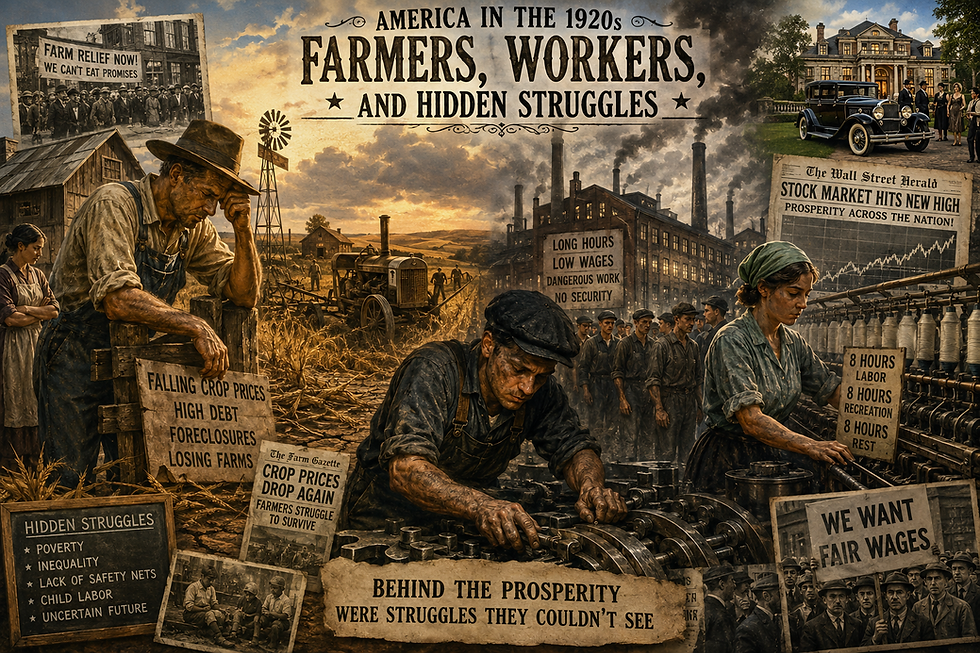
The Prosperous America Seen by Many
For people living in growing cities, the decade often felt full of opportunity. Factories produced more goods than ever before, new technologies created jobs, and many middle-class families purchased products that previous generations could only dream about owning. Electric appliances, telephones, automobiles, and entertainment became symbols of success. Investors poured money into the stock market, believing that prosperity would continue forever. To many Americans, the nation appeared stronger and wealthier than it had ever been.
The America Hidden Behind the Headlines
Away from the bustling cities, however, many families experienced a very different reality. Farmers who had expanded their operations during World War I faced falling crop prices and growing debts. Rural communities often lacked electricity, paved roads, and other improvements that urban residents increasingly enjoyed. Factory workers and laborers frequently worked long hours for wages that barely kept up with the rising cost of living. While business leaders and investors often prospered, many ordinary workers found that economic success was unevenly distributed.
A Growing Divide Between Rich and Poor
One of the hidden problems of the 1920s was the growing gap between wealthy Americans and everyone else. A relatively small percentage of the population controlled a large share of the nation's wealth. While the rich invested in stocks, purchased luxury goods, and built large fortunes, many working families lived paycheck to paycheck. If a worker lost a job or a farmer suffered a poor harvest, there were few government programs available to help. The appearance of prosperity sometimes concealed serious financial hardships that millions quietly endured.
Warning Signs Beneath the Roar
As the decade continued, economic warning signs began to appear. Farmers struggled with debt, workers faced uncertain job security, and many Americans relied on credit to purchase goods they could not fully afford. These problems did not receive as much attention as the exciting stories of stock market gains and technological progress. Yet they revealed weaknesses within the economy that would become impossible to ignore by the end of the decade. The Roaring Twenties were not only a story of success and celebration—they were also a story of challenges that many Americans faced in silence.
Looking Beyond the Prosperity
Understanding the myth of universal prosperity helps us see the 1920s more clearly. History is often remembered through its greatest achievements and most exciting moments, but the experiences of ordinary people are just as important. By looking beyond the headlines, we discover that the decade's prosperity was not shared equally. The struggles of farmers, workers, and rural families reveal that beneath the glittering surface of the Roaring Twenties, economic troubles were already beginning to grow—troubles that would soon change the nation forever.
Why Farmers Struggled After World War I
During World War I, American farmers were hailed as heroes who helped feed not only the United States but also millions of people overseas. European farms had been damaged by years of fighting, and nations at war desperately needed food. Wheat, corn, cotton, and other crops were in high demand, causing prices to soar. Farmers were encouraged by government officials, banks, and agricultural experts to plant more land and produce larger harvests. For a brief time, it seemed that prosperity had finally arrived in rural America.
The Wartime Farming Boom
As demand increased, many farmers expanded their operations. They purchased additional land, bought new tractors and machinery, and borrowed money from banks to increase production. Fields that had never been cultivated before were plowed and planted. New technologies allowed farmers to work larger areas more efficiently than ever before. With crop prices high and buyers eager to purchase their harvests, many believed the good times would continue for years. The future appeared bright across America's countryside.
A Sudden Change After the War
When World War I ended in 1918, however, the situation changed dramatically. European nations slowly rebuilt their own farms and once again began producing food for their populations. As foreign demand for American crops declined, the global market became flooded with agricultural products. Farmers continued producing large harvests, but there were fewer buyers. The result was simple economics: when supply increased and demand fell, prices dropped. Crops that had once earned farmers a healthy profit suddenly brought in much less money.
Debt Becomes a Heavy Burden
The falling prices created serious problems for farm families. Many had borrowed heavily during the wartime boom and now found themselves unable to earn enough money to repay their loans. Tractors, land payments, equipment purchases, and mortgages still had to be paid, even as farm income shrank. Some farmers lost their land through foreclosure, while others spent years struggling under crushing debt. The prosperity they had expected never fully arrived, and many rural communities entered an economic depression long before the rest of the nation.
Forgotten During the Roaring Twenties
While cities celebrated the Roaring Twenties with new technologies, entertainment, and rising stock prices, many farmers were already facing financial hardship. Newspapers often focused on booming industries and wealthy investors, but rural America told a different story. Farm prices remained low throughout much of the decade, and countless agricultural families struggled to survive. Their difficulties became one of the hidden warning signs of the 1920s economy, revealing that not all Americans were sharing in the nation's prosperity.
Farm Debt and Foreclosures
During the early 1900s, many American farmers believed they were building a brighter future. Rising crop prices during World War I encouraged them to expand their farms, purchase new equipment, and invest in modern machinery. Banks were often willing to lend money, and many farmers saw loans as an opportunity rather than a risk. Yet when agricultural markets changed after the war, those same loans became one of the greatest threats to rural families across the nation.
Borrowing for Growth
The wartime demand for food convinced many farmers that high prices would continue for years. To increase production, they borrowed money to buy additional land, tractors, plows, harvesters, and livestock. New machines allowed farmers to cultivate larger fields and produce bigger harvests than ever before. Land values also increased rapidly, leading some farmers to take out large mortgages to purchase neighboring properties. At the time, these investments seemed like wise decisions that would generate greater profits in the future.
When Prices Began to Fall
After World War I ended, the agricultural boom quickly faded. European farms recovered, global food supplies increased, and demand for American crops declined. As more crops entered the market, prices dropped sharply. Farmers often harvested just as much—or even more—than before, but their crops brought in far less money. Wheat, cotton, corn, and other agricultural products no longer generated enough income to cover expenses. Many farm families suddenly found themselves trapped between falling earnings and growing debt payments.
The Threat of Foreclosure
Banks expected loan payments regardless of crop prices. Farmers who could not make their mortgage or equipment payments risked foreclosure, a legal process in which lenders took possession of their property. Families that had worked the same land for generations sometimes lost their farms after years of financial struggle. Foreclosure sales became increasingly common in some rural areas, and many families watched neighbors lose homes, land, livestock, and equipment. The fear of losing everything weighed heavily on farming communities throughout the 1920s.
Hard Times Across Rural America
The effects of debt reached far beyond individual farms. Local businesses depended on farmers to buy supplies, clothing, and household goods. When farmers struggled, rural stores, banks, and service providers often suffered as well. Entire communities felt the impact of declining farm income. Some young people left the countryside in search of opportunities in cities, while others stayed and helped their families survive difficult economic conditions. Long before the Great Depression began, many rural regions were already experiencing economic hardship.
Overproduction on America's Farms
During the 1920s, American farmers faced a surprising problem: they were too successful. Advances in machinery, improved farming techniques, and expanded farmland allowed farmers to grow more crops than ever before. Huge harvests filled barns, grain elevators, and railroad cars across the nation. At first, producing more food seemed like a sign of progress and prosperity. However, this abundance soon created a serious economic problem that hurt farm families throughout the decade.
A Harvest Bigger Than the Market
During World War I, farmers had been encouraged to increase production because Europe needed American food supplies. Many purchased tractors, expanded their acreage, and planted every available field. When the war ended, farmers continued producing at these high levels. Unfortunately, consumers in the United States and abroad could only buy so much food. As European agriculture recovered and global markets stabilized, demand for American crops declined. Farmers were producing far more wheat, corn, cotton, and other crops than buyers wanted to purchase.
The Law of Supply and Demand
The growing surplus caused prices to fall. In a free market, when there is more of a product available than people are willing to buy, sellers must lower prices to attract customers. This is known as the law of supply and demand. Farmers found themselves caught in a difficult situation. They harvested larger crops, but each bushel of grain or bale of cotton was worth less money. In many cases, producing more food actually reduced their income instead of increasing it.
Working Harder for Less
As prices dropped, many farmers responded by planting even more crops in hopes of earning enough money to pay their bills. Unfortunately, this often made the problem worse. More production created even larger surpluses, which pushed prices lower still. Farmers worked longer hours, cultivated more land, and harvested larger yields, yet many earned less money than they had before. The harder they worked, the more difficult it became to escape their financial troubles.
The Impact on Farm Families
Falling crop prices affected nearly every aspect of rural life. Farmers struggled to repay loans, purchase supplies, and maintain their equipment. Some delayed repairs, while others reduced household spending on clothing, education, and other necessities. Entire farming communities felt the effects as local businesses saw fewer customers and banks faced growing numbers of unpaid loans. Economic hardship spread across many rural areas even while much of urban America appeared prosperous.
A Hidden Warning Sign
Overproduction on America's farms was one of the clearest warning signs that the nation's economy was not as healthy as it seemed. Beneath the excitement of the Roaring Twenties, millions of farmers faced shrinking incomes and mounting financial pressure. Their struggles revealed that economic growth was uneven and that serious weaknesses existed beneath the surface. When the Great Depression arrived at the end of the decade, many farm families had already spent years battling the consequences of producing more crops than the market could absorb.
Rural Poverty Across America
The Roaring Twenties are often remembered as a decade of wealth, excitement, and progress. Cities grew rapidly, automobiles filled the roads, radios brought entertainment into homes, and new industries generated enormous profits. Yet far from the bright lights of urban America, millions of rural families lived a very different reality. While newspapers celebrated prosperity, many farming communities struggled with poverty, debt, and limited opportunities. For these families, the Roaring Twenties often felt more like a period of hardship than a decade of abundance.
Life Far from the Prosperity
Many rural Americans depended on farming for their livelihood, and falling crop prices made it difficult to earn a stable income. Farmers often worked from sunrise to sunset, yet their earnings continued to decline throughout much of the decade. Even families that owned land sometimes lacked enough cash to improve their homes, purchase new equipment, or save for emergencies. While city residents enjoyed many of the benefits of economic growth, rural families frequently found themselves left behind.
Homes Without Modern Conveniences
One of the greatest differences between urban and rural life was access to modern technology. During the 1920s, many city homes gained electricity, indoor plumbing, telephones, and household appliances. In contrast, large portions of rural America remained without these conveniences. Families often relied on wells for water, wood-burning stoves for heat and cooking, and kerosene lamps for light. Everyday tasks that were becoming easier in cities still required hours of hard labor in many rural homes.
Education and Opportunity Challenges
Rural communities also faced challenges in education and economic opportunity. Many country schools were small, underfunded, and located far from students' homes. Children frequently helped with farm work before and after school, and some missed classes during planting and harvest seasons. Limited access to higher education and fewer local job opportunities made it difficult for many young people to improve their economic situation. As a result, some left rural areas altogether in search of better opportunities in cities.
Communities Under Financial Pressure
The effects of poverty extended beyond individual families. Local businesses, banks, and merchants depended on farmers' success. When farm incomes declined, entire communities suffered. Stores sold fewer goods, banks faced unpaid loans, and local governments often lacked the resources to improve roads, schools, and public services. Economic struggles spread throughout rural regions, creating a cycle that was difficult to escape.
A Hidden Side of the Roaring Twenties
Rural poverty revealed that America's prosperity was unevenly distributed. While some Americans invested in the stock market and purchased the latest consumer goods, many farm families struggled to afford basic necessities. Their challenges were often overlooked by those living in more prosperous areas, but they represented a significant portion of the nation. The hardships experienced in rural America served as an important warning sign that the economy was not as strong as it appeared.
Regional Hardships and Agricultural Crisis
During the Roaring Twenties, Americans often heard stories of booming cities, rising stock prices, and growing industries. Yet in many agricultural regions, prosperity was difficult to find. Across the South, Great Plains, and Midwest, farmers who depended on a single major crop faced serious economic challenges. Cotton growers, wheat farmers, and other agricultural producers discovered that when crop prices fell, entire communities could suffer. Their struggles became one of the hidden crises of the decade.
The Risks of Cash Crops
Many farmers specialized in cash crops—crops grown primarily to be sold rather than consumed by the farmer's family. Cotton in the South, wheat on the Great Plains, and tobacco in parts of the Southeast provided income for millions of Americans. Specializing in one crop could be profitable during good years, but it also created risk. If prices dropped or harvests failed, farmers often had few alternative sources of income. Entire local economies could be affected by the fortunes of a single crop.
The Cotton Crisis in the South
Southern farmers faced particularly difficult conditions during the 1920s. Cotton prices declined significantly after World War I, reducing farm income across the region. At the same time, the boll weevil, a small insect that fed on cotton plants, continued damaging crops in many areas. Tenant farmers and sharecroppers, many of whom were African American, often lived in deep poverty and remained trapped in cycles of debt. Even when cotton harvests were successful, low prices frequently prevented families from improving their economic situation.
Wheat Farmers on the Great Plains
Wheat-producing regions experienced their own challenges. During World War I, wheat farmers expanded production to meet global demand, plowing millions of additional acres. When international demand weakened after the war, wheat prices dropped sharply. Farmers who had borrowed money to purchase land and machinery suddenly found it difficult to repay loans. Although their fields continued producing large harvests, the value of those crops often failed to cover expenses, creating financial hardship throughout the region.
Communities Feeling the Impact
Agricultural problems affected more than just farmers. Small towns depended on successful harvests to support local businesses, banks, and public services. When farm income declined, merchants sold fewer goods, banks faced unpaid debts, and local governments struggled to maintain schools and infrastructure. Economic hardship spread throughout entire regions, affecting nearly everyone connected to the agricultural economy. Communities that had once been optimistic about the future faced growing uncertainty.
Different Regions, Similar Struggles
Although cotton farmers in the South and wheat growers on the Plains faced different circumstances, their experiences shared common themes. Falling prices, debt, overproduction, and dependence on a single crop created economic vulnerability. Many farmers worked tirelessly but found themselves earning less each year. These struggles demonstrated that prosperity was not reaching every corner of the country, despite the optimistic image often associated with the 1920s.
A Warning Before the Great Depression
The regional agricultural crises of the 1920s served as an important warning sign for the nation. Long before the stock market crash of 1929, many farming regions were already experiencing economic distress. Their difficulties revealed weaknesses beneath the surface of the booming economy and showed how dependent communities could be on forces beyond their control. Understanding these regional hardships helps explain why the Great Depression would hit rural America so hard when the nation's larger economic crisis finally arrived.
The Growing Gap Between Rich and Poor
The 1920s are often remembered as a decade of wealth and prosperity. New industries flourished, stock prices climbed, and consumer goods filled store shelves. To many Americans, it seemed as though the nation was becoming richer every year. Yet beneath the excitement of the Roaring Twenties was a growing economic divide. While some individuals accumulated enormous fortunes, millions of workers and farmers struggled to keep pace. The decade's prosperity was real, but it was not shared equally.
A Decade of Great Wealth
Many business owners, investors, and industrial leaders benefited from the rapid growth of the American economy. Advances in manufacturing allowed factories to produce goods more efficiently, increasing profits for many companies. As the stock market rose, investors who owned shares in successful businesses often saw their wealth grow dramatically. Luxury homes, expensive automobiles, and lavish lifestyles became symbols of success for some of the nation's wealthiest citizens.
When Prosperity Reached Only Some
Although the economy expanded, many Americans did not experience the same level of financial success. Factory workers, laborers, and farmers often earned far less than the wealthy business leaders whose companies were growing. While wages rose for some workers, they generally increased much more slowly than the profits and wealth accumulated by many of the nation's richest individuals. Millions of families continued to live modestly, with little savings to protect them from economic hardship.
The Concentration of Wealth
One of the most significant economic trends of the 1920s was the concentration of wealth in the hands of a relatively small portion of the population. A large share of the nation's income and assets was controlled by the wealthiest Americans. This meant that while total national wealth increased, much of that growth benefited a limited number of people. The economy appeared strong on paper, but many families lacked the financial resources to fully participate in the prosperity being celebrated across the country.
Challenges for Ordinary Americans
For many working-class families, financial security remained uncertain. Farmers struggled with falling crop prices and debt, while industrial workers often depended entirely on their next paycheck. Without modern safety nets such as unemployment insurance or Social Security, losing a job or suffering a poor harvest could create serious financial problems. Many households relied on credit to purchase goods, making them vulnerable if economic conditions changed.
Why the Gap Mattered
The growing gap between rich and poor created weaknesses within the economy. Wealthy Americans could only purchase so many goods, while millions of lower-income families lacked the purchasing power to sustain growing levels of production. As businesses expanded and factories increased output, the unequal distribution of wealth limited the ability of many consumers to keep buying. This imbalance became one of several warning signs that economic problems were developing beneath the surface of the booming economy.
A Hidden Warning Sign of the 1920s
The growing gap between rich and poor reminds us that economic success can sometimes hide deeper challenges. While the Roaring Twenties produced remarkable wealth and innovation, the benefits were distributed unevenly. The concentration of wealth among a relatively small number of Americans left many families financially vulnerable and contributed to weaknesses that would become more visible when the Great Depression began. Looking beyond the headlines of prosperity reveals a more complete picture of the decade and the challenges that lay ahead.
Life for Industrial Workers
The 1920s are often remembered as a time of booming factories, rising production, and economic growth. Automobiles rolled off assembly lines in record numbers, skyscrapers rose over city skylines, and American industry seemed unstoppable. Behind this success, however, stood millions of industrial workers whose labor powered the nation's prosperity. Every day, men and women entered factories, mills, steel plants, and workshops where long hours, demanding work, and uncertain conditions shaped their lives. Their experiences reveal an important side of the Roaring Twenties that is often overlooked.
The Rise of the Factory Worker
Industrial jobs attracted millions of Americans and immigrants seeking steady employment. Large factories offered opportunities that many rural communities could not provide. Workers assembled automobiles, manufactured clothing, processed food, produced steel, and created countless other products that fueled the nation's growing economy. For many families, factory work provided a path to a better life, but it often came with significant challenges.
Wages and the Cost of Living
Many industrial workers earned wages that were higher than those of previous generations, but not everyone benefited equally from economic growth. Skilled workers generally earned more than unskilled laborers, while women and minority workers were often paid less than white male workers performing similar jobs. Although some families could afford new consumer goods, many workers still lived paycheck to paycheck. Unexpected expenses, illness, or unemployment could quickly create financial difficulties because few families had substantial savings.
Long Hours and Repetitive Labor
Factory work was often physically demanding and repetitive. Assembly lines increased efficiency by assigning workers a specific task that they repeated throughout the day. While this system allowed companies to produce goods more quickly, many workers found the work monotonous and exhausting. Although working hours gradually decreased compared to earlier decades, many laborers still spent long days in noisy, crowded environments where speed and productivity were constantly emphasized.
Conditions Inside the Factories
Factory conditions varied widely, but many workplaces remained challenging. Workers frequently dealt with loud machinery, poor ventilation, dust, heat, and dangerous equipment. Safety regulations were less extensive than they are today, and workplace injuries were common in some industries. Protective equipment was often limited, and accidents could leave workers unable to earn a living. Despite these risks, many workers continued because they depended on their jobs to support their families.
Job Security and Uncertainty
Even during times of economic growth, industrial workers faced uncertainty. Factories sometimes reduced production when demand slowed, leading to layoffs or reduced hours. Workers who lost their jobs had little protection because unemployment insurance did not yet exist. Many families depended entirely on a single wage earner, making job loss a serious threat to their financial stability. The fear of unemployment remained a constant concern for countless workers throughout the decade.
Dangerous Jobs and Workplace Safety
The factories, mines, and construction sites of the 1920s helped build modern America. Steel mills produced the materials for skyscrapers, coal mines powered industries and homes, and construction crews transformed city skylines with towering new buildings. Yet behind this remarkable growth was a reality that many workers faced every day: danger. For millions of Americans, going to work meant accepting risks that could lead to serious injury, lifelong disability, or even death. Workplace safety had improved in some areas since the early Industrial Revolution, but many jobs remained hazardous.
Life Around Powerful Machines
Factories were filled with machinery designed to increase production and efficiency. Conveyor belts, presses, cutting tools, and assembly lines allowed businesses to manufacture goods faster than ever before. However, these machines could also be extremely dangerous. Workers sometimes suffered crushed fingers, broken limbs, or severe injuries when clothing or body parts became caught in moving equipment. Safety guards and protective devices were not always present, and workers were often expected to maintain fast production speeds throughout the day.
The Dangers Beneath the Earth
Coal miners faced some of the most dangerous working conditions in the nation. Deep underground, miners dealt with cave-ins, falling rocks, poor air quality, and the constant threat of explosions caused by trapped gases. Dust-filled tunnels often damaged workers' lungs over time, leading to serious health problems. Despite these dangers, mining remained one of the most important industries in America, and thousands of miners continued to risk their lives to support their families.
Building America's Cities
Construction workers also faced significant hazards. During the 1920s, cities experienced a building boom that included skyscrapers, bridges, roads, and factories. Workers often labored high above the ground on steel beams and scaffolding with limited safety equipment. Falls were a constant threat, and heavy materials could cause serious injuries if accidents occurred. The impressive structures that defined the decade were often built through physically demanding and risky labor.
Limited Workplace Protections
Unlike today, workplace safety regulations were relatively limited during the 1920s. While some states had introduced safety laws and workers' compensation programs, protections varied widely. Employers were not always required to provide the safety equipment or training that modern workers often receive. If an accident occurred, injured workers sometimes faced lost wages, medical expenses, and uncertainty about their future. Many families depended on a single income, making workplace injuries especially devastating.
The Human Cost of Progress
Industrial growth brought tremendous economic benefits, but it also came with a human cost. Every accident affected not only the worker but also families and communities that relied on that person's income and support. Workers often accepted dangerous conditions because jobs were necessary for survival, and opportunities could be limited. Their sacrifices helped fuel America's economic expansion, even when they received little recognition for the risks they endured.
Labor Unions in the 1920s
During the Roaring Twenties, American factories produced goods at record levels, businesses expanded rapidly, and the economy appeared stronger than ever. Yet many workers believed they deserved better wages, safer workplaces, and greater job security. Labor unions had spent decades fighting for these goals, helping workers organize and negotiate with employers. However, the 1920s proved to be a difficult decade for organized labor. As businesses gained influence and public attitudes shifted, unions struggled to maintain the power they had built in earlier years.
What Labor Unions Sought to Achieve
Labor unions were organizations formed by workers who joined together to improve working conditions. By acting as a group, workers hoped to gain stronger bargaining power when negotiating wages, hours, and safety standards. Unions had helped secure important improvements during previous decades, including shorter workdays and better treatment in some industries. Many workers viewed unions as an important tool for protecting their rights in an increasingly industrialized economy.
A Difficult Environment for Organized Labor
The years following World War I created challenges for labor unions. Large strikes during and after the war had caused concern among many Americans, and some people began associating labor activism with radical political movements. The fear of communism and revolution that spread during the First Red Scare made some citizens suspicious of labor organizations. As a result, unions often faced criticism from business leaders, government officials, and portions of the public.
Business Opposition to Unions
Many companies actively worked to prevent union growth. Employers often promoted what became known as the "open shop," a workplace where employees were not required to join a union. Some businesses hired private investigators, maintained blacklists of labor organizers, or dismissed workers who attempted to unionize. Companies also introduced welfare programs, recreational activities, and other benefits in hopes of reducing worker interest in unions. These efforts made organizing much more difficult.
Challenges Faced by Workers
Workers who sought better conditions frequently encountered obstacles. Joining a union could place a person's job at risk, especially in industries where employers strongly opposed organized labor. Many workers feared losing their income if they participated in strikes or labor campaigns. Without unemployment insurance or strong government protections, unemployment could quickly create financial hardship. As a result, some workers chose to remain silent even when dissatisfied with their working conditions.
Declining Membership and Influence
Throughout much of the 1920s, labor union membership declined. Rapid economic growth in certain industries reduced the sense of urgency some workers felt about joining unions, while employer opposition continued to weaken labor organizations. New industries such as automobile manufacturing often proved difficult to organize. Although unions remained important in some sectors, their overall influence during the decade was generally weaker than it had been before World War I.
Preparing for Future Change
The struggles of labor unions during the 1920s did not mark the end of the labor movement. Instead, the challenges workers faced highlighted ongoing concerns about wages, safety, and job security. When the Great Depression began, millions of Americans experienced economic hardship, leading renewed interest in collective action and labor reform. The difficulties unions faced during the Roaring Twenties became an important chapter in the long effort to improve working conditions for American workers and secure greater protections in the workplace.
Child Labor and Family Economic Pressures
The Roaring Twenties are often remembered as a time of prosperity, entertainment, and technological progress. However, for many struggling families, daily life was focused less on radios and automobiles and more on earning enough money to survive. Although reformers had spent decades fighting against child labor, the practice had not disappeared completely. Across parts of America, some children continued to work in farms, factories, mills, mines, stores, and family businesses because their families depended on every possible source of income.
The Fight Against Child Labor
During the late 1800s and early 1900s, reformers exposed the harsh realities faced by child workers. Investigative photographers and journalists revealed children laboring in dangerous factories, textile mills, and mines for long hours and low pay. These efforts led many states to pass laws limiting child labor and encouraging school attendance. By the 1920s, conditions had improved in many areas, but enforcement varied, and child labor had not been completely eliminated.
Why Families Needed Children's Earnings
Many families faced difficult financial situations. Farm prices had fallen, wages for some workers remained modest, and economic opportunities varied widely across the country. In households struggling with debt or poverty, even a small paycheck earned by a child could help pay for food, clothing, rent, or farm supplies. For these families, children's work was often viewed as a necessity rather than a choice. Economic survival frequently took priority over education and leisure.
Children at Work
Children worked in a variety of jobs during the 1920s. On farms, boys and girls helped plant crops, harvest fields, care for livestock, and perform countless daily chores. In towns and cities, some children worked as newspaper carriers, delivery helpers, store clerks, or assistants in family-owned businesses. Others found employment in industries where labor laws were less strictly enforced. While many jobs were not as dangerous as those of earlier decades, they could still be physically demanding and time-consuming.
The Impact on Education
One of the greatest concerns surrounding child labor was its effect on schooling. Children who worked long hours often had less time and energy for their studies. Some missed school during busy farming seasons, while others left school altogether to contribute to family income. Reformers argued that education offered the best opportunity for children to improve their future prospects. However, families facing immediate financial pressures often found it difficult to sacrifice a child's earnings in exchange for long-term educational benefits.
A Reflection of Economic Inequality
The continued presence of child labor revealed that prosperity was not reaching all Americans equally. Wealthier families generally expected their children to attend school and prepare for future careers, while poorer families sometimes relied on children's labor simply to get by. The fact that some children still worked despite years of reform efforts highlighted the economic challenges facing many households during the decade.
Weak Government Safety Nets
During the 1920s, millions of Americans worked hard to build better lives for themselves and their families. Factories hummed with activity, farms produced crops, and businesses expanded across the nation. Yet beneath this appearance of prosperity was a major vulnerability: if people lost their jobs, became too old to work, suffered an injury, or faced financial hardship, there were very few government programs available to help them. Many of the protections Americans rely on today simply did not exist, leaving families exposed when difficult times arrived.
A Different World Before Modern Programs
Today, many people are familiar with programs such as Social Security, unemployment insurance, and various forms of public assistance. In the 1920s, however, these programs had not yet been created. The federal government played a much smaller role in providing economic support to citizens. Most Americans were expected to rely on their own savings, family members, local charities, churches, or private organizations during times of need.
What Happened If You Lost Your Job?
For workers, unemployment could be devastating. There was no nationwide unemployment insurance to provide temporary income while searching for a new job. If a factory reduced production, a business closed, or a worker was laid off, the loss of income was often immediate and severe. Families with little savings could quickly fall behind on rent, mortgage payments, food purchases, and other necessities. Finding another job was often the only solution.
Growing Old Without Social Security
Retirement was also very different from what many people experience today. Social Security would not be created until 1935, during the Great Depression. In the 1920s, many elderly Americans depended on personal savings, family support, private pensions, or continued employment. Those who had not saved enough money often faced difficult circumstances. For some older adults, working as long as physically possible was a necessity rather than a choice.
When Illness or Injury Struck
Workplace injuries and illnesses could create serious financial hardship. Although some states had workers' compensation laws, protections varied widely and were often limited. A worker injured in a factory, mine, or construction site might lose the ability to earn a living while facing medical expenses at the same time. Families frequently relied on relatives, neighbors, religious organizations, and local charities to help them through difficult periods.
Communities Filling the Gap
Because government assistance was limited, local communities often stepped in when people faced hardship. Churches, charitable groups, fraternal organizations, and neighbors provided support whenever possible. These efforts helped many families survive difficult times, but resources were often limited. During widespread economic downturns, local organizations could become overwhelmed by the number of people needing assistance.
A Hidden Weakness in the Economy
The lack of strong safety nets became one of the hidden weaknesses of the 1920s economy. As long as jobs were available and businesses prospered, many families managed to get by. However, if economic conditions worsened, millions of Americans had little protection against hardship. This vulnerability would become painfully clear after the stock market crash of 1929, when widespread unemployment exposed just how fragile the nation's support systems truly were. The experiences of the 1920s helped inspire the creation of many programs that continue to provide assistance to Americans today.
Warning Signs Beneath the Economic Boom
The Roaring Twenties are often remembered as one of the most prosperous decades in American history. Factories produced record numbers of goods, automobiles transformed transportation, and the stock market seemed to rise higher every year. To many Americans, it appeared that the nation's economy had discovered a formula for endless growth. Yet beneath the excitement and optimism, several serious economic weaknesses were developing. These warning signs were often overlooked during the boom years, but they would play an important role in the troubles that followed.
A Nation Living on Borrowed Money
One of the growing concerns of the 1920s was the increasing use of debt. Consumers purchased automobiles, appliances, and other goods through installment plans, allowing them to buy now and pay later. Businesses and investors also borrowed heavily to expand operations and purchase stocks. While borrowing could stimulate economic activity, it also left many individuals and companies vulnerable if their income declined or investments lost value. The economy's growth increasingly depended on people continuing to spend and borrow.
Too Much Production, Too Few Buyers
American factories and farms became incredibly productive during the decade. New machinery and efficient manufacturing methods allowed businesses to produce more goods than ever before. Farmers harvested enormous crops, and factories filled warehouses with products. However, there was a problem: consumers could only buy so much. As production increased faster than demand, surpluses began to appear. Businesses and farmers often found themselves struggling to sell everything they produced, creating economic pressure beneath the surface of prosperity.
The Farm Crisis Continues
While many city residents enjoyed rising incomes, farmers faced a much different reality. After World War I, agricultural prices declined sharply as global demand weakened. Farmers continued producing large harvests, but the crops they sold brought in far less money. Many farm families struggled with debt, foreclosures, and declining incomes throughout the decade. Their hardships revealed that prosperity was not reaching every part of the nation.
The Growing Wealth Gap
Another warning sign was the unequal distribution of wealth. Although the economy was expanding, much of the nation's wealth became concentrated among a relatively small percentage of Americans. Wealthy investors and business owners often benefited greatly from economic growth, while many workers and farmers saw only modest gains. Because so much wealth was concentrated at the top, millions of Americans lacked the purchasing power needed to sustain long-term economic expansion.
A Fragile Foundation
The combination of debt, overproduction, struggling farmers, and unequal wealth distribution created a fragile economic foundation. On the surface, stock prices continued to rise and businesses appeared successful. Underneath, however, many sectors of the economy were experiencing growing stress. These weaknesses were not always obvious to the public because the excitement of the boom years overshadowed concerns about long-term stability.
The Storm Behind the Sunshine
Looking back, the warning signs of the 1920s are easier to recognize than they were at the time. The decade's prosperity was real, but it rested on economic conditions that were becoming increasingly unstable. Debt levels were rising, farms were struggling, goods were being overproduced, and wealth was unevenly distributed. These hidden problems acted like cracks beneath a beautiful building—easy to ignore until the structure began to fail. When the economy finally faltered in 1929, many of the forces that contributed to the crisis had already been developing for years beneath the economic boom.
Could the Crisis Have Been Prevented?
As the Roaring Twenties came to an end, many Americans believed their nation had entered an era of permanent prosperity. Factories were producing record numbers of goods, the stock market seemed unstoppable, and technological innovations were transforming everyday life. Yet beneath this success were warning signs that had been growing throughout the decade. Historians continue to debate whether the Great Depression could have been prevented, but there is little doubt that hidden economic struggles played a major role in setting the stage for one of the most difficult periods in American history.
Did Leaders See the Warning Signs?
Some economists, business leaders, and government officials recognized that problems existed. They could see that farmers were struggling, debt was increasing, and wealth was becoming concentrated among a relatively small number of Americans. A few experts warned that stock prices were rising too quickly and that speculation was creating risks within the financial system. However, many leaders believed the economy was fundamentally strong and expected prosperity to continue. The excitement of the boom often drowned out voices calling for caution.
The Challenges Hidden Beneath Prosperity
Several economic weaknesses were already affecting millions of Americans before the stock market crash. Farmers faced declining incomes and mounting debt. Factories often produced more goods than consumers could afford to buy. Many workers had little financial security, and wealth was unevenly distributed across society. These problems did not always receive widespread attention because the visible signs of prosperity appeared far more impressive. Yet the economy was becoming increasingly dependent on borrowing, consumer spending, and rising stock prices.
Could Different Decisions Have Helped?
Some historians believe that stronger actions might have reduced the severity of the coming crisis. Policies that supported struggling farmers, limited risky stock market speculation, strengthened banking regulations, or addressed unequal wealth distribution may have helped stabilize parts of the economy. Others argue that the economy had become so interconnected and complex that avoiding a downturn entirely would have been extremely difficult. While no one can know for certain what would have happened, many agree that earlier recognition of the warning signs could have improved the nation's preparedness.
The Crash Reveals the Weaknesses
When the stock market crashed in 1929, it did not create all of America's economic problems overnight. Instead, it exposed weaknesses that had been building for years. Families carrying heavy debt found it harder to make payments. Farmers already struggling with low crop prices faced even greater difficulties. Businesses that had overproduced goods encountered declining sales. The crash acted like a spark that ignited problems that were already present beneath the surface.
Lessons from the Hidden Struggles
The story of the Great Depression reminds us that economic success can sometimes conceal serious challenges. During the 1920s, many Americans focused on the visible signs of prosperity while overlooking problems affecting farmers, workers, and rural communities. Understanding these hidden struggles helps explain why the nation was vulnerable when the economy began to falter. It also teaches an important lesson: strong economies require more than growth alone—they require stability, opportunity, and the ability to recognize warning signs before they become crises.
Looking Back with Hindsight
Today, it is easier to see the warning signs that people living in the 1920s often missed. The combination of debt, overproduction, falling farm income, weak safety nets, and unequal wealth distribution created conditions that left the economy vulnerable. Whether the Great Depression could have been completely prevented remains uncertain, but the hidden struggles of the Roaring Twenties clearly helped pave the road toward it. By studying these challenges, we gain a deeper understanding of how economic problems develop and why paying attention to warning signs is so important for the future.
What Was Happening Around the World During this Hidden Struggles (1920s)?
Europe Recovers from World War I (1918–1929)
After World War I ended in 1918, much of Europe lay devastated. Farms, factories, railroads, and entire towns had been damaged or destroyed. During the war, Europe depended heavily on American food and agricultural products. This demand encouraged American farmers to expand production and borrow money to purchase more land and equipment. However, as European nations rebuilt during the 1920s, they once again began growing their own crops. This reduced demand for American farm goods and caused prices for wheat, corn, cotton, and other products to fall. The recovery of Europe became one of the biggest causes of farm hardship in the United States.
German Reparations and International Debt (1919–1929)
The peace settlement after World War I required Germany to pay massive reparations to the victorious Allied nations. Britain and France, meanwhile, owed large war debts to the United States. This created a complicated international financial system in which American banks loaned money to Germany, Germany paid reparations to Britain and France, and those nations used the money to repay American loans. While this system temporarily supported economic growth, it created an unstable financial foundation. Any disruption could threaten international trade and investment, making the American economy more vulnerable to future problems.
The Global Agricultural Crisis
Farmers were not struggling only in the United States. Throughout Canada, Argentina, Australia, and parts of Europe, farmers faced similar problems. Advances in machinery allowed farms around the world to produce more crops than consumers could buy. As global supplies increased, prices declined. Wheat, cotton, and other agricultural products flooded world markets. American farmers found themselves competing against producers across multiple continents, driving prices even lower and worsening rural poverty.
The Rise of the Soviet Union and State-Controlled Agriculture
Following the Russian Revolution and Civil War, the Soviet Union emerged as a new global power. During the 1920s, Soviet leaders began experimenting with economic policies designed to rebuild agriculture and industry. Although the Soviet Union was not yet a major competitor in world agricultural markets, its development signaled that large populations and new economic systems could influence future trade patterns. American leaders also viewed the Soviet system with suspicion, contributing to political tensions that affected labor movements and workers seeking reforms.
Rapid Industrial Growth Around the World
The United States was not the only nation experiencing industrial growth. Countries such as Japan, Germany, Britain, and France modernized factories and increased production. New technologies improved efficiency and reduced costs. While this helped create economic growth, it also contributed to overproduction in many industries. Factories could manufacture goods faster than consumers could purchase them. This challenge affected workers because companies sometimes reduced wages, cut hours, or laid off employees when sales slowed.
The Immigration Slowdown and Labor Markets
During the early 1920s, the United States passed laws that greatly restricted immigration. Fewer immigrants entered the country compared to previous decades. Some workers hoped this would reduce competition for jobs and increase wages. However, broader economic forces such as automation, efficiency improvements, and declining union power often had a greater impact on worker earnings. The changing labor market contributed to uncertainty for many industrial workers.
The Expansion of Global Trade
The 1920s saw major growth in international trade networks. Improved shipping, communications, and transportation connected markets around the world more closely than ever before. While this created opportunities for businesses, it also meant that economic problems in one region could quickly affect others. Farmers who depended on export markets became vulnerable to changes in foreign demand, international prices, and economic conditions overseas.
The Return of the Gold Standard
Several nations returned to the gold standard during the 1920s, linking their currencies to fixed amounts of gold. Supporters believed this would create financial stability and encourage international trade. However, the system often made it difficult for governments to respond to economic downturns. Deflationary pressures and restricted money supplies contributed to financial strains that would later worsen the Great Depression. These monetary policies indirectly affected farmers, workers, and businesses by influencing credit availability and economic growth.
The Growth of Consumer Credit
Around the world, modern consumer economies were emerging. In the United States especially, people increasingly purchased automobiles, appliances, and other goods on credit. This allowed families to enjoy a higher standard of living, but it also increased household debt. When economic conditions weakened, many families found themselves struggling to make payments. The expansion of credit helped fuel prosperity but also increased economic vulnerability.
The Chinese Civil War and Political Instability (1927–1929)
China experienced growing political conflict during the late 1920s as competing factions fought for control of the country. Political instability disrupted trade and investment in parts of Asia. Although these events had only an indirect impact on most American farmers and workers, they contributed to a broader atmosphere of uncertainty in global markets and international commerce.
The Most Important People During Farmers, Workers, and Hidden Struggles
Robert M. La Follette Sr. (1855–1925) – The Champion of Farmers and Workers
Robert M. La Follette Sr. was one of the most outspoken advocates for ordinary Americans during the 1920s. A former governor of Wisconsin and U.S. senator, La Follette fought against the growing power of large corporations and argued that government should protect workers, farmers, and consumers. In 1924, he ran for president as the Progressive Party candidate, calling for labor rights, farm relief, and stronger regulations on big business. Although he did not win, his campaign highlighted many of the economic struggles affecting Americans during the decade.
Florence Kelley (1859–1932) – Defender of Working Families
Florence Kelley devoted her life to improving working conditions for women and children. As a leader in the reform movement, she pushed for shorter workdays, workplace safety laws, and restrictions on child labor. During the 1920s, her efforts continued to influence debates about labor protections. Kelley understood that many families depended on the earnings of children and low-paid workers, and she worked tirelessly to create a safer and fairer society.
John L. Lewis (1880–1969) – Voice of America's Miners
John L. Lewis became one of the most powerful labor leaders in American history. As president of the United Mine Workers of America, he represented coal miners who worked in some of the nation's most dangerous conditions. During the 1920s, Lewis fought for better wages, improved safety standards, and stronger labor protections. His leadership helped keep workers' concerns in the national spotlight during a decade when labor unions were struggling to maintain influence.
Henry A. Wallace (1888–1965) – Agricultural Innovator
Henry A. Wallace came from a farming family and became one of America's leading agricultural thinkers. Through his work as an editor and agricultural expert, he studied the problems facing farmers, including falling crop prices and overproduction. Wallace advocated for scientific farming methods and later became a key architect of New Deal agricultural programs. During the 1920s, he helped draw attention to the growing farm crisis that many Americans overlooked.
Mary Harris "Mother" Jones (1837–1930) – The Workers' Champion
Mother Jones remained an influential figure even in her later years during the 1920s. Known as "the most dangerous woman in America" by some business leaders, she spent decades organizing miners, factory workers, and their families. Jones fought against child labor and dangerous working conditions while encouraging workers to unite in pursuit of better treatment. Her lifelong dedication made her one of the most respected labor activists in American history.
Herbert Hoover (1874–1964) – Engineer, Humanitarian, and Secretary of Commerce
Herbert Hoover played an important role in shaping the American economy before becoming president in 1929. As Secretary of Commerce, he promoted efficiency, technological innovation, and economic growth. However, Hoover also recognized some of the difficulties facing farmers and supported efforts to address agricultural problems. His experiences during the 1920s would later influence his response to the Great Depression.
Ella May Wiggins (1900–1929) – Voice of Southern Textile Workers
Ella May Wiggins represented the struggles of many working-class Americans. A textile mill worker in North Carolina, she became active in efforts to improve wages and working conditions in the South's textile industry. Wiggins spoke publicly about poverty and labor conditions despite facing opposition and threats. Her tragic death during a labor dispute in 1929 made her a symbol of the difficulties workers faced when organizing for change.
Life Lessons and Thought Processes from Farmers, Workers, and Hidden Struggles
Things Are Not Always What They Seem
One of the most important lessons from the 1920s is that appearances can be deceiving. Newspapers, politicians, and business leaders often celebrated America's prosperity, but beneath the surface many people were struggling. Farmers were losing money, workers worried about their jobs, and poverty remained widespread in some areas. This teaches us to look beyond headlines and first impressions. Whether studying history, evaluating businesses, or making personal decisions, it is important to ask deeper questions and examine the facts carefully before assuming everything is going well.
Success Can Hide Future Problems
Many Americans believed the good times of the 1920s would last forever. Businesses expanded, stock prices climbed, and new technologies created excitement. However, serious problems such as debt, overproduction, and unequal wealth distribution were quietly growing. This teaches the importance of thinking long-term. Success should never lead to complacency. Wise leaders constantly evaluate risks and prepare for challenges, even during periods of prosperity.
Hard Work Alone Does Not Guarantee Success
Farmers in the 1920s worked incredibly hard. Many rose before sunrise, worked until dark, and invested heavily in improving their farms. Yet many still struggled financially because falling crop prices were beyond their control. This lesson reminds us that effort is important, but external factors also matter. Success often requires understanding markets, timing, economic conditions, and circumstances outside our control. Hard work is necessary, but wisdom and adaptability are equally important.
Avoid Taking on More Debt Than You Can Handle
Many farmers borrowed money to buy land, tractors, and equipment when crop prices were high. They expected future profits to cover their loans. When prices fell, many could not repay their debts and lost their farms. This teaches a timeless lesson about financial responsibility. Debt can be useful when used carefully, but borrowing based solely on optimistic predictions can create serious problems. Wise decision-makers prepare for both good times and bad times.
Technology Can Be Both a Blessing and a Challenge
New machinery helped farmers produce larger harvests and allowed factories to produce more goods. However, increased production also contributed to overproduction, causing prices to fall and reducing profits. The lesson is that innovation often creates both opportunities and challenges. Whenever new technology emerges, thoughtful leaders ask not only, "What can this do?" but also, "What unintended consequences might follow?"
Pay Attention to Warning Signs
Many warning signs existed throughout the 1920s. Farmers struggled with low incomes. Workers faced job insecurity. Wealth became concentrated among a small percentage of the population. Yet many people ignored these problems because the economy appeared strong. This teaches us the value of critical thinking. Small problems often become large problems when ignored. Successful individuals and organizations learn to identify warning signs early and address them before they become crises.
Vocabulary to Learn While Studying Farmers, Workers, and the Hidden Struggle
1. Agriculture
Definition: The science and practice of farming, including growing crops and raising livestock.
Sample Sentence: Agriculture remained the primary source of income for many rural families during the 1920s.
2. Farm Debt
Definition: Money owed by farmers to banks or lenders for land, equipment, or operating expenses.
Sample Sentence: Farm debt increased when farmers borrowed money to expand production during and after World War I.
3. Foreclosure
Definition: The legal process in which a lender takes ownership of property when loan payments are not made.
Sample Sentence: Many farmers feared foreclosure after crop prices dropped and they could not repay their loans.
4. Overproduction
Definition: Producing more goods than consumers are willing or able to buy.
Sample Sentence: Overproduction of wheat caused prices to fall and reduced farmers' profits.
5. Crop Prices
Definition: The amount of money farmers receive when selling agricultural products.
Sample Sentence: Falling crop prices made it difficult for many farming families to earn a living.
6. Rural Poverty
Definition: Poverty experienced by people living in countryside and farming communities.
Sample Sentence: Rural poverty remained a serious problem despite the prosperity often associated with the 1920s.
7. Tenant Farmer
Definition: A farmer who rents land from a landowner rather than owning the land personally.
Sample Sentence: The tenant farmer paid part of his harvest to the landowner as rent.
8. Sharecropper
Definition: A farmer who works land owned by someone else in exchange for a share of the crops produced.
Sample Sentence: Many sharecroppers struggled to escape poverty because they remained in debt year after year.
9. Supply and Demand
Definition: The economic principle that prices are influenced by the amount of a product available and the desire for it.
Sample Sentence: Supply and demand caused crop prices to fall when farmers produced more food than consumers could buy.
10. Industrial Worker
Definition: A person employed in manufacturing, factories, mines, or other industries.
Sample Sentence: The industrial worker spent long hours operating machinery in a factory.
11. Assembly Line
Definition: A manufacturing process in which products move from worker to worker for each step of production.
Sample Sentence: The assembly line allowed factories to build automobiles more quickly and efficiently.
12. Labor Union
Definition: An organization formed by workers to improve wages, working conditions, and benefits.
Sample Sentence: The labor union negotiated with company leaders for better treatment of workers.
13. Collective Bargaining
Definition: The process of workers negotiating as a group with employers about wages and conditions.
Sample Sentence: Collective bargaining helped workers seek fairer pay and safer workplaces.
14. Strike
Definition: A work stoppage organized by employees to protest conditions or demand changes.
Sample Sentence: Workers went on strike to demand higher wages and shorter hours.
15. Working Conditions
Definition: The environment, safety, hours, and circumstances under which people work.
Sample Sentence: Reformers fought to improve working conditions in factories and mines.
16. Child Labor
Definition: The employment of children in jobs that may interfere with education or be harmful to their development.
Sample Sentence: Reformers worked to reduce child labor and keep more children in school.
17. Economic Inequality
Definition: The unequal distribution of wealth and income among people in a society.
Sample Sentence: Economic inequality grew as some Americans became very wealthy while others struggled.
18. Great Depression
Definition: A severe worldwide economic downturn that began in 1929 and lasted through much of the 1930s.
Sample Sentence: The Great Depression exposed many weaknesses that had been developing during the 1920s.
19. Economic Boom
Definition: A period of rapid economic growth and prosperity.
Sample Sentence: The economic boom of the 1920s did not benefit every American equally.
20. Standard of Living
Definition: The level of wealth, comfort, and material goods available to a person or community.
Sample Sentence: Some families enjoyed a higher standard of living while others remained in poverty.
Activities to Try While Studying Farmers, Workers, and the Hidden Struggle
The Family Budget Survival Game
Recommended Age: 12–18
Activity Description: Students manage the finances of a fictional family living during the 1920s. They must balance income and expenses while responding to unexpected events such as unemployment, illness, or falling crop prices.
Objective: To demonstrate how limited safety nets made economic hardships more dangerous for families.
Materials: Budget worksheets, calculators, event cards, pencils.
Instructions:
Assign each group a family profile (farmer, factory worker, miner, etc.).
Provide monthly income and expenses.
Draw event cards that introduce financial challenges.
Require students to adjust spending decisions.
Discuss how modern safety nets might change the outcome.
Learning Outcome: Students will understand how vulnerable many families were before unemployment insurance and Social Security existed.
Voices of the Forgotten Americans
Recommended Age: 13–18
Activity Description: Students research and portray real people affected by the hidden struggles of the 1920s, such as farmers, miners, textile workers, sharecroppers, or labor organizers.
Objective: To build empathy and understanding by examining history through personal experiences.
Materials: Research materials, notebooks, costume props (optional).
Instructions:
Assign or allow students to select a historical role.
Research the individual's daily life and challenges.
Write a first-person speech describing their experiences.
Present the speech to the class.
Compare the experiences of different groups.
Learning Outcome: Students will recognize that the Roaring Twenties affected different groups of Americans in very different ways.
Overproduction Market Simulation
Recommended Age: 11–17
Activity Description: Students participate in a market simulation where they act as farmers selling crops. As more crops enter the market, prices fall, helping students understand supply and demand.
Objective: To demonstrate how overproduction can reduce prices and hurt farmers.
Materials: Tokens representing crops, play money, price chart.
Instructions:
Divide students into groups of farmers.
Give each group a quantity of crops to sell.
Start with high prices and gradually increase total crop production.
Lower prices as supply exceeds demand.
Calculate profits after each round.
Learning Outcome: Students will understand how producing more crops than consumers could buy led to falling farm income during the 1920s.
Labor Union Debate
Recommended Age: 14–18
Activity Description: Students debate workplace issues from the perspective of workers, business owners, and labor union leaders.
Objective: To examine the challenges workers faced when seeking better wages, hours, and working conditions.
Materials: Role cards, debate questions, research materials.
Instructions:
Divide students into three groups: workers, employers, and labor union representatives.
Present workplace issues such as wages, hours, and safety.
Allow groups time to prepare arguments.
Conduct a structured debate.
Discuss possible compromises and solutions.
Learning Outcome: Students will understand why labor unions formed and why labor disputes became important during the 1920s.
Could the Great Depression Have Been Prevented?
Recommended Age: 15–18
Activity Description: Students act as economic advisors in 1928 and attempt to identify and solve the hidden problems affecting farmers and workers before the stock market crash.
Objective: To encourage critical thinking about historical decision-making and economic policy.
Materials: Economic data sheets, discussion guides, paper, pencils.
Instructions:
Present students with information about farm debt, overproduction, wealth inequality, and worker struggles.
Ask groups to develop plans to address these problems.
Have each group present its recommendations.
Compare student solutions with actual historical events.
Learning Outcome: Students will analyze historical problems, evaluate possible solutions, and better understand how hidden weaknesses contributed to the Great Depression.


Comments