

14. Heroes and Villains from World War II: New Weapons and Military Technology

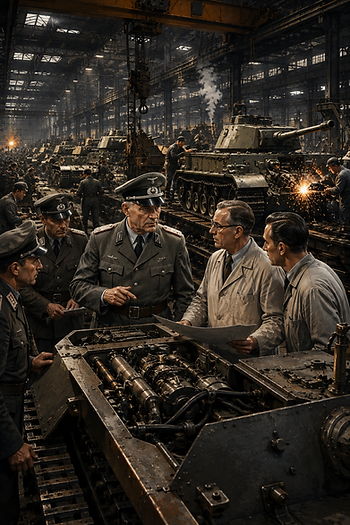
My Name is Heinz Guderian: German General and Pioneer of Armored Warfare
I was born on June 17, 1888, in Kulm, West Prussia, then part of the German Empire. My father was an army officer, and military discipline surrounded me from childhood. I entered the cadet schools and eventually joined the German Army. I learned early that victory did not depend only upon courage. An army had to move, communicate, concentrate its strength, and act before its opponent could properly respond.
Learning the Importance of Communication
During World War I, I served largely in communications and staff positions rather than becoming famous as a battlefield commander. That experience shaped my thinking. Modern armies had grown enormous, and commanders could accomplish little if they could not communicate rapidly with their units. Telephones, wireless radios, motor vehicles, and organized staff work were becoming weapons in their own right. After Germany's defeat in 1918, I remained in the small Reichswehr permitted under the Treaty of Versailles and continued studying how future wars might be fought.
The Tank Could Become Something More
The tank had appeared during World War I, but I became convinced that its greatest possibilities had not yet been realized. A tank should not merely crawl beside infantrymen and provide additional firepower. Large armored formations could penetrate an enemy position and continue moving into the rear, disrupting communications, supplies, and reinforcements. Tanks would need motorized infantry, artillery, engineers, aircraft support, and above all radios. I became a determined advocate of armored and mechanized forces and published my ideas in Achtung—Panzer! in 1937.
Speed, Radios, and Concentrated Force
By the late 1930s, Germany was creating the armored formations I had advocated. I insisted that tanks be equipped with radios because a commander who could communicate while moving possessed an enormous advantage. During the campaigns in Poland in 1939 and Western Europe in 1940, German armored forces demonstrated how quickly concentrated mechanized units could penetrate defenses and exploit openings. The world came to associate these operations with Blitzkrieg, or "lightning war," although the development of German mobile warfare involved many officers, technologies, and ideas beyond my own work.
War Against the Soviet Union
In 1941, I commanded Panzer Group 2 during Germany's invasion of the Soviet Union. At first our armored columns advanced enormous distances, but the campaign exposed the limitations of mechanized warfare. Machines required fuel, ammunition, spare parts, maintenance, and roads capable of carrying them. Distances became immense, Soviet resistance continued, and mud and winter complicated operations. I repeatedly argued with my superiors about how armored forces should be employed. After disagreements during the Soviet counteroffensive before Moscow, I was removed from command in December 1941.
Called Back to Rebuild the Panzer Forces
After the German disaster at Stalingrad, I returned to service in 1943 as Inspector General of Armored Troops. My task was to improve Germany's increasingly strained panzer forces. New machines such as the Panther and Tiger possessed formidable weapons and armor, but technological sophistication brought difficulties as well. A powerful tank that could not be supplied, repaired, fueled, or produced in sufficient numbers could become a burden. By 1944, Germany faced enemies whose enormous industrial capacity increasingly overwhelmed our ability to replace men and machines.
The Final Collapse
In July 1944, I became Chief of the Army General Staff. By then, Germany's military position was deteriorating rapidly. Soviet armies pressed from the east while the Western Allies advanced after landing in Normandy. I argued fiercely over military decisions and increasingly clashed with Adolf Hitler. In March 1945, after another confrontation, I was placed on leave. Weeks later the Third Reich collapsed, and I surrendered to American forces. I was held as a prisoner of war but was never tried at Nuremberg.
Building the Modern Tank — 1920s–1930s - Told by Heinz Guderian
When the First World War ended, the tank was still an awkward machine. The earliest models had crossed trenches, crushed barbed wire, and protected their crews from rifle and machine-gun fire, but they were often slow, mechanically unreliable, difficult to steer, and nearly impossible to coordinate once battle began. During the years that followed, engineers and soldiers across several nations asked a fascinating question: what would happen if the tank stopped being merely a machine that accompanied infantry and became the heart of a fast-moving armored force?
Building a Faster Machine
Speed required better engines, transmissions, suspensions, and tracks. Early tanks sometimes moved little faster than walking infantry, but by the 1930s many designs could travel much more rapidly. Tracks spread a tank's tremendous weight across the ground, allowing it to cross terrain that might trap wheeled vehicles. Improved suspension systems reduced the punishment suffered by crews and machinery. Yet every improvement created another engineering problem. A larger engine required fuel. More armor added weight. Greater speed placed additional stress upon tracks, transmissions, and suspension. Designing a tank was always a struggle between competing demands.
Armor, Guns, and the Moving Turret
Protection and firepower also changed dramatically. Designers experimented with thicker and better-shaped armor while placing increasingly effective guns inside rotating turrets. A turret allowed the gunner to engage targets in different directions without turning the entire vehicle. Tanks also carried machine guns for use against infantry. Nations disagreed, however, about what the tank's primary target should be. Should its main gun destroy enemy tanks, attack fortifications, or support infantry? Those different answers produced very different vehicles. There was no single perfect tank because every army expected its machines to perform different jobs.
The Crew Inside the Steel Machine
Students often look at a tank and see its gun and armor. I saw something equally important inside: the crew. A tank might contain a commander, driver, gunner, loader, and radio operator, although arrangements varied considerably. Crew organization mattered enormously. If the commander had to load or aim the gun while simultaneously observing the battlefield and directing the vehicle, his attention was divided. A well-designed turret with clearly divided crew responsibilities allowed the commander to concentrate on commanding. The efficiency of the men inside could determine whether an impressive machine was actually effective in combat.
Different Nations, Different Ideas
Britain became one of the great laboratories of tank development, experimenting with light tanks, infantry tanks, and faster cruiser tanks. France developed heavily armored vehicles and placed considerable emphasis on supporting infantry. The Soviet Union experimented aggressively with mechanized formations and produced increasingly capable designs during the 1930s. The United States also investigated mechanization, although its interwar army remained relatively small. Germany, restricted from possessing tanks under the Treaty of Versailles, studied armored warfare and secretly cooperated with the Soviet Union during part of the 1920s and early 1930s, including testing and training connected with the Kama facility near Kazan.
The Radio Changes Everything
Of all these developments, I considered radio communication indispensable. Imagine several dozen tanks moving rapidly across a battlefield through smoke, dust, woods, and villages. Without radios, commanders depended upon flags, hand signals, predetermined plans, or messengers. Once circumstances changed, coordination could collapse. With radios, commanders could report enemy positions, redirect units, request assistance, and exploit unexpected opportunities. German armored doctrine eventually placed great emphasis on equipping tanks with radio equipment, giving formations an important ability to coordinate while moving.
A Tank Never Fights Alone
This was the lesson I considered most important. A tank was not a mechanical knight that could win battles by itself. Tanks required infantry to protect them from enemy soldiers, artillery to suppress defenses, engineers to cross obstacles, reconnaissance troops to find routes and enemies, supply columns to deliver fuel and ammunition, and maintenance crews to repair damaged machines. Aircraft could add reconnaissance and firepower from above. The modern tank became truly dangerous when all these elements could move and communicate together.

My Name is Hugh Dowding: British Air Chief Marshal and Commander of RAF
I was born on April 24, 1882, at Moffat in Scotland. My father was a schoolmaster, and I was educated at Winchester College before entering the Royal Military Academy at Woolwich. I began my career in the Royal Garrison Artillery, but the arrival of powered flight fascinated me. I learned to fly in 1913. I believed that aviation was not merely an interesting new branch of military service; it was going to change the nature of warfare.
Learning War in the Air
When the First World War began, military aviation was still remarkably young. I served with the Royal Flying Corps and commanded flying units on the Western Front. Aircraft were used for reconnaissance, artillery observation, fighting enemy aircraft, and eventually bombing. The experience taught me that enthusiasm alone did not win air battles. Pilots required good machines, dependable communications, proper organization, trained ground crews, and commanders who understood when aircraft should—and should not—be committed.
Preparing Britain for the Next War
After the war, I remained in the Royal Air Force and watched aircraft become faster, stronger, and far more dangerous. In 1936, I became the first commander-in-chief of the newly created RAF Fighter Command. I was not interested in preparing merely for the war we had already fought. Britain needed modern fighters, reliable communications, trained pilots, effective anti-aircraft defenses, and an early-warning system capable of detecting enemy aircraft before they reached our cities.
Building a System, Not Just an Air Force
Radar became one of the most important parts of our preparations. Scientists including Robert Watson-Watt helped develop Britain's Chain Home radar network, but radar by itself could not defend anything. Information had to travel from radar stations and observers to operations rooms, where it could be interpreted and passed rapidly to fighter groups and squadrons. This combination of radar, the Royal Observer Corps, telephone communications, command centers, and fighter aircraft became what later generations would call the Dowding System. Its purpose was simple: put our fighters in the correct place at the correct time.
The Battle of Britain
In the summer of 1940, France had fallen and Britain faced the Luftwaffe across the English Channel. Our resources were not unlimited. Every fighter and every trained pilot mattered. I resisted demands that might unnecessarily exhaust Fighter Command because I believed Britain would soon require every aircraft we could preserve. During the Battle of Britain, Hurricanes and Spitfires rose repeatedly against German formations. Radar and our control system allowed us to concentrate fighters where they were needed instead of wasting precious fuel and strength patrolling empty skies.
Victory and Departure
The Luftwaffe failed to destroy Fighter Command or gain the air superiority Germany required for an invasion of Britain. The victory belonged to thousands of people: pilots from Britain and other nations, radar operators, mechanics, controllers, observers, factory workers, engineers, and many others whose names rarely appeared in newspapers. Yet disagreements developed within the RAF over tactics and the future direction of Fighter Command. In November 1940, shortly after the battle, I was replaced as its commander. It was not the conclusion to my service that I might have chosen.
A Different Kind of Commander
I was sometimes regarded as reserved, stubborn, or difficult. Perhaps there was some truth in those descriptions. Command is not a popularity contest. My responsibility was to preserve the fighting strength entrusted to me and use it as effectively as possible. I believed in preparation, careful calculation, technological innovation, and the proper treatment of the men expected to carry out our orders. Machines mattered greatly, but no commander should forget the human beings inside them.
The Airplane Becomes a Serious Weapon — 1920s–1930s - Told by Hugh Dowding
When I learned to fly in 1913, the aeroplane was a fragile-looking contraption of wood, wire, and fabric. During the Great War, I watched it become an instrument of reconnaissance, artillery observation, bombing, and aerial combat. Yet even in 1918, aviation remained young. During the next twenty years, that changed with astonishing speed. By the late 1930s, aircraft could fly higher, faster, farther, and with greater destructive power. The aeroplane was no longer merely the army's eye in the sky. It was becoming a weapon capable of carrying war deep into an enemy's homeland.
From Wood and Fabric to Metal
The aircraft of the First World War were commonly constructed around wooden frames covered with fabric, often supported by external wires and struts. Engineers gradually adopted stronger metal structures and streamlined designs. By the 1930s, all-metal monoplanes were becoming increasingly important. Wings became cleaner and stronger, cockpits were enclosed, and retractable landing gear reduced drag. Aircraft such as Britain's Hawker Hurricane and Supermarine Spitfire demonstrated just how far fighter design had advanced. The open-cockpit biplane was rapidly giving way to the sleek machines that would dominate the coming war.
The Race for Speed
The engine was at the heart of this transformation. More powerful piston engines allowed aircraft to carry heavier weapons and fuel while still achieving greater speed and altitude. Engineers refined propellers, superchargers, cooling systems, fuels, and aerodynamics. During the 1920s and 1930s, international air races and record attempts also pushed designers toward faster aircraft. Military planners watched these developments carefully. Speed could allow a fighter to catch a bomber, a reconnaissance aircraft to escape an interceptor, or a bomber to reach its target before defenders could respond.
Putting Greater Firepower in the Sky
Weapons evolved alongside the aircraft carrying them. Fighters received multiple machine guns, while some designs increasingly employed larger-caliber cannon. Bombers could carry far heavier bomb loads over much greater distances than their First World War predecessors. Bomb sights, navigation equipment, radios, and instruments also improved. Yet there was a persistent problem: finding and accurately striking a target from thousands of feet above the ground was far more difficult than peacetime demonstrations sometimes suggested. Clouds, darkness, enemy fighters, anti-aircraft fire, navigation errors, and simple human mistakes could all interfere.
The Bomber Changes Military Thinking
The development of long-range bombers forced governments to consider a disturbing possibility. An enemy might no longer need to defeat an army at the frontier before striking factories, railways, ports, military installations, or cities far behind it. Theorists such as Giulio Douhet argued that strategic bombing might become decisive in future wars. Britain, the United States, Germany, the Soviet Union, Japan, Italy, and other powers developed different ideas about bombing and air power. Some emphasized cooperation with armies and navies; others increasingly considered whether aircraft might independently attack an enemy's capacity and willingness to continue fighting.
An Air Force Needs More Than Pilots
A modern aircraft was only the visible tip of an enormous organization. Every squadron required mechanics, armorers, fuel crews, radio operators, meteorologists, controllers, engineers, instructors, and supply personnel. Airfields needed hangars, workshops, ammunition, spare parts, fuel storage, and communications. Pilots required lengthy training. Aircraft factories required skilled workers and huge quantities of aluminum, engines, instruments, weapons, and other components. Air power was becoming as much an industrial and organizational achievement as an act of courage in the cockpit.
The Problem of Defending the Sky
There was another question that concerned me particularly: if bombers could travel hundreds of miles to attack Britain, how would we know they were coming? Fighters could not remain in the air indefinitely. They consumed fuel, wore out engines, and exhausted pilots. Britain therefore needed a method of detecting approaching aircraft early enough to send fighters precisely where they were required. During the 1930s, this challenge helped drive the development of radar and the defensive system that would eventually combine radar stations, ground observers, communications networks, operations rooms, and fighter squadrons.
The Search for the Invisible Enemy: Early Radar — 1935–1939 - Told by Dowding
By the middle of the 1930s, I was increasingly troubled by a simple problem. Aircraft were becoming faster, bombers could cross the English Channel in a remarkably short time, and Britain could not keep fighter patrols circling endlessly in anticipation of attack. We needed to know when enemy aircraft were coming, where they were, and approximately how many there were. If we could discover an approaching enemy while he was still far away, time itself could become one of our most valuable weapons.
Could Radio Waves Find an Aircraft?
In 1935, British officials were investigating whether science might provide an answer. Physicist Robert Watson-Watt and his colleague Arnold Wilkins demonstrated that radio waves could be used to detect aircraft. During the famous Daventry experiment of February 1935, signals from a BBC shortwave transmitter were reflected from a Heyford bomber, producing measurable changes in the received signal. It was not yet the radar system Britain would ultimately use, but it proved something enormously important: an aircraft that could not be seen by human eyes might still reveal itself through radio waves.
From Experiment to National Defense
The government moved quickly. Watson-Watt and teams of scientists and engineers developed practical equipment while radar stations began appearing along Britain's eastern and southern coasts. This network became known as Chain Home. Tall transmitter towers sent radio energy outward, while receiving equipment detected echoes from aircraft. By measuring and interpreting these signals, operators could estimate the range and bearing of approaching formations and obtain information about their altitude. By 1939, a chain of stations provided substantial radar coverage along Britain's most vulnerable approaches.
Radar Was Not a Magic Eye
It is tempting to imagine radar as a perfect screen showing every aircraft exactly as modern systems might. It was nothing of the sort. Early operators studied signals on cathode-ray displays and required considerable skill to interpret what they saw. Chain Home worked best against aircraft approaching at medium and high altitudes and had difficulties detecting very low-flying aircraft. Britain therefore developed Chain Home Low to improve low-altitude detection. Equipment could provide information, but trained human beings still had to decide what that information meant.
The Observer Corps Takes Over
Radar was especially useful for warning us that aircraft were approaching the British coast, but once enemy formations crossed inland, another organization became vital. Thousands of members of the Observer Corps watched the skies from posts across Britain. Using their eyes, ears, binoculars, and identification skills, they reported aircraft type, numbers, direction, and altitude. Radar and observers therefore complemented one another. One could detect aircraft beyond the coastline; the other could help follow them as they crossed the country.
The Telephone Becomes Part of the Weapon
None of this information mattered if it remained at a radar station or observation post. Britain already possessed an extensive telephone network, and we turned communications into part of our air-defense system. Reports traveled rapidly to Fighter Command headquarters at Bentley Priory and through the system to group and sector operations rooms. Information could be filtered, plotted on large maps, and continually updated. Controllers could watch an air battle developing not by looking through a window but by watching markers move across a map.
Sending the Fighters Where They Were Needed
This was the purpose behind everything we were building. Fighter aircraft such as Hurricanes and Spitfires had limited fuel and could not patrol indefinitely. Instead, squadrons could wait on the ground until information indicated an approaching raid. Controllers could then order pilots into the air, direct them toward the enemy, and place them at an advantageous altitude and position. We were no longer simply searching an enormous sky and hoping to find the enemy. We were constructing a system designed to guide our fighters toward him.
Many Parts of One Defensive Machine
By 1939, Britain possessed something more important than radar alone. Radar stations, the Observer Corps, telephone lines, filter rooms, operations rooms, anti-aircraft defenses, fighter airfields, controllers, ground crews, and pilots were being connected into an integrated network. Later generations would sometimes associate this organization with my name, but it was built through the work of thousands of scientists, engineers, servicemen, civilian workers, and officials.

My Name is Wernher von Braun: German Rocket Engineer and Spaceflight Pioneer
I was born on March 23, 1912, in Wirsitz, then part of the German Empire. As a boy, I became fascinated by astronomy and the possibility that human beings might someday travel beyond Earth. Mathematics did not always come easily to me at first, but I quickly discovered that if I wished to understand rockets, I would have to master mathematics and physics. The stars supplied the dream; engineering would have to provide the means of reaching them.
The Dream of the Rocket
As a young man, I encountered the writings of rocket theorists such as Hermann Oberth and joined Germany's Society for Space Travel. We experimented with liquid-fueled rockets at a time when the idea of spaceflight still seemed fantastic to much of the public. A rocket was unlike an airplane because it carried both fuel and oxidizer and therefore did not depend upon atmospheric oxygen. In principle, such a machine could continue beyond the atmosphere. To me, this was not merely a weapon waiting to be invented. It was a vehicle that might someday open the universe to humanity.
The Army Takes an Interest
Germany's military authorities also recognized the possibilities of rockets. In 1932, I began working for the German Army on liquid-fueled rocket development. Our experiments eventually moved to the research center at Peenemünde on the Baltic coast, where I became technical director. We faced extraordinary engineering problems involving propulsion, guidance, aerodynamics, combustion, and structural design. Rockets failed repeatedly—sometimes spectacularly—but each failure provided information. Engineering advances when calculations, experiments, failures, and improvements are allowed to build upon one another.
Creating the A-4
Our greatest wartime achievement was the Aggregat 4, or A-4. In October 1942, an A-4 successfully flew more than 80 kilometers high and traveled roughly 190 kilometers downrange during a test. It was an extraordinary technological achievement for its time. The rocket used a liquid-fueled engine, sophisticated guidance equipment, and aerodynamic controls to travel at several times the speed of sound. Military authorities, however, saw something different from my dreams of spaceflight. They saw a weapon capable of carrying an explosive warhead far beyond conventional artillery range.
The V-2 Goes to War
The A-4 became better known as the V-2. Beginning in 1944, V-2 rockets were launched against London, Antwerp, and other targets. Unlike aircraft, the missile approached its target at such tremendous speed that conventional defenses could not intercept it after launch. Yet the V-2 did not change the outcome of the war. It was technologically revolutionary but strategically limited. Germany was spending enormous resources on a weapon while Allied armies were advancing from the west and Soviet forces were approaching from the east.
A Race for the Rocket Scientists
By 1945, I understood that Germany would lose the war. I also knew that the knowledge accumulated by our rocket team would be valuable to whichever power obtained it. I wanted to surrender to the Americans rather than the Soviets. Members of my team eventually reached American forces, and I surrendered in May 1945. Under a program that became known as Operation Paperclip, the United States brought me and other German specialists to America, where we continued working on rocket technology.
From Weapons to the Moon
In America, my work gradually turned toward the dream that had fascinated me since youth. My team helped develop the Redstone and Jupiter rockets, and after NASA was established, I became director of the Marshall Space Flight Center. We helped create the enormous Saturn V rocket. On July 16, 1969, a Saturn V launched Apollo 11 toward the Moon. Four days later, human beings walked upon another world. The distance between our primitive experiments in Germany and a footprint on the Moon had been crossed within a single lifetime.
Rockets Before the V-2 — 1920s–1939 - Told by Wernher von Braun
Before anyone heard the terrifying sound of a V-2 striking a European city, rockets belonged largely to experimenters, mathematicians, and dreamers. I was one of those dreamers. As a boy, I looked toward the Moon and imagined that human beings might someday travel there. Yet imagination alone cannot lift a machine from Earth. To reach space, we needed mathematics, fuels, engines, guidance systems, and an understanding of how a rocket could continue accelerating where no ordinary aircraft could fly.
The Scientists Who Proved It Was Possible
The foundations had already been laid. In Russia, Konstantin Tsiolkovsky had published theoretical work explaining how rockets might travel through space and describing the advantages of multistage designs. In the United States, Robert Goddard experimented with practical rockets and successfully launched the world's first liquid-fueled rocket in Massachusetts in 1926. It rose only briefly, but the principle was revolutionary. A rocket carrying liquid fuel and an oxidizer could generate thrust without depending upon oxygen from the surrounding atmosphere. In theory, such a machine could leave the atmosphere entirely.
Hermann Oberth and the Dream of Space
In Germany, Hermann Oberth became one of the men who most influenced my generation. His writings treated spaceflight not as fantasy but as an engineering problem that could eventually be solved. In 1923, he published a pioneering work on rockets and travel into planetary space. Young engineers and enthusiasts gathered around these ideas. Germany's Verein für Raumschiffahrt—the Society for Space Travel—became a center for experimentation. I joined while still a young student, eager to turn equations into machines.
Experiments at the Rocket Field
Near Berlin, experimenters established the Raketenflugplatz, or Rocket Airfield, in 1930. There we worked with small liquid-fueled rockets and engines. The machines frequently failed. Combustion chambers burned through, fuel systems malfunctioned, and rockets sometimes behaved in ways our calculations had not predicted. But failure is a stern and useful instructor to an engineer. Each unsuccessful test told us something about pressure, cooling, ignition, stability, or propulsion. Gradually, the rockets became more sophisticated.
When the Army Became Interested
The German Army saw possibilities quite different from our dreams of space exploration. The Treaty of Versailles had imposed severe restrictions on German artillery, while rockets were not specifically regulated in the same manner. Army officers therefore investigated whether rockets might eventually deliver explosives over considerable distances. In 1932, I began working with the Army's rocket program under Captain Walter Dornberger. Our experiments moved to the military testing grounds at Kummersdorf, south of Berlin. The amateur age of German rocketry was giving way to organized military research.
From Small Rockets to the Aggregat Series
At Kummersdorf, we developed increasingly ambitious experimental rockets. The A-1 was unsuccessful, but the A-2 demonstrated progress. In December 1934, two A-2 rockets, named Max and Moritz, were successfully launched from the island of Borkum and reached altitudes of roughly two kilometers. Later designs became larger and more complex. We were learning how to construct engines producing greater thrust while simultaneously confronting the difficult problems of guidance, stability, aerodynamics, and controlling a rapidly moving rocket.
Peenemünde: Building a Rocket Research Center
Kummersdorf eventually became too restricted for the scale of work we intended to undertake. A much larger research facility was established at Peenemünde on the Baltic coast beginning in the mid-1930s. Here the German Army and Luftwaffe could test rockets and other advanced technologies over greater distances. Laboratories, workshops, test stands, and launching facilities were constructed. Engineers studied propulsion, guidance, aerodynamics, materials, and instrumentation. What had begun with enthusiasts experimenting on the outskirts of Berlin was becoming one of the world's most ambitious rocket-development programs.
Tanks, Radios, and Combined-Arms Warfare — 1939–1941 - Told by Guderian
When war returned to Europe in 1939, many people looked at our armored formations and saw the tank as the secret of their speed. They were only partly correct. A tank was powerful, but a tank alone could be stopped, surrounded, deprived of fuel, or destroyed. The real transformation came when tanks, infantry, artillery, engineers, reconnaissance troops, aircraft, supply vehicles, and communications were organized to operate together. The engine gave us movement. The gun gave us firepower. But the radio allowed us to control that movement while the battle was still unfolding.
The Panzer Division Was More Than Tanks
A Panzer division was not simply a large collection of armored vehicles. Its tanks needed infantry capable of following the advance, artillery that could move quickly enough to provide fire support, engineers who could clear obstacles and repair crossings, reconnaissance units that could locate enemy positions, and supply columns carrying ammunition, food, spare parts, and enormous quantities of fuel. This organization was essential. If tanks advanced faster than the rest of the division, their apparent strength could become a dangerous weakness.
The Radio Inside the Tank
I had long regarded wireless communication as indispensable to armored warfare. German tanks were equipped with radios, though capabilities varied and not every vehicle possessed the same transmitting equipment. A commander could receive reports and orders while his formation was moving rather than waiting for a motorcycle messenger or written instructions. Some command tanks carried additional communications equipment specifically for controlling formations. On a rapidly changing battlefield, minutes mattered. Information that arrived several hours late might describe a situation that no longer existed.
Seeing, Deciding, and Moving
Speed in warfare is not merely the number shown on a vehicle's speedometer. A force must also think quickly. Reconnaissance troops moved ahead to locate roads, bridges, enemy defenses, and possible routes around resistance. Their reports could be transmitted through the command network. Officers could then redirect units, concentrate tanks against a weak point, or bring artillery forward against a stronger position. The objective was to move through the cycle of observation, decision, and action faster than the opposing commander could react.
Infantry and Engineers Keep the Tanks Moving
There were obstacles that no tank commander could simply ignore. Rivers had to be crossed. Bridges could be destroyed. Roads could be mined or blocked. Towns, forests, and fortified positions could restrict armored movement. Engineers therefore became essential members of mechanized formations, building bridges, clearing mines, and removing obstacles. Infantry protected tanks in terrain where enemy soldiers could approach closely with anti-tank weapons. Combined-arms warfare worked precisely because each branch compensated for weaknesses in the others.
Artillery and Aircraft Add Their Firepower
Mobile artillery could suppress anti-tank guns and defensive positions before armored units attempted to pass them. Aircraft added another dimension. German forces used reconnaissance aircraft to gather information, while bombers and dive-bombers could attack selected battlefield targets and communications. Air-ground coordination was imperfect and varied considerably, but when aircraft, artillery, and ground formations could be directed toward the same objective, defenders faced pressure from several directions and types of weapons at once.
The Hidden Battle of Fuel and Repair
Students often imagine armored warfare as tanks charging endlessly forward. Every commander knew otherwise. A tank consumed fuel at an alarming rate and subjected its engine, transmission, tracks, and suspension to tremendous strain. Maintenance crews followed the armored columns, recovering damaged vehicles and repairing machines whenever possible. Supply trucks carried fuel and ammunition along roads that could stretch for hundreds of miles. A Panzer division without fuel was not a mobile striking force. It was a collection of very heavy stationary machines.
Technology Required Organization
Between 1939 and 1941, armored warfare demonstrated that possessing the most impressive individual machine did not guarantee battlefield success. Some German tanks during the early war were less heavily armed or armored than certain enemy vehicles. Our advantage often came from organization, training, communications, concentrated employment, and cooperation among different branches. A technologically advanced weapon becomes truly effective only when an army develops the doctrine and support system necessary to use it.
Fighters, Bombers, and the Battle for the Sky — 1939–1942 - Told by Dowding
When war began in September 1939, the aeroplane had become far more than a scout flying above an army. Aircraft could intercept enemy bombers, photograph distant positions, attack troops and ships, carry supplies, transport soldiers, and strike factories hundreds of miles from the battlefield. Yet no aircraft could perform every task equally well. The struggle for control of the sky became a contest of specialized machines, trained crews, industrial production, communications, and the ability to put the correct aircraft in the correct place at the correct moment.
The Fighter: Speed Becomes a Weapon
The fighter's task was deceptively simple: find the enemy aircraft and destroy it. Britain's Supermarine Spitfire and Germany's Messerschmitt Bf 109 represented two of the most advanced fighters in Europe when the war began. Both were fast, single-engine monoplanes with retractable landing gear and powerful armament. But speed alone did not determine victory. Rate of climb, turning ability, acceleration, altitude performance, visibility from the cockpit, ammunition, fuel, and pilot experience could all decide an engagement lasting only seconds.
The Hurricane and the Importance of Numbers
The Spitfire became Britain's most famous fighter, but the Hawker Hurricane was at least as important during the Battle of Britain. Hurricanes equipped more RAF fighter squadrons at the beginning of the battle and were generally easier to manufacture and repair. This revealed an important truth about modern war: a nation did not simply need an excellent aircraft. It needed enough aircraft, enough replacement engines and parts, enough mechanics to maintain them, and enough trained pilots to fly them. A brilliant design existing only in small numbers could not defend an entire country.
The Bomber Brings War Beyond the Front
Bombers created an entirely different challenge. Germany employed aircraft such as the Heinkel He 111, Dornier Do 17, and Junkers Ju 88, while Britain operated bombers including the Wellington, Hampden, and Whitley before newer heavy bombers appeared. These machines could carry bombs far beyond the front lines, but bombers were vulnerable to fighters and anti-aircraft guns. Bombing accurately was also extremely difficult, particularly at night or through cloud. Navigation, weather forecasting, bomb sights, radio aids, and crew training became nearly as important as the bombs themselves.
Eyes Above the Battlefield
Reconnaissance aircraft rarely received the attention given to fighters, but information could be more valuable than firepower. Aircraft photographed ports, airfields, factories, roads, defenses, and troop movements. Specialists then examined those photographs for evidence of enemy activity. Other aircraft observed artillery fire or searched for ships and submarines across enormous stretches of ocean. A commander who knew where the enemy was located could make better use of every other weapon under his command.
From Ground Attack to the Open Ocean
Aircraft became increasingly specialized. Dive-bombers and fighter-bombers attacked troops, vehicles, bridges, and defensive positions. Transport aircraft moved soldiers and supplies. Naval aircraft searched for fleets, protected convoys, launched torpedoes, and operated from aircraft carriers. The war demonstrated that the sky was not a separate battlefield. Air power could influence events on land and at sea, making control of the air important to nearly every major military operation.
Range: The Invisible Limit
Every aircraft faced an enemy that no pilot could shoot down: fuel consumption. A fighter might possess tremendous speed and firepower but remain useful only while fuel allowed it to stay over the battlefield. During the Battle of Britain, German Bf 109 pilots operating from bases across the Channel had limited time over southern England before they had to return home. Britain, fighting near its own airfields, enjoyed important advantages. Range would remain one of aviation's greatest engineering challenges as the war expanded across Europe, North Africa, Asia, and the Pacific.
The Pilot Behind the Technology
There was also a limit no engineer could eliminate quickly: training. A modern fighter required a pilot capable of navigation, radio communication, formation flying, aircraft recognition, gunnery, and making decisions while traveling hundreds of miles per hour. Experienced pilots were difficult to replace. Training schools therefore became part of the industrial machinery of air warfare. Nations were effectively producing two complicated weapons simultaneously—the aircraft and the trained human being capable of using it.
Winning the Battle in the Factory
By 1942, the air war had become an immense industrial contest. Factories produced aircraft by the thousands while workers manufactured engines, propellers, radios, guns, instruments, and ammunition. Damaged aircraft were repaired and returned to service whenever possible. Designs were continuously modified as engineers responded to lessons from combat. The battle for the sky was therefore fought not only by pilots above the clouds but by engineers, factory workers, mechanics, instructors, radar operators, and controllers far below.

My Name is Karl Dönitz: German Admiral and Commander of the U-boat Fleet
I was born on September 16, 1891, near Berlin, in the German Empire. I entered the Imperial German Navy in 1910, when battleships were considered the great measure of naval strength. Yet my career would become tied to a very different vessel—the submarine. Beneath the surface of the sea, speed, surprise, calculation, discipline, and technology could allow a comparatively small vessel to threaten ships many times its size.
Learning Submarine Warfare
During the First World War, I served aboard surface vessels before transferring to submarines. In 1918, while commanding UB-68 in the Mediterranean, my submarine was forced to surface after technical difficulties during an attack, and I became a British prisoner of war. The experience strengthened my belief that submarines could become decisive weapons if they were properly organized. Germany could not easily match Britain's surface fleet, but submarines offered another way to attack the shipping upon which an island nation depended.
Building a New U-boat Force
After the war, the Treaty of Versailles prohibited Germany from possessing submarines, but I remained in the navy. When Germany openly began rebuilding its submarine force during the 1930s, I became one of its principal commanders. I developed tactics based upon concentration rather than isolated attacks. Instead of having individual submarines operate entirely alone, U-boats could report enemy convoys by radio, allowing other submarines to converge. These coordinated attacks became known as Rudeltaktik—the "wolfpack" tactic.
The Battle Beneath the Atlantic
When war began in 1939, my objective was straightforward: sever Britain's ocean supply routes. Merchant ships carried food, fuel, weapons, raw materials, and troops across the Atlantic. U-boats attempted to find Allied convoys, penetrate their defenses, launch torpedoes, and disappear beneath the water. At times, particularly in 1940–41 and again off the American coast in 1942, our submarines inflicted severe losses. I believed that if enough Allied shipping could be destroyed faster than it could be replaced, Britain might eventually be unable to continue the war effectively.
Technology Turns Against Us
The Atlantic became an extraordinary contest of technology and countertechnology. We improved torpedoes, submarines, communications, and tactics, while the Allies improved ASDIC sonar, radar, depth charges, escort ships, aircraft patrols, intelligence, and high-frequency direction finding. Allied codebreakers also gained valuable information from German naval communications, although we did not fully understand the extent of that success during the war. By 1943, long-range aircraft and escort carriers were helping close the dangerous gaps in Atlantic air coverage. The ocean was becoming increasingly difficult for a U-boat to hide within.
The Cost of the U-boat War
The men I commanded served under some of the most dangerous conditions of the war. A submarine was cramped, wet, foul-smelling, and constantly vulnerable. Once detected, a U-boat might endure repeated depth-charge attacks while its crew waited below, listening to explosions through the hull. Of roughly 40,000 men who served in German U-boats during the war, about 30,000 were killed. I continued sending submarines to sea because I believed their mission remained strategically necessary, even as our losses became devastating.
Commander of the German Navy
In January 1943, I replaced Grand Admiral Erich Raeder as commander-in-chief of the German Navy. By then, Germany faced increasingly powerful enemies on land, sea, and in the air. I remained loyal to Adolf Hitler and continued directing Germany's naval war. When Hitler died in April 1945, his political testament unexpectedly named me his successor as head of state. My government lasted only a few weeks. I attempted to surrender German forces in ways that would move as many soldiers and civilians as possible westward before Germany's unconditional surrender became complete.
Nuremberg and Imprisonment
After the war, I was arrested and tried before the International Military Tribunal at Nuremberg. Prosecutors examined my role in aggressive warfare and German submarine operations, including orders concerning the treatment of survivors. I was convicted of crimes against peace and war crimes and sentenced to ten years in Spandau Prison. I served the full sentence, was released in 1956, and later wrote about my naval career. I died in 1980.
The Submarine War and the Battle of Detection — 1939–1943 - Told by Karl Dönitz
When war began in September 1939, I commanded Germany's U-boat force with a clear understanding of both its power and its weakness. Britain depended upon ships crossing the oceans with food, oil, weapons, raw materials, and troops. A submarine did not have to defeat the Royal Navy's great warships to threaten Britain. It could attack the merchant vessels that sustained the nation. Yet the Atlantic soon became something more complicated than a struggle between submarines and ships. It became a technological contest in which every new method of hiding produced a new method of finding.
The Hunter Beneath the Surface
A U-boat's greatest weapon was not its torpedo. It was surprise. Despite the popular image of submarines lurking continuously underwater, the diesel-electric U-boats of my era normally traveled on the surface whenever circumstances allowed. Diesel engines provided greater speed and recharged the batteries needed for underwater movement. Once submerged, the boat depended upon electric motors and had limited speed and endurance. The sea protected us only so long as the enemy did not know precisely where we were.
The Torpedo: Powerful but Imperfect
The torpedo allowed a submarine to strike without approaching closely enough to use guns. A commander estimated the target's speed, course, and distance and calculated where the torpedo and ship would meet. Early in the war, however, German torpedoes suffered serious technical failures. Magnetic detonators and depth-control mechanisms sometimes malfunctioned, causing torpedoes to pass beneath targets or fail to explode. It was an infuriating reminder that an advanced weapon was useless if its complicated mechanisms could not be trusted.
The Wolfpack and the Radio
I believed individual submarines could accomplish more by cooperating. A U-boat discovering a convoy could report its position by radio while shadowing it. Other boats would then converge and attack, often at night and from several directions. We called this Rudeltaktik, or wolfpack tactics. Radio made such coordination possible across enormous stretches of ocean. But radio possessed a dangerous weakness: every transmission that allowed us to communicate could also help the enemy locate us.
The Enemy Learns to Listen
The British and their allies increasingly used high-frequency direction finding—often called HF/DF or "Huff-Duff"—to determine the direction from which our radio transmissions originated. Multiple bearings could help locate a transmitting submarine. Allied intelligence also worked against German naval codes, with British codebreakers at Bletchley Park at times gaining valuable access to U-boat communications. We changed codes and procedures, and there were periods when Allied decryption was interrupted, but the struggle over information became nearly as important as the torpedoes themselves.
ASDIC Searches Beneath the Waves
British escort vessels also possessed ASDIC, the system Americans generally called sonar. It transmitted sound pulses through the water and listened for echoes from submerged objects. Once a U-boat was detected, destroyers and corvettes could attack with depth charges—explosive weapons set to detonate underwater at predetermined depths. We responded with evasive maneuvers, deeper dives, and attempts to escape silently. Again, one technology produced a countermeasure, which produced another response.
Radar Changes the Night
For a time, darkness offered U-boats valuable protection when operating on the surface. Radar began taking that advantage away. Allied ships and aircraft increasingly carried radar capable of detecting surfaced submarines, sometimes before our lookouts could see the approaching enemy. This was especially dangerous because U-boats needed to surface to travel efficiently and recharge batteries. What had once been an empty nighttime horizon could suddenly conceal an aircraft racing toward us.
Aircraft Close the Atlantic
Long-range patrol aircraft became among our most dangerous opponents. Aircraft could search enormous areas and force U-boats underwater, where they became slower. For part of the war, there remained a region of the mid-Atlantic beyond the effective reach of most land-based aircraft—the so-called air gap. Improvements in long-range aircraft, particularly the Consolidated B-24 Liberator, together with escort carriers operating aircraft from the ocean itself, gradually reduced that sanctuary. The Atlantic was becoming watched from above as well as across its surface.
The Escorts Become More Dangerous
The Allies improved convoy protection continuously. More escort ships became available, crews gained experience, radar improved, and new anti-submarine weapons appeared. Escort groups increasingly shifted from merely defending merchant ships to actively hunting U-boats. Intelligence, aircraft, radar, sonar, direction finding, and coordinated escort tactics began working together. By the spring of 1943, the balance was changing rapidly. In May alone, Germany lost more than forty U-boats, and I temporarily withdrew many of our boats from the North Atlantic convoy routes.
Radar Changes the Battlefield — 1940–1944 - Told by Hugh Dowding
In 1940, Britain already possessed something extraordinary along its coastline: a chain of radar stations capable of warning us that enemy aircraft were approaching before human eyes could see them. Yet what occurred during the next four years was even more remarkable. Radar escaped from its enormous coastal towers. Engineers made systems smaller, more precise, and suitable for installation aboard ships, aircraft, and anti-aircraft defenses. Warfare was entering an age in which seeing the enemy first could be as important as possessing the more powerful weapon.
The Battle of Britain Proves the Idea
During the Battle of Britain, Chain Home radar gave Fighter Command precious warning of approaching German formations. Radar reports were combined with information from the Observer Corps and passed through our command network to operations rooms. Controllers could then send fighter squadrons toward the enemy rather than wasting aircraft and fuel on constant patrols. Radar did not shoot down a single bomber by itself. Its value was information. If you know where the enemy is and where he is going, you can decide where your limited forces will do the most good.
The Magnetron Opens New Possibilities
One of the most important advances came with the cavity magnetron, dramatically improved in Britain by John Randall and Harry Boot in 1940. It could generate powerful microwave radio waves at short wavelengths, allowing radar equipment to detect smaller targets with greater precision while using more compact antennas. Britain shared this technology with the United States through the Tizard Mission in 1940. American and British scientists then worked intensively on microwave radar, particularly at the Radiation Laboratory at the Massachusetts Institute of Technology.
Radar Takes to the Air
Putting radar aboard aircraft transformed nighttime interception. A pilot searching for another aircraft in darkness faced an enormous sky with almost nothing to guide him. Airborne Interception radar allowed specially equipped night fighters, assisted by ground controllers, to approach enemy bombers before attempting visual contact for the final attack. Airborne radar also became valuable for finding ships and surfaced submarines. Darkness and cloud, once powerful forms of concealment, were becoming less dependable.
Warships Gain Electronic Eyes
Radar at sea was equally revolutionary. Ships had traditionally depended upon lookouts, searchlights, and optical rangefinders. Darkness, fog, smoke, and bad weather could reduce their effectiveness. Shipborne radar could detect aircraft or vessels beyond normal visual range and increasingly assist with tracking and gunnery. In naval warfare, a commander who discovered the enemy first might maneuver, launch aircraft, or prepare his guns before the opposing crew even knew that danger was approaching.
Radar Aims the Guns
Radar also became connected to anti-aircraft defenses. Ground-based systems could detect approaching aircraft, estimate their position, and help direct searchlights and anti-aircraft guns. Improved gun-laying radar allowed crews to track aircraft more effectively, including at night or in poor visibility. When combined with mechanical predictors and proximity-fuzed ammunition later in the war, anti-aircraft defense became increasingly sophisticated. The gun still fired the shell, but electronics helped determine where that shell should go.
The Battle Against the U-boats
Perhaps nowhere was the contest more dramatic than over the Atlantic. German submarines frequently traveled on the surface, particularly at night, because their diesel engines gave them greater speed and recharged their batteries. Radar-equipped Allied aircraft could increasingly detect surfaced U-boats when their crews believed darkness protected them. German engineers responded with radar-warning receivers and other countermeasures. The Allies changed frequencies and equipment. Once again, invention produced counter-invention.
The Enemy Could Fight Radar Too
Radar was never an invisible magic weapon. Enemy forces could attempt to detect its transmissions, jam signals, deceive operators, or attack radar installations. Both sides developed electronic countermeasures. During bombing operations, aircraft dropped clouds of metallic strips—known to the British as Window and to the Germans as Düppel—to create confusing radar echoes. The electromagnetic spectrum itself had become a battlefield, although no soldier could see the struggle taking place.
From Giant Towers to Mobile Machines
By 1944, radar could be found in forms that would have seemed extraordinary only a few years earlier. It helped warn cities of air raids, guide fighters, direct guns, protect convoys, search oceans, and assist warships. Equipment continued to become smaller and more capable. Radar did not eliminate uncertainty, nor did it make traditional weapons obsolete. Instead, it made those weapons more effective by supplying information sooner and under conditions in which human senses could fail.
The Weapon That Did Not Fire
If I were to leave you with one lesson from radar, it would be this: the most important military technology is not always the machine with the largest gun or the fastest engine. Information can itself become a weapon. A commander who discovers the enemy five minutes earlier has five additional minutes to decide, prepare, maneuver, and strike. Between 1940 and 1944, radar extended human sight beyond darkness, cloud, fog, and the horizon. Modern warfare would never again depend upon the human eye alone.
The Tank Arms Race — 1941–1945 - Told by Heinz Guderian
By 1941, the tank had become one of the dominant machines of land warfare, but no design remained superior for long. Every time one army introduced thicker armor, its enemy sought a larger gun. A heavier gun demanded a stronger turret and suspension. More armor increased weight, which demanded a more powerful engine and consumed additional fuel. Soon the engineers were fighting a war of their own—a contest among firepower, protection, mobility, reliability, production, and maintenance. There was no perfect tank. There were only compromises.
The T-34 Changes the Equation
When German forces encountered the Soviet T-34 in large numbers in 1941, many of us recognized that we faced a formidable design. Its sloped armor increased protection without simply adding enormous thickness, its wide tracks performed well on difficult ground, and its 76.2 mm gun was powerful by the standards of the period. The T-34 was not flawless: early models could suffer from poor visibility, cramped crew arrangements, transmission difficulties, and limited radio availability. Nevertheless, its combination of armor, mobility, firepower, and potential for mass production forced German planners to reconsider what a medium tank should be.
Germany Answers with the Panther
The German response included the Panther, which entered combat in 1943. It incorporated heavily sloped frontal armor and a high-velocity 75 mm gun capable of defeating many enemy tanks at considerable distances. On paper, it was an impressive combination of mobility, protection, and firepower. Yet its early service demonstrated the danger of rushing sophisticated technology into battle. Mechanical failures, particularly involving drivetrain components, plagued the first Panthers. Improvements followed, but maintenance remained demanding. A tank that possesses an excellent gun is still of little use if it cannot reach the battlefield.
The Tiger: Power at a Price
The Tiger I followed another philosophy. With thick armor and the formidable 88 mm gun, it could destroy many opposing tanks at ranges where they struggled to penetrate it from the front. But such capability came at a cost. The Tiger was heavy, mechanically complex, expensive in resources and labor, and demanding to transport, fuel, and maintain. Germany produced only about 1,350 Tiger I tanks. It could be extremely dangerous tactically, but war is not fought by individual machines alone. Numbers, spare parts, fuel, recovery vehicles, and trained mechanics matter enormously.
The Sherman and the Power of Production
The American M4 Sherman demonstrated a different approach. It was not designed simply to possess the thickest armor or largest gun. It was comparatively reliable, mechanically standardized, transportable, and suitable for enormous industrial production. Nearly 50,000 Shermans of all types were built during the war. Its design could also be adapted for different weapons and specialized purposes. Later versions received improved guns and other modifications as enemy armor became more formidable. The Sherman illustrates a lesson sometimes overlooked when comparing specifications: a tank that can be manufactured, transported, maintained, repaired, and supplied in huge numbers possesses strategic advantages that cannot be measured merely by armor thickness.
Britain and the Search for the Right Tank
British designers followed still other paths. Early in the war, Britain distinguished between heavily protected infantry tanks intended to support foot soldiers and faster cruiser tanks intended for mobile operations. Vehicles such as the Churchill emphasized protection and cross-country capability, while later cruiser designs increasingly sought better combinations of speed and firepower. The development of the Comet near the end of the war showed how battlefield experience continually reshaped British armored design.
The Hidden Enemy: Mechanical Failure
Every tank commander learns that the enemy does not always fire the shot that stops you. Tracks break. Engines overheat. Transmissions fail. Mud swallows vehicles. Fuel runs out. A damaged tank weighing tens of tons cannot simply be pushed to the roadside. Armies therefore required recovery vehicles, workshops, spare parts, mechanics, fuel trucks, and transportation networks. Simpler and more reliable vehicles could sometimes return to battle rapidly, while sophisticated machines might remain unusable for want of one component.
Fuel Becomes Part of the Design
As tanks became heavier, fuel consumption became increasingly important. A powerful engine could move tremendous armor, but only while fuel continued arriving. Germany's growing fuel shortages during the later war made this problem particularly severe. The United States and Soviet Union possessed much greater capacity to supply enormous mechanized forces with fuel and replacement vehicles. The tank arms race was therefore connected directly to oil fields, refineries, railways, factories, trucks, and national industrial capacity.
The Best Tank Is More Than a Machine
Students often ask which tank of World War II was "the best." I would tell you that the question is incomplete. Best at destroying another tank? Best protected? Fastest? Most reliable? Easiest to repair? Cheapest to manufacture? The Tiger possessed tremendous firepower. The Panther combined an excellent gun with strong frontal protection. The T-34 offered an influential balance of mobility, armor, firepower, and mass production. The Sherman provided reliability, adaptability, and extraordinary industrial scale. Each reflected different requirements and resources.
V-1 and V-2: A New Kind of Long-Range Weapon — 1944–1945 - Told by von Braun
By 1944, Germany was launching weapons unlike anything that had previously crossed the skies of war. One was the V-1, an unmanned flying bomb powered by a pulsejet engine. The other was the V-2, a liquid-fueled ballistic missile descended from the A-4 rocket my team had developed. Neither required a pilot to fly into enemy territory. Once launched, these machines could carry explosives toward distant cities while their operators remained far behind the front. Warfare had entered the missile age.
Two Weapons with Very Different Designs
The V-1 and V-2 are often discussed together, but technologically they were quite different. The V-1 resembled a small pilotless aircraft. Its pulsejet produced the distinctive buzzing sound that became familiar over southern England, and the weapon flew within the atmosphere toward its target. The V-2 was a true rocket. Its engine burned alcohol and liquid oxygen, producing tremendous thrust that accelerated the missile upward before it followed a ballistic path back toward Earth. The V-1 could sometimes be intercepted. Once a V-2 was descending toward its target, there was effectively no defensive weapon capable of stopping it.
The Engineering Inside the V-2
The V-2 represented an extraordinary combination of technologies for the 1940s. It stood about fourteen meters tall and weighed roughly thirteen metric tons at launch. Pumps fed enormous quantities of propellant into its combustion chamber. Gyroscopes and other guidance equipment helped control its flight, while aerodynamic vanes and graphite control vanes in the rocket exhaust assisted steering. The missile climbed to very high altitude and accelerated to several times the speed of sound before descending toward its target. Many principles demonstrated by this machine would later appear in ballistic missiles and space-launch vehicles.
When the Rocket Became a Weapon
My own fascination with rockets had begun with dreams of space travel, but the German Army financed our research because it wanted a weapon. The A-4 was renamed the V-2 for propaganda purposes, and operational launches against Allied targets began in September 1944. London, Antwerp, and other locations were struck. Because the rocket traveled faster than sound during its final approach, victims received no useful warning from the sound of the incoming missile. The explosion arrived first; the noise associated with its passage could follow.
A Revolutionary Weapon That Could Not Win the War
Technologically, the V-2 pointed toward the future. Militarily, its effect was far less decisive. Its conventional explosive warhead could cause terrible destruction where it struck, but its guidance was too inaccurate for reliably attacking small military targets. Each missile also consumed considerable resources, skilled labor, specialized equipment, and scarce materials. Thousands of V-1s and V-2s were launched, killing thousands of people, yet neither weapon could reverse Germany's deteriorating military position. A revolutionary technology is not necessarily a strategically successful weapon.
The Underground Factory
There is another part of this story that cannot be separated from the engineering. After Allied bombing damaged the Peenemünde research facilities in 1943, V-2 production was moved underground to the Mittelwerk complex near Nordhausen. Prisoners from the nearby Mittelbau-Dora concentration camp system were forced to work under brutal conditions constructing these weapons. They endured starvation, disease, exhaustion, beatings, executions, and appalling living conditions. Thousands died within the camp system associated with the underground production complex.
The Human Price Behind the Machine
Engineers tend to speak in measurements: thrust, velocity, fuel consumption, range, payload, and accuracy. Those measurements can describe how a rocket operates, but they cannot describe its full history. I visited Mittelwerk and was aware that prisoners were being used as forced labor, though the extent of my knowledge and responsibility became the subject of considerable historical examination after the war. Whatever distinctions I or others later attempted to draw, the fundamental fact remains: the V-2 program depended upon a system in which human beings were enslaved, brutalized, and killed.
From the V-2 to the Missile Age
When the war ended in 1945, the victorious powers hurried to capture German rockets, documents, equipment, and engineers. The United States brought me and many colleagues to America through what became Operation Paperclip, while the Soviet Union obtained German technology and specialists for its own rocket program. The engineering principles developed for the V-2 contributed to later ballistic missiles and, eventually, rockets capable of launching satellites and human beings into space. The technology that carried explosives toward London and Antwerp became part of the technological ancestry of machines that traveled beyond Earth.
From World War Weapons to the Cold War and Space Age — 1945 and Beyond - Told by Wernher von Braun and Heinz Guderian
Imagine the two of us looking across the ruined landscape of Europe in 1945. The war was finished, Germany was defeated, and many of the machines we had helped develop or employ had ended as wreckage scattered across battlefields. Yet the technology itself had survived. Tanks, rockets, radar, jet engines, submarines, radios, and other wartime innovations were about to enter a new contest. The Second World War had ended, but a technological rivalry between the United States and Soviet Union was beginning.
The War Ends, but the Technology Survives
Von Braun: When Germany collapsed, the victorious powers understood that our rocket research possessed tremendous value. The Americans obtained members of my team, documents, and equipment, while the Soviet Union captured other specialists, facilities, and technical material. Under Operation Paperclip, I and many other German specialists were brought to the United States. The Soviets likewise used captured German knowledge while rapidly developing their own expertise. The V-2 had demonstrated that a rocket could travel beyond most of the atmosphere and return at tremendous speed. Now both emerging superpowers wanted to know how much farther such machines could travel.
Guderian: Rockets were only one part of the inheritance. Armored warfare had also changed permanently. The tank did not disappear simply because Germany's Panzer armies had been defeated. The Americans, British, French, and Soviets studied wartime experience and continued developing armored formations. Tanks gained improved guns, armor, engines, suspensions, communications, and eventually increasingly sophisticated fire-control equipment. During the Cold War, vehicles such as the American M48 and M60 and Soviet T-54 and T-55 belonged to a new generation, but the fundamental challenge remained familiar: combine protection, firepower, mobility, communications, and logistical support.
The Jet Engine Changes the Sky
Von Braun: Look upward and another revolution was already underway. Germany had placed the Messerschmitt Me 262 jet fighter into operational service during the war, while Britain had developed the Gloster Meteor. Jet propulsion allowed aircraft to move beyond many of the performance limits imposed by piston engines and propellers. After 1945, the United States, Soviet Union, Britain, and other countries accelerated jet development. Within only a few years, jet fighters were fighting one another over Korea. Aircraft that had seemed astonishing in 1944 were becoming the ancestors of an entirely new age of aviation.
Guderian: And greater speed made information even more important. A commander cannot respond effectively to an aircraft traveling hundreds of miles per hour if he discovers it too late. Wartime radar therefore evolved rather than disappeared. Radar systems became more powerful and precise, while electronics increasingly helped detect aircraft, guide interceptors, track missiles, control weapons, and watch enormous regions of airspace. The lesson was the same one I had learned with radios in armored warfare: seeing and communicating faster can be as important as moving or shooting faster.
The Submarine Becomes a Nuclear Machine
Von Braun: The submarine underwent an equally remarkable transformation. German Type XXI U-boats had demonstrated important advances in underwater performance near the end of the war, and victorious nations studied their technology. Then came nuclear propulsion. In 1954, the American USS Nautilus became the world's first operational nuclear-powered submarine. A submarine no longer needed to surface regularly to run diesel engines and recharge batteries. Nuclear power allowed vessels to remain submerged for extraordinarily long periods, transforming the submarine into one of the Cold War's most formidable weapons.
Guderian: Soon some submarines carried ballistic missiles as well. Here our technological stories intersect. The submarine supplied concealment and mobility; the missile supplied enormous range. Nuclear-powered ballistic-missile submarines could hide beneath the oceans while carrying nuclear weapons capable of striking targets thousands of miles away. Technologies that had developed separately during the Second World War were now being combined into weapons far more powerful than anything we had known.
The Rocket Points Toward Two Futures
Von Braun: Rockets also followed two paths. One led toward increasingly powerful military missiles. The other led upward toward space. In the United States, I eventually became director of NASA's Marshall Space Flight Center, where my colleagues and I helped develop the Saturn V. In 1969, that enormous rocket launched Apollo 11 toward the Moon. I had dreamed about spaceflight as a young man, long before the V-2 existed. Yet there is an unavoidable historical connection: knowledge developed through wartime rocketry contributed to the technology that eventually helped human beings reach another world.
Guderian: The Soviet Union demonstrated the other side of the competition. In 1957, Sputnik became the first artificial satellite to orbit Earth, launched by a rocket derived from Soviet ballistic-missile development. Suddenly the technological rivalry was visible in the night sky. The United States and Soviet Union were not merely competing over territory. They were competing over engineering, science, education, electronics, missiles, satellites, and prestige. Military technology and space exploration had become intertwined.
The Machine Age Becomes the Cold War
Von Braun: By the 1960s, technologies accelerated by the Second World War had been transformed almost beyond recognition. Rockets became intercontinental missiles and space launchers. Radar became part of enormous early-warning networks. Jet aircraft flew faster than sound. Electronics became increasingly important to navigation and guidance. Nuclear-powered submarines crossed oceans beneath the surface. Scientific knowledge accumulated rapidly because governments were willing to spend enormous sums to remain technologically ahead of their rivals.
Guderian: And tanks remained on the ground, reminding us that older technologies rarely disappear simply because newer ones arrive. Armored forces stood across Europe during the Cold War while aircraft flew overhead, submarines patrolled beneath the oceans, and missiles waited in underground silos. The battlefield had expanded downward beneath the sea, upward into the atmosphere, and eventually beyond the atmosphere itself.
From Battlefield Innovation to the Space Age
Von Braun: Students should therefore resist imagining 1945 as a technological ending. It was a transition. World War II did not invent every technology it employed, but wartime urgency poured extraordinary resources into laboratories, factories, testing grounds, and engineering teams. Afterward, the United States and Soviet Union inherited technologies, captured equipment and specialists, and continued investing in research. The Cold War accelerated the process again.
Guderian: The final lesson is perhaps the most important. Technology does not determine what human beings will do with it. Rockets can carry explosives or scientific instruments. Nuclear energy can propel submarines or generate electricity. Aircraft can bomb cities or transport medicine. Machines provide capability; human beings choose purposes. The technological race that began before World War II helped produce both the terrifying weapons of the Cold War and the machines that carried humanity to the Moon. Understanding that contradiction is essential to understanding the modern world.


Comments