

13. Heroes and Villains from World War II: Psychological Warfare and Propaganda


My Name is Joseph Goebbels: Minister of Propaganda in Nazi Germany
I was born Paul Joseph Goebbels in Rheydt, Germany, in 1897. Childhood illness left me with a disabled foot, preventing the military career that many young German men experienced during the First World War. Instead, I pursued education, studying literature, philosophy, history, and related subjects at several universities before earning a doctorate from Heidelberg University in 1921. I wanted to become a writer, but literary success proved elusive. Germany, meanwhile, was struggling with defeat, political violence, inflation, unemployment, and bitter arguments over what the nation should become. Into that uncertainty I searched for purpose.
Finding National Socialism
During the 1920s, I entered the National Socialist German Workers' Party and eventually became one of Adolf Hitler's most devoted political followers. I discovered that my greatest weapon was not a rifle but communication. Crowds could be moved by emotion, repetition, carefully chosen enemies, dramatic language, and simple messages. As Nazi leader in Berlin, I organized rallies, speeches, posters, newspapers, and demonstrations intended to make a relatively small political movement appear powerful and unavoidable. Politics, as I practiced it, became theater.
Taking Control of the Message
When Hitler became chancellor in 1933, I became Reich Minister of Public Enlightenment and Propaganda. My ministry sought influence over radio, newspapers, film, theater, literature, music, and other forms of public culture. Germany's dictatorship increasingly censored opposing voices while promoting messages favorable to Hitler and National Socialism. Radios became especially important because they allowed speeches and government messages to enter ordinary homes. Information was no longer simply something Germans encountered; increasingly, it was something the regime attempted to control.
Propaganda and Persecution
The system I helped direct had terrible consequences. Nazi propaganda repeatedly portrayed Jews and other targeted groups through hateful stereotypes and conspiracy theories. We presented political opponents as threats and used fear to encourage Germans to accept increasingly radical policies. These messages were not harmless slogans. Propaganda helped normalize discrimination and persecution, while censorship made it more difficult for Germans to encounter competing information. The regime's words helped prepare the environment in which increasingly brutal actions could occur.
Propaganda Goes to War
When Germany invaded Poland in September 1939 and Europe descended into war, propaganda became another battlefield. Posters demanded sacrifice. Newspapers announced victories. Radio broadcasts attempted to sustain confidence. Enemy governments and armies were portrayed according to whatever image best served the regime at that moment. Bad news could be minimized, delayed, or reframed. As German armies conquered much of Europe, propaganda celebrated the victories as proof of German strength. Yet propaganda faced a weakness no ministry could eliminate forever: people could eventually compare official claims with the world around them.
Total War
By 1943, Germany's position had dramatically worsened. After the catastrophe at Stalingrad, I addressed a massive audience at Berlin's Sportpalast and demanded commitment to "total war." The purpose was unmistakable: turn fear of defeat into determination to continue fighting. Germany mobilized more of its economy and population while Allied armies advanced and Allied bombers devastated German cities. Even as the military situation deteriorated, I continued demanding sacrifice and insisting that victory remained possible.
The Collapse
By April 1945, Soviet forces were fighting inside Berlin. Hitler's empire was collapsing around us. I moved with my wife, Magda, and our six children into the bunker complex beneath the Reich Chancellery. Hitler ended his own life on April 30. For a matter of hours afterward, I technically became chancellor under Hitler's political testament, but there was no functioning Reich left for me to govern. On May 1, 1945, Magda and I had our six children killed, and then we ended our lives together, instead of confronting what I had done. We lived for the Reich, and we died with the Reich.
Propaganda Becomes a Weapon of the State (1933–1939) — Told by Goebbels
When Adolf Hitler became chancellor of Germany in January 1933, the Nazi movement gained something more powerful than another newspaper or political rally: control of the machinery of government. In March, I became Reich Minister of Public Enlightenment and Propaganda. My task was to influence how Germans understood their country, their leader, and eventually their enemies. Newspapers, radio, cinema, literature, theater, music, posters, and public ceremonies could no longer be treated as separate things. I wanted them working together.
Bringing the Media Into Line
The Nazi dictatorship moved rapidly against independent political and cultural institutions. Opposition newspapers were suppressed, journalists faced increasing controls, and the Reich Press Chamber became part of a system regulating who could work in German journalism. Editors received directives concerning subjects that should be emphasized, minimized, or avoided. This was not simply about publishing Nazi arguments. It was also about reducing the number of competing voices capable of challenging them.
Radio Enters the German Home
Radio offered possibilities that earlier propagandists could only have imagined. The regime encouraged the production of inexpensive receivers known as Volksempfänger, or "people's receivers," helping expand access to broadcasts. Hitler's speeches, government announcements, political programs, and approved entertainment could enter millions of homes. Loudspeakers were also used for collective listening in public places and workplaces. A political message no longer waited for the citizen to purchase a newspaper. The state could speak directly into everyday life.
Politics Becomes a Spectacle
Then there were the rallies. At Nuremberg and elsewhere, enormous gatherings combined banners, uniforms, torchlight, music, architecture, marching formations, and carefully staged speeches. These were political events designed for emotional effect. Leni Riefenstahl's film Triumph of the Will presented the 1934 Nazi Party rally through carefully composed cinematic images that magnified Hitler and the movement's appearance of unity and strength. Film allowed the spectacle to continue long after the crowd had gone home.
The Poster on the Wall
Posters carried the same themes into streets and railway stations. Images could glorify Hitler, celebrate German strength, promote Nazi policies, or portray supposed enemies through distorted stereotypes. Short slogans were useful precisely because they required little time for reflection. A passerby might see an image for only seconds, but if its message resembled what he had heard on the radio and read in the newspaper, it reinforced something already familiar.
One Message From Many Directions
This was one of propaganda's most important advantages. Imagine hearing an idea in a speech. The following morning, a newspaper repeats it. Later you see it illustrated on a poster. At the cinema, a newsreel presents the same conclusion, and at a rally thousands around you appear to agree with it. These seem like separate confirmations. Under a centralized propaganda system, however, they may all trace back to the same political authority. Repetition can make a manufactured consensus appear natural.
Deciding Who Belonged
The system was also used to identify enemies. Nazi propaganda relentlessly promoted antisemitism, spreading false conspiracy theories and degrading stereotypes about Jews. Communists and other political opponents were likewise portrayed as threats. The regime did not invent European antisemitism, but it exploited and intensified existing prejudice while giving it official governmental power. Propaganda helped prepare Germans to accept discrimination and persecution by repeatedly presenting targeted groups as dangers rather than neighbors and fellow citizens.
Silencing the Other Answer
Propaganda becomes far more powerful when the audience cannot easily hear a response. Book burnings in 1933 became dramatic symbols of the assault on ideas considered unacceptable to the regime. Writers, artists, journalists, political opponents, and others faced exclusion, censorship, exile, imprisonment, or worse. Not every German believed Nazi propaganda, but public disagreement became increasingly dangerous. A dictatorship does not require universal belief when it can make opposition difficult to express.
Before the First Shots
By the time Germany invaded Poland in September 1939, the propaganda war had already been underway for more than six years. Germans had been surrounded by messages promoting Hitler's leadership, nationalism, militarism, antisemitism, territorial grievances, and hostility toward supposed enemies. The machinery required for wartime propaganda therefore did not have to be invented after war began. Much of it was already operating.
If you wish to understand the system I helped build, do not study one poster or speech in isolation. Look at the entire information environment. Ask who owns the newspaper, who controls the radio station, who produced the film, who organized the rally, and whether opposing voices are allowed to answer. Propaganda becomes most difficult to recognize when one message seems to be coming from everywhere.
Posters, Symbols, and the Power of the Image (1930s–1945) — Told by Goebbels
As Germany's Minister of Propaganda, I understood that most people would never study every political speech or read every newspaper article. But everyone could see. A worker walking to a factory, a mother waiting at a railway station, or a soldier passing through a town might give a poster only a few seconds of attention. Those seconds were enough if the image was powerful. A face, a flag, a soldier, a frightened family, or a threatening caricature could communicate an intended message before the viewer had time to examine the argument behind it.
Why Posters Survived the Radio Age
Radio was one of our most important instruments, but it did not make the poster obsolete. A radio had to be switched on. A poster waited for you. It appeared on walls, streets, stations, factories, offices, and public buildings. Nazi Germany used posters for elections and plebiscites, recruitment, wartime production, charitable drives, and political campaigns. Once war began, posters increasingly demanded sacrifice and perseverance. They followed people through everyday life.
Building a Language of Symbols
The Nazi regime surrounded Germany with recognizable symbols. The swastika appeared on flags, uniforms, armbands, buildings, posters, and political displays. Eagles, military imagery, enormous banners, and idealized images of German workers, mothers, children, and soldiers reinforced carefully selected themes of strength, obedience, sacrifice, and national unity. Hitler himself became a central visual symbol of the regime. Constant repetition was deliberate. We wanted the Nazi Party and Germany itself to appear inseparable.
Make the Audience Feel Something
An effective poster did not need to explain an economic theory or military strategy. It needed to produce an emotion. Pride could encourage enlistment. Fear could demand obedience. Anger could identify an enemy. Guilt could encourage greater sacrifice. Hope could sustain morale after setbacks. Images allowed propagandists to transform complicated political questions into emotional choices: loyalty or betrayal, courage or cowardice, victory or destruction.
Creating the Enemy With a Picture
This power became especially dangerous when directed against human beings. Nazi propaganda repeatedly depicted Jews through grotesque antisemitic caricatures and false conspiracy theories. Political opponents and foreign enemies were likewise reduced to threatening stereotypes. The purpose was not to help Germans understand these people accurately. It was to replace individuals with a manufactured image of an enemy. Once a population learns to see an entire group as dangerous or less human, discrimination and persecution become easier to present as acceptable.
Germany Was Not Alone
Every major wartime government understood visual propaganda. Britain, the Soviet Union, the United States, Japan, and others produced posters encouraging enlistment, factory production, secrecy, conservation, bond purchases, and sacrifice. Allied propaganda also sometimes relied upon offensive racial and national stereotypes, particularly in depictions of the Japanese. The political systems and purposes behind these campaigns were not identical, but they demonstrated the same principle: images could influence enormous audiences quickly.
The Picture Never Shows Everything
Here is where you should become suspicious of my craft. A propaganda poster shows you precisely what its creator wants inside the frame. Everything else disappears. A heroic soldier may be shown without the battlefield casualties surrounding him. A prosperous family may appear without shortages or suffering. An enemy may be drawn as a monster rather than a human being. What has been omitted can therefore be just as important as what has been included.
How to Analyze My Poster
If one of my posters were placed before you today, do not merely ask what it says. Ask who created it and who was expected to see it. Identify the emotion it tries to produce. Look carefully at its symbols and stereotypes. Determine whether it presents evidence or merely demands a reaction. Then compare its claims with independent sources. Understanding propaganda does not mean accepting its message; it means discovering how the message was constructed.
The Image That Outlived the Regime
By 1945, Nazi Germany was collapsing. Its posters could still promise resistance, sacrifice, and victory, but German cities lay in ruins and Allied armies were advancing from east and west. Reality was becoming impossible to conceal. Yet many of the images created during those years remain recognizable today.
That endurance demonstrates the power—and danger—of visual propaganda. An image can enter the mind faster than an argument. The best defense is equally simple: before accepting the feeling a picture gives you, stop long enough to ask who wanted you to feel it.

My Name is Edward R. Murrow: American Broadcast Journalist
I was born in North Carolina in 1908, though my family later moved west to Washington State. I did not begin life expecting to become the voice Americans would associate with a world at war. I studied at Washington State College and became interested in public speaking, debate, education, and international affairs. Those interests eventually carried me to the Columbia Broadcasting System—CBS—and then across the Atlantic. By the late 1930s, Europe was becoming a dangerous place, and my responsibility was increasingly simple to describe, though difficult to fulfill: tell Americans what was happening.
Europe Moves Toward War
I was stationed in London as the political crisis in Europe deepened. Radio journalism was still developing, and there were few established rules for covering an international emergency live. When Germany annexed Austria in 1938, our CBS team organized broadcasts from several European capitals, showing that radio could connect listeners to history almost as it happened. Soon the crises came faster—Czechoslovakia, Poland, declarations of war, mobilization. The microphone was becoming a window through which Americans could hear Europe changing.
London Under the Bombs
When German aircraft began bombing Britain in 1940, I remained in London. I sometimes reported from rooftops while anti-aircraft guns fired and aircraft passed overhead. I wanted Americans to hear more than casualty figures and military announcements. They needed to understand what ordinary people experienced when sirens sounded, buildings burned, and families disappeared into shelters. I often opened broadcasts with the words, "This is London." Those words became familiar because millions of Americans were listening to a war their country had not yet entered.
Truth and Morale
There is an important distinction between journalism and propaganda. Propaganda begins with the result it wants the audience to reach and arranges information accordingly. Journalism, at its best, begins with what happened. During the Blitz, Britain certainly needed morale, but pretending that bombs were harmless would not have strengthened anyone for long. People tend to trust a voice that acknowledges hardship. Credibility became our most valuable possession. Once a broadcaster sacrifices it, getting it back is exceedingly difficult.
Reporting the War
After the United States entered the war, I continued reporting from Europe and occasionally accompanied Allied bombing missions. Later, I followed the war onto the continent. In April 1945, I entered the liberated concentration camp at Buchenwald. What I encountered there was difficult to put into words: starving survivors and evidence of mass death. I told my listeners that if my account offended them, I was not sorry for describing what I had seen. Some realities are so terrible that softening them would be another form of dishonesty.
A New Battle at Home
After the war, television became the new communications battlefield. On CBS's See It Now, my colleagues and I examined difficult political questions. In 1954, we broadcast a program examining Senator Joseph McCarthy's methods during the anticommunist investigations. McCarthy was given an opportunity to respond. My purpose was not to tell Americans what they must think but to place evidence before them and ask whether fear was causing the country to abandon principles it claimed to defend.
The Responsibility of the Broadcaster
I eventually left CBS and, in 1961, became director of the United States Information Agency under President John F. Kennedy. I had spent much of my life watching new technologies change how people understood the world. Radio could inform or deceive. Television could educate or merely distract. The machinery itself had no conscience. Responsibility belonged to those who controlled the microphone, camera, and words.
Radio: The New Battlefield Without Borders (1930s–1939) — Told by Murrow
During the 1930s, something remarkable happened to communication. Political leaders no longer needed a newspaper editor to carry their words into the home. With a microphone and a powerful transmitter, a voice could travel hundreds or thousands of miles and arrive in a family's living room almost immediately. Radio made the world seem smaller, but it also created a new battlefield. Information could cross borders that armies had not yet crossed, and so could misinformation. By the time I arrived in Europe for CBS, it was becoming clear that the airwaves would play an important role in whatever crisis came next.
Governments Discover the Microphone
Political leaders quickly recognized radio's possibilities. Adolf Hitler and Joseph Goebbels used German broadcasting to spread Nazi messages and strengthen the regime's influence over the population. Benito Mussolini's government used radio as part of Fascist political communication in Italy. In the Soviet Union, broadcasting operated under state control. In Britain, the BBC developed a different tradition of public-service broadcasting and expanded international services as tensions increased. Franklin Roosevelt's fireside chats in the United States demonstrated something else entirely: radio could make a national leader sound as though he were speaking personally to families gathered around their receivers.
Germany Takes Control of the Airwaves
After the Nazis came to power in 1933, German broadcasting was brought firmly under government control. The regime encouraged the spread of inexpensive Volksempfänger, or "people's receivers," helping radio reach more households. Speeches, news, music, and political programming could all reinforce approved messages. That taught us an important lesson. A radio itself is neither democratic nor dictatorial. Everything depends upon who controls the microphone, whether competing voices are permitted, and whether listeners have ways to check what they are being told.
Voices Begin Crossing Borders
Shortwave and international broadcasting made national frontiers increasingly irrelevant to information. Governments could transmit programs beyond their own territory and speak directly to foreign populations. The BBC began regular foreign-language broadcasting in 1938, while Germany and other powers also transmitted abroad. Listeners could sometimes hear competing versions of the same event from different countries. A diplomatic dispute was no longer confined to government offices and newspapers. It could become an international argument conducted across the airwaves.
Reporting a Crisis as It Happened
I saw radio's potential clearly during the crisis over Austria in March 1938. CBS wanted European correspondents to explain the rapidly developing situation to American listeners. Working with William L. Shirer and others, we assembled what became an important multi-city broadcast involving several European capitals. Instead of waiting for newspapers arriving the next morning, Americans could hear correspondents describing a European crisis while events were still unfolding. Journalism had acquired a new speed, and there would be no going back.
The Danger of Speed
Speed, however, creates its own danger. A false report can travel just as rapidly as a true one. Rumors, exaggerated military claims, manipulated speeches, and carefully selected facts could reach enormous audiences before anyone had time to investigate them. A confident voice coming through a radio receiver could sound authoritative even when the information was incomplete or deliberately deceptive. That made verification more important, not less. The faster information traveled, the greater the responsibility placed upon those broadcasting it.
The Crisis of 1938
During the Munich crisis over Czechoslovakia in September 1938, Europeans listened anxiously to radio reports and political speeches as Britain, France, Germany, and Italy negotiated over the Sudetenland. Radio allowed ordinary people to experience diplomacy with an immediacy previous generations had rarely known. They could hear leaders address nations while governments simultaneously attempted to influence public opinion. The boundary between reporting events and shaping reactions to those events was becoming increasingly important.
The Airwaves Prepare for War
By September 1939, when Germany invaded Poland and Britain and France declared war, Europe already possessed an information battlefield stretching across the continent. Radio would soon carry air-raid warnings, battlefield reports, speeches, propaganda, coded messages, appeals to occupied populations, and deliberate misinformation. Armies would fight over territory while broadcasters fought over what millions of people believed was happening.
Reporting the Blitz and Fighting Fear (1940–1941) — Told by Edward R. Murrow
"This is London." Those words became familiar to millions of American radio listeners during the darkest months of 1940 and 1941. I was Edward R. Murrow, CBS's correspondent in Britain, and outside my window London was experiencing something few Americans had ever witnessed. German bombers were crossing the English Channel night after night. Sirens wailed, searchlights swept the darkness, anti-aircraft guns opened fire, and families descended into shelters. My responsibility was not to make the war sound heroic or hopeless. It was to tell listeners what I could see and hear.
The Blitz Begins
After Germany failed to destroy the Royal Air Force during the Battle of Britain, the bombing campaign increasingly struck British cities. On September 7, 1940, London suffered a massive daylight raid, followed by weeks of repeated attacks. The period that became known as the Blitz eventually struck London and numerous other British cities and industrial centers. Homes disappeared beneath rubble. Railway lines and factories were damaged. Firefighters struggled against enormous fires. Civilians were killed by the thousands. Britain was discovering that modern warfare could bring the battlefield directly into ordinary neighborhoods.
Broadcasting Beneath the Bombers
Sometimes I reported while the raid was underway. From rooftops and other vantage points, I could describe searchlights catching aircraft overhead, anti-aircraft fire illuminating the sky, and the glow of burning buildings in the distance. I tried to keep my voice controlled. The sounds surrounding the microphone often told the story better than dramatic language could. An American family listening thousands of miles away might hear explosions or gunfire behind my words. Radio had eliminated much of the distance between observer and event.
Fear Was Real
It would have been dishonest to claim Londoners were unafraid. People were frightened. Parents worried about their children. Families wondered whether their homes would still be standing in the morning. Underground stations became shelters, and many people slept in basements or other protected spaces. Yet something else was also true: life continued. Workers returned to factories and offices. Shopkeepers opened damaged stores. Firefighters and rescue crews worked through dangerous streets. Courage was not the absence of fear. Often it was simply deciding that fear would not determine what happened next.
Reporting Is Not Propaganda
That distinction mattered to me. Propaganda often begins with the conclusion it wants the audience to accept and selects information to produce that conclusion. A reporter should begin with evidence. If a bombing raid caused terrible destruction, I had no business pretending otherwise simply because Britain needed morale. In fact, credibility could strengthen morale more effectively than exaggeration. When listeners know you will tell them about the losses as well as the victories, they have more reason to believe you when you report that people are continuing to resist.
The Battle for American Opinion
The United States had not yet entered the European war, which made our broadcasts particularly important. Americans were debating how their country should respond to events overseas. My responsibility was not to order them toward a political conclusion. I wanted them to understand what was happening. When they heard the sounds of London at war and listened to accounts of civilians living beneath bombardment, Europe ceased to be merely a collection of distant names printed on a map.
Fear Campaigns and the Creation of the Enemy (1939–1942) — Told by Goebbels
When Germany entered the war in September 1939, my task as Minister of Propaganda was not simply to announce victories. The Nazi government needed Germans to believe that the conflict threatened their nation, their families, and their entire future. Fear could be transformed into obedience if people became convinced that defeat meant catastrophe. Newspapers, radio broadcasts, films, posters, speeches, and newsreels repeatedly presented Germany as surrounded by dangerous enemies. Once a population believes it is fighting for survival, measures that once seemed extreme can be made to appear necessary.
Creating a World of Enemies
We portrayed Germany's opponents not simply as governments with competing interests but as forces supposedly determined to destroy the nation. Britain could be depicted as an imperial enemy. The Soviet Union became the center of propaganda about Bolshevism. After the United States entered the war, America joined this expanding picture of enemies. Complex international disputes were compressed into simple choices: Germany or destruction, victory or annihilation, loyalty or betrayal. Such language left little room for Germans to ask whether their own government had helped create the catastrophe surrounding them.
Antisemitism Becomes Even More Dangerous
The most poisonous element of Nazi propaganda was antisemitism. Long before the war, the regime had falsely portrayed Jews as responsible for Germany's political, economic, and social problems. During the war, those lies became even more extreme. Nazi propaganda promoted conspiracy theories falsely linking Jews to supposedly opposing forces such as international finance and Soviet communism. These claims were contradictory, but propaganda does not always depend upon logical consistency. It depends upon repetition, emotion, and the creation of a target upon whom fear and anger can be directed.
Words Helped Prepare the Ground for Persecution
These messages had consequences far beyond newspapers and posters. By 1939, German Jews had already suffered years of discriminatory legislation, exclusion, dispossession, violence, and persecution. As Germany conquered territory containing millions more Jews, Nazi policies became increasingly murderous. Mass shootings followed the 1941 invasion of the Soviet Union, and the Holocaust developed into systematic genocide. Propaganda did not by itself create every decision or turn every German into an enthusiastic supporter, but it helped create an environment in which victims could be dehumanized and persecution presented as policy rather than crime.
Make the Threat Appear Everywhere
Fear becomes particularly useful to a dictatorship when the enemy seems to exist not only beyond the border but within society itself. Nazi propaganda encouraged Germans to suspect political opponents, Jews, resistance movements, and others designated by the regime as dangerous. This blurred the distinction between disagreement and betrayal. If criticism could be labeled assistance to the enemy, then questioning the government became easier to condemn. A frightened population might begin policing not only its own words but the words of neighbors, coworkers, and friends.
Silence Can Look Like Agreement
A dictatorship does not need every citizen to believe everything it says. It needs enough people to believe, enough to remain uncertain, and enough others to become afraid of speaking. Nazi Germany combined propaganda with censorship, surveillance, political repression, and severe punishment. That combination matters. When opposing voices disappear from newspapers and radio, an observer might assume everyone agrees. In reality, some may believe the government, others may remain unconvinced, and still others may simply have learned that disagreement is dangerous.
The War Begins to Change
By 1941 and 1942, Germany's war had expanded enormously. German forces were fighting the Soviet Union, Britain remained undefeated, and after Pearl Harbor Germany declared war on the United States. The promise of quick victory was becoming increasingly difficult to sustain. Our propaganda therefore placed greater emphasis on the consequences of defeat. The more uncertain the military situation became, the more useful fear could become in demanding sacrifice and continued obedience.
If you wish to understand what I was doing, examine the pattern rather than merely the individual slogan. First identify an enemy. Then exaggerate that enemy's power and intentions. Blame complicated problems upon that target. Portray disagreement as disloyalty. Finally, present increasingly extreme measures as necessary acts of protection. That pattern helps explain how fear operated within Nazi propaganda.
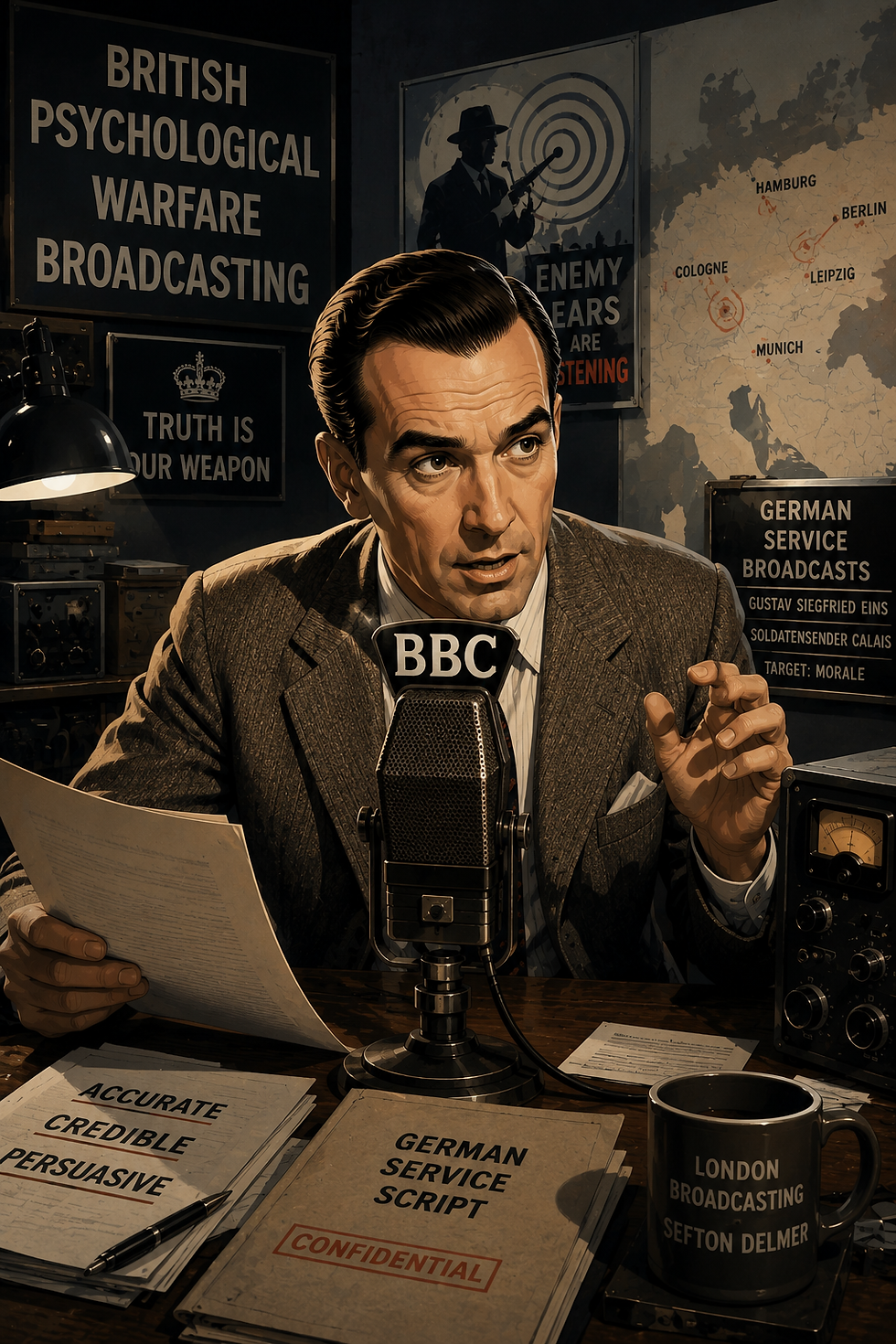
My Name is Sefton Delmer: British Journalist - Psychological-Warfare Broadcaster
I was born in Berlin in 1904, the son of Australian-born British parents. German was therefore not merely a language I learned from books; it was part of the world in which I grew up. During the First World War, my family was interned in Germany as enemy aliens before eventually returning to Britain. Those early years gave me something that would later prove extraordinarily useful: an understanding of German speech, habits, humor, prejudices, and ways of thinking. Long before anyone asked me to wage psychological warfare, I had learned to listen carefully to how Germans actually talked.
Watching Hitler Rise
I became a journalist for the Daily Express and returned to Germany as a foreign correspondent. There I watched Adolf Hitler and the Nazi movement climb toward power. I interviewed Nazi leaders, traveled through Germany, and observed their rallies and political theater at close range. Hitler understood that politics could be staged as spectacle. Flags, uniforms, music, carefully arranged crowds, repeated slogans, and radio broadcasts were not decorations around the movement—they were part of the machinery that helped it grow. As a journalist, I had the uncomfortable advantage of watching that machinery being assembled.
The War of Words Begins
When Britain and Germany went to war in 1939, information became a weapon alongside aircraft, ships, and armies. I eventually joined Britain's Political Warfare Executive. Our task was not conventional journalism. We were trying to weaken the enemy's confidence, encourage suspicion, and make German soldiers and civilians question the institutions around them. I understood something from my years in Germany: if an obvious British voice told Germans that their leaders were lying, many would simply dismiss it. A more effective message might appear to come from someone they believed was one of their own.
A Radio Station That Wasn't What It Seemed
One of our most unusual experiments was Gustav Siegfried Eins, a clandestine radio station that pretended to originate from within Germany. Its supposed broadcaster, known as "Der Chef," sounded like an angry, loyal German military man disgusted by corruption and incompetence within the Nazi establishment. We mixed genuine information with carefully constructed material. The objective was not to persuade Germans to love Britain. It was to encourage them to distrust parts of their own regime.
Learning to Manufacture Credibility
Psychological warfare depends upon credibility just as journalism does, although it uses credibility differently. A completely unbelievable lie is useless. The listener must recognize enough truth to remain interested. We studied German newspapers, military terminology, rumors, personalities, regional expressions, and everyday complaints. Details mattered. If the language sounded wrong, the illusion collapsed. We therefore tried to construct broadcasts that sounded less like foreign propaganda and more like conversations Germans might imagine taking place behind closed doors.
Soldatensender Calais
Later came Soldatensender Calais, one of the best-known British clandestine stations aimed at German servicemen. It broadcast music, military information, news, rumors, and carefully selected stories. We sometimes reported information the German authorities would rather soldiers did not hear. The purpose was psychological erosion: make a soldier wonder whether his commanders were competent, whether conditions at home were deteriorating, whether official announcements could be trusted, and eventually whether continuing the war made sense.
Paper Weapons and Battlefield Propaganda
Radio was only part of the campaign. The Allies also distributed enormous quantities of leaflets over German-held territory. Some carried news, some provided surrender instructions, and others attempted to undermine confidence in German leadership. A leaflet weighed almost nothing, but placed in the hands of a frightened or exhausted soldier at precisely the right moment, it might influence a decision. Psychological warfare was rarely about changing someone's entire worldview in an instant. More often, we tried to enlarge doubts that already existed.
The Dangerous Boundary
After the war, I returned to journalism and eventually wrote about my experiences. I had spent my career on both sides of an uncomfortable boundary: first trying to report reality and later deliberately constructing deceptive broadcasts to influence an enemy. That distinction should trouble anyone who studies my work. We were fighting a dictatorship whose propaganda machine spread hatred, persecution, and enormous falsehoods, but that did not magically turn every technique we used into truth.
What I Would Admit at the End
If I owe an apology, it is for the ease with which clever men can convince themselves that deception becomes harmless when practiced for a cause they believe necessary. I believed defeating Nazi Germany justified psychological warfare, and I do not pretend that our clandestine broadcasts were ordinary journalism. They were weapons. My experience left behind a warning more valuable than any secret radio station: when someone attempts to influence you, do not merely ask whether the message sounds convincing. Ask who wants you to believe it, why they want you to believe it, and what evidence they would rather you never examine.
Propaganda Aimed at Soldiers (1940–1942) — Told by Sefton Delmer
By 1940, Europe was fighting with rifles, tanks, aircraft—and words. I had been a journalist in Germany before the war and had watched the Nazis become remarkably skilled at political communication. When I joined Britain's psychological-warfare effort, we faced a different question: could information weaken an enemy army without firing a shot? German soldiers became an audience of enormous importance. If we could make a man question his commanders, worry about his family, distrust official reports, or wonder whether the war could actually be won, we might place a small crack in the confidence upon which armies depend.
Do Not Tell Him What He Knows Is Absurd
A soldier at the front knows certain things better than any propagandist. He knows whether he is hungry, whether ammunition has arrived, whether his unit has suffered casualties, and whether his officers appear competent. If a broadcaster tells him everything is collapsing when he can plainly see otherwise, he will stop listening. Psychological warfare therefore had to begin with believable information. Accurate details could establish credibility; once the listener stayed with you, carefully chosen information, rumor, commentary, and sometimes deliberate deception could be introduced alongside it.
Gustav Siegfried Eins
In 1941, Britain began broadcasting Gustav Siegfried Eins, a clandestine station associated with my work. Its supposed speaker, "Der Chef," presented himself not as a friendly Englishman but as a foul-mouthed, fiercely patriotic German military man disgusted with corruption and incompetence among Nazi officials. That was the deception. We wanted listeners to think they were overhearing criticism originating from within Germany itself. The station mixed factual material with fabricated or manipulated stories, making it an example of what became known as "black propaganda"—propaganda whose true source is deliberately concealed.
Attack the Commander, Not the Soldier
One useful psychological approach was to avoid immediately insulting the ordinary soldier. Tell a man that he is a coward or a fool and he will probably turn off the radio. Suggest instead that someone above him is enjoying privileges while he suffers, or that incompetent officials are wasting the sacrifices of front-line troops, and you have offered him a different target for his frustration. Psychological warfare often attempted to exploit tensions already present within military organizations rather than manufacture completely new ones.
What Is Happening at Home?
A soldier hundreds of miles from home possesses a vulnerability that no armor can protect: uncertainty. How is his wife? Are his children safe? Has his town been bombed? Are civilians receiving enough food? Has someone else taken his job—or even his place within his family? Wartime governments understood that soldiers worried about such questions. Propaganda broadcasters could exploit that uncertainty by discussing bombing, shortages, corruption, family life, and conditions inside Germany. The objective was not necessarily to make a soldier desert immediately. Sometimes making him worry was enough.
Casualties and the Battle Over Truth
Casualty figures became another psychological battlefield. Governments naturally wanted to emphasize enemy losses while controlling information about their own. But soldiers eventually notice when familiar faces disappear. Letters stop arriving. Units receive replacements. Friends fail to return from operations. If official announcements seem increasingly disconnected from personal experience, trust can begin to weaken. An enemy broadcaster who provides information that appears more accurate can become dangerous precisely because the soldier has been given a reason to listen.
The Question We Wanted Him to Ask
By 1942, German forces were spread across an enormous war stretching from occupied Western Europe to North Africa and deep into the Soviet Union. Britain remained in the fight, the Soviet Union had survived the initial German invasion, and the United States had entered the conflict. Our objective was to place a question inside the German soldier's mind: where does this end? He did not have to become pro-British. He merely had to begin wondering whether his leaders' promises matched the reality developing around him.

My Name is Virginia Hall: American OSS Operative and Resistance Organizer
I was born in Baltimore, Maryland, in 1906, and from an early age I wanted a life beyond what others expected of me. I studied languages and traveled throughout Europe, eventually working for the United States government overseas. I hoped to join the diplomatic service, but in 1933 a hunting accident in Turkey changed my plans. A shotgun discharged into my left foot, and doctors were forced to amputate part of my leg. I learned to walk with a prosthetic leg, which I called "Cuthbert." Some people saw a disability. I saw a problem that had to be managed.
France Falls
When Germany invaded France in 1940, I was there. I served as an ambulance driver before France surrendered. I eventually reached Britain, where I found another way to contribute. Britain's Special Operations Executive needed people who could enter occupied Europe, communicate secretly, organize resistance networks, and survive without attracting attention. I spoke French, understood European culture, and was willing to return. In 1941, I went into Vichy France while posing as an American newspaper correspondent.
Building a Secret Network
Espionage is rarely as glamorous as people imagine. Much of my work involved finding people who could be trusted. I helped establish contacts, arrange safe houses, move money and supplies, communicate with London, and assist Allied agents and airmen. A resistance organization survives through ordinary people willing to perform extraordinary tasks—a farmer hiding equipment, a family providing a room, a courier carrying a message, or someone quietly watching a railway station.
Information Became a Weapon
We fought with information as much as explosives. Secret radio transmissions connected resistance networks with Britain. Coded messages carried instructions. Underground newspapers and leaflets challenged German and collaborationist claims. Rumors could warn people, encourage resistance, or confuse an enemy. But information could also kill. One careless transmission, one compromised courier, or one sentence spoken to the wrong person could expose an entire network. In our world, knowing when not to speak was every bit as important as knowing what to say.
The Germans Hunt Me
The German security services eventually became aware of my activities. The Gestapo regarded me as a dangerous Allied operative and sought to capture me. By late 1942, remaining in France had become too dangerous. When Germany occupied the previously unoccupied southern zone, I escaped on foot across the Pyrenees into Spain. Crossing those mountains with an artificial leg was difficult, but capture would have been considerably worse. When I complained by radio that "Cuthbert" was giving me trouble, London initially misunderstood and reportedly suggested eliminating him. Cuthbert, fortunately, remained attached to me.
Returning with the OSS
I wanted to return to France. The British considered the risk enormous, but America's Office of Strategic Services eventually gave me the opportunity. In 1944, I returned disguised as an elderly French woman, altering my clothing, appearance, posture, and mannerisms. I operated under the identity Marcelle Montagne and worked with resistance groups as the Allied invasion approached. My job was not to become famous. Fame was precisely what an operative did not want.
Underground Information in Occupied Europe (1941–1943) — Told by Hall
When I entered France in 1941, information could be as dangerous to possess as a weapon. Germany occupied northern and western France, while the Vichy government administered the southern zone until German and Italian forces occupied it in November 1942. Newspapers and radio operated under censorship and political pressure, while listening to certain foreign broadcasts could bring serious consequences. Yet people still wanted to know what was actually happening. For resistance networks, obtaining and moving reliable information became part of the war itself.
Building a Network One Person at a Time
I worked for Britain's Special Operations Executive while posing publicly as an American correspondent. My real work depended upon people who could be trusted. A resistance network was not something you announced or advertised. It grew quietly—a railway worker here, a doctor there, a farmer with a safe building, a courier who knew the roads, someone willing to hide an agent for one night. Each person possessed only part of the picture whenever possible. If one member was captured, the entire organization could be endangered.
The Secret Radio
Radio provided one of our most important connections with Britain. Wireless operators could transmit intelligence and receive instructions, but using a transmitter was extremely dangerous. German security forces employed radio-detection methods to locate clandestine transmissions. Operators therefore had reason to keep messages concise and change locations. Codes and security procedures protected the contents, but nothing could make transmitting completely safe. Every extra minute on the air could increase the danger.
Messages Hidden in Ordinary Life
Not every message traveled by wireless. Couriers carried documents and verbal instructions between contacts. Information could be concealed in seemingly ordinary objects or delivered through prearranged meetings and signals. False identities and forged documents helped agents and resistance members move through controlled territory. The purpose was not to make espionage theatrical. Quite the opposite. The safest message was often the one that appeared so ordinary that nobody thought to examine it.
The Underground Press
Across occupied Europe, resistance groups produced clandestine newspapers, pamphlets, and leaflets. In France, underground publications such as Combat, Libération, and Défense de la France challenged occupation propaganda and Vichy censorship. Producing them required paper, ink, printing equipment, writers, printers, couriers, and distributors—all of whom could face arrest if discovered. A few printed pages could tell civilians about military developments, expose occupation policies, encourage resistance, or simply demonstrate that the occupiers had not silenced everyone.
Listening Beyond the Occupation
Foreign radio broadcasts were another source of information. The BBC broadcast news and messages into occupied Europe, including French-language programming. Listeners sometimes gathered secretly around receivers to hear reports that differed from German or Vichy accounts. The BBC also transmitted coded or seemingly mysterious personal messages, some of which were connected to resistance operations. A sentence that sounded meaningless to one listener might tell another that supplies were coming or that an operation should proceed.
Rumor: Useful and Dangerous
Rumors traveled even faster than newspapers. They could strengthen hope, spread warnings, confuse occupation forces, or damage enemy morale. They could also cause panic and get innocent people killed. Resistance work taught us that information had to be judged carefully. Where did the story originate? Had another source confirmed it? Was someone deliberately feeding us false information? German security organizations also used informers, infiltration, and deception against resistance groups. Trusting the wrong message—or the wrong messenger—could destroy a network.
The Gestapo Begins Looking for Me
By 1942, German authorities knew that an Allied woman operative was organizing resistance activities in France. The Gestapo pursued me, and remaining in the country became increasingly dangerous. After German forces occupied the southern zone in November, I escaped across the Pyrenees into Spain on foot, despite my artificial leg. Leaving France did not mean abandoning the fight. It meant surviving long enough to return.
Leaflets: Paper Weapons Falling From the Sky (1942–1945) — Told by Delmer
During the Second World War, people naturally feared bombs falling from aircraft. But sometimes what drifted down from the sky was nothing more dangerous-looking than paper. By 1942, the Allies were distributing enormous numbers of propaganda leaflets over German and German-occupied territory. I worked in British psychological warfare, where we understood that a leaflet could never destroy a tank or knock down a bridge. What it could attack was something every army needed: confidence.
Why Drop Leaflets at All?
Imagine yourself as a German soldier far from home. Your government controls much of the news you receive. Then you discover a leaflet containing information your own newspapers have not reported. Perhaps it discusses German losses, Allied advances, bombing at home, or the growing strength of Germany's enemies. You may immediately throw it away. You may call it enemy propaganda. But perhaps you read it first. For us, that moment mattered. We had placed another voice inside a system attempting to control what you knew.
Getting the Paper to the Enemy
Leaflets could be distributed by aircraft and other means, and the scale eventually became enormous. Aircraft carried bundles or specially prepared containers that released printed material over targeted areas. Wind and weather could scatter sheets across towns, countryside, and military positions. The Allies were not alone in doing this; Germany and other belligerents also distributed propaganda aimed at enemy troops and civilians. Modern warfare had created an unusual battlefield where printing presses supplied some of the ammunition.
News Could Be More Powerful Than a Slogan
The most useful leaflet was not necessarily the one shouting, "You are defeated!" Soldiers are not fools. If their army was still advancing, such a claim would destroy the propagandist's credibility. A more effective approach could be to provide accurate or plausible information unavailable through official channels. If several statements proved correct, the reader might return to the leaflet when another appeared. Establishing credibility could make later persuasion considerably more effective.
The Surrender Leaflet
Some leaflets had an extremely practical purpose: persuading soldiers to surrender and explaining how to do it. They could instruct troops on approaching Allied lines, displaying their intention to surrender, or carrying the leaflet itself. Certain Allied leaflets functioned as surrender passes, although their actual legal significance was not as simple as propaganda sometimes suggested. Psychologically, however, they offered something important—a visible alternative to continuing a battle that might appear hopeless.
Attacking Confidence in Leadership
Other leaflets questioned German military and political leadership. Why were soldiers being ordered to hold positions that appeared impossible to defend? Were senior officials sharing the hardships of ordinary troops? Was the government telling the truth about military setbacks? We tried to exploit frustrations already present rather than invent every doubt from nothing. A tired soldier who already distrusted his commanders required much less persuasion than one completely confident in them.
What About Home?
Perhaps the most sensitive subject was home. Soldiers wondered about wives, children, parents, food supplies, and cities being bombed by Allied aircraft. Psychological warfare could exploit those concerns by reporting conditions inside Germany or suggesting that the soldier's sacrifices were not protecting those he loved. Such methods could be cruel because they deliberately pressed upon genuine anxieties. Psychological warfare was still warfare, even when its weapon was a sentence instead of an explosive.
By 1944, Reality Was Helping Us
After the Allied landings in Normandy in June 1944 and the Soviet advances from the east, German troops increasingly confronted evidence that the military situation was deteriorating. This changed the psychological value of our leaflets. A warning of defeat becomes more believable when the reader can hear enemy artillery approaching. Propaganda is strongest when it attaches itself to something the audience already suspects or can observe.
Clandestine Radio and the Art of Deception (1943–1945) — Told by Sefton Delmer
By 1943, I had learned an uncomfortable truth about propaganda: sometimes the identity of the speaker matters as much as the message. If the BBC openly told a German soldier that his leaders were failing him, he knew immediately that an enemy was speaking. But what if the same criticism seemed to come from another German? Britain's clandestine broadcasting operations attempted precisely that. We created radio stations whose true British origins were concealed, making them appear to be voices from within Germany or its military world. This was "black propaganda"—information or persuasion deliberately disguised to conceal who was really producing it.
We Had Practiced Before
Our experiments had begun earlier. Gustav Siegfried Eins, which started broadcasting in 1941, pretended to represent an angry German insider known as "Der Chef." He attacked corruption and misconduct within the Nazi establishment while presenting himself as fiercely German. The important deception was the station's identity. Listeners were not supposed to imagine British propagandists sitting behind microphones. They were supposed to wonder whether Germans themselves were turning against parts of the regime.
Soldatensender Calais Takes the Air
In October 1943, Soldatensender Calais began broadcasting. Despite the name, it was a British operation. It was aimed particularly at German servicemen and attempted to sound like a genuine German military station. We mixed popular music, news, military information, commentary, rumors, and material calculated to weaken confidence. The station did not spend every minute shouting anti-Nazi slogans. That would have made our purpose obvious. Entertainment and useful information gave listeners reasons to remain tuned in.
Truth Made the Deception Stronger
Here lies one of the great paradoxes of black propaganda: lies often require truth to make them believable. We used information gathered from intelligence sources, monitoring, prisoners of war, German publications, and other material to make broadcasts sound informed. If we could report details that German listeners recognized as accurate, perhaps they would trust us when we moved into information intended to influence them. A successful deception does not necessarily invent everything. Often it builds the falsehood around a framework of recognizable reality.
Speaking Like the Audience
Language mattered enormously. I had grown up in Germany and later worked there as a journalist, so I knew that a British broadcaster speaking textbook German would immediately sound suspicious. Our broadcasts needed German expressions, military vocabulary, jokes, complaints, names, music, and details that belonged in the world of the intended listener. The smallest mistake could expose the illusion. If you wish to impersonate someone's trusted source, you must understand how that source would actually sound.
Do Not Demand Too Much
We were rarely trying to make a German soldier suddenly admire Britain. That would have been an unreasonable objective. We wanted smaller changes: doubt an official announcement, question a commander, worry about conditions at home, suspect corruption, or wonder whether Germany could still win. Psychological warfare often works through accumulation. One question leads to another until certainty begins to weaken.
The Gray Area Between News and Weapon
Soldatensender Calais could provide genuine news while simultaneously serving a British military purpose. That is precisely what makes clandestine propaganda worth studying. Accurate facts do not automatically make the overall message neutral. A propagandist can select which facts to emphasize, arrange them in a particular order, mix them with rumors, or conceal the source presenting them. The audience may therefore receive several true statements while still being deliberately manipulated toward a desired conclusion.
The Station Changes Its Name
After Allied forces advanced through France and the fiction surrounding "Calais" became increasingly unsuitable, the operation evolved. In late 1944, Soldatensender Calais was replaced by Soldatensender West, continuing broadcasts directed toward German forces as the Reich faced invasion from east and west. By then, our greatest ally was becoming reality itself. German cities were being bombed, Allied armies were approaching Germany, and Soviet forces were advancing from the east. It was increasingly difficult for official propaganda to conceal the military catastrophe.
Never Trust the Microphone (or Newspapage, or Social Media) Simply Because It Sounds Familiar
Our clandestine stations demonstrated why source verification matters. A listener could hear familiar music, fluent German, convincing military terminology, and apparently accurate news and conclude that the broadcaster must be what he claimed to be. That conclusion was precisely what we wanted.
Resistance Propaganda and the Battle for Civilian Cooperation — Told by Hall
By 1943, the war in occupied Europe was being fought in places that never appeared on military maps. A farmhouse attic could become a hiding place. A bicycle could carry a message. A railway worker could report the movement of German troops. A shopkeeper might notice something important and quietly pass it along. Resistance movements needed weapons, certainly, but weapons were useless without people. We needed civilians willing to provide food, shelter, transportation, intelligence, supplies—and sometimes the most valuable contribution of all: silence.
The Civilian Was Part of the Battlefield
German occupation authorities understood this as well as we did. Resistance fighters depended upon the communities surrounding them, so occupation forces attempted to discourage cooperation through arrests, surveillance, informers, propaganda, and severe reprisals. Helping an Allied agent or resistance member could endanger an entire family. We could not simply tell civilians to "resist" and expect them to obey. They needed reasons to believe their risks served a real purpose and that Germany would not control France forever.
Messages Behind the Occupation
Underground newspapers and leaflets became important weapons. Publications including Combat, Défense de la France, and Libération circulated despite censorship and the danger of arrest. They reported news, criticized German occupation and collaboration, encouraged resistance, and reminded readers that alternative French voices still existed. Every copy represented risk. Someone had to write it, print it, transport it, hide it, and place it into another person's hands.
The Voice Coming From Britain
Radio provided another connection to the outside world. BBC broadcasts reached listeners in occupied France with news and programs aimed at European audiences. The famous French broadcasts associated with Radio Londres helped counter German and Vichy-controlled information. Coded "personal messages" broadcast from Britain could also communicate signals to resistance groups. To most listeners, a peculiar sentence might sound meaningless. To the correct person, it could indicate that an operation or delivery was approaching.
Winning Trust
My own work depended upon trust more than slogans. When I first operated in France for Britain's Special Operations Executive, I had to identify people willing to help without exposing the network to informers. Later, after joining America's Office of Strategic Services and returning to France in 1944, the same principle remained. A farmer who hid equipment, a courier carrying instructions, or a family sheltering an operative had to believe that we were genuine and that the information we gave them could be trusted. One careless promise could cost lives.
Collaboration and the Pressure to Choose
Resistance propaganda also warned against collaboration. Occupation created difficult choices for ordinary people, and not every interaction with German authorities meant ideological support. Some cooperated willingly; others acted from fear, necessity, or coercion. Resistance messages nevertheless attempted to discourage assistance to German authorities and encourage civilians to support liberation. This was psychological warfare at the neighborhood level, where the struggle was often over whether a person would cooperate, resist, remain neutral, or betray someone.
Preparing for the Allied Return
As 1944 approached, the possibility of an Allied invasion became increasingly important. Resistance organizations gathered intelligence about roads, railways, German units, communications, and defenses. Allied planners also wanted resistance groups prepared to interfere with German movements when the invasion came. Messages from Britain helped coordinate some of these activities. Yet timing mattered. Premature action could expose networks before they could contribute effectively to liberation.
Morale, Rumors, and Misinformation Before D-Day (1944) — Told by Delmer
By early 1944, there was one secret we could not possibly keep from the Germans: the Western Allies were preparing to invade continental Europe. Britain was crowded with American, British, Canadian, and other Allied troops. Ships filled harbors, aircraft crowded airfields, and enormous quantities of equipment were arriving. The Germans knew an invasion was coming. What they desperately needed to know was where and when. That uncertainty became a weapon, and Allied planners intended to use it.
Five Different Kinds of Information
Before going further, understand the language of this strange battlefield. Propaganda is information deliberately designed to influence an audience. Misinformation is false or inaccurate information, whether spread intentionally or accidentally. Disinformation is false information deliberately planted to deceive. Military deception is broader: it can include false radio traffic, dummy equipment, misleading troop movements, double agents, and other measures intended to make an enemy take the wrong action. A rumor is simply an unverified story passed from person to person. In 1944, all five could collide.
Make Calais Look Like the Target
The shortest route across the English Channel led toward the Pas-de-Calais, and German commanders already considered that region a likely invasion area. Allied deception planners exploited this expectation. Under Operation Bodyguard, and particularly Operation Fortitude South, the Allies created the impression that a major force in southeastern England was preparing to strike across the Channel toward Calais. The fictitious First U.S. Army Group was associated with General George S. Patton, whom the Germans regarded as an important Allied commander.
An Army Built From Signals and Appearances
Creating the illusion required more than starting a rumor. Deceptive radio traffic helped suggest military formations and activity that were not what they appeared to be. Dummy equipment and carefully managed visible activity contributed to the picture. German reconnaissance and intelligence needed to discover evidence convincing enough to reinforce expectations already forming in their minds. Good deception often works best when you do not force an enemy to believe something entirely new. You encourage him to believe more strongly what he already suspects.
The Double Agents
Perhaps the most remarkable part of the deception involved Germany's own intelligence network in Britain. British counterintelligence had captured or controlled German agents, and through the Double-Cross System some became channels for carefully prepared information sent back to German intelligence. One of the most famous was Juan Pujol García, code-named Garbo by the British. He created an elaborate fictional network of sub-agents and supplied Germany with a mixture of information carefully controlled by the Allies. The enemy believed he had eyes inside Britain. In reality, those eyes were showing him a picture Britain helped construct.
Where Psychological Warfare Entered
My own field of clandestine broadcasting belonged to this larger struggle for enemy perception, though operations such as Fortitude were principally military and intelligence deceptions rather than my personal creation. Through stations such as Soldatensender Calais, we attempted to influence German servicemen with news, rumors, entertainment, and carefully selected information. Psychological warfare sought to create doubt about leadership, the military situation, and conditions at home. The broader deception campaign had a more immediate military purpose: keep German commanders uncertain about where the decisive invasion would fall.
The Danger of Believing Your Own Rumors
Rumors can help a deception, but they are difficult to control. A story may begin with a deliberate falsehood, change as people repeat it, and eventually return to its creators in a form they no longer recognize. Intelligence officers therefore had to distinguish between information genuinely obtained from the enemy and stories that originated with Allied deception. One of the dangers of information warfare is becoming trapped inside your own invention.
June 6, 1944
When Allied troops landed in Normandy on D-Day, the deception did not immediately end. Allied planners wanted the Germans to believe Normandy might be a diversion preceding another major assault toward Calais. This mattered because German forces held elsewhere could not be used against the Normandy beachhead. Deception did not win D-Day by itself—the invasion depended upon soldiers, sailors, airmen, logistics, planning, and enormous sacrifice—but uncertainty complicated Germany's response.
When People Stop Believing: The Collapse of Wartime Propaganda (1944–1945) — Told by Sefton Delmer and Edward R. Murrow
Sefton Delmer: "By 1944, Nazi Germany still possessed newspapers, radio stations, posters, speeches, and Joseph Goebbels's enormous propaganda organization. But propaganda faces a serious problem when the audience can look through the window and see evidence contradicting it. German cities had been devastated by Allied bombing. Families received notices that sons and husbands had been killed or were missing. Refugees arrived from threatened territories. German soldiers returned wounded from fronts supposedly described in reassuring language. You can manipulate information, but eventually reality begins demanding its own broadcast."
Credibility Is Spent Like Money
Edward R. Murrow: "That is why credibility matters. A broadcaster may persuade an audience to trust him today, but every falsehood places that trust at risk tomorrow. During the war, Nazi authorities sometimes minimized setbacks or presented withdrawals and defeats in language intended to maintain confidence. Yet Germans could compare those messages with letters from soldiers, bombing damage, shortages, refugees, and foreign broadcasts. Once people repeatedly discover that official information does not correspond with their experience, they begin questioning the next announcement before it has even finished."
The Map Was Becoming Difficult to Explain
Delmer: "Consider the military situation. Rome fell to the Allies in June 1944. Days later, Allied armies landed in Normandy. Paris was liberated in August. Meanwhile, the Soviet Red Army was destroying German forces and advancing westward. By early 1945, Allied armies were entering Germany from both directions. No amount of clever language could permanently disguise the direction in which the front lines were moving. The propagandist's problem was becoming brutally simple: how do you continue promising victory when the enemy is approaching your own town?"
Fear Replaces the Promise of Victory
Murrow: "When confidence becomes difficult to maintain, propaganda may turn increasingly toward fear. Nazi propaganda warned Germans about what would happen if the Allies—especially the Soviet Union—defeated the Reich. Some fears concerning Soviet reprisals had a basis in the brutal realities of the Eastern Front, but Nazi propaganda also exaggerated and manipulated threats while concealing the regime's own responsibility for launching a war of annihilation in the East. Fear could still encourage resistance even after belief in final victory weakened."
Our Side Used Propaganda Too
Delmer: "We should not pretend that propaganda existed only in Germany. I was engaged in it myself. My British clandestine stations deliberately concealed their origins and sometimes mixed reliable information with rumor, manipulation, and deception. The difference between my work and Murrow's journalism is important. I wanted German listeners to take actions beneficial to the Allied war effort. Edward wanted his listeners to understand events. Both of us valued credibility, but we used it for different purposes."
That Difference Matters
Murrow: "Precisely. A journalist who knowingly sacrifices truth for an immediate advantage may discover that the advantage is temporary while the damage to credibility lasts much longer. During my broadcasts, I tried to describe what I witnessed, whether encouraging or disturbing. The audience should never have to wonder whether I changed a fact merely because the truth was inconvenient. Journalism certainly makes mistakes, but deliberately manufacturing a desired reality is something different."
The Concentration Camps Are Opened
Delmer: "Then Allied soldiers entered the concentration camps. Buchenwald, Bergen-Belsen, Dachau, and others exposed evidence of crimes that Nazi censorship and propaganda had concealed, distorted, or justified. Prisoners emerged starving and dying. Bodies remained unburied. The physical evidence was there for liberating soldiers, journalists, photographers, and eventually the wider world to see. There are moments when propaganda encounters evidence so overwhelming that its inventions cannot survive serious examination."
I Saw Buchenwald
Murrow: "I entered Buchenwald in April 1945. I saw prisoners whose bodies had been reduced by starvation, and I saw evidence of mass death. When I later broadcast what I had witnessed, I understood that some listeners would find the account almost impossible to comprehend. But there are times when a reporter's obligation is simply to describe the evidence as accurately as possible. If reality is horrifying, making it comfortable would not make it more truthful."
The Final Collapse
Delmer: "By April 1945, Soviet troops were fighting inside Berlin while Western Allied armies had crossed deep into Germany. Hitler died on April 30, and Goebbels died the following day. Germany surrendered in May. The propaganda system that had spent years presenting Hitler as the indispensable leader of a powerful Reich ended amid ruined cities, millions dead, displaced populations, occupation, and military defeat. The contrast between promise and outcome could scarcely have been greater."
The Lesson Left Behind
Murrow: "And that is where students should finish this chapter. Propaganda does not become false merely because it is propaganda, and an official source does not become truthful merely because it possesses authority. Examine evidence. Compare independent sources. Separate observation from opinion. Ask what has been omitted. Most importantly, notice what happens when predictions repeatedly fail. Trust can take years to establish and minutes to damage. Once people discover that someone has deliberately deceived them again and again, even that person's truthful statements may no longer be believed."


Comments