

11. Lesson Plans from the Great Depression: The Debate Over the New Deal


My Name is Felix Frankfurter: Associate Justice of the U.S. Supreme Court
I was born in Vienna, Austria, in 1882, but my family immigrated to New York City when I was still a boy. America was a land filled with opportunity, and I believed education was the key to unlocking it. I worked hard in school, eventually graduating from the City College of New York and later from Harvard Law School. I quickly became convinced that careful study, reason, and the law could solve nearly any problem society faced.
Finding My Place in the Law
After law school I served in government before becoming a professor at Harvard. Teaching became one of my greatest passions because I enjoyed helping young lawyers think carefully about the Constitution and public policy. Many of my students later became judges, attorneys, and government officials. I also advised political leaders and believed educated experts should help guide public decisions. To me, good government depended upon knowledgeable people making thoughtful choices rather than emotional reactions.
Standing Behind the New Deal
When Franklin D. Roosevelt introduced the New Deal during the Great Depression, I believed the nation faced extraordinary circumstances that required bold action. Millions were unemployed, banks had failed, and families struggled simply to survive. I thought the federal government had both the authority and the responsibility to respond. I believed the Constitution was strong enough to allow government to meet new challenges, and I often found it difficult to understand why so many people feared expanding federal power if it meant helping suffering Americans.
My Critics Saw Danger Where I Saw Hope
Many Americans strongly disagreed with me. Business leaders, constitutional conservatives, and defenders of states' rights believed the New Deal threatened individual liberty and gave Washington far too much authority. I respected their intelligence, but I often believed they were placing old traditions above the nation's urgent needs. I struggled to understand why they viewed government action as a danger instead of a tool for solving enormous problems. To me, refusing to adapt seemed far riskier than trying something new.
Life on the Supreme Court
In 1939 President Roosevelt appointed me to the Supreme Court of the United States. Some people expected I would always support his policies, but I believed judges should exercise restraint. Although I personally favored many reforms, I increasingly argued that courts should avoid interfering with decisions made by elected lawmakers unless the Constitution clearly required it. This philosophy of judicial restraint became one of my lasting contributions, even though some critics believed I was inconsistent because of my earlier political involvement.
Controversial Decisions and Lasting Debate
Not every decision I made was admired. One of the most controversial came during World War II when I joined the Court's decision in the Japanese American internment case. At the time I believed the government needed broad authority during wartime emergencies. Many years later, countless legal scholars, judges, and Americans concluded that decision had failed to protect the constitutional rights of innocent citizens. It remains one of the most criticized rulings in Supreme Court history and continues to shape discussions about civil liberties during national crises.
Looking Back on My Beliefs
Throughout much of my life, I believed reason, expertise, and government action could improve society. I often assumed that if people studied the facts as I had, they would naturally reach the same conclusions. It took many years for me to recognize that thoughtful, patriotic Americans could honestly disagree about the meaning of the Constitution and the proper role of government. While I remained proud of my dedication to public service and the rule of law, I came to appreciate that wisdom sometimes requires listening as carefully as arguing, especially when questions of liberty and constitutional power are involved.
America Begins Debating the New Deal (1933–1934) – Told by Felix Frankfurter
When Franklin Roosevelt took office in March 1933, the United States was exhausted. Banks had failed by the thousands, businesses had closed their doors, farmers watched crops lose their value, and millions of hardworking Americans searched every day for jobs that no longer existed. Families who had once lived comfortably now depended on soup kitchens and charitable organizations simply to survive. Nearly everyone agreed that something had to change. The question was not whether America needed action—it was what kind of action the federal government should take. That question sparked one of the greatest political debates in our nation's history, and I watched it unfold with tremendous interest because I believed the Constitution had to meet the needs of a nation facing extraordinary hardship.
The New Deal Changes Everything
President Roosevelt moved faster than any modern president before him. During what became known as the "First Hundred Days," Congress passed an incredible number of laws designed to stabilize banks, provide jobs, assist struggling farmers, and restore confidence in the economy. To many Americans, these programs brought hope where there had been despair. I believed these reforms demonstrated that democratic government could respond effectively during a national emergency without abandoning constitutional principles. Yet almost immediately, many Americans saw these same actions very differently. They wondered whether Washington had suddenly gained powers that the Constitution had never intended it to possess.
Supporters See a Lifeline
Those who supported the New Deal came from many walks of life. Unemployed workers welcomed jobs created by public works programs. Farmers hoped government assistance would save their land. Elderly Americans looked toward the promise of future protections, while labor unions believed workers would finally gain a stronger voice. Many economists, professors, and legal scholars, myself included, believed that the nation's economic collapse required creative solutions. We argued that the Constitution was not a fragile document trapped in the eighteenth century but a framework capable of guiding America through changing times. I often found it difficult to understand why some people viewed every new federal program as a threat instead of seeing it as a necessary response to an unprecedented crisis.
Opposition Begins to Organize
Not everyone shared that confidence. Business owners worried that expanding regulations would discourage investment and slow economic recovery. Constitutional conservatives argued that many New Deal programs allowed the federal government to exercise powers that belonged to the states or to private citizens. Some feared that if Washington controlled more industries, more jobs, and more aspects of daily life, individual freedom would gradually disappear. Others simply believed the Depression would eventually correct itself if government stepped aside. These concerns united people from different political backgrounds into an increasingly organized opposition that questioned nearly every major New Deal proposal.
A Debate That Would Shape America
As 1934 approached, it became clear that the New Deal was more than a collection of recovery programs—it had become a debate over the future of American government itself. Should the federal government take an active role in protecting economic security, or should its powers remain tightly limited even during emergencies? Could the Constitution adapt to new challenges without losing its original meaning? These questions filled newspapers, courtrooms, political speeches, and dinner tables across the country. At the time, few Americans realized that this debate would continue long after the Great Depression ended, influencing Supreme Court decisions, presidential powers, and public policy for generations. It was not merely a disagreement about economics; it was a national conversation about liberty, responsibility, and the meaning of the Constitution itself.
The First Successes—and the First Doubts – Told by Felix Frankfurter
When Franklin Roosevelt's New Deal began taking effect, many Americans noticed encouraging signs that the nation's darkest days might finally be passing. The nationwide banking holiday restored confidence in the financial system, and many banks reopened with customers once again willing to deposit their savings. Emergency relief programs provided jobs instead of simple handouts, allowing thousands of men and women to earn paychecks while building roads, schools, parks, bridges, and public buildings that communities still use today. Farmers began receiving assistance to stabilize crop prices, while businesses slowly regained confidence as the economy showed the first signs of life. Although the Great Depression was far from over, Americans could finally see evidence that recovery might be possible.
Hope Returns to the American People
Perhaps the greatest achievement during these early years was not measured in dollars but in confidence. Before Roosevelt took office, fear had spread almost as quickly as the economic collapse itself. Families worried about losing everything, businesses hesitated to invest, and many believed the nation's future was hopeless. Roosevelt's speeches, especially his famous Fireside Chats over the radio, reassured millions of Americans that their government had not abandoned them. People began believing that together they could overcome the crisis. I admired this renewed confidence because democratic government depends upon citizens believing that their institutions can respond to extraordinary challenges. Hope, after all, can become one of the strongest forces in rebuilding a nation.
Questions Begin to Grow
Yet as the recovery slowly continued, another conversation began spreading across the country. Every new program required more government agencies, more federal employees, and more spending. Washington had become involved in banking, farming, labor relations, housing, business regulations, and countless other areas that had once been left largely to the states or private citizens. While I believed these actions were justified by the emergency, many thoughtful Americans wondered where the expansion of federal authority would end. They asked whether temporary emergency measures might become permanent parts of government, changing the relationship between citizens and Washington forever.
A Debate Larger Than Economics
The discussion soon became about far more than jobs or economic recovery. It became a constitutional debate about the proper role of government in American life. Some argued that if government could rescue millions from hardship, then it should continue playing a larger role in protecting economic security. Others warned that every new power granted during a crisis could remain long after the emergency had passed. I often found it difficult to understand why critics viewed these reforms with such suspicion when I believed they were designed to preserve both democracy and opportunity. To me, refusing to act during such a severe crisis seemed far more dangerous than allowing government to temporarily assume greater responsibility.
The Beginning of a Lasting National Conversation
Looking back, these early successes accomplished more than stabilizing the economy—they transformed the national conversation. Americans were no longer asking only how to recover from the Great Depression. They were asking what responsibilities government should have during times of peace as well as crisis, how much authority the federal government should possess, and how the Constitution should be interpreted in a rapidly changing nation. Those questions did not disappear when the economy improved. Instead, they became part of an ongoing debate that continues to influence American politics, Supreme Court decisions, and public policy nearly a century later.

My Name is Wendell Willkie: Business Leader, Lawyer, and Presidential Candidate
I was born in 1892 in Elwood, Indiana, where my parents taught me to value education, hard work, and lively political discussion. My family leaned toward progressive ideas, and I grew up believing that America became stronger when people debated difficult issues honestly. After studying law, I began my career as an attorney, but I never imagined that business, politics, and world events would eventually place me on the national stage.
From Lawyer to Business Executive
As my career developed, I became involved in the electric utility industry, eventually leading one of the nation's largest utility companies. I believed private businesses could provide services more efficiently than the federal government in many cases. When the Roosevelt administration created agencies like the Tennessee Valley Authority to compete with private utilities, I became one of its strongest critics. I could not understand why so many Americans believed government ownership was the better solution when I thought competition and private investment had built much of America's prosperity.
Questioning the New Deal
Although I agreed that the Great Depression demanded action, I believed parts of the New Deal expanded federal authority too far. I worried that Washington was collecting too much power while weakening businesses and the independence of individual states. Many people viewed me as an enemy of Roosevelt's programs, but I never opposed every reform. I simply believed government should know its limits. I often struggled to understand why critics labeled anyone who questioned the New Deal as uncaring toward struggling Americans.
An Unlikely Republican Nominee
In 1940, despite having once been a Democrat, I became the Republican nominee for President against Franklin D. Roosevelt. Some Republicans questioned my loyalty because I had supported several New Deal reforms, while many Democrats distrusted me because I criticized Roosevelt's growing executive power. I found myself in an unusual position where both sides believed I belonged with the other. I thought Americans should judge ideas on their merit rather than blindly following party labels, but many people preferred clear political divisions.
Standing Against Isolation
One of my most controversial positions involved foreign policy. While many Americans wanted to stay completely out of Europe's growing war, I believed Nazi Germany posed a serious threat to freedom around the world. Even after losing the election, I supported Roosevelt's efforts to aid Britain before the United States officially entered World War II. Some members of my own party believed I had betrayed them by cooperating with a political rival. I never understood why defending democracy abroad had to become a partisan issue at home.
One World
After traveling around the globe during the war, I became convinced that nations needed greater international cooperation. I shared these ideas in my book, One World, arguing that America's future depended upon working with other countries instead of remaining isolated. Critics accused me of placing too much trust in international organizations and foreign governments. I believed they underestimated how connected the modern world had become, while they believed I underestimated the importance of protecting American independence.
Looking Back
My life was filled with disagreements, not only with my political opponents but sometimes with my own supporters. I believed America needed both free enterprise and compassionate government, strong national defense and international cooperation, constitutional limits and practical leadership. For much of my life, I struggled to understand why so many people insisted these ideas could not exist together. Looking back, I came to appreciate that sincere people often reach different conclusions because they begin with different experiences and different fears. While I remained confident in many of my beliefs, I learned that lasting leadership requires listening as carefully as persuading.
Business Leaders Push Back – Told by Wendell Willkie
When Franklin Roosevelt's New Deal expanded the role of the federal government, many Americans welcomed the changes. They saw jobs returning, banks becoming more stable, and relief reaching families who had suffered through years of hardship. But from my position as a lawyer and business executive, I watched another story unfolding. Across boardrooms, factories, and investment offices, business leaders began asking difficult questions. They wondered whether the government was simply helping the economy recover or permanently changing the way American businesses would operate. I believed these questions deserved serious attention because the strength of our economy had long depended upon private enterprise, competition, and innovation.
Growing Concerns Over Regulation
The New Deal introduced new rules governing banking, labor relations, agriculture, utilities, and many other industries. Businesses were required to comply with regulations that would have been almost unimaginable just a few years earlier. While supporters argued these rules prevented abuses and protected workers and consumers, many business owners feared the growing number of regulations would make it harder to expand, invest, and hire employees. I believed reasonable laws were necessary, but I also believed excessive regulation could discourage the very businesses needed to create lasting jobs and economic growth.
Private Enterprise or Government Planning?
One of the greatest debates centered on whether America's future should be guided primarily by private businesses or by government planning. I strongly believed that entrepreneurs, investors, and competitive markets had built much of the nation's prosperity. They took risks, developed new products, opened factories, and created opportunities that government alone could never duplicate. The Tennessee Valley Authority became one of the clearest examples of this debate. As a leader in the private utility industry, I opposed the federal government's decision to compete directly with privately owned electric companies. I believed government should establish fair rules, not become a competitor in the marketplace. Many Americans disagreed, believing that government ownership was sometimes necessary when private companies failed to meet public needs.
Industry and Investors Respond
The uncertainty created by the New Deal affected financial decisions throughout the country. Some investors delayed expanding their businesses because they were unsure what new regulations or taxes might come next. Others worried that frequent government intervention made long-term planning more difficult. Large corporations, small business owners, bankers, and manufacturers often reacted cautiously, waiting to see whether Roosevelt's programs would become temporary emergency measures or permanent changes to the American economy. Supporters argued that business leaders were resisting reforms simply to protect their profits. I believed many were genuinely concerned about preserving an economic system that rewarded innovation, investment, and individual initiative.
A Debate That Still Continues
Looking back, the disagreement was never simply about one law or one president. It was about two different visions for America's future. One side believed stronger government oversight was necessary to prevent economic disasters and protect ordinary citizens. The other believed too much government control would eventually weaken free enterprise, reduce innovation, and slow economic growth. I never questioned the good intentions of those who wanted to help struggling Americans, but I found it difficult to understand why so many believed expanding government was the best long-term solution. The debate that began during the New Deal still shapes discussions today about regulation, business, taxation, and the proper balance between free markets and government responsibility.

My Name is Robert A. Taft: U.S. Senator & Defender of Constitutional Government
I was born in 1889 into a family where public service was part of everyday life. My father, William Howard Taft, served as President of the United States and later as Chief Justice of the Supreme Court. Watching him taught me that government carried enormous responsibility, but it also had clear constitutional limits. Those lessons shaped my beliefs for the rest of my life.
Education and the Law
I studied at Yale University before attending Harvard Law School, where I developed a deep respect for the Constitution and the rule of law. As an attorney, I believed that laws should be applied fairly and that government should only exercise the powers specifically granted to it. I admired careful reasoning more than exciting speeches, and I often preferred studying difficult problems over making dramatic political promises.
Entering Public Service
After serving in Ohio's state government, I was elected to the United States Senate in 1938. America was still recovering from the Great Depression, and Franklin Roosevelt's New Deal had transformed the role of the federal government. I agreed that the nation faced serious challenges, but I believed many of the solutions were creating even greater problems. I could not understand why so many Americans welcomed the rapid expansion of Washington's authority when I believed it threatened the balance carefully established by the Constitution.
My Opposition to the New Deal
I became one of the Senate's strongest critics of the New Deal. I argued that many federal programs weakened free enterprise, reduced the independence of state governments, and placed too much power in the executive branch. Some people accused me of opposing every effort to help struggling Americans, but that was never my goal. I believed people could be assisted without permanently expanding the size and power of the federal government. I often wondered why so many believed the only answer to every national problem was more government.
An Independent Conservative
Although I was considered a conservative Republican, I did not oppose every government program. I supported public housing, improvements in education, and certain labor protections when I believed they fit within constitutional principles. This sometimes frustrated both liberals and conservatives. Some thought I was too rigid, while others believed I compromised too much. I never understood why people insisted on placing every issue into simple political categories instead of judging each proposal on its own merits.
My Views on Foreign Policy
Before World War II, I believed America should be cautious about becoming involved in foreign conflicts unless its own security was directly threatened. After the war, I supported resisting communist expansion but remained skeptical of giving too much power to international organizations or allowing the executive branch broad authority over foreign affairs. Some critics labeled me an isolationist, but I believed I was protecting both the Constitution and the American people from unnecessary commitments overseas. I found it difficult to understand why many believed protecting constitutional limits at home made someone indifferent to freedom abroad.
Looking Back
I spent much of my career defending limited government, individual liberty, and constitutional restraint because I believed those principles had made America successful. I rarely softened my opinions, even when they were unpopular, because I believed public officials should stand by their convictions. Looking back, however, I came to recognize that many of those who disagreed with me were also motivated by a sincere desire to improve the nation rather than undermine it. While I remained committed to the Constitution until the end of my life, I learned that honest debate between principled people is one of the greatest strengths of the American republic.
States' Rights and Federal Power – Told by Robert A. Taft
The Great Depression forced Americans to confront questions that reached far beyond economics. As President Franklin Roosevelt introduced one New Deal program after another, many citizens focused on whether the policies would create jobs or restore prosperity. I was asking a different question: Who has the constitutional authority to make these decisions? The Constitution carefully divided power between the federal government and the states. During the emergency of the 1930s, Washington assumed responsibilities that had traditionally belonged to state governments or private citizens. While many viewed this as necessary, I believed Americans should carefully consider what would happen once those new powers became permanent.
The Expansion of Washington
Before the Great Depression, the federal government generally played a much smaller role in the daily lives of Americans than it does today. Most education, public welfare, labor issues, and local improvements were handled by state and local governments. The New Deal changed that relationship dramatically. New federal agencies regulated industries, funded public works, supported farmers, supervised labor disputes, and distributed relief across the nation. I understood why many people welcomed this assistance during difficult times, but I worried that Washington was becoming responsible for problems the Constitution had never intended it to solve. Temporary emergency powers have a way of becoming permanent institutions.
Federal Authority Versus State Governments
The framers of the Constitution believed that dividing power between the national government and the states would protect liberty. State governments could respond to local needs while the federal government handled matters affecting the entire nation. As New Deal programs expanded, many decisions that had once been made by governors, state legislatures, and local communities increasingly came from officials in Washington. I believed this weakened one of the Constitution's greatest safeguards. States often understand their own citizens better than distant federal agencies, and allowing different states to develop different solutions encourages innovation rather than one nationwide approach.
The Constitutional Debate
The disagreement was not simply about whether the New Deal helped people. It was about how the Constitution should be interpreted during a national emergency. Supporters argued that the Commerce Clause and other constitutional provisions gave Congress broad authority to address economic crises that crossed state lines. I believed those powers had limits. If every national problem justified expanding federal authority, then the balance carefully written into the Constitution could gradually disappear. I often found it difficult to understand why so many intelligent Americans believed preserving constitutional boundaries somehow meant opposing compassion or refusing to help struggling families.
A Legacy That Continues Today
The debates of the 1930s did not end when the Great Depression faded. They established precedents that influenced later discussions about education, health care, environmental regulation, transportation, civil rights, and countless other issues. Each generation has faced the same fundamental question: when should the federal government act, and when should authority remain with the states? While I recognized that America had changed, I believed constitutional limits remained just as important during prosperous times as they were during national emergencies. Looking back, I came to appreciate that many who supported greater federal power genuinely wished to improve the lives of ordinary Americans. Even so, I remained convinced that protecting the balance between national authority and states' rights is one of the surest ways to preserve both liberty and effective self-government for future generations.
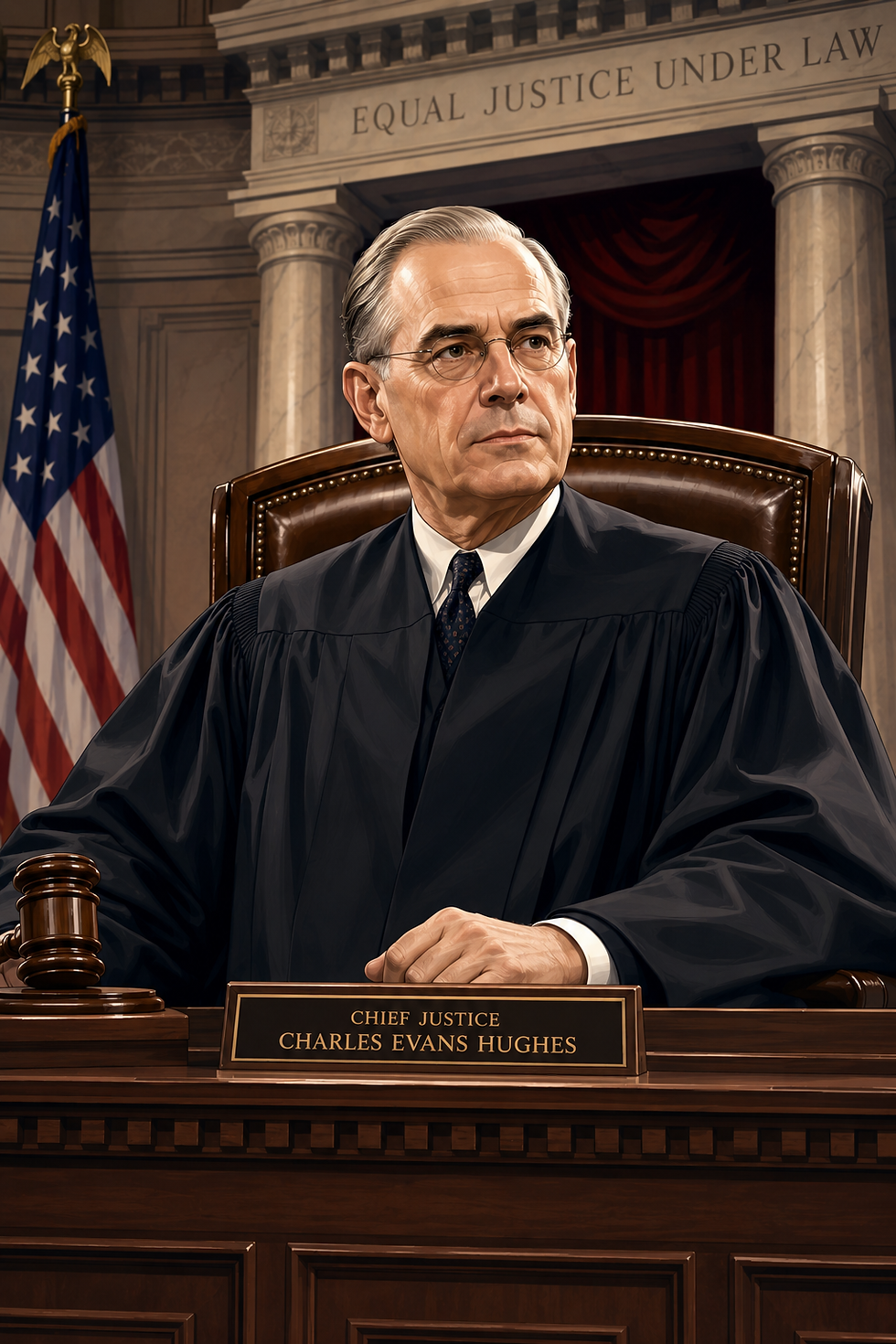
My Name is Charles Evans Hughes: Chief Justice of the U.S. Supreme Court
I was born in 1862 in Glens Falls, New York, the son of a Baptist minister who believed discipline, education, and moral character were the foundation of a meaningful life. I loved learning from an early age and eventually attended Brown University before earning my law degree from Columbia Law School. The law fascinated me because it offered a way to settle disagreements through reason rather than force, and I believed the Constitution was America's greatest guide.
Building a Reputation for Integrity
As a young lawyer, I earned a reputation for carefully investigating corruption and exposing dishonesty in government and business. My work brought me into public service, and I was elected Governor of New York in 1906. I supported reforms that made government more honest and efficient, but I also believed reforms had to respect constitutional boundaries. Some progressives thought I moved too cautiously, while others believed I was changing too much. I never understood why people believed careful reform was somehow a sign of weakness.
Serving the Nation in Many Roles
President William Howard Taft appointed me to the United States Supreme Court in 1910, but I later resigned to run for President against Woodrow Wilson in the election of 1916. After a narrow defeat, I returned to private life before serving as Secretary of State under Presidents Warren G. Harding and Calvin Coolidge. In 1930, President Herbert Hoover appointed me Chief Justice of the United States. Few people have had the opportunity to serve America in so many different roles, and each taught me something new about the balance between law and politics.
The Constitution Faces the Great Depression
When Franklin Roosevelt introduced the New Deal, the Supreme Court faced some of the most difficult constitutional questions in American history. Many of the new laws dramatically expanded the authority of the federal government. My duty was not to decide whether these programs were popular or effective but whether they followed the Constitution. Some New Deal laws were upheld, while others were struck down because the Court believed Congress had exceeded its constitutional authority. I found it difficult to understand why so many Americans expected judges to simply approve laws because they addressed serious problems.
The Court-Packing Crisis
One of the greatest challenges of my career came in 1937 when President Roosevelt proposed expanding the size of the Supreme Court after several of his programs had been declared unconstitutional. Many believed the plan would allow him to appoint enough new justices to secure favorable decisions. I strongly opposed the proposal because I believed the independence of the judiciary was essential to preserving the Constitution. I could not understand why some supporters viewed changing the Court's structure for political purposes as harmless when I believed it threatened one of America's most important constitutional safeguards.
Balancing Change and Stability
Over time, the Court's decisions evolved as new cases reached us, and many later New Deal laws were upheld. Some critics accused me of changing my views to satisfy political pressure, while others claimed I had resisted reform for too long. I believed neither accusation was fair. The Constitution had to be applied to each case individually, and changing circumstances often required careful legal analysis rather than rigid thinking. I wished more people understood that judging was rarely as simple as choosing one political side over another.
Looking Back
Throughout my life, I believed that no public official, not even the President, stood above the Constitution. I placed great confidence in the independence of the courts and the importance of maintaining the separation of powers, even when those decisions were unpopular. For many years, I struggled to understand why people expected judges to act as politicians instead of impartial guardians of the law. Looking back, I came to appreciate that fear and hardship often lead good people to seek immediate solutions, but I remained convinced that preserving constitutional principles during difficult times is one of the greatest responsibilities entrusted to any judge.
The Supreme Court Challenges the New Deal (1935–1936) – Told by Justice Hughes
By 1935, the New Deal had transformed the federal government's role in American life. Congress had passed dozens of laws designed to revive the economy, create jobs, regulate industry, and assist struggling families. Millions of Americans hoped these programs would end the Great Depression. Yet another question stood before the nation: Could the federal government legally exercise all of these new powers under the Constitution? As Chief Justice of the United States, I did not ask whether these laws were popular or well-intended. My responsibility, and that of every justice, was to determine whether they were constitutional.
Why Some New Deal Laws Were Struck Down
Several major New Deal laws soon reached the Supreme Court. One of the most important was the National Industrial Recovery Act (NIRA), which allowed industries to develop government-approved codes regulating wages, hours, prices, and business practices. In the 1935 case Schechter Poultry Corp. v. United States, the Court unanimously ruled that Congress had delegated too much of its legislative authority to the executive branch and had exceeded its power under the Commerce Clause because the business involved was conducting local, not interstate, commerce. The following year, in United States v. Butler (1936), the Court struck down key parts of the Agricultural Adjustment Act, concluding that Congress had exceeded its constitutional taxing and spending authority by using taxes to pressure farmers into production limits. These decisions were not judgments about whether the programs were useful but about whether the Constitution authorized Congress to create them.
The Importance of Separation of Powers
The framers of the Constitution divided governmental authority among three separate branches so that no single branch would become too powerful. Congress writes the laws, the President carries them out, and the courts interpret whether those laws comply with the Constitution. This arrangement, known as the separation of powers, protects individual liberty by preventing the concentration of authority. During the Great Depression, there was tremendous pressure to allow the executive branch to move quickly in response to the crisis. While I understood the urgency, I believed that emergencies did not erase constitutional boundaries. If one branch gained powers assigned to another, the balance that safeguarded American freedom could gradually weaken.
Judicial Review: The Court's Constitutional Duty
Many Americans criticized the Supreme Court after these rulings, believing we were preventing the nation from recovering. Others praised the Court for defending the Constitution. Our authority to review laws comes from the principle of judicial review, established decades earlier in Marbury v. Madison (1803). Judicial review requires courts to compare laws passed by Congress with the Constitution and declare them invalid when they conflict with it. This responsibility can be unpopular because judges sometimes invalidate laws supported by elected officials and large majorities of the public. Yet the Constitution was designed to remain the nation's highest law, even when political opinion strongly favored a different course.
A Debate That Changed American History
The Court's decisions during 1935 and 1936 sparked one of the greatest constitutional debates in American history. Supporters of the New Deal argued that the Constitution had to be interpreted broadly enough to meet modern economic challenges. Critics believed the Court was properly preserving the limits placed upon federal power by the Constitution. The disagreement eventually led to further legal battles, changes in constitutional interpretation, and a lasting discussion about the proper role of the judiciary. Looking back, I understood why Americans felt passionately on both sides. Nevertheless, I remained convinced that the Supreme Court's first loyalty must always be to the Constitution itself, for only by faithfully applying it could the rule of law endure through both prosperity and crisis.
Can Emergency Powers Go Too Far? – Told by Robert A. Taft
Every nation eventually faces moments of crisis that require strong leadership. During the Great Depression, banks collapsed, unemployment soared, businesses failed, and millions of Americans struggled simply to survive. President Franklin D. Roosevelt believed the emergency demanded swift and decisive action, and many citizens agreed. Congress granted the executive branch broad authority to create agencies, regulate industries, and oversee economic recovery. I understood why Americans wanted immediate solutions, but I believed every crisis also required another question to be asked: How much power should any president possess, even during an emergency?
The Growth of Executive Authority
The Constitution gives the President important responsibilities, but it also limits those powers. During the New Deal, Roosevelt often asked Congress for broad authority to respond quickly to changing economic conditions. New federal agencies issued regulations, administered relief programs, and made decisions affecting businesses, workers, farmers, and investors across the nation. While these actions were intended to address an unprecedented crisis, I worried that the executive branch was exercising powers that belonged primarily to Congress. I believed laws should be written by elected legislators, not by unelected administrators, no matter how urgent the circumstances.
Emergency Powers and Constitutional Limits
Emergencies often tempt governments to expand their authority because immediate action appears more effective than lengthy debate. Yet the Constitution was written with difficult times in mind, not just peaceful ones. If constitutional limits disappear whenever a crisis arises, those limits may never fully return. I often argued that extraordinary circumstances should not permanently change the balance of power between the branches of government. Many people believed I was placing legal principles above human suffering. I disagreed. I believed protecting constitutional government ultimately protected the freedoms of every American, especially during periods when fear made citizens willing to surrender liberties for security.
Lessons from History
History offers many examples of governments gaining extraordinary powers during emergencies. Abraham Lincoln suspended the writ of habeas corpus during parts of the Civil War to address rebellion and preserve the Union, an action that sparked intense constitutional debate even among his supporters. During World War I, the federal government restricted certain forms of speech through laws such as the Espionage Act and the Sedition Act, arguing that national security required such measures. Across the Atlantic during the 1930s, Adolf Hitler used emergency powers granted after the Reichstag Fire to dismantle Germany's democratic institutions and establish a dictatorship. The United States was never in the same situation, and Roosevelt remained committed to democratic elections and constitutional government. Even so, these examples reminded me that emergency powers must always be examined carefully because history shows that temporary authority can sometimes become permanent.
Protecting Liberty for Future Generations
The debates of the 1930s were not simply about one president or one economic crisis. They asked whether constitutional safeguards should remain firm when the nation faced extraordinary hardship. I believed America could solve its greatest problems without abandoning the principles that had guided the Republic since its founding. Looking back, I recognize that many supporters of expanded executive authority sincerely believed they were saving the nation from economic collapse. Nevertheless, I remained convinced that constitutional limits are most valuable during emergencies, when citizens are most willing to grant government additional power. A free society endures not because its leaders have unlimited authority, but because even in its darkest hours, the Constitution continues to set the boundaries of that authority.
Defending the Constitution While Solving a Crisis – Told by Felix Frankfurter
When the Great Depression reached its darkest days, millions of Americans questioned whether the nation's institutions were strong enough to survive. Banks were collapsing, unemployment remained painfully high, and confidence in both government and business had been shaken. Many people asked whether the Constitution, written in the eighteenth century, could truly guide a modern industrial nation through such an unprecedented crisis. I believed the answer was yes—but only if we understood that the Constitution was designed to endure through changing times rather than remain frozen in the exact circumstances of its creation.
A Broader View of Constitutional Power
Supporters of the New Deal argued that the Constitution granted Congress sufficient authority to address national problems that crossed state boundaries. The Commerce Clause gave Congress the power to regulate interstate commerce, and the General Welfare Clause allowed it to provide for the nation's well-being. As industries, transportation, banking, and communication became increasingly interconnected, many of us believed these constitutional powers had to be understood in light of modern realities. I found it difficult to understand why some believed the federal government should remain limited to powers interpreted exactly as they had been in the late 1700s when the nation itself had changed so dramatically.
Extraordinary Times Call for New Approaches
The Great Depression was unlike any economic crisis Americans had previously experienced. Local charities and state governments simply did not have enough resources to meet the overwhelming need. Entire banking systems failed, agricultural markets collapsed, and unemployment reached levels few had imagined possible. Many Americans concluded that traditional methods had failed and that extraordinary times demanded new solutions. They believed democratic government had a responsibility not merely to preserve order but also to protect citizens from economic disaster. I shared the belief that constitutional government should not become powerless simply because the nation faced challenges the Founders could never have predicted.
Understanding the Living Constitution
Although the phrase "living Constitution" has been interpreted in different ways over the years, the basic idea was that the Constitution contains enduring principles capable of being applied to new circumstances. Its words remain the same, but their application may evolve as society changes. Advances in technology, transportation, communication, and commerce created questions the Founders never directly addressed. Rather than rewriting the Constitution every generation, many legal scholars believed judges should apply its principles thoughtfully to contemporary conditions. To me, this approach preserved the Constitution's strength while allowing it to remain relevant in an ever-changing nation.
The Debate That Continues
Not everyone accepted this philosophy. Critics argued that allowing judges and lawmakers to interpret the Constitution too broadly risked giving the federal government powers never intended by its authors. They believed changes should come primarily through constitutional amendments rather than expanded interpretation. I respected the seriousness of those concerns, but I believed the Constitution had always required careful interpretation rather than mechanical application. Looking back, I recognize that both sides sought to preserve the Republic, though they disagreed on how best to accomplish that goal. The debate over constitutional interpretation that intensified during the New Deal remains one of the most important and enduring conversations in American history, influencing court decisions and public policy to this very day.
The Court-Packing Controversy (1937) – Told by Chief Justice Hughes
By 1937, the New Deal had become far more than a collection of economic recovery programs. It had evolved into a constitutional struggle over the balance of power in the American government. The Supreme Court had declared several important New Deal laws unconstitutional, while President Franklin D. Roosevelt remained convinced that stronger federal action was essential to end the Great Depression. Neither side believed it was acting against the Constitution. The President believed the nation needed greater flexibility to meet an extraordinary crisis, while the Court believed it had a duty to preserve the Constitution's limits. The disagreement would soon lead to one of the most controversial moments in Supreme Court history.
Roosevelt's Proposal
Early in 1937, President Roosevelt introduced a proposal that became known as the Court-packing plan. Instead of removing any sitting justices, he asked Congress for authority to appoint an additional justice for every Supreme Court justice over the age of seventy who chose not to retire, up to six new justices. Roosevelt argued that older judges faced an overwhelming workload and that additional members would help the Court operate more efficiently. Many observers, however, believed the true purpose was to appoint justices who would support New Deal legislation after several of his major programs had been struck down by the Court.
The Nation Responds
The proposal immediately ignited debate across the United States. Roosevelt remained personally popular, and many Americans continued to support his efforts to fight the Depression. Yet newspapers, legal scholars, members of Congress, and ordinary citizens began asking whether changing the size of the Supreme Court whenever a president disliked its decisions would permanently weaken the independence of the judiciary. Public meetings, editorials, and political speeches focused not only on the New Deal itself but also on the future relationship between the executive and judicial branches. The controversy became one of the defining political battles of the decade.
Why Many Supporters Opposed the Plan
What surprised many people was that opposition did not come only from Roosevelt's political enemies. Numerous Democrats and New Deal supporters also rejected the proposal. They believed the President had every right to disagree with the Court's rulings but feared that expanding the Court for political reasons would establish a dangerous precedent. If one president could enlarge the Court to obtain favorable decisions, future presidents might do the same whenever they disagreed with judicial rulings. I shared those concerns. I even wrote privately to Senate leaders explaining that the Court was functioning efficiently and did not need additional justices to handle its workload. In my view, the proposal addressed a problem that did not actually exist while risking lasting damage to the Court's independence.
A Defining Constitutional Debate
Although Congress ultimately rejected Roosevelt's proposal, the controversy permanently shaped American constitutional history. It reminded citizens that the Constitution depends not only upon written laws but also upon traditions that preserve the independence of each branch of government. In the years that followed, the Supreme Court's interpretation of federal power gradually became more accommodating to New Deal legislation, but the Court-packing plan itself failed. Looking back, I understood that President Roosevelt sincerely wished to help a nation suffering through economic hardship. Nevertheless, I remained convinced that the judiciary must remain independent of political pressure if it is to faithfully interpret the Constitution. The debate of 1937 continues to serve as a powerful reminder that protecting the separation of powers is essential to preserving the freedoms upon which the American Republic was built.
The Conservative Coalition Emerges – Told by Wendell Willkie
By the late 1930s, the debate over the New Deal had entered a new phase. During Franklin Roosevelt's first years in office, Congress approved many of his proposals with remarkable speed. As the economy slowly improved and the federal government continued to grow, however, a surprising political alliance began to form. Republicans who opposed further expansion of federal authority found themselves working alongside conservative Democrats who believed the New Deal had gone far enough. Although they often disagreed on other issues, these lawmakers shared a desire to slow the growth of Washington's power and preserve a greater role for private enterprise, local government, and the Constitution's traditional balance of authority.
Republicans and Conservative Democrats Unite
The Democratic Party had long included both liberals and conservatives, especially many influential Southern Democrats. As Roosevelt introduced more reforms, some members of his own party became increasingly concerned about growing federal regulation, labor policies, and executive authority. They discovered they had much in common with Republicans who had criticized these developments from the beginning. Together, these lawmakers began voting as a bloc on many major issues. It was an unusual partnership, but it demonstrated that political disagreements were not always divided neatly by party labels. Sometimes shared principles mattered more than party loyalty.
The Expansion of the New Deal Slows
This growing coalition made it far more difficult for Roosevelt to pass additional major reforms after 1937. Earlier New Deal programs had already established Social Security, banking reforms, labor protections, and numerous federal agencies. Now Congress became more cautious. Proposals for additional expansions of federal authority faced greater scrutiny and stronger opposition. The Court-packing controversy had also raised concerns among many Americans about concentrating too much power in one branch of government. While existing New Deal programs largely remained in place, the rapid pace of creating new federal initiatives slowed considerably as Congress became more divided.
A Changing Political Landscape
These events marked the beginning of a significant political realignment in the United States. Increasingly, debates centered not simply on which party someone belonged to but on competing ideas about the proper role of government. Should Washington continue expanding its responsibilities, or should greater authority remain with states, local communities, and private businesses? I believed these questions deserved thoughtful discussion rather than blind loyalty to any political party. Although I disagreed with many New Deal policies, I also believed Americans should judge each proposal individually instead of accepting or rejecting it simply because of who introduced it.
A Legacy Beyond the Great Depression
The conservative coalition that emerged during the late 1930s continued to influence American politics for decades. It shaped debates over taxation, labor unions, government spending, civil rights legislation, and the limits of federal authority. While I often criticized Roosevelt's expanding government, I never believed America had to choose between helping its citizens and preserving economic freedom. Looking back, I recognize that people on both sides sincerely wanted the nation to recover and prosper. The disagreement centered on how that goal should be achieved. The coalition that formed during this period demonstrated that American democracy is strengthened when leaders are willing to cross party lines in defense of principles they believe will best serve the nation.
How the Debate Changed American Government – Told by Robert A. Taft
When Americans debate the New Deal today, they often focus on the programs themselves. I believe the larger story is how those years permanently changed the structure of the federal government. Before the Great Depression, Washington performed far fewer responsibilities than it does today. State governments, local communities, charities, churches, and private businesses handled many of the challenges that later became federal concerns. The New Deal did more than respond to an economic emergency—it reshaped how millions of Americans viewed the role of their national government for generations to come.
The Growth of the Administrative State
One of the greatest changes was the rise of what many now call the administrative state. During the 1930s, Congress created numerous federal agencies responsible for carrying out laws, writing regulations, conducting investigations, and enforcing national policies. Agencies such as the Securities and Exchange Commission (SEC), the National Labor Relations Board (NLRB), and the Social Security Board became permanent parts of the federal government. While Congress continued passing laws, these agencies gained considerable authority to interpret and administer them. I believed this placed increasing power into the hands of unelected officials who were not directly accountable to the American people through elections.
The Expansion of Federal Agencies
The federal government had always maintained departments and offices, but the New Deal dramatically expanded both their size and responsibilities. Washington became involved in labor relations, financial markets, retirement security, housing, agriculture, infrastructure, and many other areas of everyday life. Millions of Americans now interacted directly with federal programs in ways their parents and grandparents had never imagined. Supporters argued that these agencies brought expertise and consistency to complex national problems. I understood the desire for effective administration, yet I worried that every new agency added another layer of bureaucracy and gradually reduced the authority of state governments and local communities.
Changing What Americans Expected
Perhaps the greatest transformation was not in government offices but in public expectations. Before the Great Depression, many Americans believed the federal government's primary responsibilities were national defense, foreign affairs, and maintaining order. After the New Deal, increasing numbers of citizens expected Washington to help provide economic security, regulate working conditions, stabilize financial markets, and assist people during times of hardship. These expectations became deeply rooted and influenced nearly every future administration, regardless of political party. Even leaders who criticized the New Deal often accepted many of its lasting institutions.
A Debate That Never Truly Ended
The arguments that began during the 1930s continue to shape American politics today. Every discussion about health care, education, environmental regulation, disaster relief, transportation, or economic policy eventually raises the same constitutional questions: What responsibilities belong to the federal government, and what should remain with the states or private citizens? I believed America could meet great challenges without continually expanding federal authority, because preserving constitutional limits also protects individual liberty. Looking back, I recognize that many supporters of these changes sincerely believed they were strengthening the nation and protecting vulnerable citizens. Yet I remained convinced that every new government power should be examined carefully, for history teaches that authority granted during one generation often becomes the permanent inheritance of the next.
The Long-Term Legacy of the New Deal – Told by Felix Frankfurter
When many Americans think about the New Deal, they picture the Great Depression and the desperate effort to rescue a nation in crisis. Yet I believe its greatest significance lies in what happened after the emergency passed. Many New Deal programs outlasted the Depression because lawmakers and citizens concluded they continued serving important purposes. Some programs changed the relationship between Americans and their government so profoundly that later generations accepted them as a normal part of everyday life. Whether one praises or criticizes the New Deal, its long-term influence on the United States is impossible to overlook.
Social Security and Economic Security
One of the most enduring achievements of the New Deal was the creation of Social Security in 1935. Before its passage, many elderly Americans who could no longer work depended entirely upon family members, charitable organizations, or local governments for support. Social Security established a national system of retirement benefits funded primarily through payroll taxes paid by workers and employers. The program also gradually expanded to include benefits for certain survivors and people with disabilities. I believed this represented an important recognition that a modern nation should help protect its citizens from the financial hardships that often accompanied old age or the loss of a family's primary wage earner.
Strengthening Workers and Financial Stability
The New Deal also reshaped the workplace. Laws such as the National Labor Relations Act strengthened workers' rights to organize labor unions and bargain collectively with employers. Later legislation established federal minimum wage standards, overtime requirements, and restrictions on child labor through the Fair Labor Standards Act of 1938. At the same time, banking reforms restored confidence in the nation's financial system. The creation of the Federal Deposit Insurance Corporation (FDIC) insured many bank deposits, helping reassure Americans that their savings would be protected if banks failed. Securities laws increased oversight of financial markets through the Securities and Exchange Commission (SEC), seeking to reduce fraud and improve public confidence in investing.
A New Role for Government
Perhaps the New Deal's greatest legacy was changing what many Americans expected from their federal government. Before the 1930s, Washington generally played a more limited role in economic and social affairs. After the New Deal, citizens increasingly looked to the federal government not only to defend the nation and enforce laws but also to help stabilize the economy, protect workers, regulate financial markets, and provide a measure of economic security during difficult times. I believed these changes reflected the nation's ability to apply enduring constitutional principles to new challenges without abandoning its democratic institutions.
An Enduring Constitutional Conversation
The legacy of the New Deal has never been without controversy. Supporters argue that its reforms strengthened American democracy by making the nation more resilient during economic hardship and by providing safeguards that continue benefiting millions of citizens today. Critics contend that it permanently expanded federal authority beyond the limits originally intended by the Constitution. Those debates remain active in discussions about health care, retirement, labor policy, financial regulation, and the proper role of government. Looking back, I recognize that thoughtful Americans have reached different conclusions about the New Deal's lasting impact. Nevertheless, its influence on American law, public policy, and constitutional interpretation has endured for generations, making it one of the most significant periods of governmental change in the nation's history.
The Debate Continues Today – Told by Felix Frankfurter, Robert A. Taft, Wendell Willkie, and Chief Justice Charles Evans Hughes
Felix Frankfurter: "Nearly a century has passed since the New Deal, yet Americans continue asking the same questions we debated in the 1930s. During an economic crisis, should the federal government step in forcefully, or should it exercise restraint? I believed then, and still believe, that extraordinary national emergencies sometimes require broad national action. A Constitution designed to endure must be capable of addressing problems its authors could never have imagined."
Robert A. Taft: "Felix, I never questioned the seriousness of the Great Depression. My concern was always what happens after the crisis ends. Powers granted during emergencies often remain long after the emergency has passed. If every national problem justifies expanding federal authority, then constitutional limits gradually become suggestions rather than boundaries."
The Role of Government During Hard Times
Wendell Willkie: "Perhaps both of you are looking at only part of the picture. Government certainly has responsibilities during a crisis. Families should not be abandoned when banks collapse and jobs disappear. But recovery also depends on businesses willing to invest, hire workers, and innovate. If government becomes too involved in directing the economy, private enterprise can lose the flexibility that has long driven American prosperity."
Frankfurter: "Yet without restoring confidence and stabilizing the economy, many businesses would never have survived to rebuild. Sometimes government must create conditions in which private enterprise can recover."
Taft: "And sometimes government creates dependence where independence once existed. That is why every emergency action deserves careful constitutional examination."
Who Decides What the Constitution Means?
Chief Justice Charles Evans Hughes: "That question brings us to the courts. Many people misunderstand the judiciary's role. Judges are not asked whether a law is popular or effective. They must determine whether it is constitutional. During the New Deal, the Court faced tremendous pressure from every direction, yet our responsibility remained unchanged."
Frankfurter: "Charles, we often agreed on the importance of the Constitution while differing on how broadly its powers should be interpreted. I believed constitutional principles could be applied to changing national circumstances."
“And I believed,” Hughes replied, “that constitutional interpretation must remain faithful to the document itself. Flexibility has its place, but so do limits. Without limits, constitutional government loses its meaning.”
Balancing Liberty, Opportunity, and Security
Willkie: "The real challenge has always been balance. Americans value liberty, but they also expect opportunity and security. Too little government can leave citizens vulnerable during economic collapse. Too much government can weaken individual initiative and concentrate excessive power in Washington."
Taft: "Liberty is difficult to restore once government permanently expands its authority."
Frankfurter: "But liberty without opportunity can become an empty promise for families trapped in poverty or unemployment. Government exists not only to preserve freedom but also to help create conditions in which people can exercise it."
Hughes: "Our constitutional system was designed precisely because these values often compete. The separation of powers, federalism, and judicial review force the nation to consider each carefully rather than allowing any one goal to overwhelm the others."
Why the Debate Still Matters
Hughes: "The remarkable truth is that the debate surrounding the New Deal never truly ended."
Frankfurter: "Every recession, financial crisis, natural disaster, or national emergency brings these questions back into public discussion."
Willkie: "Every proposal involving regulation, taxation, business, or economic recovery echoes arguments first heard during the 1930s."
Taft: "Perhaps that is why students should study this period so carefully. The New Deal was never simply about one president or one economic crisis. It asked enduring questions about the proper role of government, the meaning of the Constitution, and the balance between freedom and responsibility. Americans continue debating those questions because each generation must answer them for itself. Our disagreements may never disappear, but preserving the ability to debate them openly, respectfully, and within the framework of the Constitution remains one of the greatest strengths of the American Republic."


Comments