

9. Lesson Plans from the Great Depression: The Election of 1932 and the Rise of Franklin D. Roosevelt


My Name is Francis E. Townsend: Reform Advocate, and Townsend Plan Creator
I was born in 1867 in Illinois during a time when America was still rebuilding after the Civil War. My family worked hard, and like many Americans of my generation, I believed that determination and perseverance could overcome almost any obstacle. I tried several occupations before eventually becoming a physician. My medical career gave me a close look at the struggles of ordinary people, especially older Americans who had worked their entire lives only to find themselves poor and forgotten in old age.
Watching the Great Depression Unfold
When the Great Depression arrived, I practiced medicine in California and saw heartbreaking scenes every day. Elderly men and women who had once supported families now stood in breadlines or depended entirely on relatives. Many could no longer work, yet they had little savings because banks had failed and jobs had disappeared. I became convinced that America had a moral obligation to care for its aging citizens before asking younger generations to carry the burden alone.
The Birth of My Plan
In 1933, I developed what became known as the Townsend Plan. I proposed that every American over the age of sixty receive a monthly government pension, provided they retired from work and spent the money quickly each month. I believed this would accomplish two goals at once: older workers would retire, opening jobs for younger people, while their spending would stimulate businesses and revive the economy. To me, it seemed like an elegant solution to several problems at the same time.
Why I Believed I Was Right
Millions of Americans embraced my proposal. Townsend Clubs sprang up across the nation, and supporters collected millions of signatures urging Congress to act. I looked at the enthusiasm of everyday people and concluded that the evidence spoke for itself. If so many struggling Americans believed in the plan, I reasoned, why would politicians and economists refuse to support it? I often viewed critics as people who failed to appreciate the desperation of ordinary citizens rather than as individuals raising legitimate concerns about the plan's cost.
The Critics I Could Not Understand
Economists, business leaders, and many members of Congress argued that my proposal would require enormous taxes and could not be financed without damaging the nation's economy. Some believed my estimates were unrealistic, while others feared the federal government would become responsible for obligations it could never sustain. I found these arguments frustrating. From my perspective, the greater danger was allowing millions of elderly Americans to remain in poverty. I struggled to understand why so many experts focused on financial calculations instead of human suffering.
A Lasting Influence on American Government
Although Congress never adopted my plan, the movement I helped build placed enormous pressure on national leaders to address retirement security. Many historians believe that the widespread popularity of the Townsend Plan influenced the development of the Social Security Act of 1935. While Social Security was far different from the system I proposed, it reflected the growing belief that the federal government had a responsibility to help protect older Americans from poverty.
Looking Back with Greater Perspective
As I reflect on my life, I still believe my heart was in the right place. I wanted dignity for elderly Americans and sought a bold solution during one of the darkest periods in our nation's history. Yet I can also recognize that good intentions alone do not guarantee sound public policy. Some of the concerns raised by my critics deserved more careful consideration than I was willing to give at the time. Even so, I remain proud that my efforts helped spark a national conversation that forever changed how America thinks about caring for its senior citizens.
America Demands a New Direction (1931–1932) – Told by Francis E. Townsend
When I think back to 1931 and 1932, I remember something more powerful than statistics or election speeches. I remember faces. As a physician practicing in California, I watched proud men and women come into my office not only suffering from illness but from hunger, anxiety, and hopelessness. Families who had once owned homes or small businesses now worried about their next meal. Across the nation, Americans began asking a simple question: if our leaders cannot solve this crisis, who can?
The Weight of Unemployment
By 1932, millions of Americans had lost their jobs. Factories stood quiet, construction projects stopped, and businesses closed their doors. Every unemployed worker represented an entire family struggling to survive. Savings disappeared quickly, and many people who had never accepted charity suddenly found themselves standing in breadlines. It became harder for Americans to believe that the economy would simply recover on its own. Many concluded that stronger leadership and new ideas would be necessary.
Cities Running Out of Answers
Local governments tried their best to help struggling citizens, but they faced problems larger than they had ever imagined. Tax collections collapsed because so many people were unemployed or unable to pay property taxes. Cities reduced services, schools faced financial crises, and charities became overwhelmed by the growing number of families asking for assistance. Communities that had always relied on local generosity discovered there simply was not enough money to meet everyone's needs.
The Elderly Were Forgotten
One group especially troubled me: older Americans. Many had spent decades working hard, believing they would always be able to support themselves. But the Depression destroyed savings accounts, businesses, and investments. Those too old to compete for scarce jobs often depended entirely upon relatives or charitable organizations. I believed America owed these citizens something better after a lifetime of work. Their suffering convinced me that our country needed entirely new approaches to economic security.
Confidence in Old Solutions Faded
Many Americans respected President Herbert Hoover's character and his years of public service, but confidence in his policies steadily declined. As months passed without meaningful recovery, more citizens began looking beyond familiar political ideas. They were no longer asking whether government should act—they were asking how much it should do. Across dinner tables, churches, newspapers, and town meetings, conversations increasingly turned toward finding leaders willing to try something different.
A Desire for Hope
Franklin Roosevelt's campaign attracted attention because he spoke less about accepting hardship and more about confronting it. His promise of a "New Deal" did not include every detail people wanted, but it offered something many Americans desperately needed: hope that government could become an active partner in rebuilding the nation. Whether people fully understood his proposals or not, they sensed confidence, energy, and optimism at a time when those qualities were in short supply.
The Beginning of a New Era
Looking back, I believe the election of 1932 represented far more than a change of presidents. It reflected a profound shift in how millions of Americans viewed the responsibilities of government during times of national crisis. Desperation had convinced many citizens that old methods were no longer enough. The difficult years of unemployment, poverty, and failing local governments prepared the nation to embrace new leadership, setting the stage for one of the most significant political transformations in American history.

My Name is Al Smith: Governor of New York and Presidential Candidate
My name is Alfred Emanuel Smith, though nearly everyone simply called me Al. I was born in New York City in 1873 and grew up on the Lower East Side, where hardworking immigrant families struggled to earn a living. My father died when I was young, forcing me to leave school and help support my family. I worked at the Fulton Fish Market, where I learned to appreciate honest labor and the everyday concerns of working people. Those early years shaped my belief that government should improve people's lives rather than ignore their hardships.
Learning Politics from Ordinary People
Unlike many politicians, I did not attend college or law school. Instead, I learned politics by listening to my neighbors and serving in the New York State Assembly. Working with Tammany Hall gave me opportunities that I might never have had otherwise. Critics called the organization corrupt, but I saw many dedicated public servants helping immigrants find jobs, housing, and assistance when no one else would. I often wondered why people judged every member of Tammany Hall by the actions of a few dishonest individuals.
Leading New York Through Reform
As Governor of New York, I pushed for safer factories, stronger labor protections, better housing, improved hospitals, and expanded public services. The terrible Triangle Shirtwaist Factory fire convinced me that government had a responsibility to protect workers from unsafe conditions. I believed progress required action, and I never understood why some opponents insisted that government should stand aside while preventable tragedies continued. To me, protecting workers was simply common sense.
Breaking Barriers in the 1928 Election
In 1928, I became the first Roman Catholic nominated by a major political party for President of the United States. My campaign represented millions of immigrants, Catholics, and urban workers who often felt ignored in national politics. Yet I quickly discovered that many Americans viewed my faith with suspicion. Some believed I would take orders from the Pope instead of defending the Constitution. I found those accusations deeply unfair and could not understand why my religion mattered more to some voters than my record of public service.
My Support for Repealing Prohibition
One of my most controversial positions was my opposition to Prohibition. I believed the Eighteenth Amendment had encouraged organized crime, illegal alcohol trafficking, and widespread disrespect for the law. Many Americans, especially in rural communities and religious organizations, believed Prohibition protected families and public morality. I respected their concern for moral behavior, but I never understood why they believed banning alcohol was succeeding when evidence of criminal activity surrounded us. I thought regulation made far more sense than outright prohibition.
Watching Roosevelt Rise
Franklin Roosevelt had once been my political ally, and I proudly supported him during parts of his career. When he became the Democratic nominee in 1932, I hoped he would continue many of the practical reforms we had championed in New York. As his presidency unfolded, however, I grew concerned that parts of the New Deal expanded federal authority too quickly and too far. Many people embraced those changes enthusiastically, but I questioned whether such rapid growth of government would create new problems. I could not understand why so many former supporters dismissed those concerns so easily.
Looking Back on My Legacy
As I reflect on my life, I remain proud of fighting for immigrants, workers, and families who often lacked a voice in government. I challenged old prejudices and helped open doors for future generations of Americans from every background. Still, I also recognize that some of my opponents acted from sincere convictions rather than simple prejudice or stubbornness. While I never abandoned my principles, time taught me that lasting progress often requires listening as carefully as speaking, even to those who see the world very differently than I did.
The Political Climate Before the Election – Told by Al Smith
By the time the presidential election of 1932 approached, America was no longer debating whether the nation faced a crisis. That question had already been answered. Banks had failed, unemployment had reached staggering levels, and families across the country struggled to survive. President Herbert Hoover remained convinced that recovery would come with time and cooperation between government and private business, but many voters had begun to lose confidence. Every month without improvement made the political atmosphere more uncertain, and Americans increasingly searched for new leadership.
The Republicans on the Defensive
The Republican Party had enjoyed years of remarkable success during the prosperous 1920s. Many Americans had trusted Republican presidents to encourage business growth and economic stability. But when the Great Depression struck, that reputation suffered greatly. Republicans found themselves defending policies that many voters blamed—fairly or unfairly—for the nation's hardships. Even capable Republican leaders struggled to convince the public that patience would eventually bring recovery. In politics, confidence matters, and by 1932 confidence was slipping away.
A New Opportunity for Democrats
For the Democratic Party, the crisis created an opportunity unlike any it had seen in decades. Since the Civil War, Republicans had dominated many presidential elections, but now voters became more willing to consider a different direction. Democrats understood they could not simply criticize the Republicans—they needed to offer hope. The party sought a candidate who could unite urban workers, rural farmers, immigrants, Southern Democrats, and reform-minded progressives into one broad coalition capable of winning the White House.
Watching Franklin Roosevelt Rise
I had known Franklin Roosevelt for many years through New York politics. He possessed something many politicians struggled to find during difficult times: optimism that appeared genuine. Even while discussing the nation's problems, he projected confidence that America could recover. His willingness to smile, encourage people, and speak directly to ordinary citizens gave many voters reassurance. Whether one agreed with every proposal or not, Roosevelt made Americans believe that tomorrow might be better than today.
The Issues That Shaped the Campaign
The campaign focused far less on party loyalty than on survival. Americans wanted jobs, stronger banks, relief for struggling families, and renewed economic growth. Questions about the proper role of government became central to nearly every debate. Should Washington intervene more aggressively, or should recovery remain primarily in the hands of businesses and local communities? These were not merely political arguments—they reflected different visions of how America should respond to one of the greatest economic disasters in its history.
Why This Election Was Different
Many presidential elections revolve around personalities or isolated issues, but 1932 became a turning point because it asked voters to reconsider the relationship between citizens and their government. The hardships of the Depression led millions to question long-held assumptions about federal responsibility during national emergencies. Regardless of party affiliation, Americans understood that the decision they made in November could influence the country's direction for generations.
A Crossroads for the Nation
Looking back, I believe the election of 1932 marked the beginning of a new political era. It was not simply a contest between two candidates but a choice between continuing familiar approaches or embracing new ideas during extraordinary times. The American people weighed their options carefully and ultimately decided that the nation needed a different course. Their decision reshaped the Democratic Party, altered the balance of political power, and laid the foundation for many of the debates that would define American government throughout the twentieth century.
Roosevelt Wins the Democratic Nomination – Told by Al Smith
When Democrats gathered in Chicago for the 1932 Democratic National Convention, everyone agreed on one thing: our party had an opportunity unlike any it had seen in years. The Great Depression had shaken the nation, and many Americans were ready to consider new leadership. Yet choosing our nominee was anything but simple. Several respected candidates sought the nomination, each representing different regions, political ideas, and groups within the Democratic Party. The convention hall buzzed with speeches, negotiations, and countless private meetings as delegates searched for someone who could unite us.
Franklin Roosevelt Takes the Lead
Franklin Roosevelt entered the convention as the leading candidate, thanks largely to his popularity as Governor of New York. He had earned a reputation for energetic leadership and an optimistic personality that appealed to many voters discouraged by the Depression. Even so, he did not arrive with enough delegates to secure the nomination outright. Under party rules at the time, a candidate needed a two-thirds majority of delegates, making victory far more difficult than simply winning the largest number of votes.
Ballots and Behind-the-Scenes Negotiations
The convention required several rounds of voting before anyone reached the necessary total. Between ballots, party leaders met behind closed doors, discussing possible alliances and compromises. Delegates shifted their support as they tried to determine who could not only win the nomination but also defeat President Herbert Hoover in November. Politics has always involved negotiation, and this convention was no exception. Every conversation had the potential to change the outcome.
The Coalition Begins to Form
As the convention continued, Roosevelt's supporters gradually built a remarkable coalition. Northern urban Democrats, many Southern delegates, progressive reformers, labor supporters, and many rural voters all found reasons to support his candidacy. Not every group agreed on every issue, but they shared a belief that the country needed fresh leadership. Roosevelt possessed the rare ability to speak to many different kinds of Americans without losing their confidence, making him a natural choice to unite the party.
Garner's Support Changes Everything
One of the turning points came when supporters of Speaker of the House John Nance Garner agreed to back Roosevelt after negotiations between party leaders. Garner's delegates provided the votes Roosevelt needed to surpass the required two-thirds majority. Once that threshold was reached, the atmosphere inside the convention changed almost instantly. What had begun as a hard-fought contest became a celebration as delegates recognized they had selected the man who would carry the Democratic banner into one of the most important elections in American history.
A New Kind of Campaign
Roosevelt did something unusual after receiving the nomination—he traveled to Chicago to accept it in person. Most nominees simply sent a message to be read aloud, but Roosevelt believed Americans wanted to see and hear their candidate directly. During his acceptance speech, he promised what he called "a New Deal for the American people." The phrase was brief, but it captured the imagination of voters looking for hope during difficult times, even though its exact meaning would continue to develop over the coming months and years.
A Party Ready for Change
Looking back, I can see that Roosevelt's nomination represented more than a victory for one man. It marked the successful uniting of a diverse coalition that believed America needed a different path through the Great Depression. That alliance would become one of the strongest political coalitions in modern American history. As Democrats left Chicago, they believed they had found not only a nominee but also a leader capable of restoring confidence to a nation desperately searching for a new beginning.
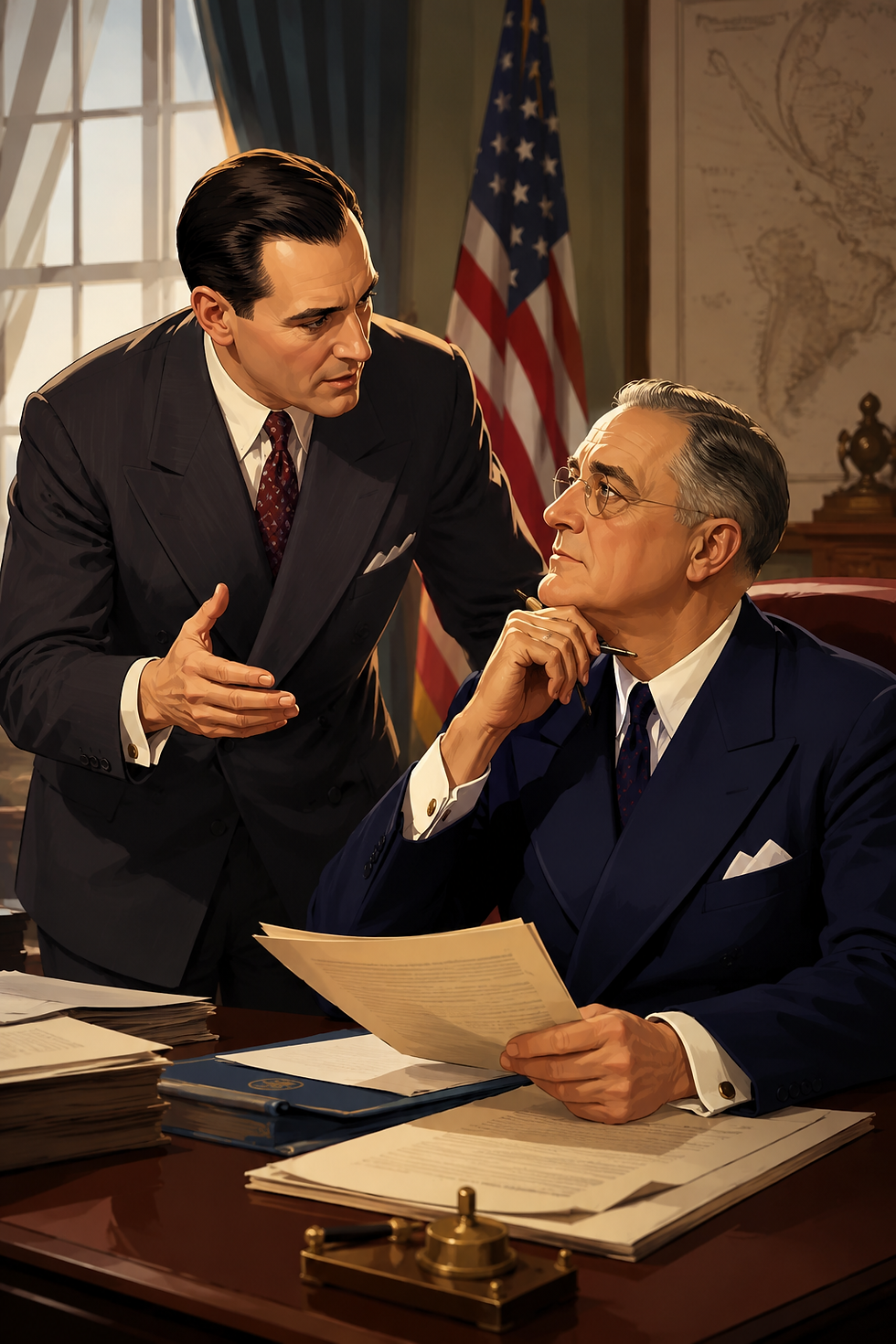
My Name is Raymond Moley: Political Adviser & Roosevelt's Brain Trust Member
I was born in Ohio in 1886. I did not begin my career expecting to shape the course of American history. I studied political science and law, eventually becoming a professor who examined how governments worked and how public policy affected ordinary people. I believed that ideas mattered, and I enjoyed studying problems carefully before proposing practical solutions. Teaching and research prepared me for opportunities I never imagined would arrive during America's greatest economic crisis.
Meeting Franklin Roosevelt
My work eventually brought me into contact with Franklin D. Roosevelt while he served as Governor of New York. He appreciated my willingness to analyze difficult problems without becoming trapped by old political traditions. Along with several other advisers, I became part of what newspapers called the "Brain Trust." We believed the Great Depression demanded fresh thinking rather than blind loyalty to economic theories that seemed unable to solve the nation's problems. I saw our role as providing ideas while Roosevelt decided which direction to take.
Building the New Deal Vision
As Roosevelt prepared to campaign for the presidency in 1932, I helped draft speeches and explain what eventually became known as the New Deal. People often imagine that we had a complete master plan from the beginning, but that was never true. We discussed possibilities, debated solutions, and adjusted our thinking as events unfolded. I believed flexibility was one of our greatest strengths. If one approach failed, we should try another rather than remain committed to policies that were clearly not working.
Critics Who Preferred the Old Ways
Many business leaders, economists, and politicians accused us of abandoning free-market principles or giving the federal government too much authority. I found those criticisms difficult to understand. Millions of Americans were unemployed, banks had collapsed, and confidence had nearly disappeared. To me, refusing to experiment seemed far more dangerous than trying new ideas. I believed extraordinary circumstances required extraordinary action, and I often thought our critics were more interested in defending old theories than solving real problems.
When My Views Began to Change
As Roosevelt's presidency continued, I gradually became uncomfortable with the direction of some New Deal policies. Programs that I initially viewed as temporary emergency measures began to appear more permanent. I worried that increasing federal authority could limit economic freedom and create lasting dependence on government. Ironically, many of the same people who had once praised my ideas now criticized me for questioning the administration. I struggled to understand why changing one's opinion in light of new evidence was treated as betrayal instead of honest reflection.
Leaving the Inner Circle
Eventually my relationship with Roosevelt cooled, and I returned to journalism and writing. I became a frequent critic of policies that I believed expanded government beyond its proper role. Former colleagues viewed me as abandoning the cause, while many conservatives remained skeptical because of my earlier work with Roosevelt. I often found myself in an unusual position, criticized by both sides even though I believed I was following the evidence where it led.
Looking Back at My Journey
Looking back, I remain proud that I helped guide America during one of its darkest hours. The willingness to experiment helped restore hope when the nation desperately needed leadership. At the same time, I learned that even the best ideas deserve continual examination and that no political movement should become immune to criticism. I spent much of my life believing others simply failed to see what seemed obvious to me, but experience eventually taught me that wise public policy often grows from listening carefully to thoughtful disagreement as much as from defending one's own convictions.
The Campaign of 1932 – Told by Raymond Moley
When Franklin Roosevelt secured the Democratic nomination in 1932, our work was only beginning. As one of his advisers, I helped draft speeches, organize ideas, and think carefully about how we could explain our vision to a nation suffering through the Great Depression. Americans were weary of political promises that seemed disconnected from their daily struggles. We believed the campaign had to offer something more than criticism of the current administration—it had to inspire confidence that recovery was possible.
Speaking Directly to the American People
One of Roosevelt's greatest strengths was his ability to communicate with ordinary citizens. Whether speaking from a train platform, before a crowded auditorium, or into a radio microphone, he made listeners feel as though he understood their hardships personally. His speeches avoided unnecessary complexity and focused instead on practical solutions, determination, and hope. People did not simply hear a politician; many felt they were listening to someone who believed the nation's best days were still ahead.
The Growing Power of Radio
Radio became one of the most powerful tools of the 1932 campaign. Millions of Americans gathered around their radios to hear candidates speak without relying entirely on newspaper summaries. A calm voice carried into living rooms across the country, allowing voters to judge a candidate's personality as much as his policies. Roosevelt understood this new form of communication remarkably well. His confident tone and conversational style helped create a sense of trust with listeners, even those who had never met him.
The Promise of a "New Deal"
During the campaign, Roosevelt frequently spoke of offering the American people "a New Deal." Contrary to what many assume today, that phrase did not describe a detailed list of programs waiting to be introduced. It represented a commitment to seek new solutions wherever they could be found. Within our group of advisers, we discussed many possibilities, but we also understood that no one possessed a complete roadmap out of the Depression. The promise was one of action, flexibility, and a willingness to confront problems rather than ignore them.
Optimism in Difficult Times
The contrast between the two major campaigns became increasingly clear. President Herbert Hoover often emphasized patience and confidence that existing institutions would eventually restore prosperity. Roosevelt, while acknowledging the seriousness of the crisis, projected energy and optimism. He spoke of rebuilding rather than simply enduring hardship. That difference mattered greatly. After years of discouraging news, many Americans found renewed hope in a candidate who appeared confident that the nation could recover through determined leadership.
Building a Broad Coalition
As the campaign continued, Roosevelt attracted support from an unusually wide range of Americans. Farmers facing foreclosure, unemployed factory workers, urban immigrants, Southern Democrats, and many middle-class families all saw reasons to support him. Not everyone expected the same policies, but they shared a belief that the federal government should take a more active role in addressing the nation's economic emergency. The campaign became less about individual interest groups and more about uniting people behind the possibility of national renewal.
A Campaign That Changed American Politics
Looking back, I believe the campaign of 1932 changed the way presidential candidates communicated with the public. Roosevelt's speeches, effective use of radio, and message of optimism helped create a personal connection with millions of voters. More importantly, the campaign convinced many Americans that government could become an active force in solving national problems. The election would decide who occupied the White House, but the campaign itself reshaped public expectations about presidential leadership for generations to come.
Why Hoover Lost Public Confidence – Told by Francis E. Townsend
When people study President Herbert Hoover, it is important to remember that public confidence does not disappear overnight. Hoover entered office with an impressive reputation as an engineer, humanitarian, and capable administrator. Many Americans initially believed he would guide the nation through the Great Depression. But as the months passed and daily life continued to worsen for millions of families, confidence slowly gave way to disappointment. By 1932, many citizens had begun looking elsewhere for hope.
Hardship Without Relief
As a physician, I spent my days meeting people whose lives had been turned upside down. Fathers searched endlessly for work that no longer existed. Mothers struggled to stretch whatever food they could find to feed their children. Elderly Americans, many of whom could no longer work, often had no savings left after bank failures and business closures. Every week seemed to bring another family facing eviction, another business shutting its doors, or another neighbor asking for help. The crisis no longer felt temporary—it had become part of everyday life.
People Wanted Results
Americans are remarkably patient during difficult times when they believe progress is being made. The problem in 1932 was that many people could not see improvement around them. They judged conditions by what they experienced in their own communities rather than by speeches in Washington. When neighbors remained unemployed month after month and local charities became overwhelmed, many voters concluded that whatever efforts were being made simply were not enough to change their lives.
Confidence Is Built on Hope
Economic recovery depends not only on money but also on confidence. Businesses invest when they believe the future will improve. Families make purchases when they feel secure about tomorrow. By 1932, uncertainty had spread throughout nearly every corner of American society. Instead of expecting recovery, many people expected more hardship. That growing sense of pessimism became one of Hoover's greatest political obstacles because confidence, once lost, is extraordinarily difficult to restore.
The Search for New Leadership
Across the country, conversations changed. Citizens were no longer asking whether the nation faced a crisis—they were asking who might lead them out of it. Franklin Roosevelt spoke with optimism about trying new approaches, and many Americans found his confidence appealing. They did not necessarily know exactly what his administration would do, but they believed a different direction might produce different results. In times of crisis, hope itself can become a powerful political force.
The Voices of Ordinary Americans
One lesson from this period is that elections are often shaped by ordinary people rather than political insiders. Breadlines, shuttered stores, struggling farms, and overcrowded charities became the experiences voters remembered when they entered the voting booth. Families compared what they had expected a few years earlier with the reality they now faced. Those personal experiences influenced public opinion far more than campaign slogans alone.
A Turning Point in American Politics
Looking back, I believe Herbert Hoover lost public confidence less because Americans questioned his character than because they questioned whether his leadership could end the Depression. Fairly or unfairly, presidents often become symbols of the nation's successes and failures. By 1932, millions of voters had concluded that continuing the same leadership offered too little hope for improvement. Their desire for renewed confidence and fresh ideas helped produce one of the most significant political changes in American history.
Election Day: November 8, 1932 – Told by Al Smith
Election Day arrived on November 8, 1932, after one of the most important campaigns in our nation's history. Americans from every walk of life traveled to polling places with the Great Depression weighing heavily on their minds. This election was about far more than choosing between two candidates. It was a decision about which direction the country should take during one of the greatest crises it had ever faced. The atmosphere was serious because nearly every voter knew the outcome could shape America's future for years to come.
Millions Head to the Polls
Despite widespread hardship, Americans turned out in large numbers to cast their ballots. More than 39 million votes were cast, reflecting a turnout of nearly 57 percent of the voting-age population. People who had lost jobs, homes, businesses, or savings believed their vote mattered. Some stood in line after traveling long distances or taking time away from searching for work. Even during difficult times, faith in the democratic process remained remarkably strong.
A Landslide Across the Electoral Map
As the election returns arrived, it quickly became clear that Franklin Roosevelt had won a decisive victory. He carried 42 of the 48 states and received 472 electoral votes, while President Herbert Hoover won only 6 states and earned 59 electoral votes. Roosevelt also won the popular vote by more than seven million ballots. States from the Northeast to the South, across much of the Midwest and West, shifted toward the Democratic Party. The electoral map reflected a nation ready for change.
Why Roosevelt Won So Broadly
Roosevelt's victory came from an unusually broad coalition of voters. Farmers suffering from falling crop prices, factory workers facing unemployment, immigrants living in large cities, Southern Democrats, and many middle-class families all found reasons to support his campaign. Not every voter agreed on every issue, but many shared the belief that new leadership offered the best chance to restore hope. The coalition that emerged in 1932 would influence American politics for decades to come.
A Difficult Night for Hoover
For President Hoover, the election results were deeply disappointing. Only four years earlier, he had won one of the largest victories in American history. Now the political landscape had changed dramatically. Such a dramatic reversal demonstrated how quickly public opinion can shift during periods of national hardship. Although Hoover accepted the outcome peacefully, the election revealed the depth of the nation's frustration with the continuing economic crisis.
A Peaceful Transfer of Power
One of the greatest strengths of the American republic is that even historic elections end with a peaceful transfer of authority. Although the transition would not occur until Roosevelt's inauguration in March 1933, both parties understood that the people had spoken through the ballot box. At a time when many nations around the world were turning toward dictatorships or political violence, the United States demonstrated that even profound disagreements could be resolved through free elections.
A Historic Turning Point
Looking back, I believe November 8, 1932, stands as one of the defining election days in American history. It reshaped the Democratic Party, transformed the role of the federal government, and marked the beginning of Franklin Roosevelt's long presidency. More importantly, it reminded the world that in times of great uncertainty, the American people retained the power to choose a new course through the simple act of casting their votes.
The Difficult Transition Before Inauguration – Told by Raymond Moley
When Franklin Roosevelt won the election on November 8, 1932, many Americans expected immediate change. Yet under the Constitution at that time, the new president would not take office until March 4, 1933. Nearly four long months separated Election Day from Inauguration Day. During that period, President Herbert Hoover remained in office while Roosevelt prepared to assume leadership. The nation had chosen a new direction, but the old administration still carried the responsibility of governing through one of the darkest moments of the Great Depression.
The Economy Continued to Worsen
The weeks following the election brought little relief. Banks continued to struggle, businesses remained uncertain, and unemployment stayed painfully high. Confidence in the financial system weakened as more Americans withdrew their savings, fearing additional bank failures. Each troubling headline reminded us that the nation could not simply pause while waiting for a new president to take office. Every day seemed to bring another challenge demanding attention.
Preparing Behind Closed Doors
Although Roosevelt could not yet make official decisions, our team worked tirelessly behind the scenes. Members of the Brain Trust met frequently, studying reports, discussing economic conditions, and debating possible solutions. We examined banking, agriculture, unemployment, public works, and federal finance, knowing that once Roosevelt entered office, there would be little time for hesitation. We did not have every answer, but we believed careful preparation would allow the new administration to move quickly.
Working Through Differences
President Hoover and President-elect Roosevelt communicated during the transition, but they often disagreed about how to respond to the worsening crisis. Hoover hoped Roosevelt would publicly support certain policies before taking office to reassure financial markets. Roosevelt, however, believed it would be inappropriate to commit his future administration to decisions before he officially assumed the presidency. The differences reflected more than politics—they showed the difficulty of governing during an emergency while leadership was changing hands.
Building a New Administration
At the same time, Roosevelt began selecting the men and women who would help lead the federal government. Cabinet appointments, agency leadership, and countless other positions required careful consideration. Every appointment mattered because each person would face enormous responsibilities from the very first day. Those of us advising Roosevelt looked not only for experience but also for individuals willing to think creatively during extraordinary circumstances.
Planning for Immediate Action
As March approached, one goal became increasingly clear: the new administration could not afford a slow beginning. We organized ideas that could be presented to Congress almost immediately after the inauguration. Rather than waiting months to study every problem, Roosevelt intended to ask Congress for rapid action. Those preparations would soon become what historians remember as the famous First Hundred Days, a period of intense legislative activity unlike anything the nation had previously experienced.
A Lesson from the Long Transition
Looking back, I believe those four months demonstrated why timing matters in government. The country desperately needed leadership, yet constitutional rules delayed the transfer of power. The experience helped convince many Americans that future transitions should occur more quickly, leading years later to the adoption of the Twentieth Amendment, which moved presidential inaugurations to January 20. Although the transition of 1932–1933 tested the nation's patience, it also showed the importance of careful preparation before assuming the tremendous responsibility of leading the United States through a national crisis.

My Name is Harold L. Ickes: Secretary of the Interior and Progressive Reformer
I was born in Pennsylvania in 1874 before my family moved to Chicago. From a young age, I believed that government should be honest and that public officials should serve the people instead of themselves. I studied law, but I spent just as much time becoming involved in civic reform movements. Corruption frustrated me, and I developed a reputation for speaking my mind, whether people appreciated my honesty or not.
Fighting Political Corruption
Long before Franklin Roosevelt entered the White House, I worked to expose political corruption and support progressive reforms. I believed political machines often cared more about winning elections than improving people's lives. Many reformers shared my goals, but others thought I was too stubborn or confrontational. I never understood why some politicians preferred compromise when they already knew corruption existed. To me, allowing dishonest government to continue was far worse than making powerful enemies.
Joining Roosevelt's Administration
When Franklin Roosevelt became President in 1933, he appointed me Secretary of the Interior. Many people expected the department to oversee only public lands and natural resources, but Roosevelt entrusted me with much more. I also directed the Public Works Administration, helping oversee billions of dollars spent on bridges, dams, schools, hospitals, roads, and other projects designed to put Americans back to work. I believed government had both the responsibility and the ability to rebuild the nation during its greatest economic crisis.
Building America During Hard Times
The Public Works Administration became one of the largest construction efforts in American history. We carefully planned projects to create lasting improvements instead of temporary jobs alone. I insisted that taxpayer money be spent honestly and efficiently, earning the nickname "Honest Harold." Contractors and politicians sometimes complained that I demanded too much oversight, but I could not understand why anyone would object to protecting public funds from waste and corruption.
Standing for Civil Rights
One issue that remained especially important to me was equal opportunity for African Americans. I opposed racial discrimination in many federal projects and publicly challenged segregation more often than many officials of my era. Some critics believed I moved too aggressively or stirred unnecessary controversy. I found those objections difficult to accept because I believed fairness under the law should not depend upon a person's race. While I understood that many Americans disagreed, I struggled to see how unequal treatment could ever be defended as justice.
Speaking My Mind
I developed a reputation for blunt speeches and sharp criticism of people I believed acted dishonestly or irresponsibly. Whether confronting business leaders, political opponents, or even fellow members of Roosevelt's administration, I rarely softened my opinions. Some people admired my determination, while others thought I was argumentative and difficult to work with. I often believed my critics focused too much on my tone instead of the problems I was trying to solve.
Looking Back on My Service
As I reflect on my years in public service, I remain proud that I fought for honest government, responsible public spending, and opportunities for Americans during one of the nation's most difficult periods. Yet I can also recognize that conviction sometimes became stubbornness and that my direct manner occasionally made cooperation harder than it needed to be. I never stopped believing in the principles that guided my career, but with time I came to appreciate that lasting reform often requires patience alongside determination, and listening can strengthen a cause just as much as speaking boldly.
Roosevelt's Leadership Style – Told by Harold L. Ickes
When Franklin Roosevelt assembled his administration, he did not surround himself only with people who always agreed with him. That surprised many observers, but it was one of his greatest strengths as a leader. He wanted advisers who brought different experiences and viewpoints to the table. Lawyers, economists, educators, reformers, business leaders, and public officials all found places within his circle. Roosevelt believed that hearing competing ideas often produced better decisions than listening to a room full of people who simply nodded in agreement.
Choosing Ability Over Friendship
I learned quickly that Roosevelt valued competence as much as loyalty. Of course, he preferred working with people he trusted, but he also looked for individuals capable of solving difficult problems. Some members of his cabinet had supported him politically for years, while others had once been skeptical of his leadership. What mattered most was whether they could contribute during a national emergency. Roosevelt understood that rebuilding the country required talent from many different backgrounds.
Encouraging Honest Debate
Cabinet meetings and discussions among advisers were rarely quiet affairs. Roosevelt often encouraged vigorous debate before making important decisions. He sometimes asked two advisers with opposing opinions to explain their arguments while everyone else listened. Rather than ending disagreement immediately, he allowed ideas to compete. He believed the strongest solutions often emerged after weaknesses had been challenged from every direction. For someone like me, who never hesitated to express an opinion, this environment provided both opportunity and challenge.
Keeping Final Decisions in His Own Hands
Although Roosevelt welcomed advice, he never surrendered responsibility for making the final decision. After listening carefully to many viewpoints, he weighed the evidence and chose the course he believed best served the nation. At times, even his closest advisers did not know which option he would select until he announced it. Some found this frustrating, but Roosevelt believed the president alone carried the responsibility of leading the executive branch. Advice informed his decisions—it did not replace them.
An Administration Full of Energy
From the moment Roosevelt entered office, the pace of government changed dramatically. Meetings began early, ideas moved quickly, and departments worked together on projects that crossed traditional boundaries. There was a sense of urgency because millions of Americans expected action. The President challenged us to think creatively and avoid becoming trapped by routine procedures. Whether every idea succeeded was another matter, but no one could accuse the administration of lacking determination.
Leading Through Confidence
One quality I admired was Roosevelt's ability to remain optimistic even during difficult moments. He understood that presidents communicate not only through laws but also through their attitude. During meetings, he often projected calm confidence, even when facing serious problems. That confidence spread throughout the administration. When those at the top believed progress was possible, others worked harder to make it happen. Leadership, I discovered, often begins by convincing people that success is still within reach.
Lessons from Roosevelt's Example
Looking back, I believe Roosevelt's leadership style helped shape one of the most active administrations in American history. He selected talented advisers, encouraged honest debate, demanded hard work, and accepted responsibility for difficult decisions. We did not always agree with one another, and we certainly did not solve every problem perfectly, but Roosevelt demonstrated that effective leadership requires both confidence and a willingness to listen. A president may stand at the center of history, but lasting achievements are often built by a team challenged to think boldly and serve with purpose.
The Vision Behind the New Deal – Told by Raymond Moley
When people hear the phrase "New Deal," they often imagine a long list of government programs. Before any of those programs existed, however, the New Deal was first a way of thinking. As one of Franklin Roosevelt's advisers, I helped discuss the philosophy that would guide our decisions. We believed the Great Depression was too severe to be solved by waiting patiently for conditions to improve. America needed leadership that was willing to act, evaluate the results, and adapt when necessary.
Relief for Immediate Suffering
Our first concern was the millions of Americans struggling simply to survive. Families without work, farmers facing foreclosure, and communities overwhelmed by poverty could not wait years for the economy to recover naturally. The idea of relief focused on helping people endure the crisis while longer-term solutions were developed. We believed that preserving hope and preventing widespread suffering were necessary if the nation was to rebuild successfully.
Recovery for the Nation's Economy
Helping individual families was only part of the challenge. America also needed its economy to function again. Factories had to reopen, businesses needed customers, farmers required stable markets, and confidence had to return to banks and investors. Recovery meant restoring economic activity so that private enterprise could once again provide jobs and opportunity. Our goal was not simply to survive the Depression but to create conditions where prosperity could return.
Reform to Prevent Another Crisis
The third principle looked beyond the immediate emergency. We asked ourselves an important question: if the nation eventually recovered, how could America reduce the chances of experiencing another disaster like this one? Reform meant examining weaknesses that had contributed to the Depression and considering ways to strengthen the nation's economic foundations. We understood that no system could eliminate every future crisis, but thoughtful improvements might lessen their severity.
The Courage to Experiment
One phrase often associated with Roosevelt was his willingness to pursue "bold, persistent experimentation." That idea reflected our approach during uncertain times. We recognized that no economist, politician, or adviser possessed every answer. Instead of remaining committed to one theory regardless of the results, we believed government should be willing to test different solutions and learn from experience. Some ideas would succeed, while others might need to be revised or abandoned. To us, thoughtful experimentation was wiser than doing nothing.
Not Everyone Agreed
Of course, many Americans viewed this philosophy with concern. Critics feared that greater government involvement could reduce individual freedom or interfere too much with private enterprise. Others argued that economic recovery should occur naturally without federal intervention. These debates became some of the most important political discussions of the twentieth century. Regardless of which side people supported, everyone understood that the choices being made would influence the nation's future for generations.
A New Way of Thinking About Government
Looking back, I believe the greatest legacy of the New Deal's philosophy was not any single policy but the broader question it raised: what responsibility should the federal government have during a national emergency? The principles of Relief, Recovery, and Reform encouraged Americans to think differently about the relationship between citizens and their government. Whether praised or criticized, this vision reshaped American political thought and laid the foundation for many of the debates that continue to this day.
Expanding the Role of the Federal Government – Told by Harold L. Ickes, Francis E. Townsend, Harold L. Ickes, and Al Smith
A Nation Looking to Washington
Harold L. Ickes: "By 1933, it had become painfully clear that many local governments simply could not carry the burden alone. Cities had shrinking tax revenues, states struggled to balance their budgets, and charitable organizations were overwhelmed by the number of families seeking help. The problems stretched across state lines, affecting banks, transportation, agriculture, and industry throughout the country. Many Americans concluded that only the federal government possessed the financial resources and constitutional authority to organize a response on a truly national scale."
The Human Cost of Waiting
Francis E. Townsend: "From my perspective as a physician, I saw suffering that could not wait for long political debates. Elderly Americans who had worked faithfully their entire lives found themselves without savings, employment, or security. Families exhausted every resource before asking for assistance, and many communities simply had nothing left to give. People increasingly believed Washington had a responsibility to protect citizens when circumstances overwhelmed local institutions. To many, expanding the federal government's role was not about gaining power—it was about meeting an extraordinary human need."
Building a Stronger Nation
Harold L. Ickes: "I believed the federal government could do more than provide temporary assistance. It could help build roads, bridges, schools, dams, hospitals, and other lasting improvements that strengthened the nation while putting Americans back to work. These projects crossed state boundaries and benefited millions of people for generations. The Depression convinced many citizens that national challenges sometimes required coordinated national action. Washington was no longer viewed merely as the capital—it became a place where Americans expected leadership during times of crisis."
The Case for Limited Government
Al Smith: "Not everyone welcomed this growing role for Washington, and it is important to understand why. Many Americans sincerely believed that expanding federal authority could weaken individual responsibility, reduce the independence of states, and place too much power in the hands of national leaders. Some worried that emergency programs created during a crisis might become permanent long after the emergency had ended. Others feared that businesses and local communities would become dependent on federal assistance instead of solving problems themselves. These concerns were not simply political attacks—they reflected deeply held beliefs about preserving liberty and limiting government."
Finding the Right Balance
Francis E. Townsend: "Those arguments were serious, yet many citizens asked an equally important question: what should government do when millions of hardworking Americans suffer through no fault of their own? The Depression forced people to reconsider assumptions that had guided public policy for generations. They did not necessarily abandon the idea of limited government, but many concluded that extraordinary emergencies demanded extraordinary responses. For countless families facing hunger and unemployment, philosophical debates mattered less than whether help would arrive in time."
A Debate That Never Truly Ended
Harold L. Ickes: "Even within Roosevelt's administration, thoughtful people disagreed about how large the federal government should become or how long emergency measures should remain in place. Yet we agreed that doing nothing was not an acceptable option. The real debate centered on where to draw the line between national leadership and local responsibility. Those discussions shaped many of the policies that followed and continue to influence American politics today."
A Lasting Legacy
Al Smith: "Looking back, I believe the Great Depression permanently changed how Americans viewed their national government. Some embraced Washington's expanded role, believing it protected citizens during hard times. Others continued to warn that liberty is safest when government remains limited. Both perspectives grew from genuine concern for the country's future. The debates that began during the 1930s did not end with the Great Depression—they became part of America's continuing conversation about freedom, responsibility, and the proper role of government in the lives of its people."
Setting the Stage for the First Hundred Days – Told by Raymond Moley
By the time Franklin Roosevelt stood to take the oath of office on March 4, 1933, Americans had waited nearly four months since Election Day. During that time, economic conditions had continued to deteriorate, and confidence in the banking system had weakened even further. The country expected more than speeches—it expected decisive leadership. Those of us who had worked with Roosevelt understood that once he became president, every hour would matter.
Months of Preparation
Many people imagine that Roosevelt entered the White House and immediately invented his plans. The truth is far more interesting. Throughout the transition, members of the Brain Trust and other advisers spent countless hours studying reports, debating ideas, and preparing recommendations. We did not agree on every proposal, but we agreed that delay was no longer an option. Our discussions focused on how to respond quickly while remaining flexible enough to adjust if circumstances changed.
A President Ready to Lead
Roosevelt possessed a leadership style that favored action over hesitation. He believed that making a thoughtful decision—and correcting mistakes if necessary—was often better than allowing fear of failure to prevent progress altogether. His confidence inspired those around him to work with extraordinary urgency. We understood that the American people had elected him because they expected movement, not months of additional uncertainty.
Working with Congress
Another important part of Roosevelt's strategy was his relationship with Congress. He recognized that meaningful reforms required cooperation between the executive and legislative branches. Shortly after taking office, he called Congress into a special session, asking lawmakers to consider an ambitious series of proposals. Members of Congress understood the seriousness of the crisis and were generally willing to act quickly. The pace of legislation became unlike anything Washington had experienced in many years.
Building Public Confidence
Roosevelt also understood that solving the Depression required restoring public confidence. Citizens needed to believe their government was organized, determined, and capable of responding to the emergency. Every announcement, meeting, and public statement aimed to reassure Americans that their leaders were actively confronting the crisis. While no single decision could solve every problem, visible leadership itself became an important part of rebuilding national confidence.
The Beginning of a Historic Period
Historians now refer to Roosevelt's first months in office as the First Hundred Days because of the remarkable number of important laws and initiatives introduced during that brief period. At the time, however, none of us knew history would remember those weeks by that name. We simply believed the nation required immediate attention, and Roosevelt intended to provide it. The speed and determination of those early months would permanently reshape expectations of presidential leadership during national emergencies.
Opening the Door to the New Deal
Looking back, I see the First Hundred Days not as the end of a campaign but as the true beginning of Roosevelt's presidency. The election had given him the opportunity to lead, but now came the difficult task of turning promises into action. The philosophy of Relief, Recovery, and Reform would soon move from speeches and discussions into practical policies that affected millions of Americans. That remarkable story—the programs, debates, successes, and controversies of the New Deal—is the next chapter in understanding how America responded to the Great Depression.
Hope, Confidence, and Public Expectations – Told by Francis E. Townsend
One of the most remarkable things about Franklin Roosevelt's election in 1932 was that the nation's mood began to change before very much in everyday life actually had. The Great Depression had not suddenly disappeared. Millions were still unemployed, banks remained fragile, and families continued to struggle. Yet I noticed something different as I spoke with patients and neighbors. People who had spent years expecting only bad news were beginning to believe that better days might finally be possible.
The Power of Hope
As a physician, I understood that hope cannot cure disease or fill an empty pantry, but it can change how people face difficult circumstances. The same was true during the Depression. Roosevelt spoke with confidence, determination, and energy. His speeches suggested that the nation's problems could be confronted rather than merely endured. That message reached people who had nearly given up. Even before new laws were passed, many Americans felt encouraged simply because they believed someone was prepared to lead with purpose.
Confidence Begins to Return
Confidence plays a powerful role in any economy. Business owners are more willing to invest when they expect improvement. Consumers are more likely to spend when they believe tomorrow will be better than today. Workers search for opportunities with greater determination when they believe jobs may return. Roosevelt's election did not immediately solve economic problems, but it helped restore confidence that action would replace uncertainty. Sometimes expectations themselves begin changing the course of events.
Expectations Were Enormous
Of course, hope also brought tremendous expectations. Many Americans believed the new administration would quickly end unemployment, restore prosperity, and relieve widespread suffering. Others expected immediate assistance for farmers, workers, and elderly citizens like those whose struggles had inspired my own proposals. The public looked toward Washington with anticipation unlike anything I had witnessed before. People were willing to be patient for a time, but they also expected visible progress.
My Own Hopes for Change
I watched these developments with particular interest because I believed the nation needed stronger protections for older Americans. While Roosevelt's campaign had not adopted my Townsend Plan, I hoped his administration would recognize the hardships facing elderly citizens who had lost everything during the Depression. Like many reformers, I believed the election created an opportunity to rethink how government could better serve people who had worked faithfully throughout their lives.
Optimism Spread Across the Country
Newspapers began reporting not only on economic difficulties but also on the possibilities ahead. Conversations in churches, businesses, schools, and neighborhoods gradually shifted from asking whether America could recover to asking how recovery might happen. This change did not erase hardship, but it replaced despair with cautious optimism. A nation that had spent years looking backward at what had been lost slowly began looking forward again.
Hope Must Be Matched by Action
Looking back, I believe Roosevelt's greatest achievement before taking office was restoring confidence that the federal government intended to confront the nation's problems boldly. Hope alone could not end the Great Depression, and Americans soon expected real results to follow encouraging words. Yet hope was an essential first step. It reminded millions of citizens that the future had not been written and that determined leadership, combined with the resilience of the American people, could begin moving the nation toward recovery.


Spent way too long hunting CC0 HDRIs for night exteriors in my game jam build.
Generating my own HDRI isn't replacing Poly Haven for me, but it filled a gap for one specific moonlit cliff scene.