

12. Lesson Plan from World War I: The War at Sea and Submarine Warfare (1916–1918)

The Importance of Control of the Seas – The War at Sea and Submarine Warfare During World War I, the oceans became just as important as the trenches on land. Nations depended on the sea to move soldiers, food, weapons, fuel, medicine, and raw materials across the globe. Without safe shipping routes, entire armies could starve, factories could stop working, and civilians could run out of food. Britain, an island nation with a massive empire, relied heavily on imported supplies, while Germany hoped to cut those supply lines and force Britain into surrender. Suddenly, control of the oceans meant survival itself.
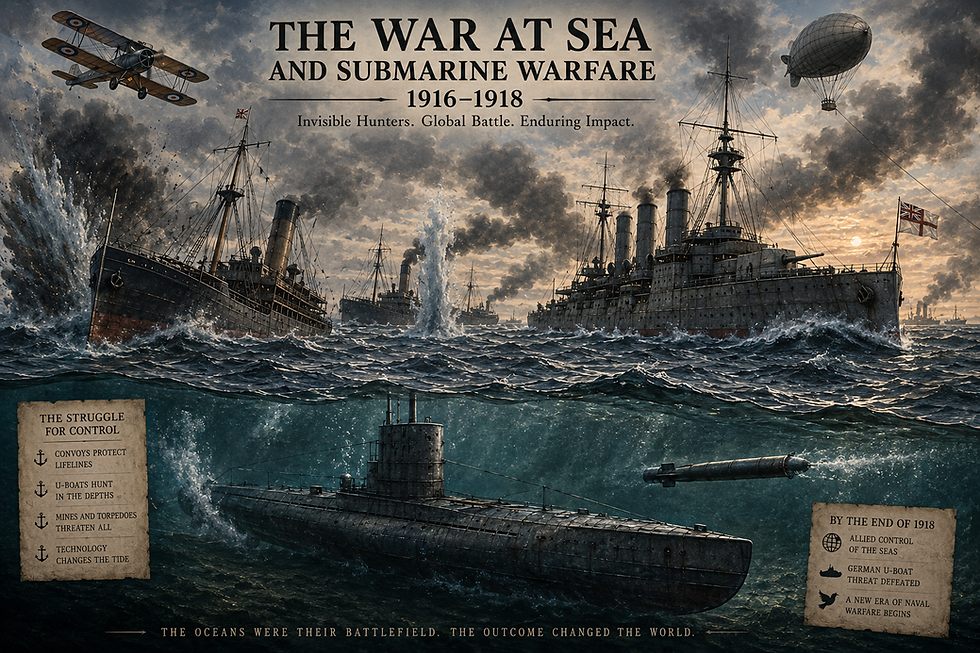
Britain’s Powerful Royal Navy
At the start of the war, Britain possessed the most powerful navy in the world. Its enormous fleet of battleships, cruisers, and destroyers protected trade routes stretching from Canada and the United States to India, Africa, and Australia. The British Royal Navy also established a blockade around Germany, stopping many ships from delivering food and materials to German ports. Over time, shortages inside Germany became severe. Civilians faced hunger, factories lacked resources, and morale began to weaken. The blockade showed that a navy could slowly damage an enemy nation without invading its shores.
Germany’s Deadly U-Boats
Germany knew it could not easily defeat Britain’s giant surface fleet in open battle, so it turned to a frightening new weapon: the submarine, called the U-boat. These underwater vessels could silently approach ships and destroy them with torpedoes before disappearing beneath the waves. Merchant ships carrying food, weapons, and passengers suddenly faced danger every time they crossed the Atlantic Ocean. Sailors often had only moments to escape after an explosion ripped through their ship. The oceans, once seen as open highways for trade, became deadly hunting grounds.
A Global Lifeline Across the Seas
The war at sea connected every corner of the world to the conflict in Europe. Wheat from North America, rubber from Southeast Asia, oil from the Middle East, and troops from colonies across the British and French Empires all traveled by ship. Millions of soldiers crossed oceans to reach the battlefields. If those sea lanes were broken, armies could collapse far from home. Control of the seas allowed nations to continue fighting year after year, proving that victory in World War I depended not only on soldiers in muddy trenches, but also on sailors battling across vast oceans.
The Struggle That Changed Naval Warfare Forever
World War I transformed naval warfare forever. Nations developed convoy systems, depth charges, naval mines, and new technologies to detect submarines. Governments used stories of sinking ships to influence public opinion and encourage support for the war. The struggle for the seas also helped draw the United States into the conflict after American ships and civilians were threatened by German submarine attacks. By 1918, leaders understood that whoever controlled the oceans controlled the movement of armies, supplies, and even the future of nations themselves.
British Royal Navy and the Naval Blockade – War at Sea and Submarine WarfareWhen World War I began, Britain possessed the largest and most powerful navy on Earth. Its massive fleet of battleships, cruisers, destroyers, and patrol vessels guarded trade routes across the globe and protected the British Empire. But Britain’s navy was not only built to fight great sea battles. It was also designed to control the oceans themselves. British leaders believed that if they could cut Germany off from the outside world, they could slowly weaken the German military, damage its economy, and reduce the ability of its people to continue the war.
Closing the Seas Around Germany
The British Royal Navy established a blockade around Germany by controlling important shipping routes in the North Sea and the Atlantic Ocean. British warships stopped merchant vessels carrying supplies to German ports and inspected cargo for anything that could help Germany continue fighting. Food, fuel, chemicals, metals, rubber, and raw materials were either seized or prevented from reaching German factories and cities. Even neutral nations trading with Germany were pressured or searched by the British fleet. Over time, Germany found itself increasingly trapped behind a wall of steel at sea.
The Growing Shortages Inside Germany
As the blockade tightened, shortages inside Germany became more severe. Factories struggled to obtain raw materials needed for weapons, ammunition, and machinery. Coal and fuel became harder to distribute efficiently. Worst of all, food supplies began to shrink. Bread, meat, milk, and potatoes became scarce in many cities. Civilians waited in long lines for limited rations, and families often survived on poor-quality substitutes. During the harsh “Turnip Winter” of 1916–1917, many Germans were forced to eat animal feed turnips because other food was unavailable. Hunger and disease spread as the war dragged on.
A Weapon Without Constant Battles
Unlike dramatic land battles filled with explosions and charging soldiers, the naval blockade worked slowly and quietly. Yet it became one of the most powerful weapons of the entire war. Britain did not need to invade Germany to cause suffering and economic damage. Instead, British naval power slowly weakened Germany month after month. German morale declined as civilians became exhausted from shortages and hardship. The blockade also increased pressure on German leaders, helping push them toward desperate measures such as unrestricted submarine warfare against Allied shipping.
The Blockade’s Lasting Impact
By the final years of World War I, the British blockade had helped cripple Germany’s economy and weaken civilian support for the war. Historians estimate that hundreds of thousands of German civilians suffered from malnutrition and disease connected to wartime shortages. The blockade demonstrated that control of the seas could decide the fate of nations just as much as armies fighting on land. World War I proved that naval power was not only about sinking enemy ships—it was about controlling trade, supplies, and the survival of entire populations.
Germany’s U-Boat Strategy – The War at Sea and Submarine Warfare (1916–1918)During World War I, Germany introduced one of the most feared weapons of the modern age: the submarine. Known as Unterseeboote, or U-boats, these underwater vessels changed naval warfare forever. Germany knew it could not easily defeat the massive British Royal Navy in direct battles on the surface of the sea. Britain possessed more battleships, controlled important trade routes, and maintained a powerful blockade that slowly weakened Germany. German leaders believed submarines offered a new way to strike back by attacking Britain’s lifeline—its merchant shipping.
The Deadly Power Beneath the Waves
Unlike traditional warships, U-boats could travel underwater and attack without warning. Hidden beneath the surface, they stalked cargo ships, troop transports, and even passenger liners crossing the Atlantic Ocean. Armed with torpedoes capable of tearing massive holes into ships, U-boats could sink vessels within minutes. Merchant sailors often had little chance to escape before freezing water flooded the decks. The sudden appearance of submarines created fear across the seas because ships could now be attacked by an enemy they could not even see.
Britain’s Dependence on the Sea
Germany understood that Britain depended heavily on imported food, fuel, weapons, and raw materials from around the world. If enough merchant ships could be destroyed, Britain might run out of supplies and be forced to surrender. German naval leaders believed submarine warfare could starve Britain into defeat faster than armies fighting in the trenches. In 1917, Germany launched unrestricted submarine warfare, allowing U-boats to attack nearly any ship heading toward Allied ports, including neutral vessels. German commanders hoped this aggressive strategy would break Britain before the United States could fully enter the war.
Danger Across the Atlantic
The U-boat campaign turned the Atlantic Ocean into one of the most dangerous places on Earth. Ships traveled in fear, constantly watching for torpedo wakes cutting through the water. Survivors described terrifying explosions, sinking decks, and desperate attempts to escape in lifeboats during storms and freezing temperatures. Some U-boats sank dozens of ships during a single patrol. The destruction shocked the world, especially after passenger ships carrying civilians were attacked. These sinkings increased anger toward Germany and helped shift public opinion in countries like the United States.
Changing Naval Warfare Forever
Germany’s submarine campaign forced the Allies to invent new defensive tactics and technologies. Convoy systems grouped merchant ships together under naval escort, while destroyers hunted submarines using depth charges and early underwater listening devices called hydrophones. Aircraft and observation balloons also began helping search for submarines from above. Although Germany ultimately failed to cut Britain off completely, U-boats proved that submarines could challenge even the world’s greatest naval powers. The lessons learned during World War I transformed naval warfare forever and shaped military strategy for generations to come.
Life Inside a U-Boat – The War at Sea and Submarine WarfareDuring World War I, German U-boats became some of the most feared weapons on Earth, but life aboard these submarines was miserable, exhausting, and terrifying. Sailors lived for weeks inside narrow steel tubes hidden beneath the ocean’s surface. Every patrol placed crews in constant danger as they hunted enemy ships while trying to avoid destruction themselves. Far below the waves, surrounded by darkness and cold water, U-boat crews faced one of the most stressful environments of the entire war.
Cramped Conditions Beneath the Sea
Inside a U-boat, space was extremely limited. Dozens of sailors lived, worked, and slept in tight compartments packed with machinery, torpedoes, pipes, fuel tanks, and batteries. Crewmen often slept in narrow bunks stacked closely together, while some shared beds in rotating shifts because there was not enough room for everyone at once. Fresh food was stored wherever space could be found, including hanging from pipes and packed between equipment. As patrols continued, food spoiled quickly, mixing unpleasant smells with engine fumes, sweat, and damp air.
Darkness, Heat, and Bad Air
The deeper a submarine traveled, the more uncomfortable conditions became. Air inside the U-boat slowly grew stale and humid, especially during long periods underwater when fresh air could not enter. The smell of diesel fuel, chemicals, and unwashed clothing filled the submarine. Temperatures could become extremely hot near the engines, while moisture collected on walls and ceilings. Electric lights provided dim illumination, but much of the submarine remained shadowy and cramped. Crew members often became exhausted from poor sleep, stress, and lack of clean air.
The Constant Fear of Destruction
Every mission carried the threat of sudden death. A single depth charge explosion from an enemy destroyer could crush the submarine beneath the sea. Sailors listened carefully for propellers overhead, knowing enemy ships might already be hunting them. When depth charges exploded nearby, the submarine shook violently as lights flickered and metal groaned under pressure. Water sometimes leaked through damaged seals while crewmen rushed to repair equipment and keep the vessel alive. If a submarine became trapped underwater or suffered serious damage, escape was nearly impossible.
Courage Beneath the Waves
Despite the dangers, U-boat crews continued their missions across the Atlantic and North Sea. Many sailors developed strong bonds with their fellow crewmen because survival depended on teamwork and discipline. Every sailor had a specific role, from navigating and operating torpedoes to maintaining engines and controlling ballast tanks. Life aboard a U-boat demanded courage, endurance, and calmness under pressure. World War I showed that submarines could become powerful weapons, but it also revealed the incredible hardships faced by the men who served deep beneath the ocean waves.
Unrestricted Submarine Warfare – The War at Sea and Submarine WarfareDuring World War I, Germany made a bold and dangerous decision that shocked the world: its submarines would attack merchant and passenger ships without warning. This policy became known as unrestricted submarine warfare. German leaders believed that if enough ships carrying food, fuel, weapons, and supplies to Britain were destroyed, Britain would eventually starve and be forced to surrender. U-boats began patrolling major shipping routes across the Atlantic Ocean, turning the seas into deadly war zones where any ship could suddenly become a target.
Why Germany Chose This Strategy
Germany faced a serious problem during the war. The powerful British Royal Navy had blockaded German ports, cutting off important supplies and weakening Germany’s economy. German leaders knew they could not easily defeat Britain’s large surface fleet in direct naval battles. Instead, they believed submarines offered a way to strike Britain’s greatest weakness—its dependence on overseas trade. German commanders hoped that by sinking merchant ships faster than Britain could replace them, they could force Britain out of the war before Germany collapsed under the blockade.
A Controversial and Dangerous Policy
Unrestricted submarine warfare quickly became one of the most controversial strategies of the war because it ignored many traditional naval rules. In earlier conflicts, warships usually stopped merchant vessels, searched them, and allowed civilians to escape before sinking the ship. Submarines, however, were vulnerable when surfaced and could easily be attacked if they followed these rules. German U-boats often launched torpedoes without warning, sometimes striking passenger liners carrying civilians. Entire ships could disappear beneath the waves within minutes, leaving passengers struggling to survive in freezing waters.
Neutral Nations Become Angry
The attacks deeply angered neutral nations, especially the United States, which had not yet entered the war. American businesses traded with both sides, and American citizens traveled aboard passenger ships crossing the Atlantic. When German U-boats sank ships carrying neutral passengers and civilians, many people believed Germany had crossed a moral line. The sinking of the passenger liner RMS Lusitania in 1915, which killed nearly 1,200 people including Americans, shocked the world and damaged Germany’s international reputation. As submarine attacks continued, anger toward Germany grew stronger.
A Strategy That Changed the War
In 1917, Germany resumed full unrestricted submarine warfare despite warnings that it might push the United States into the war. German leaders hoped Britain would surrender before American forces could arrive in large numbers. Instead, the strategy helped convince the United States to join the Allies. American soldiers, industries, and supplies soon strengthened the Allied war effort. Although German U-boats caused enormous destruction, unrestricted submarine warfare ultimately failed to defeat Britain and instead helped bring a powerful new enemy into the conflict. The campaign permanently changed naval warfare and demonstrated how battles at sea could influence the fate of entire nations.
The Sinking of the RMS Lusitania – The War at Sea and Submarine WarfareOn May 7, 1915, one of the most shocking events of World War I took place in the waters off the coast of Ireland. The British passenger liner RMS Lusitania, one of the largest and fastest ships in the world, was struck by a torpedo fired from a German U-boat. In only about eighteen minutes, the enormous ship slipped beneath the waves. Nearly 1,200 passengers and crew members lost their lives, including women, children, and 128 Americans. The sinking horrified people around the world and became one of the most famous naval disasters in history.
A Luxury Ship Crossing a Dangerous Ocean
Before the war, the Lusitania had been celebrated as a symbol of speed, technology, and luxury travel across the Atlantic Ocean. Passengers aboard the ship included wealthy travelers, businessmen, immigrants, and families heading between Britain and the United States. Even during wartime, many civilians believed passenger liners would remain relatively safe from attack. However, Germany had already warned that ships traveling near Britain could be targeted by U-boats because Britain used civilian shipping to transport supplies connected to the war effort. Despite the warnings, many passengers believed the Lusitania was too fast to be caught by a submarine.
The Attack Beneath the Waves
As the Lusitania approached the southern coast of Ireland, the German submarine U-20 spotted the ship and prepared to attack. Without warning, a torpedo slammed into the side of the liner. Survivors later described a second powerful explosion that shook the ship moments later. Panic spread rapidly as passengers rushed toward lifeboats while the ship tilted heavily. Some lifeboats could not be launched properly, while others overturned in the chaos. Within minutes, the great ocean liner vanished beneath the cold Atlantic waters, leaving survivors struggling among wreckage and freezing waves.
Worldwide Anger and Outrage
News of the disaster spread quickly across newspapers around the world. Many people were outraged that civilians had been killed without warning. In the United States, anger toward Germany grew stronger because American citizens had died in the attack even though the United States was still neutral at the time. Newspapers printed dramatic stories and illustrations showing the destruction and loss of innocent lives. Britain used the sinking as powerful propaganda to portray Germany as cruel and dangerous. The Lusitania disaster deeply damaged Germany’s reputation and increased international pressure against unrestricted submarine warfare.
A Turning Point in the War at Sea
The sinking of the Lusitania became one of the most important events in the naval war of World War I. Although the United States did not immediately enter the war, the attack changed American public opinion and increased distrust toward Germany. German leaders temporarily reduced some submarine attacks after international outrage, but tensions continued to grow. Historians still debate certain details about the ship’s cargo and the explosions aboard the vessel, but there is no doubt that the sinking shocked the world. The tragedy demonstrated how submarine warfare could affect not only soldiers and sailors, but also civilians far from the battlefield.
Convoys and Anti-Submarine Defenses – The War at Sea and Submarine WarfareAs German U-boats spread fear across the Atlantic Ocean during World War I, Allied nations faced a growing crisis. Merchant ships carrying food, fuel, soldiers, weapons, and supplies were being sunk faster than they could be replaced. Britain especially depended on these shipments to survive. If the U-boats succeeded in cutting off Atlantic trade routes, the Allies could lose the war. To stop the submarine threat, Britain, France, the United States, and their allies developed new defensive systems and technologies that transformed naval warfare forever.
The Convoy System
One of the most successful strategies introduced during the war was the convoy system. Instead of allowing merchant ships to sail alone across the ocean, dozens of ships traveled together in large groups called convoys. Powerful destroyers and other escort vessels surrounded the convoy to protect it from submarines. This system made it far more difficult for U-boats to attack because submarines could no longer easily surprise isolated ships. Convoys also allowed Allied warships to concentrate their defenses in important areas rather than trying to patrol the entire ocean alone.
Destroyers Hunt Beneath the Waves
Destroyers became some of the most important weapons in the fight against submarines. These fast and maneuverable warships escorted convoys and searched constantly for signs of enemy U-boats. Lookouts scanned the horizon for periscopes or torpedo wakes cutting through the water. When a submarine was spotted, destroyers rushed toward the area at high speed. Their crews worked under intense pressure because submarines could disappear beneath the waves within seconds. The battle between destroyers and U-boats became a deadly game of detection, speed, and survival.
Depth Charges and New Technology
To attack submarines underwater, the Allies developed depth charges—explosive barrels designed to sink beneath the sea and explode at certain depths. When destroyers believed a U-boat was hiding below, they dropped these charges into the water. Violent underwater explosions could damage submarines, rupture hulls, or force crews to surface. The Allies also experimented with hydrophones, early listening devices capable of detecting submarine engines underwater. Observation balloons and aircraft helped search for submarines from above, giving Allied forces new ways to track enemy vessels hiding beneath the ocean’s surface.
Winning the Battle of the Atlantic
By 1917 and 1918, the convoy system and anti-submarine defenses began turning the tide against Germany’s U-boats. Merchant ship losses slowly decreased while more submarines were destroyed or forced to retreat. The arrival of the United States Navy strengthened convoy protection even further. Although U-boats remained dangerous until the end of the war, the Allies successfully protected enough supply ships to keep Britain and France fighting. The struggle against submarines proved that technology, teamwork, and organization could overcome even one of the deadliest threats of modern warfare.
Major Naval Battles of the War – The War at Sea and Submarine WarfareDuring World War I, the struggle for control of the seas became one of the most important parts of the entire conflict. Massive steel battleships armed with enormous guns patrolled dangerous waters while submarines hunted beneath the waves. Britain and Germany both understood that naval power could determine victory or defeat. Whoever controlled the oceans could move soldiers, supplies, and trade across the globe. The greatest naval clashes of the war revealed new technologies, dangerous strategies, and the growing importance of modern sea warfare.
Britain’s Grand Fleet and Germany’s High Seas Fleet
At the center of the naval war stood two enormous forces: Britain’s Grand Fleet and Germany’s High Seas Fleet. Britain possessed the world’s largest navy and depended heavily on overseas trade and supplies. Germany hoped to weaken British naval dominance by using its own modern fleet to destroy portions of the Royal Navy whenever possible. German commanders knew they could not easily defeat Britain in one giant battle, so they planned carefully timed raids and surprise attacks designed to lure smaller British forces into traps before the full British fleet could arrive.
The Battle of Jutland
The largest naval battle of World War I took place from May 31 to June 1, 1916, in the North Sea near Denmark. Known as the Battle of Jutland, it involved around 250 ships and more than 100,000 sailors. British Admiral Sir John Jellicoe commanded the Grand Fleet, while German Admiral Reinhard Scheer led the High Seas Fleet. The battle began when scouting ships encountered one another, leading to a massive exchange of gunfire between powerful battleships and battlecruisers. Explosions lit the horizon as giant shells smashed into steel armor, destroying several ships within minutes.
Strategies and Survival at Sea
During the battle, Germany relied on aggressive tactics, speed, and coordinated attacks to damage British ships before retreating toward safety. Britain focused on using its superior numbers to trap and surround the German fleet. Smoke, darkness, and confusion made communication extremely difficult as ships maneuvered through dangerous waters filled with shells and torpedoes. Several British battlecruisers exploded catastrophically after enemy shells reached their ammunition magazines. Despite suffering heavier losses in ships and sailors, Britain maintained control of the North Sea and forced Germany’s fleet to retreat.
The Long-Term Impact of the Naval Battles
Although Germany claimed a tactical victory at Jutland because Britain lost more ships and men, Britain achieved the larger strategic goal by keeping control of the seas. After Jutland, the German High Seas Fleet rarely challenged the British fleet directly again. Instead, Germany increasingly depended on submarine warfare to attack Allied shipping. The battle also taught naval commanders important lessons about armor, communication, ammunition safety, and fleet coordination. World War I proved that giant battleships still mattered, but it also showed that submarines, mines, and new technologies were changing naval warfare forever.
Technology and Innovation at Sea – The War at Sea and Submarine WarfareWorld War I transformed naval warfare into a battle of science, engineering, and invention. The oceans became testing grounds for deadly new technologies designed to sink enemy ships, locate hidden submarines, and protect vital supply routes. Nations raced to create more powerful warships and more advanced weapons as the struggle for control of the seas intensified. Many of the inventions developed during the war permanently changed naval combat and shaped the future of warfare across the world’s oceans.
The Deadly Power of Torpedoes
One of the most feared weapons of the war was the torpedo. Powered by engines and launched from submarines or warships, torpedoes traveled underwater toward enemy vessels before exploding against their hulls. German U-boats used torpedoes to sink merchant ships, passenger liners, and military vessels across the Atlantic. Unlike traditional naval battles where ships exchanged gunfire openly, torpedoes allowed attacks to happen suddenly and without warning. A single successful strike could destroy enormous ships within minutes, forcing navies to rethink how fleets traveled and defended themselves.
Naval Mines Beneath the Waves
Another dangerous invention was the naval mine. These floating or anchored explosives were hidden beneath the water and detonated when ships struck them. Mines could protect harbors, block important shipping lanes, and trap enemy fleets in dangerous waters. Both the Allies and Central Powers laid massive minefields across parts of the North Sea and other strategic locations. Sailors constantly feared invisible explosives lurking beneath the waves, and entire areas of ocean became deadly obstacles for military and merchant ships alike.
Listening for Enemy Submarines
As submarines became more dangerous, Allied nations searched for ways to detect them underwater. One early invention was the hydrophone, a listening device capable of hearing submarine engines and propellers beneath the sea. Although primitive compared to later sonar systems, hydrophones gave naval crews a better chance of locating hidden U-boats before they attacked. Combined with destroyers, patrol ships, and aircraft, these detection methods slowly improved the Allies’ ability to defend convoys and hunt submarines beneath the surface.
Camouflage and Improved Warships
Navies also experimented with unusual camouflage designs called “dazzle camouflage.” Instead of hiding ships, these bold patterns of stripes, curves, and geometric shapes were designed to confuse enemy submarine crews about a ship’s speed, direction, and size. At the same time, warships themselves became more advanced, with stronger armor, larger guns, faster engines, and improved communication systems. Battleships, destroyers, and submarines all evolved rapidly during the war as nations adapted to new threats and technologies.
A New Era of Naval Warfare
The technology developed during World War I changed naval combat forever. Ships could now attack from underwater, hidden explosives could block entire seas, and machines could listen beneath the ocean for unseen enemies. Nations realized that victory at sea depended not only on brave sailors, but also on scientific innovation and industrial power. The war proved that modern technology could completely reshape warfare, turning the oceans into some of the most dangerous and technologically advanced battlefields in human history.
Merchant Ships and Civilian Sacrifice – The War at Sea and Submarine WarfareDuring World War I, millions of soldiers fighting on distant battlefields depended on merchant ships crossing dangerous oceans every single day. These civilian cargo vessels carried food, ammunition, fuel, medical supplies, uniforms, vehicles, and raw materials needed to keep entire nations alive and armies fighting. While battleships and submarines often received most of the attention, merchant sailors quietly faced some of the greatest dangers of the war. Every voyage across the Atlantic or North Sea could end in disaster as German U-boats hunted ships beneath the waves.
The Lifeline of the Allied War Effort
Britain and its allies relied heavily on overseas trade and transportation. Wheat from Canada and the United States, oil from overseas fields, steel and coal for factories, and medicine for wounded soldiers all traveled by merchant ship. Without these supplies, armies would run out of ammunition, civilians would face starvation, and factories would stop producing weapons. Merchant crews became essential workers in a global war, even though many of them were not trained soldiers. Their ships formed the lifeline that connected continents and kept the Allied war effort alive.
Danger on Every Voyage
Life aboard a merchant ship during wartime was filled with fear and uncertainty. German submarines often attacked without warning, launching torpedoes that could sink cargo ships within minutes. Crews constantly watched the sea for signs of periscopes or torpedo wakes racing toward them. Many ships sailed through storms, freezing temperatures, thick fog, and rough seas while also trying to avoid enemy submarines and naval mines. If a ship was struck, sailors often had only moments to escape before the vessel disappeared beneath the ocean.
Civilian Sailors in a War Zone
Unlike naval warships armed for combat, many merchant vessels carried little or no protection during the early years of the war. Civilian sailors faced the same deadly dangers as military personnel but often without armor, heavy weapons, or escorts. Some ships carried highly explosive ammunition or fuel, making attacks even more catastrophic. Survivors sometimes drifted for hours or days in lifeboats surrounded by freezing water and rough seas before rescue arrived. Thousands of civilian sailors from many nations lost their lives while transporting supplies across submarine-infested waters.
Courage That Helped Win the War
As submarine attacks increased, Allied nations introduced convoy systems and naval escorts to better protect merchant shipping. Even with these defenses, the danger never fully disappeared. Merchant sailors continued sailing because they knew the survival of their countries depended on the supplies they carried. Their courage, endurance, and sacrifice played a major role in keeping the Allies supplied until the end of the war. World War I showed that victory did not depend only on soldiers fighting in trenches, but also on ordinary civilians risking their lives across the world’s oceans.
Global Naval Warfare Beyond Europe – The War at Sea and Submarine WarfareAlthough many people imagine World War I being fought mainly in the trenches of Europe, the conflict at sea stretched across nearly every major ocean on Earth. Warships, submarines, merchant vessels, and colonial fleets battled across the Atlantic Ocean, the Mediterranean Sea, the Pacific Ocean, and the waters surrounding Africa and Asia. The world’s empires depended on global trade routes to move food, raw materials, soldiers, fuel, and weapons. Whoever controlled these sea routes gained enormous power, making naval warfare one of the most important global struggles of the war.
The Atlantic Ocean and the Supply War
The Atlantic Ocean became one of the most dangerous regions of the war because it connected Britain and France to supplies from North America and the rest of the world. German U-boats hunted merchant ships carrying food, ammunition, oil, and troops across the ocean. Britain depended heavily on these shipments to survive. Convoys protected by destroyers crossed the Atlantic while submarines searched for opportunities to strike. The battle for control of Atlantic shipping lanes became a fight over whether entire nations could continue feeding their populations and supplying their armies.
Conflict in the Mediterranean Sea
The Mediterranean Sea was another critical battlefield because it linked Europe to the Middle East, North Africa, and the Suez Canal. Allied ships transported troops from colonies in Africa, India, Australia, and New Zealand through these waters. Ottoman forces and German submarines threatened these important routes, attacking cargo ships and military transports whenever possible. Naval power in the Mediterranean also influenced campaigns in places such as Gallipoli, the Middle East, and the Balkans. Control of the sea allowed the Allies to move armies and supplies quickly between different fronts of the war.
Naval Warfare Around Africa and Asia
Africa and Asia were deeply connected to the naval war because European empires relied on colonies for soldiers, food, minerals, rubber, oil, and other valuable resources. Warships protected colonial shipping routes while Allied forces captured German colonies and ports throughout Africa and the Pacific. In East Africa, German forces under Paul von Lettow-Vorbeck continued resisting for years, forcing the Allies to protect nearby sea routes and coastal regions. Ships traveling around the southern tip of Africa carried supplies between Europe and Asia, making these waters strategically important throughout the war.
Battles Across the Pacific Ocean
The Pacific Ocean also became part of the global naval struggle. Japan, allied with Britain, attacked German possessions and naval bases in the Pacific and China early in the war. German raiders and cruisers attempted to disrupt Allied shipping across vast ocean distances. One important clash was the Battle of Coronel near South America in 1914, where German ships defeated a British squadron. Britain later responded by destroying much of the German East Asia Squadron at the Battle of the Falkland Islands. These battles showed that even remote oceans far from Europe could become dangerous war zones.
A Truly Global War at Sea
World War I proved that naval warfare was no longer limited to European waters. Oceans connected continents, empires, and economies together in ways never seen before. Ships carried millions of soldiers and enormous amounts of supplies across the globe while submarines and warships fought to control those routes. The naval war affected civilians, colonies, and distant nations thousands of miles from the Western Front. By the end of the conflict, it had become clear that control of the seas could shape the outcome of a world war just as much as battles fought on land.
Impact of Naval Warfare on the United States – War at Sea and Submarine WarfareWhen World War I began in 1914, the United States declared neutrality and attempted to stay out of the conflict raging across Europe. Many Americans believed the war was a distant European struggle that should not involve the United States. However, as fighting spread across the oceans, naval warfare slowly pulled America closer to the conflict. German submarine attacks on merchant ships and passenger liners shocked the American public and created growing anger toward Germany. The battle beneath the waves would eventually help change the course of American history.
America’s Trade Across the Atlantic
Even while remaining neutral, the United States traded heavily with Britain and France. American factories supplied food, ammunition, machinery, fuel, and raw materials to Allied nations across the Atlantic Ocean. German leaders understood that these shipments strengthened their enemies, so they used U-boats to attack ships traveling toward Allied ports. Unfortunately for Germany, some of these ships carried American passengers or cargo. Each submarine attack increased tensions between the United States and Germany, especially when civilians were injured or killed.
The Sinking of the Lusitania
One of the most important moments came in 1915 with the sinking of the British passenger liner RMS Lusitania. A German U-boat torpedoed the ship off the coast of Ireland, killing nearly 1,200 people, including 128 Americans. News of the disaster spread quickly through newspapers across the United States. Many Americans were horrified that civilians, including women and children, had died without warning. Although the United States did not immediately enter the war, public opinion toward Germany became far more negative after the attack.
Germany Resumes Unrestricted Submarine Warfare
For a time, Germany reduced some submarine attacks in order to avoid provoking the United States further. However, by 1917, Germany decided to resume unrestricted submarine warfare, believing it could starve Britain into surrender before America could fully respond. German U-boats once again attacked nearly all ships entering waters around Britain and parts of Europe, including neutral vessels. American merchant ships became targets, and several were sunk. Many Americans now believed Germany was threatening the freedom of the seas and violating the rights of neutral nations.
The United States Moves Toward War
As submarine attacks continued, anger grew across the United States. Newspapers described German U-boats as ruthless killers hiding beneath the sea. Political leaders warned that American lives, trade, and national honor were under attack. In April 1917, President Woodrow Wilson asked Congress for a declaration of war against Germany. Naval warfare had played a major role in changing public opinion and pushing America into World War I. The struggle on the oceans proved that battles at sea could influence not only military strategy, but also the decisions of entire nations far from the battlefield.
Last Years of the Naval War and Its Legacy – War at Sea and Submarine WarfareAs World War I entered its final years, the oceans remained some of the most dangerous battlefields on Earth. German U-boats still prowled the Atlantic Ocean, searching for merchant ships carrying food, soldiers, fuel, and weapons to the Allied nations. Every convoy crossing the sea faced the threat of torpedoes exploding beneath the waves. Germany hoped that continued submarine warfare would finally starve Britain into surrender before Allied strength became overwhelming. Yet by 1917 and 1918, the naval war had begun to change in ways Germany had not expected.
The Allies Fight Back
The Allies adapted quickly to the submarine threat by improving convoy systems and anti-submarine defenses. Merchant ships traveled together in large escorted groups protected by destroyers and patrol vessels. Naval crews used depth charges, hydrophones, aircraft patrols, and observation balloons to hunt submarines beneath the sea. The arrival of the United States Navy added even more protection to Atlantic shipping routes. Although German U-boats continued sinking ships, it became far harder for submarines to attack convoys successfully without being detected or destroyed.
Why Germany’s Strategy Failed
Germany’s submarine campaign caused enormous destruction, but it ultimately failed to achieve its most important goal. Britain never surrendered, and Allied supply lines remained open long enough to continue the war. Germany underestimated how quickly the Allies would improve convoy defenses and overestimated how rapidly Britain would collapse from shortages. Most importantly, unrestricted submarine warfare helped push the United States into the war in 1917. American soldiers, factories, warships, and supplies greatly strengthened the Allied powers at a critical moment. Instead of forcing Britain into surrender, Germany’s submarine strategy helped create a stronger enemy coalition against itself.
A New Era of Naval Warfare
World War I permanently transformed naval combat. Before the war, many naval leaders believed giant battleships would decide the future of warfare at sea. The war proved that submarines, mines, torpedoes, and new technologies could threaten even the most powerful fleets. Nations invested heavily in submarine design, anti-submarine weapons, and improved naval communication systems after the war ended. Aircraft also began playing a greater role in naval scouting and defense. The oceans had become battlefields shaped not only by large warships, but by science, stealth, and technology.
Changes to International Law and Future Wars
The destruction caused by unrestricted submarine warfare also sparked debates about international law and the protection of civilians at sea. Many nations questioned whether passenger ships and neutral merchant vessels should ever be attacked without warning. After the war, international agreements attempted to place limits on submarine warfare and naval weapons, although these rules would later be challenged again during World War II. The lessons learned during World War I influenced naval strategy for decades to come. The war at sea proved that control of the oceans could shape global politics, economies, and the outcome of entire world conflicts.
World Events That Influenced The War at Sea and Submarine Warfare (1916–1918)
The war did not happen in isolation. Events across Europe, Africa, the Middle East, Asia, and the Americas all affected the struggle for control of the oceans. Nations depended on global shipping routes for food, fuel, troops, and raw materials, meaning battles on land often influenced naval strategy at sea. At the same time, submarine warfare itself affected diplomacy, economics, revolutions, and military campaigns around the world. The oceans became the highways connecting a truly global conflict.
The British Naval Blockade of Germany
One of the most important events affecting naval warfare was Britain’s blockade of Germany. The British Royal Navy controlled major shipping lanes and prevented food, fuel, chemicals, and raw materials from reaching German ports. As shortages worsened inside Germany, German leaders became increasingly desperate to break Britain’s power. This pressure pushed Germany toward unrestricted submarine warfare, believing U-boats could starve Britain before Germany itself collapsed from hunger and economic weakness.
The Battle of Jutland (1916)
The massive Battle of Jutland in 1916 became the largest naval clash of the war and strongly influenced future naval strategy. Although Germany damaged many British ships, Britain maintained overall control of the seas after the battle. German leaders realized they were unlikely to defeat the British fleet directly with battleships alone. Because of this, Germany relied even more heavily on submarine warfare after Jutland, increasing the importance of U-boats in the final years of the war.
The Gallipoli Campaign and Mediterranean Fighting
The Allied campaign at Gallipoli and fighting in the Mediterranean affected naval operations by forcing the Allies to protect troop transports and supply ships moving through dangerous waters. The Ottoman Empire, allied with Germany, threatened shipping routes near the Dardanelles and eastern Mediterranean. German submarines also attacked Allied vessels in the region. These battles demonstrated how naval control influenced campaigns far from Western Europe and showed how sea power could decide whether armies received reinforcements and supplies.
The Russian Revolution (1917)
The Russian Revolution had a major impact on naval warfare because it weakened one of the Allied powers and eventually removed Russia from the war entirely. Germany no longer needed to fight Russia on the Eastern Front after the Treaty of Brest-Litovsk in 1918. This allowed Germany to focus more resources on the Western Front and submarine operations in the Atlantic. At the same time, political unrest and economic hardship caused by war shortages showed how blockades and disrupted trade could help destabilize entire nations.
The Entry of the United States into the War
Germany’s unrestricted submarine warfare directly influenced the United States entering World War I in 1917. German U-boats attacked neutral shipping and sank vessels carrying American passengers and goods. Events such as the sinking of the RMS Lusitania increased anger across the United States. Once America joined the war, the Allies gained access to enormous industrial power, fresh troops, and additional naval forces. American destroyers and convoy escorts greatly strengthened Allied defenses against U-boats in the Atlantic Ocean.
Colonial Trade Routes and Global Empires
European empires stretched across Africa, Asia, the Pacific, and the Middle East, making naval warfare a worldwide struggle. Britain and France depended heavily on colonial resources such as oil, rubber, food, metals, and troops transported by sea. Germany attempted to disrupt these trade routes using submarines and raider ships. Naval warfare affected shipping around Africa, through the Suez Canal, and across the Atlantic and Indian Oceans. Protecting these routes became essential to keeping Allied economies and armies functioning.
Technological Advances During the War
Rapid technological innovation also shaped naval warfare between 1916 and 1918. New inventions such as depth charges, hydrophones, naval mines, improved torpedoes, convoy systems, and aircraft patrols changed how navies fought submarines. As Germany improved U-boat tactics, the Allies developed better anti-submarine defenses. This constant race between attack and defense transformed naval combat and influenced military technology long after World War I ended.
Economic Hardship and Civilian Suffering
The naval war deeply affected civilians around the world. Blockades and submarine attacks disrupted international trade, causing food shortages, inflation, unemployment, and rationing in many countries. Germany suffered severe hunger because of the British blockade, while Allied civilians feared shortages caused by U-boat attacks on merchant shipping. These hardships weakened morale and increased political tensions. The war at sea showed that modern conflicts could affect entire civilian populations, not just soldiers on battlefields.
The Legacy of Global Naval Warfare
By 1918, the naval war had permanently changed international politics and military strategy. Nations understood that control of the oceans could determine the outcome of global wars. Submarines proved capable of threatening even the world’s strongest navies, while convoy systems and anti-submarine technologies demonstrated the importance of coordination and innovation. The events happening around the world during this period helped shape the future of naval warfare, international law, and global trade for generations to come.
The Most Important People During The War at Sea and Submarine Warfare
Admiral Sir John Jellicoe
John Jellicoe was one of Britain’s most important naval commanders during World War I. Born in 1859, he spent decades rising through the Royal Navy before taking command of Britain’s powerful Grand Fleet. Jellicoe became famous for leading British naval forces during the Battle of Jutland in 1916, the largest naval battle of the war. Although the battle ended without a clear tactical victory, Britain maintained control of the seas afterward. Jellicoe’s cautious strategies protected Britain from disaster because losing the navy could have cut the country off from food and supplies. His leadership helped ensure Britain’s blockade of Germany continued throughout the war.
Admiral Reinhard Scheer
Reinhard Scheer commanded Germany’s High Seas Fleet during some of the war’s most important naval operations. Born in 1863, Scheer strongly believed Germany needed aggressive naval action to challenge Britain’s dominance at sea. During the Battle of Jutland, he used daring tactics to escape destruction by the larger British fleet. After realizing Germany’s surface navy could not defeat Britain directly, Scheer supported expanding submarine warfare against Allied shipping. His strategies influenced Germany’s heavy reliance on U-boats during the later years of the war.
Admiral Karl Dönitz
Karl Dönitz served as a young submarine officer during World War I and later became one of the most influential submarine commanders in modern history. Born in 1891, Dönitz commanded U-boats during the war and gained firsthand experience in submarine tactics. Although he became more famous during World War II, the lessons he learned in World War I shaped future submarine strategy. He studied convoy systems, naval communication, and underwater attacks that would later influence German naval warfare for decades.
Captain Walther Schwieger
Walther Schwieger became one of Germany’s most controversial naval officers after commanding the submarine U-20, which sank the RMS Lusitania in 1915. Born in 1885, Schwieger was considered a skilled and aggressive submarine commander. The sinking of the Lusitania caused worldwide outrage because nearly 1,200 civilians died, including Americans. Although Schwieger followed Germany’s submarine policies, the attack helped turn international opinion against Germany and increased tensions with the United States.
President Woodrow Wilson
Woodrow Wilson played a major role in how naval warfare affected global politics. Born in 1856, Wilson initially tried to keep the United States neutral during World War I. However, German unrestricted submarine warfare repeatedly threatened American ships and civilians. After continued U-boat attacks and growing public anger, Wilson asked Congress to declare war on Germany in 1917. His decision brought American soldiers, industry, and naval power into the conflict, greatly strengthening the Allies.
Winston Churchill
Winston Churchill served as Britain’s First Lord of the Admiralty during the early years of World War I. Born in 1874, Churchill strongly supported naval expansion and modernization before the war. He helped prepare Britain’s navy for global conflict by supporting new warships, submarines, and naval technologies. Although he left the Admiralty after the Gallipoli campaign, Churchill remained deeply interested in naval warfare and later became one of Britain’s most famous wartime leaders during World War II.
Grace Darling and the Women of Naval Support Services
While many naval leaders were men, thousands of women played important roles supporting naval operations during the war. Women worked in shipyards, naval communication offices, hospitals, supply centers, and factories producing weapons and equipment for fleets at sea. One important figure connected to naval rescue traditions was Grace Darling, whose earlier acts of bravery at sea inspired many during Britain’s maritime history. During World War I, women served as nurses caring for wounded sailors rescued from submarine attacks and naval battles. Others worked in codebreaking, administration, and wartime industries that kept navies operating.
Life Lessons and Thought Processes from The War at Sea and Submarine Warfare
The Importance of Adaptation
One of the greatest lessons from the naval war of World War I is the importance of adapting to new challenges. At the beginning of the war, many military leaders believed giant battleships would control the seas just as they had in earlier conflicts. However, German U-boats changed naval warfare completely. Submarines attacked from beneath the water where traditional fleets struggled to stop them. The Allied nations survived by adapting quickly, developing convoy systems, depth charges, hydrophones, and new defensive tactics. This teaches us that success often belongs to those who are willing to change, learn, and respond to unexpected problems instead of relying only on old methods.
Small Innovations Can Change the World
The naval war showed that even smaller inventions can dramatically change history. A single submarine, much smaller than a battleship, could threaten massive fleets and international trade routes. Technologies such as torpedoes, naval mines, and underwater listening devices reshaped warfare across the globe. This reminds us that creativity and innovation often matter as much as size or power. In life, new ideas and smart thinking can allow individuals or smaller groups to overcome much larger obstacles.
The Danger of Underestimating Consequences
Germany’s unrestricted submarine warfare teaches an important lesson about unintended consequences. German leaders believed sinking merchant ships would force Britain to surrender quickly. Instead, attacks on civilian and neutral ships angered the United States and helped bring America into the war against Germany. A decision meant to weaken the Allies ultimately strengthened them. This shows how actions can create results that leaders did not expect. Careful thinking about long-term consequences is important in leadership, business, politics, and everyday life.
Teamwork and Cooperation Matter
The convoy system demonstrated how teamwork can overcome dangerous situations. Merchant ships traveling alone were easy targets for submarines, but groups of ships protected by destroyers and escorts became much harder to attack. Sailors, naval officers, engineers, and support crews had to work together closely to survive. The Allied nations also shared information, technology, and naval resources. The success of the convoy system teaches that cooperation often creates strength that individuals alone cannot achieve.
Courage Under Pressure
Life aboard submarines, destroyers, and merchant ships required incredible bravery. Sailors faced freezing waters, violent storms, cramped conditions, explosions, and the constant fear of sudden death. Merchant crews continued crossing submarine-infested waters because entire nations depended on the supplies they carried. Their courage reminds us that bravery is not always loud or dramatic. Often, true courage means continuing to do difficult and dangerous work because others rely on you.
Technology Is Powerful but Dangerous
World War I’s naval battles also reveal how technology can be both helpful and destructive. Scientific advancements allowed nations to communicate better, transport supplies faster, and defend convoys more effectively. At the same time, these inventions created deadlier forms of warfare capable of sinking ships and killing civilians without warning. This teaches an important thought process about responsibility. Human beings must think carefully about how technology is used and how new inventions may affect both military and civilian life.
Vocabulary to Learn While Studying about the War at Sea
1. U-Boat
Definition: A German submarine used during World War I to attack enemy ships beneath the ocean’s surface.
Sample Sentence: The German U-boat silently approached the convoy before launching its torpedoes.
2. Blockade
Definition: An effort to stop ships, supplies, or trade from entering or leaving a country by using naval forces.
Sample Sentence: Britain’s naval blockade prevented many important supplies from reaching Germany.
3. Torpedo
Definition: A self-propelled underwater weapon designed to explode against ships.
Sample Sentence: The submarine fired a torpedo that struck the cargo ship near its engine room.
4. Depth Charge
Definition: An explosive weapon dropped into the water to destroy submarines underwater.
Sample Sentence: The destroyer released depth charges after spotting the enemy submarine.
5. Periscope
Definition: A tube-like device used by submarines to see above the water while remaining underwater.
Sample Sentence: Sailors spotted the submarine’s periscope rising above the waves.
6. Merchant Ship
Definition: A civilian ship used to transport goods and supplies across the ocean.
Sample Sentence: Merchant ships carried food and ammunition to Allied nations during the war.
7. Naval Mine
Definition: An underwater explosive designed to damage or sink ships that touch or pass near it.
Sample Sentence: Several warships were damaged after entering a hidden naval minefield.
8. Hydrophone
Definition: An early listening device used to detect submarines underwater.
Sample Sentence: The crew used a hydrophone to listen for enemy submarine engines beneath the sea.
9. Dreadnought
Definition: A large and powerful battleship armed with heavy guns and advanced armor.
Sample Sentence: Britain built many dreadnoughts to maintain control of the seas.
10. Destroyer
Definition: A fast warship designed to protect larger ships and hunt submarines.
Sample Sentence: Allied destroyers escorted convoys across the dangerous Atlantic Ocean.
11. Unrestricted Submarine Warfare
Definition: A naval strategy in which submarines attacked ships without warning, including civilian vessels.
Sample Sentence: Germany’s unrestricted submarine warfare angered many neutral countries.
12. Neutral Nation
Definition: A country that does not take sides during a war.
Sample Sentence: The United States remained a neutral nation during the early years of World War I.
13. Escort Vessel
Definition: A military ship assigned to protect merchant or transport ships.
Sample Sentence: Escort vessels guarded the convoy from submarine attacks.
14. Battlecruiser
Definition: A large warship with heavy guns and high speed but lighter armor than a battleship.
Sample Sentence: Several British battlecruisers were damaged during the Battle of Jutland.
15. Armistice
Definition: An agreement between opposing sides to stop fighting.
Sample Sentence: Naval operations slowed after the armistice ended World War I in 1918.
16. Sonar
Definition: A system that uses sound waves to detect objects underwater; early forms developed from hydrophones.
Sample Sentence: Early sonar technology helped navies locate submarines beneath the ocean.
17. Fleet
Definition: A large group of warships operating together under one command.
Sample Sentence: Britain’s Grand Fleet controlled much of the North Sea during the war.
18. Maritime
Definition: Related to the sea, shipping, or naval matters.
Sample Sentence: Britain’s maritime strength allowed it to protect trade routes around the world.
Vocabulary to Learn While Studying about the War at Sea
Convoy Defense Strategy Game
Recommended Age: 10–16
Activity Description: Students participate in a hands-on strategy game where merchant ships attempt to cross the Atlantic Ocean safely while avoiding German U-boats. Some students act as convoy escorts while others play the role of submarines trying to “sink” cargo ships.
Objective: To help students understand the dangers of submarine warfare, the importance of convoy systems, and how naval strategy affected World War I.
Materials: Large map or classroom floor grid, paper ship cutouts or toy ships, markers, dice, index cards, pencils, and optional string for shipping lanes.
Instructions: Create a map representing the Atlantic Ocean with marked starting and destination ports. Divide students into teams representing merchant ships, destroyer escorts, and German submarines. Merchant ships move slowly along shipping lanes while submarines secretly position themselves to attack. Destroyers patrol and protect convoys using assigned movement rules. Teachers can introduce historical events such as storms, minefields, or hydrophone detection cards during gameplay. At the end, discuss which strategies worked best and why convoy systems became so important during the war.
Learning Outcome: Students will understand how convoys reduced shipping losses and why submarine warfare became one of the most dangerous parts of World War I.
Build a Model U-Boat
Recommended Age: 8–14
Activity Description: Students build simple submarine models while learning about how U-boats operated beneath the sea during World War I. Teachers or parents can combine engineering, science, and history into one activity.
Objective: To teach students how submarines functioned and why they became powerful weapons during the war.
Materials: Plastic bottles or cardboard tubes, tape, glue, scissors, markers, clay or weights, straws, and reference pictures of World War I U-boats.
Instructions: Have students study diagrams or images of German U-boats. Students then create their own submarine models using household or classroom materials. Older students can experiment with buoyancy by adding weights or testing floating models in water. Teachers should explain concepts such as ballast tanks, torpedoes, periscopes, and underwater movement while students build. Afterward, students can present their submarines and explain how they would operate during wartime.
Learning Outcome: Students will gain a better understanding of submarine technology, engineering principles, and the challenges sailors faced underwater.
Newspaper Front Page – The Sinking of the Lusitania
Recommended Age: 11–18
Activity Description: Students create a historical newspaper front page reporting on the sinking of the RMS Lusitania or another major naval event from World War I.
Objective: To help students explore how news and propaganda influenced public opinion during wartime.
Materials: Paper, pencils, rulers, colored pencils, computers or tablets (optional), and historical references about the Lusitania.
Instructions: Students research the sinking of the Lusitania and write articles as if they were journalists living in 1915. They should create headlines, illustrations, interviews, and opinion sections reflecting reactions from different countries. Encourage students to think about how newspapers may have influenced emotions and political decisions at the time. Students can compare how British, American, and German newspapers might have reported the same event differently.
Learning Outcome: Students will understand how media and propaganda shaped public opinion and influenced the United States moving closer toward entering the war.


I recently had a conversation with someone considering purchasing property in Marrakech, and one of the main points discussed was how the concept of luxury living has changed over time. Many buyers are no longer searching only for large villas but for places offering a more complete residential experience with consistency in design, services, and surroundings. While exploring ideas connected to branded residences in Marrakech, I found it interesting how certain developments prioritize tranquility, architectural harmony, and a stronger connection with the environment instead of excessive visual statements. Marrakech has a very distinct character, so residences that respect the atmosphere of the city while integrating modern comfort seem far more appealing in the long run. I also think people increasingly…