

9. Heroes and Villains of Ancient Persia: The Silk Road and Trade in Early Persia

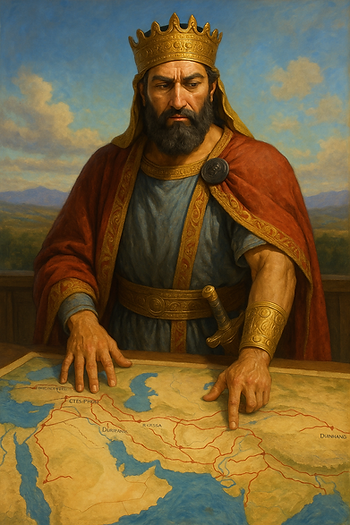
My Name is Darius I: King of Kings of the Achaemenid Empire
I was not born expecting to rule an empire stretching from the shores of the Aegean to the valleys of the Indus. Yet fate often chooses its own path. I began my life as a member of the Achaemenid royal family, serving loyally under Cambyses II. When unrest and confusion swept across the empire after his death, I stepped forward to restore order. My ascent was not peaceful. I defeated pretenders, quelled rebellions, and reclaimed the authority the Achaemenid line had nearly lost. In those early battles, I learned that unity is not a gift granted by birth; it is something won through resolve, clarity, and unyielding purpose.
Uniting an Empire of Many Peoples
When I finally secured the throne, the empire was vast but fractured. Dozens of cultures, languages, and traditions stretched across deserts, mountains, and seas. My task was not simply to rule them—it was to build a system in which they could coexist and prosper. I divided the empire into satrapies, each led by a governor responsible for collecting tribute and maintaining order. To balance their power, I created networks of royal inspectors, the “Eyes and Ears of the King,” who traveled in secret to ensure justice was upheld. I believed deeply that a ruler must listen, and that the voices of the farthest provinces should reach the palace at Persepolis.
Building the Royal Road and the Messenger System
Travel across my empire once took weeks of dangerous wandering. I transformed it. I ordered the construction and renovation of what became known as the Royal Road, a highway reaching over 1,600 miles. Along its length I built stations where riders could rest, trade could flourish, and messages could move with unprecedented speed. My couriers could travel the full length of the empire in mere days. This road became the artery of Persia, pumping information, goods, and culture from one corner to the next. It was the first true network connecting an empire of this scale, and it allowed my people to live not as scattered nations, but as partners in a shared world.
Creating a Standardized Economy
A land of this size could not thrive without economic harmony. I minted the daric, a gold coin stamped with my image, and it became the lifeblood of trade across the empire. I created standardized weights and measures, ensuring that a merchant in Lydia could trust a merchant in Egypt. Farmers, artisans, soldiers, and traders all benefited from the simplicity and honesty these systems created. My reforms did more than bring wealth—they brought trust. And with trust, commerce flourished, and prosperity spread across borders once filled with suspicion.
Expanding Persia’s Influence East and West
My reign was not spent in the halls of my palaces alone. I led campaigns to secure the empire’s frontiers, from Egypt in the west to the Indus Valley in the east. I sought to bring stability where chaos reigned and to integrate new lands into a system that valued law, fairness, and continuity. Whether dealing with rebellious satraps or rival powers, I always aimed not for destruction but for incorporation. I knew that an empire built on shared benefit would outlast one built only on fear.
Building Persepolis and the Legacy of Order
In the later years of my life, I turned increasingly toward the future. I began constructing Persepolis, a city meant not just to house administration, but to symbolize the unity of Persia’s many peoples. Its grand staircases, its audience halls, and its stone reliefs told the story of an empire drawn together from the farthest horizons. Every subject, from the Medes to the Elamites to the Egyptians, is carved bringing tribute in peace. My hope was that this city would remind future generations of the beauty that emerges when differences are woven into a single tapestry.
The Rise of the Achaemenid Empire and Early Trade Networks – Told by Darius I
When I look back on the earliest days of our people, I see a land of many valleys, deserts, and mountain passes, each inhabited by tribes who shared blood but lived apart. The Persians and Medes were strong, but our strength was scattered. Before any king could dream of an empire, he first had to bring unity where there had been only rivalry. The foundation of the Achaemenid rise lay not in conquest alone, but in the steady weaving together of cultures, loyalties, and resources across the Iranian plateau. Once united, our people gained the stability needed to look beyond their horizons.
The Vision of the First Kings
Long before my own reign, Cyrus the Great led the transformation that changed the course of our history. He brought Medes and Persians together, then incorporated Lydia, Babylon, and lands stretching to the edge of India into a system that blended respect for local customs with a shared imperial identity. These early kings understood something essential: an empire is not sustained by force but by connection. They allowed conquered regions to keep their languages, beliefs, and traditions, which helped them embrace—not resist—the wider Persian world. This harmony laid the groundwork for the networks I would later expand.
The Earliest Roads of Exchange
As new territories came under Persian rule, pathways between them became more than dirt tracks. They became channels of exchange. Merchants carried goods from Elam to Media, from Bactria to Lydia, and from Babylon to the Persian Gulf. Camels, horses, and pack animals traced routes that crossed mountains and deserts, linking distant peoples who now found themselves part of the same empire. These early roads were not yet the great highways of my own time, but they revealed how powerful trade could be in shaping unity. As regional connections grew stronger, so did the empire’s foundations.
Local Markets Become Imperial Networks
In the early days, each region had strong markets of its own, but they were isolated from one another. As unity spread, these markets began to intertwine. Lydia’s silver, Babylon’s grains, Egypt’s papyrus, and India’s spices found new value when exchanged across cultural boundaries. The empire’s diverse geography became its greatest strength. What one region lacked, another provided. What one region produced in abundance, others eagerly sought. The desire to exchange goods naturally encouraged peaceful cooperation, and the prosperity it brought strengthened loyalty to the throne.
The First Steps Toward a Greater Trade World
By the time I inherited this expanding realm, the framework for something greater had already formed. The early kings had created a realm so broad that it naturally connected the civilizations of East and West. Though the Silk Road had not yet taken shape, its future paths lay across the lands we ruled. The connections we forged paved the way for routes that would eventually carry silk from China, horses from the steppe, incense from Arabia, and ideas from every kingdom between the Mediterranean and the Indus. The rise of the Achaemenid Empire was not only a political achievement—it was the beginning of a global exchange system.
How These Early Bonds Shaped My Vision
As I studied the achievements of those who ruled before me, I understood that trade was as vital as governance. The unity they forged allowed me to create the systems that refined and expanded our networks. But before roads could be improved or couriers organized, there had to be one empire capable of sustaining them. The early Achaemenid kings gave me this gift: a stable, diverse, and interconnected realm. Their legacy allowed me to dream of a world linked by commerce and culture, a vision that would one day help shape the Silk Road itself.
Royal Infrastructure: The Royal Road and Couriers – Told by Darius I
When I assumed full command of the empire, I quickly realized that distance was our greatest enemy. Provinces stretched across mountains, deserts, and fertile plains, yet news from these regions moved slowly and often unreliably. A kingdom as vast as ours could not depend on scattered paths and inconsistent messengers. I needed a way to bind the empire together, a road that would allow ideas, commands, and goods to travel with purpose. Without such a link, unity would remain fragile, and authority would fade the farther it reached from the capital.
Designing a Road Across an Empire
I commanded the construction and restoration of a great highway that would stretch from Sardis in the west to Susa in the heart of Persia. This road, more than sixteen hundred miles long, crossed rugged terrain and passed through cities, villages, and open lands. Its purpose was not simply to connect places but to create a single, recognizable route that all could rely upon. We leveled ground, paved stretches where necessary, and ensured that bridges and safe crossings allowed caravans and envoys to travel without interruption. Every mile strengthened the bond between distant peoples.
Built for More Than Trade Alone
Though merchants would eventually make great use of this road, its first purpose was communication. I established a system in which stations were placed at regular intervals along the path. These stations housed fresh horses, shelter for riders, supplies, and guards to protect the way. The couriers who used them were trained for speed and endurance, each responsible for carrying messages from one station to the next. In this way, a single message could travel across the empire in far less time than any traveler could on his own. My couriers were not merely messengers—they were the heartbeat of the empire.
The Couriers Who Bound the Realm
To serve the empire faithfully, our messengers needed more than horses and shelter—they needed authority and trust. I granted them the right to demand priority on the road, take fresh mounts, and carry royal seals that assured safe passage. Their duty was sacred. They delivered commands that could shift armies, resolve disputes, or prevent disorder. Their efficiency impressed even foreign observers, who marveled that nothing moved faster than the couriers of Persia. These riders ensured that no satrap or general could claim ignorance or outrun responsibility.
A Road That Transformed the World
The Royal Road did more than speed messages—it reshaped the empire. Merchants found it easier to travel safely, bringing goods from one end of the realm to the other. Markets grew, ideas spread, and distant cultures came to understand one another with greater clarity. Travelers from foreign lands followed its path, learning how Persia governed and how its people prospered. Though built for the needs of governance, it became a lifeline for commerce, diplomacy, and cultural exchange.
Standardized Coinage, Weights, and Laws – Told by Darius I
When I began my work of strengthening the empire, I quickly saw that trade and governance stumbled over a single obstacle: inconsistency. Every region had its own measures, its own currencies, and its own interpretations of justice. A merchant traveling from Lydia to Bactria might be welcomed in one town but cheated in the next. A tax collector in one province might demand more from the same measure of grain than a collector elsewhere. Without harmony, prosperity could never reach its full potential. I understood that the empire required a system that treated all its people with fairness and predictability.
The Creation of the Daric
To solve this, I introduced a standardized currency—the daric. Struck in gold and carrying my likeness, it became the trusted coin of the empire. Alongside it circulated silver siglos coins, ensuring that daily commerce, large or small, could be conducted without confusion. These coins were not symbols of my rule alone; they were tools of stability. Traders now knew that a daric in Egypt had the same value as a daric in Media or Armenia. Wealth could move freely, and with it came confidence, investment, and growth.
Standardizing Weights and Measures
Coinage alone could not solve every problem. I ordered that weights and measures be standardized throughout the empire. Official stones, metal weights, and measuring rods were distributed and recorded so that no province could alter them for profit. This prevented dishonest dealings, ensured fair taxation, and removed disputes before they could ignite conflict. A measure of wheat in Syria matched a measure of wheat in Elam. For the first time, merchants traveled with certainty, knowing that the units they used were recognized everywhere under the Persian sun.
Organizing a Fair Taxation System
A vast kingdom requires resources to build, defend, and administrate, but taxation must be just to be effective. I developed a structured system in which each satrapy contributed according to its land, productivity, and population. No longer could governors impose arbitrary demands or hide their own excesses. Precise assessments ensured that each region paid its rightful amount—not too much, not too little. This created a steady and predictable flow of revenue, allowing the empire to plan for the future rather than react to crisis.
Protecting Merchants and Their Rights
With standardized systems in place, I turned to protection. Trade could not flourish if danger lurked in every transaction. I declared that merchants traveling with lawful goods were under royal protection, and wrongs committed against them would be met with severe penalties. I also supported clear contracts, recorded agreements, and impartial judgment for disputes. This fostered trust between peoples of different cultures, languages, and backgrounds. As a result, caravans grew larger, markets grew richer, and routes became safer.
These reforms were not mere administrative changes—they were the framework of an interconnected empire. By giving my people a shared currency, shared measures, and shared laws, I helped them see themselves as part of a greater whole. The daric became a symbol of reliability. Standard weights ensured honesty. Fair taxation built strength without oppression. Through these systems, I offered my empire the gift of order, and in return, the people offered stability, growth, and loyalty. I knew that long after my reign ended, these structures would continue to bind the empire together.
Early Persian Connections with Central Asia and India – Told by Darius I
Before empires carved borders across Asia, the lands to our east were already alive with movement. Tribes, traders, and travelers passed through mountain valleys and along riverbanks, carrying their goods and stories with them. When I studied the lands beyond Persia’s heartland, I understood that these regions offered more than territory—they offered opportunity. Central Asia and India were not distant mysteries; they were natural partners waiting to be connected through vision and order. To strengthen Persia, I needed to understand and engage with these lands long before any formal road existed.
The Path into Central Asia
Central Asia was a landscape of sweeping grasslands, fierce horsemen, and cities positioned along ancient trails. The peoples there excelled in horsemanship and metalwork, and their goods traveled farther than any single kingdom could control. Our earliest connections formed through diplomacy and trade with Bactria and Sogdia, lands that sat between Persia and the broader steppes. Caravans brought textiles, fine horses, and crafted goods into our territories, and we sent back grains, metals, and tools. These exchanges created a quiet but steady rhythm of interaction. Though these paths were informal and lacked the structure of later routes, they served as the first threads tying Persia to the wider world.
Into the Lands of the Indus
To the southeast lay India, a land of fertile rivers, spices, precious stones, and ancient kingdoms. When our armies and diplomats first reached the Indus Valley, we encountered a complex network of local trade routes already in motion. These routes connected farms to ports, and villages to markets, linking the region long before Persia entered the picture. By bringing these lands into the empire, we gained access to goods rarely seen in the western provinces. Cotton cloth, aromatics, exotic woods, and brilliant gemstones flowed into Persia, enriching both our economy and our culture.
Merchants as Bridges Between Worlds
Long before royal officials drew maps or surveyors measured borders, merchants served as the true explorers. They carried information about distant markets, languages, and customs, becoming living bridges between civilizations. As our connections with Central Asia and India deepened, these merchants traveled more boldly and more frequently. They brought tales of distant rulers, foreign techniques, and goods that filled our marketplaces with wonder. Their journeys formed the early lines of communication that would later shape the grand network known as the Silk Road.
Learning from Distant Cultures
These early connections did not bring goods alone—they brought knowledge. From Central Asia came new breeds of animals, styles of metalwork, and techniques for handling horses. From India came mathematics, storytelling traditions, new crops, and religious ideas. Though not yet carried on the grand scale of later centuries, these exchanges enriched Persia. They created a cultural tapestry that helped our empire understand both its own place and the potential of lands far beyond its borders.
Laying the Foundations for a Greater Network
As king, I recognized that these early interactions were the foundation for something larger. They showed that the world beyond Persia’s borders was filled with opportunities for growth, learning, and cooperation. By committing to these early routes—strengthening them, protecting them, and encouraging trade along them—I unknowingly helped prepare the way for the Silk Road that would later transform all of Asia. The great highways of exchange may not have existed yet, but the spirit of connection already lived in the journeys of those first merchants and travelers.

My Name is Zhang Qian: Envoy of the Han Dynasty
I was born in a time when China hungered to understand the lands beyond its western horizons. Under Emperor Wu, our empire sought alliances that could break the strength of the Xiongnu nomads who harassed our borders. As a young official in the Han court, I was chosen for a task that few would dare: to journey into the unknown, far beyond the reach of Chinese armies, to find the Yuezhi people and forge a partnership. I knew from the moment I accepted that my life would no longer be lived within the safe walls of Han China. The open world was calling.
Captured by the Xiongnu
My expedition had hardly begun before fate tested my resolve. The Xiongnu captured me, holding me prisoner for years. Yet even as I lived among them, guarded and watched, I did not abandon my mission. I learned their customs, their strengths, their weaknesses. I watched the movement of their tribes and understood the challenges they posed to Han China. When I finally escaped, taking my wife with me, I carried not only hope but secrets—knowledge that would shape the empire’s strategy for decades to come.
Discovering the Lands of the West
Once free, I continued westward until I reached Dayuan in the Ferghana Valley, and then journeyed further to Bactria and the lands of the Yuezhi. What I discovered far surpassed the goals of my mission. The world beyond China was filled with powerful kingdoms, skilled horsemen, bustling trade cities, and goods we had never imagined. I saw tall horses prized for their strength, hardy enough to challenge even the seasoned steeds of the Xiongnu. I witnessed the thriving marketplaces where people from many nations exchanged not only goods but ideas, religions, and technologies. This was my first glimpse of what the world would later call the Silk Road.
Failing the Mission but Finding a Greater Purpose
Though I met with the Yuezhi, they had grown settled and comfortable in their new homeland after being displaced by the Xiongnu. They had no desire for war or alliance. My original mission, in that sense, failed. Yet I felt a profound certainty: what I had seen was far more valuable than any treaty. I had found the foundations for a great network of exchange. Silk from China, horses from Dayuan, metals and wine from the west, and ideas carried by merchants who crossed mountains and deserts. I knew that if I returned home, the Han Empire would never be the same.
Returning to Han China with Knowledge of the World
After enduring another long journey filled with hardship, danger, and narrow escapes, I returned to China after more than a decade. When I stood before Emperor Wu, I carried no alliance, but I brought treasures of knowledge—vital information about foreign powers, their strengths, their products, their trade routes, and their priorities. My reports astonished the emperor. The lands I described were richer and more complex than anyone had imagined. The Han Empire suddenly saw beyond its frontiers and understood the potential of reaching the far West.
Opening the Path That Became the Silk Road
Because of my discoveries, China sought contact with these regions. Diplomatic missions followed my path. Trade caravans began to cross the dangerous trails I had walked. Silk, the treasure of our empire, traveled westward, while horses, spices, and unfamiliar goods began to flow into China. I did not forge a single road with my hands, but my footsteps laid the groundwork for a trade network that would connect civilizations for centuries. What the world came to call the Silk Road began with curiosity, courage, and a willingness to walk into lands unknown.
Zhang Qian’s Mission to Central Asia – Told by Zhang Qian
When Emperor Wu summoned me to his court and entrusted me with a mission to the far west, I understood the weight of the task ahead. The Han Empire sought allies who could help confront the Xiongnu, and the Yuezhi—once our adversaries but now driven far from their homeland—seemed the most promising. Reaching them, however, meant crossing lands no Chinese envoy had ever traversed. I accepted the mission not only out of duty but out of a deep curiosity about the world beyond our borders. The path ahead would test everything I was.
Captured in the Wilderness
My journey began with a harsh reminder of how fiercely the Xiongnu guarded their territory. Before long, my companions and I were captured, stripped of our status, and forced to live among those we had hoped to outmaneuver. Years passed. I learned their customs, their politics, their rivalries. Though a captive, I remained an envoy in spirit, waiting for the moment when escape would become possible. When that moment came, I fled with my wife, risking everything to honor the mission entrusted to me.
Reaching Dayuan and Seeing the Western Cities
Beyond the reach of the Xiongnu, I traveled westward until I reached Dayuan, in the fertile Ferghana Valley. This land astonished me. Its people rode magnificent horses unlike any in China—swift, strong, and enduring. Their cities were well-built and prosperous, filled with goods from lands even farther west. I realized that these regions were not isolated kingdoms but part of an interconnected world of trade. My mission had taken me beyond China’s borders into a world of bustling exchange and rich diversity.
Seeking the Yuezhi in Their New Homeland
Continuing my journey, I eventually reached the Yuezhi in Bactria. I expected to find a people eager for alliance and revenge against the Xiongnu, but instead I met a community settled and comfortable in their new lands. They had grown weary of conflict and preferred peace to the old cycle of vengeance. Though my primary mission appeared to fail, the journey revealed something far more valuable: knowledge of vibrant and powerful kingdoms that China had barely imagined.
Encountering the Sogdian Traders
Along the routes between cities, I encountered Sogdian merchants—men who had mastered the art of long-distance trade. Their caravans carried goods from east to west, and they moved effortlessly between languages and cultures. They told stories of distant markets and political shifts, and through them, I learned how deeply interconnected these lands were. The Sogdians were not merely traders—they were the invisible threads binding Asia together. Their presence revealed a world of commerce that stretched far beyond any one empire’s reach.
Returning Home with a New Vision
Though I returned to the Han Empire without the alliance we sought, I brought something far more consequential: a vision of the world as a network of kingdoms, each connected by trade, diplomacy, and shared ambition. The emperor listened as I described the wealth, resources, and potential partners that lay far to the west. My journey became the spark that would one day ignite the great chain of exchanges known as the Silk Road. What began as a mission of alliance ended as a revelation—a discovery that transformed China’s understanding of the world.
The First Silk Exchanges Between China and Persia – Told by Zhang Qian
Long before my journey to the West, Chinese silk had a reputation that traveled farther than any official envoy. Its smooth texture, shimmering appearance, and unmatched craftsmanship made it a treasure desired across many lands. Yet China had little sense of how deeply our silk had influenced the world beyond our borders. As I traveled west, I discovered that our fabric had already begun to speak for us—carried by merchants, gifted among nobles, and traded along routes that predated any formal connection between our empires.
Encountering Silk in Foreign Lands
In Dayuan, Bactria, and among the Sogdians, I saw silk that had originated in my homeland. It surprised me to find it worn by people who had never met a Han envoy and could only guess at the distant land from which it came. Some believed it was woven by spirits; others thought it came from magical trees. But all agreed on one thing—it was worth more than gold. The presence of silk in these markets taught me that even without China’s direct involvement, our craftsmanship had already woven itself into foreign economies.
Persia’s First Glimpse of Chinese Silk
As my travels took me closer to Persia’s sphere of influence, I learned how the Persians viewed silk. To them, it was not only a luxury but a symbol of status, refinement, and power. Persian nobles prized garments made from it, and their artisans sought to blend it with local designs. The Persians did not yet know much about China itself, but they valued the material that arrived from caravans winding through Central Asia. Silk had become a silent introduction, laying the foundation for a relationship neither empire yet fully understood.
How Silk Reached Persia Without Han Envoys
Silk reached Persia through a chain of middlemen who passed it from kingdom to kingdom. Chinese traders might sell it in border markets, where Sogdian merchants purchased it and carried it farther west. These Sogdians then exchanged it in Bactria or Sogdia, where Persian merchants acquired it and brought it into the heart of their empire. No single caravan made the entire journey, yet the fabric traveled thousands of miles through cooperation, trade, and the ambition of countless merchants. This process created the first informal link between our lands.
Persia’s Response to the New Treasure
Once silk became known within Persian courts, its demand grew rapidly. Persian weavers attempted to learn from its patterns, nobles sought more of it, and traders increased their efforts to secure reliable access. The Persians viewed silk not merely as a commodity but as a connection to distant civilizations. It inspired curiosity, competition, and a desire for more regular exchange. Though Persia had not yet met China directly, my later reports helped both empires understand the potential of establishing clearer routes and diplomatic contact.
Laying the Groundwork for Future Exchange
As I returned to the Han Empire, I brought with me the knowledge that silk had already paved the way for China’s presence in the West. Its value had established trust, opened markets, and sparked interest among distant peoples who knew nothing of our government or culture. When Emperor Wu learned of Persia’s appreciation for our silk, he recognized the potential for stronger ties. My findings helped shape policies that later encouraged more structured exchanges between our empires. The first silk that reached Persia may have traveled informally, but it set in motion a chain of events that would eventually give birth to the great Silk Road.
The Role of Sogdian Merchants – Told by Zhang Qian
During my travels across Central Asia, I encountered many peoples, but none impressed me more than the Sogdians. They were a vibrant, multilingual, and adaptable community whose caravans moved like lifelines across mountains, deserts, and valleys. Wherever I journeyed—whether in Dayuan, Bactria, or the lands beyond—the Sogdians were already there, trading, negotiating, and building relationships. I soon realized that although no empire controlled every stretch of the long routes connecting East and West, the Sogdians tied them together through skill, courage, and relentless enterprise.
Merchants Between Worlds
The strength of the Sogdians lay in their ability to move seamlessly between cultures. They spoke multiple languages and understood the customs of kingdoms separated by vast distances. This allowed them to act as translators not only of words, but of ideas and expectations. A Sogdian merchant could trade in a Chinese border market one month, travel through Bactria the next, and appear in a Persian city shortly after. Their ability to adapt made them trusted intermediaries in places where officials and diplomats could not easily reach.
Goods That Traveled Under Sogdian Care
The caravans of these merchants carried more than silk. They transported spices, metals, horses, textiles, medicines, precious stones, glassware, and even entertainment—musicians, dancers, and storytellers who traveled with them. Their wagons and camels moved with a steady rhythm, crossing dangerous terrain with remarkable endurance. They often brought news from distant lands to the places they visited, spreading information as swiftly as they carried goods. Through their work, the world became more connected, more informed, and more aware of its shared opportunities.
Cultural Bridges Across Civilizations
Sogdian merchants did more than profit from trade—they shared culture. In foreign cities, they built communities, temples, and markets that blended local traditions with their own. They introduced artistic styles, music, religious ideas, and technologies from one region to another. Even in China, their presence grew over time, bringing new foods, fashions, and customs that enriched our own society. They acted as cultural interpreters, helping civilizations understand one another far beyond the limits of formal diplomacy.
Risk, Resilience, and Reputation
Travel along these early routes was perilous. Bandits, harsh weather, treacherous terrain, and political instability threatened every journey. Yet the Sogdians persisted, building reputations as reliable, resourceful, and honest traders. Their resilience earned them trust across continents. A Sogdian contract was respected from Central Asia to Persia, and their caravans often received safe passage because rulers understood the value they brought to local economies. They became living symbols of the possibility of peaceful exchange.
Foundations for the Silk Road’s Future
By the time I returned to China, it was clear to me that the Sogdians were the true architects of long-distance trade in Asia. They had already laid the groundwork for what would later become the Silk Road. Without their skills, connections, and daring spirits, no empire—neither Han nor Persian—could have exchanged goods so efficiently or so widely. Their work proved that commerce could knit together lands separated by thousands of miles. And as China began to expand its influence westward, the Sogdians were ready to carry our silk, our stories, and our ambitions to the far corners of the world.
Cultural Diffusion Through the Early Silk Road – Told by Zhang Qian
When I first set out into the western lands, I believed my mission was purely political—to find allies and gather information. Yet as I traveled, I discovered that the roads linking East and West carried far more than merchandise. Along these paths moved ideas, beliefs, skills, and stories that shaped the character of every region they touched. The early routes across Central Asia were not yet formalized, but they were already alive with the exchange of culture. Long before the Silk Road earned its name, it served as a bridge of understanding between civilizations.
Sharing Technologies Across Borders
One of the most striking forms of exchange was technological. As I journeyed, I saw tools and innovations that had begun in one land but were now used many miles away. Metalworkers in the West fashioned goods with techniques unfamiliar to us in China. Horse breeders in the Ferghana Valley practiced methods that produced powerful animals admired by all travelers. In return, technologies developed in the Han Empire gradually made their way outward—methods of sericulture, agricultural tools, and techniques of craftsmanship that others eagerly adopted. These exchanges proved that invention did not belong to any one nation; it was a treasure shared by many.
The Movement of Beliefs and Spiritual Traditions
I also witnessed the spread of religious ideas along the early trade routes. In Bactria and Sogdia, temples stood beside bustling markets, devoted to beliefs that blended influences from India, Persia, and Central Asian traditions. Travelers carried their gods with them, and as they settled in foreign cities, they shared their rituals with new neighbors. I encountered stories of deities I had never heard of and prayers spoken in languages far removed from my own. This exchange did not erase local beliefs but added to them, weaving together a tapestry of spiritual understanding that crossed borders as effortlessly as any caravan.
Artistic Inspiration Between Civilizations
Art, too, flowed freely along these routes. I saw pottery decorated with foreign motifs, textiles dyed in unfamiliar colors, and carvings that blended stylistic elements from multiple cultures. Artists borrowed techniques from the travelers who passed through their towns, transforming local traditions into something broader and more vibrant. Even musical instruments and dances traveled these roads, carried by entertainers accompanying merchant caravans. The arts grew richer and more varied because of these constant meetings between cultures.
Agricultural Knowledge on the Move
Even the fields reflected the influence of distant lands. Farmers in Central Asia grew crops that had originated near China, while Chinese markets offered produce from regions far west of the Han frontier. Travelers shared seeds, irrigation practices, and farming methods that helped communities adapt to new climates and expand their harvests. These exchanges strengthened food supplies, encouraged settlement, and helped shape economies. The land itself bore the marks of cultural exchange.
How These Exchanges Changed My Understanding
As I traveled back to China, I realized that the early Silk Road was not merely a path of commerce—it was a living channel of human creativity and knowledge. Ideas moved as easily as goods, shaping societies in ways no single king or empire could control. The worlds I visited were connected not only by trade but by the curiosity of their people. My reports to Emperor Wu described not just economic opportunities but the immense cultural wealth that flowed along these early routes. In time, these connections would deepen and expand, transforming the Silk Road into one of history’s greatest engines of cultural diffusion.

My Name is Shapur II: King of Kings of the Sasanian Empire
My life began unusually, for I was chosen to rule even before I took my first breath. My father, Hormizd II, had died, and the nobles, unable to agree on a successor, placed the royal crown upon the belly of my mother. Thus, I was proclaimed king as an unborn child. When I entered this world, I did so not as a helpless infant alone, but already as Shapur II, King of Kings. The burden of rule rested on my head before I could speak a word, but destiny had carved a path for me, one I would grow into with resolve and strength.
Growing into Power Amid Chaos
My early years were marked by vulnerability and danger. Regents ruled in my place, but the empire was shaken by internal rivalries and external threats. Arab raiders swept across the southern deserts, Roman ambitions pressed from the west, and nomadic tribes eyed our eastern borders. I learned quickly that a boy king must become a warrior king. As I grew, so did my determination to restore the glory and security of the Sasanian Empire. When I took full control of the throne, I vowed that Persia would no longer be prey to its enemies.
Driving Back the Arab Tribes
My first campaigns targeted the Arabs who had long exploited our weakness. I rode into the deserts myself, leading my forces with relentless discipline. Tribe after tribe was subdued or driven back, and I built new fortified cities to secure our southern frontier. Because of these victories, many would later call me “the Arab-Slayer,” though my goal was not cruelty but stability. I knew that Persia must be shielded from constant raids if it were to thrive. The deserts grew quiet, and our borders once again stood firm.
Battles Against Rome
No threat loomed larger than Rome, the eternal rival to our empire. My wars against them were fierce and unyielding. I besieged their strongholds, including the mighty city of Nisibis, and confronted their armies along the Tigris and Euphrates. Though we exchanged victories and losses, I proved that Persia would not bow to Roman pressure. When Emperor Julian invaded our lands, his campaign ended not in triumph but in his death on the battlefield. His successor sued for peace, agreeing to terms that restored land and honor to the Sasanian Empire. Through strength and strategy, I forced Rome to recognize Persia once more as its equal.
Strengthening the Heart of the Empire
Conquest alone cannot sustain a realm as vast as mine. I worked diligently to improve our administration, our military organization, and our agricultural wealth. I strengthened the cavalry, the pride of Persia, ensuring they were equipped, trained, and respected. I encouraged the building of qanats to bring life-giving water to our lands, enabling farmers to expand their fields and feed the empire. I protected Zoroastrianism, the faith of our ancestors, and worked to unify my people under shared traditions and values. A strong empire is not only defended by swords, but rooted in identity.
Guardians of the Silk Road
My reign stood at a crossroads of global trade, and I understood the value of connecting Persia to the wealth of East and West. Caravans traveling the Silk Road relied on our protection as they passed through mountains, plains, and desert routes. By securing these paths, I strengthened Persia’s role as a gatekeeper of commerce. Goods flowed through our cities—silk, spices, gold, ivory, and knowledge. The prosperity of the empire grew not only through war but through trade, diplomacy, and the careful safeguarding of the routes that linked civilizations.
Rise of the Sasanian Empire After the Achaemenids & Parthians – Told by Shapur
When the Achaemenid Empire fell and the Parthians later rose in its place, Persia remained proud but fractured. The centuries that followed were filled with shifting alliances, regional power struggles, and fragmented control over the trade routes that once brought wealth flowing through our lands. By the time my ancestors founded the Sasanian dynasty, Persia remembered the greatness of old but lacked the unity and strength to reclaim it. The echoes of our past glories lingered, urging us to rebuild an empire capable of standing against rivals and commanding respect across continents.
The Parthian Years of Unstable Trade
The Parthians were fierce warriors and skilled horsemen, but their system of governance left the empire divided among noble families who often acted independently. Trade routes that had once thrived under Achaemenid protection became vulnerable to raids, heavy tolls, and shifting political control. Merchants struggled to move goods safely, and foreign powers took advantage of these uncertainties. Persia still sat at the heart of east–west exchange, but it no longer shaped the flow of goods with the authority it once held.
The Mission of the Sasanian Kings
When the Sasanian dynasty emerged, it did so with a clear purpose: to restore central power, strengthen the military, and reestablish Persia as the guardian of the trade arteries connecting India, Central Asia, and the Roman world. Under Ardashir I and my grandfather Shapur I, the empire began this work, forging a stronger administrative system and reclaiming lands that had drifted beyond effective control. They understood that Persia was destined to be more than a collection of local rulers—it had to be a unified empire capable of directing its own future.
Why Trade Dominance Was Essential
By the time I took the throne, the importance of controlling trade was beyond question. Nations that commanded the flow of goods also commanded wealth, influence, and diplomatic power. Silk, spices, precious metals, glassware, and countless other treasures crossed our borders. If we permitted these routes to fall into foreign hands or banditry, Persia would lose not only revenue but its position on the world stage. Trade was more than an economic pursuit; it was a means of shaping alliances, discouraging rivals, and encouraging stability within our own territories.
Reorganizing and Securing the Empire
To reclaim this dominance, we strengthened our armies, fortified our borders, and demanded loyalty from the governors who oversaw key regions. We confronted threats on all sides—Arabs to the south, Romans to the west, nomadic tribes to the east—to ensure that no power disrupted the flow of commerce. By securing caravan paths and reviving cities that had suffered neglect, we encouraged merchants to return to our roads. Trade cannot flourish under fear, and so we rebuilt the confidence that Persia was once again a safe and prosperous passageway.
A Renaissance of Persian Power
As the Sasanian Empire regained control of its trade routes, internal stability grew. Markets revived, customs revenue increased, and cities along our borders and interior thrived. Wealth fed our armies, supported our artisans, and strengthened our diplomatic standing. The world came to see Persia not as a weakened remnant of older empires but as a renewed force—a power fully capable of balancing Rome, harnessing the Silk Road, and influencing the fate of nations across Asia.
The Momentum That Carried Us Forward
By the height of my reign, Persia had reclaimed its rightful place as a commanding presence in global commerce. With unity restored, we could face our rivals on equal terms and protect our lands with pride. The rise of the Sasanian Empire was not merely the rebirth of political authority—it was the revival of Persia’s long tradition as the heart of the world’s great exchanges. In reclaiming trade dominance, we reawakened the spirit of our ancestors and prepared the path for future generations to walk with confidence and strength.
Silk Road Security: Protecting Caravans and Guarding Passes – Told by Shapur II
When I came to rule, it was clear that the prosperity of the Sasanian Empire depended not only on our armies and cities, but on the great arteries of trade that crossed our lands. The Silk Road was more than a path for merchants; it was the source of our strength, wealth, and international influence. Every caravan that passed through Persia carried not just goods but trust—trust that our empire would protect them, welcome them, and ensure their safe journey. Without security, even the richest empire would wither.
The Importance of Guarding the Eastern Gates
Our eastern frontiers opened toward the vast steppes and mountain pathways where nomadic tribes wandered, sometimes peaceful, sometimes predatory. These lands formed the approach to Persia for caravans coming from Central Asia and beyond. Bandits, raiders, and rival powers could easily threaten travelers in these remote regions. I stationed strong garrisons near key mountain passes and fortified strategic towns, ensuring that those who dared to attack caravans would find Persia ready to answer. These guards were not merely soldiers—they were guardians of the empire’s economic lifeline.
Patrolling the Desert Routes
To the south and southwest, the harsh deserts created long, vulnerable stretches where caravans traveled with little cover. Here, danger often came swiftly from tribes who moved with the sands, striking quickly before disappearing back into the wilderness. I established patrol routes for our cavalry and created fortified outposts where merchants could rest safely. These measures transformed the desert from a place of dread into a manageable, protected corridor. Merchants learned that under Sasanian watch, even the harshest landscapes could be crossed with confidence.
Ensuring Safety Through Law and Reputation
Military strength alone was not enough to secure the roads. I declared that any attack on a caravan under Persian protection was an affront to the throne itself. Those who violated this law faced severe consequences, and word of these punishments spread wide. Over time, our reputation became one of fairness but firm resolve. Bandits avoided our roads, and rival powers recognized that Persia treated the security of its trade routes as a sacred duty. This reputation alone protected many caravans, for fear often succeeds where force is not required.
Supporting Caravan Leaders and Guides
The success of trade depended not only on soldiers but on the skill of those who led caravans across mountain ranges and deserts. We provided maps, ensured that guides were trained and trustworthy, and offered resources to help merchants prepare for long journeys. By supporting these leaders, we strengthened the entire system of exchange. Merchants began to see Persia not merely as a territory to pass through, but as a partner in their success.
The Roads as Pathways of Diplomacy
Protected roads also served diplomatic purposes. Envoys from distant lands traveled these same routes, relying on Persian safety to carry messages, alliances, and agreements across continents. Maintaining secure roads allowed me to project Persia’s power without drawing a sword—simply by guaranteeing that travelers, goods, and ideas could move freely. Every safe journey reinforced our position as a respected, stable force in the ancient world.
A Legacy of Order Along the Silk Road
By the time my reign matured, the Silk Road under Sasanian protection had become one of the safest and most reliable networks in the known world. Travelers spoke highly of our organization, our soldiers, and our commitment to justice. These roads connected cities, cultures, and nations, all under the shield of Persia’s strength. Through vigilance, discipline, and determination, we ensured that the Silk Road remained a channel of prosperity—not chaos. My efforts were not only for the empire of my day, but for future generations who would walk these paths and reap the benefits of a world securely connected.
Persian-Roman (Byzantine) Rivalry Over Silk Trade – Told by Shapur II
The world often remembers the wars between Persia and Rome for their battles, sieges, and shifting borders. Yet one of our greatest rivalries unfolded not on open fields, but along the trade routes that carried silk from the east. Silk was more than a luxury; it was a currency of influence. Whoever controlled its flow held power over economies, alliances, and political leverage. Rome sought this control just as fiercely as it sought victory in war, and our competition over silk became a quiet but decisive struggle shaping the destiny of two empires.
Rome’s Hunger for Eastern Wealth
Roman nobles and elites desired silk with a passion that bordered on obsession. Draped in shimmering robes, they displayed their wealth and status before the world. Yet Rome lacked direct access to the lands where silk originated. The Chinese wove the finest strands, and the merchants of Central Asia carried them westward. For Rome, Persia was a barrier between desire and fulfillment. Every bolt of silk that reached their markets had passed through lands under our authority. This dependence gave us influence—and Rome resented it deeply.
Persia as Gatekeeper of the Silk Routes
Our position between East and West allowed us to regulate, tax, and monitor the movement of silk. By controlling the main overland routes, we could decide how much silk entered Roman territory and at what cost. This was not merely an economic strategy; it was a diplomatic one. When Rome acted aggressively or violated agreements, limiting their silk supply sent a clear message. In moments of tension, trade became a lever more powerful than armies. We used it carefully, knowing that the silk routes were not only channels of wealth but tools of negotiation.
Rome’s Attempts to Undermine Our Influence
Rome was not content to rely on Persia’s goodwill. They sought alternative ways to bypass our lands, sending emissaries and merchants southward toward Arabian ports, or attempting to establish direct sea routes to India. They even encouraged border tribes to disrupt our control in hopes of weakening the flow of silk through our territory. Yet these efforts rarely succeeded. Geography, politics, and the strength of our administration ensured that Persia remained the central artery of east–west exchange.
Silk as a Measure of Power
During my reign, silk became a symbol of how deeply intertwined trade and politics had become. If Rome gained too much access, their wealth would swell, and their influence would grow. If we tightened control too severely, they might seek alliances or strategies that threatened our stability. Balancing strength and restraint was essential. Silk, in my eyes, was not merely a commodity—it was a tool of statecraft, shaping alliances and warning rivals without the need for sword or siege engine.
Maintaining Dominance Through Stability
I understood that Persia’s advantage lay not only in controlling routes, but in ensuring that these routes remained safe and prosperous. Merchants chose our paths because they trusted them, and trust is a precious form of power. By fostering stability, enforcing justice, and protecting caravans, we ensured that the world continued to bring its goods through our lands. Rome could challenge us on the battlefield, but they could not easily replicate the security and organization we provided along the silk routes.
A Rivalry That Shaped Empires
The tension between Persia and Rome over silk was a contest of patience, strategy, and economic wisdom. While their armies marched and clashed with ours, another quieter conflict played out along the caravan paths. Through control of these routes, we shaped markets, influenced diplomacy, and preserved the balance of power. Silk may have been soft to the touch, but in the hands of empires, it became a weapon—one I wielded with intention, guarding Persia’s interests while shaping the destiny of nations far beyond our borders.
The Economic Transformation of the Sasanian Empire – Told by Shapur II
When I assumed full authority over the empire, I knew that military strength alone could not secure Persia’s future. The people needed stability, food, and opportunity. Centuries of shifting rule had left fields neglected and villages weakened. My first priority was to restore the agricultural backbone of the empire. We repaired irrigation systems, expanded qanat networks, and encouraged farmers to reclaim abandoned lands. As fields flourished once again, granaries filled, and the empire regained the confidence that comes from knowing its people will not go hungry.
Reviving Workshops and Craft Production
A strong agricultural base allowed us to turn our attention to industry. Throughout the empire, I promoted the reopening and expansion of workshops where artisans practiced metalwork, weaving, pottery, and carpentry. These workshops did more than produce goods—they created skilled communities whose labor supported both local markets and long-distance trade. Craftsmen were given fair protections and incentives, helping them refine their skills and pass them on to future generations. Their work represented the ingenuity of Persia, transforming raw materials into items prized across Asia.
Strengthening the Minting Centers
Commerce needed a reliable system of currency, so I reformed and strengthened the empire’s minting centers. These mints produced coins with consistent weight and purity, ensuring that merchants could conduct business with confidence. A stable currency reduced disputes, supported taxation, and encouraged foreign traders to use Persian markets. By reinforcing the integrity of our money, we unified the empire’s economy and made trade smoother, safer, and more predictable across all provinces.
The Rise of Caravan Cities
With renewed stability came increased trade, and with increased trade came the growth of caravan cities—vibrant hubs where travelers rested, exchanged goods, and found protection within our walls. Cities such as Ctesiphon, Gundeshapur, and Nishapur expanded as merchants from India, Central Asia, Arabia, and the Roman world passed through their gates. These cities were more than markets; they were crossroads of culture and diplomacy. Inns, warehouses, guard posts, and workshops sprang up to support the constant flow of caravans. The wealth they generated fueled further development and attracted scholars, traders, and artisans from distant lands.
Encouraging Economic Self-Sufficiency
As our economy strengthened, I encouraged each region to develop its own specialties. Some produced fine textiles, others supplied grains or metals, and still others crafted luxury goods. This diversified economy allowed the empire to withstand hardships more easily, for no province relied solely on one resource. By connecting these regions through secure roads and fair administration, we ensured that goods could move freely, enriching the entire empire rather than isolated regions.
Economic Strength as a Shield for the Empire
A prosperous economy gave Persia more than wealth—it gave us leverage. Strong markets attracted foreign traders, stable currency encouraged investment, and thriving cities demonstrated the competence of our rule. These achievements strengthened diplomacy and discouraged rivals who realized that Persia’s power rested not only on its soldiers but on its economic vitality. The transformation of the Sasanian economy became a shield as important as any armor forged in our workshops.
A Prosperous Legacy for Future Generations
By the later years of my reign, the Sasanian Empire had become one of the most prosperous realms in the known world. The fields were productive, the cities lively, and the caravan routes secure. Where once economic uncertainty had limited our ambitions, newfound stability allowed us to project influence across Asia. The economic transformation I oversaw was not simply for my time—it laid the groundwork for generations who would benefit from a Persia restored to strength and dignity. Through diligence and vision, we built an economy that reflected the greatness of the empire and ensured its endurance for years to come.

My Name is Khosrow I Anushirvan: King of Kings of the Sasanian Empire
When I ascended the throne in 531 AD, I inherited an empire bruised by rebellion, strained by corruption, and challenged by powerful neighbors. My father, Kavadh I, had stabilized Persia after years of internal conflict, but much remained undone. I understood from the first moment of my reign that power meant responsibility, and justice must be the foundation of rule. It was this belief that earned me the title Anushirvan, “of the Immortal Soul,” and later, “the Just.” I intended to restore not only the strength of Persia, but the dignity of its people.
Reforming the Administration
My first steps were to bring order to the government. Corruption had seeped into the satrapies and court, weakening trust between the rulers and the ruled. I instituted a cadastral survey to assess land fairly and ensure equitable taxation. I reorganized the empire’s finances, cutting waste and demanding accountability. Officials who exploited their authority were removed, no matter their rank. My goal was simple: the law should be the same for the powerful and the humble. In this way, justice became my most important tool of governance.
Building an Economy of Prosperity
To strengthen Persia, I needed more than fair laws—I needed prosperity. I encouraged the construction and maintenance of qanats that brought water to fields otherwise left barren. Agriculture flourished, sustaining both cities and villages. I maintained and expanded our trade routes, knowing that the Silk Road was more than a path for merchants; it was a bridge connecting civilizations. Goods from China, India, the Roman world, and Arabia passed through our lands, and with them came wealth, ideas, and opportunity. By supporting commerce and securing roads, I ensured that Persia remained the heart of global exchange.
Strengthening the Military and Defending the Realm
While I valued peace, Persia lived in a world where strength determined survival. I reformed the military, ensuring soldiers were trained, paid, and respected. I fortified our frontiers and prepared for conflict with the Eastern Roman Empire, a rival that had long contested our borders. Through strategic battles and careful diplomacy, I brought stability to these contested lands. My reign saw victories that restored pride and security, proving that justice did not weaken a king—it strengthened him.
The Blossoming of Knowledge and Culture
One of my greatest joys was fostering a world of learning. At the Academy of Gundeshapur, scholars from Greece, India, Persia, and beyond gathered to study philosophy, astronomy, medicine, and mathematics. I welcomed their ideas regardless of origin, for wisdom knows no borders. The academy became the greatest center of learning in the known world, preserving ancient knowledge and creating new discoveries. I encouraged the translation of foreign works, believing that the pursuit of truth enriched the soul of the empire. My reign became known as a golden age of culture, where scholars and thinkers found a home within Persia’s embrace.
Diplomacy, Strategy, and the Silk Monopoly
Trade with Rome was both a gift and a weapon. I knew silk was desired everywhere, and Persia controlled the routes through which it flowed. Through negotiation and regulation, I ensured that Persia benefited from this precious commodity. When necessary, I restricted certain exchanges, forcing rival powers to meet our terms. Diplomacy, after all, could achieve what armies sometimes could not. By managing trade with precision, I strengthened Persia’s economic power without drawing unnecessary bloodshed.
Ensuring Justice for All People
Throughout my reign, I listened to the grievances of my subjects. Stories were later told of how I sat disguised among the people, learning their struggles firsthand. Whether these legends are true or not, they reflect the heart of my rule. A king must understand his people to lead them. Justice cannot come from distance or arrogance; it must come from compassion joined with discipline. I worked to ensure that even the poorest citizen could find fairness in the courts and stability in daily life.
Khosrow I’s Taxation and Administrative Reforms – Told by Khosrow I
When I ascended the throne, the empire stood strong in name but weakened beneath the surface. Years of inconsistent administration, uneven taxation, and corrupt local officials had burdened the common people and drained the state of stability. I knew that if Persia was to flourish again, its foundations needed to be rebuilt with fairness and clarity. My reforms were not designed merely to increase revenue—they were meant to restore trust between the people and their ruler.
The Purpose of Fair Taxation
My first priority was to ensure that taxes were just. Under earlier systems, many assessments were based on arbitrary judgment or personal influence, leaving some burdened unfairly while others escaped responsibility. This unevenness bred resentment and undermined loyalty. I believed that every subject, whether a humble farmer or a wealthy noble, should contribute according to their means. Fair taxation was not merely an economic policy; it was an expression of justice. Only when the people felt protected by the law would they willingly support the empire.
The Cadastral Survey: Understanding the Land
To accomplish this, I ordered a comprehensive cadastral survey—a detailed record of every plot of land, its quality, and its productivity. Teams of inspectors traveled throughout the empire, evaluating fields, measuring boundaries, and cataloging resources. This survey gave us the knowledge needed to assign taxes based on the true value of each property, rather than on the whims of local administrators. With accurate information, we could plan our economy more effectively, ensure fairness, and distribute obligations in a balanced manner.
Combating Corruption Among Officials
Corruption was one of the most dangerous forces undermining the empire. In many provinces, officials had enriched themselves through bribes, dishonest assessments, and favoritism. I refused to tolerate such behavior. I restructured the administrative system, reducing the power of any one official to manipulate records or extort the population. Those who violated the trust of their office faced punishment regardless of status. By enforcing strict oversight, I made clear that governance was a sacred responsibility, not an opportunity for personal gain.
A More Efficient and Transparent System
These reforms simplified administration across the empire. With accurate records and standardized procedures, tax collection became more predictable and less oppressive. Errors were easier to identify, abuses easier to prevent, and revenues steadier and more reliable. Communities found relief knowing that their obligations would not change suddenly at the whim of a local official. Transparency replaced suspicion, and order replaced confusion.
Strengthening the Bond Between Ruler and People
The results of these reforms reached beyond economics. As fairness spread through the land, the people came to see their ruler as a guardian rather than a distant authority. Farmers could work without fear of exploitation. Merchants could conduct business with confidence. Even provincial officials, once tempted by corruption, now found pride in serving a just system. A prosperous and trustworthy administration became the backbone of the empire’s renewed strength.
Persia’s “Silk Monopoly” Strategy – Told by Khosrow I
During my reign, silk was far more than an elegant fabric. It was a symbol of refinement, a source of immense wealth, and a lever of geopolitical influence. The great kingdoms of the world—Rome, India, and the distant lands of the East—desired it with an intensity that shaped their trade partnerships and political maneuvers. I understood that whoever controlled the flow of silk held a quiet but commanding power. Persia, positioned between East and West, was uniquely suited to guide this commerce, and I resolved to strengthen our influence through careful strategy.
Negotiating Access to the Eastern Supply
Silk arrived in our empire through the hands of merchants who traveled long distances across Central Asia. Though the Chinese guarded their production secrets, they relied on the routes that passed through our lands. I established diplomatic channels with eastern states and merchant groups to ensure that Persia remained the preferred conduit for silk moving westward. These negotiations were conducted with precision: I offered protection, favorable tariffs, and stable markets, while also requiring that foreign traders respect our laws and pay their due. In this way, we positioned ourselves as the indispensable link in the chain.
Regulating Silk Trade Within the Empire
Once silk passed into Persia, it did not flow freely without oversight. I implemented a system of regulation that ensured our economy—not foreign interests—benefited most. Prices were monitored, merchants were supervised, and the movement of high-quality silk was tracked to prevent smuggling or evasion of royal duties. I encouraged Persian artisans to refine raw silk into finished goods, enhancing its value before it left our markets. This added both wealth and prestige to our realm, strengthening our hand in international exchange.
Restricting Exports When Necessary
There were times when restricting silk became essential to protecting Persia’s broader interests. Rome, our frequent rival, coveted silk deeply and was willing to pay vast sums for it. Yet supplying them without restraint would have increased their wealth and influence at our expense. In moments of political tension, I limited the amount of silk permitted to cross into Roman territories or imposed strict tariffs that forced their merchants to accept unfavorable terms. These restrictions were not acts of hostility, but tools of diplomacy. Through them, we reminded Rome that Persia— not any foreign power—held the keys to the eastern treasures they valued so highly.
Balancing Opportunity and Caution
Despite the advantages of controlling silk, I was careful to avoid excessive harshness. Cutting off trade entirely would have harmed our own markets and encouraged others to seek dangerous new routes that bypassed us. My strategy required balance: enough regulation to maintain leverage, enough openness to preserve prosperity. By guiding the flow of silk rather than choking it, I ensured that Persia enjoyed both wealth and influence while maintaining peaceful relations when they served our interests.
Silk as a Bridge of Diplomacy
Under my rule, silk became a silent ambassador. Gifts of fine Persian-crafted silk garments strengthened alliances. Favorable trade terms encouraged cooperation. Even restrictions sent clear messages regarding our intentions and expectations. Where soldiers could not travel without risk, silk traveled safely, carrying with it the weight of our empire’s authority. Through this delicate but powerful strategy, Persia shaped the diplomatic landscape of the Near East and maintained equilibrium with great powers.
A Strategy That Endured Beyond My Reign
By the end of my reign, Persia’s influence over the silk trade had become a cornerstone of our economic and political success. My policies ensured that wealth flowed into our cities, that our artisans refined their skills, and that foreign powers recognized our strength without the need for constant warfare. This strategy did more than bring prosperity—it reinforced Persia’s role as the central axis of Eurasian exchange. Through careful negotiation, regulation, and restraint, we upheld a legacy of wisdom, securing our place at the heart of the world’s most coveted trade.
Trade Expansion to India, Arabia, and the Roman Empire – Told by Khosrow I
During my reign, one truth became increasingly clear: Persia’s strength depended not only on armies or laws, but on our ability to serve as the crossroads of the world. Our lands sat at the center of Asia, the Near East, and the Mediterranean, granting us unmatched access to the trade of three great regions. I sought to turn this geographic fortune into a lasting legacy. By expanding our trade partnerships with India, Arabia, and the Eastern Roman Empire, I ensured that Persia became the essential link between diverse civilizations.
Strengthening Ties with India
Our connections with India had deep roots, but my reign brought new vigor to this ancient partnership. Indian merchants brought spices, gems, textiles, and knowledge that enriched our markets and our culture. In return, Persia offered fine goods, crafted luxuries, and access to the wider western world. By fostering safe maritime routes in the Persian Gulf and encouraging exchange through caravan paths, I strengthened economic bonds that benefited both sides. These ties also brought intellectual exchange—mathematics, philosophy, and medicinal knowledge flowed into our academies, invigorating our culture of learning.
Expanding Trade Through Arabian Routes
Arabia lay to our southwest, its deserts hiding both dangers and opportunities. The tribes who lived there commanded vital routes connecting Africa, India, and the Levant. Under my guidance, we cultivated alliances with key Arabian groups, offering protection and favorable terms to those who cooperated with us. By stabilizing these routes, we opened new channels for incense, perfumes, leather goods, and rare commodities that enriched our markets. Arabia also provided crucial access to the Red Sea, expanding our maritime connections and increasing our influence across the southern world.
Balancing Commerce with the Eastern Roman Empire
Our relationship with the Eastern Roman Empire was complex, shifting between rivalry and cooperation. Yet trade often succeeded where politics struggled. Roman merchants sought our silk, textiles, metalwork, and luxury goods, while we valued their glassware, wine, and fine craftsmanship. Through carefully negotiated agreements, I encouraged this trade when it served our interests. Even during times of tension, commerce continued in controlled forms, proving that economic exchange could maintain stability when diplomacy wavered. Persia gained wealth and influence by shaping the terms of these interactions, ensuring that Rome recognized our central role in the flow of goods.
Persia as the Great Intermediary
As trade expanded, Persia grew not only wealthier but more interconnected. Caravans from India passed through our cities on their way to Roman markets. Arabian merchants brought goods from distant seas to our ports, where they met craftsmen, scholars, and traders from across the empire. Roman and Byzantine products found new markets further east, carried by the same merchants who purchased treasures from our own lands. Persia became the great meeting place—a hub where the world exchanged not only goods but ideas and traditions.
The Cultural Rewards of Trade
These expanding networks enriched Persia in ways far beyond material wealth. Through trade, we encountered new artistic styles, scientific discoveries, and spiritual ideas. Our scholars gained access to foreign texts, our artisans learned new techniques, and our physicians expanded their knowledge of healing. Trade opened windows into distant cultures, making Persia a center of learning as well as commerce.
The Intellectual and Cultural Flourishing Under Khosrow I – Told by Khosrow I
When I took the throne, I saw clearly that an empire built only on armies and wealth would never endure. To secure Persia’s future, we needed a foundation of knowledge—a culture that valued learning as much as power. My reign sought not only to strengthen our borders but to enrich the minds of our people. In this spirit, I championed scholarship, welcomed foreign ideas, and cultivated an environment where wisdom could thrive. This commitment gave birth to one of the greatest intellectual centers of the ancient world.
The Academy of Gundeshapur
The jewel of my cultural initiatives was the Academy of Gundeshapur. Though it existed before my reign, I transformed it into a center of excellence unmatched in the region. Here, scholars from many lands gathered to study medicine, philosophy, astronomy, mathematics, and literature. The academy’s libraries held knowledge from countless traditions. Physicians trained with techniques drawn from multiple cultures, while philosophers debated ideas that stretched across continents. Gundeshapur became a place where learning was honored as a noble pursuit and where knowledge served the needs of both the court and the common people.
Welcoming Scholars from Distant Lands
Throughout my reign, I invited scholars displaced by wars, political change, or religious tensions to find refuge in Persia. Greek philosophers arrived after being exiled from their schools. Indian mathematicians and physicians brought advanced knowledge of numbers, medicine, and logic. Syriac-speaking scholars carried with them the wisdom of earlier civilizations. These diverse minds found safety within our borders, contributing their talents to the academy and enriching the cultural fabric of the empire. I believed that Persia grew stronger not by closing its doors but by opening them.
Blending Greek, Indian, and Persian Traditions
The true brilliance of our intellectual flourishing lay not only in gathering knowledge but in blending it. Greek logic and philosophy interacted with Indian mathematics and medical techniques. Persian organizational skill and scientific curiosity tied these ideas together. At Gundeshapur, no single tradition dominated. Instead, scholars compared methods, challenged assumptions, and forged new paths of discovery. This synthesis produced advancements in medicine, astronomy, engineering, and literature that influenced regions far beyond our borders. The fusion of cultures created a unique intellectual identity for the Sasanian Empire.
Innovation Through Translation
A significant part of this flourishing came from the work of translators who labored to preserve and reinterpret texts from many languages. They rendered Greek works into Middle Persian and Syriac, Indian treatises into accessible forms, and Persian scholarship into languages used by neighboring civilizations. Through translation, knowledge crossed borders effortlessly, circulating throughout the empire and shaping future generations. This commitment ensured that wisdom would not be lost but continually expanded.
A Culture That Valued Learning
I encouraged not only elite scholars but also craftsmen, physicians, and administrators to engage in continuous improvement. Workshops refined scientific tools, hospitals applied advanced medical practices, and officials used new methods of analysis to govern more effectively. By elevating the role of knowledge in every sphere of life, we cultivated a society confident in its ability to understand and improve the world.


Comments