

17. Heroes and Villains of World War I: The Treaty of Versailles: Terms, Punishment, and Consequences

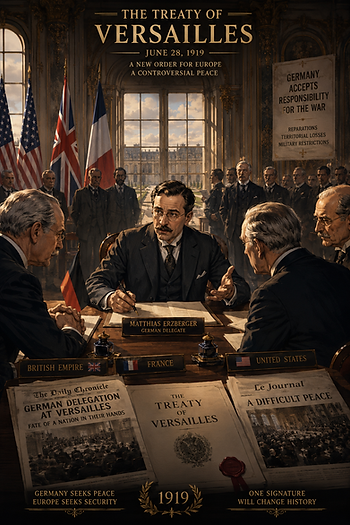
My Name is Matthias Erzberger: German Statesman and Advocate for Peace
I was born in 1875 in the Kingdom of Württemberg, the son of a tailor living in modest conditions. Unlike many powerful German politicians, I did not come from wealth or military tradition. I became a teacher before entering politics, and my Catholic faith shaped much of my thinking. I believed government should serve ordinary people rather than only generals, aristocrats, and industrial elites. Many conservative Germans distrusted men like me because I challenged the old order that had ruled Germany for generations.
Entering Politics
I joined the Catholic Centre Party and quickly became known as a determined speaker and organizer. Early in my political career, I supported German expansion and defended the empire’s role in the world. Like many Germans, I believed our nation deserved greater influence and respect among the great powers. My critics later accused me of changing my beliefs too easily, but I saw myself as practical rather than stubborn. I believed leaders needed to adapt when reality changed around them.
The Great War Changes Everything
When World War I began in 1914, I strongly supported the war effort and believed Germany could achieve victory. But as the war dragged on, millions died, the economy weakened, and starvation spread across the country. By 1917, I had become convinced that Germany could not continue fighting without destroying itself completely. I shocked many people by supporting peace negotiations and parliamentary reforms. Nationalists accused me of betrayal, but I could not understand why admitting reality was considered treason.
Calling for Peace
I became one of the leading voices calling for a negotiated peace instead of endless war. Germany’s military leaders wanted to continue fighting, even when defeat seemed unavoidable, and I believed they were sacrificing the nation to protect their pride. I pushed for democratic reforms and greater civilian control over government decisions. Many officers and conservatives hated me for this. They believed I weakened Germany from within, while I believed I was trying to save it from total collapse.
Signing the Armistice
In November 1918, I was chosen to lead the German delegation that signed the Armistice ending the war. It was one of the most painful moments of my life. Germany’s military situation had become hopeless, and I believed ending the fighting was necessary to prevent even greater suffering. Yet many Germans refused to accept defeat. Instead of blaming the generals who led the war, they blamed politicians like me who admitted the truth. I never understood why honesty made me more hated than the men who led millions into disaster.
The “Stab-in-the-Back” Myth
After the war, nationalist groups spread the false claim that Germany’s army had been betrayed by politicians, socialists, and Jews rather than defeated militarily. Because I had signed the Armistice, I became one of their favorite targets. Newspapers attacked me constantly, and enemies portrayed me as weak and dishonorable. I defended the new democratic government because I believed Germany needed reform and stability, but extremists saw compromise itself as weakness. Their hatred grew stronger each year.
Rebuilding Germany
As Finance Minister in the new Weimar Republic, I worked to reform Germany’s tax system and stabilize the economy. Wealthy elites and conservatives resisted many of my policies because they feared losing influence and money. I believed Germany needed fairness and modernization to survive after the war. Yet every reform created new enemies. It seemed to me that many Germans wanted recovery without sacrifice and strength without responsibility.
The Armistice Ends the Fighting (November 1918) - Told by Matthias Erzberger
By the autumn of 1918, Germany was exhausted. For four years our armies had fought across Europe while our people at home struggled with hunger, shortages, and fear. British blockades cut off supplies, cities faced starvation, and soldiers returned from the front with stories of endless death and collapsing morale. Yet many Germans still believed our armies remained strong because the war had not reached deep into Germany itself. Enemy soldiers were not marching through Berlin, and that fact would shape dangerous ideas in the years ahead.
The Final Collapse
What many civilians did not fully understand was how quickly the military situation was breaking apart. Germany’s great spring offensives in 1918 had failed, and fresh American troops were arriving in massive numbers. Along the Western Front, our soldiers were retreating under constant Allied attacks. Generals such as Paul von Hindenburg and Erich Ludendorff realized the war could no longer be won. Yet instead of publicly admitting complete military defeat, they pushed civilian politicians like me to negotiate peace, allowing the army to avoid much of the public blame.
Chosen for an Impossible Mission
I was selected to lead the German delegation because I supported peace negotiations and parliamentary reform. To many nationalists, that already made me suspicious. Still, I accepted the task because I believed continuing the war would destroy Germany entirely. We traveled through devastated countryside into a railway carriage in the Compiègne Forest of France, where Allied commanders waited. There was no celebration, no discussion between equals, and little room for negotiation. The Allies dictated terms while Germany listened in silence.
The Armistice Terms
The terms were harsh but unavoidable. Germany had to withdraw from occupied territories, surrender enormous amounts of military equipment, release prisoners, and accept the continuation of the naval blockade. Our navy and army were left weakened while Allied forces prepared for occupation along the Rhine. Many Germans later asked why we accepted such conditions, but they did not see the reports I saw. The front was collapsing, supplies were disappearing, and revolution was spreading inside Germany itself.
The Eleventh Hour
At 11:00 a.m. on November 11, 1918, the guns finally fell silent. Across Europe, soldiers climbed from trenches after years of living among mud, rats, gas, and death. Church bells rang in Allied cities while crowds celebrated in the streets. In Germany, however, the mood was far more uncertain. Relief mixed with confusion, anger, and disbelief. Because German territory had not been fully conquered, many civilians struggled to understand how the nation could suddenly agree to stop fighting.
The Dangerous Myth Begins
That confusion soon turned into something even more dangerous. Many Germans convinced themselves the army had not truly been defeated in battle and that politicians had “betrayed” the nation through negotiation. This became known as the “stab-in-the-back” myth. Nationalists claimed civilian leaders, reformers, and democrats had surrendered while the army remained undefeated. I knew this was false. Germany’s military leaders themselves had demanded an armistice because they understood the war was lost. But admitting defeat was painful, and many people preferred anger over reality.
The Shadow Over Germany
The armistice ended the fighting, but it did not bring peace to Germany’s spirit. The nation entered the postwar years divided, humiliated, and searching for someone to blame. I feared that the refusal to accept the truth about the war would poison Germany’s future, and in many ways, it did. The guns of World War I had fallen silent, but bitterness and resentment continued marching forward long after the battlefield grew quiet.

My Name is David Lloyd George: Prime Minister of Britain and Architect of Peace
I was born in Manchester in 1863, but it was Wales that shaped me. My father died when I was very young, and my family struggled with poverty. My uncle, a shoemaker and a strong Liberal, raised me to believe that ordinary people deserved opportunity and respect. I grew up surrounded by hardworking families who distrusted the wealthy elite of Britain, and I carried that feeling with me into politics. Even as a young solicitor, I believed I understood the problems of common people better than the men born into power.
The Radical Politician
When I entered Parliament, I quickly became known as a troublemaker. I attacked wealthy landowners, criticized the House of Lords, and pushed for reforms that shocked many traditional politicians. I helped create pensions for the elderly and programs for workers, and I believed Britain could become stronger if the government protected the poor. My opponents called me dangerous and reckless, but I thought they simply feared change. I often wondered why so many powerful men resisted reforms that seemed so obvious to me.
War and Leadership
When the Great War began in 1914, Britain faced a disaster unlike anything Europe had seen. At first, I was uncertain about the war, but as Germany pushed through Europe, I became convinced Britain had to fight with everything it had. I eventually became Prime Minister in 1916 and transformed Britain into a nation fully committed to total war. I demanded more weapons, more soldiers, and greater sacrifice from civilians. Some people believed I pushed too hard and gave the government too much power, but I saw hesitation as weakness in a fight for survival.
The Peace Conference
After the war ended, I traveled to Paris to help shape the peace. Britain wanted Germany punished, but I also feared that destroying Germany completely would create even greater problems in Europe. I found myself caught between angry citizens demanding revenge and leaders who wanted severe punishment. I believed I was being reasonable, yet nearly everyone accused me of betraying them. The French thought I was too soft, while many Germans saw me as cruel. I could never understand why compromise angered so many people.
The Treaty of Versailles
At the Paris Peace Conference, I supported reparations and limits on Germany’s military, but I warned against pushing Germany into total ruin. Still, I allowed harsh terms to remain in the treaty because public pressure in Britain was enormous. Many citizens wanted Germany to pay for the suffering of the war, and I believed ignoring that anger could tear Britain apart politically. Economists like John Maynard Keynes argued the treaty would create disaster, but at the time I believed Europe needed justice before it could have peace.
Power, Scandal, and Decline
My years after the war became increasingly controversial. Critics accused me of selling honors and political favors, and many believed I cared too much about staying in power. I defended my decisions fiercely because I believed strong leadership required flexibility and political skill. Yet over time, people who once admired me began to turn away. By 1922, my government collapsed, and I spent the rest of my political life watching others reshape the world I had helped build.
Europe After the Great War - Told by David Lloyd George
When the guns finally fell silent in November 1918, Europe looked less like the center of civilization and more like the aftermath of a giant disaster. Entire regions of northern France and Belgium had been blasted apart by artillery fire. Villages vanished from maps, roads were shattered, railways twisted into scrap metal, and farmland became fields of mud filled with shells, barbed wire, and graves. Millions of soldiers never returned home, and those who did often carried wounds that could not be seen. Europe had won the war against Germany, but in many ways the continent itself had been broken.
The Human Cost of War
Nearly every nation involved in the war faced staggering losses. France lost over a million soldiers, Germany suffered millions of casualties, Russia collapsed into revolution, and Britain mourned an entire generation of young men. Families across Europe lived with empty chairs at dinner tables and communities stripped of fathers, brothers, and sons. Hospitals overflowed with wounded veterans blinded by gas attacks or crippled by machine-gun fire. At the same time, the deadly influenza pandemic swept across the world in 1918 and 1919, killing millions more people weakened by years of war and hunger.
Starvation and Economic Collapse
Even after the fighting stopped, many Europeans struggled simply to survive. Germany and parts of Central Europe faced severe food shortages caused by wartime blockades and economic collapse. Children fainted in schools from hunger, coal shortages left homes freezing during winter, and inflation destroyed the value of savings people had spent their entire lives building. Governments borrowed enormous sums during the war, and by 1919 many nations were buried under mountains of debt. Britain owed money to the United States, France demanded reparations from Germany, and Germany itself stood on the edge of financial ruin.
Empires Fall Apart
The war destroyed far more than buildings and economies. It shattered ancient empires that had ruled Europe for centuries. The German Empire collapsed, Austria-Hungary broke into smaller nations, the Russian Empire fell into revolution and civil war, and the Ottoman Empire began to disintegrate in the Middle East. In their place came new countries with uncertain borders, competing ethnic groups, and weak governments struggling to survive. Many people celebrated freedom and independence, but others immediately began fighting over territory, language, religion, and power.
Fear of Revolution
One of the greatest fears after the war was the spread of revolution. In Russia, the Bolsheviks had overthrown the old government and created a communist state under Vladimir Lenin. Across Europe, workers went on strike, soldiers mutinied, and radical political groups promised to tear down existing governments. Germany experienced uprisings in its cities, Hungary briefly fell under communist rule, and many leaders feared Europe could descend into total chaos. To men like me, restoring order became just as important as punishing those responsible for the war.
The Burden of Peace
At the Paris Peace Conference, we faced an impossible challenge. People demanded justice for the suffering of the war, but Europe also needed stability and recovery. France wanted security against future German attacks, Britain wanted to preserve balance and trade, and smaller nations demanded recognition and territory. Every decision carried consequences. Too much punishment could create bitterness and revenge, while too little could make the sacrifices of the war seem meaningless. We were not rebuilding a peaceful continent—we were trying to hold together a wounded one.
A Fragile Future
As I looked across Europe after the war, I realized victory had not truly solved the continent’s problems. Hatred, debt, hunger, and political extremism still lingered beneath the surface. Millions hoped the Great War would be “the war to end all wars,” yet many nations left the conflict angry, fearful, and distrustful of one another. Europe survived the war, but the peace that followed remained fragile, uncertain, and haunted by the destruction that had come before.
The Paris Peace Conference Begins - Told by David Lloyd George
In January 1919, the city of Paris became the meeting place for the most powerful leaders on Earth. Diplomats, generals, advisers, journalists, and representatives from dozens of nations crowded into the French capital, all hoping to shape the future after the destruction of the Great War. Hotels overflowed with officials carrying maps, reports, and demands from their governments. Everywhere one looked, there were uniforms, flags, and arguments. The war had ended on the battlefield, but another struggle was only beginning at the negotiating table.
The Victorious Powers Arrive
Although many nations attended the conference, a small group of leaders quickly dominated the discussions. I represented Britain, while Georges Clemenceau spoke for France, Woodrow Wilson represented the United States, and Vittorio Emanuele Orlando fought for Italy’s interests. Newspapers called us the “Big Four.” Each of us arrived believing our nation had sacrificed greatly during the war and deserved influence over the peace that would follow.
France Wants Security
No nation feared Germany more than France. Much of the war’s destruction had taken place on French soil, and entire regions lay in ruins. Clemenceau demanded harsh punishment against Germany to ensure France would never again face invasion. He wanted Germany weakened militarily, economically, and territorially. Many French citizens supported him completely because they had witnessed the horrors of trench warfare firsthand. To France, security mattered more than mercy.
Britain Seeks Balance
Britain’s position was more complicated. Many people at home demanded Germany pay heavily for the war, especially after years of submarine attacks and battlefield losses. Yet I also worried that crushing Germany too severely could damage European trade and create instability across the continent. Britain depended on a balanced Europe for economic strength and global influence. I often found myself caught between public anger demanding punishment and my belief that Europe needed recovery as much as revenge.
Wilson’s Vision of Peace
President Wilson arrived in Paris with ideas that sounded very different from the traditional politics of Europe. He spoke about self-determination, open diplomacy, and a new international organization called the League of Nations that would prevent future wars. Crowds welcomed him as a symbol of hope, but many European leaders privately doubted whether his idealism matched reality. Wilson believed nations could cooperate peacefully through fairness and negotiation, while others believed strong nations survived only through power and caution.
Italy and the Smaller Nations
Italy entered the conference determined to receive the territories it had been promised for joining the war against Germany and Austria-Hungary. Orlando argued passionately for Italian claims along the Adriatic coast, while representatives from smaller nations across Europe demanded independence, borders, and recognition. Poles, Czechs, Serbs, Arabs, Greeks, and many others arrived hoping the collapse of old empires would finally give them freedom. Yet many of their territorial claims overlapped, creating endless arguments over maps and borders.
Germany Left Outside
One of the most important facts about the conference was that Germany itself was excluded from the early negotiations. The defeated powers were not treated as equal participants in shaping peace. Instead, the victorious nations debated Germany’s future without German representatives present. This decision deeply angered many Germans and later fueled resentment toward the treaty. At the time, however, most Allied leaders believed Germany had forfeited the right to negotiate after causing such devastation across Europe.
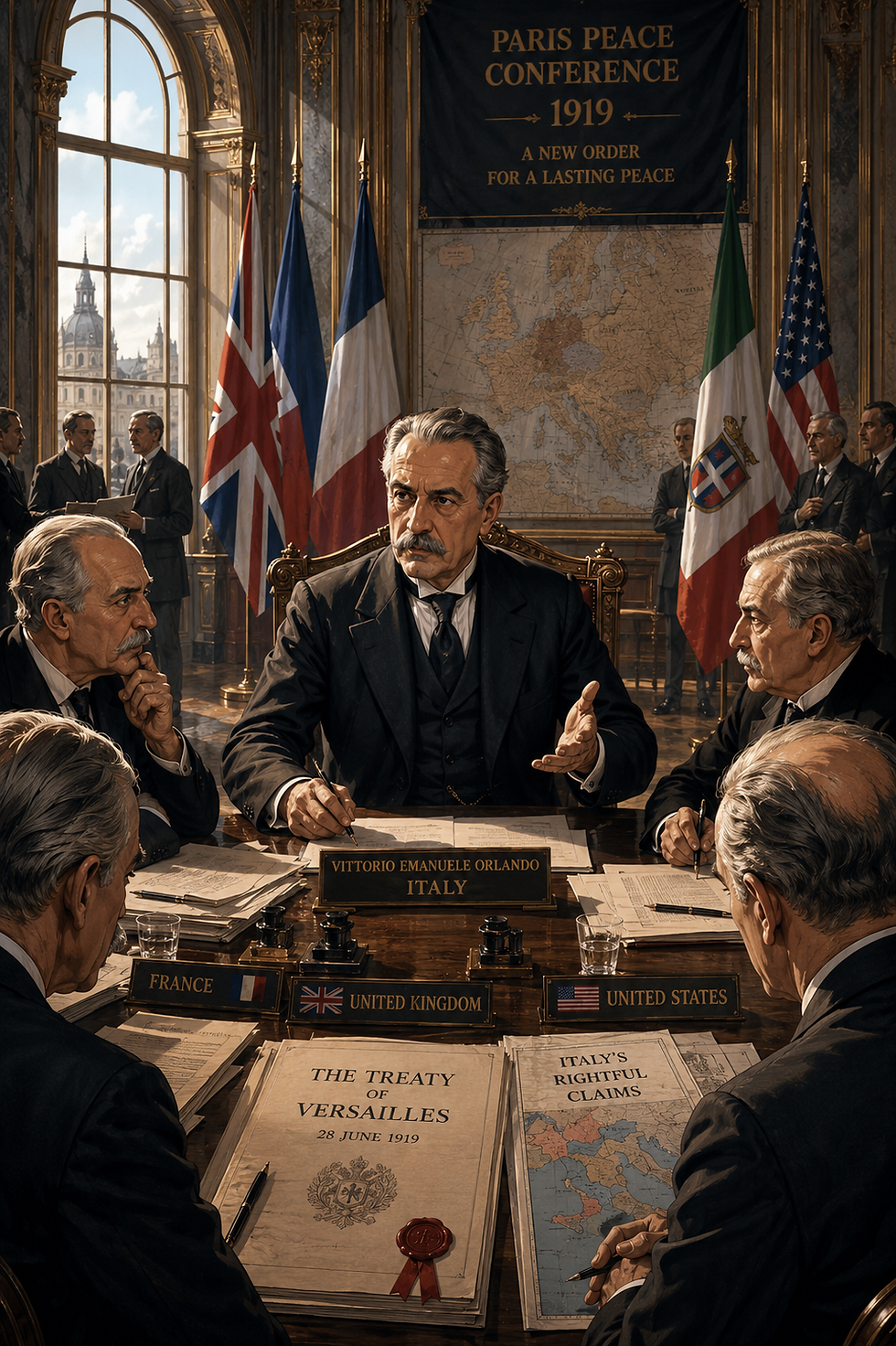
My Name is Vittorio Emanuele Orlando: Prime Minister of Italy
I was born in Sicily in 1860 during a time when Italy itself was still young and struggling to become united. Violence, political instability, and poverty surrounded much of my early life, and I learned quickly that government could either strengthen a nation or leave it weak and divided. I studied law and became fascinated with the power of the state. To me, Italy deserved respect among the great powers of Europe, and I spent much of my life trying to make that happen.
The Scholar Becomes a Politician
Before becoming Prime Minister, I built my reputation as a legal scholar and politician. I believed strongly in constitutional government, but I also believed leaders needed authority and strength during times of crisis. Some critics accused me of caring too much about national pride and not enough about compromise, but I thought compromise without strength only invited humiliation. Italy had long been treated as weaker than Britain, France, or Germany, and I wanted to change that forever.
Italy and the Great War
When the Great War began, Italy at first remained neutral, but eventually joined the Allies after being promised territory in return for entering the war. The fighting along the Alps became brutal beyond imagination, and hundreds of thousands of Italian soldiers died in terrible conditions. When I became Prime Minister in 1917 after the disaster at Caporetto, I focused on rebuilding morale and convincing the Italian people that victory was still possible. I believed Italy had sacrificed too much to walk away empty-handed.
The Paris Peace Conference
At the Paris Peace Conference in 1919, I arrived determined to secure the territories promised to Italy during the war. I argued fiercely for lands along the Adriatic coast and believed Italy had earned them through blood and sacrifice. Yet many Allied leaders resisted Italian demands, especially over the city of Fiume. I could not understand why nations that preached self-determination suddenly opposed Italian claims when it suited their interests. To me, their arguments sounded hypocritical and dishonest.
Walking Out in Protest
Frustrated by the negotiations, I temporarily walked out of the conference in protest. Many foreign newspapers mocked me for it, but I believed Italy deserved dignity and respect. Back home, many Italians supported my anger because they felt the Allies treated Italy as a secondary power despite its sacrifices during the war. Critics later claimed my actions weakened Italy’s position, but at the time I thought firmness was the only language powerful nations understood.
The “Mutilated Victory”
Although Italy gained territory after the war, many Italians believed the victory had been stolen from them. Nationalists called it a “mutilated victory,” arguing that Italy had not received everything it had been promised. I shared much of that frustration. I believed the Allies had ignored Italy’s suffering while protecting their own interests. I never fully understood why other leaders expected Italians to quietly accept disappointment after enduring years of hardship and sacrifice.
The Rise of Mussolini
The anger and instability after the war helped extremist movements grow across Italy. As the years passed, Benito Mussolini rose to power by promising strength, order, and national pride. Although I opposed dictatorship, I recognized that many Italians had lost faith in the old political system after Versailles. Some later blamed leaders like me for failing to stabilize the country, but I believed the postwar settlement itself created much of the bitterness that extremists exploited.
Conflicting Goals of the Allied Powers - Told by Vittorio Emanuele Orlando
When the fighting ended in 1918, many people imagined the Allied nations would stand together in complete agreement after defeating Germany and the Central Powers. They were wrong. The moment we gathered in Paris for the peace conference, it became clear that each nation wanted something very different from the peace settlement. Though we had fought together during the war, we had not suffered in the same ways, and we certainly did not share the same vision for Europe’s future.
France Demands Protection
No Allied nation pushed harder for punishment than France. Large sections of northern France had been destroyed by years of trench warfare, and millions of French families mourned dead soldiers. Georges Clemenceau believed Germany must be weakened permanently so France would never face another invasion. He demanded reparations, military restrictions, and territorial changes that would leave Germany unable to threaten France again. To the French, harsh peace terms were not revenge—they were survival.
Britain Walks a Narrow Path
Britain’s position, led by David Lloyd George, was more complicated. British citizens wanted Germany punished for the war and for submarine attacks against civilians and merchant ships. Yet Britain also depended on trade and worried that destroying Germany’s economy entirely could damage Europe as a whole. Lloyd George often found himself balancing between public anger at home and fears that excessive punishment could create future instability. Britain wanted Germany weakened, but not so broken that chaos spread across Europe.
America Brings Idealism
The United States entered the conference with ideas that many Europeans viewed as unrealistic. President Woodrow Wilson spoke constantly about fairness, self-determination, and his vision for the League of Nations. Wilson believed lasting peace could come through cooperation between nations rather than secret alliances and old European rivalries. But many leaders privately questioned whether idealism alone could protect nations from future wars. Europe had spent centuries surviving through power politics, not hopeful speeches.
Italy Wants What Was Promised
Italy entered the war in 1915 after being promised territory by the Allies in the secret Treaty of London. Hundreds of thousands of Italian soldiers died fighting Austria-Hungary in brutal mountain warfare, and the Italian people expected rewards for their sacrifices. I arrived in Paris determined to secure those promised territories, especially along the Adriatic coast. Yet I quickly discovered that some Allied leaders suddenly opposed the very agreements they had once supported. I could not understand why Italy was expected to sacrifice like a great power during war but accept treatment like a lesser nation during peace.
Smaller Nations Demand Independence
Beyond the major powers, representatives from smaller nations filled Paris with their own demands. Poles wanted a reborn Poland. Czechs and Slovaks sought independence from Austria-Hungary. Serbs hoped to unite South Slavic peoples into a new nation called Yugoslavia. Arabs sought independence from the collapsing Ottoman Empire. Everywhere, old empires were breaking apart and new national movements were rising. But many of these groups claimed the same lands, creating endless disputes over borders, ethnicity, and political control.
Arguments Behind Closed Doors
Much of the conference became a battle of competing fears and ambitions. France feared another German invasion. Britain feared economic collapse and instability. Italy feared humiliation and broken promises. Smaller nations feared being ignored entirely. Meetings that began with speeches about peace often turned into tense arguments over maps, reparations, military power, and national pride. Every leader claimed to seek justice, but each nation defined justice differently.
A Peace Built on Disagreement
In the end, the Allied powers signed treaties together, but true unity never existed beneath the surface. The peace settlement reflected compromise, pressure, and political bargaining rather than complete agreement. Some nations left Paris believing the treaty was too harsh, while others believed it was far too soft. The conference revealed a difficult truth: even victorious allies can become divided once the common enemy is gone.
Germany Excluded from Negotiations - Told by Matthias Erzberger
When the war ended in November 1918, many Germans believed peace negotiations would involve discussion between nations seeking stability after years of bloodshed. Instead, Germany discovered it would not be treated as a partner in peace, but as a defeated power expected to accept decisions made by others. While the Allied leaders gathered in Paris to reshape Europe, German representatives were forced to wait outside the process, uncertain of what future was being designed for our country behind closed doors.
The Allied View of Germany
The victorious powers believed Germany carried the greatest responsibility for the war and therefore had no right to help shape the settlement. France had suffered invasion and destruction, Britain had lost enormous numbers of soldiers and ships, and millions across Europe blamed Germany’s leadership for unleashing the conflict in 1914. Allied leaders feared that allowing Germany equal participation might weaken the peace terms or create endless arguments before agreements could even begin. To them, Germany had surrendered and therefore had forfeited the privilege of negotiation.
A Humiliating Silence
For months, the conference continued while Germany received little information about the discussions taking place in Paris. Maps were redrawn, reparations debated, colonies reassigned, and military restrictions planned without German participation. Many Germans found this deeply humiliating. Even citizens who accepted that Germany had lost the war struggled to understand why their nation was denied a voice entirely. The situation created the feeling that peace was not being negotiated at all—it was simply being dictated.
The Treaty Is Revealed
In May 1919, German delegates were finally summoned to Versailles, but not to bargain. Instead, they were handed the completed treaty and told to accept it. When the terms became public, shock spread across Germany. The treaty demanded territorial losses, severe military restrictions, reparations, and acceptance of responsibility for the war through Article 231, later called the War Guilt Clause. Many Germans believed the treaty went far beyond reasonable punishment and treated Germany as though it alone had caused the catastrophe that destroyed Europe.
The Feeling of Betrayal
One reason resentment grew so quickly was because many Germans believed the Armistice had been based on President Woodrow Wilson’s Fourteen Points, which spoke about fairness, self-determination, and open diplomacy. Germans expected negotiations built on those principles. Instead, they felt trapped by terms decided before they were even allowed into the room. This created anger not only toward the Allies, but toward German politicians like myself who argued the treaty must still be accepted to avoid renewed war and occupation.
Why Germany Still Believed It Could Negotiate
Unlike nations completely occupied during war, Germany’s situation in 1918 confused many citizens. Allied armies had not marched to Berlin, and much of Germany itself remained intact. Because of this, millions believed the army had not truly been defeated in the field. They saw the sudden surrender and harsh treaty as political weakness rather than military necessity. The exclusion from negotiations strengthened this belief because Germans felt they had been denied even the dignity normally given to defeated nations.
Anger Turns Dangerous
As resentment spread, nationalist groups began claiming Germany had been deliberately humiliated by foreign powers and betrayed by internal enemies. The exclusion from the peace process became one of the most powerful symbols of that humiliation. Many Germans no longer saw the treaty as a fair settlement between nations, but as a punishment forced upon them without representation. This bitterness weakened support for the new democratic government and fueled extremist movements that promised revenge and national restoration.
The War Guilt Clause - Told by Matthias Erzberger
Among all the terms in the Treaty of Versailles, no section created more outrage inside Germany than Article 231, later called the “War Guilt Clause.” The article declared that Germany and its allies accepted responsibility for causing the war and for the damage that resulted from it. To many Allied leaders, this clause was a legal necessity used to justify reparations and financial compensation. But to millions of Germans, those words felt like a national humiliation written into history itself.
Why the Allies Demanded It
The Allied nations emerged from the war devastated. Northern France had been destroyed by years of trench warfare, Belgium had been invaded, millions of soldiers were dead, and entire economies had collapsed under the weight of total war. Leaders such as Georges Clemenceau believed Germany should pay for the enormous damage caused during the conflict. In order to demand reparations legally, the treaty needed a statement assigning responsibility. Article 231 became that statement.
Germany’s View of the War
Inside Germany, however, the clause sparked fury almost immediately. Many Germans did not believe their nation alone had caused the war. They pointed to the tangled alliance system, the militarism of multiple European powers, Russian mobilization, Serbian nationalism, and the aggressive policies of many governments before 1914. Even Germans who admitted their leaders had made serious mistakes often rejected the idea that Germany should carry sole blame for a catastrophe involving nearly all of Europe’s major powers.
The Psychological Blow
The wording of the clause mattered deeply because it attacked more than Germany’s finances—it attacked national pride. Millions of German soldiers believed they had fought bravely and honorably for their country during four years of terrible warfare. To them, Article 231 seemed to transform their sacrifices into acts of criminal aggression. Veterans returned home feeling dishonored, while families mourning lost sons heard foreign governments declare Germany responsible for the deaths of millions.
Fuel for Political Extremism
The War Guilt Clause became one of the most powerful weapons used by nationalist movements against the new German government. Because democratic politicians eventually signed the treaty, extremists accused them of betraying the nation and accepting false guilt forced upon Germany by foreign powers. The clause strengthened the dangerous “stab-in-the-back” myth, which falsely claimed Germany’s army had not truly lost the war but had been betrayed by politicians, reformers, and civilians at home.
A Divided Germany
Even moderate Germans who wanted peace struggled to accept the clause. I myself understood why the Allies wanted compensation for the destruction of the war, but I also knew the wording of Article 231 would create bitterness for generations. Germany’s people were more willing to discuss reparations than to accept permanent moral condemnation. The distinction mattered enormously. One involved money and rebuilding. The other involved national honor and historical memory.
Debates Among Historians
Over time, historians have debated Germany’s responsibility for the outbreak of World War I. Many scholars agree Germany played a major role, especially through its support for Austria-Hungary during the July Crisis of 1914. Yet most historians today also recognize that the causes of the war were complex and involved many nations, alliances, rivalries, and decisions made across Europe. This complexity is one reason the War Guilt Clause remains controversial even now.

My Name is John Maynard Keynes: Economist and Challenger of Governments
I was born in Cambridge, England, in 1883, into a family that valued education and intellect above nearly everything else. My father was an economist and my mother was deeply involved in public life, so discussions about politics, ideas, and society filled my childhood. From an early age, I believed problems could be solved through reason and careful thinking. Numbers fascinated me, but so did people. I never understood why governments often ignored logic when making decisions that affected millions of lives.
Cambridge and Confidence
At Cambridge University, I quickly developed confidence in my own ideas. I studied mathematics and economics and surrounded myself with brilliant writers, artists, and philosophers. Many people thought I was arrogant, and perhaps I was. I often believed I could see flaws in economic systems that others either ignored or refused to understand. To me, economies were not mysterious forces beyond control. They were human creations, and humans could change them if they had the courage to think differently.
The Great War
During the First World War, I worked for the British Treasury and helped manage Britain’s wartime finances. The war drained Europe of money, resources, and lives, and I watched governments make desperate financial decisions to keep fighting. While many leaders focused only on victory, I worried about what would happen after the guns fell silent. I believed Europe’s survival depended not only on military success, but on rebuilding economies before desperation turned into chaos.
Versailles and My Anger
When I attended the Paris Peace Conference in 1919, I was shocked by what I saw. Leaders demanded harsh reparations and punishment against Germany, and I believed they were blinded by revenge and political pressure. I argued that crushing Germany economically would damage all of Europe and create bitterness that future generations would inherit. Yet many politicians dismissed my warnings as weakness or sympathy for the enemy. I could never understand why so many intelligent men refused to see that starving nations rarely remain peaceful.
The Economic Consequences of the Peace
Frustrated and angry, I resigned from the conference and wrote my book, The Economic Consequences of the Peace. In it, I attacked the Treaty of Versailles and accused Allied leaders of acting recklessly. The book made me famous around the world, but also deeply controversial. Many believed I exaggerated the danger or undermined the sacrifices of the war. I did not apologize. I thought history would prove I was right, and I often spoke as though my critics simply lacked vision or courage.
Challenging Old Economics
As the world economy struggled during the 1920s and collapsed during the Great Depression, I pushed even harder against traditional economic thinking. Most economists believed governments should spend less during hard times, but I argued the opposite. I believed governments should invest money, create jobs, and stimulate demand to rescue economies from collapse. Critics called my ideas reckless and dangerous, and some accused me of encouraging debt and government control. I could not understand why people preferred economic suffering over bold action.
War, Recovery, and Reflection
During the Second World War, many governments finally adopted ideas similar to the ones I had argued for years earlier. I helped shape plans for rebuilding the global economy and creating new international financial institutions after the war. By then, people treated me less like a radical and more like a visionary, though I remained convinced that governments still moved too slowly and feared change too much.
Reparations and Economic Punishment - Told by John Maynard Keynes
When the First World War ended in 1918, Europe faced destruction on a scale few people had imagined possible. Cities and villages across France and Belgium had been shattered by artillery fire, factories destroyed, railways ruined, and farmland turned into wastelands filled with trenches and unexploded shells. Millions of soldiers were dead, while governments had borrowed enormous amounts of money simply to keep fighting. The victorious nations believed someone should pay for this devastation, and they looked directly at Germany.
What Reparations Meant
Reparations were financial payments demanded from Germany to compensate the Allied nations for wartime damage and losses. The idea itself was not entirely new. Victorious nations had often demanded payment after wars throughout history. But after World War I, the scale was unlike anything Europe had seen before. France demanded money to rebuild destroyed regions, Britain sought compensation for military losses and debts, and smaller nations also expected payment for suffering caused during the conflict.
The Political Pressure for Punishment
Leaders at the Paris Peace Conference faced enormous pressure from their citizens. In Britain, many newspapers and politicians demanded Germany “pay the bill” for the war. French citizens who had watched their homes and towns destroyed wanted justice and security. Politicians feared appearing weak toward Germany after so many millions had died. As emotions rose, reparations became not only an economic issue, but also a symbol of punishment and revenge.
Why I Became Alarmed
As a member of the British delegation at Versailles, I watched these discussions with growing concern. Many leaders spoke as though Germany possessed endless wealth that could simply be extracted without consequences. I believed this was dangerously unrealistic. Germany’s economy had already been weakened by war, naval blockades, shortages, and political instability. If the Allies demanded excessive payments, Germany would struggle to rebuild, trade would collapse, unemployment would spread, and all of Europe could suffer economically.
The Economic Web of Europe
What many politicians failed to understand was that Europe’s economies were deeply connected. Germany had been one of the continent’s major industrial powers before the war. Factories in Britain, France, and other countries depended on trade with German businesses and consumers. If Germany collapsed economically, the damage would not stop at its borders. Starvation, inflation, unemployment, and political chaos could spread across Europe like a disease. I feared the peace conference was creating a settlement driven more by emotion than practical economics.
The Treaty and the Numbers
The final reparations amount demanded from Germany eventually reached 132 billion gold marks, an enormous sum for the time. Germany was expected to pay through money, industrial goods, coal shipments, and other resources. Even many Germans willing to accept defeat believed the demands were impossible. As economic pressure increased during the 1920s, Germany faced hyperinflation so severe that paper money became nearly worthless. People carried wheelbarrows filled with banknotes simply to buy bread.
My Warning to Europe
After resigning from the peace conference, I wrote a book called The Economic Consequences of the Peace. In it, I argued that the treaty’s economic punishment would create bitterness, instability, and future conflict rather than lasting peace. Many politicians dismissed my warnings at the time. Some believed I exaggerated the danger or cared too much about Germany’s economy. But I believed starving and humiliating a major European nation would create desperation that extremist movements could exploit.
The Dangerous Legacy
In the years that followed, economic hardship and resentment helped weaken Germany’s democratic government and fueled radical political movements promising revenge and national restoration. Though reparations alone did not cause Europe’s future crises, they became one of the most controversial parts of the Treaty of Versailles. The lesson many later learned was simple but important: peace built entirely on punishment can create wounds that continue growing long after the war itself has ended.
Military Restrictions on Germany - Told by David Lloyd George
When the First World War ended, Europe feared Germany’s military power more than anything else. For four years, German armies had marched across Belgium and France while German submarines attacked ships across the Atlantic. Millions had died in battles caused by industrialized warfare on a scale never seen before. At the Paris Peace Conference, many Allied leaders believed lasting peace would be impossible unless Germany’s military strength was permanently reduced.
The Army Reduced
One of the most important parts of the Treaty of Versailles involved strict limits placed on the German army. Before the war, Germany possessed one of the largest and most powerful armies in the world. Under the treaty, however, Germany’s army was reduced to only 100,000 soldiers. Conscription, which had allowed Germany to rapidly build huge forces, was banned entirely. Germany could no longer maintain massive reserves of trained men ready for future war. To France especially, this restriction was considered necessary for survival.
Weapons Germany Could Not Have
The treaty also forbade Germany from possessing many modern weapons. Tanks, heavy artillery, poison gas stockpiles, and armored vehicles were heavily restricted or banned outright. Allied leaders believed these weapons had transformed World War I into a catastrophe of endless destruction. By limiting Germany’s access to advanced military equipment, the Allies hoped to slow any future attempt at rearmament and prevent another conflict before it could begin.
The End of Germany’s Air Force
One of the most dramatic restrictions involved Germany’s air power. Before and during the war, aircraft technology had advanced rapidly, and German planes had bombed cities and fought deadly battles in the skies. The Treaty of Versailles completely banned Germany from having an air force. Military aircraft, pilot training programs, and aviation weapons were prohibited. At the time, many leaders feared air warfare would become even more destructive in future conflicts.
Restrictions on the German Navy
Britain focused especially on Germany’s navy. Before 1914, Germany had challenged British naval dominance by building a powerful fleet of battleships and deadly U-boats. During the war, German submarines nearly strangled Britain’s supply lines and helped draw the United States into the conflict. Under the treaty, Germany’s navy was reduced to a small defensive force with only a few ships allowed. Submarines were completely banned because Allied leaders viewed them as one of the most dangerous weapons of modern warfare.
The Rhineland Demilitarized
Perhaps the most sensitive issue involved the Rhineland, the region along Germany’s western border near France. The treaty declared the Rhineland a demilitarized zone, meaning Germany could not station troops or build military fortifications there. France demanded this protection because German invasions had repeatedly crossed through this region in previous wars. To the French, a demilitarized Rhineland created a security barrier against future attack. To many Germans, however, it felt like foreign powers were controlling part of their homeland.
German Reaction to the Restrictions
At first, Germany had little choice but to accept these terms because the country remained weakened and politically unstable after the war. Yet many Germans viewed the military restrictions as deeply humiliating. Veterans who believed they had fought honorably saw the treaty as an attempt to strip Germany of pride and sovereignty. Nationalists argued that no great nation could remain respected while forbidden from defending itself properly.
The Long-Term Consequences
The Allied powers hoped military restrictions would prevent another world war, but over time the treaty’s limits became a source of growing resentment inside Germany. During the 1930s, Adolf Hitler used anger over Versailles to gain support, promising to rebuild Germany’s armed forces and restore national strength. When German troops eventually re-entered the Rhineland in 1936, many Europeans realized the restrictions created at Versailles were beginning to collapse. The treaty had attempted to secure peace through disarmament, but peace requires more than limiting weapons alone.
Territorial Losses and Colonial Changes - Told by Vittorio Emanuele Orlando
When the First World War ended, the leaders gathered in Paris did far more than negotiate peace terms. We reshaped the political map of Europe and much of the world. Old empires collapsed, borders moved, and entire populations suddenly found themselves living under new governments. Germany, as the defeated power, lost territory, colonies, and much of the influence it had built before the war. Many Allied leaders believed these changes were necessary for security and justice, but they also created anger and instability that would echo for decades.
Germany Loses Land in Europe
One of the most immediate consequences of the Treaty of Versailles was Germany’s loss of territory within Europe itself. France regained Alsace-Lorraine, a region Germany had taken after the Franco-Prussian War in 1871. Belgium received smaller border territories, while Denmark regained Northern Schleswig after a public vote. In the east, large sections of German territory were transferred to the newly recreated nation of Poland, giving Poland access to the Baltic Sea through what became known as the “Polish Corridor.”
The Dividing of East Prussia
The creation of the Polish Corridor had enormous consequences. It separated East Prussia from the rest of Germany, leaving part of the country physically cut off by Polish territory. Germans deeply resented this arrangement because millions believed ethnic Germans had been unfairly placed under foreign rule. At the same time, Poland argued that access to the sea was necessary for its survival as an independent nation. The conference revealed how difficult it was to draw borders fairly in regions where different ethnic groups had lived side by side for centuries.
The Saar and the Rhineland
Germany also lost control over important industrial regions. The Saar Basin, rich in coal, was placed under League of Nations administration while France gained access to its coal mines. The Rhineland remained part of Germany, but it was demilitarized to protect France from future invasion. These decisions weakened Germany economically and militarily while strengthening French security. To many Germans, however, they felt like foreign occupation hidden behind diplomatic language.
The Loss of Overseas Colonies
Before the war, Germany possessed colonies in Africa, the Pacific, and parts of Asia. These territories included German East Africa, German Southwest Africa, Cameroon, Togo, and island possessions across the Pacific Ocean. Under the Treaty of Versailles, Germany lost all of them. Instead of becoming independent, most were handed over to Allied powers as League of Nations mandates. Britain, France, Japan, Belgium, South Africa, Australia, and New Zealand all gained control of former German territories.
A Shift in Global Power
The loss of colonies represented more than territory alone. Colonies symbolized power, prestige, resources, and influence in the age of imperialism. By stripping Germany of its overseas empire, the Allies hoped to weaken its global reach and prevent future competition abroad. Japan expanded its influence in the Pacific, Britain strengthened its empire, and France increased its colonial holdings in Africa and the Middle East. The balance of imperial power changed dramatically after the war.
The Rise of New Nations
Germany’s territorial losses occurred alongside the collapse of Austria-Hungary and the Ottoman Empire. New nations such as Poland, Czechoslovakia, Yugoslavia, Finland, Estonia, Latvia, and Lithuania emerged from the ruins of old empires. Many people celebrated these nations as victories for self-determination and national identity. Yet the borders often included minorities who did not wish to live under the new governments, creating future tensions and conflicts.
The Seeds of Resentment
Many Allied leaders believed territorial changes would create stability and prevent another war. Instead, the settlement left millions dissatisfied. Germans saw the losses as humiliating punishment forced upon them without negotiation. Italians felt they had not received all the land promised during the war. Ethnic groups trapped inside new borders complained of unfair treatment. The maps drawn after World War I ended one conflict, but they also planted many of the arguments that would shape Europe’s troubled future.
The League of Nations - Told by David Lloyd George
When the Great War finally ended in 1918, Europe stood exhausted and traumatized. Millions were dead, empires had collapsed, and entire regions lay in ruins. Across the world, people feared that another war like this could destroy civilization itself. At the Paris Peace Conference, many leaders understood that punishing Germany alone would not guarantee peace. The world needed a new system that could prevent future conflicts before armies marched and millions died again.
Wilson’s Great Idea
The strongest supporter of this new vision was Woodrow Wilson, the President of the United States. Wilson believed the old system of secret alliances, military buildups, and power politics had helped drag Europe into war in 1914. He proposed creating an international organization called the League of Nations, where countries could meet, discuss disputes, and work together to stop aggression before conflicts exploded into global war.
The Idea of Collective Security
At the center of the League was the idea of collective security. Instead of nations protecting only themselves, the League would encourage countries to defend one another against aggression. If one nation attacked another unfairly, the rest of the League could respond together through economic sanctions, political pressure, or possibly military action. The hope was that no country would risk starting a war if it knew many nations might unite against it.
Debates at the Peace Conference
Not everyone agreed on how powerful the League should become. Some leaders feared it might interfere too much in national affairs or drag countries into unwanted conflicts. France wanted stronger military protections against Germany, while Britain focused on maintaining stability and protecting its empire. I supported the League in principle, but many British leaders remained cautious about giving too much authority to an international organization. The challenge was balancing cooperation between nations while preserving national independence.
The Covenant of the League
The League of Nations became part of the Treaty of Versailles through a document called the Covenant. Member nations promised to respect each other’s independence, reduce armaments, and settle disputes peacefully whenever possible. The League would also supervise former German and Ottoman territories through a mandate system and oversee international issues ranging from refugees to labor conditions. To many people in 1919, it seemed like the beginning of a new era in world diplomacy.
A Major Weakness Appears
Yet from the very beginning, the League faced serious problems. Ironically, the United States never joined the organization despite Wilson’s efforts. Many American senators feared the League could force the United States into foreign wars without congressional approval. Without American membership, the League lost one of the world’s strongest economic and military powers. This weakened the organization before it had even fully begun its work.
Early Successes and Growing Problems
During the 1920s, the League achieved some successes by settling smaller international disputes and providing humanitarian aid. However, it struggled whenever major powers challenged the system. The League had no army of its own and depended on member nations to enforce decisions. When powerful countries ignored its rulings, the organization often lacked the strength to respond effectively. Aggressive leaders soon realized that resolutions and speeches alone could not always stop military expansion.
Keynes Warns About the Future - Told by John Maynard Keynes
When I arrived at the Paris Peace Conference in 1919 as part of the British delegation, I expected difficult negotiations after such a devastating war. Europe had suffered unimaginable destruction. Millions were dead, governments were drowning in debt, and entire economies stood close to collapse. Yet as the negotiations continued, I became deeply troubled by the mood surrounding the treaty. Too many leaders spoke not about rebuilding Europe, but about punishing Germany as harshly as possible.
The Desire for Punishment
France demanded security after years of invasion and destruction, while many British politicians faced enormous pressure from voters demanding Germany “pay” for the war. The public anger was understandable. Cities had been destroyed, families shattered, and economies weakened by four years of total war. But I feared emotion was beginning to overpower reason. Many leaders believed Germany could be forced to carry crushing economic burdens without damaging the rest of Europe. I believed this was dangerously shortsighted.
Europe’s Economies Were Connected
One of the greatest mistakes made at Versailles was the failure to understand how interconnected European economies had become before the war. Germany had been a major industrial and trading nation. Its factories produced goods used across Europe, and its businesses purchased products from neighboring countries. If Germany’s economy collapsed under impossible reparations and restrictions, the consequences would spread beyond its borders. Poverty in Germany could quickly become instability throughout Europe itself.
The Danger of Humiliation
I worried not only about economics, but also about human nature. Nations humiliated and impoverished after war rarely become peaceful and cooperative. Instead, suffering often creates bitterness, anger, and a desire for revenge. The Treaty of Versailles forced Germany to accept blame for the war, surrender territory, reduce its military, and pay enormous reparations. Many Germans would not see this as justice. They would see it as humiliation forced upon them by foreign powers.
Resigning in Protest
As the final terms became clear, I reached a painful conclusion: I could no longer support the negotiations. I resigned from the British delegation and left Paris deeply frustrated. Soon afterward, I wrote a book called The Economic Consequences of the Peace. In it, I argued that the treaty would not create lasting peace, but instead plant the seeds for future conflict. I warned that economic collapse and political extremism could rise from the suffering imposed on Germany.
The Rise of Instability
During the years that followed, many of the fears I expressed began appearing across Europe. Germany faced severe economic problems, including devastating hyperinflation during the early 1920s. Savings became worthless, unemployment spread, and ordinary families struggled simply to survive. Political extremists on both the left and right gained support by blaming democratic governments and foreign powers for Germany’s suffering. Desperate people often listen to dangerous voices promising strength, revenge, and national restoration.
Why Some Ignored the Warnings
At the time, many leaders dismissed my concerns as sympathy for Germany or weakness toward aggression. Others believed the treaty had to remain severe because the war itself had been so terrible. But my argument was never about excusing Germany’s actions. It was about understanding that peace built entirely on punishment often creates future instability. A starving, humiliated nation in the center of Europe could become more dangerous than a defeated one treated with fairness and caution.
German Anger and Political Unrest - Told by Matthias Erzberger
When the First World War ended in November 1918, Germany entered a period of confusion, fear, and bitterness unlike anything I had ever witnessed. Millions of soldiers returned home expecting answers about why the war had ended so suddenly. Families faced shortages, unemployment, and political chaos while the old German Empire collapsed around them. Because Allied armies had not marched into Berlin, many ordinary Germans struggled to understand how the nation could have lost the war at all.
The Birth of the “Stab-in-the-Back” Myth
Out of this confusion emerged one of the most dangerous ideas in modern German history: the “stab-in-the-back” myth. Nationalists claimed Germany’s army had remained undefeated on the battlefield and that politicians, reformers, socialists, and civilians had betrayed the nation by surrendering. This story ignored the reality that Germany’s military leaders themselves had privately admitted the war could no longer be won. Yet the myth spread quickly because it gave angry people someone to blame besides the generals who had led Germany into disaster.
Why the Myth Was Powerful
The myth succeeded because many Germans wanted to believe it. After years of sacrifice, starvation, and loss, admitting complete military defeat was painful and humiliating. The Armistice and Treaty of Versailles seemed to arrive suddenly, almost as though Germany had been robbed of victory rather than exhausted by war. Politicians like myself became symbols of surrender because we supported negotiations instead of endless fighting. Extremists portrayed us not as men trying to save Germany from collapse, but as traitors who had weakened the nation from within.
Protests and Street Violence
Germany’s cities soon became centers of unrest and violence. Workers went on strike, soldiers mutinied, and revolutionary groups filled the streets with protests. Communist movements inspired by Vladimir Lenin attempted uprisings in several German cities, hoping to create a revolution similar to the one in Russia. At the same time, nationalist groups organized armed militias called Freikorps, made up largely of angry veterans who blamed democracy and reformers for Germany’s humiliation.
The Weimar Republic Under Attack
The new democratic government, known as the Weimar Republic, faced enemies from nearly every direction. Communists wanted revolution, monarchists wanted the old empire restored, and nationalists demanded revenge against the Allies and those who signed the peace treaty. Many Germans associated democracy itself with defeat because the republic was created at the same time Germany surrendered. This made it difficult for democratic leaders to earn trust or stability in the years after the war.
Economic Suffering Fuels Extremism
Economic hardship made the unrest even worse. Reparations, debt, shortages, and later hyperinflation devastated ordinary families. Savings disappeared, unemployment spread, and people lost confidence in the government’s ability to protect them. Extremist parties gained followers by promising simple solutions to complex problems. They offered enemies to blame, whether foreign powers, communists, capitalists, or politicians accused of betrayal. Fear and anger became powerful political weapons.
Hatred Toward Peace Supporters
Because I had signed the Armistice and defended peace negotiations, I became one of the most hated figures among German nationalists. Newspapers attacked me constantly, accusing me of weakening Germany and helping foreign enemies. Threats against my life became common. Yet I believed continuing the war in 1918 would have brought complete destruction upon Germany. I could never understand why admitting reality made me more despised than the leaders who prolonged the suffering for years.
Winners Who Felt Like Losers - Told by Vittorio Emanuele Orlando
When the First World War ended, Italy stood among the victorious Allied powers. Our soldiers had fought through freezing mountain battles, brutal artillery bombardments, and enormous casualties along the Alpine Front against Austria-Hungary. More than 600,000 Italian soldiers died during the war, and millions more suffered wounds, hunger, and hardship. Yet when the peace negotiations began in Paris, many Italians soon felt something unexpected: despite being on the winning side, Italy was not being treated like a true victor.
The Promises of War
Italy had not entered the war immediately in 1914. Instead, our government joined the Allies in 1915 after signing the secret Treaty of London. Britain and France promised Italy territory if we entered the war against Austria-Hungary and Germany. These promises included lands along the Adriatic coast, parts of the Alps, and influence in regions where Italians believed their people deserved national unity. Italians saw these agreements as payment for the sacrifices we would make during the war.
The Battle Over Territory
At the Paris Peace Conference, I arrived determined to secure the territories promised to Italy. Some gains were achieved, especially in the Alpine regions, but major disputes quickly emerged over areas along the Adriatic Sea, particularly the city of Fiume. President Woodrow Wilson opposed several Italian claims, arguing that self-determination should guide the new borders rather than secret wartime agreements. To many Italians, this felt like betrayal by the very allies who had encouraged Italy to fight.
The “Mutilated Victory”
As negotiations dragged on, Italian newspapers and nationalist leaders began using the phrase “mutilated victory.” They argued that Italy had sacrificed enormous amounts during the war but had been denied the full rewards promised by the Allies. This phrase spread rapidly throughout the country because many Italians already felt economically exhausted and politically frustrated after years of conflict. Instead of celebrating triumph, large numbers of citizens felt humiliated and ignored.
Economic Hardship After the War
The disappointment over territory became even more dangerous because Italy’s economy was struggling badly after the war. Inflation rose sharply, unemployment spread, and returning soldiers often found few jobs waiting for them. Factories closed, strikes erupted in major cities, and fear of socialist revolution spread among the middle and upper classes. Many Italians blamed the government and the peace settlement for failing to improve conditions after such terrible sacrifices.
Nationalism and Anger Grow
The feeling that Italy had been cheated created fertile ground for radical political movements. Nationalists claimed weak politicians had allowed foreign leaders to insult Italy and deny its rightful place among the great powers. One dramatic example came in 1919 when the nationalist poet Gabriele D'Annunzio led supporters to seize the city of Fiume by force after Italy failed to gain it through diplomacy. His actions inspired many Italians frustrated with the peace settlement.
A Lesson About Peace Settlements
Italy was not the only nation dissatisfied after the war. Some Germans felt humiliated by punishment, while some Eastern European groups believed new borders ignored their interests. But Italy’s situation revealed an important truth: even victorious nations can feel cheated if expectations are not met. A peace settlement does not create stability simply because one side wins. People judge peace by whether they believe their sacrifices were respected and rewarded.
The Seeds of Future Conflict
The bitterness left behind in Italy after the Paris Peace Conference weakened faith in democratic government and strengthened extremist voices promising national pride and strength. In the years that followed, Benito Mussolini used these frustrations to gain support, claiming Italy had been humiliated by weak leadership and foreign powers. The Great War had ended, but disappointment among the so-called victors helped create new political storms that Europe would soon struggle to control.
Did the Treaty Create Another War? - Told by Orlando and Keynes
Orlando: When the guns of the First World War finally fell silent, many of us believed we were building a peace that would protect Europe from another catastrophe. Yet within only twenty years, Europe once again collapsed into war. Historians still debate whether the Treaty of Versailles directly caused World War II or whether other events were more responsible. I believe the treaty alone did not create another war, but it certainly left many nations angry, fearful, and dissatisfied.
Keynes: I warned about this danger almost immediately after the treaty was signed. Europe emerged from the war economically shattered, yet many leaders focused more on punishment than recovery. Germany was humiliated, burdened with reparations, stripped of territory, and blamed publicly for the conflict. A peace built on humiliation rarely remains stable for long. I feared the treaty planted bitterness into the heart of Europe itself.
Germany’s Resentment Grows
Orlando: Germany’s anger after the treaty became impossible to ignore during the 1920s and 1930s. Many Germans believed the settlement treated them unfairly and denied them dignity among nations. The military restrictions, territorial losses, reparations, and the War Guilt Clause became symbols of humiliation. Extremist politicians used these grievances constantly to gain support among people desperate for hope and national pride.
Keynes: Economic suffering intensified that resentment. Hyperinflation devastated Germany during the early 1920s, destroying savings and trust in the government. Later, the Great Depression created mass unemployment and desperation across Europe. In such conditions, radical leaders thrive because frightened populations search for simple answers and strong leadership. The treaty did not create every economic crisis, but it weakened Germany’s stability at the worst possible time.
The Rise of Hitler
Orlando: Adolf Hitler understood how deeply Germans hated Versailles. Nearly every major speech he gave attacked the treaty and promised to overturn its restrictions. He vowed to rebuild Germany’s military, reclaim lost territories, and restore national pride. Millions of Germans supported him not simply because they wanted war, but because they believed Germany had been unfairly punished after World War I.
Keynes: Hitler used both economic misery and national humiliation as political weapons. The treaty became proof, in the minds of many Germans, that foreign powers wished to keep Germany weak forever. I believed years earlier that excessive punishment could transform resentment into extremism, and sadly that fear became reality. Yet it is important to remember that treaties do not force people to follow dictators. Human choices still mattered greatly.
The Weakness of the League of Nations
Orlando: Another problem was that the peace settlement lacked strong enforcement once powerful nations began challenging it. The League of Nations hoped to prevent future wars through collective security, but it struggled whenever aggressive governments ignored international agreements. When Germany rebuilt its military and moved troops into the Rhineland, many European nations hesitated instead of responding forcefully.
Keynes: The world after 1919 depended heavily on cooperation between nations, but cooperation weakened as fear and economic hardship spread. Democracies became divided, governments changed constantly, and international trust collapsed. The treaty may have created some of the conditions for future conflict, but the failure of nations to confront aggression during the 1930s also played a major role in allowing another war to grow.
Was the Treaty Alone Responsible?
Orlando: I do not believe the Treaty of Versailles alone caused World War II. Europe faced many problems after 1919: economic collapse, political extremism, fear of communism, weak governments, and aggressive dictators. Yet the treaty left too many nations dissatisfied. Germany felt humiliated, Italy felt cheated despite being victorious, and several new nations struggled with unstable borders and ethnic tensions.
Keynes: I agree that history is never caused by one decision alone. Still, I believe Versailles failed because it sought peace through punishment instead of long-term stability. Europe needed rebuilding, cooperation, and economic recovery, but instead many leaders focused on revenge and political pressure at home. The result was a fragile peace that collapsed when new crises emerged.
The Final Lesson
Orlando: The Treaty of Versailles ended one war, but it failed to remove the anger and fear left behind by the conflict. In many ways, the peace settlement became a pause between two disasters rather than a permanent solution.
Keynes: The greatest lesson of Versailles is that peace agreements shape not only borders and armies, but also emotions, memories, and national pride. A treaty that leaves millions humiliated, starving, or resentful may silence the battlefield temporarily, but bitterness can survive long after the cannons stop firing.


I spent a long time trying to understand why some websites in competitive industries keep attracting steady traffic while others disappear after a few months. Most of the advice I found online felt very generic and often disconnected from real business situations, especially for brands targeting international audiences. While comparing different approaches, I came across click here and I found the perspective on digital visibility in the Gulf region much more grounded than the usual recycled marketing content. What stood out to me was the focus on long-term positioning instead of chasing quick results that rarely last. It also made me rethink how important content structure and user intent are when trying to grow a brand online in a sustainable way.