History Curriculum/Book 24
Book twenty-four of the curriculum
The History of Ancient India and Southern Asia
The twenty-fourth book in the curriculum and the tenth of the Ancient Civilizations set: the history of ancient India and southern Asia. Sixteen chapters across four weeks — the land and its rivers, the first farmers of Mehrgarh and the cities of the Indus; the end of those cities, the Vedas and the coming of Indo-Aryan speech, and the later Vedic kingdoms; Hinduism, Buddhism and Jainism and the art and buildings they made; and the sixteen great states, Alexander in the northwest, the Mauryan empire and Ashoka, the Gupta kings, and the legacy carried on by Harsha, the Chalukyas, Al-Biruni and the Mughals. TWO THINGS TO KNOW BEFORE YOU START. First, the first-person accounts in both printed editions are HISTORICAL FICTION — written to tell the story, informed by archaeology and the surviving record, and not the words of the people named. Most of the narrators are real people or figures of tradition known from texts written long after them, and a few are invented. Much of early Indian history rests on texts handed down by memory for centuries before they were written, and on a script no one can yet read: the dates of the Vedas, of the Buddha and of Mahavira are reckoned, not recorded, and this course says so. Second, at the back of the Ultimate Guide, after the chapters (pages 315–347), there are Cross-Curricular sections — Math, Science, English and Social Studies — and Cross-Curricular Testing questions with answer keys, to use alongside this course. They are not a fifth week and there is nothing to hand in for them.
Read the book
Turn the pages of both editions right here. Ancient Southeast Asia is a members’ book: subscribers and Adventure Box Course families read every page.
🔒 A members’ book — Living History 249 pages, Standard Book 347 pages. Subscribe, or buy an Adventure Box, to read it.
4 Weeks, 16 Chapters, Choose 8+ to Read
Pick the chapters you want to read each week. The living books and the sources are one click away.
Pick two or more of these chapters to read. Finish two of the ones you choose to open Week 2.
K–5th Grade
6th–8th Grade
9th–12th Grade
The Land: Rivers, Rains and Coasts
- Rigveda 10.75, 'The Rivers' (tr. Ralph T. H. Griffith; Internet Sacred Text Archive) a hymn of the Rigveda, the oldest of the Vedas; Griffith's translation, The Hymns of the Rigveda, 2nd ed. 1896THE RIVERS BY NAME, in India's oldest book. The hymn praises the Sindhu — the Indus — above every other stream: "Sindhu in might surpasses all the streams that flow." It calls on the rivers of the north one by one, the Ganga among them: "Yamunā, O Sutudri, Paruṣṇī and Sarasvatī". The hymn belongs to the Vedic age of week 2; it is given here because it is the oldest written map of the river country where the Indus cities had stood.
- Strabo, Geography 15.1: India's rivers and the summer rains (Fordham Ancient History Sourcebook) written under Augustus and Tiberius (by about AD 23) from the reports of Alexander's officers and Megasthenes; the English translation on the Sourcebook names no translatorWhat the Greeks learned of the land. Strabo reports Eratosthenes: "India is watered by the summer rains and that the plains become marshes", and lists the crops that follow the seasons — "in the rainy seasons flax is sown, and also millet", and in winter "wheat and barley and pulse". Aristobulus, who marched with Alexander, said that in the mountains "the rains pour unceasingly and violently from the clouds, both day and night". The monsoon and the snow-fed rivers, the two facts on which every farmer of the Indus and the Ganges depended.
- The Periplus of the Erythraean Sea §§38–39: the mouths of the Indus (tr. W. H. Schoff; Fordham Ancient History Sourcebook) a Greek merchant's guide to the Indian Ocean, 1st century AD; Schoff's translation, London 1912THE COAST. A sea captain's directions for reaching the Indus: "the river Sinthus, the greatest of all the rivers that flow into the Erythraean Sea, bringing down an enormous volume of water". "This river has seven mouths, very shallow and marshy"; ships anchored at the market-town of Barbaricum, and "sailors set out thither with the Indian Etesian winds, about the, month of July" (so the text). Among the goods taken away were "cotton cloth, silk yarn, and indigo". Written two thousand years after Lothal's dockyard, it describes the same coast and the same winds.
- Rock Shelters of Bhimbetka (UNESCO World Heritage Centre) Raisen district, Madhya Pradesh; inscribed on the World Heritage List 2003WHAT THE GROUND SHOWS of the first people of the plateau, long before farming. The shelters lie "in the foothills of the Vindhyan Mountains on the southern edge of the central Indian plateau": "five clusters of natural rock shelters, displaying paintings that appear to date from the Mesolithic Period right through to the historical period". UNESCO adds that the site is "closely associated with a hunting and gathering economy as demonstrated in the rock art".
Before the Cities: Mehrgarh and the First Villages
- Archaeological Site of Mehrgarh (UNESCO Tentative List, Pakistan) Kachi plain, Balochistan, at the mouth of the Bolan Pass; occupied c. 6500–2500 BC; on Pakistan's Tentative List since 2004 (not inscribed)THE FIRST FARMERS of the region, as the excavators found them. The mounds lie "close to the mouth of the Bolan Pass"; the sequence is "over 11 metres deep, spanning the period between the seventh and third millennium BC", from an "Aceramic Neolithlic" (so the page) phase without pottery onwards. The page records "the on going domestication of cattle and barley" and that "The French Archaeological Mission to Pakistan excavated the site for thirteen years between 1974 and 1986". Mehrgarh was abandoned before the great cities rose.
- Archaeological Site of Rehman Dheri (UNESCO Tentative List, Pakistan) near Dera Ismail Khan; occupied from c. 3300 BC; on Pakistan's Tentative List since 2004 (not inscribed)A TOWN BEFORE THE CITIES. On a mound of about twenty-two hectares the last town can still be seen on the surface: "a large walled rectangular area with a grid iron network of streets and lanes dividing the settlement into regular blocks". The sequence covers "over 1,400 years beginning at c.3,300 BC", and the town "was abandoned at the beginning of the mature Indus phase" — so its early plan survives undisturbed, which the page calls "the most exceptionally preserved example of the beginning of urbanisation in South Asia".
- F. A. Khan, Preliminary Report on Kot Diji Excavations 1957–58 (harappa.com) excavated in 1957–58 by the Department of Archaeology of Pakistan, Khairpur district, Sindh; booklet published by the Department; scan hosted by harappa.comTHE LAYER BENEATH. Kot Diji lies "about 40 km from Mohenjo-daro". The page explains that in this booklet Dr. Khan, Pakistan's Director of Archaeology, "describes a distinct, older layer of civilization sitting directly beneath the Harappan levels", now called Early Harappan, with "the massive defensive wall built of mud-bricks and stone" and its own thin-walled pottery. It was the first site to show the older villages and the later city culture one on top of the other.
- Bowl with painted decoration, Damb Sadaat, Baluchistan (Metropolitan Museum of Art 57.99.2) Early Harappan, early to mid-3rd millennium BC; excavated 1950–51 by the American Museum of Natural History's expedition; Metropolitan Museum of Art, New YorkA painted pottery bowl from a hill village west of the Indus. The Met: "Damb Sadaat, located in Baluchistan, was outside the area controlled by the cities of the Indus Valley. Similarities in ceramic form and design, however, show that these areas were in contact during the middle and late third millennium B.C." The Met's record states that it was excavated in 1950–51 by the American Museum of Natural History's Afghan Expedition and came to the Met by exchange in 1957.
The Great Cities: Mohenjo-daro, Harappa, Dholavira and Lothal
- Archaeological Ruins at Moenjodaro (UNESCO World Heritage Centre) Larkana district, Sindh; 3rd millennium BC; excavated from 1922; inscribed on the World Heritage List 1980THE GREATEST OF THE CITIES, as dug. "The Archaeological Ruins at Moenjodaro comprise burnt brick structures covering 240 ha, of which only about one third has been excavated since 1922." UNESCO describes a citadel in the west and a lower city to the east, where "buildings are laid out along streets intersecting each other at right angles, in a highly orderly form of city planning that also incorporated systems of sanitation and drainage". The stupa on the citadel is much later, of "the 2nd century AD".
- John Marshall, Mohenjo-daro and the Indus Civilization, vol. 1 (1931; Internet Archive) the official account of the Archaeological Survey of India's excavations of 1922–27, by the Director-General who directed them; London, Probsthain, 1931THE EXCAVATOR'S OWN REPORT. Marshall's preface sums up what was found: wheel-turned pottery, tools of copper and bronze, ornaments of gold, carnelian and shell, and "a form of script which, though peculiar to India", resembled the scripts of western Asia. He wrote that "the Great Bath of Mohenjo-daro and in its roomy and serviceable houses", with their wells, bathrooms and drains, set the city apart from Egypt and Mesopotamia, where the finest buildings were temples and royal tombs.
- Dholavira: a Harappan City (UNESCO World Heritage Centre) Khadir island, Kutch, Gujarat; occupied c. 3000–1500 BC; inscribed on the World Heritage List 2021"The ancient city of Dholavira, the southern centre of the Harappan Civilization, is sited on the arid island of Khadir in the State of Gujarat." It has "a fortified city and a cemetery"; "A sophisticated water management system" caught the water of two seasonal streams; bead workshops have been found, and "Evidence for inter-regional trade with other Harappan cities, as well as with cities in the Mesopotamia region and the Oman peninsula".
- Archaeological remains of a Harappa Port-Town, Lothal (UNESCO Tentative List, India) on the Bhogava river near the Gulf of Khambhat, Gujarat; on India's Tentative List since 2014 (not inscribed)THE PORT. The nomination describes an upper and a lower town and, beside a warehouse, "a basin measuring 217 m long and 26 meters in width, identified as a tidal dock-yard". "Stone anchors, marine shells and seals possibly belonging to the Persian Gulf" were found, and "the area had a bead-making factory". India's submission calls it "the only port-town of the Indus Valley Civilisation".
Seals, Script and the Trade with Sumer
- Stamp seal: unicorn and incense burner (?) (Metropolitan Museum of Art 49.40.1) Mature Harappan, c. 2600–1900 BC; burnt steatite; acquired by John Marshall in the Montgomery district of the Punjab (the district of Harappa); bought from him 1949; Metropolitan Museum of Art, New YorkTHE WRITING THAT CANNOT YET BE READ. The Met: "In the large urban centers of the Harappan civilization, hundreds of square-shaped stamp seals were found in excavations." They show animals and figures, and "Most of the square stamp seals have inscriptions along the top edge. The Indus script, invented around 2600 B.C., is yet to be fully deciphered." Seal impressions on clay tied bundles of goods, as at Lothal's warehouse.
- Cylinder seal of Ishri-ilum, Akkadian (Metropolitan Museum of Art 1999.325.4) Mesopotamia, Akkadian period, c. 2250–2150 BC; albite; Metropolitan Museum of Art, New YorkTHE INDUS SEEN FROM SUMER. A Mesopotamian seal on which a hero wrestles a water buffalo. The Met: "The animal's wide horns are displayed frontally, as found on contemporary stamp seals from the Indus Valley where the water buffalo was native. Such imagery demonstrates cultural interaction resulting from trade and possibly diplomatic connections between the Akkadian empire and the Indus Valley (Harappan) civilization." Its cuneiform inscription "names the seal owner as Ishri-ilum".
- Enki and the World Order: the boats of Meluha (Electronic Text Corpus of Sumerian Literature, Oxford, t.1.1.3) Sumerian poem, copies of the early 2nd millennium BC; ETCSL translation, Oxford 1998–2006WHAT THE SUMERIANS WROTE. In this poem the god Enki names the far countries that trade with Sumer: "Let the lands of Meluha, Magan and Dilmun look upon me", and "Let the magilum boats of Meluha transport gold and silver and bring them to Nibru for Enlil". Meluha is the name the Mesopotamian texts give to a land reached by sea beyond Magan (Oman) and Dilmun (Bahrain), generally identified with the Indus region; later in the poem Enki "proceeded to the land of Meluha".
- Enki and Ninhursaga: the carnelian of Meluha (Electronic Text Corpus of Sumerian Literature, Oxford, t.1.1.1) Sumerian poem, copies of the early 2nd millennium BC; ETCSL translation, Oxford 1998–2006A second Sumerian poem lists what each foreign land sends to the island of Dilmun: "May the land of Meluha load precious desirable cornelian, mec wood of Magan and the best abba wood into large ships for you." Carnelian beads were made in the bead workshops of Dholavira and Lothal; the poem and the workshops are two sides of the same trade.
Pick two or more of these chapters to read. Finish two of the ones you choose to open Week 3.
K–5th Grade
6th–8th Grade
9th–12th Grade
The Late Harappan Phase
- Archaeological Site of Harappa (UNESCO Tentative List, Pakistan) Sahiwal district, Punjab, on an old course of the Ravi; on Pakistan's Tentative List since 2004 (not inscribed)WHAT CAME AFTER THE CITIES, as the excavators date it. The page gives Harappa's sequence: "Harappan Phase c.2600-1900 BC", "Transitional Phase c.1900-1800 BC" and "Late Harappan Phase c.1800-1300 BC", with Cemetery H belonging to the last. It also records why the late levels are thin: "the removal of thousands of bricks for railway ballast in the 1850s, destroyed many of the late phases of occupation".
- Madho Sarup Vats, Excavations at Harappa, vol. 1 (1940; Internet Archive) the Archaeological Survey of India's account of the excavations of 1920–21 and 1933–34; Delhi, Manager of Publications, 1940THE LATE CEMETERY, as the man who dug it described it. Vats reports "the prehistoric Cemetery H which lies in low ground to the south of Mounds D and E", which "reveals two ways of disposal of the dead, one earlier and the other later": the earlier bodies laid in the earth, which "have been called Earth-burials", and above them burials in painted urns. "The Cemetery H shows only two strata of occupation which are evidently later than the Late Period of the mounds".
- Ernest Mackay, Further Excavations at Mohenjo-daro, vol. 1 (1938; Internet Archive) the Archaeological Survey of India's account of the excavations of 1927–31; Delhi, Government of India, 1938THE LAST YEARS OF MOHENJO-DARO, in the excavator's words. In the uppermost (Late Period) levels Mackay found a quarter "many of whose inhabitants were potters", with six kilns inside the city, and a lane whose crooked line "is markedly at variance with the careful town-planning of the earlier periods of the city". His chapter 'The Decline of the City' sets out what the upper levels showed.
- Woman riding two Brahman bulls, Kausambi (Metropolitan Museum of Art 2015.505) late Harappan period, c. 2000–1750 BC; bronze; said to come from Kausambi, Uttar Pradesh; gift of Jonathan Rosen, 2015; Metropolitan Museum of Art, New York (Gallery 234)The Met: "This remarkable object is the oldest bronze object in the Museum’s Indian collections, and is a rare survivor of the early bronze culture associated with the late Harappan civilization shared across northern India and the Indus Valley (Pakistan) in the second millennium B.C." A woman kneels on a platform carried by two humped bulls; the record shows it was with a private collector by 1991.
The Rigveda
- Rigveda 1.1, 'Agni' (tr. Ralph T. H. Griffith; Internet Sacred Text Archive) the first hymn of the Rigveda; Griffith's translation, 2nd ed. 1896THE OPENING OF THE OLDEST VEDA. The hymns were learned by heart and handed down by priestly families for centuries before they were written. The first is to Agni, the sacred fire: "I Laud Agni, the chosen Priest, God, minister of sacrifice". The singer asks the fire to carry the offering to the gods: "He shall bring hitherward the Gods."
- Rigveda 7.18: King Sudas and the Battle of the Ten Kings (tr. Ralph T. H. Griffith; Internet Sacred Text Archive) a hymn of Book 7, which the tradition ascribes to the family of the seer Vasistha; Griffith's translation, 2nd ed. 1896TRIBES AND KINGS. The hymn thanks Indra for the victory of King Sudas of the Tritsus over an alliance of tribes on the river Parushni (the Ravi): "Indra made them shallow and easy for Sudās to traverse." It names the peoples who came against him — "the Pakthas, the Bhalanas, the Alinas, the Sivas, the Visanins" — and the poet names himself: "Vasiṣṭha hath poured forth his prayers". One of the oldest accounts of a battle in Indian literature.
- Rigveda 10.90, 'Purusha' (tr. Ralph T. H. Griffith; Internet Sacred Text Archive) a hymn of Book 10, the latest book of the Rigveda; Griffith's translation, 2nd ed. 1896The hymn of the cosmic person, Purusha, from whose sacrifice the gods made the world: "A THOUSAND heads hath Puruṣa, a thousand eyes, a thousand feet." It names the four classes (varnas) of Vedic society: "The Brahman was his mouth, of both his arms was the Rājanya made. His thighs became the Vaiśya, from his feet the Śūdra was produced."
- Rigveda 10.129, 'Creation' (tr. Ralph T. H. Griffith; Internet Sacred Text Archive) a hymn of Book 10 of the Rigveda; Griffith's translation, 2nd ed. 1896A hymn that asks how the world began. "THEN was not non-existent nor existent: there was no realm of air, no sky beyond it." It ends with a question: "Who verily knows and who can here declare it, whence it was born and whence comes this creation? The Gods are later than this world's production." The questions it asks are taken up again in the Upanishads.
Kings, Assemblies and the Move East: the Later Vedic Texts
- Atharva-Veda 3.4, 'Prayer at the election of a king' (tr. Maurice Bloomfield, Sacred Books of the East 42; Internet Sacred Text Archive) a hymn of the Atharva-Veda, the fourth Veda; Bloomfield's translation, Oxford 1897HOW A KING WAS MADE among the clans of the later Vedic age. The hymn greets the new ruler: "(Thy) kingdom hath come to thee: arise, endowed with lustre! Go forth as the lord of the people", and promises: "Thee the clans, thee these regions, goddesses five, shall choose for empire!" It asks him to "distribute goods among us".
- Atharva-Veda 7.12, 'Charm to procure influence in the assembly' (tr. Maurice Bloomfield, Sacred Books of the East 42; Internet Sacred Text Archive) a hymn of the Atharva-Veda; Bloomfield's translation, Oxford 1897The two councils of a Vedic people, the sabha and the samiti, called on as goddesses by a man about to speak in them: "May assembly and meeting, the two daughters of Pragâpati, concurrently aid me!" He prays that "all those that sit assembled in thee utter speech in harmony with me". Evidence that the early kingdoms had gatherings where men argued and decided.
- Satapatha-Brahmana 1.4.1: Mathava the Videgha carries the fire east (tr. Julius Eggeling, Sacred Books of the East 12; Internet Sacred Text Archive) a Brahmana, prose explaining the sacrifice, of the later Vedic age; Eggeling's translation, Oxford 1882THE MOVE INTO THE GANGES PLAIN, as the priests told it. King Mathava of Videgha "was at that time on the (river) Sarasvatî"; the sacred fire "went burning along this earth towards the east" and the king and his priest Gotama Rahugana followed it to the river Sadanira, which "the Brâhmans did not cross in former times". "Now-a-days, however, there are many Brâhmans to the east of it." The land beyond was then "very uncultivated, very marshy".
- Satapatha-Brahmana 1.8.1: the story of the flood of Manu (tr. Julius Eggeling, Sacred Books of the East 12; Internet Sacred Text Archive) a Brahmana of the later Vedic age; Eggeling's translation, Oxford 1882The oldest Indian telling of the flood. As Manu washed, "a fish came into his hands" and said: "Rear me, I will save thee!" … "A flood will carry away all these creatures". Manu built a ship as the fish told him, tied its rope to the fish's horn and "passed swiftly up to yonder northern mountain". The story was retold in the later epics and Puranas.
The Upanishads
- Chandogya Upanishad 6.13: the salt in the water (tr. F. Max Müller, Sacred Books of the East 1; Internet Sacred Text Archive) one of the oldest Upanishads, of the later Vedic age; Müller's translation, Oxford 1879A father, Uddalaka Aruni, teaches his son Svetaketu: "'Place this salt in water, and then wait on me in the morning.'" The salt cannot be seen, yet every sip tastes of it. So with the hidden essence of all things: "It is the True. It is the Self, and thou, O S vetaketu, art it" (so the page spaces the name) — the saying 'tat tvam asi', 'thou art that'.
- Brihadaranyaka Upanishad 2.4: Yajnavalkya and Maitreyi (tr. F. Max Müller, Sacred Books of the East 15; Internet Sacred Text Archive) one of the oldest Upanishads; Müller's translation, Oxford 1884The sage Yajnavalkya is about to leave home for the forest and offers to divide his property between his two wives. Maitreyi asks whether the whole earth full of wealth would make her immortal. "'No,' replied Yâgñavalkya" (so, with spacing, the page); "there is no hope of immortality by wealth." She asks for his knowledge instead, and he teaches that "the Self is to be seen, to be heard, to be perceived, to be marked".
- Katha Upanishad 1.1: Nachiketas and Death (tr. F. Max Müller, Sacred Books of the East 15; Internet Sacred Text Archive) a verse Upanishad of the late Vedic age; Müller's translation, Oxford 1884A boy's question. When his father gives away his goods at a sacrifice, Nachiketas asks: "'Dear father, to whom wilt thou give me?'" The angry answer sends him to the house of Yama, Death, who, having kept a guest waiting three nights, tells him to "choose now three boons". The third boon is the question the Upanishad answers: what happens to a man after death.
- Isa Upanishad (tr. F. Max Müller, Sacred Books of the East 1; Internet Sacred Text Archive) the short Upanishad that forms the last chapter of the Vagasaneyi-Samhita of the White Yajurveda; Müller's translation, Oxford 1879Eighteen verses, among the shortest of the Upanishads. It opens: "ALL this, whatsoever moves on earth, is to be hidden in the Lord (the Self)." and "Do not covet the wealth of any man!" It describes the Self that "stirs and it stirs not; it is far, and likewise near", and the man "who beholds all beings in the Self, and the Self in all beings".
Pick two or more of these chapters to read. Finish two of the ones you choose to open Week 4.
K–5th Grade
6th–8th Grade
9th–12th Grade
Hindu Traditions: the Epics, the Gita and the Law-Book of Manu
- The Bhagavad Gita (tr. Edwin Arnold, The Song Celestial; Fordham Indian History Sourcebook) an episode of the Mahabharata, composed in the last centuries BC; Arnold's verse translation, 1885The dialogue on the battlefield of Kurukshetra between Prince Arjuna and Krishna, his charioteer, when Arjuna will not fight his kinsmen. Krishna teaches that the soul does not die: "Never the spirit was born; the spirit shall cease to be never", and "Birthless and deathless and changeless remaineth the spirit for ever". The Sourcebook gives the whole poem.
- The Ramayana of Valmiki (tr. Ralph T. H. Griffith; Project Gutenberg) the epic attributed to the poet Valmiki; Griffith's verse translation, 1870–1874The epic of Rama, prince of Ayodhya. Its first canto gives the whole story in brief, as the sage Narad told it to Valmiki: Queen Kaikeyi claims two promised gifts, "That Ráma to the woods should flee, / And that her child the heir should be"; "Ráma, to please Kaikeyí went / Obedient forth to banishment", with his brother Lakshman and his wife Sita. (Matched in the Gutenberg plain-text file.)
- The Mahabharata, Book 1: Adi Parva (tr. Kisari Mohan Ganguli; Project Gutenberg) the great epic attributed to Vyasa; Ganguli's prose translation, Calcutta 1883–1896How the tradition says the longest poem in the world was written down. In the opening chapter the bard Sauti tells that Vyasa called on Ganesa: "be thou the writer of the Bharata which I have formed in my imagination". Ganesa answered: "I will become the writer of thy work, provided my pen do not for a moment cease writing." (Matched in the Gutenberg plain-text file.)
- The Laws of Manu, chapter 3 (tr. Georg Bühler, Sacred Books of the East 25; Fordham Indian History Sourcebook) the law-book attributed to Manu, in its present form by about the 2nd century AD; Bühler's translation, Oxford 1886 (the Sourcebook's heading gives an earlier date)The rules of life of the Brahmanical tradition, set out as Manu's teaching to the sages. On the householder, the second of the four stages of life: "As all living creatures subsist by receiving support from air, even so (the members of) all orders subsist by receiving support from the householder." The book opens with the sages asking Manu to declare "the sacred laws of each of the (four chief) castes".
The Buddha and His Teaching
- Dhammacakkappavattana Sutta (SN 56.11): Setting the Wheel of Dhamma in Motion (tr. Thanissaro Bhikkhu; Access to Insight) the first sermon, as the Pali canon records it; Thanissaro Bhikkhu's translation, 1993THE FIRST SERMON. "I have heard that on one occasion the Blessed One was staying at Varanasi in the Game Refuge at Isipatana." To five monks he taught: "There are these two extremes that are not to be indulged in by one who has gone forth" — sensual pleasure and self-torment — and the middle way between them: "Precisely this Noble Eightfold Path". Then follow the four noble truths.
- Ancient Buddhist Site of Sarnath (UNESCO World Heritage Centre) near Varanasi, Uttar Pradesh; inscribed on the World Heritage List 2026The place of the first sermon, as dug. UNESCO's page: Sarnath is "the sacred site where the Buddha is believed to have delivered his first sermon"; "Numerous stupas, temples and viharas were constructed in different historical periods, with evidence from the pre-Mauryan period, through the Kushana and Gupta periods". It "fell into obscurity until its rediscovery in the 18th century".
- Maha-parinibbana Sutta (DN 16): the Last Days of the Buddha (tr. Sister Vajira and Francis Story; Access to Insight) the Pali canon's account of the Buddha's last journey and death at Kusinara; translation published by the Buddhist Publication Society, KandyTHE LAST JOURNEY. The Buddha, now old, walks from town to town with his attendant Ananda: "Come, Ananda, let us go to Kusinara." Three months before his death he exhorts the monks: "All compounded things are subject to vanish. Strive with earnestness." The sutta tells of his death "in the Mallas' Sala Grove, in the vicinity of Kusinara, between two sala trees".
- The Dhammapada, chapter 1: The Pairs (tr. Acharya Buddharakkhita; Access to Insight) verses of the Pali canon that the tradition gives as the Buddha's own sayings; Buddharakkhita's translation, 1985The best-known verses of the Buddhist canon. "Hatred is never appeased by hatred in this world. By non-hatred alone is hatred appeased. This is a law eternal." Of the man who only recites: "Little though he recites the sacred texts, but puts the Teaching into practice", he "partakes of the blessings of a holy life".
Mahavira and the Jains
- Acaranga Sutra 1.8.1, 'The Pillow of Righteousness' (tr. Hermann Jacobi, Sacred Books of the East 22; Internet Sacred Text Archive) the oldest book of the Svetambara Jain canon; Jacobi's translation, Oxford 1884MAHAVIRA AS HIS FOLLOWERS REMEMBERED HIM. "As I have heard it, I shall tell how the Venerable Ascetic, exerting himself and meditating, after having entered the order in that winter, wandered about". "For a year and a month he did not leave off his robe"; after that he went naked and homeless. "Many people assembled, shocked at the sight; they struck him and cried."
- Kalpa Sutra of Bhadrabahu: Life of Mahavira, Lecture 5 (tr. Hermann Jacobi, Sacred Books of the East 22; Internet Sacred Text Archive) the Jain 'Lives of the Jinas', ascribed to Bhadrabahu; Jacobi's translation, Oxford 1884The Jain tradition's life of Mahavira, the twenty-fourth Tirthankara. It records where he spent his rainy seasons — "twelve in Vaisâlî" and fourteen in Rajagriha and "the suburb of Nâlandâ" among them — that he died "in the town of Pâpâ", and that he "lived thirty years as a householder" and "seventy-two years on the whole".
- Sutrakritanga 1.6, 'Praise of Mahavira' (tr. Hermann Jacobi, Sacred Books of the East 45; Internet Sacred Text Archive) the second book of the Jain canon; Jacobi's translation, Oxford 1895A hymn of the early Jain community. Monks and householders ask: "Who is he that proclaimed this unrivalled truly wholesome Law"; the answer praises the son of the Gnatri clan: "This wise man had explored all beings, whether they move or not", and "Like a lamp he put the Law in a true light."
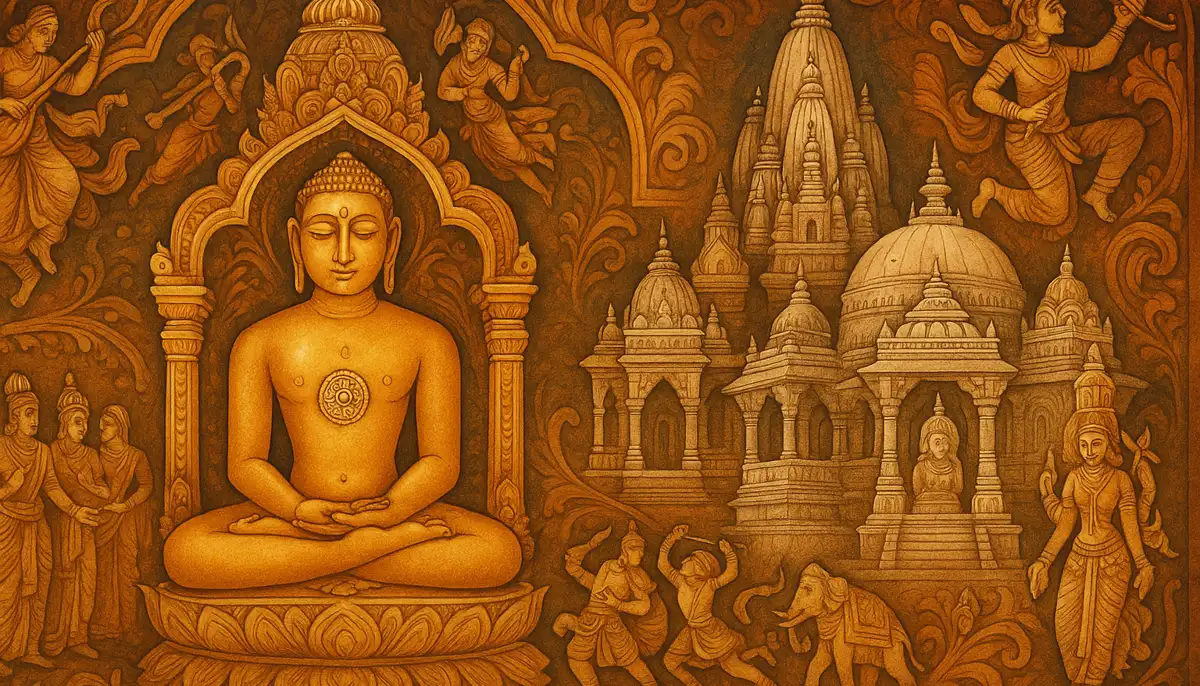
- Enthroned Jina, probably Neminatha, Akota (Metropolitan Museum of Art 2008.279) Gujarat (Akota), late 7th century AD; Metropolitan Museum of Art, New YorkA LATER JAIN IMAGE, made about twelve centuries after Mahavira. The Met: "An enthroned Jain savior is deep in meditation, seated in a yogic posture"; on the pedestal "two kneeling deer venerate the wheel-of-law (dharmachakra), a symbol of religious wisdom shared with Buddhism". The attendants identify the jina as Neminatha, "the twenty-second in the lineage of twenty-four historical jinas recognized by the Jain religion".
Holy Places: Stupas, Rock-cut Caves and the First Temples
- Buddhist Monuments at Sanchi (UNESCO World Heritage Centre) Raisen district, Madhya Pradesh; founded in Ashoka's time, 3rd century BC; inscribed on the World Heritage List 1989THE STUPA. "On a hill overlooking the plain and about 40 km from Bhopal, the site of Sanchi comprises a group of Buddhist monuments (monolithic pillars, palaces, temples and monasteries)", most of which "date back to the 2nd and 1st centuries B.C."; "It is the oldest Buddhist sanctuary in existence". The page notes "Aśoka’s column with its projecting capital of lions" and the later shrines of the Sunga, Kushana and Gupta kings.
- Two lotuses from the railing of the Bharhut stupa (Metropolitan Museum of Art 1972.215) Madhya Pradesh, Shunga period, c. 1st century BC; Metropolitan Museum of Art, New York (Gallery 234)A piece of a stupa's stone railing. The Met: "These lotuses were part of a wish-fulfilling vine at the top of a high railing (vedika), which enclosed the sacred precinct of the Bharhut stupa (relic mound)." The railing "was also embellished with some of the earliest reliefs illustrating past lives of the Buddha (jatakas)"; "The lotus is an auspicious symbol that alludes to the Buddha's enlightenment."
- Ajanta Caves (UNESCO World Heritage Centre) Aurangabad district, Maharashtra; inscribed on the World Heritage List 1983THE ROCK-CUT CAVES. "The first Buddhist cave monuments at Ajanta date from the 2nd and 1st centuries B.C. During the Gupta period (5th and 6th centuries A.D.), many more richly decorated caves were added to the original group." Monasteries and prayer halls cut straight into a cliff; Xuanzang describes them in the 7th century (week 4).
- Mahabodhi Temple Complex at Bodh Gaya (UNESCO World Heritage Centre) Gaya district, Bihar; inscribed on the World Heritage List 2002THE PLACE OF THE ENLIGHTENMENT, AND AN EARLY TEMPLE. "The first temple was built by Emperor Asoka in the 3rd century B.C., and the present temple dates from the 5th or 6th centuries. It is one of the earliest Buddhist temples built entirely in brick, still standing in India, from the late Gupta period." The Bodhi tree beside it marks where, the tradition says, the Buddha sat.
Pick two or more of these chapters to read.
K–5th Grade
6th–8th Grade
9th–12th Grade
Kingdoms, Alexander and Chandragupta Maurya
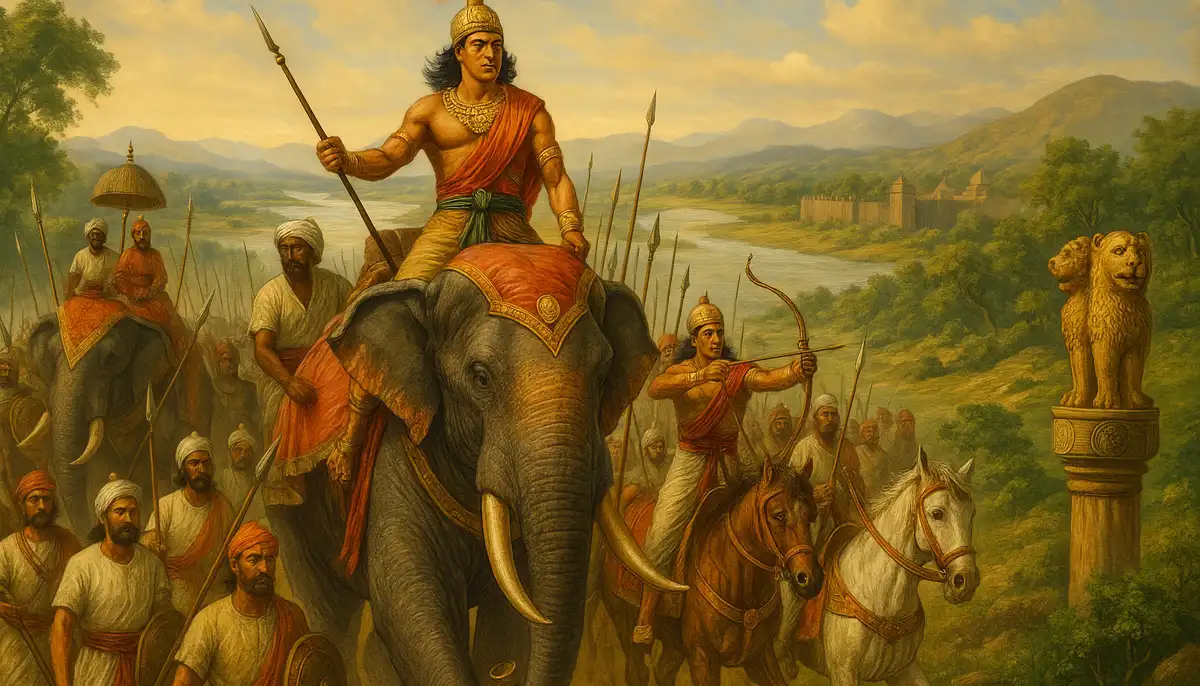
- Muluposatha Sutta (AN 3.70): the sixteen great lands (tr. Thanissaro Bhikkhu; Access to Insight) a discourse of the Pali canon; Thanissaro Bhikkhu's translation, 1997THE KINGDOMS OF THE BUDDHA'S DAY. Teaching on the Uposatha observance, the Buddha compares it with ruling "these sixteen great lands replete with the seven treasures" and names them: the Angas, Magadhans, Kasis, Kosalans, Vajjians, Mallas, Cetis, Vansans, Kurus, Pancalas, Macchas, Surasenas, Assakas, Avantis, Gandharans and Kambojans — the sixteen mahajanapadas. "Kingship over human beings is a meager thing when compared with heavenly bliss."
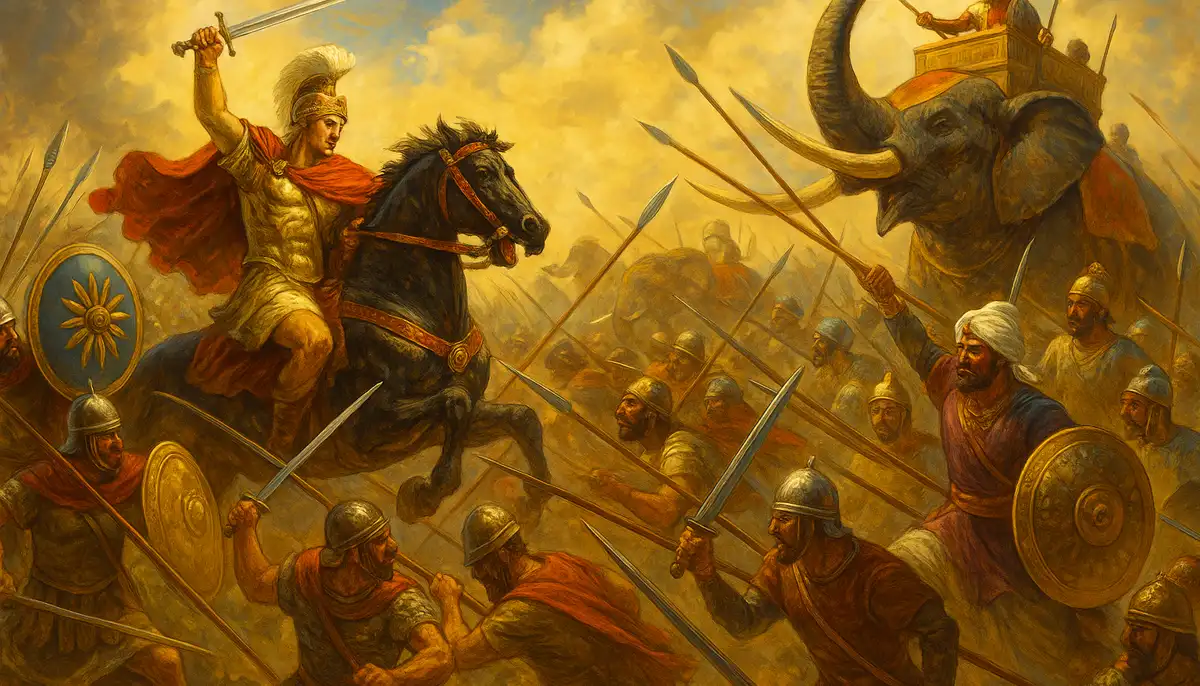
- Arrian, Anabasis of Alexander 5.18–19: Porus at the Hydaspes (tr. E. J. Chinnock; Project Gutenberg) written in the 2nd century AD from the memoirs of Ptolemy and Aristobulus; of the battle of 326 BC; Chinnock's translation, London 1884THE GREEK INVASION. Arrian describes the Indian king Porus fighting from his elephant until wounded, and then brought to Alexander, who "admired his handsome figure and his stature". Asked how he wished to be treated, "The report goes that Porus replied: “Treat me, O Alexander, in a kingly way!”" Alexander left him his kingdom. (Matched in the Gutenberg plain-text file.)
- Plutarch, Life of Alexander 62: the army refuses the Ganges, and the young Androcottus (Dryden translation, ed. A. H. Clough; Project Gutenberg) written c. AD 100; the 'Dryden' translation revised by Arthur Hugh Clough, 1864Plutarch reports why Alexander turned back: his men were told that "the kings of the Gandaritans and Praesians expected them there" with a vast army and "six thousand fighting elephants". He adds that "Androcottus, then a boy, saw Alexander there" — this is Chandragupta Maurya — and that he later "made a present of five hundred elephants at once to Seleucus, and with an army of six hundred thousand men subdued all India". (Matched in the Gutenberg plain-text file.)
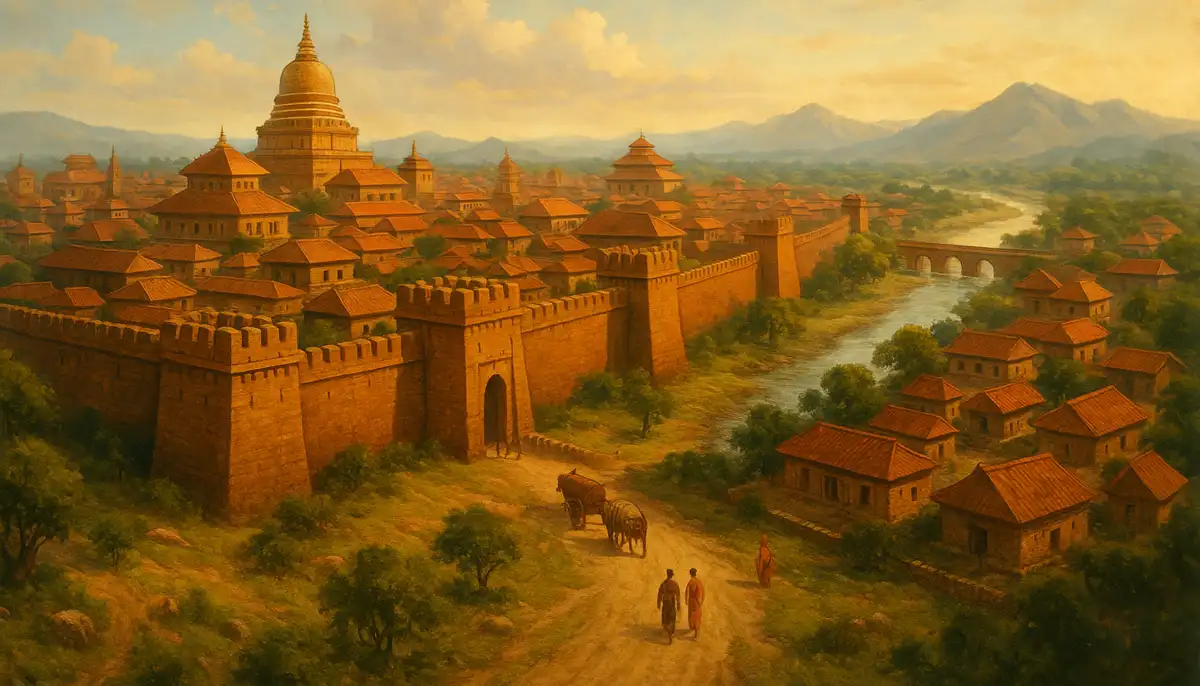
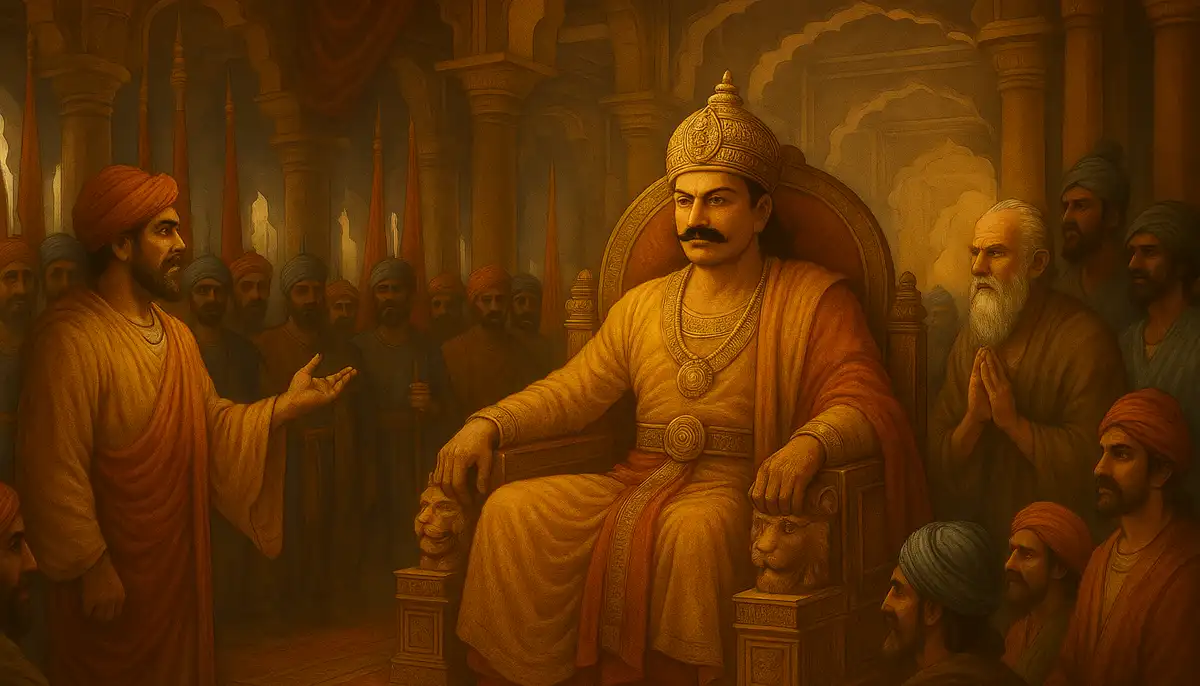
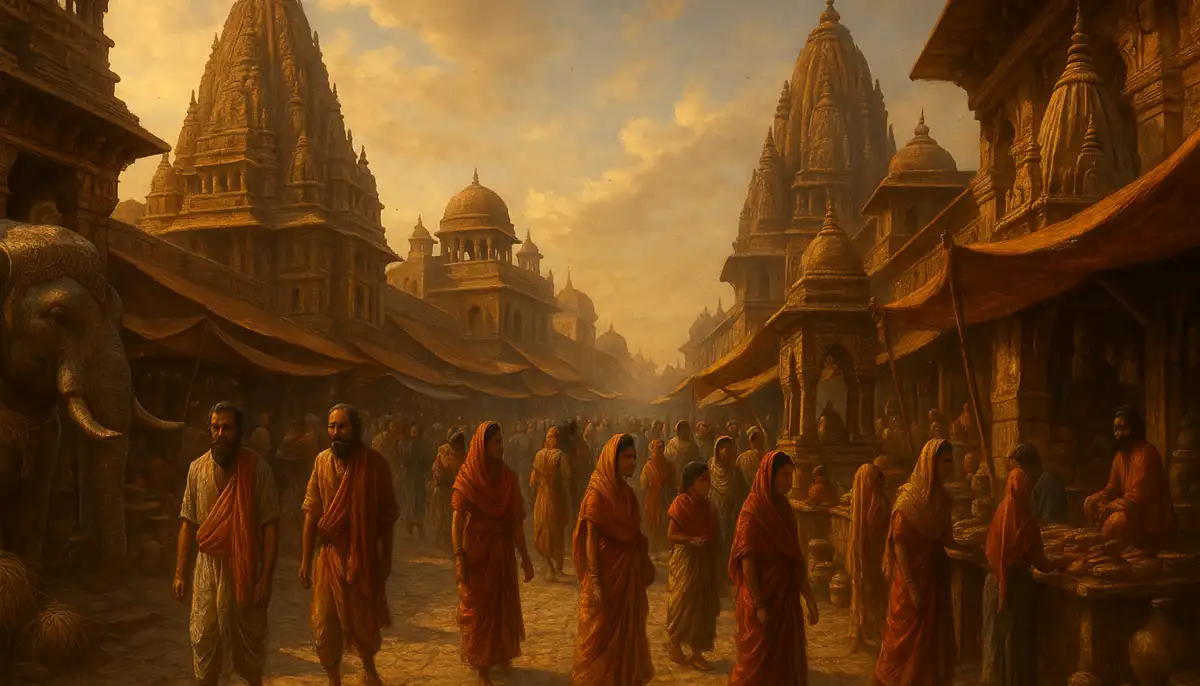
- Arrian, Indica 5 and 10–11: Megasthenes on Sandracottus, Palimbothra and the seven classes (tr. E. Iliff Robson; Fordham Ancient History Sourcebook) written in the 2nd century AD from the lost book of Megasthenes, Seleucus's envoy to the Mauryan court, c. 300 BC; Robson's Loeb translation 1933AN ENVOY AT THE MAURYAN COURT. Megasthenes "states that he met Sandracottus, the greatest of the Indian kings". He described the capital: "The greatest of the Indian cities is called Palimbothra" (Pataliputra, modern Patna), at the meeting of the Ganges and the Erannoboas, with a ditch round it and "five hundred and seventy towers, and sixty-four gates". He reported that "The Indians generally are divided into seven castes", beginning with the wise men who offer the sacrifices.
Ashoka and the Mauryan State
- Kautilya, Arthashastra, Book 1, chapters 7 and 19: the life and duties of a king (tr. R. Shamasastry; Fordham Indian History Sourcebook) the treatise on statecraft that tradition ascribes to Kautilya, minister of Chandragupta Maurya; Shamasastry's translation, 2nd ed., Mysore 1923THE KING'S DUTY, as the Indian manual of government states it. "In the happiness of his subjects lies his happiness; in their welfare his welfare; whatever pleases himself he shall not consider as good, but whatever pleases his subjects he shall consider as good." "Hence the king shall ever be active and discharge his duties; the root of wealth is activity". The Sourcebook also gives chapters on buildings, debts, slaves and labourers, and justice.
- Ashoka, Rock Edict XIII at Shahbazgarhi: the Kalinga war (E. Hultzsch, Inscriptions of Asoka, Corpus Inscriptionum Indicarum 1, 1925; Internet Archive) carved c. 256 BC in the Kharoshthi script on a boulder at Shahbazgarhi, near Mardan; Hultzsch's edition and translation, Oxford 1925THE KING'S OWN WORDS ON HIS WAR. When King Devanampriya Priyadarsin "had been anointed eight years, (the country of) the Kalingas was conquered". "One hundred and fifty thousand in number were the men who were deported thence"; a hundred thousand were slain, and many times as many died. "This is the repentance of Devanampriya on account of his conquest of (the country of) the Kalingas". He now holds "the conquest by morality" the chief one. (Matched in the item's OCR text.)
- The Edicts of King Asoka (tr. Ven. S. Dhammika; Access to Insight) the rock and pillar edicts, 3rd century BC; Dhammika's English rendering, Buddhist Publication Society, Wheel 386/387, 1993THE EDICTS ON GOVERNMENT. Rock Edict 1: in the royal kitchen "hundreds of thousands of animals were killed every day to make curry. But now with the writing of this Dhamma edict only three creatures, two peacocks and a deer are killed". Rock Edict 2: the king "made provision for two types of medical treatment: medical treatment for humans and medical treatment for animals". Pillar Edict 7: "Along roads I have had banyan trees planted so that they can give shade to animals and men".
- Lumbini, the Birthplace of the Lord Buddha (UNESCO World Heritage Centre) Rupandehi district, Nepal; Ashoka's inscribed pillar; inscribed on the World Heritage List 1997WHERE ASHOKA LEFT A PILLAR. UNESCO's page: Lumbini "soon became a place of pilgrimage. Among the pilgrims was the Indian emperor Ashoka, who erected one of his commemorative pillars there." The pillar's inscription records the king's visit to the place the tradition names as the Buddha's birthplace.
The Gupta Age
- Faxian, A Record of Buddhistic Kingdoms (tr. James Legge; Project Gutenberg) the travels of the Chinese monk Faxian in India, AD 399–414; Legge's translation, Oxford 1886AN EYEWITNESS OF THE GUPTA KINGDOM. Of the 'Middle Kingdom' of the Ganges plain Faxian wrote: "The people are numerous and happy; they have not to register their households, or attend to any magistrates and their rules". "The king governs without decapitation or (other) corporal punishments. Criminals are simply fined". He reports that the kings gave land to the monasteries, "the grants being engraved on plates of metal". (Matched in the Gutenberg plain-text file.)
- The Allahabad pillar inscription of Samudragupta (J. F. Fleet, Inscriptions of the Early Gupta Kings, Corpus Inscriptionum Indicarum 3; Internet Archive) composed c. AD 350–375 by Harishena, an officer of Samudragupta, and cut on an Ashokan pillar; Fleet's edition and translation, Calcutta 1888 (this copy the 3rd revised edition, Varanasi 1960)A GUPTA KING'S RECORD OF HIS CONQUESTS, cut on the same pillar as an edict of Ashoka. The poem names the kings Samudragupta overthrew and the frontier peoples who paid him tribute, and calls him "the giver of many hundreds of thousands of cows". It ends by naming its author: "this poetical composition" is the work of the high officer Harishena. (Matched in the item's OCR text.)
- Serial nomination of Gupta Temples in North India (UNESCO Tentative List, India) twenty temples of the 5th–6th centuries AD, from Sanchi to Bihar; on India's Tentative List since 2025 (not inscribed)THE FIRST STONE AND BRICK TEMPLES. India's submission: "Among many cultural contributions of the Gupta dynasty, one of the most prominent was the construction of structural temples", built round "the deity’s chamber, the garbhagriha". It lists Temple 17 at Sanchi, Udayagiri Cave 1, the brick temple at Bhitargaon and the temple at Deogarh among its twenty sites, and says of Temple 17 that "it represents an early stage in the development of temple architecture in India".
- Nagini (serpent queen), Madhya Pradesh (Metropolitan Museum of Art 1987.415.2) Gupta period, second quarter of the 5th century AD; sandstone; Metropolitan Museum of Art, New York (Gallery 236)GUPTA SCULPTURE. One of a pair with a serpent king (1987.415.1). The Met: "Both Buddhism and Hinduism adopted nagarajas and naginis (serpent kings and their consorts) as protective divinities and depicted them like human beings." The figures stand before cobras "whose open hoods form canopies for their heads"; "They date from the early part of the Gupta period and maintain ties to the style of the late Kushan period."
After the Guptas: Harsha, Pulakeshin II and Al-Biruni
- Xuanzang, Si-yu-ki, Book 11: Maharashtra, King Pulakeshin and Harsha (tr. Samuel Beal, vol. 2; Internet Archive) the record of the Chinese pilgrim Xuanzang's travels in India, AD 629–645; Beal's translation, London 1884TWO KINGS SEEN BY ONE TRAVELLER. Of the king of Maharashtra Xuanzang wrote: "His plans and undertakings are wide-spread"; "His subjects obey him with perfect submission." Harsha (Siladitya) of Kanauj "has conquered the nations from east to west, and carried his arms to remote districts", but this country alone had not submitted to him, though "He has gathered troops from the five Indies". The next pages of the same book describe the Ajanta caves. (Matched in the item's OCR text.)
- The Aihole inscription of Pulakeshin II, AD 634 (ed. F. Kielhorn, Epigraphia Indica 6; Internet Archive) a Sanskrit poem by Ravikirti on the Meguti temple at Aihole, Karnataka, dated Saka 556 (AD 634–635); Kielhorn's edition and translation, Calcutta 1900–1901PULAKESHIN'S OWN RECORD OF THE WAR WITH HARSHA. Verse 23 says that Harsha, lord of many vassals, "melted away by fear, having become loathsome with his rows of lordly elephants fallen in battle". The poem is dated by the years of the Saka kings and of the Bharata war, and ends: "This stone mansion of Jinendra … has been caused to be built by the wise Ravikirti" — a Jain temple. (Matched in the item's OCR text.)
- Evolution of Temple Architecture – Aihole-Badami-Pattadakal (UNESCO Tentative List, India) the Chalukya capital and temple towns of the Malaprabha valley, Karnataka, 6th–8th centuries AD; on India's Tentative List since 2015 (not inscribed); Pattadakal itself inscribed 1987WHERE PULAKESHIN'S DYNASTY BUILT. The submission lists the caves and temples of Aihole — the "Meguti temple" among them — and of Badami, and explains that "the craftsmen in Malaprabha river Valley under Early Chalukya patronage transformed the landscape into a cradle of Temple architecture".
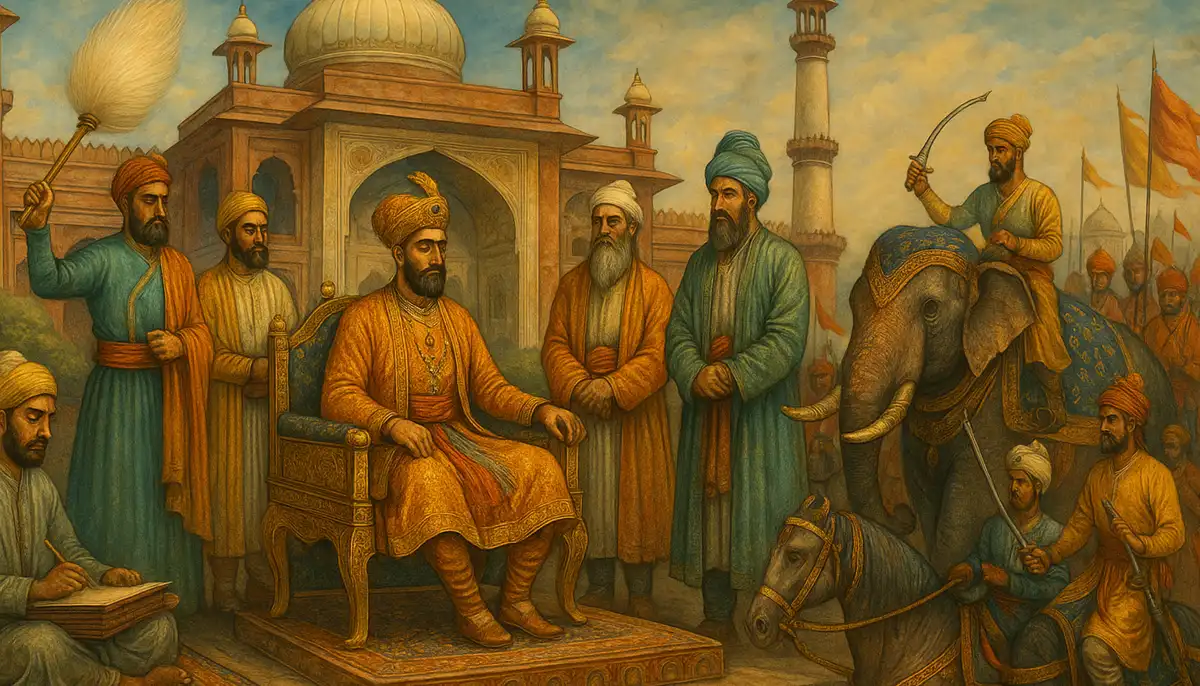
- Al-Biruni, India (tr. Edward C. Sachau, vol. 1; Internet Archive) written c. AD 1030 by the scholar of Ghazni; Sachau's translation, London 1888 (this copy the popular re-issue of 1914)THE FIRST OUTSIDER TO STUDY INDIA'S BOOKS. Al-Biruni learned Sanskrit and described Indian religion, science and customs, and stated his method: the book was to be nothing but a "simple historic record of facts": "I shall place before the reader the theories of the Hindus exactly as they are, and I shall mention in connection with them similar theories of the Greeks". (Matched in the item's OCR text.)
What comes with the book
The Ultimate Guide
The textbook itself — the sixteen chapters these lessons are built from.
Living History
Ancient South Asian History — Told By Those Who Were There. The Heroes & Villains series, in the first person.
The Adventure Box
Cards, lesson plans, activities, coloring pages and the craft kit for this era.